Venezuela: Running Out the Clock in 2016

By Michael McCarthy*

venezuela-military

A military exercise in Caracas, Venezuela. The Venezuelan military remains tolerant, if not actively supportive, of President Nicolás Maduro’s government. / Cancilleria del Ecuador / Flickr / Creative Commons

Despite continuing high tensions in Venezuela, neither President Nicolás Maduro nor the opposition appears likely to gain an upper hand in their years-long confrontation over the next couple months.  Venebarómetro polls buttress press reports and observers’ impressions that the opposition is slowly making gains, but support for the government – while extremely low – has stabilized.  A plan to reschedule 2017 debt owed by the national oil company will probably give the administration some breathing room, especially if oil prices continue to recover – a more likely scenario thanks to OPEC’s announced production cut agreement.
  • The very high turnout for the opposition’s Toma de Caracas demonstration on September 1, which mobilized hundreds of thousands of people, showed the depth of support for the anti-Maduro platform. The Electoral Tribunal’s announcement last week of onerous requirements on the opposition to schedule a referendum to recall Maduro (requiring, for example, the signatures of 20 percent of residents of all states, rather than nationally) rekindled opposition anger and unity.  A Venebarómetro poll earlier this month showed that 90 percent of Venezuelans view their overall situation negatively, and 71 percent support Maduro’s immediate resignation, but that only roughly 50 percent identify with the opposition.  The Mesa de Unidad opposition coalition is under great pressure to satisfy different constituencies – promoting street mobilization and pursuing dialogue at the same time – even when these initiatives seem at counter purposes.  Hamstrung by coalitional politics, anti-Maduro forces have not shown the cunning needed to force a course reversal from the Electoral Tribunal.
  • While Maduro’s popular support remains extremely low (22 percent), an internal party revolt against him appears unlikely. The government’s big push for a deal under which PDVSA creditors would swap debt coming due in 2017 for generous new 2020 bonds is making headway, according to the press.  Enhanced short-term liquidity may result in increased imports, a development which cannot come soon enough for a government that faces a restive population that has seen quality of life deteriorate dramatically during the crisis.

The common wisdom that the military is at least tolerant, if not actively supportive, of Maduro still stands.  Armed Forces chief Vladimir Padrino López showed an independent streak during last December’s Parliamentary election but this has not translated into a public rivalry with Maduro.  He moved into the spotlight when Maduro tasked the military with taking charge of food distribution, but he has since kept a lower profile.  Other senior commanders’ political leanings are even more difficult to discern.  Appealing to the military is a key element of the opposition’s current strategy, but there are still no signs of an increase in the institution’s willingness to press Maduro to step down or even change policies.

Maduro’s time-buying strategy looks likely to prevail for now.  His repressive tactics toward the opposition – keeping pressure on while occasionally offering negotiations, prisoner releases, and other gestures – are gaining the government time but failing to address any of the underlying causes of the ongoing crisis.  The debt swap is also a palliative that only delays the implementation of major reforms.  Popular unrest, political instability, and even violence are the factors that might conceivably persuade the military that its support and patience are misplaced.  However, with the world watching, most of the opposition leadership wants to play by constitutional rules.  Those who consider the chances of success justify the human price of further ramping up protests may see their hand strengthened if government obstructionism kills the referendum this year.  Few Venezuelans, moreover, view possible talks with the Vatican and the United States as likely to produce a breakthrough.  Even if the government alleviates the pain a bit to generate some Christmas cheer, the country will wake up with a terrible national hangover in 2017.

September 30, 2016

* Michael McCarthy is a Research Fellow with the Center for Latin American and Latino Studies.  He is international associate for Venebarómetro polling and publishes Caracas Wire, a newsletter on Venezuela and South America.

UNASUR and the Venezuelan Hot Potato

By Andrés Serbin and Andrei Serbin Pont*

Ernesto Samper UNASUR

Photo Credit: Carlos Rodríguez/ANDES/Flickr/Creative Commons

The Venezuelan crisis, which the hemisphere has turned to UNASUR to resolve, could break the South American organization and overshadow its past successes in regional mediation.  UNASUR was created in 2008, amid the proliferation of regional organizations such as ALBA that excluded the United States and Canada, as an inter-governmental mechanism to promote regional autonomy, conflict prevention and resolution, and the coordination of public policies, particularly regarding social issues, security, infrastructure, and energy.  It has been driven by individual presidents’ leadership and managed by high-ranking officials and, despite rhetoric to the contrary, has not shown deep commitment to greater civil society participation.  Among its important successes have been defusing internal conflicts in Bolivia and Ecuador, as well helping reduce tensions between Ecuador and Colombia, and between Colombia and Venezuela.  In years past, the group’s effectiveness raised questions about the OAS’s comparative ability to deal with regional conflicts.

In recent years, however, UNASUR has suffered decline.  As the commodities boom ended, regional economies were hit hard, and internal political factors started to change the political map, undermining leftist governments and enabling the election of center-right governments less committed to the UNASUR vision.  This coincided with the profound decline of Venezuela as it fell into the abyss of hyperinflation, debt, scarcity, criminality, and debilitating political instability.  The Venezuelan opposition’s achievement of a parliamentary majority last December, after 17 years of Chavista hegemony, brought no relief as the government reacted with an all-out effort to block it.  UNASUR, which first sought to foster a dialogue between the government and the opposition in 2013, has repeatedly failed to broker a solution.  In May 2016 the organization turned to three former heads of state – Spanish Prime Minister José Luis Rodríguez Zapatero, Dominican Lionel Fernández, and Panamanian Martín Torrijos – to attempt mediation again, to no avail so far.  The government continues to resist change, and the opposition, in addition to remaining firm in its demands of a recall vote to remove Maduro and the unconditional release of political prisoners, has shown persistent mistrust of UNASUR and its representatives, whom they perceive as allies of the government. Such suspicions may not be unfounded, considering Zapatero’s objections regarding the participation of some relevant opposition leaders in the dialogue process.

For the first time in its almost 10 years of existence, UNASUR faces potential failure in its attempt to solve a strategically important political crisis in the region.  To hold off an initiative by OAS Secretary General Almagro to enforce the Inter-American Democratic Charter against Venezuela, the OAS Assembly called on UNASUR and the former presidents to renew mediation efforts yet again last month, but neither Maduro nor the opposition has budged from their fundamental positions.  The situation is, again, stalled.  Indeed, in the context of declarations, extraordinary sessions, initiatives and trips, the commitment to end the crisis in Venezuela still appears quite limited among OAS members, including UNASUR.  Governments supporting dialogue seem most eager to avoid risking valuable political capital both in the domestic and the international spheres.  Neither UNASUR nor the OAS is prepared to handle the Venezuelan hot potato, and both stand to lose credibility for this failure.  But UNASUR’s general lack of leadership and direction in recent years suggests that failure in this crisis, with implications beyond Venezuela’s borders, would be potentially fatal to the organization.  UNASUR, with previous achievements in social, political and regional matters, must now prove that it is still a viable regional mechanism, able to deal collectively with the political turbulence of a changing regional landscape.

July 6, 2016

* Andrés Serbin and Andrei Serbin Pont are members of the analysis team of the Coordinadora Regional de Investigaciones Económicas y Sociales (CRIES), a Latin-American think tank.

Venezuela: Trying to Stay Afloat

By Michael McCarthy* and Fulton Armstrong

Venezuela Oil Maduro

Photo Credit: Democracy Chronicles and Charles Henry (modified) / Flickr / Creative Commons

Venezuelan President Nicolás Maduro continues to receive increasingly bleak economic news, and his modestly positive policy responses seem unlikely to help.  Oil revenues dropped 293 percent from 2014 (US$37 billion) to 2015 (US$12.5 billion).  The value of oil exports, which account for 95 percent of the country’s export earnings, has dropped to a 30-year low ($30 a barrel), accelerating a recession, paralyzing shortages, and soaring inflation.  The Central Bank reported that inflation reached 180.9 percent in 2015, and that the GDP contracted for the second consecutive year (5.7 percent).  Maduro blamed an “imperialist strategy in a petroleum war” aimed at destroying OPEC.  He also asserted that Venezuela suffered from an “international financial blockade” that – by obstructing the country’s efforts to refinance its debt – was intended to force it “to its knees” and to “take over” its wealth.

Several days after celebrating a Supreme Court decision reaffirming his authority to declare an “economic emergency,” which the opposition challenged last month, Maduro this week announced several modest economic measures aimed at stemming the slide.

  • He ordered a 60-fold increase in gasoline prices – dramatic-sounding but preserving Venezuelan gas (about US$0.23 per gallon at the black-market exchange rate) as one of the cheapest in the world – but the decision is significant as the first increase in about 20 years. An increase in 1989 triggered riots – the famous Caracazo that most analysts cite as the beginning of the end of the old order that Hugo Chavez toppled definitively when elected President in 1998.  In allusion to this past, Maduro said he “hoped people on the streets would understand.”  (Caracas-based consultancy Ecoanalítica estimates that the existing fuel subsidy costs the Venezuelan government US$12 billion a year.)
  • Maduro also announced a 37 percent devaluation of the bolívar – from 6.3 to 10 to the U.S. dollar – for official exchange rates used for the essential goods like food and medicine. The bolívar trades at about 1,000 to one on the black market, but the decreased subsidy implicit of the official rate for necessities is nonetheless significant.
  • Venezuela’s proposal for an OPEC freeze in oil production, in hopes of driving oil prices back up, drew supportive remarks from Qatar, the United Arab Emirates, Russia, Saudi Arabia, and even Iran, but the scheme has lacked traction. Industry observers said one reason is that Tehran is eager to increase exports to regain market share as sanctions against it are lifted.
  • Maduro replaced economic czar Luis Salas – known as a hardline leftist – just five weeks after appointing him, and appointed in his place a more business-friendly economist, Miguel Pérez Abad, who had been serving as Minister of Commerce. Pérez Abad, whose appointment the President of the Venezuelan Chamber of Commerce described as a “friendly sign,” has publicly (and accurately) said that Venezuela must simplify its byzantine exchange rate system.
  • These changes come amid Maduro’s increasingly frank self-criticism about state corruption. He recently described a government food distribution company as “rotten” while calling for a restructuring of state-run food import and distribution outlets.

In a four-hour speech replete with foul language and insults against opposition leaders, the President argued that the measures are “a necessary action to balance things,” and he said, “I take responsibility for it.”  But his measures are piecemeal at best.  As opposition leaders have pointed out, he has not explained how he is going to pay Venezuela’s debt, obtain the foreign exchange to import sufficient amounts of basic goods, and guarantee food for the people.  With US$10 billion in bond payments coming due this year, the country has no clear path for avoiding default.  However painful for the population and politically costly for the government, measures such as gasoline price increases will have little impact.  The government wanted the opposition to share some of the costs for economic policy changes, but opposition politicians say that the gas price increase and devaluation are too little, too late. Most believe economic revival depends on dismantling the entire chavista system.  They are once again talking about removing Maduro through a referendum or other means – with one leader, Henrique Capriles, openly calling for a presidential recall, and another, Henry Ramos, the President of the National Assembly, calling for a constitutional amendment to cut the presidential term from six to four years.  The government’s measures suggest a welcome change from Maduro’s previous strategy of buying time through diversionary tactics.  However, the economic measures are likely to fail and, moreover, they increase the chances political temperatures will surge once again.

February 19, 2016

* Michael McCarthy is a Research Fellow with the Center for Latin American & Latino Studies.

Venezuela: Implications of the Opposition’s Landslide Victory

By Michael McCarthy*

Venezuela Elections 2015

Photo Credits: Nicolas Raymond and 2 dvx ve (modified) / Flickr and Wikimedia Commons, respectively / Creative Commons

Venezuela is just beginning to feel the shock waves of the opposition’s landslide victory and humbling defeat of President Nicolás Maduro’s PSUV.  Riding a wave of discontent with the Maduro government’s management of the economy and political repression, the opposition Mesa de Unidad (MUD) coalition won at least 112 seats in the 167-seat parliament, giving it a commanding two-thirds majority.  The MUD won the popular vote 56-41.  The political scenarios are wide open.  Some preliminary analytical judgments follow:

  • Maduro has accepted the election results, but serious questions remain whether he and his advisors will engage in the give-and-take necessary to make divided government work. He is restructuring his cabinet and has called on supporters to “relaunch” the Bolivarian Revolution.  He says he will strenuously oppose any amnesty law for imprisoned opposition members – a top MUD priority – and that he will “go to combat” if the opposition tries to remove him from office.
  • Despite its historic achievement, the opposition will face challenges to build sustainable unity. The MUD is a heterogeneous electoral alliance, and the hardline and moderate factions are likely to disagree about strategy – whether the time is ripe for pressing for Maduro’s resignation or for cultivating support from disaffected chavistas.
    • The opposition faces the challenge of demonstrating a commitment to what they have criticized most about chavismo – democratic inclusion.  If they want to put Venezuela back together, for example, the MUD will have to decide how to provide PSUV officials guarantees of political inclusion.
    • Passing an amnesty law for political prisoners and addressing the dire economic situation are high on the MUD’s unified agenda – and probably will remain part of a consensus platform.
    • Less clear is how aggressively the opposition will push its agenda from the National Assembly.  Most in the MUD are more closely aligned with the moderate strategy of former presidential candidate Henrique Capriles, but others will want to push harder.  They may try to remove chavista-appointed Supreme Court judges likely to oppose Constitutional changes that would curtail Maduro’s powers.
    • The forced resignation of Guatemalan President Pérez Molina and the recent opening of an impeachment process against Brazilian President Dilma Rousseff may embolden similar initiatives in Venezuela.
  • The country’s tarnished election system functioned better than many critics had predicted. The 74 percent voter turnout was eight points higher than the last legislative elections.  Reports of violence and irregularities were few.  The Armed Forces provided effective security at the polls, and behaved in a manner that suggests an interest in defending their institutional reputation.  The National Electoral Council (CNE) disappointed many by issuing an unprecedented call for voting centers to remain open even if there were no voters in line, and for delaying reporting the final results, but the voting process was clean enough.
  • Outside Venezuela, chavismo’s loss may be a setback from some leftists – but a relief for most others. Maduro’s defeat is a potential liberation from the albatross that the disastrous Venezuelan regime has become.  For most left-leaning leaders, chavismo had become a deeply flawed project that has, for several years, been toxic.
  • For anti-chavistas outside Venezuela (including some in Washington), the election results indicate that the way to overcome the catastrophe over which Maduro presided was not to threaten the regime with sanctions and encourage extremists in the opposition, but instead to push for the election to take place, with the most safeguards possible. There is precedent for Latin American dictatorships falling in elections that they put on the agenda and then could not stop.
  • Although Maduro’s saber-rattling along the Colombian and Guyanese borders failed to divert attention from his internal mess, his rhetoric of resistance to yielding power suggests the international community should keep an eye on him in case he tries again.
  • The Venezuelan victors should also understand the anxiety of their neighbors over the future of Petrocaribe and other initiatives. Venezuela under Chavez did an enormous service to the region by subsidizing oil in ways that helping governments achieve important social advances.  Long before Chavez, Venezuela used its oil wealth to support allies.  Such assistance is as important now as it has been for decades.

December 9, 2015

* Michael McCarthy is a Research Fellow with the Center for Latin American and Latino Studies.

Venezuelan Elections: Economic Crisis Turns Up the Heat on Chavismo

By Michael M. McCarthy*

A faded legacy. Photo Credit: Julio César Mesa / Flickr / Creative Commons

A faded legacy for Chavismo? Photo Credit: Julio César Mesa / Flickr / Creative Commons

Twenty-four long months since their country’s last national election, Venezuelans head back to the polls to elect a new National Assembly on December 6 in a tense political climate – with no promise that the government will respect the opposition’s near-certain victory.  All 167 seats in the unicameral body will be up for grabs in a race polarized between Chavismo’s pro government coalition and the Mesa de Unidad Democrática opposition coalition.  Thanks largely to a rapidly deteriorating economy, the government’s approval rating decreased from 50 percent in 2013 to 20 percent in September, according to the national Venebarómetro poll.  A range of polls in September indicated the MUD is poised to win either a simple or “qualified” (60 percent) majority.  Observers generally agree that the main measure of success for Chavismo is preventing the MUD from obtaining a two-thirds majority, and that blocking a qualified majority would be a major triumph.

For ordinary Venezuelans the campaign is overshadowed by the massive economic crisis.  Skyrocketing inflation, severe shortages of basic goods and services, and reduced social assistance programs are contributing to tensions on the street, where the campaign is not as present as in years past.  Nevertheless, heavy turnout is still expected – 66 percent of eligible voters participated in the last National Assembly elections in 2010, and pollsters report a strong intention to vote.

  • The MUD has shaped its campaign around leveraging the vote as a mechanism for punishing economic mismanagement and restoring some institutional balance to a political system that barely reflects opposition voices at the national level. Skepticism of the National Electoral Board, which rejected the MUD’s request for international electoral observation by the OAS, EU or UN, has increased.  Slashes to budgetary support for opposition governors and mayors, while the government channels funds to unelected parallel state and municipal authorities, make supporters wonder whether a victory will be fully respected.
  • The government refreshed its slate of candidates by promoting generational and gender diversity, but stalwarts, including current National Assembly leader Diosdado Cabello, remain prominent. The party is distributing last-minute pork to mobilize voters, and it’s working the system’s rural bias – each department is automatically allocated three deputies – where strong government presence gives it a strategic advantage.  Strikingly, the Chávez legacy has become a liability for President Maduro because the former President was much more charismatic and economic conditions were considerably better during his tenure.

The Maduro administration seems to have run out of diversionary moves after exaggerated external threats from Colombia and Guyana faded.  It is also on the defensive after the Rousseff administration, Maduro’s most powerful diplomatic partner, expressed unhappiness about Caracas’s opposition to its choice of a Brazilian political heavyweight to lead UNASUR’s “electoral accompaniment mission.”  The President has also been set on back on his heels by intensified international criticism of the trial and conviction of opposition leader Leopoldo López, who, according to a state attorney who worked the case, was sent to jail for 14 years on fraudulent charges.  Regardless of the outcome on December 6, the direction of the country is highly uncertain.  Maduro has said he’ll accept the results “whatever they are,” but he has also said “we have to win, by whatever means possible” (como sea and cualquier manera), and that if the opposition wins “I will not hand over the revolution” but rather “proceed to govern with the people in a civic-military union.”  In the next couple weeks, the government may still try to throw the opposition off course, but the MUD does not seem interested in renewing street protests – more violence is unlikely to advance its objectives. Neither do its leaders seem confident that a renewal of talks on rebuilding democratic institutions will help.

November 9, 2015

* Michael McCarthy is a Research Fellow with the Center for Latin American and Latino Studies.

Maduro Cites Security to Suspend Rights on the Border

By Michael M. McCarthy*

Photo Credit: Globovisión / Flickr / Creative Commons

Photo Credit: Globovisión / Flickr / Creative Commons

The Maduro government’s closure of a key border crossing into Colombia and declaration of a state of emergency in nearby towns mark not only a low in relations with Colombia but also in efforts to manipulate the playing field ahead of legislative elections slated for December 6.  President Maduro blamed Colombian “paramilitaries” for an August 19 firefight in which three Venezuelan soldiers were wounded.  He announced the deployment in the area of the “Operations for the Liberation and Protection of the People” (OLP), which are heavily armed military and police units specially created to force out alleged paramilitaries, and security forces swept through the area forcibly deporting more than a thousand undocumented Colombians.  Last week, the pro-government coalition of the Venezuelan National Assembly called for expanding the emergency measures to two other important border states.  The two countries’ foreign ministers met on August 26 for what Colombian Minister Holguin called a “positive, frank and realistic” exchange, but there was no agreement to reopen the border.

Maduro’s objectives seem to go far beyond stemming border violence.  Two reputable polls put his popularity in the lower 20s and project the opposition as likely to win a Congressional majority in the December 6 legislative elections.  His Chavista political movement is bleeding supporters amid a mounting economic crisis. Skyrocketing inflation and acute shortages of basic goods and services have created daily hardships for the popular sectors that once served as Chavismo’s base.  The opposition coalition Mesa de Unidad Democrática called the state of emergency a diversionary tactic – “to cause a situation of intense conflict and internal confusion” – and claimed that the maneuvering shows Maduro fears the election and may suspend it.  The state of emergency in Táchira, which is a renewable in 60 days, restricts the right to public assembly and gives Maduro powers to seize assets and limit the sale of basic goods and services.  The value of the annual illegal border trade is estimated to have grown to roughly $5 billion.  The order may become a mechanism for intensifying government controls over industry, which Maduro regularly accuses of waging war against the government.

Maduro’s political objectives in declaring the state of exception are obvious to reset the political agenda in line with a government narrative of external threats.  This security rationale appears greatly exaggerated, suggesting he’s more interested in scapegoating Colombia for the sorry state of affairs in Táchira than in sparking a diversionary armed conflict.  He also recently escalated an historic border dispute on his eastern flank with Guyana after Exxon discovered oil in Guyanese territory claimed by Venezuela.  So far, Maduros actions have not seemed to threaten the soft truce between Washington and Caracas, which has led to a toning down of mutual recriminations.  Over the weekend, the U.S. State Department issued a mild statement that noted “continuing concern about the situation along the border between Venezuela and Colombia,” although Washington did take him to task for the deportations.  The real implications of the emergency decree are internal to Venezuela. Maduro’s state of emergency not only raises human rights concerns in the affected territories; it suggests the specter that the government will resort to increasingly desperate measures to maintain control as its credibility, like the economy, collapses.

August 31, 2015

* Michael McCarthy is a Research Fellow with the Center for Latin American and Latino Studies.

The Venezuelan Opposition: Can the Center Hold?

By Michael M. McCarthy*

Leopoldo Lopez (R) being escorted by the National Guard after turning himself in on February 18, 2014.  Photo Credit: Juan Barreto via Globovisión / Flickr / Creative Commons

Leopoldo Lopez (R) being escorted by the National Guard after turning himself in on February 18, 2014. Photo Credit: Juan Barreto via Globovisión / Flickr / Creative Commons

The leaked video of jailed Venezuelan opposition leader Leopoldo López declaring a hunger strike and calling for a renewal of street demonstrations this Saturday threatens to reopen splits within the Venezuelan political opposition.  With Venezuela experiencing an economic crisis – the bolívar lost a quarter of its value on the black market last week and shortages of basic goods plague daily life – the opposition, a disparate group of 29 political parties organized under the Mesa de Unidad Democrática (MUD), seems poised to score a pivotal victory in this year’s legislative election.  But López’s call to protests could renew divisions between those supportive of last year’s La Salida street demonstrations and the moderate camp, led by Governor Henrique Capriles, eager to punish the government at the polls for its poor management of the economy.

  • On May 17 the MUD held open primaries for 37 candidacies, and turnout (8 percent of all registered voters) exceeded expectations, despite very little media attention being devoted to the races. Capriles’s First Justice (PJ) and López’s Popular Will (VP) parties won 13 and 10 candidacies with 19.7 percent and 18.2 percent of the votes, respectively.  Regionally-based parties Democratic Action, strong in rural areas, and A New Time, strong in western Zulia state, performed well, with other small parties winning the remaining candidacies. The results consolidated the negotiating leverage of the PJ and VP as the MUD began internal talks about selecting the remainder of its candidates by consensus and campaign tactics – whether to use a tarjeta única ticket or let individual parties be listed on the ballot on voting day.  (The National Election Council has yet to announce the date.)

The López video, first leaked on government media outlets before going viral on social media late last Saturday, was forceful.  It emerged after news broke that López’s cellmate, VP politician Daniel Ceballos – the former mayor of San Cristobal, an epicenter of the street demonstrations last year – would be transferred to a public jail for common criminals where security guarantees are considerably weaker.  In the video, López mentions the U.S. investigation into chavista National Assembly President Diosdado Cabello for alleged involvement in narco-trafficking; condemns the “permanent repression of our rights”; and demands “the liberation of all political prisoners,” the “halt to persecution, repression, and censorship,” and the setting of an official date for the legislative elections, with OAS and European Union observers.  On Monday, a leader of López’s party endorsed his call for a rally on Saturday, and Lopez’s wife and spokeswoman declared that Venezuela is entering “a new stage of struggle.”

The countrys situation is palpably worse than a year ago, when López went to jail, but opening a new front is not what most of the opposition had in mind.  Capriles and the MUD have issued statements of support since the video leaked, and the MUDs Executive Secretary Jesus Chuo” Torrealba posted a call for unity on Twitter.  Going to the elections divided is a loss, he said.  Going to the street divided is suicide.  Will we learn?  Unanswered, however, is the question of the oppositions ability to avoid becoming bogged down in a leadership struggle just as the campaign season kicks off.  Oppositionists had finally found a political middle ground based on prioritizing the elections and the narrative of ordinary Venezuelans facing daily hardships to find food and other basic necessities.  However legitimate the oppositions fury at the governments repression and mismanagement, the call to the streets risks changing that narrative and diminishing prospects of opposition unity going into the election season. 

May 27, 2015

* Michael McCarthy is a Research Fellow with the Center for Latin American and Latino Studies.

Venezuela: Globovisión Doesn’t Show Strong Pro-Government Bias

By Mike Danielson, Michael McCarthy, and Paula Orlando*

Photo Credit: CLALS and Rodrigo Suarez / Flickr / Creative Commons

Photo Credit: CLALS and Rodrigo Suarez / Flickr / Creative Commons

A study conducted by CLALS has revealed that, contrary to popular perception in Venezuela, Globovisión – standard bearer in news television for the opposition’s political agenda until a May 2013 ownership change – does not exhibit a strong pro-government bias.  Our report, Bias or Neutrality? An Assessment of Television News Coverage in Venezuela by Globovisión, concludes that Globovisión’s framing of the issues has tended to be neutral, and that there was no significant bias in favor of the government or the opposition.  To examine the station’s performance during the first 15 months of new ownership (May 2013-August 2014) – the previous owners felt compelled to sell after mounting fines caused them to operate at a loss – the study examined content during four critical junctures: the 2013 municipal elections, street demonstrations in 2014, the international attempts to mediate Venezuela’s internal political crisis, and shortages of basic goods.  Using content analysis to examine coverage of government and opposition representatives, the favorability of the presentation and portrayal of prominent individuals and organizations, and the choice of issues and perspectives receiving coverage, the review concluded:

  • Non-partisan actors received most coverage (45.3 percent), and pro-government and pro-opposition partisans were equally likely to receive attention (28.4 and 26.3 percent, respectively).  Even in the instances that a small pro-opposition bias was found, pro-opposition voices received only slightly more visibility in terms of total on-air minutes – receiving 37.5 percent, while 33.6 percent went to pro-government partisans, and 28.9 percent went to nonpartisan actors.
  • Pro-opposition perspectives were favored in the periods focused on the municipal elections and street demonstrations, and coverage was more neutral when focused on the international dimensions of the crisis and the shortages of basic goods.
  • There was, however, a pro-government slant regarding story placement, as stories that were more favorable to the Administration of President Nicolás Maduro tended to “lead” as the first stories in a news broadcast.

Privately owned news media in Venezuela face numerous challenges to providing visibility and fair depiction to sharply different perspectives on enormously controversial events.  Although this report calls attention to the need to reassess the perception that Globovisión is strongly biased in favor of the government, notable holes in the channels news coverage suggest international concerns about press freedom issues in Venezuela remain justified.  For example, the case of jailed opposition leader Leopoldo López received less attention from Globovisión than from international outlets such as CNN en español or NTN24.  Additionally, footage of former presidential candidate and Governor of Miranda state Henrique Capriles was shown 11 times in the studys sample, but Capriles was not an interview guest on any of the Globovisión programs.  President Maduro, on the other hand, appeared 42 times (beyond government-controlled network broadcasts called cadenas). In spite of Venezuela’s chronic political crisis and extremely difficult political circumstances and the related pressures on news media, Globovision coverage, on balance, was not significantly biased either in favor or against the government.

May 19, 2015

*Mike Danielson (Visiting Assistant Professor of International Affairs at George Washington University), Michael McCarthy, and Paula Orlando are CLALS fellows.  Click here to see their full report and here to see their interview with Voice of America.

OAS: New Leadership, Old Challenges

By Aaron Bell and Fulton Armstrong

José Miguel Insulza and Luis Almagro Lemes Photo Credit: OEA - OAS / Flickr / Creative Commons

José Miguel Insulza and Luis Almagro Lemes Photo Credit: OEA – OAS / Flickr / Creative Commons

Uruguayan diplomat Luis Almagro, elected secretary general of the Organization of American States (OAS) last week, says he wants to revitalize the hemispheric organization – a herculean, if not impossible, task.  Almagro was the only candidate remaining after Guatemalan Eduardo Stein and Peruvian Diego García-Sayán withdrew from the race – the former for health concerns, and the latter due to a perceived lack of support from his government.  Almagro previously served as Foreign Minister under former president José Mujica and is a member of his Movimiento de Participación Popular, whose left-leaning sympathies led observers to wonder whether Almagro could draw sufficient backing even running unopposed.  But Almagro received formal support from several prominent nations ahead of time, including Brazil, Argentina, Mexico, and the United States, and he got 33 of 34 votes (Guyana abstained) to secure his election.  Following the election, U.S. Deputy Secretary of State Antony Blinken called for the new Secretary General to “lead the OAS through this genuine reform process by helping to refocus the OAS on its core pillars – democracy, human rights, sustainable development, and citizen security,” all while resolving its fiscal challenges.  “We look to [him] for his leadership, but we want him to know that he does not stand alone.”  His five-year term begins in May.

In his acceptance speech, Almagro stated that he intends to rise above the role of crisis manager and facilitate “the emergence of a revitalized OAS,” but major challenges await him:

  • The political crisis in Venezuela has long challenged the OAS, and an escalation in sanctions and rhetoric from the United States has made its balancing act harder. Current Secretary General José Miguel Insulza criticized the Obama administration’s national security warnings while also calling out the Maduro government for the arrest of opposition leader Antonio Ledezma and its resistance to dialogue with the opposition.  Almagro has been critical of U.S. sanctions as well, and quietly worked behind the scenes to encourage negotiations between political opponents in Venezuela, but his public silence on abuses by the Maduro government worries his critics.
  • The Cuba issue will also put Almagro in a tight spot. Havana’s participation in the Summit of the Americas is likely to build pressures for its readmission to the OAS, and Almagro’s record shows he’ll be sympathetic.  But the process could be fraught with risks for the new Secretary General.  Outgoing Secretary General Insulza bears scars attesting to U.S. Senators’ penchant for personalizing attacks when the OAS doesn’t go their way.
  • Any reform agenda is going to get battered from both sides. The OAS mandates are broad and expensive, and members don’t agree on priorities.  As Deputy Secretary Blinken’s comments suggest, Washington wants the organization to focus on its agenda, but much of South America, particularly the ALBA countries, wants the OAS to pull away from U.S. influence.  Nor do differences lie strictly along North-South lines, as made clear by protests during last year’s general assembly against Brazil’s resolution condemning discrimination based on sexual orientation and gender identity.

Almagro seems to have the experience and temperament to be an excellent choice for the job, and his coming from Uruguay, whose good offices have credibility virtually everywhere, may serve the OAS well.  But the challenges will be daunting.  He faces several ongoing crises, particularly in Venezuela, and ongoing splits within the region over the OAS’s role.  One tempting option would be for Almagro to try to distance himself and the organization from Washington – a difficult task at best.  Not only is his headquarters several hundred meters from the White House and the State Department, but the United States government (and to a lesser extent Canada) provides substantially more funding for the OAS’s general fund and through special donations than any other member state.  Almagro’s actions will also be watched closely by U.S. conservatives who, stung by President Obama’s move toward diplomatic relations with Cuba, are looking for a fight over Venezuela, Ecuador, Argentina, and even on some issues with Brazil.  Whatever Almagro does, it will be with the black cloud of the OAS’s financial difficulties over him, and the possibility that failing to successfully balance all of these issues may weaken the OAS and benefit regional organizations like CELAC and UNASUR, which are smaller and less well established, but independent of North American influence.

March 23, 2015

Venezuela: Obama into the Fray

By Michael M. McCarthy

(l) President Obama, (r) UNASUR Commission Visits Venezuela. Photo Credits: Steve Jurvetson and Cancillería de Ecuador / Flickr / Creative Commons

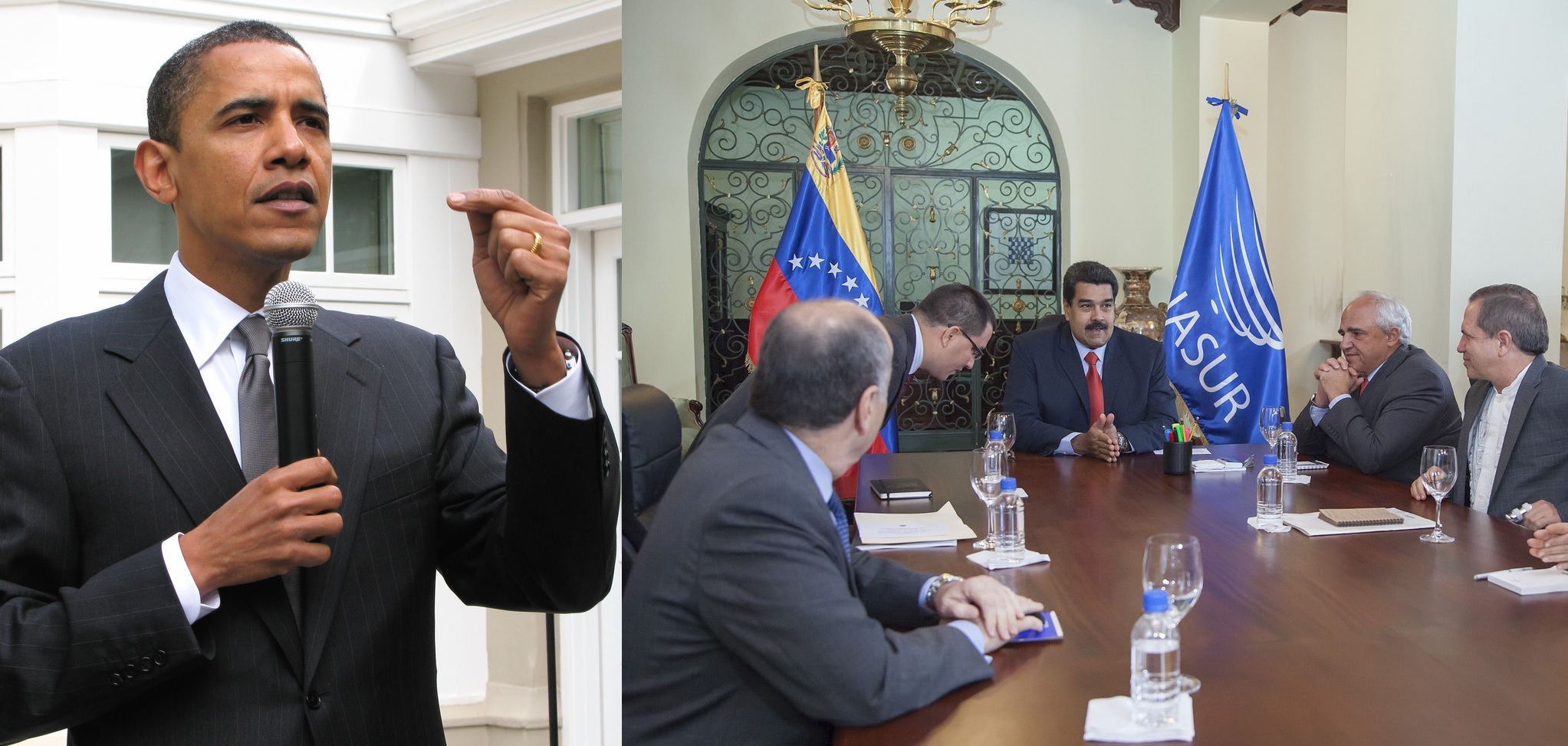
(l) President Obama, (r) UNASUR Commission Visits Venezuela. Photo Credits: Steve Jurvetson and Cancillería de Ecuador / Flickr / Creative Commons

The March 9 decision by the Obama Administration to sanction Venezuelan government officials – this time freezing the U.S.-based assets of seven of them – appears to be drawing Washington into a conflict it recently viewed as a problem for Latin America to solve.  Implementing the “targeted sanctions,” the U.S. government made the determination that Venezuela’s “situation” was a threat to its national security.  Such a determination is not unique – Washington continues to declare Colombian narco-trafficking a national security threat – but the language in this case is widely seen as inflammatory because the cited source of the threat is President Maduro’s government itself.

  • The action generated a predictably exaggerated reaction from Caracas.  Maduro, who faces an economic crisis with no end in sight and has approval ratings of 22 percent, took the sanctions as an opportunity to change the conversation.  He branded them as “hypocritical,” describing Washington as the “real threat” to world order and criticizing Obama as returning to Cold War-style tactics.  On March 14 the armed forces conducted hyped-up exercises to “counter” the U.S. threat and the day after Congress granted Maduro Decree Powers through an “Anti-Imperialist Ennabling Law for Peace” that lasts through the end of the year.
  • Reactions to the U.S. measure varied greatly among opposition leaders. Governor Henrique Capriles, the opposition’s candidate in the last two presidential elections, echoed the U.S. position that the sanctions are targeted against “the corrupt government elite,” rather than the country or the Venezuelan people.  Governor Henri Falcón, a former military officer who left chavismo’s ranks in 2010 criticized them as “disrespectful.”  The Mesa de Unidad coalition stressed that Venezuela is “not a threat to any country.”  Whereas more hardline opponents are behind the scenes happy about stepped-up U.S. involvement, the more moderate camps – including Capriles’s – appear puzzled about the timing because Washington’s actions effectively moved Maduro to the safer ground of defending sovereignty.
  • The sanctions ignited strong criticism from some regional players.  Nonetheless, they renewed UNASUR’s efforts to mediate, which had gotten off to an unpromising start in Caracas on March 6.  An emergency March 14 UNASUR meeting in Quito issued two declarations – one strongly rejecting the sanctions, even calling for Obama to rescind them, and another reiterating support for the UNASUR Secretary General Ernesto Samper’s pursuit of “the most open dialogue possible” in Venezuela.

The Obama Administration’s stated reasons for the sanctions – measures similar to those proposed in the “Venezuela Defense of Human Rights and Civil Society Law” last year – are not surprising.  Washington has watched with dismay as Maduro has cracked down on opponents, alleged U.S.-supported coup-plotting, and hemmed in U.S. embassy personnel and even tourists with increasingly tough limitations on their activities.  With the opening to Cuba ongoing, the Obama administration may have calculated it could try to appease conservatives in the U.S. Congress and endure a hit to its regional image for imposing sanctions.  Emboldened by UNASUR’s criticism of the sanctions and Europe’s unwillingness to follow Obama’s lead, Maduro will almost certainly continue efforts to play the anti-imperialist card for a while.  The U.S. has shifted the action back into the bilateral relationship, breathing new life into a previously closed chapter in the Venezuelan crisis.

March 16, 2015

* Michael McCarthy is a Research Fellow at the Center for Latin American and Latino Studies.