Brazil: Relative Success – So Far – Receiving Venezuelan Refugees, Migrants

By João Jarochinski Silva*
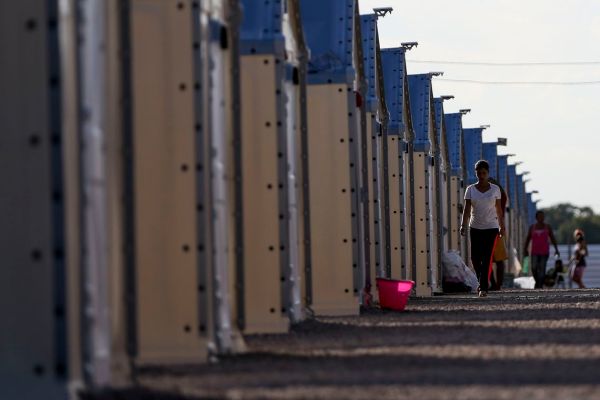
Venezuelan migrants walk past UNHCR tents at a camp in Boa Vista, Roraima

Venezuelan migrants walk past UNHCR tents at a camp in Boa Vista, Roraima/ Marcelo Camargo/ Wikimedia Commons/ Creative Commons License

The influx of Venezuelan refugees and migrants since 2013 into the Brazilian state of Roraima has challenged the state’s ability to settle them, but a continued or increased flow will require a significant expansion of efforts to relocate and integrate the new arrivals. The flow has not been unmanageable or caused significant problems in public services, as some local politicians claim, and has actually generated some benefits. In the past six years, over 260,000 Venezuelans have applied for refugee or residency status in Brazil, with the vast majority entering through Roraima, which is north of Manaus and shares borders with both Venezuela and Guyana. A voluntary relocation program, called Interiorização, has moved more than 20,000 to other Brazilian cities, but most remain in municipalities near the border. Roraima state itself has less than 600,000 inhabitants.

  • The Venezuelans in Roraima are mostly working age (16-64 years old). National authorities, assisted by UNHCR, the International Organization for Migration (IOM), and others, have developed policies related to education, training, and employment to take advantage of their productive capacity and facilitate their integration in Brazil. These initiatives enhance the emergency benefits the migrants receive and help them become autonomous.

International, national, and local experts, including at the Federal University of Roraima, Getulio Vargas Foundation, and OBMigra, have found that the Venezuelan arrivals’ impact on Roraima has been mixed.

  • The state registered positive economic growth and diversification during 2016‑17, the period of most intense Venezuelan flow, when Roraima’s GDP grew 2.3 percent, compared to the 1.4 percent of other Brazilian states. In the two following years, the state registered significant growth in agricultural production, including Brazil nuts and some livestock items, and showed the largest recorded increase in planted area (28.9 percent), while Brazil as a whole saw a decline of 0.6 percent. Roraima surpassed all other regions with an 8 percent increase in its economic diversification index. Expanded retail trade and exports in 2018‑19 fueled a 25 percent increase in tax revenues.
  • Unemployment and poverty, on the other hand, also rose during this period. While many of the Venezuelans found jobs in services such as restaurants, retail, and construction, unemployment in the state rose by 6.1 percentage points between 2017 and 2019, while Brazil’s national rate fell 0.6 percentage points. The incidence of extreme poverty in Roraima also grew from 1.64 percent in 2015 to 5.7 percent in 2018, compared to 4.2 percent nationally in 2018. (The new Venezuelan workers, however, have not significantly reduced the wages of Brazilians living in Roraima.)

Local anxieties about new strains on social services have not been fully borne out. The Venezuelans have enrolled children in schools and used medical services, but available data do not show unusually high demand. There has been, in fact, a downward trend in outpatient care provided by Roraima municipalities, and the increase in hospitalizations in the state coincided with that seen nationally.

  • The research suggests that the state’s increase in tax revenues is on a par with the additional costs of these and other services provided to the Venezuelans. Both figures are about US$22.5 million.

Roraima’s experience – so far – shows that the influx of refugees and migrants into Brazil has not had a profound impact, but the crisis in Venezuela shows no sign of abating and could get worse. Roraima, the state with the smallest population in Brazil, has a limited ability to absorb new arrivals and settle them locally without significant new resources. Expansion of the successful elements of Roraima’s approach, such as the voluntary Interiorização relocation program, would help. Additional work-related training and professional qualification programs would also help new arrivals contribute economically after relocation. Particularly if flows continue to be strong or increase, Roraima state and its municipalities are likely to feel growing urgency to develop systems to manage them and beef up social protection networks to support relocation – with the same goal of taking advantage of the economic potential of the Venezuelans’ full social and economic integration.

February 3, 2020

* João Jarochinski Silva is a CLALS fellow, professor at the Universidade Federal de Roraima (UFRR), and one of the report’s researchers. The research, funded by the Escola Superior do Ministério Público da União (ESMPU) and the UNHCR, is available here in Portuguese.
U.S.- Latin America: Policy Shifts Ahead?

By Fulton Armstrong

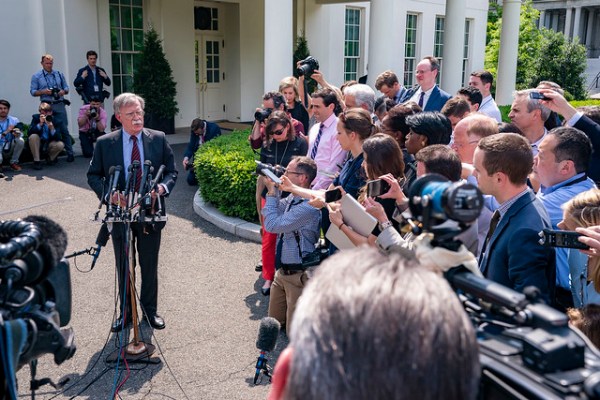
Former White House National Security Adviser John Bolton speaks to reporters on events occurring in Venezuela Tuesday, April 30, 2019, outside the West Wing entrance of the White House.

Former National Security Advisor John Bolton speaks to reporters on Venezuela in April 2019/ Tia Dufour/ White House/ Wikimedia Commons

The sudden departure of President Trump’s outspoken national security advisor, John Bolton, is unlikely to result in changes in U.S. policy objectives in Latin America but could lead to the same sort of swings in tactics – harder or softer – that characterize other U.S. policies around the world. The continued weakness of the State Department’s input, aggravated by erratic staffing in its Latin America offices, further suggests that it will not play a balancing role.

Trump and Bolton’s statements over their 17 months together indicated no disagreement on objectives and tactics in Latin America, including immigration, close relations with Brazilian President Bolsonaro, efforts to rescue the Argentine economy, and Venezuela. They had identical positions on the waves of sanctions against Venezuela, U.S. commitment to remove President Nicolás Maduro, and unstinting support for National Assembly President Juan Guaidó’s claim to the Presidency, including backing Guaidó’s flopped coup in April. They both also explicitly linked taking down Maduro with achieving regime change in Cuba.

  • Trump and U.S. Senator Marco Rubio, widely seen as his top referent on Latin America and related political matters, are trying to signal that after Bolton’s departure the Administration is going to turn up the heat on Venezuela and Cuba. In apparently coordinated tweets between them, Trump said, “In fact, my views on Venezuela, and especially Cuba, were far stronger than those of John Bolton. He was holding me back!” This complements rumors that Trump has been frustrated that Bolton’s strategy in Venezuela, particularly the fact that Maduro supporters had tricked him into false confidence in Guaidó’s failed coup, has not removed Maduro from office. (It is unclear if one of his concerns is that U.S. sanctions are worsening the refugee flow challenging neighboring countries.)

Most Washington-based observers believe, however, that Latin America is the least important of the five issues that, according to press, caused friction between Trump and Bolton. The President’s personal involvement has been much greater with North Korean leader Kim Jong Un, in efforts to achieve regime change in Iran, in talks with the Taliban for withdrawal of U.S. troops from Afghanistan, and in maintaining good relations with Moscow despite the complex situation in Ukraine.

  • Trump has appeared to lack deep interest in Latin America policy and sees it as primarily a domestic political tool for consolidating his base – among anti-Maduro and anti-Cuba voters in Florida, an important state in his re-election calculus, and among supporters for his wall on the Mexico border and other anti-migration measures. Long ago he essentially handed the Venezuela and Cuba issues over to Senator Rubio, and the National Security Council brought a Rubio ally, lobbyist, and blogger, Mauricio Claver-Carone, to the White House to work the issue. They appointed Elliot Abrams, despite baggage from the Iran-Contra era and the Bush-Cheney Administration, to handle diplomatic operations on Venezuela for them.
  • By all appearances, Secretary of State Michael Pompeo has subordinated his own Latin America team to the White House operators, essentially stifling a traditionally important voice at the policy table. When Assistant Secretary Kimberly Breier resigned last month, only nine months after being confirmed by the U.S. Senate, she said it was to spend more time with her family, but her bureau’s marginalization left questions about her policy impact. Her acting successor, veteran State Department lawyer Michael Kozak, who has spent much of the last 10 years managing “democracy promotion” programs in Latin America and elsewhere, is not likely to challenge Rubio and Claver-Carone unless Pompeo takes the lead, which he shows no sign of doing.

The new national security advisor will have more urgent problems to deal with than wrestling with Rubio, Claver-Carone, and their allies. Indeed, Trump may even give them a green light to escalate provocations even further. For example, Administration allegations that Colombian guerrillas and narcotics-traffickers receive crucial aid from Caracas – buttressed by invocation of the Rio Treaty last week – are logical ways of laying the political groundwork for some sort of military action, perhaps jointly with Colombia, against alleged camps in hopes that the Venezuelan military finally tells Maduro that it’s time to go. 

  • President Trump’s trademark approach to thorny problems has been unpredictability and experimentation with wide-ranging alternatives, including face-to-face negotiations and deal-making with opponents that pose much tougher challenges to U.S. interests than do Venezuela and Cuba. Such flexibility notwithstanding, with the U.S. elections just 14 months off, Trump’s electoral calculus strongly suggests he’s going to stay the course with policies toward Latin America that he’s told are popular in South Florida.

September 17, 2019

Venezuela’s Communal Councils: Holding on During Dark Times

By Michael McCarthy and Jared Abbott*

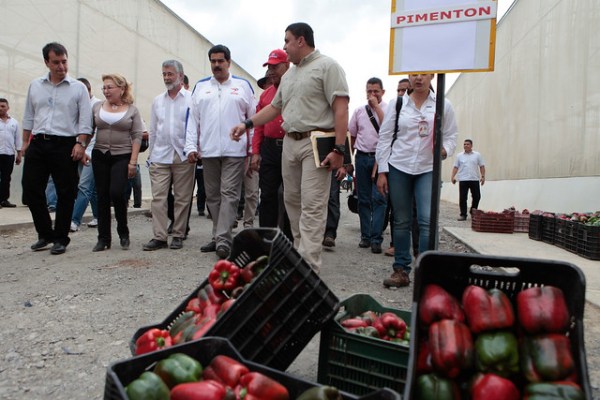
Venezuelan President Nicolas Maduro walking with community leaders

Maduro in Protected Cultivation Houses of Quibor-Edo / Flicker / Creative Commons /https://www.flickr.com/photos/chavezcandanga/8402610886/in/photostream/

Venezuela’s Communal Councils (Consejos Comunales), created in 2006, endure as an influential grassroots mechanism amid the country’s cataclysmic economic depression and political crisis. Increasingly, their primary function appears to be helping embattled President Nicolás Maduro’s ruling party maintain loyalty among its declining base. Three factors linked to Chavismo’s melding of party and state have enabled the Councils to survive amid radically changed conditions: linking them to state-run food distribution programs, giving them problem-solving functionality, and building block-level group ties in Council-created spaces.

  • Survey data we collected in late 2018 demonstrates that participation in Councils has declined as resources have contracted, but the groups remain alive and well. Our poll of more than 1,078 Communal Council participants revealed that about a third perceive the Councils’ reach as remaining as strong as before the economic slide accelerated four years ago, while another 13 percent believe participation has even grown. Sixty-two percent of respondents who reported ever participating said that they still did in 2018.
  • The Councils have been critical in minimizing major disturbances in popular sectors over the past five years through the role they have played – in coordination with the Comités Locales de Abastecimiento y Producción (CLAP) – in distributing monthly food boxes to a large majority of the population. Not surprisingly, of all the Councils’ thematic committees, food committees are by far the most active. Council participants reporting being active in a food committee increased from zero in 2009 to 20 percent in 2018.
  • Our survey and interviews show that the Councils have been crucial in sustaining the party’s capacity to mobilize its core supporters in key moments such as during widely criticized elections that Maduro held in May 2018. Our research also finds that most Councils are not necessarily ideologically soaked spaces of pro-regime behavior, although many citizens understand them in highly political terms. Participation, while heavily skewed toward Chavismo, reflects the whole Venezuelan political spectrum and often transcends partisan politics. Our survey shows, moreover, that over 60 percent of Venezuelans reported as recently as last December that the Councils benefit the whole community, not just party members. This practical problem-solving dimension helps enable the Councils to retain relatively broad support among Venezuelan society.
  • Our survey results suggest that the Councils are effective in increasing positive attitudes toward the government even in the absence of direct material benefits. For instance, of those who reported that their opinion of the ruling party improved since they began participating in a Council, the vast majority cited their improved social status in the community or increased political efficacy, rather than the receipt of material benefits through the Councils, as the reason for their improved attitude toward the party.

The Councils have operated across three competing models: a “deepening democracy” model focused on expanding avenues of citizen participation within the existing political system; a utopian “dual power” model aimed at replacing the existing political system with a radical direct-democracy; and a “vanguardist” model where the councils serve as a direct instrument of the party to mobilize and grow the electoral base. While all three models played an important role during the early years of the Councils, the vanguard model has recently superseded the others. Although still sometimes used by different party factions to stimulate debate about the government’s policies and performance, the Councils’ role in consolidating a loyal base of supporters to withstand the current period of economic and political crisis has been much more important.

The Councils’ evolving relationship with the ruling Socialist Party raises serious questions about whether, as political and economic conditions grow less stable, participatory institutions like the Councils open political spaces for engagement and incorporation, or devolve into a cynically deployed tool of populist autocrats – with unsettling implications for the future of participatory democracy that some leftist parties in Latin America advocate. Indeed, the Venezuela example suggests that, when political and economic conditions become less favorable for sustaining participatory institutions, most parties will either abandon them or instrumentalize them as part and parcel of an authoritarian power consolidation strategy. The groups’ changing political character becomes a matter not of “if,” but of “when.” Political party leaders can, if they want and if they try, stay true to the participatory vision through imaginative leadership and creative organizational schemes. In Venezuela, however, they have not.

September 9, 2019

* Michael McCarthy is a Research Fellow with the Center for Latin American & Latino Studies, Adjunct Professor of International Affairs at GWU’s Elliott School, and publisher of Caracas Wire, a newsletter on Venezuela and South America. Jared Abbott is a PhD Candidate in Political Science at Harvard University. This is adapted from their article, Grassroots Participation in Defense of Dictatorship, in the Summer 2019 Fletcher Forum.

Venezuela: Inching Toward Negotiations?

By Fulton Armstrong

A group of Venezuelans protest against International Contact Group for Venezuela. The Venezuelan flag is held in the background as a protester holding a young child looks on.

Community of Venezuelans protest against International Contact Group for Venezuela / https://www.shutterstock.com/image-photo/montevideo-uruguay-february-8-2019-community-1307825104?src=qNES6S7x3QlbnYg-a1h2wg-1-0 / Shutterstock

As Venezuelan National Assembly President Juan Guaidó reiterates his welcome to U.S. military intervention, his international supporters – rejecting a military solution – are moving toward promoting a negotiated settlement that would include President Maduro or, in one scenario, a chavista he designates. Guaidó publicly stated this past weekend that he has directed his representative in Washington to meet with the U.S. Southern Command, whose top officer recently said “we’re on the balls of our feet and ready to go,” to discuss “cooperation.” Although the 50-plus countries that recognized Guaidó’s claim as “interim president” in January have not abandoned him, press reports indicate that they are increasingly looking at alternatives to his strategy of instigating the Venezuelan military to overthrow Maduro and, failing that, asking Washington to do so.

  • The failure of Guaidó’s attempted coup in Operación Libertad, on April 30 – after other stalled initiatives over humanitarian aid at the Tienditas Bridge in February and numerous street mobilizations – has dispirited foreign supporters who joined Guaidó’s cause almost four months ago with the expectation that he would replace Maduro within days. Leaders in Latin America and the European Union have repeatedly expressed concerns about senior U.S. officials’ assertion that “all options,” including military action, are under consideration. (Secretary of State Pompeo last week repeated that the United States “will do what’s required.”)

These shifts give momentum to diplomatic initiatives to start and monitor a negotiated internal settlement. Advocates of negotiations, such as Spanish Foreign Minister Josep Borrell, who last week said the United States was acting “like cowboys,” have begun to push harder.

  • On May 3, the “Lima Group,” including 12 Latin American countries and Canada, called for the first time for broader consultations on initiatives undertaken by the International Contact Group (the ICG, consisting of eight EU countries plus Uruguay, Costa Rica, and Ecuador) and, over the objections of Guaidó’s representative at their meeting, called for dialogue with Cuba to explore ways of ending the crisis. The ICG, meeting on May 7 with the important participation of the Vatican and Lima Group hardliner Chile, agreed to send a “high-level political delegation” to Caracas to discuss “concrete options” with both sides. Soon after, Canadian Prime Minister Justin Trudeau called his Cuban counterpart, President Miguel Díaz-Canel, to urge Havana’s help. (Cuba’s position remains that it would gladly participate if Maduro requested it.)
  • Federica Mogherini, the EU’s chief of foreign affairs, has kept up criticism of Maduro, condemning the arrest last week of National Assembly Vice President Zambrano, but press reports indicate that she’s maneuvering the 28-nation community away from absolute support for Guaidó and toward an inclusive negotiation process that produces a “political solution and early elections.” She has softened her previous demand of Maduro’s departure as a precondition.

The United States still firmly rejects any negotiated settlement, steadfastly repeating that Maduro and the “occupation forces” – Cuba and Russia – must leave Venezuela immediately. But, even if starting a negotiation does not ensure a good settlement, most of the international community is reaching the conclusion that sanctions, such as those that are worsening humanitarian conditions in the country by the day, are increasingly unlikely to produce the desired regime change and stable outcome. Anyone watching Venezuela over the years knows that both the opposition and Maduro (the latter more frequently) have thrown wrenches into past negotiations in belief that they would win a war of attrition. Advocates of a return to negotiations are under no illusion that talks this time will be easy. The U.S. sanctions will soon begin to bite harder, but Guaidó’s stumbles have convinced many that humanitarian suffering does not translate into regime change – and they may even think that now is time to begin using the leverage of sanctions and at least try to get a process going. There are few guarantees in world affairs, of course, but pragmatists seem to be betting that the probability of rescuing Venezuela from an even deeper abyss is greater with negotiations than with more sanctions and rhetoric about military attack.

May 13, 2019

Venezuela: Washington Trying to Tighten the Noose

By Eric Hershberg

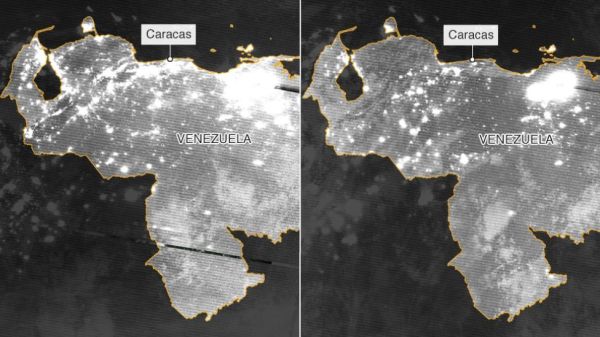
Two side by side images of Venezuela's territory comparing the electrical grid on March 7 and March 12, after six days of blackout

Satellite images of Venezuela. Left image taken on March 7, 2019; right image taken on March 12, 2019 during a blackout / Wikimedia Commons / Creative Commons

As Venezuelan President Nicolás Maduro completes 11 weeks in office since Washington and dozens of other countries recognized National Assembly President Juan Guaidó as “interim president,” the Trump Administration is ratcheting up the pressure. U.S. officials’ rhetoric and actions against both Venezuela and Cuba, which the State Department says is “propping up the former [Maduro] regime,” are escalating. A “senior official” told reporters last Friday that new sanctions would “tighten the noose of financial strangulation of Maduro and his cronies,” while U.S. Vice President Pence, speaking in Houston, reiterated that “all options are on the table.” Pence further focused U.S. regime-change policy on Cuba, citing Guaidó’s wife as the source of evidence that “the only way [Maduro] clings to power is with the help he receives from Communist Cuba.” Pence also said six U.S. businessmen arrested on corruption charges last year “are being held hostage by the Maduro regime,” suggesting another pretext for aggressive action.

  • Last Friday, the U.S. Treasury Department designated 34 vessels owned by PDVSA and two owned by non-Venezuelan companies for sanctions. Treasury Secretary Steven Mnuchin said the move was to block Venezuelan oil exports and cut off supplies to Cuba under the two countries’ “oil-for-repression schemes.”.
  • Press reports on Venezuela’s oil shipments have varied, but Thomson Reuters specialists have reported that Venezuelan oil shipments, after a 40 percent drop in February, remained basically steady in March despite the crisis and electricity disruptions at oil facilities. PDVSA was shipping almost 1 million barrels a day in March, with the bulk going to India, China, and Russia. Reuters calculated that some 65,000 barrels a day went to Cuba.

Electricity blackouts and resulting water shortages have continued for three weeks. While conceivably the result of serious neglect of infrastructural maintenance by Maduro’s Administration, the outages have all the markings of covert sabotage operations. Venezuela has suffered from short power outages many times in recent years, but the latest blackouts have been by far the most extensive, longest, and most damaging. U.S. officials have denied any U.S. role, direct or indirect, in the blackouts. On March 8, Special Representative Elliott Abrams said, “So the United States did not cause those [electricity] problems, the international community did not; the regime caused those problems.”

The U.S. sanctions and related operations are having an impact, but Washington’s initial estimations of Maduro’s strength and the timeline for his collapse were not realistic. Meanwhile, denials of involvement in the blackouts are hard to take at face value. The phrase “all options” surely includes covert action. Turning out the lights is a common disruption tactic, and extraordinary neglect in system maintenance makes the power grid a particularly tempting target in Venezuela. Sabotage and disinformation operations have long been core components of American covert operations in the hemisphere. They were essential tools in successful efforts to depose Guatemalan President Arbenz in 1954 and Chilean President Allende in 1973. The CIA has also formed armed groups, such as the Bay of Pigs force in 1961 and the Nicaraguan Contras in the 1980s (where CIA also mined Corinto harbor). These historical precedents may provide some indications of next steps in the administration’s campaign to bring about regime change in Caracas.

April 11, 2019

From Washington to Brussels and Montevideo: No Common Plan for Venezuela

By Stefano Palestini Céspedes*

Photograph of the EU High Representative for Foreign Affairs

EU High Representative for Foreign Affairs at the International Contact Group Meeting in Montevideo, Uruguay / EFE / Presidency of Uruguay / Creative Commons

A common feature of international efforts to deal with the years-long political crisis in Venezuela has been an inability to come up with a common approach – which, despite many countries’ agreement that it’s time for Nicolás Maduro to go, continues to hamper effective solutions. Three different and partly contradictory international approaches have emerged.

  • Regime change, supported by the United States, the Secretary General of the OAS, and the 13 Grupo de Lima states (without Mexico). It assumes that there is no exit from the political crisis without the immediate ousting of Maduro and his cronies. All international actions are “on the table,” including coercion through threatened military action, coercion through sanctions (implemented), international recognition of a parallel interim president (implemented), financial support to Maduro’s opposition (implemented), and delivery of humanitarian aid (being attempted).
  • Mediation with conditions, launched in Montevideo last Thursday by the Grupo de Contacto. Backed by member states of the EU, the EU High Representative for Foreign Affairs, Uruguay, Ecuador, and Costa Rica, it proposes that the solution to the political crisis must be through peaceful means, namely national dialogue with international mediation. It imposes, though, a condition for dialogue and mediation to start: immediate presidential elections.
  • Mediation without conditions, sponsored by Mexico, Bolivia, Uruguay, and the Caribbean Community (CARICOM). The so-called Montevideo Mechanism also assumes that the crisis can be overcome only through a national dialogue, with international mediation and monitoring, but it does not impose any conditions on any of the parties before undertaking the dialogue and mediation.

All three strategies entail problems and challenges, although the first sets a precedent that by far is the most problematic. It establishes regime-change, including military intervention by internal or foreign forces, as a legitimate international action to solve political crises. In contrast to what OAS Secretary General Luis Almagro has held in conferences at think-tanks, most experts assess that regime-change violates international law and, in particular, Inter-American Law. From an international perspective, such an action might be justifiable only under the strict observation of the criteria put forward by the UN Responsibility to Protect doctrine, which do not apply to the Venezuelan crisis as severe as it may be. The UN Secretary General has expressed his concern with the regime-change strategy, and some governments at the Lima Group also showed uneasiness with the military option at a summit in Ottawa on February 4. A main criticism is that it endangers civilians’ lives by making them potential targets in a confrontation, and it curtails any other alternative course of diplomatic action.

  • The second and third strategies could be the way forward, but they compete with each other, nullifying their potential leverage over the parties in conflict. The “Montevideo Mechanism” was launched by Mexico and Uruguay less than 24 hours before European representatives landed in Montevideo to discuss the Contact Group’s mission. That timing and Twitter politics suggest a leadership struggle between Mexico and the EU that undermines what should have been a common alternative plan. The apparent split has allowed Maduro to reject the EU-sponsored Contact Group and hold out for the “Montevideo Mechanism”. Guaidó has rejected both and suggested that the states supporting national dialogue and mediation are not “on the right side of history.”

International actors’ inability to agree on a common plan severely hampers diplomatic efforts – and plays into the U.S.-led push for regime change by non-diplomatic means. For the Venezuela crisis to have a resolution that sets positive precedents, international actors will need to abide by common international norms, including Inter-American Law, and set aside political interests and ideological visions that preclude the emergence of a unified, effective front that forces Venezuelans to get serious about ending a crisis.  Failing that, the opposition’s preference for military-style regime change and Maduro’s preference for buying time through unconditional negotiations allow them to suck international actors into their family feud – and only delay an end to the crisis.

February 12, 2019

* Stefano Palestini Céspedes is an Assistant Professor at the Institute of Political Science, Catholic University of Chile.

Venezuela: A Test of U.S. Hegemony in Latin America

By Eric Hershberg

Lima Group members standing at a podium

Lima Group members in Torre Tagle in Perú / Flickr / Creative Commons

The showdown in Venezuela reflects an extraordinary attempt by the United States government to resurrect hegemonic power in Latin America.  From the mid-19th century to the dawn of the 21st, it was common for Washington to directly overthrow Latin American governments or to bolster clients seeking transitions to dictatorship or democracy.  But recent years had witnessed a clear decline in U.S. hegemony.  As Latin America appeared to have escaped Washington’s imperial reach, many of us were persuaded of the finality of the Obama administration’s recognition that the era of the Monroe Doctrine had ended.  We were dismissive, perhaps excessively, of the assertion of Trump administration officials and advisors that the infamous Doctrine could somehow be revived.

Yet the dynamics of the Venezuelan confrontation result from an unprecedented, Washington-forged hemispheric coalition – of the genuinely willing – trying to force a regime transition.  Traditionally, Washington conducted such interventions on its own, opposed by most of Latin America.  Yet today not only the 12 members of the Lima Group but also Canada and several EU governments are on board with the administration’s boldly assertive intervention in Venezuela’s political crisis.  Russia’s and China’s support for incumbent President Nicolás Maduro underscores that what is at stake is the enduring relevance of the Monroe Doctrine, which almost two hundred years ago unilaterally established an American veto over extra-regional engagement with nominally sovereign countries “in its own backyard.”

For champions of the Trump administration’s policy, asserting hegemony – after the Obama administration had declared it “dead” – is an end in itself.  Rejecting the Monroe Doctrine did not provoke a crescendo of acceptance from much of the foreign policy establishment in Washington, and abandoning that stance has been a core aspiration of right-wing foreign policy networks that have taken over the Executive Branch.  Countless statements over the years by the presumed architect of the present intervention – de facto Secretary of State for Latin America Senator Marco Rubio – reflect how an enduring hatred for the Cuban Revolution, and movements inspired by it such as Chavismo and the ALBA alliance, fuels antagonism toward intra- or extra-regional engagement that call into question U.S. authority.  Russian and Chinese interest in sustaining Chavismo thus reinforce Washington’s determination to eradicate it.

  • Venezuela today is an ideal target for a US-sponsored intervention to bring about regime change and reassert American hegemony in Latin America. The dictatorship is increasingly vicious, and Maduro’s claim to legitimacy is entirely fraudulent.  Moreover, Maduro’s government has so wrecked the economy that desperate millions are fleeing the country, creating an urgent humanitarian crisis that overwhelms neighboring countries already unable to provide for the basic needs of their own populations, making them more amenable to an interventionist exit.
  • Venezuela’s opposition has been long hindered by incompetence and racked by competing personal ambitions. With its most assertive leaders imprisoned, under house arrest, or in exile, it has proven incapable on its own of bringing about Maduro’s removal, either peacefully through his rigged institutions or through uprisings in the streets.  Absent an internal path toward regime transition, conditions were ripe for Washington to coax regional partners to back a daring strategy of intervention.  To have any prospects for success, the venture required that the domestic opposition finally unify – or at least acquiesce in –the anointment as Interim President of Juan Guaidó, a young political unknown whose ties with right-wing patrons are not as well known.  That unification, presumably, was made possible by recognition that only with external support could internal resistance succeed, and only with a unified or quiescent opposition would the international partners take the aggressive stance that they did.

Just as the opening to Cuba was the signature achievement of the Obama administration with regard to Latin America, the effort to overthrow the Venezuelan government appears destined to be the signature act of the Trump administration.  The support of almost all of Latin America for it will have consequences far beyond the fate of the incompetent dictator clinging to power in Caracas.  If their gambit succeeds, Senator Rubio and National Security Advisor John Bolton could move on next to Nicaragua and then perhaps to the king’s crown in Havana. 

  • Those tempted to attribute this to abhorrence of violators of democratic norms would do well to consider the administration’s supportive stance toward increasingly authoritarian regimes in Honduras and Guatemala. Those cases, and the recognition that much of the opposition leadership wants to restore Venezuela to “what it used to be” (i.e., before Chavez tried with considerable popular support to forever end what Venezuela used to be), underscore the ideological drivers of U.S. policy today.  While Washington may have embarked on a course that can finally extricate Venezuela from Chavista misrule, the history of American influence over the region does not bode well for what a return to U.S. hegemony in Latin America could bring.  Surely that point is not lost on leaders of countries such as Mexico and Uruguay.  If the coming weeks bring a continuing stalemate between the Venezuelan regime and opposition, perhaps their good offices could catalyze a negotiated path to free elections and to a resulting regime that would not be Made in USA.


January 31, 2019

Venezuela: When Will the Military Flip?

By Fulton Armstrong

venezuelan military marching

A military exercise in Caracas, Venezuela. / Cancilleria del Ecuador / Flickr / Creative Commons

Venezuelan leader Juan Guaidó and his backers, including the Trump administration, are increasingly focused on swaying the country’s security forces to switch allegiance from Nicolás Maduro to the National Assembly President.  Guaidó has appealed to the military to support his efforts to “restore constitutional order” and is pushing through the legislature a law giving amnesty to cooperating officers for certain crimes committed since President Chávez took office in early 1999.  U.S. officials, apparently to shake up the armed forces, continue to say that “all options are on the table”; National Security Advisor John Bolton held a notepad at a press briefing referring to “5,000 troops to Colombia.”  Maduro, for his part, continues to orchestrate loyalty pledges from senior officers and preside over military exercises.

  • Several small units of the military have flipped, and Maduro’s military attaché in Washington – serving there for a number of years to get medical treatment – has declared loyalty to Guaidó. The vast majority of the officer corps, however, still maintain an appearance of commitment to Maduro.

The most common explanation for the military’s apparent loyalty cited by Maduro’s opponents is that the high command has been bought off by opportunities to engage in corruption.  Other factors, however, may better explain why the institution has stuck with him this long.

  • Ideological reasons? Most available information suggests that Madurismo – with its gross, incompetent mismanagement of the economy, corruption, and thuggery – is not attractive to the officer corps.  But they appear to know that Chavismo has deep roots; that the elites, including the more hardline opposition, don’t understand the significance of change since 1999; and that efforts to return to the pre-Chávez era would be destabilizing and bloody.
  • Financial reasons? Although historically and perennially corrupt, senior officers arguably have been able to do more corruption under Maduro than under another regime.  That said, in their heart of hearts, they probably know a lot of their activities will continue under any government.
  • Distrust of the opposition? The military traditionally has communicated better with opposition moderates, such as Henrique Capriles, and in recent years has shown no trust in the faction that Guaidó comes from and its leader, Leopoldo López.  Information is very limited, of course, but many officers may believe that this group’s obsession with overthrowing Maduro and its no-negotiation stance has contributed to the crisis.  Senior officers’ confidence in Maduro’s ability to hold the country together seems to have evaporated, but the opposition have not presented a viable, comprehensive alternative.
  • Concern about the López-Guaidó faction’s ties with Colombia and the U.S.? Good information is elusive, but senior officers’ posture suggests that they see Bogotá’s strategic objective to keep Venezuela weak and Washington’s objective to purge the country of Chavismo and themselves.
  • Concern that the “international community” will not give them a fair deal? Distrust of Washington seems obvious, but – within their logic – senior officers almost certainly are suspicious of OAS Secretary General Luis Almagro, the Lima Group, Brazilian President Jair Bolsonaro, and others as intolerant and biased.
  • Belief that, in the face of total chaos and widespread bloodshed, they can force a last-minute peaceful solution onto Maduro? Senior officers presumably have good enough intelligence to know when and how to intervene – and persuade Maduro to accept a peaceful solution and fly into exile.  The bigger problem at this point is that they do not see a viable alternative to sticking it out.
  • Fear that Maduro’s people have deeply penetrated officer ranks, and their lives will be at stake if they move against him? As the scope of the crisis grows and the credibility of Maduro’s power begins to slip, this would appear now to be less important.  Officers talk among themselves more than outsiders think.

The Venezuelan military’s threshold for intervening against civilian governments of any stripe has always been high, amplified by the embarrassment of the reversed coup against Chávez in 2002.  None of the factors that, on balance, still appear to favor sticking with Maduro is unmovable.  Distrust of the United States, OAS, and the Lima Group – the outside forces that legitimized Guaidó’s claim to power – leave the military with no reliable allies; Cuban, Russian, and Chinese friends can provide no solace.  A credible negotiation proposal from someone like Mexican and Uruguayan Presidents López Obrador and Vázquez, especially if backed by Pope Francis, could conceivably give them a credible direction in which to push Maduro.  But at this moment – subject to rapid change – the balance still argues in favor of the military fearing a new course.

Venezuela: Is Guaidó the Knight in Shining Armor?

By Fulton Armstrong

Guaidó and Maduro image

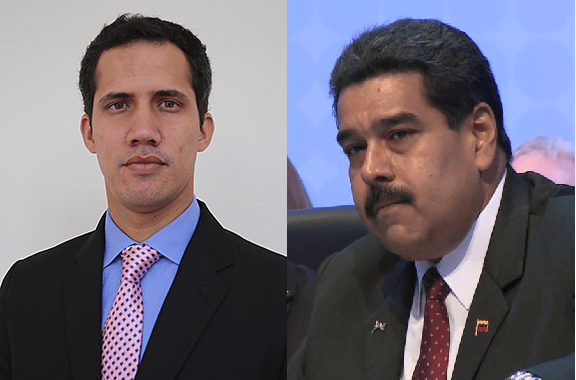
Guaido and Maduro / Wikimedia Commons

The OAS, United States, and a number of Latin American governments are pinning high hopes that newly inaugurated National Assembly President Juan Guaidó will lead Venezuela out of its crisis and “back to democracy,” but the opposition needs much more than foreign support to achieve its goal of ousting President Nicolás Maduro.  The 35-year-old Guaidó, an engineer with eight years of political experience, proclaimed last Friday that “we will oust Maduro and his gang from power” and that he had the right to call new Presidential elections and to serve as Interim President while they are prepared.  He called on the military, which has shown some small fissures but so far appears to remain overwhelmingly loyal to President Nicolás Maduro, to “assume its responsibility … and remove the usurper [Maduro].”  He is organizing a national march on January 23 that, according to observers, he hopes will show the military the strength of his support.  (Maduro’s party, the PSUV, has announced its own demonstration that day.)

  • International reaction came fast and strong. OAS Secretary General Luis Almagro, who calls the Maduro government a “narco-dictadura,” immediately started referring to Guaidó in Tweets and public statements as “interim president” of the republic.  Brazilian President Jair Bolsonaro’s son sent a congratulatory message also recognizing Guaidó in that capacity.  The dozen predominantly conservative governments speaking as the Grupo de Lima have declared Maduro illegitimate and embraced Guaidó’s leadership if not the title.  President Trump’s National Security Advisor, John Bolton, praised the leader’s “courageous decision” to challenge the Maduro government without explicitly recognizing him as Interim President.

Inside Venezuela, reactions to Guaidó’s power play reflected longstanding political alignments.

  • Maduro, who refers to Guaidó as un muchacho, has ridiculed his statements as a “Twitter coup,” and his political machine has followed with the usual attacks. Maduro has reiterated his call for negotiations with leaders of the opposition.  He has distanced himself from the embarrassing arrest of Guaidó last Sunday, claiming that it was made possible by “the corrupt and traitorous cooperation of a group of officials” in his intelligence service, SEBIN.
  • Guaidó’s party, Voluntad Popular (VP), is solidly behind him. Its founder, Leopoldo López, who is under house arrest, has led the charge in his defense, and their key allies – including María Corina Machado (Súmate), former Attorney General Luisa Ortega Díaz, and many leading Venezuelans in the United States – are supporting him too.
  • The party’s splits with opposition moderates remain deep, however. Henrique Capriles (Primero Justicia) issued a scathing critique of Guaidó’s strategy.  He accused VP of sponsoring violence that will use “the people of Venezuela as cannon fodder,” and he has called them “saboteurs” blocking serious talks and feeding the people unrealistic expectations.”  Other moderates have also recoiled from Guaidó’s approach and are reportedly bewildered by the OAS Secretary General and others’ support for direct confrontation.

As the political class engages in yet another cycle of struggles, the military, once again, is seen as the ultimate arbiter that all sides want to influence.  Maduro’s punishment of seemingly disloyal officers recently has probably been a double-edged sword – feeding resentment while instilling discipline – but unhappiness with Maduro does not translate into support for the opposition.  There appears to be no love between the military and the Voluntad Popular leadership, whose confrontational tactics almost certainly concern the military and whose political program and popular base remain unclear.  Despite deep corruption in the officer corps, moreover, most officers probably see themselves as nationalists and might chafe at the idea of the OAS or regional governments trying to be the kingmakers.  Strange things can always happen, but celebration of the Interim President seems premature and even counterproductive.

 January 17, 2019

South America: Venezuela Humanitarian Crisis Roiling Region

By Michael McCarthy*

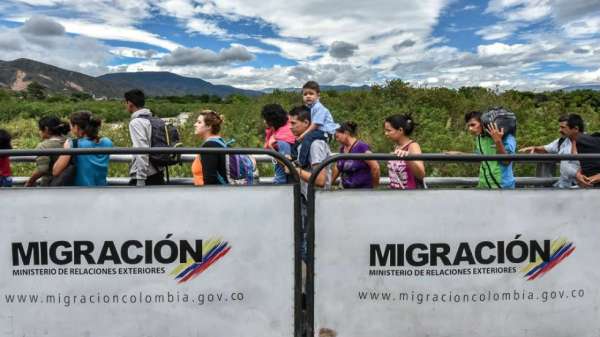
A line of Venezuelan migrants at a Colombian border checkpoint.

Venezuelan migrants at a Colombian border checkpoint. / Colombia Reports / Wikimedia

The humanitarian crisis driven by both Venezuela’s increasingly dire economic situation and political repression is taxing all of northern South America, with no remedy in sight.  In what UN High Commissioner for Refugees officials call “one of the largest mass-population movements in Latin American history,” an estimated 2.3 million Venezuelans – about 7 percent of the country’s population – have poured out of the country since 2014.  According to UNHCR, more than half of them suffer from malnutrition, and a significant percentage suffer from diseases, such as diphtheria and measles, previously thought to be under control.  The crisis is posing economic and security challenges to neighboring countries:

  • Colombia has seen the greatest flow. About one million refugees have crossed the border since 2015, but arrivals have peaked – reaching about 5,000 per day – as the Venezuelan economy hits new lows.  Venezuelans’ fears that Colombia’s new president, Iván Duque, will close the border have driven part of the surge, but Venezuelan President Nicolás Maduro’s recent policy announcements – including a fórmula mágica that includes controlling inflation by lopping five zeros off current prices – are main drivers, according to most observers.
  • Ecuador received more Venezuelans in the first half of 2018 than in all of 2017 (340,000 to 287,000). Confronted with severe disruptions in border communities, Quito has declared a month-long “emergency” in four border provinces and has sent doctors and other personnel to help mitigate the impact of the arrival of several thousand Venezuelans a day.  Ecuador has announced that it is now denying entry to persons without passports.  Quito last week called for a regional summit on the crisis in mid-September.
  • Peru is the largest refugee hosting country in the Americas, but it has now begun to demand official documentation.
  • Brazil has taken in several tens of thousands of Venezuelans, but the influx is provoking local tensions. A regional judge closed the border – a decision overturned by the Supreme Court – and locals in the border city of Pacaraima took matters into their own hands vigilante-style, burning down a tent city and chasing about 1,200 Venezuelans back across the border.  Argentina and Uruguay, which last granted residency to 31,000 and 2,500 Venezuelans, are beginning to feel pressure to slow the flow.
  • Guyana is also upset because Venezuelans claiming Guyanese citizenship are arriving with claims to properties held by others since at least the 1980s. As the International Court of Justice takes up Georgetown’s case on its decades-old border dispute with Venezuela, the refugees’ arrival is an unwelcome distraction.

The United States and European Union have offered assistance, mostly to Colombia.

  • Earlier this month, Washington announced it would give Colombia an additional US$9 million in aid to provide water, sanitation, hygiene and some medications to Venezuelan migrants – bringing the overall U.S. commitment to over US$46 million over the past two years. USAID has cast the aid as supporting a “regional response” to the problem, but Washington’s closest ally, Colombia, will receive the overwhelming share.  U.S. Defense Secretary Mattis has announced he’s sending a hospital ship, the USNS Comfort, to Colombia and “possibly other destinations” to help.
  • In June, the EU committed €35.1 million (US$40.2 million), mostly for “emergency aid and medium-term development assistance” for people remaining in Venezuela and for neighboring countries affected by the crisis, and the EU Commission promised it would mobilize its migration and asylum program to provide help for migrants.

Assistance from the U.S. and EU, as well as any future help from multilateral development banks, is crucial but, ultimately, these interventions are palliatives.  Durable solutions will have to come from within Venezuela and from regional initiatives.  The summit proposed by Ecuador will produce little without strong leadership that at the moment appears absent.  The Organization of American States seems fatigued by the issue, and its Secretary General’s personalization of the struggle against Maduro over the past year has left him few options as well. UNASUR has been severely weakened – most recently by Colombian President Duque’s announcement of his country’s definitive withdrawal from the group – and its interlocutors from past efforts to find a solution in Venezuela have refrained from public comment.  The leadership of UN refugee specialists is critical, but the Security Council is very divided over the Venezuela crisis and the Secretary General has failed to gain traction with efforts to take a more active political role to address the Venezuelan crisis.  With Maduro’s fórmula mágica for resolving Venezuela’s economic challenges having next to no possibility of helping, the hemisphere should not be surprised that the flow of refugees will surely continue.

August 28, 2018

* Michael McCarthy is a Research Fellow with the Center for Latin American & Latino Studies.  He publishes Caracas Wire, a newsletter on Venezuela and South America.