Is Chairman Menendez the Right U.S. Signal for Latin America?

By Eric Hershberg and William M. LeoGrande, Professors of Government, American University School of Public Affairs

U.S. Senator Bob Menendez | by Talk Radio News Service | Flickr | Creative Commons

U.S. Senator Bob Menendez | by Talk Radio News Service | Flickr | Creative Commons

Fresh and credible allegations about U.S. Senator Bob Menendez’s bullying of Latin American governments and influence-peddling for political cronies raise further doubts about what Washington is signaling to the region – and the implications for U.S. relevance in the second Obama Administration.  Secretary of State Kerry’s successor as chairman of the Senate Foreign Relations Committee, Menendez is now a major architect of U.S. policy, and his activities and policies are an indication of U.S. intentions around the world, especially in Latin America, which has been the focus of much of the Senator’s attention.

Media reports have documented well how Menendez persistently intervened on behalf of a wealthy campaign donor to pressure the government of the Dominican Republic to institute port security programs over legitimate objections of local authorities.  When Dominican officials appropriately exercised their duties and pointed out that the donor lacked expertise for the exorbitantly priced contract, Menendez only turned up the heat.  This was consistent with an ongoing pattern of behavior.  In 2011, according to reliable sources, Menendez demanded a U.S. policy of forcing the government of El Salvador to fire a cabinet minister he did not like, clearing the way for the military to capture the position.  Earlier, when the OAS opened discussions on whether to lay out conditions for Cuba’s readmission to the hemispheric body, he threatened to cut all of its U.S. funding.  A self-proclaimed champion of “democracy promotion” and “accountability” in Latin America, the New Jersey Democrat never missed a chance to criticize centrist or left-leaning governments.  Governments in the region are not the sole targets of his interventions:  Menendez has used his influence to intimidate bureaucrats throughout the U.S. foreign policy community into either supporting his initiatives or, at least, turning a blind eye to them.

Latin American opinion-makers grew accustomed to Menendez’s ways during his tenure (2010‑12) as Chairman of the Senate’s subcommittee on the western hemisphere, but his ascension to the chair of the full committee from within Obama’s own party makes his voice – and style – much more important.  His influence-peddling for his buddies’ business interests – at the expense of other U.S. government and foreign partners’ priorities – can only fuel greater cynicism about U.S. preachiness on anticorruption and “democracy promotion.”  It also further risks U.S. relevance at a time that many in the region remain hopeful of a revival of President Obama’s short-lived emphasis on “partnership” in the “neighborhood.”  The investigations into Menendez’s activities may run into serious obstacles – many bureaucrats fear his ire, and will be reluctant to talk – but it’s already clear that his bullying and influence-peddling make him the wrong person for a leadership role in U.S. policy toward Latin America. 

High Time for a U.S.-Bolivia Reset

By Rob Albro, CLALS Faculty Affiliate

President Evo Morales in a climate meeting at the University of Oslo | by Utenriksdept | Flickr | Creative Commons

President Evo Morales in a climate meeting at the University of Oslo | by Utenriksdept | Flickr | Creative Commons

Little has changed in the U.S-Bolivia relationship since each expelled the other’s ambassador and suspended full diplomatic ties in 2008.  Last month a Bolivian official accused the United States of trying to sabotage the administration of President Evo Morales, and Morales has not dropped his pugnacious anti-U.S. rhetoric.  Washington, for its part, has persistently criticized Bolivian anti-drug policies, while not acknowledging the failures of its own decades-long “war on drugs.”  As discussions surrounding Secretary of State Kerry’s January 24 confirmation hearing suggested, U.S. policy toward several Latin American countries – including Bolivia – is still on Cold War autopilot, continuing to use code-words like “socialism,” implicitly and incorrectly viewing the recent and historic changes in that country largely through the prisms of Venezuela and Cuba.

Along with many observers outside of Washington, the Bolivian government understands itself to be addressing long-standing demands to correct a historical lack of social inclusion, to institute a more participatory (and “plurinational”) democratic process, and to pursue economic sovereignty.  In notable contrast to Venezuela, with which Bolivia is often lumped together, the country’s long-marginalized indigenous majority is in the national political driver’s seat for the first time.  Despite Morales’s rhetoric to the contrary, Bolivia is far from rejecting the free market. It recently applied for full participation in MERCOSUR, and has welcomed foreign investment in its sizable petroleum and lithium deposits. Along with Peru and Ecuador, Bolivia has also sought ways to maintain economic growth while protecting the environment and avoiding unsustainable extractivist policies.  Bolivia’s is a hybrid approach: mixing an alternative democratic tradition domestically with the promotion of Bolivia Inc. globally.

It is past time for Washington to move on from its one-size-fits-all approach toward Andean countries, and to take more seriously the perspectives and priorities of their peoples and governments.  And Bolivia’s recent history provides ample opportunity for the U.S. to identify common – if not identical – ground.  Morales’s frequent statement that Bolivia is looking for “partners, not bosses” echoes President Obama’s own 2009 speech about “partnership” in our hemispheric “neighborhood.” Obama’s recent inaugural call for more effective “collective action” resonates with the spirit of Bolivia’s ongoing plurinational democratic experiment.  And if climate change is back on the U.S. political agenda, Bolivia continues to be a global catalyst for this important multilateral discussion. Emphasizing these shared problems, experiences, and aspirations, can provide a foundation for closer relations.

Secretary-designate Kerry Hews to Old Line on Latin America

Photo by: cliff1066™ | Flickr | Creative Commons

Photo by: cliff1066™ | Flickr | Creative Commons

Senator John Kerry’s confirmation hearing to be Secretary of State focused overwhelmingly on Syria, Iran, and Libya, but there were glimpses of the nominee’s approach – at least for now – to Latin America.  His almost-certain successor as Chairman of the Senate Foreign Relations Committee (SFRC), Democrat Bob Menendez of New Jersey, sees Latin America through a distinctly Cuban-American optic and asked Kerry predictably leading questions about the region.  Menendez asked Kerry how he would respond to change in the Western Hemisphere, highlighting “changing political tides,” potential transition in Venezuela, public security in Mexico and Colombia’s talks with the FARC.

Kerry’s responses did not challenge the premises of Menendez’s questions and stuck closely to recent U.S. policies.  He offered neither details nor hints of change.  Reflecting the State Department’s emphasis on a programmatic approach to the region, he highlighted security cooperation with Mexico and Central America, unspecified energy and climate initiatives with Brazil, and development assistance to Honduras and Guatemala.  Kerry praised former president Álvaro Uribe, under whose aegis most of the $8 billion in Plan Colombia funds were spent, for helping make Colombia “one of the great stories in Latin America.”  He termed Venezuela and its allies as “outlier states” and said U.S. policy should “induce people to make a better set of choices.”  When Arizona Republican Jeff Flake expressed support for a broader opening on Cuba travel, arguing that unleashing hordes of American students on spring break would pose a greater challenge to the Castro brothers than continued restrictions, Kerry smiled but remained quiet. Later, Menendez lashed back and turned the focus to Cuba’s human rights record.

As expected, Kerry did not advocate any major shifts or offer new ideas on U.S. policy toward Latin America – obviously preferring to avoid confrontation with Menendez and Republican Cuban-American Marco Rubio.  Kerry’s strategy was to ruffle no feathers.  His remarks about President Uribe, for example, appeared intended to assuage right-wingers unhappy with his focus as Chairman on the Colombian President’s dismal human rights record and lack of accountability for a host of abuses of power.  Likewise, agreeing with Menendez that President Chávez was a problem was thin gruel; eagerly awaiting the Venezuelan’s demise does little to address the shortcomings of U.S. leadership in the hemisphere.  

Latin America-watchers know well that Kerry and President Obama will be more focused on other regions, leaving space for the SFRC conservatives to weigh more heavily on Latin American policy than they already do.  Despite the Cuban-American community’s obvious shifts away from most elements of the right wing’s Cuba policy, Menendez and Rubio have already declared they will block any efforts toward better relations with Cuba even on a people-to-people level.  By extension, they will oppose any outreach to Venezuela before they believe regime change has occurred.  Nor did Kerry offer any departures from the U.S. war on drugs.  Stagnation on these two policies puts the United States on a collision course with even close friends in the region, who have said they will not participate in hemispheric conferences that continue to exclude Cuba and that advocate a more candid conversation about the failure of the “war on drugs.”  This approach risks continuing to undermine U.S. relevance and influence in the region.

Impasse in U.S.-Cuba Relations Enters 54th Year

Three American University professors recently traveled to Cuba for research and discussions on Cuba’s reform process – called “Updating Socialism” – and the island’s relations with the United States.  Today’s entry looks at the bilateral relationship.

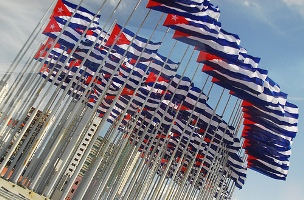
Flags in front of U.S. Interests in Malecón.  By: Luiza Leite "Luiza" | Flickr | Creative Commons

Flags in front of U.S. Interests in Malecón. By: Luiza Leite “Luiza” | Flickr | Creative Commons

U.S. and Cuban experts at a conference in Havana in December observed that, despite important areas of mutual interest, the Obama Administration has so far shown little inclination to accept a dialogue.  Some experts opined that the imprisonment of USAID contractor Alan Gross has become a convenient excuse for Obama to avoid any serious engagement.

Other key points:

  • There is no effective political channel for resolving bilateral problems – indeed, no contacts at all at political levels.  The Interests Sections in each other’s capitals handle routine matters, but Washington has rejected Cuban requests to continue semi-annual migration talks.  Cuba gave the United States a proposal for resolving the Gross situation, which the State Department has not even acknowledged receiving.
  • In addition to reiterating longstanding frustration that U.S. policy is stuck in the regime-change mode forged by President George W. Bush, Cuban experts lamented that many Americans latch onto every challenge Cuba faces – such as whether the passing of Venezuelan President Chávez will lead to reductions in oil supplies – as evidence that the Cuban government will “collapse” and therefore that dialogue with it would be foolish.
  • Cuban rhetoric espousing the swap of the “Cuban Five” for USAID contractor Alan Gross has fueled powerful political expectations in Cuba, but Havana’s bottom line on the elements of a humanitarian release is far from clear.  Experts from both countries are perplexed that Washington will not have a dialogue at any level to discuss whether a deal is possible.
  • Many Cuban and American experts believe that one incentive for the United States to improve relations is to rebuild its image in Latin America.  But they note – ruefully – that Latin American does not seem to be a priority for the Obama Administration anyway.

The Gross situation is merely the most recent of a long string of issues blamed for the dysfunctional relationship.  The real causes of the impasse at this point are whether Washington can shift away from policies and well-funded programs fashioned to achieve regime change in Cuba, and whether the two governments can manage the influence that both have given ultra-conservatives unprepared to broach compromise – be it Cubans opposed to releasing Alan Gross while four of the “Cuban Five” remain in U.S. jail, or Cuban-Americans benefiting from the sort of regime-change operations that Gross was conducting.  The lack of a reliable channel for political leaders above both bureaucracies to talk creates the risk of manageable problems spinning out of control, to the detriment of both countries’ interests.

Obama and Peña Nieto: Turning the same page?

By Tom Long
CLALS doctoral research fellow

Official White House photo by Pete Souza | public domain

Official White House photo by Pete Souza | public domain

On Saturday, Mexico’s new president Enrique Peña Nieto took office and the country’s oldest party, the Partido Revolucionario Institucional, returned to power. After six years dominated by an exhausting and bloody war against drug cartels, Mexico seems ready to turn the page on outgoing President Felipe Calderón. During the last few months, Peña Nieto has tried to steer the attention of the world—and the United States—away from a disproportionate focus on drug violence. In a recent article published in The Economist, the new president downplayed drug cartels, focusing instead on plans for the economy and to “recover our leadership in Latin America.” Security was just one of thirteen proposals in his inaugural speech. In part, Calderón has given Peña Nieto a head start as he begins his term, leaving behind strong economic growth and a dip in violence. Although Calderón himself started the switch to a violence-reduction strategy, his name is likely to remain closely associated with the frontal military assault on the cartels launched at the beginning of his administration and recalibrated only in his final year; Peña Nieto is positioned to gain credit for a return to normalcy.

This desire to turn the page also marked Peña Nieto’s s pre-inaugural meeting with President Barack Obama. Both leaders seemed to be playing the same tune.  Mexico has become the front line in the war on drugs, and the U.S. has spent billions on military, police, and other projects lumped under a “Merida Initiative” label. After their meeting, Obama and Peña Nieto promised to expand the bilateral agenda to include an expansion of trade, cooperation on energy, and discussions of immigration that go beyond border fences. Obama spoke effusively of Mexico’s importance as a partner, while Peña Nieto said the two had a “shared vision” of how to create jobs in both countries. On the stage with Obama as elsewhere, Peña Nieto reiterated calls for the United States and Canada to build on NAFTA and further regional integration to improve competitiveness.

It would be a healthy change if the two presidents could restore balance between economic and security aspects of U.S.-Mexico relations. Image matters – and the deterioration of Mexico’s brand has undermined both investment and tourism. The military approach to drug trafficking has inflicted enormous costs in economic and human terms with questionable payoffs, but Mexico cannot go back to old patterns of accommodation. Domestically, the new president needs to attack the culture of impunity by building a stronger and more independent judiciary in order to reduce the frightful percentages of crimes that are never investigated or prosecuted. Accountability remains weak, especially at state and local levels; improving it would require Peña Nieto to take on powers in his own party. Placing all these objectives under a “Merida plus” framework would counterproductively squeeze broad reforms into the drug-war box. If the two presidents are sincere about rebuilding a balanced partnership, they need to take action quickly on immigration and commerce. Otherwise, the gravitational pull of the war of drugs will again consume bilateral ties.

U.S. Marijuana Vote Unlikely to Impact Mexico in Short Term

The following is excerpted from an article by InSight Crime* analyst Elyssa Pachico

Photo by: Editor B | Flickr | Creative Commons

Approval last week in Colorado and Washington state of measures allowing the recreational use of marijuana has fueled debate on whether legalization will reduce drug traffickers’ profits and the violence surrounding the illicit narcotics trade.  In both states, ballots passed with comfortable margins of 53 percent (Colorado) and 55 percent (Washington).  The measures legalize personal possession of up to one ounce of marijuana and allow the drug to be legally sold (and taxed) in licensed stores.  A similar initiative failed to pass in Oregon, gaining less than 45 percent of the vote.

A recent study by a Mexican think tank, the Mexican Institute of Competitiveness (IMCO), and Alejandro Hope (an InSight Crime contributor) found that passage of the initiatives in all three states would reduce the revenue of Mexican drug trafficking organizations by as much as 30 percent.  Hope has pointed out on Animal Político, a popular Mexican news site, that the impact will depend on the U.S. federal government’s response.  Attorney General Eric Holder strongly opposed such measures in 2010 when California residents voted on Proposition 19, but he did not issue strong statements this year.  The government’s response to last week’s votes has been muted; according to Reuters, the US Justice Department reacted to the measures by stating that its drug enforcement policy had not changed.

Mexico, a major supplier of marijuana, is unlikely to feel the impact of these measures for a while.  Parts of the Colorado measure will come into effect after 30 days, but the Washington measure will not take effect for a year.  But, over the long term, the votes indicate shifting attitudes towards marijuana prohibition in the United States – on the heels of similar shifts in Latin American countries eager to find alternatives to the current war on drugs.  The presidents of Guatemala, Mexico, and Colombia have emphasized the need for discussions, and Uruguay and Chile have considered their own marijuana legalization bills.  InSight Crime cautions, however, that the drug organizations have proved to be very adaptable in finding new sources of revenue – including methamphetamines, migrant smuggling, and even illegal mining.

Insight Crime is affiliated with American University’s Center for Latin American and Latino Studies, which produces AULABLOG.   Click here for the full text and additional links. 

The U.S. Election: A Sigh of Relief, A Moment of Hope?

Photo by: Hanoian | Flickr | Creative Commons

Latin American media see a glimmer of hope in President Obama’s reelection that was largely absent during the campaign.  The breadth and composition of the coalition that carried Obama to victory appears to have impressed commentators, and some believe that Obama might be freer of political constraints in a second term.  In Mexico, undergoing its own presidential transition, there is expectation that continuity in Washington will facilitate a smoother transition there.  The prospect that Obama will be willing, and perhaps more able, to press for additional stimulus measures to jumpstart the U.S. economy – with obvious benefit for interdependent Mexico – may also be a factor.  El Tiempo in Colombia noted that “with Obama, there won’t be surprises,” and that stability is welcome during the difficult peace talks.  The ALBA countries generally welcomed Obama’s reelection, and – probably reflecting a wider view – Cuban media proclaimed: “U.S. elections: the worst one did not win.”  Some media, such as Brazil’s O Globo, reminded readers that the U.S. House of Representatives remains under Republican control, and that the GOP “had been kidnapped” by the Tea Party.

A quick review of regional commentary reveals interest in the fact that Latino voters, more than 70 percent of whom opted for the President, were an important part of his coalition in Virginia, Colorado, and New Mexico.  Despite the Obama administration’s record number of deportations and its failure to introduce comprehensive immigration reform during its first term, there is little doubt that the President’s June 2012 decision to implement provisions of the Dream Act increased enthusiasm.  Challenger Mitt Romney’s tough talk on Cuba and Venezuela did not win over South Florida, suggesting that demographic change is undermining support there for hardline policies.  Bolivian President Evo Morales said, “Obama needs to recognize and pay that debt to the Latinos.”

No one so far has dared to expect a major shift in emphasis toward Latin America during Obama’s second term, but reelection gives the President another opportunity to make good on his vision for “partnership” in our hemispheric “neighborhood.”  Early analysis of the voting, particularly in Florida and in Latino communities, suggests that he will have the political space to live up to the expectations created by his soaring rhetoric during his first Summit of the Americas in 2009.  Not only can he explore reasonable approaches to longstanding issues such as Cuba, which will improve the U.S. image throughout the region; he can reengineer Washington’s relations with Central and South America in ways that reflect the region’s own evolution and ambitions – enhancing and facilitating them, rather than fearing or even resisting change.  If Latin America is ready to move into the future with a new, constructive interaction with the United States, now is the time to give it a try.

How Real is Anti-Americanism in Latin America?

Photo: WideAngleWandering | Flickr | Creative Commons

American University professor Max Friedman’s new book* offers a refreshingly original account of the sources of “anti-Americanism” in international affairs, with direct implications for U.S.-Latin America policy.  For Friedman, anti-Americanism is defined as a tendency – often ideological – to hate or resent the United States, driven primarily by cultural conflict or a rejection of democracy.  While not denying the existence of anti-Americanism, Friedman’s well-researched argument demonstrates that anti-Americanism is also a self-serving “myth” that U.S. policy makers repeat to each other, and to the U.S. public, in their unilateral pursuit of policy goals.  As the alter ego of American exceptionalism, it is too often a story we tell ourselves about the rest of the world, increasingly to our own detriment.

For Latin America, Friedman emphasizes the U.S. tendency during the Cold War to interpret regional governments as either “pro” or “anti-American,” maintaining a counterproductive “North-South perceptual divide.”  For example, Washington badly mischaracterized Guatemalan governments in 1954 and again in 1963 as communist puppets, despite significant support for the United States, which facilitated two U.S.-backed coups.  The installation of a dictatorship and subversion of democracy led to worldwide condemnation, the alienation of Latin American countries otherwise favorable toward the United States, and accusations of U.S. hypocrisy.  Even today, when the Obama Administration’s Latin America policy appears on auto-pilot, alarmists write about “the axis of anti-Americanism” in the region.  This theme is fueled by Washington’s isolation over its Cuba embargo and counternarcotics approach, its failure to deal effectively with the coup in Honduras in 2009, and its continued emphasis on free-trade zones with decidedly lukewarm governments pursuing other opportunities.

The United States has been slow to realize that its role in the region is diminishing, and Washington policy makers have not appreciated the varying economic, political, and security interests of the different countries in the region and the interplay among them.  These intraregional interests reflect motives or objectives not simply attributable to the U.S.-Latin American relationship.  But too often, as Friedman makes clear, the U.S. has dismissed Latin American concerns as latter day anti-Americanism, a manifestation of pathological hatred, irrationality, jealousy, resentment, illegitimate slander, pride, fear, inferiority, political immaturity, ideological intransigence, or an anti-modern hostility to free society.  And, as Friedman says, this “myth of anti-Americanism” promotes analytic failures and mistaken interpretations about regional conditions; it limits access to useful information from regional counterparts; equates criticism with hostility, and highlights an unwillingness to treat Latin American governments as independent actors; while it justifies faith in the superiority of U.S. thinking. As the U.S. seeks new footing in the region, none of this ultimately serves the national interest.

* Rethinking Anti-Americanism: The History of an Exceptional Concept in American Foreign Relations
by Max Paul Friedman
Cambridge University Press
ISBN-10: 0521683424
ISBN-13: 978-0521683425

Central America on U.S. Elections: A Shy Shadow

Photo by Norman B. Leventhal Map Center at the BPL’s | Flickr | Creative Commons

The U.S. election doesn’t seem to matter much for Central America.  Salvadoran President Mauricio Funes – speaking at an event with U.S. Ambassador Mari Carmen Aponte – publicly wished the “best of luck” to President Barack Obama, reflecting his close relationship with the American President.  At the Summit of the Americas in Cartagena last spring, Funes – along with Honduran President Porfirio Pepe Lobo – appeared to be Washington’s closest ally in the “war on drugs.”  This came after newly elected Guatemalan President Otto Pérez had raised the idea of legalizing marijuana, which Obama´s State Department has opposed fiercely.  Costa Rican President Laura Chinchilla slammed “the international community” – code for the United States – for pushing a policy in which only Central Americans died.  Nicaraguan President Daniel Ortega, while perhaps Washington’s most effective partner in counternarcotics, has resorted to old-school anti-U.S. rhetoric.  Panama is missing in action as a Central American voice.

The U.S. has two main interests in the subregion.  One is combating the drug trade, and the other, according to informed observers, is blocking the influence of Venezuelan President Hugo Chávez.  The U.S. Southern Command estimates that roughly 500 tons of cocaine enters the U.S. market through Central America, accounting for some 60 percent of U.S. consumption.  But there are very few clues in the American electoral narrative about either Obama´s or Republican contender Mitt Romney´s views on Latin America, not to mention Central America.  Romney´s Latin America advisors are perceived as the same hawks, with the same close ties to the Miami lobby, who dominated during the Bush administration.  Robert Zoellick, the fixer for the Central American Free Trade Agreement (CAFTA) in Washington some eight years ago, is also close to the GOP campaign and has been mentioned as a potential cabinet member, perhaps suggesting a push for some sort of second chapter of neoliberal reform.  To date there are no signs of fresh faces in the Obama camp, casting doubt as to whether a second-term State Department will be more open to out-of-the-box thinking.

This apparent estrangement comes at a time that the northern triangle of Central America – Guatemala, Honduras and El Salvador – is on a very dangerous path towards uncontrolled violence and even more weakened states. Neighboring countries are hardly in a position to help.  President Laura Chinchilla´s tenure in Costa Rica is fading rapidly toward lame-duck status, and Panamanian President Ricardo Martinelli is surrounded by corruption allegations.  For a second-term or incoming U.S. President, Nicaragua´s slippage on good-governance, despite the country’s economic tranquility, provides little political space for cooperation.  The next U.S. President will have no easy options in the most violent region of the world, which now faces, as Colombia did 20 years ago, a clear and present danger.  The absence of visible alternatives is probably a consequence of the fact that, since the Salvadoran Peace Accord ended the Cold War in Central America, Washington has not perceived much urgency to grapple with the fundamental political and economic challenges confronting the region.  Only by doing so will a new administration identify opportunities to move forward with a jointly articulated agenda.

FTA Dreaming: Promises to Expand Free Trade in the Hemisphere

Photo by: Starley Shelton | Flickr | Creative Commons

Although Latin America has not been an issue in the U.S. presidential campaign, Republican presidential contender Mitt Romney has stated multiple times that he would promote hemispheric trade agreements.  In the second debate, he said, “I’m also going to dramatically expand trade in Latin America. … I want to add more free trade agreements so we’ll have more trade.”  Romney did not specify, however, with which partners he would conclude trade agreements.  (A request to the Romney campaign for more information has not been answered.)  President Barack Obama did not comment on Romney’s promise, suggesting the president’s lack of focus on the region or calculus that voters simply don’t care.  Under Obama, the United States ratified pacts with Colombia and Panama, negotiated during the Bush administration.  The U.S. already had FTAs with Central America and the Dominican Republic, Chile, Mexico, and Peru.

While that would seem to leave a number of large economies, nearly all of them are unlikely partners. The most important remaining economies – Brazil, Argentina, Venezuela, Uruguay, and Paraguay – are part of the Mercosur trading bloc.  Washington has refused to negotiate with them as a group, and the group prohibits members from signing bilateral accords.  Meanwhile, Venezuela, Bolivia, Nicaragua, Ecuador, Cuba, and several Caribbean nations have joined together specifically to counter U.S. proposals for free trade in the hemisphere.  The few remaining countries have tiny trading relations with the United States.

The idea of adding FTAs in Latin America looks quixotic.  Nevertheless, that is hardly an excuse for failing to improve trade relations short of comprehensive agreements.  There are important opportunities to deepen the United States’ most important trade relations with Canada and Mexico, as AU Professor Robert A. Pastor has argued.  Moreover, if the United States is willing to use the Andean Trade Preferences Act as a tool for development instead of a cudgel against Latin Americans it considers wayward, it could expand trade in ways that benefit all parties.  Likewise, trade problems have become outsized irritants in U.S. relations with Brazil and Argentina – to say nothing of the broader implications of U.S. “trade policy” with Cuba.  These problems have largely festered under Obama, and Romney’s promises of free trade agreements do not seem a serious proposal to correct them.