Righting a Wrong: Family Reunification and Immigration Reform

Photo credit: mdfriendofhillary / Foter.com / CC BY-SA

Photo credit: mdfriendofhillary / Foter.com / CC BY-SA

As debate around the immigration reform bill is expected to heat up on the Senate floor, a contested provision allowing for some non-criminal deportees to return to the United States remains intact. For how long, no one is quite sure. The controversial measure, outlined in Section 2101 of the current bill, would permit deported immigrants with children, parents, or spouses who are currently U.S. citizens or legal permanent residents to petition for a waiver to return to the U.S. and apply for Registered Provisional Immigrant (RPI) status. While reprieves have been granted to undocumented immigrants residing in the U.S. in the past—under the Immigration Reform and Control Act of 1986 and President Obama’s DACA memorandum last July—never before has a Congressional or Executive effort to overhaul immigration policy contemplated the return of deportees.

The “right to return” provision survives even as the rate of deportations continues to soar. Since 2009, the Obama administration has removed 1.5 million unauthorized immigrants and is on track to surpass 2 million by the end of fiscal year 2013. According to recent federal data unearthed through a Freedom of Information Act (FOIA) request, 205,000 undocumented immigrants with at least one U.S. citizen child were deported between July 2010 and September 2012, representing an average of 90,000 per year. The contentious deportee measure stems from acknowledgement on the part of the bill’s authors of the destructive effects that these enforcement policies have had on American families, particularly U.S. citizen children. A spokesman for Senator Marco Rubio, one of the bill’s most conservative drafters, noted that the Senator had “personally concluded that giving parents a chance to reunite with their children was the right thing to do.” The toll that family separation takes on the mental and physical health of children has only recently attracted serious attention, with studies suggesting links between parental deportation and depression, separation anxiety disorder, post-traumatic stress disorder, and poor cardiovascular health.

Central to the compromise reached by the bill’s sponsors – known as the Gang of Eight – is the question of how to prioritize family reunification without shattering the bill’s prospects. The argument from the right has been that in promoting family-based immigration, the 1986 reform prompted the larger waves of immigration seen since then. In response to these concerns over “chain migration,” however exaggerated they may be, the proposed legislation calls for a gradual move away from the family-based immigration model, eliminating some 90,000 annual visas given to the siblings and married adult children of legal immigrants and granting up to 110,000 visas to immigrants skilled in science and math. Democrats have viewed this shift toward a more comprehensive “merit-based” system as a necessary compromise, but have built into the bill measures such as the “right to return” as well as an expedited path to citizenship for DREAMers (the children of unauthorized immigrants) and a clearing of family-based immigration backlogs – all of which vindicate the importance of the nuclear family. It is time for Senators from the right to follow the lead of Republican drafters and make some concessions of their own, including the Gang of Eight’s compromise to allow for the reunification of families torn apart by a decade of immigration enforcement policies run amok. Immigration reform must have as its foundation a concern for family unity and a respect for what families contribute to our society. It should also take into account the welfare of 4.5 million U.S. citizen children in mixed-status homes who will be better equipped to contribute to our society if they have the opportunity to grow up in the presence of their parents.

U.S.-China: Competing over Central America and the Caribbean?

President Obama and President Chinchilla in Costa Rica | Photo by: The White House | Public domain

President Obama and President Chinchilla in Costa Rica | Photo by: The White House | Public domain

The recent visits to Central America, Mexico, and the Caribbean by Chinese President Xi Jinping and U.S. President Obama (and Vice President Biden to Trinidad and Tobago) suggest a handoff from Washington to Beijing of the role as the region’s sugar-daddy, but not a strategic shift in influence.  The presidents’ visits were similar in their innocuous itineraries.  Both got pompous welcomes; met with “real” citizens (Xi ate empanaditas de chiverre with a coffee farmer); and praised the bilateral relationships.  Both held sub-regional summits – Obama in San José and Xi in Port of Spain.  Both repackaged ongoing or recently negotiated projects as new “accords.”  Obama pledged another $150 million a year for funding the Central America Regional Security Initiative (CARSI), part of the strategy started under President Bush to counter the drug trade and related threats.  Xi got headlines in Costa Rica for providing more than $1.5 billion for refinery and road projects and to purchase replacement taxis and buses from Chinese manufacturers.  Significantly, China is also building Costa Rica’s new National Police Academy – the sort of project Washington used to thrive on.

President Chinchilla and President Xi Jinping | Photo credit: Presidencia de la República de Costa Rica / Foter.com / CC BY-NC-SA

President Chinchilla and President Xi Jinping | Photo credit: Presidencia de la República de Costa Rica / Foter.com / CC BY-NC-SA

Despite the similarities, the visits had different orientations and feel.  Xi’s principal task appeared to be to open his checkbook, while Obama’s main deliverable was a policy shift – the welcome word that Washington was pulling back from making its top regional priority the interdiction of narcotics produced in South America and transiting the isthmus on their way to consumers in the United States.  According to press reports, despite the continued CARSI funding, Obama had absorbed Costa Rican President Chinchilla’s complaint last year at a summit with Biden that it was unfair that Central Americans were dying in efforts to stop narcotics that Americans use.  The media tried to give the two presidents equal coverage, but the disparity became obvious.  The Chinese distributed copies of the China Daily (in English) even into the San José suburbs, whereas Obama didn’t need to do his own publicity.  Despite whiffs of resentment about airport and street closures, the papers covered all of Obama’s events with affectionate quotes from government and common folk alike – and showed people, including a kid dressed as Spider-Man, waving to his motorcade.  La Nación, on the other hand, reported that school children cheering a Chinese speaker couldn’t understand a word he was saying.

The goodies each president brought created little excitement – and no small amount of skepticism.  Important details about China’s offer to help repair the Costa Rican gasoline refinery remain unknown, and Chinese cars already have a bad reputation.  China’s handouts aren’t going to be turned down, of course, and Xi’s pledge to buy more Costa Rican coffee (now about 5 percent of what Japan buys) and to encourage Chinese tourists to travel to the country (now a micro-percentage of visitors) are welcome.  Obama’s CARSI funding looks like bureaucracy on autopilot.  Few Central Americans can cite concrete benefits from the seven-year-old Central American Free Trade Agreement (CAFTA) with the United States either, and the general impression – reinforced by Secretary Kerry’s recent reference to the region as the U.S. “backyard” – is that Washington is yielding the playing field to China.  But the natural ties and strategic mutual interests between Central America and the United States remain strong and give the United States, should it wish to fill it, ample space to play a positive role in the region’s future beyond programs on autopilot.

U.S.-Cuba: Time to End the Visa Charade

By Eric Hershberg

Slide1Bad habits die hard, especially when they involve Cuba and American bureaucrats eager to appease the right wing.  For more than 50 years, Washington has been at loggerheads with a revolutionary regime eager to reciprocate incessant aggression and stick its finger in the eye of the Colossus to the North.  Although nothing as absurd as a confrontation at the brink of nuclear war has occurred since 1962, during the ensuing decades both governments have repeatedly provoked one another to exacerbate a conflict that even in 2013 bizarrely perpetuates the Cold War.  To this day, the U.S. proclaims “regime change” as its bottom line condition for normalizing relations with a sovereign country for which such imperial proclamations are justly anathema.  Havana, in turn, is not beyond demonizing American citizens – people who have no connections to the U.S. government or its misguided regime-change programs – who seek to engage their Cuban counterparts.  Last month I spent two hours in the Havana airport answering hostile questions from government goons for whom my assurances that my visit was academic in nature were mysteriously insufficient to get me smoothly admitted through immigration.  An American University colleague reports that she suffered similar harassment at the Havana airport in March.

One manifestation of the anachronistic dispute between the two governments is the infantile tit for tat that both parties play with permitting travel across the Florida Straits even for purposes both claim to support. The dynamic is pernicious, and reflects a combination of ideological extremism and petty bureaucratic behavior on both sides.  Organizers of scholarly meetings in Cuba are increasingly being told that the participation of one person or another would not be acceptable to unspecified authorities in Havana, and the result has been that they have been “disinvited” from workshops in which their participation would have been appropriate.  More troubling, from my perspective as an American citizen, is that since the Center for Latin American and Latino Studies was established three years ago, on three separate occasions the State Department delayed the visas of Cuban academics who I had invited to the University and refused to say why.  Last week, when the Latin American Studies Association convened its annual meeting in Washington, assembling 5,000 scholars from around the world, Cuban researchers who have long traveled to and from the U.S. were denied visas, again for no stated reason. They included three individuals with whom the Center has time-tested, ongoing working relationships:  Rafael Hernández, who edits one of Cuba’s principal journal of society and culture and has taught as a Visiting Professor at Harvard and Columbia; Milagros Martínez, who directs international academic affairs at the University of Havana; and Juan Luís Martín, arguably Cuba’s most innovative sociologist.

That the Cuban government interferes with academic life should be no surprise.  That the practice continues on the U.S. side is another matter.  One would think that Washington would by now have gotten beyond this shameful charade, five years into an administration that knows better.  Somewhere in the system and its mysterious processes –the opacity contradicts our democratic principles – bureaucrats are denying visas arbitrarily and with no accountability.  What threat do these academics, whose work has at times catalyzed important debates in Havana, conceivably pose to the United States?  What is the U.S. national interest in slamming the door on people eager to hear what we have to say in our universities and academic conferences?  The State Department’s visa denials undermine the professional activities of American citizens and contradict the Administration’s own policy of “people-to-people” relations.  It may be too much to expect President Obama to risk incurring the wrath of a shrinking minority in the Cuban-American community and in the Congress to put forth a rational Cuba policy.  But one would have thought that Secretary of State Kerry has the wherewithal and influence required to put an end to the use of visa requests as a means of restaging scenes from a cold war era that ought to have been left behind twenty years ago. The State Department’s actions over the past month evidence its disregard for academic freedom and the hollowness of its assurances to the scholarly community that it does not intend to interfere with our work.  I say: Enough is enough.


Immigration Reform Legislation: Better than Nothing, But Still Flawed

Immigration reform rally / Photo credit: quixoticlife / Foter.com / CC BY-NC-SA

Immigration reform rally / Photo credit: quixoticlife / Foter.com / CC BY-NC-SA

The comprehensive immigration reform proposal that the bipartisan group of U.S. Senators dubbed the “Gang of Eight” released on April 17 is an important step forward but probably dooms us to repeat history.  The plan includes mechanisms for documenting the roughly 11 million inhabitants of the U.S. who are now living in the shadows and opening a path to citizenship for undocumented immigrants who have been in the country since December 2011.  The process to gain citizenship would be long – taking typically 13 years – arduous, and expensive, requiring payment of substantial fees and fines.  The Senate Judiciary Committee began its review of the bill on May 9, covering 30 of 300 proposed amendments.  Prospects for the legislation remain uncertain, as the fragile alliance among these eight senators may not be sufficient to sway skeptics on both the left and right of the political spectrum.  If passed, the measures would take effect after the U.S. government certified that heightened border security measures have been implemented.

Supporters of comprehensive immigration reform from both sides of the aisle have long called for a “once-and-for-all” solution to the country’s broken immigration system.  Nevertheless, the original 867-page proposal – like the Immigration Reform and Control Act of 1986 that regulated the status of just under three million undocumented immigrants – is by no means a permanent fix.  In an important sense it cannot be: it reflects a static conception of immigration, whereas historical analysis of migration patterns shows that they are inevitably dynamic processes, responding to unpredictable fluctuations in labor supply and demand in sending and receiving economies alike.

However imperfect it may be, the Senate bill represents the most promising step yet to address this ongoing challenge.  Proposed amendments introduced thus far have not addressed the dynamic nature of the problem, focusing instead on the digression of border security, as if fences or bloodhounds were capable of controlling cross-border population flows.  Institutional frameworks that acknowledge the dynamic factors that shape human migration and offer avenues for managing the movement of peoples intelligently are on the back burner.  As AU history Professor Alan Kraut has suggested, one way that legislators could achieve this would be through establishment of a commission on foreign and domestic economies and labor markets that would conduct periodic reviews of the conditions associated with optimum migration flows.  Absent the deeper understanding of migration that such reviews would provide, the U.S. legislation – albeit better than nothing – will probably yet again repeat the error of proclaiming an unattainable once-and-for-all resolution of immigration policy.

Venezuela Update: Confusion in Caracas…and Washington

Photo credit: INTERNATIONAL REALTOR / Foter.com / CC BY

Photo credit: INTERNATIONAL REALTOR | Foter.com | CC-BY

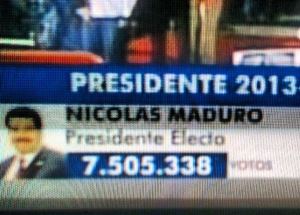
Three weeks after elections to choose Hugo Chávez’s successor, confusion still reigns in both Caracas and Washington.  The Venezuelan opposition has rejected the results of the election, which the electoral tribunal says Chávez’s handpicked man – Nicolás Maduro – won by only 1.8 percent.  Opposition candidate Henrique Capriles originally asked only for a vote recount – considered reasonable by many because of the narrow margin – but his lawyers upped the ante on 2 May when they officially demanded that the vote be invalidated and new elections be held.  Isolated incidents of political violence turned up the heat in Caracas, although the Götterdämmerung scenarios in the streets that some analysts predicted have not yet materialized.

Every major country of the hemisphere has recognized Maduro as President – except the United States.  (Canada wavered at first but seems to have moved on.)  Washington has invested millions of dollars in “democracy promotion” programs over the years and has provided Capriles and the opposition enduring political support in their efforts to beat Chávez at the polls and later to beat Maduro as his hand-picked successor.  Since the April election, the U.S. government has endorsed the opposition’s call for a vote recount.  So has the OAS, which offered experts to assist in the process.  But only Washington has said that while it is “working with” the Maduro Government, it doesn’t recognize its legitimacy.  The State Department spokesman dodged the issue repeatedly last week, and in an interview with Univisión broadcast at the conclusion of his visit to Mexico last Friday, President Obama himself refused to say whether his Administration officially recognized Maduro as President.  He left little doubt as to his real position, however, when he said that basic principles of human rights, democracy, press freedom and freedom of assembly were not observed in Venezuela following the election.

As AULABLOG pointed out on 23 April, the irony of the United States demanding a hand-count of the ballots is not lost on millions of Latin Americans who remember Washington’s performance in the 2000 Bush-Gore vote – and that it was a politically divided Supreme Court that made the final decision.  The tightness of the vote, Venezuelan electoral realities (past and present), and President Maduro’s over-the-top rhetoric – last week he again accused Washington of backing “neo-Nazis” allegedly trying to overthrow his government and accused a filmmaker of being a spy – make it hard for observers to argue that the elections are legitimate.  President Obama’s statements, including his remark that the spying charge was “ridiculous,” have been measured and continue a noteworthy shift since the near-hysteria about Venezuela during the Bush Administration.  But the fact remains that the U.S. Government’s posture on Venezuela – perhaps unique in its bilateral relations with Latin America since the Cold War – has made it once again the outrider and, among people who remember the Bush-Gore decision, the butt of many jokes.  Importantly, Capriles may be reading Washington’s stance as an endorsement of his own increasingly puzzling demands.  As our 23 April post suggested, Capriles ought to see himself as having a historic chance to lead, poised to challenge Chavismo easily at the polls the next time around.  Yet, like Mexico’s Andrés Manuel López Obrador in 2006, he may be squandering an opportunity to present himself to the Venezuelan electorate as the responsible grownup in the room.

Will Tensions Over Security Spoil the Obama-Peña Nieto Summit?

By Tom Long

Military in D.F. Photo credit: ·júbilo·haku· / Foter.com / CC BY-NC-ND

Military in D.F. Photo credit: ·júbilo·haku· / Foter.com / CC BY-NC-ND

The meeting in December between recently re-elected President Barack Obama and President-elect Enrique Peña Nieto was marked by cordiality and a desire to talk about anything but the often grisly drug-related violence in Mexico during the previous six years.  Since then, Peña Nieto has continued the changed emphasis, aided by headlines pivoting to positive stories.  Mexico has been recently hailed for its economic growth, particularly in export-oriented manufacturing, and for a series of political compromises that The Washington Post favorably compared with the U.S. Congressional stalemate.  Despite optimistic claims from the government, Mexican media reports indicate that drug-related violence continues at nearly the same pace as last year.  (Click here for a summary and analysis by our colleagues at InSight Crime.)  Moreover, pressure is growing on questions of human rights violations committed in the name of the war on drugs.  When Presidents Peña Nieto and Obama meet again in early May, holding back a renewed focus on security is likely to be a challenge.

Peña Nieto’s political incentives do not point to the same, high-profile cooperation with the United States that occurred under President Felipe Calderón, who had already begun shifting priorities last year.  Despite the major turnaround signified by the PRI’s signing NAFTA almost 20 years ago, Peña Nieto’s PRI still contains elements more skeptical of U.S. “intervention” than Calderón’s PAN.  Materially, moreover, most of the U.S. aid planned under the Mérida Initiative has been disbursed, and Congress exhibits little appetite for major new appropriations.  (Even at its height, U.S. spending was a fraction of Mexico’s contribution to the drug war.)  That reduction, coupled with growing awareness that the Calderón strategy actually fueled violence, diminishes the enthusiasm in and outside of government for continuing his policies.   Frustration from the left in both countries regarding persisting human rights violations and the slow pace of judicial reform could also grow more serious.

While these problems may be causing tensions between U.S. and Mexican police and military at the operational level, they seem to be manageable so far – and both Presidents are likely to emphasize intelligence-sharing and similar bilateral cooperation that does not require resources.  Upper echelons of the Obama administration seem to understand that Peña Nieto’s push to de-emphasize security and promise to focus on violence reduction over drug interdiction is politically necessary.  But the moral argument has not changed:  Mexicans suffer the violent consequences spawned by U.S. drug use and counterdrug policies.  Weapons sold on the U.S. side of the border continue to flow into Mexico, an issue now atop the U.S. political agenda for entirely domestic reasons.  If the two countries can manage to keep security problems at a lower decibel, they will better cooperate on issues that are just as vital but could pay larger dividends — immigration, transboundary energy, educational exchange, and infrastructure.

Obama’s Second Trip to Central America

SICA logo | Wikimedia Commons | GNU Free Documentation License

SICA logo | Wikimedia Commons | GNU Free Documentation License

The White House has cast President Obama’s trip to Mexico and Central America on May 2-4 as “an opportunity for the President to demonstrate his leadership in the international community in a really important way.”  The spokesman emphasized the “important people-to-people ties” between the United States and Central America because “there are a lot of immigrants” from the region.  The Administration’s press releases stress that the summit in San José, with the presidents of the Central American countries and the Dominican Republic under the rubric of the Central American Integration System (SICA), will focus on collective efforts to promote economic growth and development in the region and on “our ongoing collaboration on citizen security.”

Regional reaction to the visit and summit has been positive – Obama’s interest is clearly welcome – but leaders are already managing expectations.  Costa Rican Foreign Minister Castillo last weekend cautioned that the United States is not able to provide significant new assistance for either economic or security programs.  Commentators note that the visit has not been preceded by the sort of diplomatic activity that would indicate the rollout of significant new policies or programs.

At a summit in Guatemala with Vice President Biden one year ago, Costa Rican President Chinchilla crystalized regional criticism of the U.S. counternarcotics strategy when she said that Central America “is sacrificing the lives, making its enormous sacrifice” and, in a clear reference to Washington, called on the “international community [to] take greater co-responsibility in this struggle.”  Hosting the SICA summit with Obama suggests she is prepared to put such criticism aside, perhaps in hopes that talks focus on the economic and immigration issues.  The White House spokesman’s reference to immigrants – at a time that Obama is pushing ahead with related legislation – may indicate that immigration will be a primary concern for him also.  The last time Obama went to Latin America, for the Summit of the Americas in Cartagena in April 2012, he seemed ill-prepared for criticism of U.S. policies, including its counternarcotics strategy, even from Washington’s closest friends.  With perhaps the exception of Nicaraguan President Ortega, the participants in this Central American get-together seem less likely to deliver a similar grilling, making what diplomats call a “successful meeting” very likely.

South America and the United States after Chávez

By Tom Long

Banco del Sur | Photo by: Presidencia de la N. Argentina | Foter.com | CC BY

Banco del Sur | Photo by: Presidencia de la N. Argentina | Foter.com | CC BY

In many depictions, South America’s relations with the United States have been structured around Hugo Chávez for much of the last decade.  So it is natural for the region to wonder where U.S. policy will head now that he is gone.  In the Bush Administration’s framework – which the Obama Administration has largely continued – Chávez and his closest allies in Ecuador, Bolivia, and Argentina were an emerging anti-American axis.  Colombia and Chile were considered Washington’s last bastions of support, and Brazil under Presidents Lula and Dilma variously positioned itself as a quiet moderator or, on occasion, private fan of the estrangement between the unruly ALBA countries and the United States.  With Chávez’s passing, the narrative will change.

Although Chávez’s charisma, boundless energy, seductive regional pride, and resumption of Venezuela’s traditional oil subsidies made him larger than life, the depth and endurance of his influence was exaggerated by friends and foes alike.  Elements of his vision of a “Bolivarian” Latin America united in resisting U.S. influence have always been present and always will be, but the dynamic Chávez sought, with himself at its center, seems likely to fade fast.  Bolivia’s President Morales was the closest to being a protégé, but even he has been compelled by domestic politics to give priority to relations with Washington. Ecuador’s President Correa was never as close to Chávez and largely steered his own independent course. Chavez’s detractors had tired of using him as a foil as well.  For years no Latin American leader had found tangling with Caracas – thereby giving Chávez the attention he craved – to be worthwhile.  Since Álvaro Uribe’s departure, even Colombia, apparently taking a cue from the oil-hungry United States, has made trade a bigger priority than criticizing its erratic neighbor.  Many high-profile Venezuelan initiatives for the continent, such as the Banco del Sur, fizzled.  Despite Chávez’s role in their founding, even UNASUR and CELAC had grown away from his personal leadership.

Concerns in Washington that someone will take Chávez’s place as counterweight to U.S. influence seem at least five years out of date.  There is no candidate with both the desire and ability to assume Chávez’s mantle.  Just as the benefits of close cooperation with the United States have declined, most leaders have little to gain from overt conflict.  South American international relations have already grown considerably more complex, as countries developed their own responses to Chávez without taking orders from either Washington or Caracas.  The trend of increasing autonomy is natural and, in ways, inevitable – even though it may be irksome to some in Washington, who are skeptical of Latin Americans’ commitment to what Washington thinks should be a shared interpretation of democracy, trade and counternarcotics policy.

Honduras: Simmering Crisis

Porfirio Lobo and Hillary Clinton
US Embassy Guatemala
/ Foter.com / CC BY-NC-ND

Little good and lots of bad has transpired in Honduras since the night in June 2009 that an Army-backed coup d’état, orchestrated by the economic elites, ousted President Mel Zelaya and installed Roberto Micheletti as the de facto ruler.  Almost four years later, Honduras remains one of the places in the Americas where democracy is at permanent risk – where drug trafficking, corruption, impunity, private armies and feudal caudillos thrive in a climate of spiraling violence.  Honduras today is the most violent country in the Americas and last year was among the top three in the numbers of assassinated journalists.  Honduras also remains one of the poorest countries in the hemisphere.

President Porfirio “Pepe” Lobo lacked credibility from the moment he donned the presidential sash in January 2010 – the candidate who, by almost all accounts, would have lost the election had not the coup reversed that fate, clamped down on opposition media, and suspended many civil rights.  While Washington worked hard to gain OAS recognition of his government, Lobo offered no guarantees – to either Hondurans or foreigners – that he would reverse the ongoing activities of the Army and rapacious economic elites to undermine democratic institutions.

  • Timid attempts to show independence, such as a projected police reform, languished due to lack of political will and financial support.
  • Honduras’s doors opened ever wider to organized crime and corruption.  According to U.S. agencies, roughly 60 percent of the cocaine passing through Central America on its way to U.S. markets in 2011 went through Honduras.  (The Obama Administration funded a militarized drug interdiction program that sputtered after Honduran civilians were killed.)
  • Politically motivated murders by sicarios – reminiscent of 1980s death squads – skyrocketed.  Investigations were few, and prosecutions were nonexistent.
  • By the end of last year, Lobo was pointing fingers at his old allies in the Army, the elites, and even his own party, accusing them of trying to destabilize his government. He failed to pass constitutional reforms that he claimed would protect democracy.  General Romeo Vásquez Velásquez, the military commander during the coup, announced that he was running for president.
  • Honduras is facing one of the worst fiscal crises of its history – a significant landmark for the perennially mismanaged country.

In Washington none of this seems to raise red flags.  On the contrary, the ideological bent of statements from both the executive and legislative branches suggests satisfaction with the state of affairs in Honduras – and willingness to keep the crisis there unsolved.  Hillary Clinton´s State Department was, to say the least, shy when addressing the deteriorating situation of the Central American country.  In January, at Senator John Kerry’s confirmation hearing, Republican Senator Marco Rubio’s assertion that what happened in Honduras in 2009 wasn’t a coup went unchallenged – despite the overwhelming consensus otherwise throughout our hemisphere.  The first sign offered by Kerry as Secretary of State, however, gives room to expect at least a modest change in the narrative: on March 4th, the State Department gave one of eight International Women of Courage Awards to Julieta Castellanos, a respected human rights advocate and critic of corruption and impunity in Honduras.  This hint of a less ideological and a more strategic and humanistic approach to the unsolved Honduran question is welcome.

The Overlooked Dimension of U.S. Immigration Reform

By Eric Hershberg

Immigration reform rally | by Anuska Sampedro | Flickr | Creative Commons

Immigration reform rally | by Anuska Sampedro | Flickr | Creative Commons

The 2012 U.S. presidential elections brought national attention to the Latino vote and, with it, immigration reform.  Embarking on his second term, President Obama immediately labeled the matter a priority, and some but not all of the Republican leadership is eager to reach a deal.  Beyond electoral calculations, there are many good reasons for Washington to finally resolve the status of roughly 11 million people living in the United States without legal documentation.  The border with Mexico has become increasingly impermeable, stripping critics of reform of one of their principal talking points.  Virtually all credible studies demonstrate that immigrants contribute more to the tax base than they receive from public expenditures, and they are a crucial source of community revitalization in some of the nation’s depressed cities and towns.  Meanwhile, a generation of youth brought to the country as young children – the “Dreamers” – languishes without recognition of their de facto status as Americans.  There are also humanitarian issues: families and neighborhoods are torn apart by the more than 400,000 deportations in each of the past several years.

Immigration reform matters to Latin America as well.  With millions of Latin Americans residing in the United States, several of the region’s economies are highly dependent on a steady flow of remittances, which are destined to increase if undocumented workers come out of the shadows.  In 2012, Mexico and Central America received more than $35 billion from migrants in the U.S.  Particularly striking is the case of El Salvador, a U.S. ally.  Nearly a third of its population lives in the U.S., and remittances surpass all other sources of revenue – now 16 percent of GDP.  For several Central American governments the welfare of migrants working in the U.S. is not only a humanitarian concern: these citizens are a crucial foundation for economic viability – and thus nothing less than a national security priority.

Yet remarkably absent from the U.S. immigration debate are the implications of a comprehensive reform for the eroded credibility of the U.S. in Latin America.  Virtually alone among senior officials, former Secretary of State Hillary Clinton acknowledged soon before leaving her post that creating a pathway to citizenship “will be a huge benefit to us in the region, not just in Mexico, but further south.”  The point merits emphasis.  The failure to enact comprehensive immigration reform, the result of domestic policy shortcomings, has serious consequences for U.S. standing in the region – as serious as other policy failures such as Washington’s continued inability to normalize relations with Cuba, to stop illicit gun exports, or to stem the demand for illicit drugs that is fueling violence and corruption across the region.  If the new administration wishes to avoid a replay of the open rebellion by Latin American governments against U.S. policy that emerged at last year’s Summit of the Americas in Cartagena, it would do well to show the region that it is willing and able to enact comprehensive immigration reform.