Deciding Asylum: Challenges Remain As Claims Soar

By Dennis Stinchcomb and Eric Hershberg

asylum-blog-graph

Graphic credit: Nadwa Mossaad / Figure 3, “Refugees and Asylees 2015” / Annual Flow Report, November 2016 / Office of Immigration Statistics, Department of Homeland Security

The exodus of children and women from the three countries of Central America’s Northern Triangle – El Salvador, Honduras, and Guatemala – is accelerating, but information gaps and institutional flaws are obstructing asylees’ access to legal protections and hindering equitable decision-making on their claims in the United States.  The United Nations has recorded a nearly five-fold increase in Northern Triangle citizens seeking asylum in the United States since 2008, a trend driven largely but not exclusively by a spike in child applicants.

  • Legal scholars agree that high-quality, verifiable data on forms of persecution experienced by migrants in their home countries better equip attorneys to establish legitimate asylum claims and inform the life-transforming decisions by U.S. immigration judges and asylum officers.  Accumulating evidence also indicates that deeper systemic challenges to transparent, unbiased processing and adjudication of asylum claims remain, with grave consequences for the wellbeing of Central American migrants with just claims for protection under international and U.S. law.

In a December hearing before the Inter-American Commission for Human Rights (IACHR), advocates presented immigration court data from U.S. jurisdictions dubbed “asylum-free zones” – large swaths of the map where low asylum approval rates prevail.  In Atlanta, Georgia, for example, U.S. government data show that 98 percent of asylum claims were denied in Fiscal Year 2015; in Charlotte, North Carolina, 87 percent were rejected – far above the national average of 48 percent.  The month before, the highly respected U.S. Government Accountability Office (GAO) issued a scathing report, citing variations in application outcomes across immigration courts and judges.  (See full report for details.)  Attorneys and advocates refer to this phenomenon as “refugee roulette,” an arbitrary adjudication process further complicated by the fact that many asylees’ fate is determined by Customs and Border Protection (CBP) officers who function as gatekeepers to the asylum system.  Border Patrol is an increasingly militarized cadre of frontline security officers whose members took the remarkable and unprecedented decision to publicly endorse the presidential candidacy of Donald Trump.

Accurate information on the conditions asylees face in their native countries is fundamental to getting fair treatment in the United States.  The barriers to due process and disparities in asylum outcomes have long been sources of concern, and the systemic flaws – and politicization of CBP processes – raise troubling questions about screener objectivity and the degree to which prevailing U.S. screening procedures conform to international norms.  That asylum claims made by many Central Americans are first considered by officers of institutions whose primary responsibility is to deport undocumented persons, rather than to protect refugees, signals a glaring misallocation of responsibilities.  The U.S. failure to accurately and efficiently adjudicate claims at all levels of the discretionary chain – from frontline officers to immigration judges – also undermines efforts to promote fair treatment of intending migrants elsewhere in the hemisphere.  Mexico’s overburdened refugee agency COMAR, for example, continues to struggle to provide requisite protections, even while reporting a 9 percent increase in applications each month since the beginning of 2015.  Meanwhile, the UN reports steady increases in applications in Belize, Nicaragua, Costa Rica, and Panama.  Citizens of the Northern Triangle states who have legitimate grounds for seeking protection as refugees stand the most to lose, but the consequences of institutional failure in the U.S. and neighboring countries’ asylum systems reverberate beyond individuals and families.  With virtually no government programs to reintegrate deported migrants, growing numbers of displaced refugees returned to Northern Triangle countries ill-equipped to receive and protect them will further complicate efforts to address root causes of migration throughout the region.

January 19, 2017

A workshop on Country Conditions in Central America & Asylum Decision-Making, hosted by CLALS and the Washington College of Law, with support from the National Science Foundation, examined how social science research on conditions in El Salvador, Guatemala, and Honduras can assist in bridging the gap between complex forms of persecution in the region and the strict requirements of refugee law.

This material is based upon work supported by the National Science Foundation under Grant No. 1642539. Any opinions, findings, and conclusions or recommendations expressed in this material are those of the authors and do not necessarily reflect the views of the National Science Foundation.
What Will Trump Do About NAFTA?

By Malcolm Fairbrother*

trump-nafta

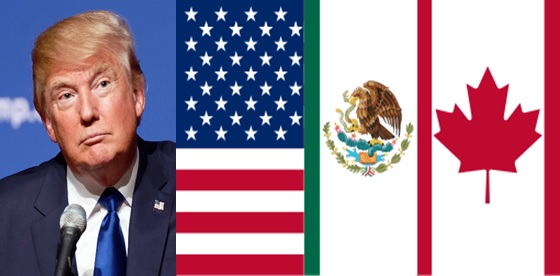
U.S. President-elect Donald Trump and the flag of the North American Free Trade Agreement (NAFTA). / Flickr and Wikimedia / Creative Commons / Modified

Despite his campaign rhetoric repeatedly attacking the North American Free Trade Agreement, U.S. President-elect Donald Trump probably won’t touch it, except in superficial ways.  He has called NAFTA the “worst trade deal ever,” and promised to pull the U.S. out unless Mexico and Canada agree to renegotiate it.  Last week, he suggested renegotiation of NAFTA will include provisions for Mexico to repay the U.S. government for the wall he wants to build along the border.

Dismantling or even significantly rewriting the accord is unlikely for a couple reasons:

  • First, the billionaires, chief executives, and friends he is choosing for his cabinet are hardly people inclined to dismantle an agreement whose contents largely reflect what American business wanted from the U.S.-Mexico relationship when NAFTA was being negotiated in the early 1990s. Corporate preferences weighed heavily against any big deviation from the status quo after the last political transition in Washington, in 2008.  Barack Obama too said that “NAFTA was a mistake,” though his criticisms were a little different.  He railed against lobbyists’ disproportionate influence over trade policy, and promised big changes to international trade agreements, including better protections for workers and the environment.  Even so, he didn’t touch NAFTA, and the Transatlantic Trade and Investment Partnership (TTIP) and the Trans-Pacific Partnership (TPP) he negotiated included – like NAFTA – shady provisions for investor-state dispute settlement.
  • It would be near-impossible, or least massively expensive, to get what Trump seems to want most: a big drop in imports from Mexico. In his eyes this would make NAFTA a better deal for America, though of course serious economists disagree.  Realistically, reopening the agreement would be very messy, and if he tried to throw up massive new trade barriers business leaders would strongly object.  NAFTA could include some additional measures to make it easier for goods and/or people to get around among the NAFTA countries, but that’s not what Trump has promised.

His economic nationalism makes the Republican Party establishment squirm, but it’s clear it also helped Trump win several Midwestern states, tipping the electoral college in his favor.  Insofar as agreements like NAFTA entrench rules friendly to business, and generate market efficiencies and economies whose benefits accumulate in the hands of the few, voter hostility is no mystery.  But economics is only part of the reason.  The bigger issue is what the backlash against globalization – embodied also by Brexit and the rise of neo-nationalist parties in Europe – means more broadly.  The average Democratic voter has a lower income than the average Republican voter, but Democrats are more supportive of trade agreements because they are more internationalist, more open to other cultures, younger, more educated, and more urban.  Throughout his presidency, Trump will therefore be squeezed between his working class rhetoric – appealing to the distrustful – and his business class milieu.  He is an extreme case of the politicians’ mercantilist thinking on trade, wherein exports are good and imports are bad, and “trade deals” like NAFTA are somehow like deals in the business world, where it’s possible to out-negotiate someone.  The reality is that this thinking – which flies in the face of basic economics – doesn’t point to any clear course of action.  This is why Trump won’t actually do much about NAFTA.

January 10, 2017

* Malcolm Fairbrother is social science researcher and teacher/mentor in the School of Geographical Sciences at the University of Bristol (UK).  This article is adapted from a recent blog post for the American Sociological Association.

Cuba: Preparing for President Trump

By Fulton Armstrong

15859186069_103bf8055c_b

Photo credit: Day Donaldson / Flickr / Creative Commons

Cubans are already calibrating their expectations for relations with the United States under President Trump – hoping the normalization process does not unravel but preparing for a return to a sanctions-based policy from Washington.  Conversations in Havana reveal deep concern that the President-elect’s tweets and statements about Cuba, Mexico, and Latinos in the United States will translate into efforts to slow, stop, or reverse normalization.  The past two years of dialogue have focused on mutual interests, without ignoring remaining differences between capitals but not allowing them to blot out hopes of mutually beneficial cooperation.  Cuba will interpret a return to bombastic rhetoric, exaggerated conditions to reach a “deal,” and the pressure tactics of the pre-Obama era as a sign of U.S. willingness to put bullying a small neighbor eager for improved ties ahead of its own national interests.

Cubans present the stiff upper lip in conversations and, not surprisingly, defiantly note that they’ve already survived decades of U.S. pressure, but their disappointment is palpable.

  • Most concerned are entrepreneurs in Cuba’s small but growing private sector, who depend on investment from U.S.-based relatives and friends. More than 100 Cuban private businessmen wrote a letter to Trump last week urging restraint.
  • Nationalism has precluded Cubans from saying that normalization would be a major driver of their long-promised economic reforms, but few deny that improving ties with the United States would eventually present Havana important opportunities. U.S. retrenchment will remove important incentives for the government to move ahead with its reform strategy.
  • Rumors about tensions between Cuban proponents of normalization and conservative opponents may have some merit, but Cubans across the spectrum will close ranks if Trump gets aggressive.

Cuba’s reactions to Trump’s election, including President Raúl Castro’s congratulatory message to him, so far suggest that it will hold its tongue and resist being provoked.  A U.S. return to full-bore Cold War tactics would not pose an existential threat to Cuba, even considering the country’s difficulties dealing with unrelated problems such as the crisis in Venezuela.  Popular reactions to the passing of Fidel Castro last month are being construed as evidence of residual political legitimacy for the government and support for it to deliver on promised improvements.  Moreover, Cuba’s progress in normalization; its effective contribution to the Colombia peace accord; its new political dialogue and cooperation agreement with the European Union; and the recent Havana visit of Japanese Prime Minister Abe have boosted the country’s international image – and blame for collapse of normalization will surely fall solely upon the United States.  However difficult it will be for the proud people of Cuba to resist rising to whatever bait the Trump Administration throws its way, showing forbearance in the bilateral relationship and moving “without hurry but without pause,” as Raúl Castro said, with its national reform plan would protect the investment that Cuba has already made in normalization.

December 19, 2016

China, Latin America, and the New Globalization

By Andrés Serbin*

31128355276_da6ad8d3a0_k

Chinese President Xi Jinping received a medal of honor from the Peruvian Congress during his tour of South America last month, which included the Asian-Pacific Economic Cooperation summit in Lima. / Ministerio de Relaciones Exteriores, Peru / Flickr / Creative Commons

In Latin America and elsewhere, the world is undergoing tectonic movements that indicate the birth of a new world order with new rules of play.  For much of the past decade, dynamism in world commerce and finance has been shifting from the Atlantic basin to the Pacific.  While the international economy has shown fragility and the developed economies – particularly the European Union and the United States – have shown slow growth since the crisis of 2008, China and the emerging economies of the Asian-Pacific region have experienced sustained growth.  China, now the second biggest economy in the world, has been the driver of that growth and, according to most projections, is poised to overtake the United States as the biggest.  After several centuries in which power has been concentrated in the West, the emergence of new powers in a multi-polar world will naturally bring about changes in the norms and rules governing the international agenda.

In Latin America and other regions, there is growing awareness of this process – with China and its own version of globalization at its center.  The region has witnessed the paralysis of the Transatlantic Trade and Investment Partnership (TTIP) between the EU and the United States as well as U.S. President-elect Donald Trump’s declaration that he will withdraw the United States from the Trans-Pacific Partnership (TPP) as part of a broader anti-globalization policy.  Trump’s announcement drew two different reactions from participants from TPP country leaders at the Asian-Pacific Economic Cooperation summit in Lima late last month.  One was the express decision to proceed with TPP even without the United States, and the other was a clear receptivity to Chinese President Xi Jinping’s invitation that they join regional economic groups that he is pushing – the Regional Comprehensive Economic Partnership (RCEP) and the Free Trade Area of the Asia-Pacific (FTAAP).

  • Both agreements explicitly exclude the United States and abandon norms customarily pushed in free trade by the West. They emphasize reducing tariffs and give no consideration to labor and environmental regulations and non-tariff measures.
  • They complement China’s “one belt, one road” initiative, a modern-day revitalization of the Silk Road creating trade links between China’s western regions with Russia, Central Asia, and eventually to Europe, developing land and maritime routes along the way. The Shanghai Cooperation Organization (SCO) – an economic and security pact linking China, Russia, four Central Asian nations, and now welcoming India and Pakistan – is explicitly linked to RCEP.

Washington’s pending rejection of TPP eliminates a central part of President Obama’s “pivot” strategy to counter China’s rapidly expanding influence in Southeast Asia and the South China Sea, but it also has implications for Latin America and the Caribbean as China moves in rapidly to fill the void left by U.S. withdrawal.  While President-elect Trump has pledged to “renegotiate” NAFTA – which he called “probably the worst trade deal ever agreed to in the history of the world” – China last month presented to Latin America a detailed document proposing a new era in relations with “comprehensive cooperation” in all areas and reaffirming a “strategic association” with the region.  In sharp contrast with the new U.S. President’s views of Latin America, Beijing calls Latin America and the Caribbean “a land full of vitality and hope,” praises the region’s “major role in safeguarding world peace and development,” and calls it “a rising force in the global landscape.”  While some analysts suggest that globalization is slowing if not ending, these developments more strongly indicate that it is rather taking on a new form within a new world order that clashes with the visions and values of the West.  We appear to be transitioning into a world that is genuinely multi-polar with globalization under new rules.

December 13, 2016

* Andrés Serbin is the president of the Coordinadora Regional de Investigaciones Económicas y Sociales (CRIES), a Latin American think tank.  This article is adapted from an essay in Perfil, based in Buenos Aires.

What Comes After TPP?

By Fulton Armstrong and Eric Hershberg

31117865785_a3bb9a557a_k

President Barack Obama and President Pedro Pablo Kuczynsky at the APEC 2016 summit / Ministerio de Relaciones Exteriores – Peru / Flickr / Creative Commons

The Obama administration’s failure to win U.S. approval for the Trans-Pacific Partnership is a disappointment for Latin American countries on the Pacific Rim – and such a big opportunity for China to expand its influence that President-elect Donald Trump, despite his theatrical pledge to withdraw from it, might eventually consider rescuing the accord. The Asia-Pacific Economic Cooperation (APEC) summit in Lima last weekend was the last chance for Latin American leaders to say goodbye in person to President Obama and to mourn the passing – for at least the short term – of his TPP-centered vision for trans-Pacific trade.  In a meeting with leaders of the 11 other TPP countries, Obama tried hard to convince them of “the United States’ continued strong support for trade” despite growing evidence to the contrary.  Both U.S. President-elect Donald Trump and Hillary Clinton, who was Obama’s Secretary of State for four years, firmly and repeatedly stated opposition to TPP.  The White House continued efforts all the way up to election day (November 8) to persuade the U.S. Senate to approve the deal in a lame-duck session, but the Republican leaders – like Clinton champions of free trade until it became a 2016 campaign issue — slammed the door on it.

With the collapse of TPP, several Asian countries have already signaled a willingness to sign on with China’s own free trade initiative, the Regional Comprehensive Economic Partnership (RCEP) – which Latin America is not yet part of. Malaysian Prime Minister Najib Razak, angry with the United States over trade and other issues, threw his lot with China during a visit to Beijing last month.  (The Philippines, which has also moved aggressively to ally itself with China in recent months, is not in TPP.)  Japanese Prime Minister Shinzo Abe met with Trump last week and said his country “could have great confidence” in the President-elect, but he has nonetheless warned his parliament that RCEP will prevail.

  • Latin Americans are also slowly but surely gravitating toward China as trans-Pacific leader in trade. Just days before the Lima summit, Peruvian Foreign Minister Eduardo Ferreyros announced that, while Lima still hoped TPP would become reality, his government has begun talks with China over accession to RCEP. His Chilean counterpart, Heraldo Muñoz, last Friday also expressed preference for TPP but told the Wall Street Journal that his country was leaning toward joining RCEP. Chinese President Xi Jinping, in Lima for the summit, was also making stops in Ecuador and Chile. (He’s visited Mexico, Argentina, Brazil and Venezuela on previous trips.) In an op-ed in Peru’s El Comercio just before the summit, Xi said, “United by the same dream, there isn’t a more timely moment for the deepening of our multidimensional cooperation.”

The APEC forum may have been trying to counter Trump and others’ criticism of the lopsided impact of global trade by issuing a statement – titled “Quality Growth and Human Development” – emphasizing the benefit of global trade to all citizens in all countries. It was certainly in this spirit that the host of summit, Peruvian President Pedro Pablo Kuczynski, warned that proponents of trade barriers would do well to revisit the history of the 1930s, singling out for unusually sharp criticism the stance taken by the U.S. President-elect.  On its face, Trump’s campaign rhetoric suggests TPP is totally dead; he’s many times called it a “disaster” being “pushed by special interests who want to rape our country.”  Free-traders found a glimmer of hope in an organizational chart reportedly leaked by the Trump transition team last week that listed a former lobbyist from the U.S. Chamber of Commerce, which has strongly supported TPP, as head of his “trade reform” team.   Yet if the new U.S. Administration is going to reengage on TPP, the primary reason would probably be to undercut China’s RCEP initiative.  Much of the U.S. foreign policy establishment of both parties believes fervently that the impact of U.S. disengagement with the Pacific Rim would be harmful to U.S. global and hemispheric leadership.  Should those concerns sway the incoming President, he could opt to set aside his caustic rhetoric on TPP, negotiate face-saving adjustments to the accord, and instead focus his tough talk on China. TPP’s flaws may ultimately appear minor and manageable compared to the competing scenario of Latin American governments seeking commercial prosperity through a Chinese-led Pacific economic bloc. That is certainly the hope of most Pacific Rim governments across Latin America, whose alarm at developments in the U.S. already has them eying alternatives across the pond.

November 22, 2016

Guatemala: Cheers for Trump?

By Ricardo Barrientos*

22441078334_df0b0beceb_k

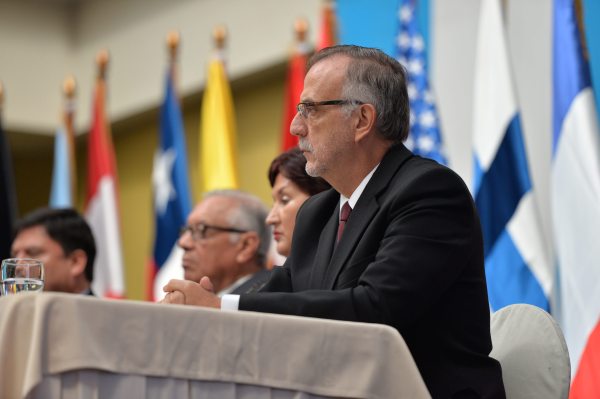
Iván Velásquez, head of the UN International Commission Against Impunity in Guatemala (CICIG). Velásquez and his team face a difficult task of bolstering Guatemalan anti-corruption efforts. / US Embassy Guatemala / Flickr / Creative Commons

Anti-corruption efforts in Guatemala have suffered serious setbacks in recent months, and the election of Donald Trump as U.S. president appears likely to hurt them further.  A number of media reports have already documented that efforts by right-wing Army veterans accused of crimes against humanity during the civil war, politicians, and campaign financiers are seriously threatening anti-corruption efforts started in 2015, which swept former President Pérez Molina from office.  President Jimmy Morales, who campaigned that he was “neither corrupt, nor a thief,” has failed to fulfill voters’ mandate to fight corruption, and instead has allowed Army friends to dominate his administration.  Called la juntita, Morales’s closest advisors are former military officers who operate in the shadows, are widely suspected of crimes against humanity during the war, and are alleged to be using their influence for personal enrichment.

  • The Supreme Court and Congress are also under pressure. Numerous media reports point to members of the Supreme Court, including its President, being tainted.  One magistrate, whose son has already been convicted of illicit use of public funds, is widely suspected as well.  In the legislature, the election of a new Directive Board increased the power of members long suspected of links with the mafias.  (Some local observers speculate that the internal voting was conducted on the U.S. Election Day because U.S. Ambassador Todd Robinson, an advocate of anti-corruption initiatives, and his staff would be too busy to care about what was going on in the Guatemalan Congress.)

With the Central Square in Guatemala City empty and only memories remaining of the citizen mass demonstrations of 2015, the last line of defense against the “re-capture” of the Guatemalan State are Iván Velásquez, head of the UN International Commission Against Impunity in Guatemala (CICIG), and Guatemalan Attorney General Thelma Aldana.  They have already started investigations and are prosecuting corrupt members of Congress, including members of the new Directive Board.  U.S. government support has been crucial.  Ambassador Robinson may have crossed the thin line between active diplomacy and intervention at times, but many observers note that – quite unusual in Latin America for a U.S. ambassador – he enjoys strong support and sympathy from Guatemalans, and he is disliked by the Army veterans and others who are part of what in Guatemala is known as the “old politics.”

Corrupt Guatemalans appear to believe that their first hope – to neutralize the U.S. Embassy – moved one step closer to reality with the election of Donald Trump last week.  Politicians and commentators opposed to U.S. support for CICIG celebrated.  One proclaimed that “Democrats shriek; Republicans vote,” while another interpreted the message of Trump’s victory for Ambassador Robinson: “You’re fired!”  The mafias would not expect a Trump Administration to support them, but rather – interpreting the President-elect’s campaign statements – simply adopt a policy of indifference toward Guatemala and its internal affairs.  The corruption networks of the “old politics” in Guatemala hope that Trump will stay focused on nothing in Latin America except stopping migration.  Analysts who say that everyone in Latin America is regretting Trump’s victory are wrong.  Trump’s election may help the corrupt win a battle or two, but the war against corruption in Guatemala is far from over.

November 18, 2016

*Ricardo Barrientos is a senior economist at the Central American Institute for Fiscal Studies (Icefi).

Latin America: Wait-and-See Reaction to Trump – For Now

By Catie Prechtel and Carlos Díaz Barriga*

trump-effigy

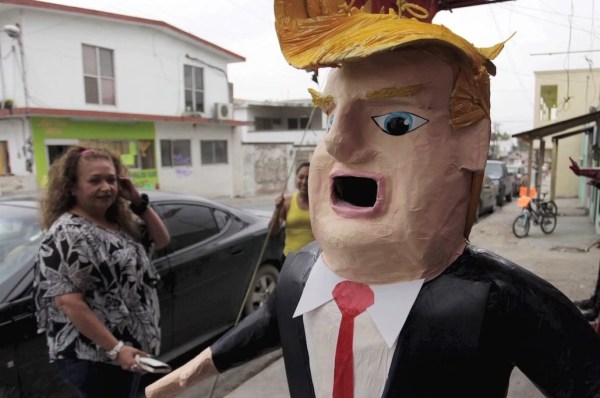
An effigy of Donald Trump in Mexico City. / Sequence News Media / Daniel Becerril / Wikimedia / Creative Commons

Most Latin American leaders publicly reacted with caution to Republican presidential candidate Donald Trump’s victory in last week’s U.S. elections, but reactions will sharpen quickly if Trump tries to make his campaign rhetoric about the region and Latino immigrants into policy.  Mexico and Central America showed clear anxiety over the implications for their economies and regional migration pressures.  Some South American presidents expressed mild enthusiasm and voiced hope for a positive relationship with the new administration, although Trump’s avowed opposition to the Trans-Pacific Partnership trade accord – under discussion at the APEC summit in Lima this week – has fueled concerns about the future of free trade.  Fear that the new U.S. President, who takes office on January 20, will deport millions of undocumented migrants from Mexico and Central America and force U.S. firms to shut factories in those countries has seized the media there.

  • Mexican newspapers headlines screamed “Be afraid!” and warned of a “Global shakedown.” Reports recited the many promises Trump had made against Mexico, including his proposal to build a border wall (and make Mexico pay for it); revising NAFTA and raising taxes on Mexican imports, putting conditions on remittances, and charging more for visas. The peso suffered three consecutive days of losses before recovering slightly following interviews by Trump and his team suggesting a softer stand on the wall and free trade.  President Peña Nieto phoned Trump with congratulations and agreed to meet soon to discuss bilateral issues, including presumably the wall.
  • Guatemala’s Prensa Libre reported businessmen are worried Trump’s rejection of free trade could have a direct impact on the economy and described the possible mass deportations as a “social bomb” for the country. In Nicaragua, newspapers speculated that Trump’s victory will give a boost to U.S. legislation, the Nicaragua Investment Conditionality Act (NICA), which calls for economic sanctions if President Daniel Ortega doesn’t take “effective steps” to hold free and fair elections.  In El Salvador, the main concern is the deep economic stresses of mass deportations of Salvadorans in the United States.  Honduras shares those concerns but apparently was more wrapped up in President Juan Orlando Hernández’s announcement confirming his intention to make a controversial bid for reelection.
  • Venezuelan President Nicolas Maduro, often given to bombastic rhetoric, has focused on working with Washington in the closing months of the Obama Administration. In a phone conversation with Secretary of State John Kerry, he stressed the need to establish an agenda with the next administration that favors bilateral relationships, but he specifically called on Obama to “leave office with a message of peace for Venezuela” and rescind a determination that Venezuela is a “threat to the United States.” Obama himself last April said the designation was exaggerated.
  • Media in Colombia speculated that Trump will be less committed to aid and support for finalizing and implementing a peace accord with the FARC. Argentina, Brazil, and Chile offered calm reactions to the news.  For Buenos Aires and Santiago, the biggest concern was potentially strained commercial relationships and free trade agreements with the United States, according to press reports.  Brazil offered little reaction to the news, but Trump’s win brought four consecutive days of losses for the real – weakening 7.6 percent since the election.

The political leaders’ cautious reactions conceal a broad and deep rejection for President-elect Trump’s values and intentions as he stated them during the campaign.  Former Mexican President Vicente Fox once again tweeted his disapproval for Trump, while José Mujica, former President of Uruguay, expressed dismay on Twitter, summing up the situation in one word: “Help!”  Press reports and anecdotal information indicate, moreover, that large segments of Latin American society have shown a widespread distaste for Trump’s win.  Their general wait-and-see attitude will end when and if Trump proves himself the unpredictable and reactionary he seemed on the campaign trail.  Latin American leaders have a lot of work ahead as they navigate a new relationship with the United States.

November 15, 2016

* Catie Prechtel and Carlos Díaz Barriga are CLALS Graduate Assistants.

The Cataclysm that the Latino Vote Couldn’t Stop

By Eric Hershberg

ft_16-11-09_exitpolls_race_ethnicity

Presidential candidate preference, by race or ethnicity / Pew Research Center

In unprecedented numbers, Latino voters flexed their muscles in the bitter and destructive U.S. presidential campaign, but that wasn’t enough to elect a competent but mistrusted centrist and block an erratic TV showman espousing policies anathema to their interests.  Former Secretary of State Hillary Clinton lost in the electoral college, which in the American system is what actually matters, but she won the popular vote by a slim margin – little consolation to Latinos.  Donald Trump and the forces that will accompany him into the Executive branch have pledged to begin efforts to deport millions of undocumented immigrants, build walls to keep Latin Americans out of the country, and reverse decades of policies meant to strengthen ties among the Americas.  The election highlighted deep cleavages in U.S. democracy:

  • An inclusive coalition of the well-educated, urban dwellers, youth, and racial and ethnic minorities lost to a bloc of angry white working-class, rural, and small-town voters rallied by a man whose behavior and rhetoric were called repugnant by leaders of even his own party. The outcome testifies to the degree to which vast segments of the American population feel ignored and denigrated by political and cultural elites and alienated by profound social changes that accelerated during the Obama administration, including shifts regarding such issues as gender and sexual identity and, particularly, racial diversity and empowerment.
  • The Trump-led “whitelash” has been largely rhetorical up to this point, but it will soon be manifested in public policies with life-changing consequences for immigrants, minority populations, and impoverished citizens. There’s a possibility that, once charged with running the country, the Trump faction will moderate on some issues, but it’s frightening to recall that no fewer than 37 percent of German voters mobilized behind an analogous cocktail of racial resentment and violent impulses in 1932.  In 2016, nearly half of the American electorate did just that, with profound implications for civil discourse, tolerance, and respect for sometimes marginalized sectors of the country’s population. If Trump’s exclusionary rhetoric becomes translated into concrete policies that diminish the country’s diversity, the U.S. will lose its status as among the most dynamic and creative places in the world.

The Latino vote was expected to be among the decisive factors that would sweep Clinton into the White House and swing the Senate back to Democratic control, albeit by the slimmest of margins.  But while it was influential, diminishing Trump’s margin of victory in reliable Republican strongholds such as Arizona and Texas, and enabling the Democrats to eke out victories in states such as Nevada, New Mexico, and Colorado, the Latino vote was insufficient to rescue Clinton’s fortunes in the pivotal states of Florida and North Carolina.  Whereas in 2012 Obama had an estimated 71-27 percent advantage among Latinos against his opponent, Clinton failed to match that total – exit polls indicate roughly a 65-29 percent split – even against a candidate explicitly targeting Latino interests.  Trump called for mass deportations of the country’s 10 million undocumented Latino residents and a rollback of the Obama administration’s efforts to provide safe haven and legal status for at least half of this vulnerable segment of American communities.  Whatever the reasons for their low participation, these communities now confront existential threats.

  • If Trump follows through on his promises, the impact will be manifested in numerous domains beyond immigration and related human rights that have profound implications for the welfare of U.S. Latinos, including the composition of the Supreme Court and its commitment to voting rights; protection against discrimination in employment, housing, and financial services; access to health care for 20 million people who for the first time gained coverage through the Affordable Care Act (“Obamacare”); opportunities for pre-school and tertiary education; and environmental regulations needed to protect public safety and health.

Political scientists and informed citizens must now revisit their assumptions about the impact that a growing Latino population may have on the outcome of presidential elections.  The gap separating the two parties in terms of Latino preferences is vast and increasingly consolidated, suggesting an enormous and enduring disadvantage for the Republicans.  But whether the Latino vote can become a decisive, rather than merely influential, component of the electorate is much less certain.  The anger among white voters – at least this time around – carried the day.  This “whitelash” may or may not be a transitory phenomenon, but the prospects for efforts to make the United States a force for good in the world, and to make government an agent for social and economic justice for all, will depend in large part on the future mobilization of the Latino community.  Arguably, the future of the United States – and by extension the world’s – hinges on the capacity of Latino voters to make America great again.

November 10, 2016

U.S. Elections: Latino Voters Lost in the Noise?

By Fulton Armstrong and Eric Hershberg

pew-latinos-for-blog

The U.S. general election on November 8 could give Latino voters their biggest chance yet to flex their political muscles.  The Pew Research Center has released new projections showing that a record 27.3 million Latino voters – 4 million more than in 2012 and 12 percent of the U.S. total – are eligible to vote this year.  Millennials (born since 1981) now make up 44 percent of Latino eligible voters, and Pew Research says that first-time voters represent one-fifth of those who say they are “absolutely certain” to vote.  (Only 9 percent of those over 36 are “absolutely certain.”)  Pew is agnostic, however, on whether their turnout in November will set a record.  Latino non-participation rates are generally high:  their turnout rate was only 48 percent in 2012.  Indeed, analysts at the New York Times cautioned last month that comparisons between Clinton’s support among Latinos now and Obama’s in 2012 – which are similar – indicate that she can’t take them for granted.

Latinos’ political preferences – traditionally Democratic except in the Cuban-American community, which itself is trending towards the Democrats – appear poised for an unprecedented surge in favor of Democratic candidate Hillary Clinton next month.  The “Vote Predict” model of Latino Decisions shows Clinton stands to win 82 percent of the Latino vote, and her Republican counterpart, Donald Trump, 15 percent, with a 5.5 percent margin of error.  This 67-point gap breaks the previous record of a 51 percent split between President Bill Clinton and Senator Bob Dole in 1991, and the 71-to-27 difference between President Obama and Mitt Romney in 2012.  Press reports indicate that, despite unhappiness with aspects of the Obama Administration’s immigration policies which Clinton supported as Secretary of State, Latinos judge that Donald Trump’s policies of walls and expulsions call for active opposition.  Pew’s polls confirm that two-thirds of Millennial Latinos say their support for Clinton is more a vote against Donald Trump than for her.  The Republican Party’s own “autopsy” of its resounding 2012 electoral defeat underscored the importance of attracting Latino voters, who were dismayed by anti-immigrant and xenophobic stances they associated with the GOP.  In nominating Trump, the party fulfilled its strategists’ worst fears.

An overwhelming Latino majority for Clinton seems almost certain.  Political scientists increasingly predict that their rejection of the Republican brand may endure for generations to come, with profound implications for the viability of the Republican Party beyond the Congressional district and state levels.  Latinos may not get credit as the crucial swing vote in the presidential race, but they could be crucial in other contests.  The Latino vote could prove critical to the outcome of key Senate races in states such as Florida, North Carolina, and Arizona.  While the absolute number of Latino voters appears likely to rise, turnout in this unusual – even unsightly – presidential contest is one of the most unpredictable variables confounding polling experts, who see signs that many Americans’ faith in democracy and its processes is dropping, at least temporarily.  A survey reported in the Washington Post, for example, showed that fully 40 percent of 3,000 registered voters say they “have lost faith in American democracy,” while just 52 percent say they have not.  An astounding 28 percent said they probably would not accept the legitimacy of the outcome if their candidate loses.  These trends, along with Trump’s allegations that the election may be rigged, make the timing of the coming-of-age of Latino Millennials truly ironic in this extraordinary election year.  Many Latinos, or their parents or grandparents, left polarized, imperfect democracies and, after earning U.S. citizenship and the right to vote, find themselves in a polarized, imperfect democracy with deep historical roots but an uncertain near-term future.

October 20, 2016

As Mexico “Absorbs” Central American Refugees, Record Numbers Reach the U.S.

By Dennis Stinchcomb

uac-family-unit-apprehensions_aula-01

The meeting of world leaders that President Obama convened on Tuesday to rally support for refugee resettlement and inclusion across the globe was good diplomacy but contradicts Washington’s policies even in the Americas.  At a meeting on the margins of the UN General Assembly, Obama thanked Mexico for “absorbing a great number of refugees from Central America,” yet the data make clear that Mexico is hardly absorbing refugees.  During the first seven months of 2016, as WOLA has reported, Mexico granted asylum to just under 1,150 Central Americans but deported over 80,000 others.  Meanwhile, far greater numbers of Central Americans have reached the U.S., principally women with children (whom U.S. Customs and Border Protection labels “family units”) and minors traveling without a guardian (“unaccompanied children”).  With one month remaining in Fiscal Year 2016, apprehensions of Central American women with children total over 61,000 – up 79 percent from FY15 – and are on pace to surpass the FY14 record.  Likewise, apprehensions of unaccompanied children have already exceeded the FY15 total, and September numbers will likely push the current tally of 42,000 just shy of the FY14 record.

This renewed influx comes despite the Obama administration’s multi-pronged strategy to deter unauthorized migration from the Northern Triangle countries of El Salvador, Guatemala and Honduras:

  • U.S. support for Mexico’s Southern Border Program has resulted in unprecedented numbers of both detentions and deportations of Central Americans in Mexico, yet the dramatic increases in arrivals to the U.S. and shifting points of entry – including an upswing in seaborne trafficking – suggests that the exodus from the Northern Triangle continues and that human smugglers have adapted to stepped-up enforcement measures by forging new routes through Mexico.
  • Ongoing raids by U.S. Immigration Control and Enforcement (ICE) authorities, which under the banner of Operation Border Guardian aim to roundup unaccompanied youth who had been ordered deported from the U.S. and have recently turned 18, have not stemmed the tide of new arrivals fleeing untenable circumstances in their countries of origin.
  • Despite a July 2016 expansion of the CAM Program for in-country processing of youth applications for refugee status and for others in Central America asserting that they are at risk of harm, the pool of beneficiaries remains miniscule. Whereas the program had received 9,500 applicants by mid-year, only around 270 had been resettled in the U.S. With a six- to eight-month processing period and room for only 200 applicants at a time at shelters that have been set up in Costa Rica, desperate Central Americans continue to turn to more efficient human smugglers.
  • Public messaging campaigns launched in the region with U.S. government funding, to warn Central Americans of the dangers involved in irregular migration and to dispel misperceptions regarding U.S. immigration policies, also appear fruitless, as outlined in a recent American Immigration Council report).

President Obama’s efforts to galvanize international action in response to forced displacement worldwide highlight his own administration’s shortcomings in addressing refugee flows closer to home.  Expedited hiring of border patrol agents and an increase in the number of beds at contract detention facilities, among other domestic measures, have enabled the administration to process large volumes of Central American migrants while avoiding the appearance of a “border crisis” akin to 2014.  Meanwhile, an emphasis on curtailing outflows from Central America (without regard to the justification of people’s decision to flee), detention (rather than absorption) in Mexico, and deportation in both Mexico and the U.S. has not been matched with analogous investments to address the needs of Central American migrants already in the U.S. who may have legitimate claims for asylum or other forms of protection.  Central American families and unaccompanied children, for example, now account for over one-fourth (26 percent) of the 512,000-case backlog in immigration courts, yet only 53 percent of families and 56 percent of unaccompanied minors have access to attorneys.  In failing to guarantee legal representation for these vulnerable populations the administration is sidestepping the same moral obligation to thoroughly vet and provide safe, inclusive communities for refugees that President Obama challenges other governments to fulfill.  Perhaps funding that is supporting Mexico’s strategy of detention and deportation could be better allocated to programs that ensure proper adjudication of asylum claims – in both Mexico and the U.S. – and to genuinely seek to absorb individuals and families who, through due process, are judged to qualify as refugees.

September 22, 2016