Mercosur’s Future: Whither Economics?

By Tom Long

Mercosur’s December 6 meeting in Brasilia might seem to be a watershed. The organization formally integrated Venezuela and signed adhesion agreements with Bolivia. Ecuadorean President Rafael Correa was in attendance, too, along with officials from other South American countries. The bloc was established starting in 1991, with goals of removing internal tariffs, setting a common external tariff, coordinating commercial policies, and harmonizing regulations. An unwritten objective was to spur industrialization and decrease dependence on foreign manufactures. Yet more than twenty years on, Mercosur appears to be further than ever from establishing a common market. The Inter-American Development Bank notes that Brazil and Argentina have traded protectionist measures, and that “Buy Brazil” provisions in government procurement have been a bilateral irritant.
Mercosur

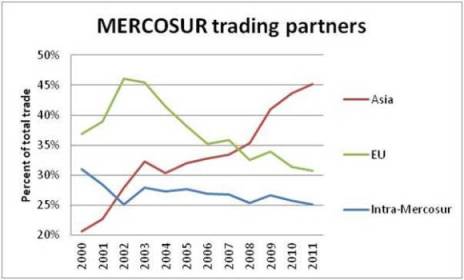
Expanding breadth masks decreasing depth. While both Mercosur’s total trade and trade among its members have grown greatly over the past decade, the former has outpaced the later.  WTO data show that intra-regional trade as a percentage of total trade has declined from 31 percent in 2000 to 25 percent in 2011. Instead of being driven by integration, MERCOSUR’s trade patterns are propelled by skyrocketing trade with Asia, led by Argentine and Brazilian commodity exports. In this light, the failure of late October meetings between Mercosur and the European Union suggest that China has taken the place of Europe.

Evaluated from a strictly economic perspective, Mercosur’s recent expansion represents a step backwards. The inclusion of Bolivia will not add much economic heft to the pact, and with the addition of each new member, reaching consensus will become even more difficult. The full membership of Venezuela increases the bloc’s size, but also its dependence on natural-resource exports. Neither newcomer—nor the two original heavyweights—appear committed to the original common market mission. Is the bloc’s raison d’etre shifting from the economic to the political? If so, what will be Mercosur’s relation to ALBA and UNASUR? Whereas Brazil was never fully comfortable with the Bolivarian Alliance—in part because of the anti-U.S. tone—it has now brought ALBA’s two most committed members to its own table. Inside Mercosur, Brazil has a greater voice than it does in UNASUR, but the hijacking of a potentially important trade alliance masks a lack of economic leadership for South America.
Brazil’s Protest: If You Get QE3, We Get Tariffs

Photo by “SqueakyMarmot” | Flickr | Creative Commons

For two years Brazilian voices have complained that U.S. policies of near-zero interest rates and “quantitative easing” have been damaging its economy.  Lax monetary policies in the U.S. and Japan are blamed for the high valuation of the Brazilian real, which further suppresses Brazil’s  languishing manufacturing sector.  Tensions escalated following the September 2012 announcement of the U.S. Federal Reserve’s third round of quantitative easing.  Now the debate has spilled over into discussions about Brazilian restrictions on trade.  As Finance Minister Guido Mantega warns of a “currency exchange war,” Brazil is increasing tariffs on U.S. goods and foresees the imposition of taxes on inflows of foreign capital, which further inflate the Real.  Writing in Folha de São Paulo, Luiz Carlos Bresser-Pereira argues that Brazil is acting in self-defense.  The tariffs Brazil is contemplating are by his account not protectionist but simply an effort to compensate for the unfair advantage that the U.S. seeks to achieve through its monetary policy.

The tension is spreading beyond Brazil, as currency appreciation is portrayed as a drag on manufacturing in much of South America.   In an interview with CNN, Chilean President Sebastián Piñera criticized “QE3,” asserting that “printing money” would not solve U.S. economic woes.  So far, Andean countries are responding by purchasing dollars and cautiously reducing interest rates, but the Brazilians, in particular, present protectionist measures as counter-cyclical tools of their own, necessitated by American attempts to “drive down” the dollar.

The Brazilian and South American claims may be overdrawn somewhat; many experts believe that overvaluation is primarily a consequence of Chinese demand for South American commodities and the decision by most Latin American countries to maintain high interest rates in order to forestall inflation.  But U.S. policies meant to boost job growth are indeed having unintended consequences in the hemisphere.  There has been little thought in the United States of the external implications of Fed policy—beyond a belief that a reinvigorated U.S. economy would be good news for everyone.  Brazil has been the first, and most vocal, challenger of a stance that always frowns on tariffs while presenting monetary policy as a purely domestic matter.  It is a bit much for Brazilians to expect that U.S. monetary policy should be crafted with an eye to its impact on the region, particularly when conventional fiscal policy measures are thwarted by Congressional dysfunction, but Washington should not be surprised when efforts to tamp down its currency – not unlike Chinese policies that Washington condemns  – are seen abroad as aggressive threats to competition.

South America: Low Expectations for U.S. Election

Photo is in the public domain

Media in Colombia, Chile, and Peru are paying close attention to the U.S. presidential election, but only in Colombia do commentators seem to sense that November’s vote could have a direct impact on their country.  Colombian opinion-makers have not articulated specific concerns; their attention appears premised merely on the immensity of the relationship.  In Peru, commentators have noted concern about the positions advocated in the Republican primaries on a host of issues, such as immigration and the Cold War optic the GOP candidates espoused.  Chileans are following the horse race with curiosity but little mention of its potential implications.  In these countries, which are generally open to working with Washington, there is dissatisfaction with Obama but greater trepidation about a return to the foreign policies that characterized the Bush-Cheney era.  “Obama losing would not matter much,” wrote Antonio Caballero in Colombia’s Semana.  “But what would matter, a lot, is his Republican rival Mitt Romney winning.”  The columnist said it would be like re-electing Hoover after four years of Roosevelt.

Commentators fret that Romney’s swing right during the primaries proves he is unable to stand up to what they describe as conservative, white Tea Partiers on issues including gun control and taxes, but especially on immigration.  In Diario Correo, Peruvian Isaac Bigio wrote that Romney and Ryan would “launch an offensive against immigrants.”  On foreign policy, commentators see Obama’s record as mediocre.  In Colombia, the president gains points for passing the free trade agreement, but loses them for an overall lack of focus on the hemisphere.  But Romney’s rhetoric, punctuated by swipes at Russia and what he labeled a Chávez-Castro axis in the hemisphere, has created uneasy feelings.  “Romney advocates an aggressive discourse and hard hand in international relations,”writes Sergio Muñoz Bata of Bogota’s El Tiempo.  “If this sounds like a repetition of Bush’s policies, that is because those who dictate the foreign policy of the Republican candidate today are the same people who dictated Bush’s policies yesterday.”  Peruvian Santiago Pérez writes in Los Andes that Romney might “harden the U.S. position against ALBA…and try to intimidate (probably unsuccessfully) his unthreatening Bolivarian enemies.”  A return of the GOP could pose problems for the ongoing talks with the FARC and ELN, moderate Colombians fear.  Writing in Portafolio, Ricardo Ávila Pinto noted that Bogotá should be wary of “the U.S. reaction to any eventual success in the peace process with the FARC.”  Likewise, Chile’s Ernesto Ottone writes that Romney’s “uncultured simple-mindedness in foreign affairs responds to identity-based fanaticism with a warlike tone.”

A consistent theme is that the 2012 election lacks the hope of four years prior – hope for more effective U.S. partnership with the region, which Obama promised at the Summit of the Americas soon after his inauguration but has failed to deliver.  Many outlets reported former President Jimmy Carter’s comment that neither candidate was likely to pay much attention to the region.   While Colombian and Peruvian media reflect public concerns about immigration, the most prevalent fear is that a return to strident rhetoric would only heighten tensions between the U.S. and ALBA-aligned countries.  Colombia, Peru, and Chile don’t want to be stuck in the middle. There are no great expectations for improvement, but there is considerable worry about further decline.

Mercosur, Unasur Holding Firm on Democracy in Paraguay

Photo by Christian Van Der Henst S. via Flickr , http://www.flickr.com/photos/cvander/5215442086/

As Paraguay marked the one-month anniversary of the summary removal of President Lugo from office, the distance between South America and the rest of the hemisphere on how to deal with the “constitutional coup” remains great and is perhaps growing.  OAS Secretary General Insulza announced last week that the regional organization’s Permanent Council decided to take no further action, except to send a “support mission” to Asunción.  The Obama Administration’s inaction further indicates that the United States is prepared to allow things to stand unchallenged and even unexamined.

Mercosur, Unasur, Spain and, more predictably, ALBA have all been tougher.  Mercosur last week announced that the new Paraguayan government, led by President Federico Franco, is still barred from participating in the organization’s activities, although the government to be elected in April 2013 will be welcome.  Unasur made clear that Paraguay’s participation will be suspended “until democratic order is reestablished.”  ALBA countries have minced no words in condemning Lugo’s ouster.  Spanish Foreign Minister García-Margallo suggested publicly last week that Paraguay’s participation in the Ibero-American Summit in November may not be appropriate.

This division among hemispheric players is reminiscent of the tensions following the coup that removed democratically elected President Mel Zelaya in Honduras three years ago.  Whereas the United States quickly softened its stance on the value of isolating the golpista government of Roberto Micheletti in 2009 and later became Tegucigalpa’s most ardent advocate for speedy readmission to the OAS – while Brazil and most South Americans remained committed to seeking a more democratic outcome – Washington is now showing patience with the right-wing factions that ousted Lugo.  Mercosur’s formula for welcoming the government to be elected next year helps avoid the sort of crisis for the incoming leadership that hindered Honduran President Lobo’s efforts to push back against his country’s golpistas, who to this day are undermining his administration.


Paraguay Coup: Setback to Democracy Even if Technically Constitutional


Photo by: Juan Alberto Pérez Doldán, via http://www.flickr.com/photos/38384810@N02/3531158719/

President Fernando Lugo, struggling to consolidate power since taking office in 2008 in Paraguay’s first meaningful transfer of power in 60 years, was removed from office on Friday by the same elites who had resisted him all along.  In a series of lightning actions, the Senate convened an impeachment process – giving him only two hours to prepare a defense – and voted him out of office.  Opposition leaders cited the government’s mishandling of a squatter protest earlier this month, resulting in 17 dead, but they had been undermining him from day one of his administration.  By Friday afternoon, Lugo accepted his removal and left the Presidential residence.  His vice president, Federico Franco, was sworn in and subsequently declared, “The country is calm. … Activity is normal and there is no protest.”

International reaction was slow at first, as the region focused on an environmental summit in Brazil.  But Brazil, Argentina and the ALBA nations condemned Lugo’s ouster and threatened sanctions.  President Dilma Rousseff urged immediate suspension of Paraguay in Mercosur and UNASUR, and Brasilia and others have withdrawn their ambassadors.  The U.S. State Department expressed “concern” at first and then urged “all Paraguayans to act peacefully, with calm and responsibility, in the spirit of Paraguay’s democratic principles.”  The OAS held an extraordinary session of the Permanent Council and sent a fact-finding mission to Asunción.

As President Lugo said, the action was as much against “Paraguay’s history, its democracy” as it was against him.  Like the coup that removed President Mel Zelaya in Honduras three years ago, the action was intended to stop a popular president and influence elections scheduled in coming months, but Zelaya was removed and exiled by the military, and the Congressional documents sanctioning it were fabricated after the fact.  The events in Paraguay pose an important challenge to the democracy clauses of the various regional charters (Mercosur, UNASUR, OAS) as well as the leadership of the region’s biggest democracies, including Brazil and United States.  At this early point, the Paraguayan elites probably judge that they can weather the storm because the U.S. and Brazil – with the diplomatic tensions about the Honduran coup, elections and reaccession to the OAS still fresh – have few options for restoring Lugo to presidency.  Insofar as entrenched elites sense that Washington will react mildly to the removal of democratically elected presidents they can cast as “leftist,” coups like those that have taken place in Honduras and Paraguay will continue.