Prospects for Energy Integration in Latin America

By Thomas Andrew O’Keefe*
  Embed from Getty Images

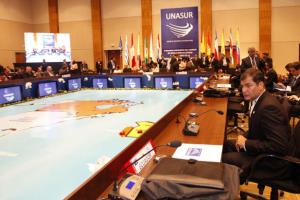
South America’s presidents began discussing energy integration years before UNASUR made it one of its central initiatives, but these efforts have been hobbled by differences on what role the private and public sectors should play.  One tangible project that has emerged from UNASUR seeks to interconnect the electricity grids of Bolivia, Chile, Colombia, Ecuador, and Peru.  While the Colombian, Ecuadorian, and Peruvian grids (as well as that of Venezuela) are already linked, cross-border transmission of electric power is relatively insignificant.

Since the Sixth Summit of the Americas in Cartagena in April 2012, the UNASUR project has become part of a wider hemispheric agenda called “Connecting the Americas 2022,” which includes Panama and potentially – once the long-delayed Electrical Interconnection System for the Central American Countries (SIEPAC) becomes fully operational – all of North America.  The idea was promoted by the Colombians as hosts of the last Summit and emerged as one of the key mandates.  It seeks universal access to electricity through enhanced electrical interconnections, power sector investment, renewable energy development, and cooperation.  By focusing on electrical interconnections, the hope is to allow countries with excess power to export electricity to those facing deficits as well as permit greater integration of renewable energy resources and exchanges among countries with varying climate and seasonal needs.  Interconnection also expands the size of markets, creating economies of scale that can attract private sector investment, lower capital costs, and reduce electricity costs for consumers.  A separate initiative focuses on Brazil and the River Plate countries as well as the Caribbean.

A number of unanswered questions about “Connecting the Americas 2022” raise doubts about its viability.  For one thing, including Chile and Bolivia means that huge swaths of relatively empty territory will have to be traversed, which inevitably leads to losses of electrical power transmitted over long distances.  (The Chilean grid itself is not integrated, but divided into three separate systems.)  Furthermore, electricity generation in the Andean countries relies heavily on hydropower sourced from high mountain glaciers that are gradually disappearing as a result of climate change.  If “Connecting the Americas 2022” is to succeed, the regulatory frameworks of each participating nation must also be harmonized to facilitate long-term cooperation and network development.  Nationalistic concerns that have plagued the integrated Central American electricity network since it first came on line in the late 1990s must also be overcome.  The actual amount of electricity traded among the Central American countries has, to date, been minimal and is actually declining, as national governments have been reluctant to permit long-term contracts for the international sale of electricity that might put access to domestic electricity supplies at risk.  Such obstacles must be overcome to fulfill any vision for Latin American energy integration.

*Thomas Andrew O’Keefe is President of San Francisco-based Mercosur Consulting Group, Ltd. and teaches at Stanford University.
Venezuela: Vicious Cycle Continues

By CLALS Staff

Photo Credit: Cancillería Ecuador / Flickr / Creative Commons Attribution 2.0 Generic (CC BY 2.0)

Photo Credit: Cancillería Ecuador / Flickr / Creative Commons Attribution 2.0 Generic (CC BY 2.0)

UNASUR has shown energy and flexibility as a facilitator during the Venezuela crisis, but neither the government, nor its opponents, nor the opposition’s allies in Washington have matched it – prolonging the vicious cycle that’s been plaguing the country for years.  Speaking as UNASUR, the foreign ministers of Colombia, Brazil and Ecuador reflected the continent’s frustration when they threw up their hands this week and left Caracas after another failed attempt to get a national dialogue on track.  Their statements represented a balance between the UNASUR members that are generally perceived as tolerant of the Venezuelan government’s “Bolivarian” revolution and those perceived as opposing it.  They reiterated calls, issued officially in Suriname on 16 May, for both sides to “achieve a broad dialogue that permits Venezuelans, without interference, to reach an accord that guarantees peaceful coexistence and stability in the country.”

The government, opposition and Washington have not heeded the appeal by UNASUR and the Vatican’s nuncio to be constructive and patient.  The government’s attack on opposition and student camps in early May and subsequent arrest of more than 200 protestors highlighted the authoritarian tendencies that have given momentum to the demonstrations.  The Mesa de Unidad Democrática (MUD), representing important sectors of the opposition, gave the foreign ministers yet another list of demands – including a Truth Commission investigating rights violations (and not headed by the pro-government president of the National Assembly, Diosdado Cabello) and the selection of an entirely new National Elections Council.  The MUD’s executive secretary declared that he has no interest in participating in a peña or chit-chat session, and said, “The ball is in the government’s court.”  Although U.S. Assistant Secretary Roberta Jacobson said during a hearing that sanctions were premature (a statement that she attributed to “confusion”), the foreign affairs committees in both house of the U.S. Congress – without objection from the Obama Administration – have passed bills authorizing an array of punitive measures against Venezuelan officials.  The legislation also authorizes an additional $15 million dollars in aid to the government’s opponents.

The less overtly political agenda that first sparked the protests in February – soaring crime rates, rocketing inflation, and shortages of basic goods and services – has been overshadowed by the shouts of opposition leaders eager to force President Maduro from office and by Maduro’s defenses from the plotting against him.  Demands that Maduro negotiate with a foreign-funded opposition that has as its clear goal his removal as constitutionally legitimate president – something no head of state in the hemisphere would accept – naturally keep his bases on edge.  Political leaders on both sides manipulate popular opinion and claim el pueblo as supporting them.  Another of each side’s real strengths is its ability to portray itself as a victim of the unfairness of the other – because their victimhood rationalizes whatever actions they wish to take.  In that regard, the U.S. sanctions against the government and subsidies to the opposition play into Maduro’s hand.  Washington’s extra $15 million is a drop in the bucket for the well-funded opposition, but the U.S. support is as clear a signal as any of its desired outcome.  With both the United States and important segments of the opposition appearing to aim for nothing short of regime change, UNASUR is wise to step aside and see if anyone decides to get serious about ending the crisis.  Should the situation on the ground deteriorate further, however, UNASUR will probably ramp up its engagement and press both sides to make concessions in exchange for regional support.

UNASUR Looking for Leadership and Direction

By Andrés Serbin

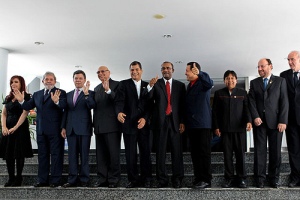
unasur meetingThe seventh UNASUR head of state summit, held in Suriname in August, failed to give the organization the shot in the arm that it needed to continue developing as an effective voice for South America. Despite grandiloquent declarations that it was a “historic event” for the region, the summit was in danger of being overshadowed by several incidents. The son of Suriname´s President and summit host, Desi Bouterse, (who himself has a checkered past) was detained in Panama the day before the summit and extradited to the United States, where he faced drug- and arms-trafficking charges.  (The son was subsequently charged with “attempting to support a terrorist organization” as well.)  Moreover, four of the 12 UNASUR heads of state didn´t attend the Summit, and bilateral tensions between some of the participants got the meeting off to a rough start:  Bolivia was irritated that Brazil gave asylum to a senator accused of corruption; Uruguay’s decision to expand a paper plant on the Paraná River peeved Argentina; Chile and Argentina were in a row regarding the Chilean airline LAN’s use of facilities in Buenos Aires; Chile and Peru continue a battle in the Hague about a territorial dispute; and Paraguay was still in limbo after being suspended from UNASUR (and MERCOSUR) after President Lugo’s removal last year by the Congress.

Even as the dust settled, however, UNASUR was unable to take on the most important task of the summit – appointing a new Secretary General for the organization.  Despite their contrasting styles – sometimes complementary and sometimes in open competition – Presidents Chávez and Lula de Silva had driven the creation and consolidation of UNASUR after the end of the FTAA project during the Mar del Plata Summit of the Americas in 2005, but that strong leadership is not there anymore.  Their absence laid bare the weak political will of most other South American leaders to consolidate the organization and to build a strong institutional basis for its development.  No one, except perhaps former (and controversial) Paraguayan President Lugo has expressed interest in the job of Secretary General.  It was no surprise, moreover, that the Summit was not able to advance other crucial decisions, such as the creation of the long expected Banco del Sur. A resolution condemning U.S. initiatives regarding Syria was one of the few relevant and consensual results of the Summit.

UNASUR started out as a political endeavor based on regional, instead of national, interests, and much of its earlier momentum was driven by rejection of earlier “neoliberal” attempts at regional integration and of the role of the United States in the region. Members’ new focus is clearly state-centric and political, as regional market and trade issues have been superseded by a new agenda focusing on infrastructure and communications development, energy and security agreements, global financial impact and environmental concerns. The absence of new leadership to move forward a regional agenda poses a series of challenges to this process.   In the meantime, other processes continue.  Paradoxically, some of the member countries are deeply involved in the creation of a new initiative – the Pacific Alliance (Alianza del Pacífico), clearly oriented towards free trade.

Latin America’s Emerging Burden of Chronic Non-Communicable Diseases

By Fernando De Maio*

Photo credit: FLICKR.com/diapositivasmentales / Foter.com / CC BY

Photo credit: FLICKR.com/diapositivasmentales / Foter.com / CC BY

Despite significant improvements over the past 30 years in some of the most crucial health indicators – including increases in life expectancy and decreases in infant mortality – Latin America faces an impending epidemic of chronic non-communicable diseases such as heart disease, stroke, cancer, chronic respiratory diseases and diabetes.  The region has avoided the worst effects of the HIV/AIDS epidemic.  Brazil, for example, is now widely accepted by health policy analysts as offering the world valuable lessons for combating the spread of HIV and in ensuring access to life-saving antiretroviral medicine.  But chronic non-communicable diseases are now stretching under-funded and fragmented health care systems, revealing deep lines of social inequality.

The World Health Organization (WHO) has warned of an impending epidemic of such ailments, which are already the leading causes of death in all areas of the world except for sub-Saharan Africa.  In Latin America, chronic diseases account for more than 60 percent of deaths, with some variance between countries (more than 70 percent in Uruguay, more than 60 percent in Argentina and Chile, but less than 40 percent in Bolivia and Paraguay).  The latest data indicate that this burden is growing across the region, driven by increases in some of the most important risk factors (physical inactivity and obesity in particular).  Surveys in the region allow us to disaggregate national data, revealing the social inequalities underlying the problem.

In Argentina, we have used the National Risk Factor Surveys from 2005 and 2009 to examine how social gradients are changing:

  • Physical inactivity – an important risk factor for cardiovascular disease – has increased substantially (from 46 to 55 percent).  The further down we go in the socioeconomic hierarchy, the more this important risk factor seems to be increasing.
  • Obesity has also increased in this four-year period (from 14 to 18 percent), with a steepening social gradient for women.
  • Data on diabetes from these surveys are mixed.  The percentage of the adult population told they have diabetes or high blood sugar has risen (8.4 to 9.6 percent), but experts believe the increase reflects both increases in diabetes in the population and an in access to health care resulting in more cases being detected.
  • Some good news may be found in preventive cancer screening: rates of mammograms and pap smears have increased, and social gradients for mammograms are decreasing, raising the hope of diminished inequalities in cancer mortality in the future.

The WHO’s Commission on the Social Determinants of Health recently concluded that “reducing health inequalities is… an ethical imperative.  Social injustice is killing people on a grand scale.”  Among its recommendations is a call for the routine monitoring of health inequalities.  The growing body of data documents the linkage between inequality and the occurrence of chronic non-communicable diseases – demonstrating that, fundamentally, it is a question of social justice.  Social inequalities in physical inactivity, obesity, diabetes – and, crucially, tobacco consumption – are not natural but socially and politically produced.  Empirical research in the coming years will need not only to document the rise of chronic non-communicable diseases in aggregate terms, but also to closely monitor the inequalities embedded in national figures.  Policy analysis will likewise need to examine not just the national-level effects of new initiatives, such as new taxes on tobacco products or new standards for salt consumption, but, at a disaggregated level of analysis, examine how new initiatives affect people across the socioeconomic spectrum.

* Dr. De Maio is a professor in the Department of Sociology at DePaul University.


Transgender Rights: Signs of Progress in Latin America

By Emily McGranachan

Marcha de Orgullo, Buenos Aires, Argentina / Photo credit: blmurch / Foter.com / CC BY

Marcha de Orgullo, Buenos Aires, Argentina / Photo credit: blmurch / Foter.com / CC BY

Social and structural discrimination limit the economic, health, and social prospects of transgender individuals, often leading to precarious lives fraught with human rights violations.  According to Argentine psychologist Graciela Balestra, transgender people around the world have an average life expectancy of only 30 years.  In Latin America, they have the highest rate of HIV infection (35 percent) and frequently face violence and insecurity.  According to the 2012 Trans Murder Monitoring Project report, of the total reported murders of transgender people in the world between 2008 and 2011, 79 percent took place in Latin America.  International HIV/AIDS Alliance and Red Latinoamericano y del Caribe de Personas Trans (REDLACTRANS) published similarly startling statistics in a 2012 report titled “The Night is Another Country.”  While the report focused on the experiences of transgender women, it also reveals that transgender men also experience high rates of discrimination and violence throughout Latin America.  Of the transgender women interviewed in the study, about 80 percent reported experiencing violence or threats by police and other officials.  Throughout Latin America the prevalence of transphobia – defined as the fear or hatred of transgender people – has led to impunity for violence and discrimination against transgender people, and these crimes, including murder, are seldom prosecuted.  The transgender community also faces challenges of social discrimination and the lack of access to health care and jobs, marginalizing transgendered people in society.

While the current situation is stark, some societies have shown greater openness to transgender people.  Whereas Brazil and Colombia allow identity card changes only after surgery and board evaluation, Argentina in 2012 became the first country in Latin America to pass a progressive law easing the rules with regard to gender identity and identification.  Now a person in Argentina can change the name and sex on their identity card without having to go through the long and discriminatory process of sex reassignment surgery or going before a judicial review board.  In 2009, Uruguay slightly loosened its controls when it began requiring only board approval for identity card changes.  Government initiatives, like that of Argentina, have direct impacts on the lives of transgender people, who are able to access jobs and other securities, according to Balestra.  Greater inclusion in society and stronger legal protections by the government can signify or signal a change in social values within the broader society.

The Obama Administration has been a vocal supporter of LGBT (Lesbian, Gay, Bisexual and Transgender) rights as part of a broader human rights agenda in international diplomacy.  Among its initiatives are the Global Equality Fund to support local LGBT organizations and advocates, a greater recognition of refugee rights for LGBT people, and a general promotion of rights abroad through working with NGOs and states.  Recognizing the situation in Latin America, the State Department highlights its work trying to establish a special rapporteur for LGBT human rights within the Inter-American Commission for Human Rights.  As some aspects of LGBT rights progress in the United States (the U.S. still has a high rate of violence against transgender people as well), it is expanding its understanding and definition of human rights.  While the right to security, health care, employment and dignity have long been international human rights, only recently has the discrimination and violence transgender people face become an important part of the human rights platform.  The incorporation of LGBT human rights into U.S. foreign policy, backed by a strong U.S. example of justice and security for transgender citizens, will encourage other countries to follow suit. 

Constitutions: End-State or National Dialogue?

By Todd Eisenstadt

Protestor holding the Constitution of Honduras. Photo credit: giggey / Foter.com / CC BY-NC

Protestor holding the Constitution of Honduras. Photo credit: giggey / Foter.com / CC BY-NC

The role of constitutions is evolving as deeply as the countries in which they are being written.  At least since 1787, constitutions have been pacts around which societal expectations converge – the written record of elite agreements on how things should be.  During the “Third Wave” of democratic transitions (since the 1970s), they were viewed as precursor “contracts” to founding elections.  But increasingly, constitutions are way stations rather than destinations.  The content and implementation of constitutions is of course important, but the politics surrounding them can, in some cases, be more important than the clauses and amendments contained therein.

In Bolivia, Ecuador, Venezuela, and perhaps, in the near future in Paraguay, constitutional moments seem to be taking on different meanings.  Optimism about constitutions as core elements of Third Wave democratization pacts is giving way to the 21st century reality of democratic backsliding, semi-authoritarianism, and hybrid regimes – making it all the more important to reconsider how to read constitutions and evaluate governments’ adherence to them.  These are not stale parchments, but living narratives which represent iterations in decades-long intra-elite bargaining efforts to stall Arab Spring-like social movements (regardless of whether they actually seek to create spaces for new political actors).  They represent societal gains – both real and symbolic, even with ephemeral institutional advances.  This may be especially true in new and developing democracies, which need government services, constitutions that improve fairness and equity, and implementation of those commitments.  Developed democracies fall short too, but in developing countries new to the art of promulgating democratic constitutions, these shortcomings are more transparent as they are less proficiently hidden from view.

We need an intellectual space where Madison’s Dilemma – how to empower citizens without overpowering political institutions with the tyranny that unruly majorities can bring – meets Hugo Chávez’ shadow.  Chávez, who was obsessed with linking the Boliviarian Union of nations via new trade agreements and political arrangements, sought to empower himself and his political allies in the guise of solomonic constitutional reform to consolidate democracy.  Observers have long criticized “window dressing institutions” in the electoral arena, as evident in studies of “electoral engineering” and “sham elections.” While “sham constitutions” – a phrase that may ring too loudly – require more subtlety and political craftsmanship, we do need to question the longstanding stylization of constitutions as the “last word” (literally) on a nation’s quality of democracy.  There is much to learn, and a conference held last week at American University by CLALS Affiliate Rob Albro, SIS Researcher Carl LeVan, and I, and sponsored by the Latin American Studies Association and the Mellon Foundation, made some headway in finding new ways to conceive of constitutions not as the “final word,” but only as the most recent one.

Chavismo Wins a Battle But the Tide May Have Turned

By Eric Hershberg

Inauguration of Nicolás Maduro | Photo credit: Presidencia de la República del Ecuador / Foter.com / CC BY-NC-SA

Inauguration of Nicolás Maduro | Photo credit: Presidencia de la República del Ecuador / Foter.com / CC BY-NC-SA

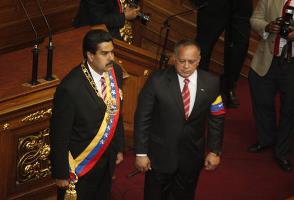
President Nicolás Maduro’s inauguration last Friday marked a new stage in the contest between chavistas and the Venezuelan opposition.  Maduro’s surprisingly weak showing at the polls – winning by a meager 1.8 percent margin despite the huge (and abused) advantages of incumbency – plus tensions within his party and his own rhetorical excesses, suggest that chavismo without Chávez confronts challenging odds.  Chávez attracted more votes alive than he could in death, as his hand-picked successor could not match his patron’s appeal at the ballot box.  Looking forward, Maduro and the Partido Unido Socialista de Venezuela (PSUV) will be judged on the basis of their performance.  The road ahead will not be easy for Maduro, as the government  confronts growing economic and security problems, and his ineffective campaign may energize potential competitors from within Chavismo.

Henrique Capriles’s strong showing in the election bodes well for the opposition.  However, athough Maduro’s blanket reference to them as “fascists” is absurd, their apparent eagerness to use the vote recount – reluctantly agreed to by the electoral council hours before Maduro’s inauguration – to remove him from office could breathe life into his allegation that the opposition consists of  golpistas obsessed with taking power.  Overreaching could be their undoing, as it has been in the past.

Latin American presidents, through a UNASUR statement of support and participation in the inauguration, have endorsed Maduro’s ascendance to the Presidency.  Their strong interest, for a variety of reasons, is in a balance between continuity and change in Venezuela. Although there are signs that both Chile and Colombia wavered momentarily, South American governments overall were united in their preference for a chavista government, as this would favor both  internal and regional stability.The United States, on the other hand, has appeared timid.  Maduro’s accusations of U.S. attacks on him and the presence of Iranian leader Ahmadinejad at the inauguration made it impossible for Washington to send a senior emissary to the swearing-in.  Yet the evident absence of the United States, even after the UNASUR endorsement, was petty.  Through statements calling for a recount of 100 percent of the votes both the State Department and the U.S. Ambassador to the United Nations came across as unable to outgrow a grudge match with Chávez or to grasp that the American position would isolate Washington once again from prevailing sentiment in South America.

There were two winners in the Venezuelan election:  Maduro, who is now the elected President, and Capriles, who managed to secure nearly half the votes in the face of overwhelming odds.  The latter comes out ahead in the long run, but only if he manages his cards wisely.  Washington, meanwhile, seems still not to understand two things:  First, after Bush v. Gore, it will be at least another generation until Americans can say anything about how to count votes.  It was legitimate and appropriate for the OAS to demand a recount, as its record in election monitoring is impeccable.  Secretary General Insulza achieved the core objective of the Organization and should be recognized for having done so.  For the American government to have taken the position that it did suggests an inability to understand the consequences of the 2000 election in Florida for its credibility in election-related issues in the region.  Second, democratic change in Latin America is typically an evolutionary process.  This may be less satisfying to some policymakers who would prefer to see a foe’s outright defeat, but it may be better, for Chavismo’s enemies in both Washington and Caracas, than having their favorite step in at this particular time of high tensions.  If Capriles and his coalition can brand themselves as democratic reformists rather than golpistas, they have a good chance of coming to power when Maduro’s six-year term is exhausted, or even before, and if they convey a message of responsible opposition, key South American governments might well approve of an alternation in power the next time around.

South America and the United States after Chávez

By Tom Long

Banco del Sur | Photo by: Presidencia de la N. Argentina | Foter.com | CC BY

Banco del Sur | Photo by: Presidencia de la N. Argentina | Foter.com | CC BY

In many depictions, South America’s relations with the United States have been structured around Hugo Chávez for much of the last decade.  So it is natural for the region to wonder where U.S. policy will head now that he is gone.  In the Bush Administration’s framework – which the Obama Administration has largely continued – Chávez and his closest allies in Ecuador, Bolivia, and Argentina were an emerging anti-American axis.  Colombia and Chile were considered Washington’s last bastions of support, and Brazil under Presidents Lula and Dilma variously positioned itself as a quiet moderator or, on occasion, private fan of the estrangement between the unruly ALBA countries and the United States.  With Chávez’s passing, the narrative will change.

Although Chávez’s charisma, boundless energy, seductive regional pride, and resumption of Venezuela’s traditional oil subsidies made him larger than life, the depth and endurance of his influence was exaggerated by friends and foes alike.  Elements of his vision of a “Bolivarian” Latin America united in resisting U.S. influence have always been present and always will be, but the dynamic Chávez sought, with himself at its center, seems likely to fade fast.  Bolivia’s President Morales was the closest to being a protégé, but even he has been compelled by domestic politics to give priority to relations with Washington. Ecuador’s President Correa was never as close to Chávez and largely steered his own independent course. Chavez’s detractors had tired of using him as a foil as well.  For years no Latin American leader had found tangling with Caracas – thereby giving Chávez the attention he craved – to be worthwhile.  Since Álvaro Uribe’s departure, even Colombia, apparently taking a cue from the oil-hungry United States, has made trade a bigger priority than criticizing its erratic neighbor.  Many high-profile Venezuelan initiatives for the continent, such as the Banco del Sur, fizzled.  Despite Chávez’s role in their founding, even UNASUR and CELAC had grown away from his personal leadership.

Concerns in Washington that someone will take Chávez’s place as counterweight to U.S. influence seem at least five years out of date.  There is no candidate with both the desire and ability to assume Chávez’s mantle.  Just as the benefits of close cooperation with the United States have declined, most leaders have little to gain from overt conflict.  South American international relations have already grown considerably more complex, as countries developed their own responses to Chávez without taking orders from either Washington or Caracas.  The trend of increasing autonomy is natural and, in ways, inevitable – even though it may be irksome to some in Washington, who are skeptical of Latin Americans’ commitment to what Washington thinks should be a shared interpretation of democracy, trade and counternarcotics policy.

Brazil’s Counternarcotics Policy Challenges

By Tom Long

Minister Alexandre Padilha meeting to discuss policies against crack | Photo by: Ministério da Saúde | Flickr | Creative Commons

Long a significant market for cocaine – the second or third largest in the world according to estimates – Brazil is suffering a major increase in crack cocaine use.  Visible in the centers of major cities, drug abuse has become a more serious national concern as Brazil prepares to mount the world stage as host of the 2014 World Cup and the 2016 Rio Olympics.  Brazil was slow to recognize the problem as it grew to epidemic levels, surpassing the United States as the largest consumer of crack cocaine, according to a recent report from the Federal University of São Paulo.  While national and local authorities have emphasized their recent approach to drugs as focused on public health – in contrast with the U.S.-led, supply-oriented policies – Brazil also has increased control and interdiction efforts.  According to the UN, cocaine seizures by Brazilian security tripled between 2004 and 2010.

The effort to control the flow of cocaine into and through Brazil will test both the country’s diplomacy and state capacity.  Its long, undefended and sparsely populated borders touch every major narcotics-producing and ­transiting country in South America, and cooperation in addressing the problem varies widely for political reasons and disparities in capabilities.  For example, the government of President Evo Morales in Bolivia has declined Brazilian requests for crossborder eradication, InSight Crime reported.  Other countries’ counternarcotics focus is almost completely internal, such as in Colombia and Peru.  As a result, Brazil is increasing action on its own.  President Dilma Rousseff supports plans to spend some $400 million on an expanded fleet of unmanned aerial vehicles, or drones, to provide surveillance of its borders.  Military patrols have increased, albeit in necessarily limited areas.

Experts have long warned that the “balloon effect” of counter-narcotics policies – when successful drug operations push the trade into less-defended countries and regions – was going to worsen the flow and use of narcotics in Brazil, and Brazil has long sought ways, within its resources, to collaborate.  When U.S.-Bolivia cooperation deteriorated in 2009-2010, for example, Brasilia tried to fill some of the void.  Brazilian diplomats have usually tried to lead quietly, build consensus, and avoid obvious pressure on neighbors.  However, as concerns grow, domestic politics could push Brazilian leaders to be more assertive, with the potential benefits and risks that would entail.  The challenge will be for them to find ways to collaborate on a common drug strategy with often skeptical neighbors while making gains to reduce internal demand.  Four decades of U.S. experience provide a cautionary tale.

Cumbritis and Prospects for Latin American Regionalism

By Carlos Portales
Washington College of Law and Center for Latin American and Latino Studies

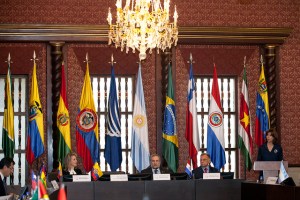
UNASUR Cumbre by  Globovisión | Flickr | Creative Commons

UNASUR Cumbre by Globovisión | Flickr | Creative Commons

Latin America has experienced a veritable proliferation of presidential summits (cumbres) in recent years, an indication of how the hemisphere’s complex web of regional ties is shuffling the landscape of multilateral organizations. This trend was manifested in the Nov. 16-17 Iberoamerican Summit in Cadiz, Spain, followed in quick succession by summits for UNASUR on Nov. 30 and MERCOSUR on Dec. 7. The New Year will witness two summits in Santiago, Chile, the first between the European Union and Latin American and Caribbean States, the second among Latin American and Caribbean States (CELAC).  While sometimes useful in isolation, the cumulative impact of these meetings may be less than the sum of its parts. Indeed, the region may be suffering a bout of cumbritis that is as distortive as it is productive.

The Cadiz summit reflected Spanish determination to sustain an Ibero-American bloc amidst its own profound crisis. Spain’s investments in Ibero-America, particularly in banking and telecommunications, are keeping alive important sectors of the Spanish economy. When the VI UNASUR Summit met in Lima two weeks later, the Presidents of Argentina, Brazil, Venezuela and suspended Paraguay were all absent. Still, the meeting reaffirmed UNASUR’s role in political and military matters: UNASUR was active in the crisis in Paraguay, sent its first-ever electoral mission to Venezuela, the South American Defense Council provides coordination in defense industries and natural disaster responses, and aspires to support protection of human rights.

The following week in Brasilia, MERCOSUR formally incorporated Venezuela and signed an adhesion protocol with Bolivia. However, as Tom Long wrote in “Mercosur’s future: Whither economics?” on Dec. 18, MERCOSUR’s expanding breadth masks a lack of depth. The trade bloc has not agreed on a common external tariff, and integration has stalled as Argentina and Brazil adopted unilateral protectionist measures both during and after the global financial crisis. Though its market is growing, MERCOSUR’s ability to negotiate with third parties is limited. The countries most interested in boosting trade have split off on their own under the loose Pacific Alliance (PA), whose Presidents met on the sidelines during the Cadiz summit. Chile, Colombia, Mexico and Peru have set high targets for the reduction of customs duties and plan on reducing visa requirements for their citizens while already having FTAs with the US and Europe.  Chile and Peru have reached similar accords with China and other main Asian countries. However, the Alliance is primarily an informal gathering of free-trade-minded presidents, and so far institutionalization is minimal.

Brazil is leading South America-centered institutions (UNASUR and MERCOSUR) when it perceives that these suit its interests; The Venezuela-led ALBA has lost steam due in part to President Chavez’s illness; the PA process remains low-key and trade centered. Meanwhile, the Organization of American States risks irrelevance. Its robust human rights system has come under attack from ALBA countries and others, while four ranking members of the U.S. Senate Foreign Relations Committee have lambasted its leadership publically. The OAS may not be unsalvageable, and it remains potentially useful, though that potential will only be realized if the United States endeavors to support rather than undermine its efforts.

And Summits alone will not ensure the success of any of these multilateral forums: increasingly ubiquitous conversations among presidents can be effective for defusing immediate crises and for establishing guidelines for cooperation, but their long-term impact on policy coordination will be limited if they are not matched by analogous cross-national dialogue among key government ministries. The symptoms of chronic cumbritis lie in the failure of many presidential declarations to result in concrete advances in cooperation.