Mexico: Will AMLO Bring a “Fourth Transformation” or Return to Authoritarian Past?

By Daniela Stevens*

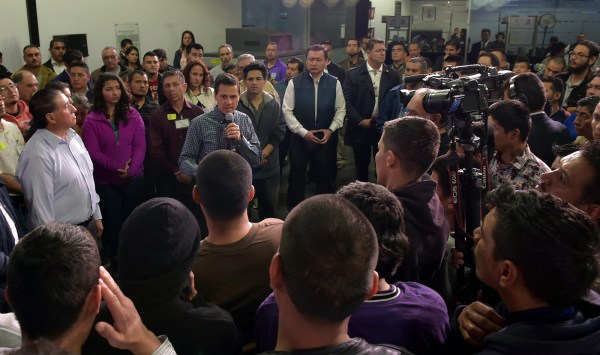
President-Elect Andrés Manuel López Obrador / Eneas / 500px / Creative Commons

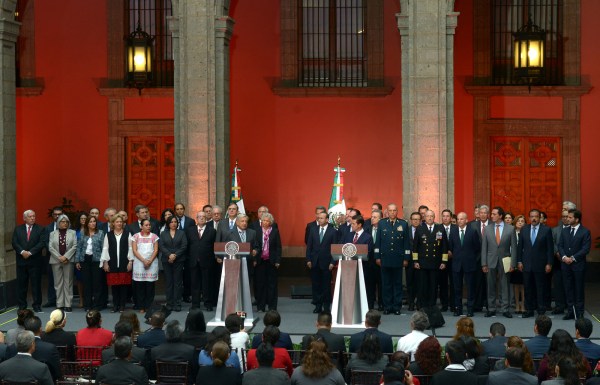
A week before his inauguration, Mexican President-elect Andrés Manuel López Obrador (AMLO) continues to stress his commitment to be a “good president” and leader of the country’s “Fourth Transformation,” but some of his early actions suggest that he will challenge political pluralism and destabilize the investment environment.  His sexenio could have a rocky start both politically and economically.

  • AMLO’s handling of a “national consultation” over the ongoing construction of Mexico City’s new international airport – a project that he criticized as corruption-laden – raised red flags about his intended governing style. Most observers say the consultation was unconstitutional and, with only one percent of registered voters participating, inconsistent with the President-elect’s pledge to respect the “people’s will.”  AMLO’s reaction to the criticism – asking “¿quién manda?” (who governs?) – was widely interpreted as a sign that the airport maneuver was not about careful financial planning but rather political power.  He held another referendum last weekend, a “consultation” with citizens on 10 projects on which he seemed to have made up his mind beforehand.  These referendums seem intended to legitimize his intentions and enhance his power.
  • He and his party, Movimiento de Regeneración Nacional (Morena), appear to be moving ahead with plans to increase control over public spending, eroding institutional checks on presidential power. The Morena majority in the Tabasco state congress, for example, last month approved a provision empowering the next governor, also from Morena, to assign public works and acquisitions directly, without public bidding.  If the Supreme Court does not deem the reform unconstitutional, the administration will build a refinery in Tabasco without any review of the integrity of the process.
  • To reduce imports of gasoline and natural gas, AMLO plans to halt oil exports and reserve production for national consumption only, as well as to build a new refinery and modernize six existing ones. Critics say such policies reflect an outdated vision of national sovereignty closely tied to oil, and that they would directly diminish Mexico’s creditworthiness, endanger the finances of state-owned Petróleos Mexicanos (Pemex), and, according to Moody’s, result in a two percent decrease in GDP.  Additionally, oil experts say, the emphasis on refining would detract from important efforts to expand exploration and production.  The country cannot immediately meet domestic demand for crude.  Similarly, the transition team seems to disregard the potential of renewable energies and the need to electrify transportation.

Morena proposals to reduce the autonomy of regulatory agencies are scaring investors as well.  A Morena Congressman, for example, is pushing to incorporate the energy sector’s regulatory agencies into the Secretariat of Energy, subordinating them to greater political control.  Although AMLO did not publicly support the initiative, his appointee as Secretary of Energy, Rocío Nahle, has already asked the director of the National Commission of Hydrocarbons, one of the regulatory agencies, to step down three years ahead of schedule.  Given its debt and deficits, Pemex can ill afford to strain its partnerships with private capital.

It’s too early to assess how many of these actions reflect AMLO’s and Morena’s inexperience or a considered approach to governing, but the incoming leadership so far seems unaware or unconcerned that such measures undercut their stated vision of ushering in a “Fourth Transformation” on a par with the country’s three previous ones – independence (1810–1821), the Reforma wars (1857–1861), and revolution (1910).  The hints of authoritarianism, alongside decisions to appoint single-representatives in the states and to maintain a pervasive military presence in the streets, suggest AMLO’s tenure may indeed transcend history – as a government not different from the priista centralized governments of the 20th century, and the militarized calderonista administration (2006 2012) he vehemently criticizes.  After 1997, when the hegemonic Partido Revolucionario Institucional (PRI) – from which AMLO had already defected to lead the leftwing Partido de la Revolución Democrática (PRD) – lost the majority of the Chamber of Deputies for the first time, political analysts and academics pointed out the disadvantages of divided governments in presidential systems, such as political gridlock.  A unified government under AMLO, however, may not be the answer for Mexico either, unless progressives in Morena committed to democracy and its institutions find a way to restrain his impulses and keep his government on a democratic path. 

November 27, 2018

* Daniela Stevens is a Ph.D. candidate in Political Science in the School of Public Affairs at American University.
U.S.-Central America-Mexico: Migrant Caravan Shaking up Relations

By Fulton Armstrong

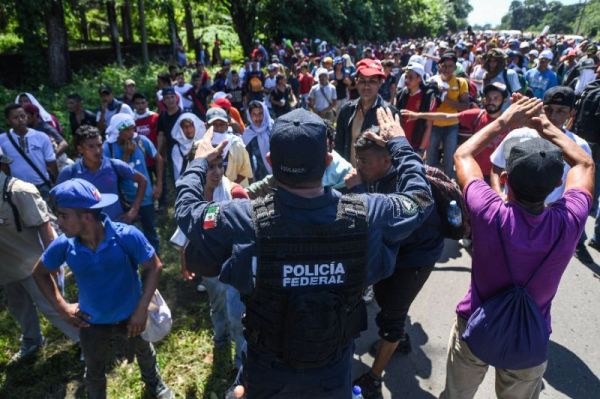
Honduran migrants meet with Mexican police in Chiapas

Honduran migrants meet with Mexican police in Chiapas. / Pedro Pardo / AFP Photo / Creative Commons

The underlying drivers of Central American migration remain the same as always – the lack of economic opportunity and strong institutions to protect citizens from violence and other threats – but the Trump administration’s accusations and threats in reaction to the caravan of migrants heading toward the United States is moving relations into uncharted territory, just two weeks after the parties congratulated themselves for progress made at a summit in Washington.

  • Honduran, Guatemalan, and now Mexican authorities have been unable to stop the peaceful caravan of 5,000-7,000 people without violating their rights and causing ugly incidents with high political costs at home. After shows of force, Guatemalan and Mexican border guards allowed them to pass, and local businesses and churches have spontaneously provided food, water, and shelter in each town.  Mexico originally said it would allow only those with current passports and identification to apply for refugee status, but, citing obligations under international agreements and national law, relented.  The migrants are now in Chiapas.

At a meeting with U.S. Vice President Pence and Secretary of State Pompeo on October 11, leaders from Central America’s three “Northern Triangle” countries – Honduran President Hernández, Guatemalan President Morales, and Salvadoran Vice President Ortiz – and Mexican Foreign Minister Videgaray trumpeted the progress that they had made in slowing the flow of migrants from the region to the United States since launching the Alianza para la Prosperidad in 2014.  CLALS research, other studies, and many press reports show, however, that the underlying drivers of migration remain essentially unchanged.

  • The Alianza may eventually foment economic growth and jobs, but multidimensional poverty and high underemployment continue to drive many to flee their homeland. An analysis by the Instituto Centroamericano de Estudios Fiscales (ICEFI) shows that about 6.2 million children, adolescents, and young adults in the Northern Triangle lack access to an educational system.  Homicide rates have declined, but the region remains one of the most violent in the world.  UN estimates show a steady increase in the number of gang members in all three countries, up to 20,000 each in El Salvador and Guatemala.  The gangs often fill voids left by government institutions that are underfunded and, often, weakened by corrupt officials’ embezzlement.  While violence has long been a driver of migration from urban areas, it is now causing new patterns of migration from rural areas as well.  Domestic violence and abuse, which UN data indicate affects up to 40 percent of girls and 16 percent of boys, is another problem some parents want children to escape.
  • President Trump has not acknowledged these drivers, and instead has portrayed the migrants in the caravan as an “onslaught” of criminals. (He also claimed that “unknown Middle Easterners” are among them but later admitted “there’s no proof of anything.”)  He apparently calculates that stirring up fear helps his allies in the U.S. Congress as midterm elections approach, as well as his campaign for a new wall on the U.S.-Mexico border.  He has threatened the Northern Triangle governments and Mexico for not stopping the migrants, tweeting Monday that he will “now begin cutting off, or substantially reducing, the massive foreign aid routinely given to [them]” because “they did nothing for us. Nothing.”  Mexican officials, relieved that the confrontation over the NAFTA renegotiation was resolved, now fear another major disruption in bilateral relations.

The migrant caravan is testing the administration’s relations with its closest allies in Central America.  Trump’s jettisoning of the nice talk from Pence’s recent summit will not in itself harm ties; the Central Americans and Mexicans are aware of his impulsive streak and may calculate that they can weather the windstorm.  His accusations and threats to suspend aid, however, reveal a fundamental misunderstanding of the underlying drivers of the migration, and he seems unaware that his partners have been unwilling to undertake the political and economic reforms needed to address those drivers except in minor ways that U.S. aid enables.  Trump apparently thinks his partners should use force – even the military if needed (as he’s threatened on the U.S. border) – to stop the flight of humans from the miserable conditions in which they live.  He also apparently judges that the more migrants are made to suffer, such as through the separation of family members who manage to cross the border, the less likely they are to try.  The caravan’s provocations and Trump’s reactions could blow up the game that has allowed both sides to pretend the problem will go away with token programs, intimidation, and a wall.

October 24, 2018

Mexico: Is Centralization the Way to Battle Corruption?

By Daniela Stevens*

A large group of people stand on a stage.

Mexican President-elect Andrés Manuel López Obrador (center left) meets with current President Enrique Peña Nieto and members of his cabinet during the transitional government period. / Presidencia de la República Mexicana / Flickr / Creative Commons

Half way through Mexico’s five-month transition period, an effort by President-elect Andrés Manuel López Obrador (AMLO) to increase central government oversight over states’ affairs suggests an agenda that may go beyond the “republican austerity” he frequently calls for.  His plans to lower the numbers and salaries of high-ranking bureaucrats have been well received, but he raised hackles when he announced plans to appoint a single federal representative – a delegado – to liaise with each of the 32 states, eliminating the 20 to 30 central government representatives that until now have been dispersed throughout each jurisdiction.  He claims the measure is to save on the bureaucracy payroll, but many observers are concerned it will concentrate more power in his own hands.

  • Criticism has already forced AMLO to repackage his plan somewhat. He uses mixed language to refer to the responsibilities of the delegados.  While he has strongly defended his legal ability to appoint a single delegado, he more recently reassured aggravated governors that his representatives would maintain “institutional relations” and respect local elected officials’ autonomy and authority.  Olga Sánchez Cordero, AMLO’s appointee as Secretary of the Interior, further clarified that the delegates would only be in charge of social development programs, constituting a “layer of proximity to citizens” currently or potentially enrolled in social programs.  Under AMLO’s proposal, delegados would take over all kinds of programs, including youth scholarships, conservation efforts, health care, and social security programs for special populations – a herculean portfolio for a single representative.
  • Critics argue that the appointment of single delegados reporting directly to AMLO will undermine federalism. Electoral and administrative decentralization were integral to Mexico’s long democratization process.  For decades, the president was not only the predominant force over the legislative and judicial powers; he also appointed governors from the hegemonic party to the states.  The delegados would potentially create a power structure that parallels and rivals that of the state governors.  Some governors argue that the constitution does not recognize intermediate authorities, and wonder whether persons with partisan agendas will get too deeply involved in local budgets and policies.  In addition, the position would be coveted for its discretionary power and direct link to the president – giving politicians from AMLO’s party, Morena, a leg up as potential candidates for governor.

If done right, however, the measure could alleviate the plague of corruption that permeates the states, and the governorships in particular, and which AMLO has repeatedly condemned.  Governors routinely abuse their powers and engage in serious acts of corruption and financial crime.  As Agustina Giraudy has documented, undemocratic governors have used their offices to perpetuate “subnational undemocratic regimes” in the wake of Mexico’s 2000 transition to electoral democracy at the national level.  Former Governor Javier Duarte, of Veracruz, stole hundreds of millions of dollars from the public budget, and others, like Humberto Moreira in Coahuila, left their state with large debts.  Oversight from an anti-corruption executive in Mexico City might not necessarily be a bad thing.

Ideally, state legislatures – rather than the president or his delegado – would constitute the brake on governors’ decisions, providing a real counterweight anchored in local political dynamics.  AMLO’s efforts to turn Mexico into an “authentic democracy” will miss the mark – and amount to a crass political move – if the transformation does not include an institutionalization of leadership.  His party, Morena, is extraordinarily dependent on his personal leadership; it is an amalgam of politicians who abandoned other parties or joined it because of personal ties to him.  AMLO, who plans to preach integrity by example, cannot alone be the foundation of the “fourth transformation” he purports to lead (the first being independence, the second the “Reforma,” wars, and the third the 1910 Revolution).  With institutionalization, AMLO and Morena could put appointees and delegados through a transparent, legal vetting process – based on merit – and give them clear, legal operational responsibilities.  Failing that, their reforms may prove to be a primarily partisan project.

September 14, 2018

* Daniela Stevens is a Ph.D. candidate in Political Science in the School of Public Affairs at American University.

Trump on NAFTA: An Offer Canada Can’t Refuse?

By Malcolm Fairbrother*

Chrystia Freeland meets with Mexican President Enrique Peña Nieto

Canadian Foreign Minister Chrystia Freeland meets with Mexican President Enrique Peña Nieto in July 2018. / Presidencia de la República Mexicana / Flickr / Creative Commons

U.S. President Donald Trump’s threat last week to abrogate free trade with Canada while signing a new bilateral agreement with Mexico alone has led many to think that NAFTA – which will be 25 years old on January 1, 2019 – has no future.  But the likeliest outcome remains just a set of fairly modest changes to the agreement.  Much of Trump’s bluster on NAFTA does not reflect the facts in U.S.-Canada-Mexico trade, though Canadian officials will still have to take his threats seriously.  Canadian Foreign Minister Chrystia Freeland, whose government sat out the United States’ renegotiation of NAFTA with Mexico this summer, rushed to Washington after the bilateral accord was announced, launching new talks with U.S. counterparts.  While Trump has said he will make no concessions, Freeland has continued seeking common ground, and looks ready to compromise on at least some issues.

  • The best econometric studies suggest that North American free trade has had disappointingly modest benefits – nowhere near advocates’ earlier projections. But the transition costs of moving to a world without free trade would still be enormously costly for Canada.  The economic and political risk of the highly unlikely, but not completely inconceivable, scenario of losing NAFTA entirely are just too great for the Canadian government to bear.

Canada, which in past negotiations stood up for Mexico on some key issues, now finds itself in the ironic position of looking to Mexico for support.  The two countries are often in a position to benefit from working together, but Trump’s wrath has tempted each to throw the other under the bus – a classic prisoner’s dilemma.

  • In the last few weeks, Mexico decided to give the U.S. what it wanted: most importantly, protectionist rules of origin for autos and textiles, and some enhanced intellectual property rights. Mexico calculated that, compared to Trump’s threats not long ago to kill NAFTA in its entirety, these concessions were a modest price to pay to keep the agreement alive.  Also importantly, Mexican leaders appear to have avoided a national humiliation of epic proportions – putting an end to Trump’s dream of getting Mexico to pay for the wall he wants to build on the border.
  • Looking for a much-needed “win,” Trump has now made an offer he thinks Canada can’t refuse. His wish list covers things Canada specifically fought hard for in the original free trade talks back in the 1980s and 90s, including protections for Canada’s cultural industries and agricultural supply management programs, and what Canada’s trade minister said in 1992 were “the vitally important dispute settlement provisions” of Chapter 19.  Now, just as Canadian opponents of free trade forewarned in the 1980s, Canada’s economy has become so enmeshed with that of its much larger neighbor that the government cannot say no to the demands of an aggressive administration in Washington.

Yet the situation does not spell disaster for U.S.-Canada trade or for Canada itself.  Trump’s claims notwithstanding, the U.S. Congress has final say over U.S. trade policy, and most of its members (with business lobbyists whispering in their ears) recognize that severing the many economic ties built up between Canada and the United States over the last quarter-century would be unnecessarily disruptive and costly.  Freeland and her negotiators will know that Trump’s threat to kill free trade is not really credible.

  •  Even caving on all of Trump’s demands would not be catastrophic for Canada. Contrary to Trump’s zero-sum perspective on trade (like on everything else) as an international battleground, most of the important conflicts with respect to trade are actually within countries.  Canada’s supply management system favors the country’s producers at the expense of consumers, for example, just as do strict rules of origin for U.S. textiles manufacturers.  So while the transition costs of dismantling free trade in North America would be substantial, the impacts of the changes Trump is proposing would be tolerable to all three countries – even if some make no sense (the sunset clause); are just giveaways to specific industries (stricter patents for pharmaceuticals); or favor some industries at the expense of others (U.S. lumber producers and U.S. home builders, respectively, as regards the possible elimination of Chapter 19).  For Canada’s government, the heaviest costs of compromise will be political: Justin Trudeau’s Liberal government will have to choose which bitter pill to swallow, as any concessions will lead to angry recriminations from one domestic constituency or another.

September 7, 2018

* Malcolm Fairbrother is Professor of Sociology at Umeå University and a researcher at the Institute for Futures Studies, both in Sweden.  He is originally from Vancouver, and has been a visiting researcher at multiple institutions in all three countries of North America. He has also participated in the Center’s North America Research Initiative.

Mexico: Tough Congressional-Executive Relations Ahead

By Daniela Stevens*

Piñata with the Mexican flag in the background

Bandera mexicana en el Zócalo de la Ciudad de México / Wikimedia/ Creative Commons

Whoever wins Mexico’s presidential election on July 1 probably will face a divided and cantankerous Congress – especially if, as appears likely, Andrés Manuel López Obrador of the Morena Party is the victor.  López Obrador has been ridiculed by the Mexican political class, some of whose leaders have called him the next Hugo Chávez, but most polls give the polemical candidate at least a 10-point lead over Ricardo Anaya of the coalition Por México al Frente.  In Congressional races, polls also give the advantage to López Obrador’s party and its coalition partners, including Partido del Trabajo (PT) and Partido Encuentro Social (PES), under the joint banner of Juntos Haremos Historia.  According to the Parametría poll, 32 percent of respondents intend to vote for Morena, five percent for PT, and two percent for PES.  Other polls give them higher numbers.

  • The formerly hegemonic Partido Revolucionario Institucional (PRI) appears likely to fall to third place due to President Peña Nieto’s poor performance and the party’s association with corruption, while the Partido de la Revolución Democrática (PRD), traditionally the largest leftist party, would be the fourth.
  • Under the most likely post-election scenarios, López Obrador’s coalition would constitute the largest minority in the Chamber but still fall short of the 51 percent absolute majority, except perhaps by the thinnest of margins. Under Mexico’s mixed electoral system – with both majority and “proportional representation” determining the allocation of Congressional seats – the larger parties lure the smaller ones into coalitions, but unity is often seriously challenged during legislative and other battles.

The traditional categories of left and right are growing obsolete in Mexico, as parties and candidates increasingly resort to opportunism rather than act based on loyalty to any particular ideology or party.  Personal and political grudges also often trump political agendas.

  • As a result, an alternative scenario may emerge in which alliances shift after election day in a way that enhances López Obrador’s power. Tensions between the left-leaning PRD and López Obrador, who was its leader for many years, were so deep that the candidate split with it and created Morena as a party in 2014, but opportunists in the party could well jump ship and join him if he wins by a comfortable margin.  In the PRI also, frustration with party leadership could also prompt defections, and López Obrador – a prominent Priista in the 1970s and 1980s – could also harness their backing.
  • Party switching from one election to another has long been a common practice of politicians in Mexico, but only recently have representatives switched parties in the midst of legislative periods. In particular the PRD’s ranks significantly dwindled as legislators elected under its rubric defected to join Morena. Were this to be replicated later this year or next, López Obrador’s congressional majority could be larger than polls suggest.
  • Party discipline in Mexico has been comparatively higher than in other multi-partisan presidential systems such as Brazil, because of the constitutional prohibition of consecutive reelection. In the past, incumbents did not have incentives to serve their constituencies because their careers depended strictly on party leaders, who centralized nominations to elective positions.  From 2018 on, representatives in both Chambers may run for reelection.  The promise of a Morena candidacy can fuel even more defections into its ranks if the party keeps growing its electoral base.
  • If Morena achieves such dominance, the Congress’s commissions, the equivalent of U.S. Congressional committees, could be important partners of López Obrador because the executive delivers proposals directly to them, and they, in turn, issue the final dictamen that the plenary votes on. Juntos’ influence in the commissions would translate into a fairly unexamined prioritization of the presidential agenda.

Even a comfortable victory on July 1 will not assure López Obrador a readily compliant Congress.  Most legislators in the Por México al Frente coalition, which includes PAN, PRD, and Movimiento Ciudadano stalwarts, will certainly constitute an obstructionist opposition.  How successfully they can sabotage the president’s agenda will obviously depend on their numbers, but unity in opposition to Constitutional amendments required by some of his campaign promises appears certain.  Constitutional amendments require a two-thirds majority in both chambers of Congress and in a majority of state legislatures – unachievable in any likely political configuration during a López Obrador administration.  His proposals for revocation of presidential tenure, lowering high-ranking officials’ salaries, and reversing education reforms– which would require Constitutional amendments – thus appear dead on arrival.  Absent reliable Congressional support, López Obrador would also have difficulty passing essential budget and revenue bills and gaining confirmation of important appointees such as the attorney general and key prosecutors.  No candidate would have an easy Congress, but the Mexican parties’ willingness to set aside petty divisions and coalesce behind pressing issues, at least early in the presidential term, appears lower than ever before.  Thus, López Obrador would have a lot riding on the willingness of some sectors of the opposition to defect.

May 24, 2018

* Daniela Stevens is a Ph.D. candidate in Political Science in the School of Public Affairs at American University.

U.S.-Mexico: Trump’s Misguided Approach to NAFTA Renegotiation

By Robert A. Blecker*

Three people stand at podiums with flags behind them

Canadian Foreign Minister Chrystia Freeland, U.S. Trade Representative Robert Lighthizer, and Mexican Minister of Economy Ildefonso Guajardo (L to R) participate in the fourth round of NAFTA negotiations in Washington, DC in October 2017. / State Department / Flickr / Creative Commons

President Trump has characterized NAFTA as a “win” for Mexico and a “loss” for the United States; his administration is currently working on a renegotiated “deal” that would allegedly reduce the U.S. trade deficit and recapture lost manufacturing employment, but his nationalistic approach fails to recognize the fundamental causes of both U.S. and Mexican economic problems.  In fact, NAFTA was a huge success for President George H.W. Bush and his administration, as it achieved their fundamental goal of enabling U.S. corporations to make products in Mexico with low-cost labor – without fear of expropriation, regulation, or other loss of property rights – and export them to the United States duty-free.  The Mexican government went along because it thought NAFTA would bring in desperately needed foreign investment and provide a growth stimulus, while U.S. and Canadian workers rightly feared that they would lose jobs as a result.  While much discussion has focused on which country “won” or “lost” in NAFTA, that is the wrong way to evaluate a trade agreement.  The two key criteria for judging the accord are which sectors, groups, or interests won and lost in each country, and how it, in conjunction with other policies, has affected long-term growth, development, and inequality in each.

  • Under NAFTA, U.S.-Mexican trade in goods and services has grown exponentially, reaching $623 billion (with a U.S. deficit of $69 billion) last year. However, NAFTA (along with other causes and policies) has contributed to worsening inequality in both the United States and Mexico.  Less-skilled U.S. workers definitely lost, with wage losses up to 17 percent in local areas most exposed to NAFTA tariff reductions.  In Mexico, although consumer gains from trade liberalization were widespread, upper-income groups and the northern region benefited the most.  Real wages for Mexican manufacturing workers have stagnated since 1994.  Labor shares of national income have fallen in both countries since the late 1990s.
  • Domestic policies, exchange rates, financial crises, and the impact of China can make the impact of NAFTA difficult to identify, but effects in some sectors are clear. Mexico gained jobs in automobiles and parts, appliances, electrical and electronic equipment, and seasonal produce.  The United States gained in basic grains, soybeans, animal feed, and paper products.  Although about a half million jobs in automobiles and related industries have “moved” to Mexico, total U.S. job losses in manufacturing (5 million since 2000) have been much more affected by China and technology than by Mexico.  What Trump’s nationalistic rhetoric ignores is that U.S. companies capitalized on these dislocations to raise their profit margins and increase their bargaining leverage over workers and governments both within North America and globally.

Trump’s aggressive posture about NAFTA exploits political discontent with these sectoral effects and the overall worsening of inequality, but the U.S. Trade Representative (USTR)’s key demands in the renegotiation appear unlikely to remedy either problem.  USTR Lighthizer is focused on protection for the auto sector, by requiring higher U.S. content (or higher wages for Mexican auto workers), and on changes to dispute resolution procedures that would favor investment in the United States instead of in Mexico.  At best, these measures could bring back a small number of U.S. jobs; at worst, they could make some U.S. industries less competitive (if costs increase).

All of this debate in the United States ignores the fact that NAFTA has been a huge disappointment for Mexico.  Although export industries like automobiles have prospered, the gains to domestic sectors of the Mexican economy have been limited, resulting in sluggish growth (only 2.5 percent per year since 1994, far below the 7.6 percent achieved in East Asia) and leaving millions in poverty while millions more emigrated to the United States.  Of course, other policies and events (including Chinese competition) played into these outcomes, but NAFTA (and related liberalization policies) didn’t turn out to be the panacea for the Mexican economy that then-President Carlos Salinas promised in 1993.  Yet, in the short run the Mexican economy remains highly dependent on foreign investment and exports to the U.S. market, so Trump’s demands for a revised NAFTA and his threats to withdraw are undermining Mexico’s current economic prospects.  Instead of following Trump’s nationalistic approach, the three NAFTA members should focus on making all of North America into a more competitive region with rising living standards for workers in all three countries.  This would start with policies at home, such as public investment in infrastructure, education, and R&D, that could foster industrial growth, along with redistributive measures like higher minimum wages consistent with each country’s economic conditions.

May 11, 2018

* Robert A. Blecker is a Professor of Economics at American University.

“New Transnationalisms” in Latin American Cinemas

By Dolores Tierney*

Guillermo del Toro speaks on a panel

Mexican director Guillermo del Toro, who won the Oscar for Best Director last month. / Gage Skidmore / Flickr / Creative Commons

When Mexican film director Guillermo del Toro won the Oscar for Best Director for The Shape of Water last month, it was another example of the “new transnationalism” of contemporary Latin American cinemas.  Working across cultures while preserving his Mexican creative identity, del Toro follows in the footsteps of his compatriots, Alejandro González Iñárritu (Best Director for Birdman in 2014 and The Revenant in 2015) and Alfonso Cuarón (Best Director for Gravity, 2013).  An examination in my recent book of these and three other Latin American directors – Brazilians Walter Salles and Fernando Meirelles, and Argentine Juan José Campanella – finds that their work is part of a broader shift toward transnational filmmaking: films made in one country produced with capital, creative input, or paradigms borrowed from another, and actors and directors making films in nations other than their own.

  • To a certain extent, Latin American filmmaking has always involved the use of personnel, equipment, and cinematographic styles from Europe and the United States. This comingling has become more radical, however, since the early 1990s, when neoliberal policies in the three major filmmaking nations – Mexico, Brazil, and Argentina – in particular led to a withdrawal of government financial support for the industry.  State-owned film infrastructures, including film institutes, distribution companies, and theater chains, were dismantled.  Production numbers fell from close to 100 annually in each country to less than ten, and Hollywood films increasingly dominated box offices.  In Mexico, government patronage still contributed to Cuarón and del Toro’s first features, respectively Sólo con tu pareja (1991) and Cronos (1993), but large numbers of directors, cinematographers, and actors left to look for work in the United States film industry.

At the turn of the century, however, production shifted toward a new model of transnational production.  Mexican cinema experienced a box office and critical renaissance because deregulation of movie ticket prices encouraged investment in new U.S.-style multiplex theatres situated in upscale shopping malls and neighborhoods.  Among the hits were Amores perros; Y tu mamá también; El crimen del padre Amaro; and Sexo, pudor y lágrimas.  The new multiplex-goers welcomed a range of Hollywood-derived genre films (romantic comedies, teen films), narratives, and practices (tie-in soundtracks) that reflected Mexicans’ own evolving tastes – finding common ground between Mexican and U.S. culture even if, quantitatively, “Hollywood” films still dominated.  In the same general time period, moreover, Mexican state support shifted toward a new model of privately and transnationally financed filmmaking that includes funds from European countries, other Latin American countries, and the United States.  Iñárritu, Cuarón and del Toro straddled two markets and two cultures, and excelled in both.

  • A similar evolution took place in Argentina and Brazil, with state withdrawal in the early 1990s and then a push to filmmaking in a reformed model of co-production in more recent years. Brazil and Argentina’s most successful domestic films are made with a combination of funds from the state (or state-owned businesses such as Petrobras) and private companies working with foreign partners, such as the Spanish Telefe and U.S.-based Disney affiliate Miravista (in Argentina), and a consortium of foreign firms partnered with Globo in Brazil.

Latin American film critics often lament that the region’s transnationalized cinemas borrow too much from the aesthetic models of the north – the genre templates of the crime film, melodrama, and romantic comedy among others.  But closer analysis shows that, while such artistic appropriation and the international co-producers’ distribution muscle are important, the films’ success also depends on their strong elements of “local exceptionality.”  Transnationally funded artists whose films circulate successfully in Europe and North America have leverage to tackle important sociopolitical aspects of their respective national histories.  Argentine director Lucrecia Martel (La ciénaga, La niña santa, La mujer sin cabeza, Zama) and Peruvian Claudia Llosa (Madeinusa, La teta asustada) are able to get around funding bodies’ prescriptive demands to make films that challenge stereotypes of developing nations.  In his recent Oscar-winning film, The Shape of Water, del Toro has made an English-language adult fairy tale with nods to science fiction, spy thrillers, and the musical, but it is much more than a product of U.S. industry.  It is a transnational film that reflects what del Toro refers to as the contradictions of his Mexican identity – a mixing of the “dark” and the “good” – and explores how Latin American and Latinness function in the U.S. political and racial imaginary.  His transnational film doesn’t diminish his Mexican voice; it enhances it.

 April 2, 2018

* Dolores Tierney is Senior Lecturer in Film Studies at the University of Sussex and former CLALS Fellow.  Her book, New Transnationalisms in Contemporary Latin American Cinemas, was published by Edinburgh University Press last month.

Presidential Elections in Mexico: Tough Campaign, Tougher Challenges Ahead

By Daniela Stevens*

Andrés Manuel López Obrador stands at a microphone

Frontrunner candidate in Mexico’s 2018 presidential elections, Andrés Manuel López Obrador, speaks to the press. / ANDES / Micaela Ayala V / Flickr / Creative Commons

Campaigning for Mexico’s July 1 presidential election officially begins next week, and no candidate appears to have an insurmountable advantage over the others.  Polls vary, but Andrés Manuel López Obrador (MORENA) appears to be the frontrunner, with 35 to 44 percent of support.  He is followed by PAN-PRD coalition candidate Ricardo Anaya, who has between 24 and 31 percent of the vote.  The PRI candidate, José Antonio Meade, seems a third option, at about 20 to 26 percent, and Margarita Zavala, the only independent candidate who officially obtained registry, lags far behind.  It is too early to see if voters will base their decisions on party loyalty or on perceptions of the candidates.

  • López Obrador (widely known by his initials, “AMLO”) has broad name recognition – 84 percent of Mexicans are familiar with him for better or for worse – but Anaya, Meade, and Zavala have an important opportunity to build new images and attract voters. Indeed, AMLO sometimes seems to be in a race against himself; his rhetoric is often harsh, and his disregard for international free trade alienates a large sector of the business world and the media.  His mixed signals regarding a “review” of the contracts made in conjunction with energy reforms have fostered distrust and uncertainty.
  • Ricardo Anaya’s strategy appears likely to be open confrontation with PRI candidate Meade, aiming to attract PRI voters who see him as the candidate best positioned to prevent an AMLO victory. Anaya’s focus has been on winning the endorsement of key figures in states that constitute large electoral strongholds, such as Jalisco.  However, Anaya’s alleged involvement in a money laundering scandal stands to undermine his support.   PRI Secretary General Claudia Ruiz Massieu tried to tar him in an international context last week by giving the OAS a file with evidence she claimed substantiates the charges against him.  Anaya has cried foul.
  • José Antonio Meade, a highly skilled and seasoned technocrat associated with both PRI and PAN presidencies, is being held back by his association with the very unpopular incumbent President Enrique Peña Nieto. He is trying to cast himself as a PRI “sympathizer,” rather than as a party “militant” responsible for recent years’ weak performance.  To distance himself from his party’s image of electoral fraud, corruption, and crony capitalism, he has emphasized his commitment to transform the PRI.  The party is cooperating, framing him as a “citizen candidate.”

While candidates are immersed in the customary personal attacks against each other, violence appears to be playing into electoral politics with renewed intensity.  The Second Report of Political Violence in Mexico, prepared by the risk assessment firm Etellekt, documents 141 attacks against politicians and public servants since the start of the pre-campaign period last September.  Over 50 of these attacks have been assassinations of officials, incumbents, and candidates at all levels of government.  Violence is worst in Guerrero, Veracruz, the State of México, and Puebla, all states with significant organized crime.

Public insecurity is certain to join organized crime, corruption, inequality, and redistribution of income as central in the Mexican landscape as elections approach, and each candidate will pledge to make those issues his or her top priority.  As in other Latin American countries, the election also appears likely to signal the deepening discredit and low representation of the traditional party system.  Voters could very well select a candidate who, while not an outsider, presents him- or herself as committed to attacking the corruption of the major parties.  While running on a law-and-order slate, the candidates will also likely promise new approaches on the “war on drugs” that, led by both PAN and PRI, has devastated the country – with little or no prospect of avoiding the same pitfalls as predecessors.  Winning the election on July 1 will not be easy for any of the declared candidates; governing once in office will be even harder.

March 23, 2018

* Daniela Stevens is a Ph.D. candidate in Political Science in the School of Public Affairs at American University.

Mexico: Migrants Getting Political but Not Driving Reform

By Michael S. Danielson*

A large group of people gathers in an airport.

Returning Mexican migrants are greeted upon their arrival in Mexico by Mexican President Enrique Peña Nieto. / Presidencia de la República Mexicana / Flickr / Creative Commons

Mexican migrants who currently live in the United States or have returned home after spending many years abroad have become an important social and political constituency in the Mexican polity, but they do not uniformly enhance local democracy.  A growing body of research indicates that migrants affect the politics of their home towns and home countries through both direct and indirect channels.  Their departure releases pressure on prevailing authorities to reform, and the prospect of future migration causes citizens to disengage from the political process.  Friendships, alliances, and other contacts allow migrants to become intimately involved in their home communities from abroad as they communicate their attitudes and ideologies among themselves and friends and relatives back home.  Returning home with accumulated social, political, and economic capital also enables them to become influential leaders there.

  • Analysis of the municipalities to which U.S.-based migrants provide financial support, for example, shows that migrants are more likely to contribute where migrant civil society has become more deeply institutionalized at the state level and in municipalities and states with longer histories of migration.
  • A survey of more than 400 mayors in Oaxaca shows that migrants returning to their home communities who become mayors are more likely to be members of the popular classes than their non-migrant counterparts, suggesting that migration might be a pathway to power for non-elite individuals. But the same data also show that migrant mayors are just as likely to align with dominant political groups as with opponents of the status quo, suggesting the limits of their transformative and democratizing potential.

Field research shows different outcomes in different states.  In Oaxaca – where the exclusion of migrants from influence has alienated them from the governing party (an attitude further fueled by their experiences of exploitation and resistance as migrants in Mexico and California) – returnees tend to enter the political fray in opposition to dominant powers.  In contrast, the returning migrants who have been most influential in the states of Guanajuato and Zacatecas have tended to be mobilized by and act in support of the dominant parties in their states.  The institutionalization of the state-migrant relationship in these states facilitates migrant social and political engagement with governing parties.

  • Ethnographic data in 12 high-migration municipalities in Oaxaca, Guanajuato, and Zacatecas indicate, moreover, that the political engagement of returning migrants resulted in increased political competition that, in all but one case, caused factionalism and a divided opposition at best and deep, violent social conflict at worst. In the remaining six municipalities, dominant political actors either incorporated migrants into the prevailing system by establishing neocorporatist equilibria or successfully blocked the influence of migrant actors all together, despite high levels of migration.

Returning migrants’ political influence will only increase.  The historic flow – some 16 million Mexicans entered the United States in the 50 years since 1965 – has been reversed, as more migrants are returning to Mexico than entering the United States.  The economic, social, cultural, and political ties forged between communities on both sides of the border are growing, and the futures of the two countries are more intertwined than ever.  The economic and social importance of migration in some municipalities helps migrant political actors gain influence back home, and it can open up a pathway to local power for historically excluded social groups, even if – as in the cases that I have examinedthis influence has only rarely translated into fundamental changes in the way that politics are done.  The engagement of millions of Mexican migrants in their home towns has not resulted in thousands of political earthquakes, but rather the Mexican political system is incorporating these new actors without instituting fundamental changes to the way that politics are done.

 January 4, 2018

*Michael S. Danielson is CLALS Research Fellow and Visiting Professor at the University of California Washington DC Program.  His new book, Emigrants Get Political: Mexican Migrants Engage Their Home Towns, was published by Oxford University Press.  He has also participated in CLALS’ North America Research Initiative as a Pastor Scholar.

Canada and Mexico Face Uncertainty of NAFTA Renegotiation

By Daniela Stevens*

Two men stand at podiums with Mexican and Canadian flags behind them

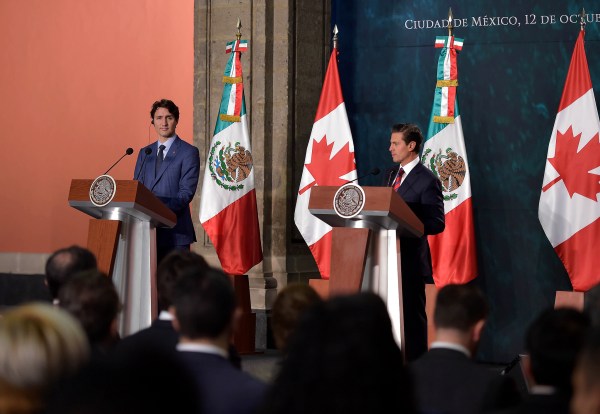
Canadian Prime Minister Justin Trudeau gives a presentation with Mexican President Enrique Peña Nieto during an official visit to Mexico in October 2017. / Presidencia de la República Mexicana / Flickr / Creative Commons

Facing the growing possibility that the Trump Administration is walking away from the North America Free Trade Agreement (NAFTA), Mexico and Canada are beginning to look for trading partners beyond the United States.  The interdependencies binding the three are strong.  Both Mexico and Canada have deep commercial ties with the United States, which imports about 80 percent of Mexico’s exports and about 70 percent of Canada’s.  Both have significant leverage vis-à-vis the United States as well.  U.S. auto and agriculture industries have a major stake in free trade with Mexico, which also provides important cooperation on security issues and controlling Central American migration.  Liberalization measures within the energy sector by the current Mexican administration make Mexico a strategic partner in terms of energy security.  Canada buys about 19 percent of U.S. exports.

But these ties are fraying as conversations drag on.  Trump Administration proposals are hurting the talks; especially contentious are changes in the “rules of origin” (since the United States proposed increasing the U.S. content of autos to 85 percent from the current 62.5 percent) as well as the inclusion of a “sunset clause” that would make NAFTA expire unless it is renegotiated every five years.  NAFTA’s Article 2205 lets either of the three member countries announce its withdrawal from the accord with six months’ notice.  Canadian and Mexican trade officials have not given such notice yet, but they show signs of heading in that direction.  Both have held high-level meetings with counterparts from South America and Europe, according to official and non-government sources.

  • Mexican President Peña Nieto’s administration has expressed a preference for leaving the negotiations over accepting “a free trade agreement that ceases to promote free trade.” President Trump has said that his administration would be willing to negotiate a free trade agreement with Canada alone if the NAFTA talks fail.  However, Canadian Prime Minister Trudeau’s government has stated a preference for keeping the trilateral alive rather than resorting to bilateral agreement, since the terms of the U.S.-Canada deal were more outdated than the NAFTA’s.  The two presidents have been reluctant to take these actions because they apparently believe, as do many experts, that dismantling NAFTA would inevitably create uncertainty and inefficiencies for the three economies.  For example, the auto sector relies on three-way product flows that move several times across borders to be assembled into finished products.  Canadian and Mexican auto parts makers have a direct stake in each other’s dealings with the United States.  Even small duties would add up.
  • Nonetheless, some increased trade and a bilateral free trade agreement between just Mexico and Canada is possible. The two countries originally joined NAFTA to protect their access to the U.S. market, not to obtain access to each other’s.  Canadian public opinion and media reflect continued disinterest in Mexico, which is viewed as unstable due to drug-related criminality and corruption.  However, as the completion of a satisfactory NAFTA renegotiation is unlikely, Canadians are exploring deepening the bilateral link.  Mexican interest in Canada is also growing, according to some specialists.  Beyond North America, moreover, Canadians and Mexicans are exploring trade and investment diversification.  Canada is looking for increased cooperation with Latin America, in particular within the Pacific Alliance, a free trade partnership that includes Mexico, Chile, Peru and Colombia, and of which Canada is already Associate Member.  Mexico started a renegotiation last January of its free trade agreement with the European Union, which parties hope to finalize in the next few days.  It has begun warming up neglected ties with the Southern Cone and has already pledged to deepen ties with China.

Trade experts convened recently within the framework of American University’s Robert A. Pastor North America Research Initiative (NARI) were unanimous that that a trilateral agreement that protects the interests of all three partners would be the optimal outcome, but few observers of the NAFTA talks are confident that the Trump Administration will soften its position.  Canada’s commitment to a trilateral renegotiation should exert more pressure on the U.S. to compromise while strengthening both Canada and Mexico’s negotiating positions.  In the event of U.S. withdrawal from NAFTA, however, the two can expand their trade and investment relationship by lowering barriers further through modernization and e-commerce.  In addition, trade can potentially expand between the two since they have similar approaches to achieving various commitments of the Paris Accord involving energy projects and greenhouse gas emissions reductions.  Pastor Scholars concluded that both countries will have to carry out public campaigns to explain to their constituencies the benefits of continued cooperation, either trilateral or bilateral, if the United States significantly alters or abandons NAFTA.  Mexico and Canada have options outside North America in the quest for trade and investment diversification – even though their preferred scenario is a stronger NAFTA.  China, South America, and the European Union arise as the most readily available partners.

December 21, 2017

*Daniela Stevens is a Ph.D. Candidate in the American University School of Public Affairs and a Pastor Scholar.  Her research focuses on national and subnational policies that put a price on carbon emissions.