From Hope to Harm: Asylum Restrictions and Violence Facing Migrants in Mexico

By Veronica Gomez & Katheryn Olmos

Image of Mexican Flag with a cloudy sky in the background. Retrieved from Wikimedia Commons.

The current Trump administration has exacerbated the challenges faced by immigrants and asylum seekers. The administration signed Executive Order 14159, which effectively banned people from requesting asylum at the U.S.-Mexico border. This EO narrows legal pathways and exposes migrants and asylum seekers to potential violence and fear.

The Immigration Lab has conducted interviews with migrants and asylum seekers who have recently arrived in the Washington, D.C. metropolitan area. Our research has highlighted a series of commonalities in their experiences, both in their home country and on their migration journey.

Mexican Migration

From our interviews, we find that Mexicans migrate primarily for economic and safety reasons. Mexicans migrate to the U.S. in order to access economic mobility that they did not have access to in their home country, or to escape organized crime and the war on drug trafficking.

“Veracruz es muy violento ahora, ajá. Yo salí para rehacer una nueva vida, para hacer un futuro, para darle algo a mi hijo o mi familia, mi mamá y papá… Por esa es la razón de hacerle una casa a mi mamá, mi papá, porque vivíamos en una casa abandonada. Pobre cada que llovía, cada que nevaba, siempre el agua caía en la cama. Nos mojábamos y yo dije ‘algún día yo voy a hacer una casa’… Aunque sea de lunes a viernes o fin de semana, pero trabajar 5 días, lo que sea, [un trabajo] es lo más importante para mí.”


“Yes, Veracruz is very violent right now. I left to rebuild a new life to make a future, to give something to my son or my family, my mom, and dad…. Yes, that’s what I want. Make a house for my mom, my dad because we lived in an abandoned house. Every time it rained, every time it snowed, the water would always fall on our bed. We would get wet, and I said, ‘one day I will build a house’… Even if it is from Monday to Friday or the weekend, whatever. A job is the most important thing for me.

— Mateo, Mexican man, 39

Through our analysis, we were able to identify and describe the journey of people migrating through parts of Mexico on their way to the United States. For many individuals, migrating to the U.S. is not the first option. We have also analyzed interviews where Mexican people have gone through up to 7 different states in Mexico just trying to find employment before deciding their best chance at finding work is coming to the U.S.

A participant from Veracruz, Mexico, named Mateo, who is now living in New York City hoping to find a good job to give back to his family in Mexico, recounted one of his experiences:

“Yo crucé. Salí del DF, agarré un autobús, me vine para Chihuahua, salí para Sonora, cruce la Frontera y llegué a Tucson y de ahí seguí hasta Phoenix, Arizona.”


“I crossed. I left from Mexico City, I took a bus, I came to Chihuahua, it left for Sonora, I crossed the border, and I arrived in Tucson and from there I stayed traveling until Phoenix, Arizona.”

— Mateo, Mexican man 39

Map of Mateo’s Journey. Map retrieved from Google Maps, edited by Katheryn Olmos.

Mexico as a Place of Transit

Many of our participants across different nationalities mentioned Mexico as part of their migration journey, and they noted the dangers faced while traversing the country, even after migrating through the Darien Gap, where they encounter deadly terrain and the remnants of the diseased. Participants shared that that Mexico is the worst part of their journey.

“Porque la selva para nosotros fue– caminar, caminar, caminar. Nos veíamos, por lo menos por donde nosotros pasamos. No vimos ningún peligro de que nos hicieran daño ni de eso. Sino que fue caminar arriesgar la vida en cuanto a los ríos y eso nada más. Pero cuando llegamos a México eran ya las personas que nos querían hacer daño.”


“Because the jungle, for us, was just walking––walking, walking…it was more about risking our lives with the rivers and all that. But when we got to Mexico, that’s when there were people who wanted to harm us.”

— Alison, Venezuelan woman, 32

When travelling through Mexico, our participants encountered cartel activity, including trafficking and extortion. Sofia, a Venezuelan woman who migrated through Mexico, recalled the fear of being kidnapped or killed by organized crime members.

“Lo que pasa es que en México hay muchos–cómo le llaman, narcotraficantes? Algo así. Así que ellos se creen dueños de como que decir del pueblo, entonces si, si tú te arriesgabas o equis y cosas o ellos te agarraban, pues tú, este, te podrían matar, te podrían lastimar incluso cortar una parte del cuerpo, cosas así.”


“The thing is that in Mexico, there are many–what do they call it, drug traffickers? Something like that. They think they own the town, so if… they grabbed you, then you could be killed. They could even cut off a part of your body–things like that.”

— Sofia, Venezuelan woman, 32

These cartels serve as informal gatekeepers. When migrants are moving through Mexico, they will likely go through several checkpoints and encounters with cartel members who typically request a fee from migrants so that they can keep moving.

“Cuando yo estuve en México–no me acuerdo el pueblo–yo caminé mucho, 3 días por una vía de tren, porque nos bajaron los carteles y nos dejaron sin nada.”


“When I was in Mexico–not sure what town–I walked for three days on train tracks because the cartels made us get off and left us with nothing.”

— David, Colombian/Venezuelan Man, 28

If migrants refuse to pay the fee or have no money, they risk “disappearing” or being killed. Sometimes, gang members will rob and kidnap migrants and ask for an outstanding amount of money. Cartel members will ask for an outstanding sum of money.

“Como que en un desierto y [los pandilleros] nos agarraron y ellos nos decían que nos iban a matar. Que querían 3,000 dólares por cabeza.


“It was like a desert, and [the gang members] grabbed us and told us they were gonna kill us. They wanted 3,000 dollars per capita.”

— David, Colombian/Venezuelan Man, 28

Paying organized crime to make the journey to the U.S. border is part of the immigration process, though it is unclear what the relationship is between the cartel and government authorities. Diego, a young Venezuelan man, recalls meeting and paying a cartel member to accompany him to the port of entry where his CBP One appointment was scheduled.

“Tuve que llegar donde otra gente como un mismo cartel, que uno le pagaba una plata para que ellos te dejaban pasar tranquilo y todo. Les pagué y nos estuvieron los dos días que volamos dos días antes y de allí ellos mismos nos trajeron. Nos soltaron allí en el puerto y cuando ya pasé ya pues la felicidad de uno estar aquí ya todo fue, pues mejor.”


“I had to go to some other people, like from a cartel, and I paid them some money because they would let you pass through calmly and all that. I paid them, and they stayed with us during the two days after we flew in, and from there, they themselves brought us. They dropped us off there at the port, and when I crossed, well, the happiness of being here, everything just felt, well, better.”

— Diego, Venezuelan man, 20

Mexico as a Place of Allyship

During the Biden administration, Venezuelans would remain in Mexico for months, even years, before attaining an appointment on the CBP One app. Despite the dangers in Mexico, many of our participants were able to persevere with the help of Mexican citizens. Some good Samaritans in Mexico provided shelter, work, and food to migrants passing through.

No conocía a nadie, nada, o sea mi vida era el trabajo y pues no todos los mexicanos, pero hay unos que sí son muy, muy malos pues con uno… [Una señora] nos propuso, que sí, trabajáramos de las 7 [de la mañana] hasta las 10 de la noche y le dijimos, o sea, le dijimos que sí. Empezamos a vivir allí en casa de pues ella no nos cobraba que si la comida ni nada de eso, o sea, dormíamos allí.  Gracias a Dios nos hicimos muy amigos de ella, y del hijo, y de la hija también. Este y allí no, pues nos hicimos panas del hijo … ya estábamos allí, pues, bien diría yo. Y allí duramos, bueno, allí dure yo todo… ese tiempo. Y trabajé hasta que me salió la cita [de CBP One].”


I didn’t know anyone, nothing—My life was just work. And not all Mexicans, but there are some who are really, really mean to you… [A lady] offered us [a job] from 7 in the morning to 10 at night…we told her yes. We started living at her house, and she didn’t charge us for food or anything like that, I mean, we like, we slept there. Thank God we became really good friends with her, and with her son, and daughter too. And there, well, we became friends with the son… So yeah, we were doing pretty well, I’d say. And I stayed there, well, I stayed there that whole time. And I worked until I got my [CBP One] appointment.”

— Diego, Venezuelan man, 20

David, a Venezuelan man, recalls his time on La Bestia–also known as “The Train of Death”– where passengers are vulnerable to starvation, cold nights, extortion, kidnapping, injuries, and even death.

“Gracias a Dios, mira, nos montamos en esa bestia de al día y medio, teníamos hambre de todo y en ese camino como teníamos como un día y medio en esa bestia montado y pasamos por un pueblo que en el pueblo tiraban cosas a la gente.

Mira eso fue como que, Dios mío, si, yo estaba acostada [un carril] así me cae así, pero en la cara… me cayó fue una bolsa de jamón. Y al ratico tirado, otra de pan, y yo entre mi, ¿Será que estoy soñando o qué? Yo estaba en eso me entiendes. Y pero yo digo ‘Dios mío, señor, yo no puedo creer, ¿será?’

Y me paro yo alegre y… empiezo [a comer], yo me atraganté y ahí mismito que viene mi amigo con una garrafa de agua de 5 litros y [dice], ‘Hermano mira lo que agarré: el agua!’ Y yo, ‘Amigo mira lo que yo tengo aquí!’

Mira eso fue lo yo digo que eso fue uno de los momentos más difíciles de mi vida. Esa hambre y esa sed que yo tenía mira ahí se me quitó todo.”


“Thank God, look, we got on La Bestia, and after a day and a half, we were starving and everything. And on that journey, since we had been on La Bestia for about a day and a half, we passed through a town where people were throwing stuff at folks.

Look, it was like, my God, I had been lying down on [a boxcar], it hit me right in the face… What hit me was a bag of ham. And a little while later, they threw a bag of bread, and I was like, ‘Am I dreaming or what?’ That’s how I felt, you know? And I said, ‘My God, Lord, I can’t believe this—is this real?’

So, I stood up all happy and… I started eating, and I started choking from eating too fast. And right then, my friend shows up with a 5-liter water jug and says, ‘Brother, look what I got—water!’ And I said, ‘Friend, look what I’ve got here!’

Look, I tell you, that was one of the hardest moments of my life. That hunger and thirst I had—man, it all went away right there.”
— David, Colombian/Venezuelan man, 28

Image of people giving migrants bags with food, drinks, and resources for migrants travelling on La Bestia. Retrieved from Wikimedia Commons.

Mexican strangers, yet friends and allies, save lives with their generosity. However, in order to resolve the violence against those who reside in Mexico, the government must take action.

Key Takeaways

It is important in understanding that Mexican migrants are not all the same ––and that Mexican migration is complex. For many, migration is more than a destination, it’s more than Point A and Point B. It is important to understand Mexico as a place of internal displacement and international passage.

The border Texas shares with Mexico is one of the most populated in the country, where both Mexicans and Americans use entry points to go to work, travel, transport commerce, and more. Now, the U.S.-Mexico border faces daily difficulties with the current administration’s immigration policies. Border security and enforcement have largely increased – the image above displays military security from the Mexican Government, with Border Patrol Agents on the other side.

Image of the US-Mexico Southern Border (The Reynosa-McAllen border). Retrieved from CLALS/Veronica Gomez.

The “Remain in Mexico” Policy was implemented by the first Trump Administration, where the Department of Homeland Security requires asylum seekers migrating to the United States by land to wait in Mexico while their cases are pending. This not only puts Mexican border cities, such as Reynosa, in a difficult spot being responsible for them, but most importantly, it puts all immigrants at risk. CBP One partly improved the situation. Now, CBP One no longer works, it is harder for international migrants to arrive at the border, and it is almost impossible to enter by asking for asylum between ports of entry or at ports of entry without passports and visas. Some international immigrants will settle in Mexico, some in a third country, and others will go back to the places they left.

Katheryn Olmos is a Research Assistant at the Center for Latin American and Latino Studies and a graduate student at the Sociology Research and Practice program at American University. 

Veronica Gomez is a Research Assistant at the Immigration Lab and an undergraduate at American University.

Edited by Ernesto Castañeda, Director, and Noah Green, Joseph Fournier, intern at the Center for Latin American and Latino Studies and the Immigration Lab.

Surviving the Criminalization of Migration

by Ernesto Castañeda, Makenna Lindsay, and Natalie Turkington*

Survivor of Ciudad Juarez Migrant Detention Center Fire / Creative Commons License

On March 27, 2023, a fire at a migrant detention center in Ciudad Juarez, Mexico killed 40 migrants and injured 29 more. One of those injured was Justen (pseudonym), a man in his late 20s from El Salvador who lost six of his friends in the fire. Dr. Ernesto Castañeda, Director of the Immigration Lab and the Center for Latin American and Latino Studies (CLALS) sat down with Justen last year to discuss the horrors experienced inside of the center and what happened after. The following testimony reveals the cruelty inside the Ciudad Juarez detention center fire as well as the treatment victims encountered by both U.S. and Mexican officials after the fact. 

Justen mentioned how difficult it was to transit through Mexico. He crossed into Chiapas in a pickup truck under a tarp. Later in Northern Mexico, he was stopped and questioned. He claimed he was from Chihuahua, Mexico but the authorities decided that given his answers, he was not Mexican, and he was taken to an immigration detention center. At the center, people had different rights and access to necessities such as mattresses and water bottles—only if they had money to pay for them. After some of the immigrants complained that they had no water to drink, the officials would reply that it was not up to them to support them and that it was their fault “por andar migrando” for migrating. Some of the people detained got angry, put the mattresses together, and said “if you do not open the doors or give us water, we will burn them.” An agent said, “Que les vaya bien”— “farewell,” as he saw them light the place on fire and left without opening the door.  

When the fire broke out, Justen felt his skin getting too hot, the smoke made it hard to breathe. He ran to the bathrooms to try to get away from the flames and found dozens of people, all crammed together–there was no running water. He and others screamed “Please let us out! “We do not want to die!” However, migration officials did not open the door. Justen recalls that, “the immigration officials did not at any moment try to open the door or call other authorities or ambulances.” Trapped in the bathroom, Justen lost consciousness, thinking he would die being burnt alive.

He later heard people crediting a passing firefighter who saw the smoke, called the fire department, and ran towards the building. Firefighters stopped the fire before everyone died inside. Justen’s burnt but breathing body was brought to Mexico City where he underwent treatment and a hospital stay of over two weeks and was incubated for much of that time. Immediately following his discharge, he had multiple interactions with agents of the Mexican government to arrange lodging for the remainder of his recovery. “When I saw migración [migrant agents] there, I said, ‘Why, why are our aggressors looking out for us?’’ Even in his injured state, Justen recognized the paradox that although migration officials played a major role in his near-fatal condition, they also “helped” him to recover. Ironically, they also helped bring his mother from El Salvador for humanitarian reasons.  

This is not the only striking paradox illuminated by the fire. The fire, namely smoke inhalation and dehydration caused immense damage to Justen’s lungs and kidneys. The doctor told him that 90% organ function would be considered great given the extent of the organ damage; he would likely never recover full function and health. “…I have to keep living and be more cautious of my lungs, airways, and kidneys… if I ever get too dehydrated because this could jeopardize my life.” Indeed, he would often cough while we spoke. 

The sequelae are not only related to his physical health but also to his mental health. In the interview Justen shared that to this day he still hears the cries of people trapped screaming, ‘We don’t want to die! We don’t want to die!’, and his own screams: ‘I don’t want to die! I don’t want to die!’ Six of his travel companions died in the fire. He also expressed the mistreatment and further neglect he endured from the Executive Commission of Attention for Victims (CEAV), and the chronic health problems he must deal with because of the tragedy. 

Following the fire, Justen was allowed to apply for asylum in the United States. Given his condition, Justen was asked about his health care and public services access in the United States. He specifically notes the conditional nature of his asylee status he understood that “…it was a condition of the government that we were in good health and all that and not to be a public charge.” He will not apply to receive disability income and will depend on remittances from his wife in DC and a job the mom can find in Texas.

The acute irony of the situation is that the United States government played a pivotal role in the development of his condition by asking Mexico to more forcefully enforce its immigration policies and to dissuade Central American and other immigrants from reaching the U.S./Mexico border, and yet it granted him asylum as a survivor of a tragedy abroad. Nonetheless, in establishing such a condition, the U.S. evades its responsibility to not only protect migrants but to protect and honor the rights of asylees.  

As discussed in the book “Reunited: Family Separation and Central American Youth Migration,” Justen was on his way to the U.S. in part to reunite with his wife and family who are living in the Washington, DC area. Justen’s wife escaped violence from El Salvador and moved to Nicaragua, but then the situation got unstable in Nicaragua and she came to DC. Justen and his mother were relocated by non-profits to a city in Texas under humanitarian parole and applied asylum, but his wife is undocumented and cannot apply for asylum simultaneously because she was not traveling with him and she was not at the fire. Justen is not in condition to work yet, though his wife has a job in DC and therefore, they still live apart despite both being in the United States. Such family separations show how immigration laws tend to work at the individual level, putting family unity and well-being in a secondary place.  

Violence against immigrants, like that in the Ciudad Juarez fire is a direct result of immigrant restrictionism and the externalization of borders that we see in North America and Europe. There is a need for the public to pay closer attention to the realities experienced by migrants, asylees, and refugees. Unjust treatment which goes unnoticed points to the lack of care taken to uphold the human rights of those on the move.   

For more see: 

Délano Alonso, Alexandra. “Before and After the Juárez Fire.” CLALS Working Paper, no. 45 (2023). https://www.american.edu/centers/latin-american-latino-studies/upload/ssrn-id4655183.pdf 

Brashear, Madeline and Diaz, Sarah and American University, CLALS, No Right to Life: Lives Lost and the Legalized Violence That Shaped a Humanitarian Crisis in the Arizona Borderlands (November 15, 2023). Available at SSRN: https://ssrn.com/abstract=4634297 

Book Review: Migration and Mortality: Social Death, Dispossession, and Survival in the Americas https://www.academia.edu/108876335/Book_Review_Migration_and_Mortality_Social_Death_Dispossession_and_Survival_in_the_Americas 

Guerra, Sofia. Invisible Deaths. https://aulablog.net/2024/03/07/invisible-deaths/  

Copyleft Creative Commons. Reproduction with full attribution is possible by news media and for not-for profit and educational purposes. Minor modifications, such as not including the “About the Study” section, are permitted. 

*Ernesto Castaneda is the Director of the Center for Latin American and Latino Studies, and the Immigration Lab. He conducted the interviews and helped write the blog. Makenna Lindsay, Coordinator of the Immigration Lab, and Natalie Turkington, a Research Assistant with the Center for Latin American and Latino Studies at American University, transcribed and translated the interview, and drafted and edited this blog. 

Blinken and Mayorkas visited Mexico to Discuss Migration

By Ernesto Castañeda

January 11, 2024

Republicans in Congress are denying funding to Ukraine and Israel over migration and border security, but the premises and assumptions used to discuss the issue fail to take the following elements into account.

It is hard to determine if numbers are really without precedent. There has been a change in that immigrants come and turn themselves in to try to come in with a legal immigration status, such as through asylum or the regularization programs available to Ukrainians, Afghans, Cubans, Haitians, Venezuelans, Nicaraguans, and other groups. In previous decades, many low-skilled workers knew there were no avenues to enter legally and would try to pass undetected and live undocumented in the United States. That is less common today for so-called low-skilled, recently arrived immigrants. So, an imaginary example would be to count people who once would mainly drive to New York City for the holidays and then compare them to a time when most people would arrive via plane. It would be easier to count the people arriving on planes, but that would not necessarily mean that there are more people arriving now by plane than the ones who arrived driving in the past. 

Historically, numbers are not comparable because, before Title 42, apprehensions were counted versus encounters afterward. Previously, most apprehensions would happen inside the U.S., while today, most people present themselves in groups and in a visible manner at ports of entry, along the physical border, or in front of the border wall. Another important difference is that in the past, undocumented workers relied on established family members and networks to get provisional housing and food and find a job. Many recent arrivals may not have close people in the United States and are actively asking for temporary housing and food from city governments. The U.S. does this for refugees and has done it in the past for Cubans and others escaping repressive regimes. Research and history show that these short-term expenses have been good investments, given that refugees and immigrants are more likely than U.S.-born individuals to work, start businesses, and be innovative leaders. Republicans in Congress have denied requests from the White House to provide funding to cities to cover some of these costs.

Some propose detention as deterrence, but prolonged detention in the United States is very expensive and mainly benefits the companies or workers providing and managing detention centers.

A misconception repeated in the media is that most people are immigrating illegally. That is technically incorrect because people are presenting themselves to immigration authorities. Many migrants are applying to legal programs, asking for asylum, or being placed in deportation proceedings.

The situation that we are seeing at the border and some of the solutions proposed indicate some important points that have been rarely discussed,

1) Border walls do not work. Smugglers can cut them, and people can walk around them or come in front of them on U.S. territory. 

2) People are turning themselves in, so contrary to what Trump said recently, authorities know where people are from and where they are going. They have notices to appear in immigration court, and they register an address in order to receive notices and updates if they want to continue with their asylum process and regularize their status. In the past, a great majority of people go to their migration court hearings.

3) CBP One appointments are too cumbersome to make, and there are not enough slots available, so people are showing themselves at ports of entry and between them.

4) The parole program for Haitians, Cubans, Venezuelans, and Nicaraguans is working to create a more rational and orderly process. Taking the program away —as Republicans in the Senate want—would make things worse. 

5) Putting more pressure on Mexico to deport more people and stop them from getting to the border is unsustainable. Mexico cannot manage the issue by itself unless it gets pressure and funding from the U.S. and international organizations, like Colombia does, to establish immigrant integration programs for immigrants who want to stay in Mexico, and it provides paths to citizenship for them. 

Thus, Blinken, Mayorkas, and their companions and team’s visit to Mexico is important. Mexico has been a willing partner, agreeing to take people from third countries under the Remain in Mexico and Title 42 programs, but those programs could only work temporarily. Mexico has also increased the number of deportations. However, deportation only works if people are unwilling to try multiple times. Increasing immigration surveillance, deterrence, and deportation does make arriving in the U.S. harder. It also makes it more expensive and thus attractive for organized crime to get involved in it as a business, thus getting more people to the border once they figure out the business model and logistics even with new policies in place. 

Mexican President Andrés Manuel López Obrador has asked for a regularization of U.S. relations with Cuba and Venezuela. There have been positive steps with Venezuela already. This could be a good opportunity to remove Cuba from the list of states sponsoring terrorism, which would reduce some of the emigration pressure in Cuba. 

Mexican authorities have disbanded many caravans and slowed the trek of thousands of migrants. Nevertheless, people who are escaping violence and persecution or have sold everything will try to get to the United States. 

Long-term ways to address the root causes of migration are to continue providing international aid and supporting democratic institutions. One has to keep in mind human rights. The Mexican Supreme Court of Justice has found that profiling people suspected to be migrants in buses to be unconstitutional. To engage the Mexican Army is not the solution either.

The silver lining is that despite the images we see in the news and seasonal peaks, it is not as if all the world is on the way to the U.S.-Mexico border. Most people want to stay home.

Congresswoman Delia C. Ramirez (IL-03)

Congresswoman Delia C. Ramirez (IL-03) presenting immigration policies the Congress could be working on instead.

In the January 10 hearing towards impeaching DHS Secretary Alejandro Mayorkas, Republicans repeated many myths, cliches, and anti-immigrant talking points but did not propose any sensible solutions. It was remarkable that Democrats in the committee saw the political nature of the exercise, and many offered actual solutions to improve the situation at the border and inside the United States in a way that makes the immigration and asylum processes more humane and above ground.

Ernesto Castañeda is the Director of the Center for Latino American and Latino Studies and the Immigration Lab at American University.

Creative Commons license. Free to republish without changing content for news and not-for-profit purposes. 

Takeaways from the North American Leaders Summit and Biden’s Visit to Canada

Editorial

By Ernesto Castañeda*

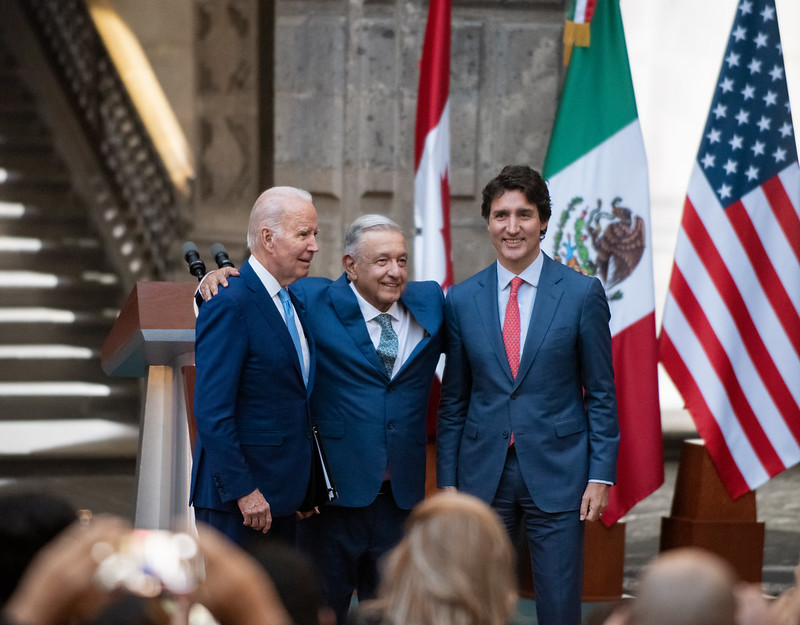
North American leaders, Andrés Manuel López Obrador, Justin Trudeau and Joe Biden, met in Mexico for the 10th North American Leaders’ Summit /Eneas De Troya /Flickr/ Creative Commons License

President Joe Biden conducted his first trip to Mexico in the context of the North American Leaders’ Summit on January 10, 2023. These summits started with George W. Bush in 2005 and did not take place at all while Trump was President. The 2021 and 2023 meetings signal a return to thinking of and valuing the North American region as such. The discussions were best when they decoupled local political considerations, common challenges, and regional opportunities. Three points toward integration are described here.

  1. President Joe Biden, Canadian Prime Minister Justin Trudeau, and Mexican President Andrés Manuel López Obrador (AMLO) discussed the advantages of further integrating supply chains within the region. Labor costs in China have gone up, and the pandemic showed that relying on long-distance shipping can delay things during crises, epidemics, and international disputes. There was a push for nearshoring, meaning having an increasing proportion of essential and high-value products manufactured in Canada, Mexico, and Central America rather than Asia. Concrete efforts were mentioned to increase manufacturing in the region within the context of the regional trade agreement USMCA, which includes regulations, respects local preferences, and supports specific sectors and products. Thus, during the summit, Biden and Trudeau were able to look past Mexican President Andrés Manuel López Obrador’s protection of PEMEX, Mexico’s oil company, and specific controversies about car manufacturing. Furthermore, Biden, Trudeau, and López Obrador discussed the desire for further integration beyond trade. The Mexican President mentioned in his closing speech that Mexico will be represented in planned regional integration meetings by Foreign Minister Marcelo Ebrard, Finance Minister of Mexico Rogelio Ramírez de la O, Secretary of Economy Raquel Buenrostro Sánchez, and independent businessman who represents the business community, Alfonso Romo Garza. During the meetings, Prime Minister Trudeau was accompanied by his wife, Sophie Gregoire Trudeau, Minister of Foreign Affairs Melanie Joly, Minister of International Trade Mary Ng, and the Minister of Public Safety Marco Mendicino. President Biden was accompanied by the First Lady Dr. Jill Biden, Secretary of State Anthony Blinken, National Security Advisor Jake Sullivan, U.S. Ambassador to Mexico Ken Salazar, U.S. Ambassador to Canada David Cohen, Secretary of Homeland Security Alejandro Mayorkas, Special Presidential Advisor for the Americas Chris Dodd, Secretary of Commerce Gina Raimondo, and National Security Council Senior Director for the Western Hemisphere Juan Gonzalez. The size and high profile of the entourage show the seriousness of these talks and the intentions to communicate further and coordinate around shared challenges and regional integration.
  2. The three leaders emphasized that migration is a regional process requiring a regional approach. Biden and Trudeau recognized their history and reality as countries of immigration. Canada emphasized its desire to welcome new people to keep growing its population and economy. Biden recognized the history of the United States as a country built largely by immigrants. The Mexican President missed an opportunity to acknowledge that in the last hundred years, a substantial number of people moved to Mexico from places like Spain, Chile, Argentina, Cuba, Lebanon, Guatemala, and the United States. There were mentions about the need for Mexico to become the place where some of the people from the hemisphere should receive asylum and be allowed to settle legally long-term. The three heads of government also stressed a safe, humane, and legal entry for migrants through more legal pathways and shared responsibility as advocated for in the Los Angeles Declaration. Additionally, Biden announced the monthly legal entry of 30,000 migrants from Cuba, Nicaragua, Haiti, and Venezuela with appropriate sponsors, background checks, and airplane flights. Generally, they recognized that the people who emigrate do it as an option of last resort. They expressed the humanitarian need to help create ways to migrate more safely than is currently possible for many.
  3. Prime Minister Trudeau and Presidents López Obrador and Biden committed to collaborating on climate change and promoting racial equity, diversity, and inclusion, including collaborating with marginalized populations to fight violence against Native women and girls and expand the protection of LGBTQI+ people. Regarding climate change, the three nations promised to reduce methane emissions by 15% by the end of 2030, develop a plan to cut food loss and waste in half by 2030, and create trilateral infrastructure for EV chargers. The three leaders also spoke about their support for democratic practice and condemned the events on January 8 in Brazil. Biden and Trudeau spoke about how a feature and strength of their democracies is their diversity. Overall, most of the meetings were about strengthening ties and facing shared challenges pragmatically and collectively. The demeanor was friendly, forward-looking, and about partnership. As Justin Trudeau said, “We are stronger together.”

Where are we two and a half months later, when Biden visited Canada?

Biden spoke about the interconnectedness of the U.S. and Canadian economies, sports leagues, and people. Saying that “the U.S. and Canada share one heart.” Both spoke about green jobs and more regional manufacturing with unionized jobs.

Nevertheless, the attention was focused on asylum seekers. President Biden referred to the Los Angeles Declaration and the importance of helping migrants as a region. Canada announced the orderly welcoming of 15,000 immigrants from the Western Hemisphere. However, the discussion about the official announcement underlines “irregular migration” while mainly talking about people seeking prompt and secure asylum. Cable media commentary often referred to an agreement to address “illegal arrivals” to Canada by people asking for asylum. Nonetheless, asking for asylum is a right that people have under U.S., Canadian, and international law. The issue is that some have arrived away from official ports of entry and then approached authorities to announce themselves and exercise their right to ask for asylum proactively. Under the new agreement, Canada can send migrants back to the United States if they have not applied for asylum in-country first and vice versa. This agreement further weakens the right to asylum in North America and criminalizes those seeking it. The often-mentioned record numbers are probably inaccurate regarding legal and undocumented migrants as a proportion of the population. Still, an increasing number of asylum seekers from Ukraine, Afghanistan, Haiti, Cuba, and the Americas are arriving at land borders. The announcement of this agreement with so much fanfare constitutes a narrowing of asylum avenues and conceding to the Canadian opposition’s framing of immigrants and asylum seekers as “burdens.” It contradicts the speeches of Biden and Trudeau at the North American Leaders Summit in Mexico City on January 10 and Biden’s speech at the Canadian parliament, which recognized the many contributions immigrants make and have made to both countries.

President Biden noted the continued interest of the U.S. and Canada in supporting democracy in the Western Hemisphere.

In the meantime, the Mexican President did not appreciate messages of alarm from the north about the proposed changes to the independent Mexican electoral agency (INE) and other signs of de-democratization. In turn, AMLO spoke about the possible criminal charges against Trump being politically motivated. He also wrongly stated that Mexico is safer than the U.S. after the killing and disappearances of U.S. citizens and legal permanent residents in Mexico.

Therefore, a few months after the North American Leaders Summit, we see how some leaders are more concerned with national politics, popularity polls, and elections than working with other countries to face common problems. At the same time, working meetings about regional cooperation also serve as a reminder that despite nationalistic and isolationist presidents (like Trump was), civil servants continue working with their counterparts to make sure that regional trade, tourism, migration, consular relations, and educational and cultural exchanges continue.

March 28, 2023

*Ernesto Castañeda is the Director of the Center for Latin American and Latino Studies, Immigration Lab, and the MA in Sociology Research & Practice.

Fact-checking and editing by Karen Perez-Torres. Copy-editing by Mackenzie Cox.

CC BY-ND: This license allows reusers to copy and distribute the material in any medium or format in unadapted form only, and only so long as attribution is given to the creator. The license allows for commercial use by news sites. 

U.S. Immigration Debate Skewed by Bad Statistics

By Ernesto Castañeda*

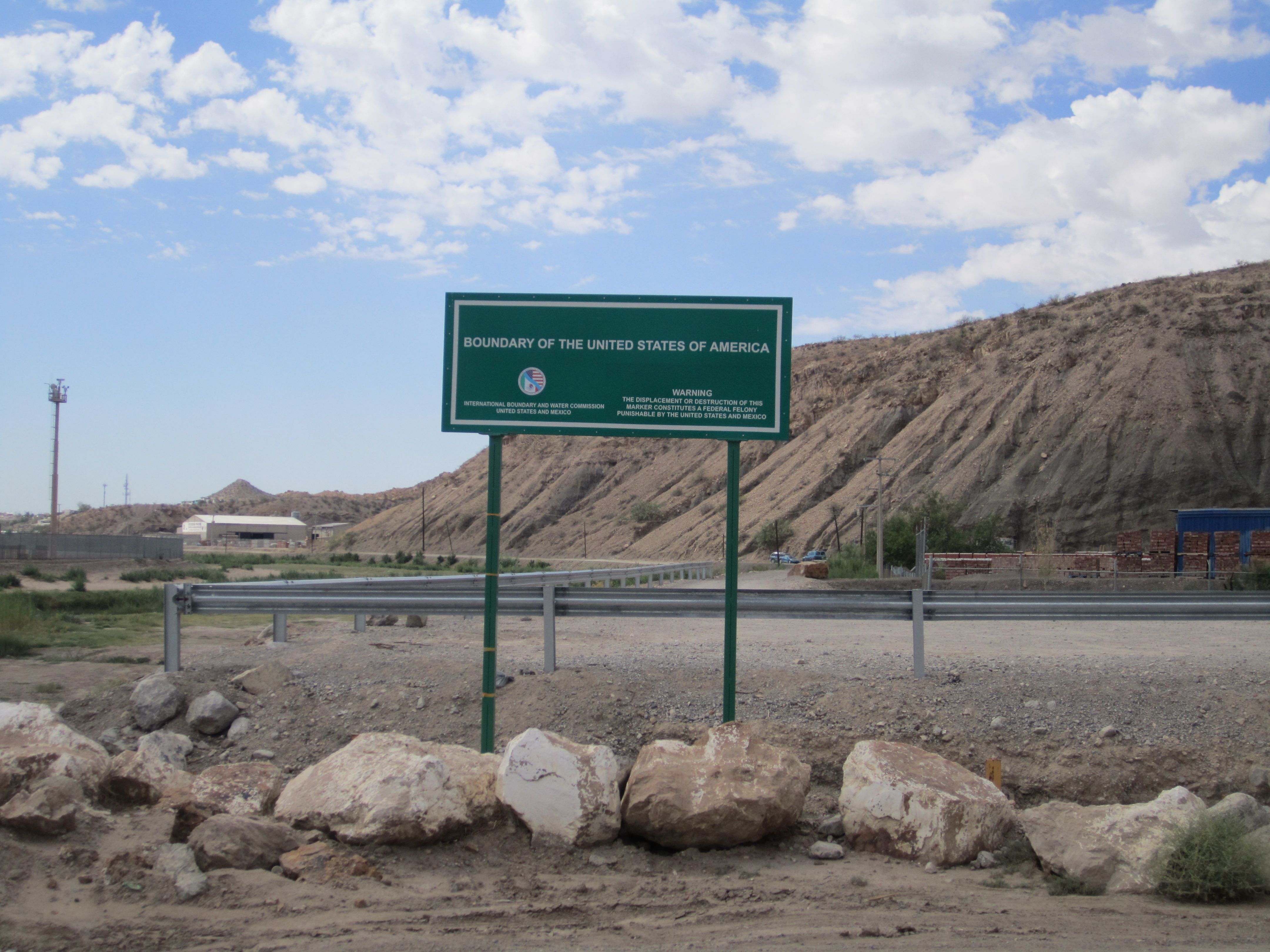
Sign demarcating US and Mexico territory on the southern US border in El Paso, Texas / Ernesto Castañeda / Creative Commons License

Immigration figures have long driven heated political debate in U.S. politics – even worse in recent years – but the data often exaggerate the problem because the responsible government agencies are double-counting and media reports are analyzing the numbers incorrectly. Opponents of President Joe Biden claim that over 2 million undocumented immigrants have entered the United States each year since he became President. The numbers reported by relevant agencies should not drive headlines or be interpreted as stock tickers about whether immigration is up and down, but the data become political footballs serving generally anti-immigration political interests.

Border encounters involving people without immigration papers are just a small subset of all immigrants, emigrants, visitors, and border crossing commercial and tourist activity – almost 300 million over the past 12 months. Analysis of the numbers about border crossers reported by the U.S. Department of Homeland Security requires clarification of what it considers “encounters.”

  • Because many people enter multiple times, the figures also reflect double-counting of many of the same individuals – sometimes more than five times each. Those of certain nationalities can be quickly removed and returned to Mexico for various reasons without adequate recording of their names and other details, making it impossible to know how many people are counted multiple times. Even those repatriated after a judge determines they do not qualify for asylum, humanitarian parole, or other special visa often try again and count as another “encounter.”
  • “Encounters” do not equal unique individuals but rather interactions between asylum-seekers or migrants and DHS personnel anywhere along the border. The U.S. Government reports, for example, that 1 million-1.3 million migrants were removed from the United States under Title 42 provisions intended to protect U.S. health in the context of the COVID pandemic – almost half of the total reported “encounters.” So “encounters” do not equal individuals entering the U.S. either.
  • The numbers include individuals whom the United States normally welcomes, including 140,000 unaccompanied minors looking to reunite with family members in the country, and over 20,000 Ukrainians. Russians and Afghans are in a similar situation. Cubans no longer are fast-tracked for permanent residency under the Cuban Adjustment Act, but the U.S. government cannot deport them because neither Mexico nor Cuba will take them back. Hundreds of thousands of Venezuelans, Haitians, and others are fleeing situations that most U.S. observers consider intolerable.
  • Comparing year-on-year figures is also deceptive. During 2020, the acceptance of asylum-seekers came almost to a halt. The pandemic, Title 42, and the “Remain in Mexico” program (under which individuals who pass a “credible fear” screening are forced to stay in Mexico while awaiting a hearing) created a backlog and bottleneck for the normal mobility that had occurred in previous years. Shifts in DHS accounting between years have also exaggerated the impression of a surge.

Other observers have confirmed migration specialists’ concerns about the over-counting. Syracuse University’s Transactional Records Access Clearinghouse (TRAC), which monitors the staffing, spending, and enforcement activities of the federal government, reported in September that detention data released by Immigration and Customs Enforcement (ICE) “is, once again, riddled with errors.” TRAC found “egregious” mistakes in several data categories that led the agency to seriously misrepresent conditions in its public statements.

While the U.S. government’s bad information makes precise calculations of migrant flows impossible, what is sure is that the total number of distinct individuals entering the United States without documentation is much less than 2 million a year. More credible estimates are that –after accounting for thousands of deportations – probably less than half a million people have been allowed in.

  • Among them, some were granted asylum – a right under U.S. and international law. Many others are welcome refugees and asylum-seekers like those from Ukraine and Afghanistan. Many others are waiting their turn in immigration court. Therefore, most of those included in this estimated half-million are in the United States legally, and the government knows who they are and where they live. By definition, they are not “illegal” or hiding. Allegations by a Texas senator and others that “4.2 million illegal immigrants have streamed across the border” since Biden took office are simply not true.

* Ernesto Castañeda teaches in the Department of Sociology in the College of Arts and Sciences.

Latin America: Lessons Learned from Abortion Rights Struggle

by Brenda Werth and Katherine Zien*

A protestor tying green scarves to a fence at a pro-abortion demonstration in Argentina / Fotomovimiento / Flickr / Creative Commons license

With the U.S. Supreme Court apparently poised to strike down Roe v. Wade, U.S. supporters of women’s reproductive rights could learn from the strategies of their Latin American counterparts, who have made important advances even if they still feel they must struggle for implementation. The decision will put the United States out of step with global progress being made in sexual and reproductive rights, according to the Secretary General of Amnesty International. In the last 25 years, around 50 countries have increased legal access to abortion. Latin America, a traditionally Catholic region, has been at the forefront of decriminalizing and legalizing abortion rights.

  • In 2012, Uruguay legalized abortion of fetuses up to 12 weeks. In January 2020, Argentina became the largest Latin American nation to legalize abortion, allowing pregnancies to be terminated up to 14 weeks. Mexico followed suit and decriminalized abortion in September 2021, and in February 2022, Colombia decriminalized abortion up to 24 weeks. Chile, if its new Constitution is approved, will be the first country in the world to make abortion a constitutional right. While abortion rights are more limited in 10 countries in Latin America and the Caribbean, these represent major strides forward.

The progress in Latin America comes on the heels of a revolution in gender and sexuality rights across the region catalyzed by feminist mobilization against gender violence and femicide in movements and street protests such as NiUnaMenos (Argentina), Un Violador en tu camino (Chile), and NiUnaMás (México). Abortion rights – framed as crucial to protecting reproductive health – were integrated into a preexisting human rights framework. Feminist groups have argued that the prohibition of access to legal and safe abortion is an act of gender violence.

  • The path toward legalization is clearest in Argentina, where a human rights culture created initially by groups like Madres de Plaza de Mayo during the last dictatorship (1976-83) led to feminist movements such as NiUnaMenos and the Marea verde (Green Tide), symbolized by the green handkerchiefs donned by supporters of the Campaign for Legal, Safe and Free Abortion. The Campaign also used inclusive language to expand the definition of those entitled to abortion rights to include anyone capable of gestation, including gender non-conforming individuals. The struggle has also been intergenerational (Barbara Sutton, “Intergenerational Encounters”). Sometimes referred to as the “revolución de las hijas” or “las pibitas,” a young generation including high schoolers took to the streets and transformed public spaces and social perceptions of abortion rights in Argentina.
  • Abortion rights in Argentina thus intersected with progressive legislation on gender and sexuality rights. In 2020, President Alberto Fernández, who described abortion as “a matter of public health” during his campaign, introduced the bill in Congress legalizing abortion. His predecessor, conservative President Mauricio Macri (2015‑2019), had allowed the bill to be debated in Congress, and before him, left-wing President Cristina Fernández de Kirchner (2007‑2015) supported progressive legislation on sexual and gender rights even though she refused to support abortion reform because of personal views.

The “doble militancia” (Debora Lopreite, “The Long Road”) – the popular mobilizations and political coalition-building pushing for reproductive rights as issues of human rights, public health, and social justice – contributed to Argentina’s landmark law. Activists continue to be vigilant, however, as abortion access has been hindered by opponents and the high percentage of doctors, particularly in the northwest provinces, who declare themselves “conscientious objectors.”

  • Argentina’s path has been very different from that of the United States. The right to abortion in the United States was nested within the umbrella of privacy rights and became a federal policy via the judiciary rather than the legislature. U.S. activists have not strategically framed it as a human right firmly in the context of public health and social justice. To achieve lasting change, they could shift discourse away from abortion as a single issue, an anti-religious position, or an abstract philosophical debate, and situate it firmly in the context of public health and social justice. Grassroots social mobilization across generations, strategic coalition-building, and transversal relationships between activists and policymakers don’t guarantee irreversible change, but they are more reliable drivers of change than the shifting political winds affecting Supreme Court justices.

June 9, 2022

* Brenda Werth is an Associate Professor of Latin American Studies and Spanish at American University. Katherine Zien is an Associate Professor of Drama and Theater at McGill University

North America: More Support Than Meets the Eye

By Malcolm Fairbrother, Tom Long, and Clarisa Pérez-Armendáriz*

Mexican President Andrés Manuel López Obrador (L) and Canadian Prime Minister Justin Trudeau (R) join President Joe Biden for the North American Leaders Summit (NALS) at The White House/ The White House/ Flickr/ United States government work

U.S., Canadian, and Mexican leaders’ support for North American integration has ebbed and flowed in the years since the North American Free Trade Agreement (NAFTA) was signed in 1994. But our analysis of some previously little-known polls taken a few years ago shows that, even when support for trade integration and other big-picture institutional initiatives has been weak, interest in some forms of cooperation has been relatively strong in all three countries.

  • Discussions of North American integration have been fraught from the beginning. Fiery debates over NAFTA in the early 1990s meant politicians had to work hard to sell regional cooperation. Canadian politicians’ approach to North America has been pragmatic, low-key, and mostly bilateral with the United States. U.S. politicians gave North American cooperation a tepid embrace at best, until Donald Trump turned to repeatedly badmouthing NAFTA and both neighbors. Although Mexican political and business leaders’ enthusiasm for NAFTA has cooled in recent years, and President Andrés Manuel López Obrador is a longtime NAFTA critic, they have made a reluctant peace with its regional economic structures.

Perceptions of NAFTA as a political loser paint too dark a scenario for North American cooperation. Though U.S. views briefly soured and polarized in 2016-17, strong public support for the agreement’s successor – the U.S.-Mexico-Canada Agreement (USMCA) – suggest those negative views were short-lived. North American cooperation beyond trade enjoys robust support. Our analysis of surveys conducted before the “Trump shock” shows that respondents in Canada, Mexico, and the United States have long favored more cooperation in a variety of areas, albeit with a few important qualifications. In our recently published study, Areas, Sovereignty Costs, and North Americans’ Attitudes Toward Regional Cooperation, we show: 

  • The three countries share strikingly similar aggregate levels of support for free trade. But levels of support for regional coordination in six different issue areas – currency, energy, defense, economic affairs, environment, and border security – vary by issue and country, and are often higher. For respondents, it matters “on what” North America cooperates in ways that questions about trade and NAFTA do not capture. For example, there was significant support in all three countries for regional policy coordination with respect to environmental protection and border security.
  • Mexicans show the highest level of aggregate support for regional cooperation, but also the greatest variation by issue area, suggesting that they are attuned to the potential costs and benefits of cooperating in an asymmetrical region. Only Mexicans express much support for North American currency coordination, but they showed comparatively little desire for cooperation in energy. They are strong backers of border and environmental cooperation.
  • Although Canadians are skeptical of the benefits of some aspects of the relationship, they also identify cooperation on the border and environment as worth pursuing. Canadians expressed the lowest average support for policy coordination. In contrast to their government’s approach, Canadians slightly prefer trilateralism to bilateralism. Indeed, Canadians, Mexicans, and Americans don’t always want to cooperate trilaterally. Americans report stronger support for regionalism with Canada alone, rather than trilateral cooperation with both Canada and Mexico. 

North America is a highly asymmetric, U.S.-centric region. That shapes patterns of public attitudes as Canadians and Mexicans are concerned about national vulnerabilities vis-a-vis the United States. Mexican citizens’ support appears to be shaped by perceptions that Mexico stands to gain from regional cooperation on many shared problems that Mexico struggles to address alone, such as the environment and border security. Still, support for coordination in the United States also was comparatively high for border security, perhaps a result of politicians’ dramatizing a supposed U.S. inability to “control” the border. 

  • Paying attention to the issues where public support exists and overlaps may allow supporters of regional projects to build on firmer – albeit narrow – ground.

March 22, 2022

Malcolm Fairbrother is Professor in the Department of Sociology, Umeå University and the Institute for Futures Studies, Sweden, and the Department of Sociology, University of Graz, in Austria. Tom Long is Associate Professor in the Department of Politics and International Studies, University of Warwick, UK and Affiliated Professor in the División de Estudios Internacionales, Centro de Investigación y Docencia Económicas, Mexico. Clarisa Pérez-Armendáriz is Associate Professor the Politics Department and Program in Latin American and Latinx Studies at Bates College, USA. This article, part of the Robert A. Pastor North American Research Initiative, draws on “Issue-Areas, Sovereignty Costs, and North Americans’ Attitudes Toward Regional Cooperation,” published recently in Global Studies Quarterly. The underlying surveysRethinking North America, were conducted in 2013 by Miguel Basáñez, Frank Graves, and Robert Pastor. 

Mexico: Setting a “New Social Ethic” of Sustainability?

By Veronica Limeberry*

Maize plot using agro-ecological options in Mexico/ International Maize and Wheat Improvement Center/ Flickr/ Creative Commons License

Mexican President Andrés Manuel López Obrador’s decree phasing out the use of the herbicide glyphosate and genetically modified (GMO) corn has strong support in Mexico – for now – and could conceivably show a way ahead on sustainable development for other countries. Announcing the decree on New Year’s Eve, AMLO framed it as creating a “new social ethic” in food production that puts the wellbeing of the Mexican people before the interests of private companies and profits. The government is moving ahead with implementation of the decree this month despite rapid and harsh pushback from Mexican and U.S. agribusiness. The U.S. Farm Bureau Federation, whose members sell GMO corn to Mexico, appealed to U.S. Agriculture Secretary Vilsack to oppose Mexico’s move.

  • Advocates of sustainable development have long opposed the use of glyphosate, the world’s most commonly used herbicide. The chemical was declared a probable carcinogen in a 2015 World Health Organization (WHO) report. Concern about glyphosate has surged in Mexico since a 2019 study by the University of Guadalajara found that all 148 children in the study had glyphosate in their urine, and all had chronic health conditions. The herbicide’s producer, Bayer-Monsanto, is in the midst of one of the largest settlements in history ($10.9 billion) involving tens of thousands of suits claiming that it causes cancer and death. Despite these growing concerns, glyphosate sales grew from $3 billion in 2015 to $8.5 billion last year, and industry watchers forecast them to be over $13 billion by 2027.

AMLO’s decree on GMO corn also reflects growing interest in Mexico to reclaim the country’s agricultural biodiversity. Mexico is the center of origin of over 59 food varieties, including corn, beans, squash, and cocoa. Mexican corn has long been part of the country’s national identity. The campaign Sin Maíz No Hay País (Without corn there is no country), launched more than a decade ago, embraces the grain as “the basis of our culture, our identity, adaptability and diversity.” Nonetheless, Mexico imported 18 million tons of GMO corn from the United States in 2020, comprising 40 percent of corn consumption. Seeking to reverse this, progressive deputy agriculture minister Víctor Suárez led the push for the decree and emphasizes “achieving self-sufficiency and food sovereignty.”

The decree includes radical terminology and establishes agroecology as national policy informed by Mexican food identity and traditions. AMLO and Suárez have defended its emphasis on sustainable, ethical, and increased food production “through the use of agroecological practices and inputs that are safe for human health, the country’s biocultural diversity, and the environment, as well as congruent with the agricultural traditions of Mexico.” The measure has the support of rural communities and both houses of Congress.

  • Some of the AMLO Administration’s rhetoric seems intended to provide leadership to other countries seeking alternatives to herbicides like glyphosate as well as GMO foods while trying to decenter the needs of industry. Numerous studies point to agrarian crises in many countries – such as the farmers’ movement in India – for which AMLO’s move conceivably offers a model. The Mexican decree offers language of community, sovereignty, and wellbeing attractive to advocates of agricultural sustainable development for the future. It will take some time, however, to see if Mexico’s approach persuades others that it can be implemented and retain popular support over the long term.

March 31, 2021

* Veronica Limeberry is a doctoral student at American University focusing on agroecology, food sovereignty, and indigenous territorial rights.

Mexico: AMLO’s Backwards Move on Fossil Fuels

By Daniela Stevens*

Comisión Federal de Electricidad (CFE) Building/ ThinkGeoEnergy/ Flickr/ Creative Commons License

Mexican President Andrés Manuel López Obrador’s proposal early last month to overhaul the country’s electricity market – which appears likely to become law – will betray the country’s climate change commitments, curtail private investment, and hurt consumers. Rooted in 1960s left-wing nationalism, AMLO’s vision is for a state-led, fossil fuel-powered electricity system. It is blind to what many experts consider the urgency for the government to coordinate with the private sector, which he prefers to portray as an adversary, on strategies to curb carbon emissions.

  • The lower Chamber approved the proposal “without changing a comma,” as the President asked. The Senate passed it last night, but the law will face obstacles in court. The Supreme Court in February declared that some guidelines that the Secretariat of Energy presented last May were unconstitutional because they hindered free competition and unduly benefitted the state electricity utility, La Comisión Federal de Electricidad (CFE).
  • AMLO’s plan reverses the principle of “economic dispatch” – a provision of the 2014 Electricity Industry Law (LIE) that requires the most efficient power plants (those with the lowest production cost) to be the first to upload electricity to the grid. Given the inefficiency of the CFE’s aging hydroelectric and thermoelectric plants, the law currently favors renewables like wind and solar, which are generally inexpensive and in the hands of private investors. AMLO wants to give preference to CFE ahead of private generators.
  • Since hydroelectric plants cannot satisfy electricity demand, the main beneficiaries will be the power plants that generate electricity from fossil fuels. The administration has repeatedly argued, without evidence, that renewables should be downsized because they are unreliable and give undue advantage to private capital. In the President’s view, the initiative would end “price simulation” in a market that favors private participants.

The international community, private sector, and civil society organizations immediately rejected the proposal.

  • The country’s largest business organization, El Consejo Coordinador Empresarial (CCE), called it an “indirect expropriation” of private power plants. Further, the private sector warned that the proposal would lead to national and international lawsuits for state compensation.
  • Diplomats representing the European Union, Canada, and the United States in Mexico said the move will damage the investment climate. The U.S. Chamber of Commerce pointed out that the “deeply worrisome” initiative violates the free trade spirit of the United States-Mexico-Canada Agreement (USMCA), undermining the confidence of foreign investors.
  • Activists and civil society organizations across Mexico said the policy reverses progress toward decarbonization and called it an infringement of international environmental commitments, such as the Paris Agreement and the Sustainable Development Goals of the United Nations’ 2030 Agenda.

López Obrador’s response to the criticism has been to claim his proposal restores Mexico’s energy sovereignty and self-determination, but it ignores the reality of the country’s dependence on U.S. natural gas – brought home when last month’s snowstorm in Texas paralyzed production and eventually caused blackouts in 26 of Mexico’s 32 states. Indeed, he flipped the narrative in claiming Mexico’s handling of the crisis was a “success of CFE’s workers,” compared to the “failure” of the liberalized electricity sector in Texas.

  • Relying predominantly on the fossil fuel intensive CFE only deepens Mexico’s vulnerability. Natural gas – 80 percent of which comes from the United States – is used to cover around 60 percent of Mexican energy needs. The proposal also fails to address some deeper issues, such as the lack of storage capacity, diversity in power generation sources, and investment in the electric grid to incorporate renewables.

The move is typical of AMLO’s fixation with grandiose national projects, such as El Tren Maya and the Dos Bocas refinery, both of which will harm the ecosystem of the Tehuantepec Isthmus, and to waste money in obsolete and polluting technology that shows disregard for climate change in favor of short-sighted energy nationalism. The reform not only defies climate issues; it challenges the energy sector’s autonomy, chills the investment environment, and marks a return to monopolistic and authoritarian practices.

March 3, 2021

* Daniela Stevens is an Assistant Professor at the Centro de Investigación y Docencia Económicas (CIDE) in Mexico City.

Mexico and Central America: Taking Aim at Corruption in Pharmaceutical Procurement

By Thomas Andrew O’Keefe*

Secretary of Health Headquarters, Mexico City, Mexico / Diego Delso / Wikipedia, Not Modified / Creative Commons License

Under pressure to reduce the cost of medications and medical supplies, the governments of Mexico, Guatemala, and Honduras have resorted to an international facilitator to combat inefficiencies and a lack of transparency in medical procurement while attempting to build their own capacity to manage purchases and reduce related corruption in the future.

  • The Mexican government has been trying to obtain lower prices from manufacturers and distributors of patented or single-sourced medications and medical devices since at least 2008, when it created a Coordinating Commission to Negotiate the Prices of Medications and Other Health Inputs. A pooled procurement mechanism overseen by the country’s Social Security Institute (IMSS) was established in 2013 to purchase pharmaceutical products and medical supplies on behalf of various federal and state agencies. When President Andrés Manuel López Obrador (AMLO) took office at the end of 2018, he labelled the Coordinating Commission as ineffectual and IMSS’ pooled procurement process as hopelessly corrupt – and terminated both. He consolidated purchasing authority for Mexico’s public health sector in the Secretariat of Finance and Public Credit, which also proved incapable of handling the task. To address widespread shortages throughout the country that were putting lives at risk, the Secretariat was signing contracts at exorbitant prices.
  • Last July, the AMLO administration executed an agreement with the United Nations Office for Project Services (UNOPS), a not-for-profit agency based in Copenhagen better known for implementing humanitarian and development projects. For 2021, the Mexican government is expected to spend some $4 billion to procure medications through UNOPS on behalf of federal entities and 26 of Mexico’s 32 states. UNOPS will reportedly net a 1.25 percent commission for what will be its largest single procurement project to date. In 2022, UNOPS will set up an electronic reverse auction system to conduct the bidding process with international suppliers.

Guatemala and Honduras reached out to UNOPS, with good results, years ago.

  • In 2014, UNOPS began assisting the Honduran Social Security Institute (IHSS) and Ministry of Health to establish a more effective and transparent procurement system for purchasing medications and medical supplies. After a year, UNOPS was able to procure medications at costs at 40 percent or more lower than what had previously been paid. Government funding remains a problem, but allegations of corruption in medical purchases have dropped sharply.
  • Following major corruption scandals at Guatemala’s Social Security Institute (IGSS), the Guatemalan government signed a contract with UNOPS in 2016 that involved both procurement and technical assistance to the IGSS to enhance transparency and strengthen its procurement processes. As a result, the Guatemalan government estimates the IGSS achieved an estimated 57 percent reduction in the prices of procured medicines and a 34 percent savings in surgical medical supplies and cochlear implants. The IGSS claims it was able to utilize these savings to, among other things, build new hospitals and extend health insurance coverage to more Guatemalans.
  • These experiences build on Guatemala and Honduras’ participation since 2010 in a mechanism overseen by the Council of Ministers of Health of Central America and the Dominican Republic (COMISCA) to jointly negotiate the prices of medications and medical devices for subsequent purchase by the public health sector in their countries.

Ensuring efficiency and reducing corruption in medical purchases will ultimately depend on the governments’ ability to reform their own systems, not on developing a permanent dependency on UNOPS or other international entities. UNOPS is scheduled to hand the entire procurement system over to the Mexican government in 2024. The recently created Mexican Institute of Health for Well-Being (NSABI) will initially oversee distribution within Mexico, but the AMLO administration has indicated that this function will eventually be taken over by a more specialized agency that will also have warehousing capabilities (including cold storage facilities).

  • AMLO signed an executive decree at the end of October that recognizes the health safety certificates issued by regulatory authorities in other countries as being equivalent to those issued by the Federal Commission for Protection against Health Risks (COFEPRIS) in Mexico. The decree also simplifies the process for COFEPRIS to issue certifications for the sale and consumption of all imported medications in Mexico. These moves are intended to undermine the ability of unscrupulous pharmaceutical firms to “capture” the regulatory approval process and thereby hinder competition.
  • The positive experiences in Guatemala and Honduras with UNOPS may encourage reformers in other Latin American countries, as just happened in Mexico, to look to the self- financing UN agency for assistance in clamping down on corruption, ensuring better management of the public health care sector, and implementing modern procurement systems to address the longstanding challenge of getting essential medical supplies to citizens who need them. The COVID 19 pandemic has made health a global priority and exposed serious deficiencies that no longer can be ignored. Without robust and equitable public health care systems, there is no sustainable economy.

December 21, 2020

* Thomas Andrew O’Keefe is president of Mercosur Consulting Group, Ltd. and lecturer with the International Relations Program at Stanford University.