
Is the Truth Finally Arriving in El Salvador?

By Héctor Silva Ávalos
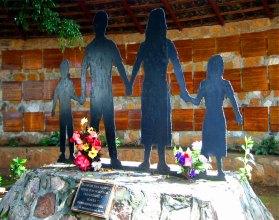
Memorial of massacre site at El Mozote, Morazan, El Salvador | By Efrojas | Wikimedia Commons | public domain

Memorial of massacre site at El Mozote, Morazan, El Salvador | By Efrojas | Wikimedia Commons | public domain

A U.S. court is on the verge of making a major contribution to El Salvador’s struggle to end impunity.  A former Salvadoran military commander six weeks ago admitted in a Miami immigration court that his troops had engaged in human rights violations and extrajudicial killings in the 1980s.  More significantly, he confirmed that the U.S.-trained and -funded Atlacatl Battalion was responsible for the horrendous massacre at El Mozote, a hamlet in which the elite Marine-style battalion killed an estimated one thousand peasants, mostly women and children, over three days in December 1981.  Until recently, current and former military commanders claimed that reports of the bloodbath were communist propaganda.  In his defense, General José Guillermo García, who was defense minister, said he was unaware of the soldiers’ actions at the time.  The judge responded skeptically, saying García “didn’t do what a military officer respectful of the law should have done in order to fully serve his country and his people.”

The General’s confession is no small matter.  An Amnesty Law passed in 1993, pushed by allies of the war-era government, put the lid on many investigations.  Its passage kept two mid-ranking officers convicted of involvement in the 1989 Jesuit massacre from serving their prison sentences, and it paved the way for other military and civilian leaders to cover up that atrocity. The air of impunity has endured for 20 years.  General García’s testimony provides the first real open window for Salvadorans to start learning about what happened despite strong efforts to keep the truth under wraps.  The political and economic elites’ defense of the Amnesty Law has focused on the argument that El Salvador should not be confronting its past if it really wants reconciliation and peace.  But two decades after the peace accord brought the end of the war, that kind of thinking is beginning to fade, and will continue to wane as Salvadoran society is confronted with the naked truth, the naked horrors.

The Obama Administration deserves some credit for advancing the legal case against García and a former colonel facing similar immigration charges in Boston, Inocente Orlando Montano.  Both processes have been encouraged by a U.S. policy of locating and ousting foreigners on U.S. soil who have been credibly accused of human rights violations abroad.  However ironic it is that some of the violations were committed by units receiving U.S. assistance, Washington is promoting an important lesson:  generals who once held in their hands power over citizens’ lives and deaths become common defendants – criminals – when the truth is known.  The impunity enjoyed by the colonels and generals – and their civilian sponsors – has grown roots in Salvadoran institutions and still feeds today a culture of obscurity, injustice and inequity that prevents the country’s progress towards development and modernity.  This vicious cycle will not will not end until they are held accountable.

Read the full text of this essay.

Salvadoran Gang Truce: Opportunities and Risks

By Héctor Silva, CLALS Research Fellow

President Funes of El Salvador | Photo by: Blog do Planalto | Flickr | Creative Commons

President Funes of El Salvador | Photo by: Blog do Planalto | Flickr | Creative Commons

Despite the general agreement that the truce between El Salvador’s two main gangs, MS-13 and Barrio 18, has lowered the homicide rate dramatically – from 14 killings a day in 2011 to some 5-6 in 2012 – many serious challenges persist. The truce was brokered by a former guerrilla commander and a Catholic bishop and, after two months of denying a government role, Security Minister General David Munguía Payés acknowledged that his office was the mastermind.  It is now entering a second stage in which six municipalities, ruled by both the governing FMLN and the rightist opposition party ARENA, have pledged to join the initiative. This new stage involves local ad hoc prevention plans aimed at gang members’ families and youth at risk. The truces have become the principal security policy of the Funes administration.

The lack of transparency around the planning and implementation – above all the origin of the initial pact –has fueled skepticism among journalists, politicians and the general public, and polling has not shown wide support for the truce.  The United States has become one of the fiercest critics of the initiative, with its first official reaction a few days after Salvadoran electronic news outlet El Faro revealed details in March 2012 of secret negotiations between the gangs and the Salvadoran intelligence service. U.S. Under Secretary of State María Otero, visiting San Salvador, declared that the gangs must disappear, suggesting disapproval of the appeasement implicit in secret talks, and U.S. law enforcement officials have always been privately skeptical.  The Treasury Department is helping local American police departments attack MS13’s financial networks, which some in San Salvador interpret as a political signal of Washington distancing itself from the truce – an ironic twist given that Munguía Payés was installed largely because of U.S. pressure.  The stakes were raised last week when the State Department issued a warning to travelers to El Salvador, expressing for the first time in writing doubts about the truce.

The Salvadoran state and society face a complex road ahead.  The reduction in the homicide rate is, of course, welcome, and opposition to the second stage of the plan, the municipal sanctuaries, will be muted in a preelectoral year.  (The ARENA candidate for President, Norman Quijano, has remained skeptical but seems likely to jump on the bandwagon.) But with its ambiguous public stance on the truce despite its Security Minister’s political commitment, the Funes administration has not pledged to fund the second stage of the truce, and it seems very unlikely that the United States will be stepping in.  Another factor is that while El Salvador´s security operations are constrained by the truce, other important problems – such as extortion, drug trafficking, impunity and corruption – remain untouched. Furthermore, evidence is slowly emerging that the organized crime rings are using the circumstances to expand their influence and take advantage of their relationship with some of the gangs’ most violent cliques to enhance trafficking routes. Washington’s skepticism about the truce is valid and should be followed up with an emphasis on the underlying causes of El Salvador’s ills.

El Salvador’s “Constitutional Crisis”

Photo by: rosaamarilla via Flickr http://www.flickr.com/photos/amccy/3395160591/

A months-long political feud over the Supreme Court in El Salvador has blossomed into what observers are calling a constitutional crisis.  The first shot was fired in April when legislators from the FMLN engineered a “legislative decree” to replace five court Magistrates, the outgoing Assembly’s second shot at choosing justices during its three-year term.  The court’s Constitutional Chamber in June declared the decree unconstitutional – because each Legislature gets to vote only once for Magistrates.  At the same time, the Chamber invalidated a similar move by the opposition ARENA party affecting Magistrates chosen in 2006.

The theater came to a head this month when two feuding Supreme Courts met in different wings of the same building and claimed legitimacy – one with five members elected in 2009 and the other with the 10 invalidated members.  The rightwing ARENA party and its allies in Washington are claiming the crisis represents a shift against democracy by the FMLN.  Two Cuban-American members of the U.S. Senate have called on the Obama Administration to impose sanctions – principally suspending negotiations on a second Millennium Challenge Corporation compact potentially worth hundreds of millions of dollars – if the crisis is not ended quickly and in the manner they wish.  The Inter-American Commission on Human Rights (IACHR) has called for prompt resolution, and the U.S. Ambassador in San Salvador and the State Department have expressed “concern.”  A Washington Post editorial this week lambasted the FMLN for shifting toward Chávez-style authoritarianism and President Funes for failing to stop it.

This episode reflects maneuvering within the FMLN – fueled by frustration that President Funes’s soft line toward ARENA has only weakened the party’s influence – and poor judgment among activists on where and how to pick the fight.  The legislators rushed the decree because they anticipated correctly that they were about to lose control of the Assembly in elections several weeks later.  The crisis falls into a much more ominous pattern, however, in that – like the coups in Honduras (2009) and Paraguay (2012) – the right wing and its coreligionists in Washington exploit events to challenge the democratic credentials of a democratically elected reformist government to rationalize weakening it, while the Obama Administration responds timidly.  ARENA is again demonstrating its superior lobbying skills in Washington, which have already severely disadvantaged President Funes on issues such as relations between his security cabinet and its U.S. counterparts – resulting in a serious erosion of his own influence over security issues.  If the current political impasse is not resolved to the satisfaction of U.S. conservatives, Washington’s threats – ironically directed against the Administration’s “best friend” in Central America – will likely continue and relations will be strained, further persuading hardliners around Funes that moderation pays no dividends.