Statements by Eric Hershberg and William LeoGrande on Release of Alan Gross – UPDATED

Havana, Cuba
December 17, 2014, 12:30 p.m.

President Obama’s statement pledging to move forward expeditiously toward full normalization of relations between the United States and Cuba constitutes a welcome and long overdue reversal of policies that have long worked to the detriment of both countries.  Initial steps carried out today, including a prisoner exchange and the release of government contractor Alan Gross, imprisoned in Cuba five years ago for clandestinely distributing high technology communications equipment in Cuba under a USAID program intended to destabilize the Cuban government, mark the beginning of a process that must move forward rapidly during the weeks and months ahead. Pledges to re-open embassies in both countries and to curtail restrictions associated with the half century-old U.S. embargo portend an accelerated process which can be facilitated by prompt Congressional action to abolish provisions of the embargo that were codified into law by the Helms-Burton Act.  In the meantime, the administration can take numerous actions unilaterally, as noted today by the White House.  It must remove Cuba from its list of state sponsors of terrorism, lift licensing restrictions on travel to Cuba by U.S. citizens, abolish constraints on U.S. investment in Cuban private enterprises and cooperatives, and cease covert USAID programs aimed at destabilizing the Cuban political system. Washington should also signal its commitment not to block Cuba’s engagement with international financial institutions, which Cuba may wish to engage to facilitate the success of the country’s ongoing economic reforms. Today’s announcements from the White House mark a fresh start for bilateral relations, which will benefit the peoples of the United States and Cuba alike, and they afford an opportunity for the United States to make good on its stated commitment to open a new era of equal partnership and mutual respect in its relations with all countries of Latin America.

Eric Hershberg

This is a historic development in US-Cuban relations, and hopefully a step toward full normalization of relations. Obama’s actions represent the most positive actions to improve relations since President Carter. This will assure that the Summit of the Americas will be a success and this move will be applauded by governments throughout Latin America and beyond.

William LeoGrande

About the American University-Center for Latin American & Latino Studies (CLALS) Cuba Initiative:

CLALS is proud of the contributions of all schools at American University and of our research fellows in promoting normalization of relations between the United States and Cuba.  Faculty at each and every one of AU’s Schools and Colleges as well as its Center for Latin American & Latino Studies have published countless books, articles, op-ed pieces, and blogposts shedding light on the relationship and demonstrating the U.S. national interest in better relations with Cuba.  AU experts have worked tirelessly to underscore the costs of Washington’s anachronistic policies toward Cuba; inform journalists and policy-makers of opportunities for normalizing relations; lead path-breaking student and faculty exchange programs linking the university with counterpart institutions in Cuba; and participated in dozens of high level dialogues connecting leading Cuban researchers and policy advisors with AU faculty and foreign policy experts from the United States.

Cuba: Can Official Labor Meet the Needs of Private Workers?

By Geoff Thale*

Alberto Yoan Arego Pulido / Flickr / CC BY-NC 2.0

Alberto Yoan Arego Pulido / Flickr / CC BY-NC 2.0

As Cuba embraces a new but still undefined economic model, it’s unclear whether or how the country’s old labor laws and regulatory systems will be adapted to accommodate the interests of employees in the growing private and cooperative sectors, or in the newly autonomous state enterprises.  The trade union structure cannot play the social role it played in the past with the emergence of businesses owned by both individuals and cooperatives, a growing role for foreign investment, and increasingly decentralized state enterprises.  During a recent trip to Cuba, our research team met with representatives and staff from a range of officially recognized trade unions.  We met with the national labor federation – the Central de Trabajadores de Cuba (CTC) – and with national and local officials from some member unions, including the national president of the health care workers’ union; local trade union officials in the hotel and restaurant workers union in the tourist sector in Old Havana; and local officials representing self-employed and small-business owners who have joined the union for retail and commercial workers.  A Labor Code approved by the National Assembly in December 2013 changed some aspects of the legal framework for labor relations.  It continued to privilege the CTC as the sole labor federation, while also taking some steps to recognize the new issues that confront workers in the emerging sectors of the economy.  It established a maximum number of hours of work (44) for private-sector employees, required the self-employed or small-business owners to pay into a social security fund and ensure social protections – health care, pensions, etc. – for employees.  And it guaranteed private-sector employees seven days paid vacation per year (though less than the one month given to state-sector workers).

Our interviews, however, turned up more questions than answers.  Newly autonomous state enterprises have greater latitude in setting wages, incentives and working conditions, but it remains unclear how these decentralized enterprises will handle labor relations issues, and what kind of negotiations might take place on compliance with regulations on workplace safety and protection, wage requirements and employment opportunities.  Indeed, it is unclear how the current worker organizations will represent workers in these decentralized enterprises.  The growth of the private sector presents another challenge.  The CTC has sought to organize the self-employed into the unions in the industries in which they are functioning – the food service and restaurant union, the retail and commercial sector union, and so on – but it is unclear how the union will represent the interests of both owners of independent small businesses – cuentapropistas – and the 15 percent of “self-employed” who are actually employees in those enterprises.  Similar queries are popping up in the cooperative sector and in enterprises run as joint ventures with foreign corporations or as wholly foreign-owned companies.

Cuba’s new labor policies are clearly a work in progress, but they signal recognition that there is an emerging stratum of non-state sector employees – and that they need social protections.  It also reflects a balancing act between ensuring stable employment and benefiting from the flexibility that private sector employment models provide.  The new Labor Code requires, for example, that employers sign year-long contracts with employees while guaranteeing them access to health care, parental leave and other benefits during that period.  New challenges will emerge, especially in terms of the structures that represent the interests of these groups and advocate for them.  But for now, there appears to be progress in establishing a system of social protections for the self-employed and for their employees under the new labor code.  Concerns about the burden of compliance appear likely to be muted for at least the near term because, as it was clear to us during our visit, the self-employed and their employees are earning substantially higher incomes than are workers in the state sector.

*Geoff Thale, program director at the Washington Office on Latin America (WOLA), in October led the research team’s fifth visit to Cuba examining the impact of economic change on workers.

December 9, 2014

Who Will Attend the OAS Presidential Summit in Panama?

By Fulton Armstrong and Eric Hershberg

OAE-OAS & tgraham / Flickr / Creative Commons Attribution-NonCommercial-ShareAlike 2.0 Generic (CC BY-NC-SA 2.0)

OAE-OAS & tgraham / Flickr / Creative Commons Attribution-NonCommercial-ShareAlike 2.0 Generic (CC BY-NC-SA 2.0)

The Summit of the Americas isn’t until next April, but interest in how Panama as host handles near-unanimous pressure from Latin America to invite Cuban President Raúl Castro, and how the United States and Cuba will respond, is growing fast.  Speaking to reporters at the United Nations last week, U.S. Assistant Secretary of State Roberta Jacobson answered several questions on the U.S. position.  Key excerpts follow:

  • Asked “if the United States is still opposed to Cuba attending.”  On the Summit of the Americas, I think we’ve been pretty clear in our position on the summit, which is that obviously Panama is the host country for the summit, and as the host country they will make the decisions on invitations to that summit.  …  And the fact of the matter is we have said from the start that we look forward to a summit that can include a democratic Cuba at the table.  We also have said that the summit process, ever since Quebec in 2001, has made a commitment to democracy, and we think that’s an important part of the summit process.  But the decision about invitations is not ours to make, and obviously there’s been no invitations formally issued to the United States and other countries. And so there is no acceptance or rejection yet called for or made. …
  • Asked “is there a chance that the U.S. might refuse going.”  Again, I think you won’t be surprised to hear me say that we’re really not going to answer hypotheticals in the future yet.  Obviously, the Summit of the Americas is in April and that’s not a situation that we can answer, although I think we have made clear that we believe the summit process is committed to democratic governance and we think that the governments that are sitting at that table ought to be committed to the summit principles, which include democratic governance. And therefore that’s our position at this point.  Obviously, we have a position on Cuba which does not at this point see them as upholding those principles.

Panama’s likely invitation to Cuba – reflecting the consensus of 32 hemispheric nations at the last Summit – will draw protests from official quarters in Washington.  But it’s far from certain that the Obama Administration would risk blame for torpedoing the 20-year Summit process.  Obama survived a handshake with Raúl Castro at Nelson Mandela’s funeral last December, and being in the same room with him again as a President in the second half of his second term will have little political consequence.  A workshop in Mexico City in June, in which CLALS researchers participated, and another in Ottawa in September, sponsored by the Center and the University of Ottawa, explored likely outcomes.  Mexican international relations specialists speculated that a reasonable outcome was for the United States to show up like a polite guest, and thus avoid having the anachronism of U.S. antagonism toward Cuba overshadow its broader relations with Latin America.  Canadian experts were deeply concerned that Cuba’s inclusion might undermine the centrality to the OAS of the Inter-American Democratic Charter, but they agreed that failure to convene a Summit would constitute a serious blow to the OAS and to the regular summits that provide Canada a seat at the inter-governmental table.

The reality is that Cuba does not conform to the Democratic Charter or to the broader OAS criteria of democratic rule, but equally real is that Latin America sees Cuba as a full member of the hemisphere and has lost all patience with those in Washington who would deny that.  Either Washington — and Ottawa — set aside their objections to Cuba’s inclusion or they bid farewell to such fora and their constructive impact on regional relationships that ought to matter to them.  Moreover, if they acquiesce to Cuban participation but then try to commandeer the agenda and make the Summit a seminar on democracy and human rights, it will only reinforce the widespread sense in the region that Washington cannot move beyond its obsession with the trivial matter of Cuba and get on with a serious conversation among equal partners.  They would thus sacrifice an opportunity to discuss issues on which significant, substantive advances are possible through dialogue among leaders of countries throughout the hemisphere.  The value of the Summit rests with the capacity of all involved to act like grownups.  President Obama did so at Mandela’s funeral, and it will be telling whether he can do it again in Panama this coming April.

October 2, 2014

Cuban Infrastructure and Brazilian State Capitalism: The Port of Mariel

By Eric Hershberg

Panamax Container Ship / Wikimedia Commons

Panamax Container Ship / Wikimedia Commons

The Port of Mariel – long associated with a boatlift in 1980 that brought more than a hundred thousand Cubans onto U.S. shores – could either help launch Cuba into a new regional role as a shipping/trading hub or be yet another white elephant project.  This irony was noted in a recent New York Times piece, which portrayed the venture in an optimistic light.  According to some observers, the massive port upgrading that is underway there at the moment, with Brazilian funds and a leading Singaporean port operator slated to operate the venture, is a ticket for Cuba to thrive in the 21st century as a vital logistics hub, funneling goods to Europe, the Greater Caribbean and, eventually, the United States.  All of this is on the agenda because of the Panama Canal expansion that will allow for post-Panamax ships to transit the canal.  These ships will have the capacity to carry over twice the amount of cargo than the current vessels that transit the canal, thus re-routing trade that now travels from the west coast of the U.S. by land to the east coast, and at the same time expanding traffic from Asia on to Western Europe.

The $957 million Mariel project entails a Brazilian investment of $682 million with the rest of the financing coming from Cuba.  The ambitious project goes well beyond the port itself, as the Cuban government has taken the exceptional step of authorizing a surrounding free trade zone – essentially an export processing zone along the lines of those that have housed maquilas throughout much of the Greater Caribbean as well as in regions such as Guangdong, in China, which became an export powerhouse.  The notion is that industries that locate within the special economic zone around Mariel will enjoy 50-year, renewable contracts and numerous beneficial tax treatments, including tax-free processing of imported inputs into products that will in turn be shipped out through the state-of-the-art port.

For some analysts of Cuba’s economic development prospects, this is a historic opportunity, one that will become even more relevant once the U.S. embargo finally goes away.  By this account, a combination of geographic location and a highly skilled workforce places Cuba in an ideal situation to take advantage of these massive investments.  If the Mariel initiative were to work as envisioned, the result would be a massive increase in industrial employment in Cuba which, under this scenario, could become a high value-added manufacturing hub and a distribution point for goods transiting from Asia to the greater Atlantic.  The opportunity may be all the more exciting given the failure of the U.S. federal government to invest in port upgrading of a sort that a well-functioning capitalist state would undertake.  At the moment, The Economist reports only Baltimore and Norfolk have the capacity to accommodate post-Panamax ships, leaving the field open for newcomers such as the Bahamas (already equipped) and Havana (about to be so).  Other analysts observe, however, that the project faces severe constraints, ranging from the institutional bottlenecks in Cuba to the reality of competition from other deep water ports (which do not suffer from the sclerotic institutional environment that plagues so much in Cuba), as well as competition from other countries with highly skilled workforces (Costa Rica, the Bahamas, and much of the English-speaking Caribbean).

Nevertheless, critics in Cuba and abroad question whether the massive Brazilian investment in the project – essential to its success – is driven not only by economic opportunities but also by the domestic political calculations of President Dilma Roussef. Loans provided to the Brazilian engineering conglomerate Odebrecht to build the port are from the Brazilian development bank, BNDES, and guaranteed by the Brazilian state, so unlike EU companies that eschewed investment in Mariel, Odebrecht incurs minimal risk.  Mariel represents both a geostrategic and a domestic political calculation by the Dilma government. Brazil is happy to take advantage of the U.S. absence in Cuba to build the port and its relationship with Cuba.  At home, it allows the government to reward the construction firms – such as Odebrecht – that are consistently the largest campaign donors in Brazilian politics.  It also helps to slake the passions of factions of the left that seek closer ties to Cuba, and have been disappointed by the Dilma and Lula administrations’ relative political moderation at home.  The fortunes of Mariel may in the end reveal as much about Brazil as about Cuba.

More Cracks in the EU’s “Common Position” on Cuba

By William M. LeoGrande*

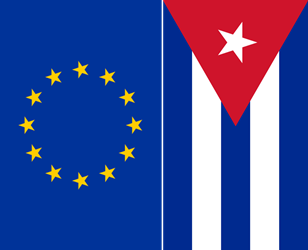
eu cubaThe visit of Dutch Foreign Minister Timmermans to Cuba earlier this month marks yet another crack in the European Union’s 1996 Common Position on Cuba, which conditions normal relations with the island on democratic reforms. Days later, EU Commission President Barroso acknowledged that a number of member states were pressing for a reevaluation of the Common Position, and Spanish Foreign Minister García Margallo announced that the issue would be taken up at the EU foreign ministers meeting on 10 February – adding, however, that any new policy “would have, as a determining factor, respect for human rights.” Amending the Common Position will require unanimity among the EU’s member states, something conservative governments – especially in the former socialist countries – have thus far blocked.

The Common Position has severely constrained the ability of Brussels to respond creatively to rapidly changing conditions in Cuba today, but various European governments have expanded their bilateral economic and political ties with Cuba despite its strictures. Trade between Cuba and Europe, at 2.5 billion euros annually, has roughly tripled since 1996, and official development assistance to Cuba has quadrupled to nearly 60 million euros annually. Policies of engagement have proven more successful than policies of hostility and confrontation.  In 2010, quiet diplomacy by José Luis Rodríguez Zapatero’s government enabled Spain to play a crucial mediating role between the Cuban government and the Catholic Church, leading to the release of more than a hundred political prisoners – the largest such release since the 1970s.

Cuba today is moving in directions that the EU has long favored.  The “updating” of the Cuban economic model, begun in 2011, entails greater economic openness, reduced government regulation of private markets, and a larger role for private sector businesses. At the same time, although challenging Cuba’s one-party system or its socialist society is still out of bounds, there has been a very gradual opening of political space to debate the shape of Cuba’s future.  Replacing the Common Position does not mean that European states, individually or collectively, would abandon their commitment to encouraging greater human rights and democracy in Cuba.  But a warmer political climate would enable them to express their concerns more effectively through quiet diplomacy. What offends Cuba’s leaders is not that other states have different views on these issues; it is that the Common Position makes normal relations contingent on Cuba conforming to European norms, a litmus test that no other Latin American country is required to pass.

*Dr. LeoGrande is Professor of Government in the School of Public Affairs at American University.  This article is excerpted from an essay (click here) he wrote for the London School of Economics and Political Science blog.

What’s Up with Cuba Policy?

By William M. LeoGrande

Photo by Rinaldo W. / Flickr / Creative Commons

Photo by Rinaldo W. / Flickr / Creative Commons

A little over six months into President Obama’s second term, the administration is giving hints that something is afoot in relations with Cuba.  Back in 1994, Fidel Castro told a group of former U.S. ambassadors that he needed a two-term U.S. president to normalize relations with Cuba because no first-term president would have the political courage to do it.  Could Barack Obama be that president?  Efforts to engage with Cuba during his first term were frozen after the 2009 arrest of USAID subcontractor Alan Gross.  Despite evidence that Gross had violated Cuban law, the administration insisted that Gross had done nothing improper and demanded that he be freed immediately.  When he wasn’t, the U.S. position hardened: there would be no improvement in relations with Cuba, not even on issues of mutual interest, until Gross was released.  Gross is still in jail four years later; the non-negotiable demand strategy failed utterly.

The second Obama administration appears to be trying something new.  In May, the Department of Justice dropped its insistence that René González, a member of the “Cuban Five,” serve out his probation in Miami rather than Cuba.  Shortly thereafter, Cuba granted Alan Gross’ request to be examined by his own doctor.  In late May, Josefina Vidal, the Cuban Foreign Ministry official in charge of relations with the United States, met in Washington with Assistant Secretary of State for Western Hemisphere Affairs Roberta Jacobson – the highest-level U.S. official to meet with a Cuban diplomat in several years. After this reportedly constructive encounter, the State Department announced the resumption of bilateral talks on immigration (suspended since January 2011), and on re-establishing direct postal service. Working-level diplomats have resolved most points of disagreement on a postal accord, a Coast Guard search and rescue accord, and an oil spill containment protocol – although the U.S. side is loath to use the word “agreement,” lest it stir up trouble with a small but loud contingent in Congress.

Although U.S. policy is no longer completely paralyzed by the predicament of Alan Gross, it remains tentative, cautious, and incremental – far from the bold stroke that Fidel Castro was hoping for from a second-term president.  In May, the State Department again listed Cuba as a “state sponsor of terrorism” in its annual report, although the rationale read more like a justification for removing Cuba from the list—a move reportedly under discussion by the Obama team.  When the administration sent its FY2014 budget request to Capitol Hill, it again requested $20 million for “democracy promotion” in Cuba, continuing programs like the one that got Alan Gross arrested.  Radio and TV Martí, which cost U.S. taxpayers $28 million a year, continue to beam programs below Voice of America standards to a shrinking radio audience and non-existent TV viewers.  (Cubans call TV Martí “la TV que no se ve” —No-See TV.)  If Obama had the mettle to make the bold stroke, these provocative, ineffectual programs  would be on the chopping block in tough budgetary times.  More positively, the president could take the initiative by appointing a special envoy to talk turkey with Havana, and he could promote a U.S. policy debate on Cuba that’s long overdue.  Incrementalism will only take us so far.  Real change in U.S.-Cuban relations requires vision and courage – qualities Obama displayed on comprehensive health care and immigration reform.  After all, as Lyndon Johnson once said, “What the hell’s the presidency for?”

Dr. LeoGrande is Professor of Government in the School of Public Affairs at American University.

U.S.-Cuba: Time to End the Visa Charade

By Eric Hershberg

Slide1Bad habits die hard, especially when they involve Cuba and American bureaucrats eager to appease the right wing.  For more than 50 years, Washington has been at loggerheads with a revolutionary regime eager to reciprocate incessant aggression and stick its finger in the eye of the Colossus to the North.  Although nothing as absurd as a confrontation at the brink of nuclear war has occurred since 1962, during the ensuing decades both governments have repeatedly provoked one another to exacerbate a conflict that even in 2013 bizarrely perpetuates the Cold War.  To this day, the U.S. proclaims “regime change” as its bottom line condition for normalizing relations with a sovereign country for which such imperial proclamations are justly anathema.  Havana, in turn, is not beyond demonizing American citizens – people who have no connections to the U.S. government or its misguided regime-change programs – who seek to engage their Cuban counterparts.  Last month I spent two hours in the Havana airport answering hostile questions from government goons for whom my assurances that my visit was academic in nature were mysteriously insufficient to get me smoothly admitted through immigration.  An American University colleague reports that she suffered similar harassment at the Havana airport in March.

One manifestation of the anachronistic dispute between the two governments is the infantile tit for tat that both parties play with permitting travel across the Florida Straits even for purposes both claim to support. The dynamic is pernicious, and reflects a combination of ideological extremism and petty bureaucratic behavior on both sides.  Organizers of scholarly meetings in Cuba are increasingly being told that the participation of one person or another would not be acceptable to unspecified authorities in Havana, and the result has been that they have been “disinvited” from workshops in which their participation would have been appropriate.  More troubling, from my perspective as an American citizen, is that since the Center for Latin American and Latino Studies was established three years ago, on three separate occasions the State Department delayed the visas of Cuban academics who I had invited to the University and refused to say why.  Last week, when the Latin American Studies Association convened its annual meeting in Washington, assembling 5,000 scholars from around the world, Cuban researchers who have long traveled to and from the U.S. were denied visas, again for no stated reason. They included three individuals with whom the Center has time-tested, ongoing working relationships:  Rafael Hernández, who edits one of Cuba’s principal journal of society and culture and has taught as a Visiting Professor at Harvard and Columbia; Milagros Martínez, who directs international academic affairs at the University of Havana; and Juan Luís Martín, arguably Cuba’s most innovative sociologist.

That the Cuban government interferes with academic life should be no surprise.  That the practice continues on the U.S. side is another matter.  One would think that Washington would by now have gotten beyond this shameful charade, five years into an administration that knows better.  Somewhere in the system and its mysterious processes –the opacity contradicts our democratic principles – bureaucrats are denying visas arbitrarily and with no accountability.  What threat do these academics, whose work has at times catalyzed important debates in Havana, conceivably pose to the United States?  What is the U.S. national interest in slamming the door on people eager to hear what we have to say in our universities and academic conferences?  The State Department’s visa denials undermine the professional activities of American citizens and contradict the Administration’s own policy of “people-to-people” relations.  It may be too much to expect President Obama to risk incurring the wrath of a shrinking minority in the Cuban-American community and in the Congress to put forth a rational Cuba policy.  But one would have thought that Secretary of State Kerry has the wherewithal and influence required to put an end to the use of visa requests as a means of restaging scenes from a cold war era that ought to have been left behind twenty years ago. The State Department’s actions over the past month evidence its disregard for academic freedom and the hollowness of its assurances to the scholarly community that it does not intend to interfere with our work.  I say: Enough is enough.


The Danger of Dependence: Cuba’s Foreign Policy After Chávez

By William M. LeoGrande, World Politics Review

Photo credit: ¡Que comunismo! / Foter.com / CC BY-NC-SA

Photo credit: ¡Que comunismo! / Foter.com / CC BY-NC-SA

On March 8 in Caracas, Raúl Castro, looking somber, stood in a place of honor beside Hugo Chávez’s casket during the late Venezuelan president’s state funeral. Castro was no doubt pondering what Chávez’s death means for Cuba’s ambitious economic reform program — or “updating” of the economic model, as Cubans prefer to call it. Not long after Chávez’s first election victory in 1998, he and Fidel Castro signed the first of what would become more than 100 bilateral cooperation agreements. By the time Chávez died, Venezuela was providing Cuba with some 110,000 barrels of oil daily at subsidized prices, worth $4 billion annually and representing two-thirds of Cuba’s domestic oil consumption. In exchange, Cuba provided some 40,000 skilled professionals, working mostly in health, enabling Chávez to extend health care into the poor barrios of Venezuela, thereby solidifying his political base.

With the Venezuelan economy foundering under a huge fiscal deficit, will Chávez’s successor continue this barter arrangement on the same preferential terms? If not, will the resulting oil shock derail Raúl Castro’s plan to move Cuba from a hyper-centralized planned economy, which even its architect Fidel Castro admitted no longer works, to a socialist market economy modeled on Vietnam and China?

Full article available on the World Politics Review site.

Changing of the Guard, Cuban-Style

By William M. LeoGrande

Cuba Coat of Arms | Wikipedia Commons

Cuban Coat of Arms | Wikipedia Commons

In his speech to the closing session of Cuba’s National Assembly on February 24, Raúl Castro formally announced that he would retire at the end of his current presidential term in 2018. Even now, only a handful of “los históricios” – the founders of the revolutionary regime – remain in office, though they still dominate the Communist Party’s Political Bureau. Raúl also announced the immediate retirement of several elderly comrades-in-arms, including First Vice-President José Machado Ventura. In his place, the Assembly elected 52-year-old, Miguel Díaz-Canel, putting a leader born after the triumph of the revolution in the direct line of political succession for the first time.

But Díaz-Canel is not the first presumptive heir to appear on the Cuban political scene. He is preceded by several others, all of whom came to a bad end, falling into disgrace and obscurity as quickly as they rose. The first was “Landy” – Luis Orlando Domínguez, a rising star in his forties whose power derived from his leadership of the Grupo de Apoyo, Fidel’s personal staff. He was arrested in 1987 for embezzlement and sentenced to 20 years in prison. The next was Roberto Robaina, the charismatic pony-tailed head of the Young Communist League. In 1993, Fidel appointed “Robertico” foreign minister at the age of 36, then sacked him six years later for disloyalty. Robaina, it turned out, was a little too friendly with foreign businessmen and officials.  Next came Felipe Pérez-Roque and Carlos Lage. Pérez-Roque served as Fidel’s personal assistant for a decade before being appointed, at age 34, to succeed Robaina at the Foreign Ministry. Announcing his appointment, Granma explained that he was qualified for the job despite his age because, “He is familiar, as very few others are, with Fidel’s ideas and thoughts.” Lage served as Fidel’s economic adviser during the Special Period, becoming one of the vice-presidents of the Council of State and executive secretary to the Council of Ministers – the closest thing Cuba had to a prime minister. Pérez-Roque and Lage were both removed by Raúl in 2009 for criticizing los históricos behind their backs and being too eager to push the older generation off stage. They were, as Fidel wrote, “seduced by the honey of power.”

All these early heirs owed their ascent to their personal relationships with Fidel.  Before his illness, the elder Castro was, as we social scientists say, a “minimum winning coalition” all by himself. If Fidel decided on a policy, the rest of the leadership dutifully fell into line. Political power, then, was directly correlated with proximity to Fidel. It was no accident that the principal path to power for an aspiring young politician led through Castro’s personal staff. But the meteoric rise of Domínguez et al., denied them the political savvy only experience can provide, and imbued them with the hubris of Icarus.

Díaz-Canel appears to be an heir of a different order. An electrical engineer by training, he has spent his career rising through the ranks of the Communist Party, building a reputation for competent, pragmatic management. He served as Party first secretary in Villa Clara and Holguín provinces before moving to the national stage, becoming Minister of Higher Education and a vice-president of the Council of State. In public, his austere demeanor suggests the archetypical apparatchik, but in person he is said to be warm, personable, and modest – disdaining the prerogatives of office. While serving as first secretary in Villa Clara, he visited far-flung towns and villages by bicycle.

Díaz-Canel seems to be as different from the earlier heirs as Raúl is from Fidel. Fidel was always suspicious of institutions that might constrain his freedom of action, and never hesitated to circumvent them when it suited his purposes. Raúl, on the other hand, has been the quintessential organization man, valuing careful management, sound administrative processes, and institution-building. His proposal for term limits for all senior government and party officials represents the final institutionalization of the revolution, elevating the system over the pretensions of individuals. In 1973, Granma ran a headline, “Men Die, but the Party is Immortal.” Now, as los históricos are dying, the future of the revolution is finally being vested in the institutions they built and the successors those institutions have produced.

Impasse in U.S.-Cuba Relations Enters 54th Year

Three American University professors recently traveled to Cuba for research and discussions on Cuba’s reform process – called “Updating Socialism” – and the island’s relations with the United States.  Today’s entry looks at the bilateral relationship.

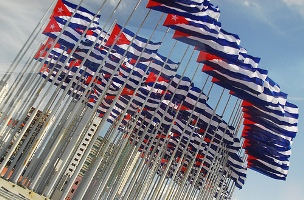
Flags in front of U.S. Interests in Malecón.  By: Luiza Leite "Luiza" | Flickr | Creative Commons

Flags in front of U.S. Interests in Malecón. By: Luiza Leite “Luiza” | Flickr | Creative Commons

U.S. and Cuban experts at a conference in Havana in December observed that, despite important areas of mutual interest, the Obama Administration has so far shown little inclination to accept a dialogue.  Some experts opined that the imprisonment of USAID contractor Alan Gross has become a convenient excuse for Obama to avoid any serious engagement.

Other key points:

  • There is no effective political channel for resolving bilateral problems – indeed, no contacts at all at political levels.  The Interests Sections in each other’s capitals handle routine matters, but Washington has rejected Cuban requests to continue semi-annual migration talks.  Cuba gave the United States a proposal for resolving the Gross situation, which the State Department has not even acknowledged receiving.
  • In addition to reiterating longstanding frustration that U.S. policy is stuck in the regime-change mode forged by President George W. Bush, Cuban experts lamented that many Americans latch onto every challenge Cuba faces – such as whether the passing of Venezuelan President Chávez will lead to reductions in oil supplies – as evidence that the Cuban government will “collapse” and therefore that dialogue with it would be foolish.
  • Cuban rhetoric espousing the swap of the “Cuban Five” for USAID contractor Alan Gross has fueled powerful political expectations in Cuba, but Havana’s bottom line on the elements of a humanitarian release is far from clear.  Experts from both countries are perplexed that Washington will not have a dialogue at any level to discuss whether a deal is possible.
  • Many Cuban and American experts believe that one incentive for the United States to improve relations is to rebuild its image in Latin America.  But they note – ruefully – that Latin American does not seem to be a priority for the Obama Administration anyway.

The Gross situation is merely the most recent of a long string of issues blamed for the dysfunctional relationship.  The real causes of the impasse at this point are whether Washington can shift away from policies and well-funded programs fashioned to achieve regime change in Cuba, and whether the two governments can manage the influence that both have given ultra-conservatives unprepared to broach compromise – be it Cubans opposed to releasing Alan Gross while four of the “Cuban Five” remain in U.S. jail, or Cuban-Americans benefiting from the sort of regime-change operations that Gross was conducting.  The lack of a reliable channel for political leaders above both bureaucracies to talk creates the risk of manageable problems spinning out of control, to the detriment of both countries’ interests.