Innocence Suspended: From Seeking Security to the Guantanamo Concentration Camp

Luis Alberto Castillo Rivera graduating from high school in Venezuela (Photo courtesy of his family; Source: Migrant Insider)

Luis Alberto Castillo Rivera graduating from high school in Venezuela (Photo courtesy of his family; Source: Migrant Insider)

The story of Luis Alberto Castillo Rivera, a Venezuelan asylum seeker, has gone viral on TikTok and gained media coverage. Castillo is a man without any criminal history or gang affiliation who entered the United States through a legal pathway. In 2024, this Venezuelan asylum seeker flew to Mexico and awaited his court date. Once he received his appointment date on the CBPOne app on January 19th, 2025, he presented himself at the U.S.-Mexico border in El Paso, where he was processed by immigration authorities and held in detention for no given reason. At the ICE detention center in El Paso, authorities started to question his tattoos, specifically one he had of Michael Jordan. Authorities claimed his Jordan tattoo was affiliated with the Venezuelan gang Tren De Aragua. Many of the tattoos identified by a law enforcement list as used by Tren de Aragua, including stars, roses, tigers, and jaguars, are common among Americans. These so-called identifiers may just be a flimsy pretense for criminalizing the average, non-criminal migrant.

Castillo in a photo released by the Department of Homeland Security of the first flight of migrants preparing to takeoff for Guantanamo Bay, Feb. 4, 2025. DHS

Castillo in a photo released by the Department of Homeland Security of the first flight of migrants preparing to takeoff for Guantanamo Bay, Feb. 4, 2025. DHS

On February 3rd, Castillo told his family that he would be deported to Venezuela, even without a hearing. The next day, he lost contact with his family and was sent to Guantanamo Bay, Cuba on February 4th. President Trump stated he is sending those who have committed crimes in the U.S. to Guantanamo Bay, but Castillo had no criminal history nor gang affiliation and never even had the chance to freely step foot in the U.S.

Castillo’s family was not notified that he would be held at the “longest-running war prison.” His family members only found out about this after seeing pictures online of migrants arriving in Guantanamo Bay. When his family searched for him on the US Immigration and Customs Enforcement website, it appeared he was still in the processing center in El Paso, Texas. Attorneys are calling Guantanamo Bay a “legal black hole,” a place where typical legal protections do not exist for some of the detainees. Some are being held without due process indefinitely without trial or conviction, including thousands of Haitian refugees in the 1990s and almost 800 Muslim men, including minors, over the past two decades. Some of these prisoners have endured incredible physical and psychological abuse and torture in this extralegal space.

Now, the first group sent to Guantanamo Bay, including low-risk migrants and migrants with no criminal record, such as Castillo, were detained in the “counterterrorism suspect” part of the prison – rather than the Migrant Operations Center used in the past to process migrants. The conditions these individuals are facing at this maximum-security prison are inhumane, including mold, undrinkable water, and a lack of adequate medical care. Guantanamo Bay does not even meet the minimum safety standards for detention facilities as set by the U.S. government. Furthermore, the detainees at Guantanamo Bay are subject to permanent physical and psychological trauma.

A less-known but recent story close to home is one where five migrants in North Florida went into a gas station to grab breakfast on the way to their construction job on January 27th and were detained by ICE. Four of them remain detained in Florida. One of them, a Mexican man name Jose Angel Juarez, was sent to Guantanamo Bay; the rumors go that he would be held there for two years. He has no criminal record beyond being caught multiple times crossing the border. He is simply a worker who has been entering and leaving the U.S. every year to work and go home. The idea that Guantanamo Bay was ever for the “worst of the worst” is an illusion. These are just two among many cases of immigrants being detained, held, deported, or sent indefinitely to Guantanamo Bay without due process after being profiled racially or for having tattoos. 


Katheryn Olmos is a Research Assistant at the Center for Latin American and Latino Studies and a graduate student at the Sociology Research and Practice program at American University.

Edited by Ernesto Castañeda, Director, and Emma Wyler, intern at the Center for Latin American and Latino Studies and the Immigration Lab.

The Legacy of U.S. Immigration Policy Towards Cuba

by William M. LeoGrande*

Cuban Privilege by Susan Eckstein / Creative Commons License

Susan Eckstein’s recent book, Cuban Privilege: The Making of Immigrant Inequality in America, is a deep dive into how the U.S. government structured its immigration policy to the advantage of Cuban migrants as part of its Cold War policy to destabilize Fidel Castro’s revolutionary government. The book caused quite a stir among some Cuban Americans, who were insulted that someone pointed out policies that helped make the Cuban American community a success story.  

Cuban Privilege was not Eckstein’s first book on Cuban diaspora. She has written extensively on the threads that connect Cubans abroad with their family still on the island. Her book The Immigrant Divide: How Cuban Americans Changed the U.S. and Their Homeland was one of the first in-depth studies of how the Cuban American community began reconnecting to the island in the 1980s and 1990s, building bridges based mainly on family ties.

In the 1960s and 1970s, both the Cuban and U.S. governments erected a “sugar cane curtain” that made it almost impossible for families to stay connected across the Florida Strait. Travel was prohibited, direct mail service was unavailable, and connecting by phone was nearly impossible and prohibitively expensive. 

But in the 1980s, travel opened up, and remittances began to flow. Ever since the Special Period, Cuba’s economic crisis in the 1990s, Cuban American remittances have made an essential contribution to the livelihood of millions of Cuban families—a stark reality demonstrated by the humanitarian crisis on the island that resulted when Donald Trump and the COVID-19 pandemic cut remittance flows by some two-thirds. 

Cuban Privilege reverses the lens to look not at Cuban immigrants but at the U.S. immigration policies that brought them here. It is the definitive account of how Washington, motivated by the Cold War, gave Cuban immigrants privileged access to the United States and unprecedented support once they got here. Key elements of that privilege remain in place today, exacerbating the current migration crisis—foremost among them the Cuban Adjustment Act, which allows Cubans living in the United States for a year to apply for permanent residence, regardless of their form of entry.  

Most of the time, academics toil in relative obscurity, writing for one another in hopes of contributing new knowledge to their chosen field. On occasion, they write for a broader audience, hoping that their expertise might have some positive impact on public policy. And most of the time, when they speak truth to power, power isn’t listening. Rarely do academic contributions to the public debate attract much attention or make much difference.

Susan Eckstein’s Cuban Privilege is a cautionary tale of what can happen when the public does take notice. Presenting her book in Miami, Eckstein endured 30 minutes of hate, denounced as an agent of Castroism, because she had the nerve to state the obvious — Cuban immigrants to the United States have enjoyed enormous privileges that no other immigrant group has enjoyed. To say that is not an attack on Cuban Americans; it’s a simple truth. 

Ironically, the policy of privileged immigration for Cubans, which was intended to weaken and embarrass the Cuban government, has instead weakened and embarrassed the U.S. government producing a series of migration “crises” or more correctly punctuated increases (Camarioca in 1965, Mariel in 1980, the rafters crisis in 1994, and the post-Covid increase in emigration that is ongoing today), and distorting U.S. domestic politics by creating one of the most powerful domestic foreign policy lobbies in history—Cuban Americans in south Florida.

For 30 years, successive presidents —with the sole exception of Barack Obama— have been afraid to stand up to the Miami lobby on U.S. policy toward Cuba. As President George H. W. Bush’s National Security Adviser Brent Scowcroft put it, “Cuba is not a foreign policy question. Cuba is a domestic issue.” The result is a policy of regime change that, in 65 years, has done nothing to advance the cause of democracy or human rights in Cuba, but has lowered the living standard of the Cuban people and alienated Washington from allies in Latin America.

Before the Trump administration, Cuban American attitudes were gradually evolving toward moderation and support of engagement. President Obama won more Cuban American votes in Florida than any Democrat before him. And a majority—albeit a narrow one—supported his normalization policy.

But Trump’s return to a policy aimed at overthrowing the Cuban government re-energized the most recalcitrant Cuban American right. Recently both attitudes and voting behavior in the community seem to have swung sharply to the right, the result of a new wave of immigrants, a toxic social media environment, and disinformation spread by some of Miami’s Spanish language media.

As a result, Democrats have gone back to being afraid of Cuba—not the island, but the issue. Despite his campaign promise to return, for the most part, to Obama’s policy of engagement, President Biden has kept in place most of Donald Trump’s draconian economic sanctions aimed at strangling the Cuban economy.

            The final irony is that Florida does not actually matter very often in presidential elections. Conventional political wisdom casts it as a critical swing state. But in the sixteen presidential elections since 1960, Florida has determined the outcome in Electoral College only twice: in 2000, when Cuban Americans gave George W. Bush a 537-vote margin over Al Gore because the Clinton administration returned six-year-old Elián González to his father in Cuba; and in 2004 when Bush narrowly beat John Kerry.

            Kerry lost Florida by such a wide margin that he would have lost the state even if he had won the Cuban vote. So Cuban Americans in Florida have only cost the Democrats the White House once: in the unforgettable election of 2000. Ever since, Democrats have suffered from electoral post-traumatic stress disorder over the issue of Cuba, and it appears that 2024 will be no different. That is the legacy of the immigration policies that Susan Eckstein so expertly chronicles in Cuban Privilege.

Copyleft Creative Commons. Reproduction with full attribution is possible by news media and for not-for profit and educational purposes. Minor modifications, such as not including the “About the Study” section, are permitted. 

*William M LeoGrande is a CLALS faculty affiliate and Professor of Government at American University in Washington, DC, and co-author with Peter Kornbluh of Back Channel to Cuba: The Hidden History of Negotiations between Washington and Havana(University of North Carolina Press, 2015).

Ecuador: The Formation of Gangs in Prison Systems

By Erica Criollo

January 17, 2024

Solidarity rally in Queens, New York by members of the Ecuadorian diaspora. Photo by Erica Criollo 

On January 7th, 2024, José Adolfo Macías Villamar, alias“Fito,” the leader of one of Ecuador’s most prominent gangs, was found missing from his luxury prison cell the day he was meant to be transferred to a maximum-security prison to be held in isolation.

While Macías began his 34-year sentence in 2011, he remained the leader of the criminal gang, Los Choneros, due to their longstanding influence over government officials and extensive illicit drug networks. Following his escape, the country descended into chaos resulting in President Daniel Noboa declaring that the country was under “armed internal conflict” to mitigate gang wars and the killings of police officers.

This presidential declaration has prompted questions as to how Ecuador could have experienced such a sudden upsurge in gang violence. Along with government corruption, the escalation can be traced to the gradual formation of gangs dominating prison systems over several years. 

 In 2003, Los Choneros, who are associated with Mexican and Colombian cartels, took control of the drug trafficking route in the province of Manabí, Ecuador, from where drug shipments were sent to Mexico, the United States, and several European countries. Transnational networks and external groups engaged in the illicit drug trade utilized Ecuador’s coasts, leveraging its access to major shipping routes and ports to transport illicit drugs across international borders. 

Furthermore, Ecuador’s adoption of the U.S. dollar, coupled with inadequate enforcement and prevalent corruption, has facilitated money laundering by drug traffickers through industries such as real estate, illegal mining, and the illicit timber trade. This impacted the way corruption played a role in the country’s efforts to combat such illicit activities. 

When Former President Rafael Correa took office in 2007, he gained public favor through his initiative to remove the United States from the Manta military base from which the U.S. has been controlling anti-drug efforts with targets against the Colombian illicit drug trade since 1999.

However, following the U.S. withdrawal from the Manta military base, the country witnessed a worsening of drug trafficking. Former President Correa failed to stop the activities of groups like Los Choneros and other Mexican cartels, allowing the unhindered transportation of drugs to and from Ecuador.

Before Macías, Los Choneros was led by Jorge Luis Zambrano, alias “Rasquiña,” who, while incarcerated, directed orders alongside arrested gang members. By 2010, the group had transitioned to operating within prison systems and communicating with members on the outside. This operational shift steered the group away from international drug trafficking, focusing instead on micro-trafficking, contract killings, extortion, and contraband activities.

Emerging factional gangs, including Los Choneros, Gorras, Lagartos, Latin Kings, and the Cubanos, have become more extensive and aggressive, leading to deadly conflicts in prisons. In 2019, a brutal fight claimed the lives of several inmate gang members at Penitenciaria del Litoral, and in 2021, a prison riot resulted in the deaths of 119 inmates in the same facility. These deviations of gangs were also a result of government initiative in dismantling gang groups through the transfer of leaders between prisons, but it only multiplied the presence of gang wars.

Following Zambrano’s death in 2020, Macías obtained leadership, triggering an uproar of chaos and gang violence across the country as gang leaders fought to dominate. Despite being in prison, Macías remained in control. For him, communication with members was not an obstacle, as several reports indicate Macías’ prison cell had plugs to charge his cell phone and an internet router. Macías was also open to sharing his lavish living space on social media, regularly throwing parties, and having access to weapons, appliances, liquor, jewelry, and ceramics.

Ecuador has experienced a long trajectory of government corruption which has led to an escalation in gang formation and violence in prison systems. With Macías’ most recent escape, the country has been submitted to crazed gang members responsible for several car bombings, kidnappings, and slayings of prison guards and innocent civilians. In response to President Daniel Noboa’s crackdown on gang members in prisons, gang leaders on the outside have resorted to hostage-taking, capturing military and prison guards. These captives are coerced into recording messages, pleading with President Noboa to halt military operations in prisons and cease the killing of gang members. The objective behind these threats is to secure the gangs’ dominance within prisons and ensure the unrestricted proliferation of gang members. 

In one such video shared on Facebook, a gang member asserts, “Just as you safeguard the right to life of Ecuadorian citizens, we too have the right to live…we are not afraid of your tactics.” In essence, Ecuador is confronted with a formidable coalition of gangs wielding enough power to subvert the law and pursue their objectives, fueled by their substantial numbers and collective readiness to act in unison to carry out attacks. 

Currently, President Noboa’s plan to overpower gang violence is to enforce stricter regulations in prisons. However, this raises concerns for Ecuadorian citizens alarmed by several online videos featuring hostages pleading with the government for compliance to spare their lives. As events unfold, President Noboa’s actions will require careful consideration to ensure that no more civilian lives are endangered and to respect the human rights of all people. 

*Erica Criollo is a Graduate Research Assistant of the Immigration Lab at American University. 

Creative Commons license. Free to republish without changing content for news and not-for-profit purposes. 

Blinken and Mayorkas visited Mexico to Discuss Migration

By Ernesto Castañeda

January 11, 2024

Republicans in Congress are denying funding to Ukraine and Israel over migration and border security, but the premises and assumptions used to discuss the issue fail to take the following elements into account.

It is hard to determine if numbers are really without precedent. There has been a change in that immigrants come and turn themselves in to try to come in with a legal immigration status, such as through asylum or the regularization programs available to Ukrainians, Afghans, Cubans, Haitians, Venezuelans, Nicaraguans, and other groups. In previous decades, many low-skilled workers knew there were no avenues to enter legally and would try to pass undetected and live undocumented in the United States. That is less common today for so-called low-skilled, recently arrived immigrants. So, an imaginary example would be to count people who once would mainly drive to New York City for the holidays and then compare them to a time when most people would arrive via plane. It would be easier to count the people arriving on planes, but that would not necessarily mean that there are more people arriving now by plane than the ones who arrived driving in the past. 

Historically, numbers are not comparable because, before Title 42, apprehensions were counted versus encounters afterward. Previously, most apprehensions would happen inside the U.S., while today, most people present themselves in groups and in a visible manner at ports of entry, along the physical border, or in front of the border wall. Another important difference is that in the past, undocumented workers relied on established family members and networks to get provisional housing and food and find a job. Many recent arrivals may not have close people in the United States and are actively asking for temporary housing and food from city governments. The U.S. does this for refugees and has done it in the past for Cubans and others escaping repressive regimes. Research and history show that these short-term expenses have been good investments, given that refugees and immigrants are more likely than U.S.-born individuals to work, start businesses, and be innovative leaders. Republicans in Congress have denied requests from the White House to provide funding to cities to cover some of these costs.

Some propose detention as deterrence, but prolonged detention in the United States is very expensive and mainly benefits the companies or workers providing and managing detention centers.

A misconception repeated in the media is that most people are immigrating illegally. That is technically incorrect because people are presenting themselves to immigration authorities. Many migrants are applying to legal programs, asking for asylum, or being placed in deportation proceedings.

The situation that we are seeing at the border and some of the solutions proposed indicate some important points that have been rarely discussed,

1) Border walls do not work. Smugglers can cut them, and people can walk around them or come in front of them on U.S. territory. 

2) People are turning themselves in, so contrary to what Trump said recently, authorities know where people are from and where they are going. They have notices to appear in immigration court, and they register an address in order to receive notices and updates if they want to continue with their asylum process and regularize their status. In the past, a great majority of people go to their migration court hearings.

3) CBP One appointments are too cumbersome to make, and there are not enough slots available, so people are showing themselves at ports of entry and between them.

4) The parole program for Haitians, Cubans, Venezuelans, and Nicaraguans is working to create a more rational and orderly process. Taking the program away —as Republicans in the Senate want—would make things worse. 

5) Putting more pressure on Mexico to deport more people and stop them from getting to the border is unsustainable. Mexico cannot manage the issue by itself unless it gets pressure and funding from the U.S. and international organizations, like Colombia does, to establish immigrant integration programs for immigrants who want to stay in Mexico, and it provides paths to citizenship for them. 

Thus, Blinken, Mayorkas, and their companions and team’s visit to Mexico is important. Mexico has been a willing partner, agreeing to take people from third countries under the Remain in Mexico and Title 42 programs, but those programs could only work temporarily. Mexico has also increased the number of deportations. However, deportation only works if people are unwilling to try multiple times. Increasing immigration surveillance, deterrence, and deportation does make arriving in the U.S. harder. It also makes it more expensive and thus attractive for organized crime to get involved in it as a business, thus getting more people to the border once they figure out the business model and logistics even with new policies in place. 

Mexican President Andrés Manuel López Obrador has asked for a regularization of U.S. relations with Cuba and Venezuela. There have been positive steps with Venezuela already. This could be a good opportunity to remove Cuba from the list of states sponsoring terrorism, which would reduce some of the emigration pressure in Cuba. 

Mexican authorities have disbanded many caravans and slowed the trek of thousands of migrants. Nevertheless, people who are escaping violence and persecution or have sold everything will try to get to the United States. 

Long-term ways to address the root causes of migration are to continue providing international aid and supporting democratic institutions. One has to keep in mind human rights. The Mexican Supreme Court of Justice has found that profiling people suspected to be migrants in buses to be unconstitutional. To engage the Mexican Army is not the solution either.

The silver lining is that despite the images we see in the news and seasonal peaks, it is not as if all the world is on the way to the U.S.-Mexico border. Most people want to stay home.

Congresswoman Delia C. Ramirez (IL-03)

Congresswoman Delia C. Ramirez (IL-03) presenting immigration policies the Congress could be working on instead.

In the January 10 hearing towards impeaching DHS Secretary Alejandro Mayorkas, Republicans repeated many myths, cliches, and anti-immigrant talking points but did not propose any sensible solutions. It was remarkable that Democrats in the committee saw the political nature of the exercise, and many offered actual solutions to improve the situation at the border and inside the United States in a way that makes the immigration and asylum processes more humane and above ground.

Ernesto Castañeda is the Director of the Center for Latino American and Latino Studies and the Immigration Lab at American University.

Creative Commons license. Free to republish without changing content for news and not-for-profit purposes. 

Latin America: Empowering Young Women to Overcome Violence, Poverty, and Discrimination

By Fulton Armstrong*

Study participants take part in group discussion in Cali, Colombia / Universidad del Valle / FLACSO-Costa Rica / Creative Commons license

In addition to documenting the often-overwhelming challenges facing young women in Latin America, the Vidas Sitiadas (Besieged Lives) project coordinated by the Facultad Latinoamericana de Ciencias Sociales (FLACSO) of Costa Rica analyzed promising approaches for empowering women to improve their lives. The solutions are not one-size-fits-all, but they address similar underlying drivers – gender inequality, systemic violence, and the chronic lack of social inclusion and economic opportunities – in Argentina, Colombia, El Salvador, Uruguay, and Costa Rica.

  • Governments have largely failed to address young women’s rights to political and economic inclusion, to protection from community violence, and to progress in reducing and ending gender-based violence. Many of the women feel like prisoners in social and cultural constructs that ignore their needs, undermine their sense of self-worth, and deprive them of the skills and self-confidence necessary to build a better life. Women who want to improve their lot in life often can’t afford the necessary education, and are held back by being from stigmatized neighborhoods, lack of basic social services and transportation, and limited access to employment.

The challenges have deep roots and defy quick fixes, but the Vidas Sitiadas studies revealed that projects addressing their underlying causes can enable progress in individuals’ lives, especially when government steps up in coordination with private companies and NGOs. The programs examined have been in place for several years, so their long-term impact is difficult to gauge, but participants’ feedback shows they are based on sound analysis and point to practical, sustainable solutions.

  • The Girasoles (“Sunflowers”) programs designed and implemented by the Paniamor Foundation in Costa Rica emphasize close collaboration among civil society and government at the national and municipal level. Located in a municipality of San José, the initiative is supported by the Ministry of Justice and Peace, the semi-autonomous National Institute for Learning (INA), and the “Civic Centers for Peace” of the area. Girasoles works with young women to overcome their sense of vulnerability through developing skills, rethinking identities, and rebuilding relationships.
  • The Primer Trabajo (“First Job”) initiative by the Arbusta Company, which specializes in information technology, and Santiago-based Espacio Público demonstrated that getting a first job is a woman’s best means to increase social and economic inclusion in Buenos Aires, Montevideo, and Medellín. In addition to providing on-the-job training, the company empowers women through personal development classes in areas such as listening and speaking skills, problem-solving, and dealing with violent situations. The experience has enabled some women to change homes, drop old relationships and make new ones, and feel agency over their lives for the first time.
  • The Club de Niñas (“Girls’ Club”) by Glasswing International in El Salvador has demonstrated the value of women creating social bonds while in detention facilities and after their release. The program focuses on the roots of problems that contributed to their involvement in criminal activities – poverty, exclusion, gender discrimination, and lack of opportunity. It improves young women’s ability to protect themselves from gender-specific threats and provides opportunities to replace old friendships and reduce economic dependencies that contributed to their past troubles. Interviews show the program increases their self-confidence to make and carry out decisions.
  • The Jardines Maternales (Nursery Schools), run by the Buenos Aires Municipalidad de Avellaneda, have demonstrated the value of childcare to young women who are employed, receiving assistance, or otherwise engaged in positive social interaction, according to a report by FLACSO Argentina. The program enables young women to work and develop important social capital, which also positions their children for greater stability and progress.
  • An Economic Opportunities study, carried out by the Universidad del Valle (Colombia) with young women who live in high-violence neighborhoods in Cali validated two important recommendations to support women striving to liberate themselves from the traps of inequality and exclusion. Based on in-depth interviews, the study called on governments to guarantee higher education – to build skills and enable social contacts – for women who finish secondary education and to provide early-childhood care so they can work full-time.

The problems of young women are the problems of all of society – economic, security, political, cultural – and long-term solutions therefore need the support of broad swaths of society. The Vidas Sitiadas project shows that equipping girls and young women with tools to navigate unequal and struggling economies, systemic violence, and suffocating gender roles is important – and feasible. It has provided the proof of concept and identified some concrete steps forward that alleviate the suffering and fear of at least some young women. That incremental progress is important, but macro solutions reducing or eliminating the many obstacles women face will take political will and time.

  • Government collaboration in some of the projects has already been key, and that success could provide the foundation for persuading political, economic, and security elites to broaden and deepen it. Increasing social inclusion and reducing violence in society and in the home will benefit everyone. Long-term progress will require serious reflection into deeply entrenched aspects of each country’s attitudes and practices toward women, but Vidas Sitiadas has shown that concerted action can make a difference.

This is the final of three AULABLOG articles on the Vidas Sitiadas project. The first two discussed the impact of the COVID‑19 pandemic on women and programs for women under detention. For additional information about the project, undertaken by FLACSO-Costa Rica and its partners with support from the International Development Research Centre (IDRC) of Canada, please consult the Vidas Sitiadas website.

September 12, 2022

*Fulton Armstrong is a Research Fellow at CLALS and Director of the AULABLOG.

Cuba: Is the Economic Crisis Prompting Meaningful Reform?

By Ricardo Torres*

Cuban flag jigsaw puzzle / Yasiel Scull / Pexels / Creative Commons license

The economic measures that the Cuban government recently announced may help on the margins with the country’s deepening economic crisis, but they are short-term fixes with potential downsides and, yet again, fall far short of the comprehensive reforms needed for significant growth. 

  • The country’s economic troubles are alarming. While inflation officially clocked in at 77 percent in 2021, the GDP price index – a broader measure of price dynamics – suggests an increase of 500 percent, which is more consistent with partial data from informal retail vendors and anecdotal evidence. [The preceding sentence was updated on August 11 to reflect new information.] Skyrocketing prices coincide with shortages of practically all goods and services; long lines to buy basic goods; and rapidly expanding blackouts. After a brief rise in May, the Cuban Peso continues to depreciate. 
  • Small but growing numbers of public protests and sustained, strident criticism on social media indicate a notable drop in popular confidence that the authorities can deal with this crisis. As it has expanded electricity rationing, the government has warned that it does not have a short-term solution. The devastation at the Matanzas Supertanker Base will surely be another setback to energy supply shortages and the broader economy. The health system lacks essential medications and supplies, and officials have acknowledged that they lack resources to deal with an infestation of mosquitos responsible for the rapid spread of dengue. 

To respond to some of the more important economic problems, the government announced a series of measures during the National Assembly sessions in late July. Most of the steps are aspirational rather than concrete changes in economic policy, and are aimed at the short-term crisis. The government is reopening a formal market where people can sell hard currency (although they cannot yet buy it); moving to adopt new regulations to open up foreign investment in private companies; and – if the statements are to be believed – probably will implement a program to reduce the fiscal deficit. 

  • Details are lacking, but some aspects of the measures could actually worsen the crisis. The announcement that the exchange market will start with only the state as purchaser of hard currency, offering a rate similar to that in the informal markets, entails significant risks. To stabilize a market, transactions have to go both ways, or else people will continue to buy currency at higher prices on the street – fueling its depreciation. The use of the hard currency market to finance the economy reflects the decline in productive capacity on the island, and the purchase of dollars without increasing the supply in Pesos is frankly inflationary. The most impoverished sectors will not receive relief from this step.
  • With regard to foreign investment, the dominant tendency has been to try to reproduce for private companies an operating framework similar to that of state enterprises. If the Cuban state hopes to give potential investors confidence by using, for example, investment mechanisms like its own, with unclear policies for approving projects, or with extended delays for approval of investments, it will be repeating the same errors as in the past. 

Even if robustly implemented, the measures are at best focusing on the symptoms of the economic crisis, while the short- and long-term real causes remain unaddressed. The ongoing recessive cycle is taking place in the middle of an international situation that is adverse for small countries dependent on imported energy and food, such as Cuba. The island is particularly vulnerable to a context featuring dramatic effects of the pandemic, the Venezuelan crisis, the war in Ukraine, and continued U.S. sanctions. But neither is the government showing resolve to fix the systemic problems rooted in the Cuban economic model itself. 

  • Recycling measures implemented in the 1990s, such as the hard-currency market, will have limited effectiveness. Cuba’s economy operates against a backdrop of structural problems that Cuban leaders have dodged for decades because of the social and political costs of a serious adjustment, ideological dogmatism in economic policy, and for many years the existence of external allies that could “pay the bill” of inefficiencies of the system. 
  • The government perceives that the United States and some groups in the country will take advantage of any change that transforms the distribution of power. That logic is understandable, as is Cuban leaders’ preference for stability over radical reform. They remember well the lessons of uncontrolled perestroika. But they must find a middle-ground between micro-measures of little strategic value and potentially destabilizing change. They can tone down their ideological statements and media wars, and surround themselves with a competent economic policy team to draw up a roadmap for long-term reform. Compared to clinging to empty promises of reform, that approach would potentially help them find some allies and recover the confidence of its citizens and, no less important, recover social peace. Without a strategic plan, as various Communist Party resolutions have warned over the years, the problems will multiply over time, as they have since 1990.

August 9, 2022

*Ricardo Torres is a CLALS Research Fellow.

U.S.-Cuba: Putting the “Sonic Attacks” Myth behind Us?

by Fulton Armstrong and Philip Brenner*

The U.S. Embassy in Havana, Cuba / Ajay Suresh / Wikimedia Commons / Creative Commons license

The Biden Administration’s recent announcement that it is resuming “limited” consular functions at the U.S. Embassy in Havana suggests that it’s prepared to put the “sonic attacks” meme – President Donald Trump’s stated rationale for closing the Consulate in 2017 – behind it, but Washington still appears unlikely to restart the normalization process. U.S. and Cuban officials met last month for the first time in four years to discuss implementation of a migration accord signed in 1995. Orderly migration is only one among several interests the United States could advance if it were willing to resume discussions with Cuba. But the Biden administration has placed electoral politics ahead of U.S. interests and appears unlikely to do more.

  • A State Department official told reporters that consular officers will process applications from only the Cuban parents of U.S. citizens, and that persons in all other non-emergency categories will still have to go to Guyana or another third country to apply. A few of the vice-consuls reportedly will fill previously permanent slots, but others will be assigned to the Embassy on a temporary basis.
  • When it ceased consular services in 2017, the State Department unilaterally abrogated a bilateral agreement, which enjoyed bipartisan support for two and a half decades, to process visas in a manner that would keep migration legal and safe. Renewing limited services, officials cited the surge in “irregular Cuban migrants” to the United States “via land and maritime routes.” Cubans are the second largest group arriving on the Southwest border – 16,531 in February alone, according to U.S. Customs and Border Protection. The U.S. Coast Guard has interdicted more than 1,000 Cubans in the Florida Strait since October.

The State Department has not publicly reconciled its consular decision with its repeated allegations of a Cuban role in, or at least failure to prevent, the “sonic attacks” that the Trump Administration cited, after months of inaction, as reason for reducing the Embassy. Now referred to as “Havana Syndrome” and “unexplained health incidents” by the Biden Administration, those allegations have never been substantiated.

  • Various reports have seriously challenged the official claims, but the U.S. Government has continued efforts to find scientists who will corroborate them. As early as November 2018, scientists of the prestigious JASON advisory group concluded that the reported sounds “most likely” were caused by Caribbean short-tailed crickets; it found they were “highly unlikely” from ultrasound or microwave equipment as alleged. A half-dozen investigations later, CIA officials last January said that all but two dozen of the 1,000 reported cases could be explained by environmental conditions, undiagnosed medical conditions, or stress rather than a global campaign by a foreign power. (Director of National Intelligence Avril Haines and CIA Director William Burns soon came forward to stress that “while we have reached some significant interim findings, we are not done.”)

The “sonic attacks” in Havana initially took place in late 2016, but the Trump Administration did not mention them in announcing its first round of measures in June 2017 to slow and eventually reverse President Obama’s normalization policies – perhaps because it too didn’t take the allegations seriously. Public complaints by self-identified victims in August 2017 found a receptive audience on Capitol Hill, however, and legislators pressed the Trump Administration to use it as pretext to reduce the U.S. Embassy in Havana (and to force Cuba to cut back its Embassy staff in Washington). The Biden Administration embraced the same rationale three and a half years later, despite overwhelming evidence that the blame on Cuba was misplaced, with literally hundreds of victims from around the world (even in Washington, DC) coming forward with similar claims of unexplained head injuries. The Biden Administration seems now to seek a quiet way back to addressing a migration crisis for which it, like the Trump Administration, has been complicit.

  • The Administration seems to think its policies will help it win hearts and minds in Florida, but its failure to provide leadership on issues like “sonic attacks” is further narrowing its political space. Now it faces challenges not only from the usual characters in Congress who oppose normalization, but also moderates such as Democratic Senators Jeanne Shaheen (New Hampshire) and Mark Warner (Virginia), who cosponsored the “HAVANA Act.” In addition to permanently linking the issue to Havana, the legislation, which Biden signed into law last October, has contributed to a surge in alleged cases of anomalous symptoms by offering compensation to “victims.”
  • Neither does the Administration seem concerned about the implications of its Cuba policies for U.S. interests throughout Latin America – one of the main drivers of President Obama’s pivot on the island in 2014. Mexican President Andrés Manuel López Obrador’s statement this week that he will not attend the Summit of the Americas that Biden is hosting in Los Angeles next month if Cuba is not invited is a blow. Similarly, Ambassador Ronald Sanders of Antigua & Barbuda, widely seen as “dean” of the Caribbean diplomatic corps, declared that Biden’s continued embrace of Trump policies on Cuba and Venezuela “has continued to haunt US‑Caribbean relations.”

May 13, 2022

* Fulton Armstrong directs AULABLOG. Philip Brenner is Emeritus Professor of International Relations and History at American University. His latest books are Cuba Libre: A 500-Year Quest for Independence and Cuba at the Crossroads.

Latin America: Is There a Constructive Side to U.S. Policy?

By Fulton Armstrong

President Joe Biden, National Security Adviser Jake Sullivan and NSC Senior Director for the Western Hemisphere Juan Gonzalez gathered at the President's desk in the Oval Office.
President Joe Biden, joined by National Security Adviser Jake Sullivan and NSC Senior Director for the Western Hemisphere Juan Gonzalez, talks on the phone with Jeff Zients on Wednesday, April 21, 2021, in the Oval Office of the White House / Adam Schultz / The White House / Flickr / Creative Commons License.

While many of the Biden Administration’s policies in Latin America – particularly toward Cuba, Venezuela, and China’s activities – remain largely the same as during the Trump era, some of its actions and statements suggest more nuanced approaches on other regional issues. 

  • National Security Council senior director for the Western Hemisphere, Juan Gonzalez, has been the point person for maintaining the hard line on Venezuela and Cuba. In early March, he met in Caracas with President Nicolás Maduro, who later said, “we’ve agreed to work on an agenda going forward,” but the Administration vehemently denied this and has continued to maintain that opposition leader Juan Guaidó is President of Venezuela. In Cuba, according to various sources, Gonzalez last year vetoed a promised plan for reversing a Trump halt to the flow of remittances to the island. He recently stated that new U.S. sanctions against Russia were also intended “by design” to put pressure on Cuba, Venezuela, and Nicaragua.

At Congressional hearings in February and March, other senior officials have laid out various Administration priorities.

  • Commander of the U.S. Southern Command, General Laura Richardson, testified that the hemisphere is “under assault from a host of cross-cutting, transboundary challenges that directly threaten our own homeland.” In addition to helping the region with COVID-19 and the “climate crisis,” she said U.S. policy is to counter China’s “relentless march” to expand its influence in the region and its “challenges [to] U.S. influence.” She also pledged to combat transnational criminal organizations, which “operate nearly uncontested and blaze a trail of corruption and violence that create conditions that allow the PRC and Russia to exploit, threaten citizen security, and undermine public confidence in government institutions.” She said her command is “putting integrated deterrence into action.” 
  • In testimony in February, Assistant Secretary of State for the Western Hemisphere, Brian Nichols, praised President Biden’s recent “Summit for Democracy” and acknowledged that “too many ordinary citizens have seen their governments fail to meet their aspirations for a better future.” He also said the Administration’s “Build Back Better World” initiative, including investments that respond to partners’ infrastructure needs, will counter China’s “Belt and Road Initiative” and “will help demonstrate that democracies can deliver for their people.” His counterpart in the Bureau of International Narcotics and Law Enforcement Affairs, Todd Robinson, stressed rule of law programs under the “Root Causes Strategy,” although he noted that “in some cases,” governments lack the political will to tackle the corruption that is a root cause of their nation’s problems.
  • USAID Assistant Administrator responsible for Latin America, Marcela Escobari, testified that her priority is mitigating the harm caused by COVID-19 and climate change. While criticizing the state of democracy and human rights in “extreme cases” like Venezuela, Cuba, and Nicaragua, she expressed concern about “democratic backsliding” elsewhere, noting that “even in more established democracies, authoritarian tendencies have emerged.” 

The Administration has not articulated how some of its steps diverge from the aggressive and transactional approaches that characterized the Trump Administration’s engagement with the region. The White House pressed the International Monetary Fund (IMF) hard to reach an accommodation with Argentina, whose government Trump kept at arm’s length, and helped it avoid default on its 2018 stand-by loan. Vice President Harris has given strong support to Honduran President Xiomara Castro since her inauguration in January – and probably contributed to Washington’s decision to request the extradition on drug charges of her predecessor, Trump ally Juan Orlando Hernández. In their Congressional testimony, current officials have repeatedly made nuanced remarks about the perceptions and reality of homegrown challenges in Latin America. Their emphasis on corruption and lack of will to address those scourges suggests awareness that not all is well, even in those countries that Washington embraces as democracies. After a slow initial response, the Administration has been generous in providing support for vaccine availability and for the capacity of public health systems to effectively respond to the COVID‑19 pandemic.

  • These factors suggest that while tired regime-change policies on Cuba and Venezuela and “integrated deterrence” against China and drug cartels may remain central to Washington’s approach to hemispheric affairs, there is awareness as well of how deeper cooperation with the region could simultaneously promote both U.S. and Latin American interests. The upcoming Summit of the Americas in Los Angeles may be the Administration’s best chance to seek meaningful common ground around the imperative of strengthening democratic governance, a challenge which Washington’s leadership now perceives as one that it shares with virtually all of its Latin American counterparts. 

March 31, 2022

How Is the Crisis in Ukraine Like the Cuban Missile Crisis?

By William M. LeoGrande*

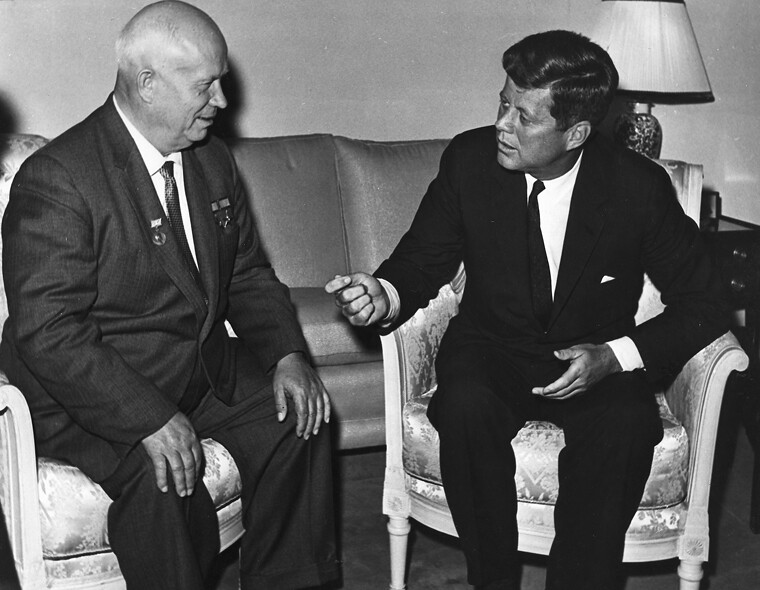
President John F. Kennedy and Soviet General Secretary Nikita Khrushchev/ U.S. Department of State & Kennedy Presidential Library/ Flickr/ Creative Commons License

When Russian Deputy Foreign Minister Sergei Ryabkov warned that the standoff between Moscow and Washington over Ukraine could trigger a crisis akin to the Cuban Missile Crisis, he wasn’t just referring to the danger of nuclear war, narrowly averted. He was also reminding Washington that Russia is not the only great power jealous of its sphere of influence. Russia has its “near abroad,” and the United States has its “own backyard” as defined in the 1823 Monroe Doctrine warning European powers to stay on their own side of the Atlantic. 

Sixty years ago this October, the Soviet Union projected its military power into the Western Hemisphere by placing missiles with nuclear warheads in Cuba. Soviet Premier Nikita Khrushchev’s principal purpose, we know now, was to protect Cuba from another U.S. invasion. (The Bay of Pigs invasion had failed the year before, and Washington had plans for an encore using U.S. troops.) 

To President John F. Kennedy, this intrusion into the U.S. sphere of influence was intolerable, not just because it posed a military threat, but because a U.S. failure to defend its own neighborhood would throw Washington’s credibility into doubt. To Kennedy, it was worth risking thermonuclear war to repel the Soviet incursion. Had Khrushchev not backed down, agreeing to withdraw the missiles, the United States was ready to launch a full-scale invasion of Cuba.

To this day, the United States has not accepted the idea that a hostile government allied with a rival superpower should be allowed to exist just 90 miles off the coast of Florida. This year marks not only the 60th anniversary of the Missile Crisis, but also the 60th anniversary of the U.S. economic embargo against Cuba designed to overthrow the Cuban government and replace it with one more to Washington’s liking. As Donald Trump’s national security adviser, John Bolton, candidly proclaimed, “The Monroe Doctrine is alive and well.” 

The Biden administration, however, appears not to recognize its own great power conceits. “We can’t go back to a world of spheres of influence,” Secretary of State Antony Blinken told CNN, chastising Russia for its attempts to exert influence over former Soviet states. “We’re not going back to that.” He apparently had not read the U.S. Southern Command’s annual Posture Statements for the past decade, each of which defines the growing influence of Russia, China, and Iran as one of the principal threats the United States faces in the Western Hemisphere. The 2021 version elevates these interlopers to a collective proper noun: External State Actors (ESAs) – external to the U.S. sphere of influence.

When Russian diplomat Sergei Ryabkov suggested that Russia might enhance its military posture in Cuba and Venezuela in response to the U.S. build-up in Eastern Europe, the U.S. warning was unequivocal. Any Russian attempt to deploy missiles in Latin America would be an “aggressive action,” declared United Nations Ambassador Linda Thomas-Greenfield, and would be met with a “strong response.”  “If Russia were to move in that direction,” said National Security Adviser Jake Sullivan, “we would deal with it decisively.” 

Biden’s officials seem not to grasp the irony of defending a U.S. sphere of influence while condemning Russia’s claims to its own. Not much has changed in the 60 years since the Missile Crisis, when Soviet missiles in Cuba were, by definition, “offensive” weapons, whereas U.S. missiles in Turkey were merely “defensive.”

If President Joe Biden is serious about replacing spheres of influence with what Secretary Blinken called a “rules based international order” in which small states can decide their own future free of great power coercion, Biden can start in his own backyard. Washington’s policy of regime change toward Cuba, based on economic coercion and subversion – a policy Biden inherited from Donald Trump and continues unchanged – has not worked for more than 60 years. Replacing it with a policy of engagement and coexistence would set a good example for President Putin in his near abroad.

February 1, 2022

* William M. LeoGrande is Professor of Government at American University and co-author with Peter Kornbluh of Back Channel to Cuba: The Hidden History of Negotiations between Washington and Havana (University of North Carolina Press, 2015).

Cuba: Communists Convene

By William M. LeoGrande*

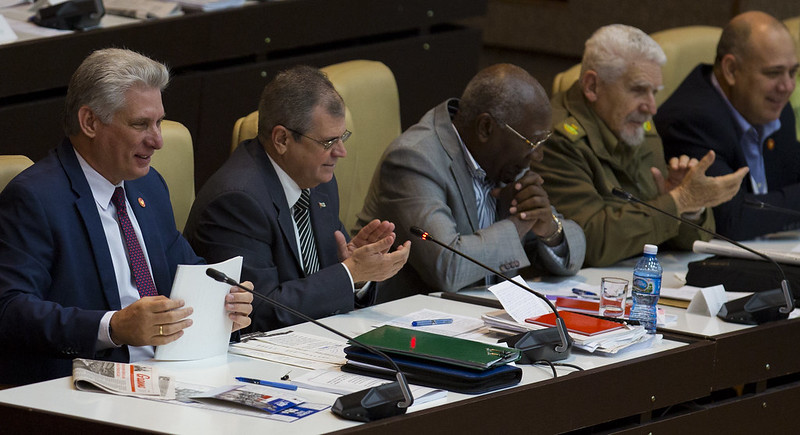
(From left to right) Miguel Díaz-Canel, Homero Acosta, Salvador Valdés, Ramiro Valdés, and Roberto Morales Ojeda/ Cubadebate/ Flickr/ Creative Commons License

The Cuban Communist Party (PCC) will convene its Eighth Congress on April 16‑19 to choose new leadership and assess policies intended to address longstanding economic and political challenges – with no indication of bold new departures. After all, Raúl Castro’s heir apparent as party leader, Miguel Díaz-Canel, has adopted as his favorite hashtag #SomosContinuidad. The meeting will have three major agenda items: selection of a new First Secretary to replace 89-year-old Raúl Castro and – perhaps – the replacement of other elderly party leaders; an assessment of progress implementing economic policies adopted at the Sixth Congress in 2011; and a review of the party’s political work, as mandated by the First National Party Conference in January 2012.

  • The Cuban leadership is undergoing a generational transition from “los históricos,” who founded the revolutionary regime, to a new generation born after 1959. Castro has affirmed his intention to step down as First Secretary in favor of Díaz-Canel, who succeeded him as President in 2018. However, Castro has not publicly ruled out remaining a member of the Political Bureau, and neither have the four other veterans of the struggle against Batista on the 17-member body – including reputed conservatives Second Secretary José Machado Ventura and Ramiro Valdés. The generational transition will not be complete until they depart; it’s hard to imagine Díaz-Canel would truly be in charge if he is still surrounded by these powerful old-timers.

Pummeled by President Trump’s tightened sanctions and the COVID-19 pandemic that closed the tourist industry, Cuba is suffering the worst economic crisis since the “Special Period” of the 1990s after the Soviet Union collapsed. The central theme of the Party Congress will be an exhortation to the party faithful to go full speed ahead on economic reforms, overcoming the bureaucratic resistance that has impeded them until recently.

  • When Raúl Castro introduced the reforms in 2011, he said it would take a decade to put them in place. Ten years later, they are far from finished, although the pace of reform has accelerated over the past nine months. The number of permitted private-sector occupations has increased from just over a hundred to more than 2,000. The dual currency and exchange rate system that created crippling distortions in the economy has been scrapped. And state enterprises have been put on notice that they have 12 months to become profitable or close their doors. In the short term, however, the economy remains hobbled by inefficiencies and unable to satisfy many basic needs.

The Congress will also review the party’s “political work” the task of building public support for the government. In 2012, Raúl Castro criticized the party’s poor performance. Endless meetings degenerated into “formalism,” in which no real criticism was ever voiced and little was accomplished, thereby “spreading dissatisfaction and apathy” among the membership. These failings weakened the party’s ties to the broader public, for whom it seemed remote and inaccessible. Another indicator of the party’s tenuous standing was an 18 percent decline in membership from 2011 to 2016 – the first decline since the party was founded in 1965.

Cuba’s party congresses always convene on the anniversary of the Bay of Pigs invasion – 60 years ago this April –  to commemorate Cuba’s successful defeat of Washington’s imperial designs. The focus of the upcoming Congress, however, will be on how the party can steer its way past the shoals of Cuba’s internal challenges and “update” its economic model of socialism through reforms that it nominally embraced years ago but has failed to fully carry out. With popular discontent at a peak because of the desperate economic situation and with critics mobilizing through social media to challenge state policy, the party has its work cut out for it.

April 5, 2021

* William M. LeoGrande is Professor of Government at American University.