The Politics of the Brazilian World Cup

By Luciano Melo

Embed from Getty Images

The 2014 World Cup, scheduled to begin in just 66 days, at this point poses greater risks for President Dilma and her administration than it does benefits.  When the Brazilian government presented its preliminary budget for the event in 2007 – around US$14 billion, or an estimated billion dollars for each 70,000-seat stadium – President Lula was perhaps the most popular president Brazil had ever had.  Despite the mensalão vote-buying scandal several years earlier, Lula was a “man of the people” with a strong personal magnetism.  Brazilians were seeing themselves as an emerging power with a dynamic economy.  Dilma, Lula’s chief of staff, was anointed his successor; she easily won the 2010 election; the Workers Party’s continuity in office seemed assured for the foreseeable future; and the World Cup would be a crowning jewel.

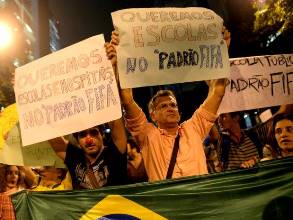
The scenario today looks far grimmer for Dilma.  Her support in the polls dropped from 43 to 36 percent just last month, underscoring her lack of charisma, and the largest Brazilian companies – Petrobras and Eletrobras – have lost half of their market value under her administration.  Cost overruns on World Cup projects have tripled and now exceed the annual budgets for both health and education ($35.6 and $28.8 billion, respectively).  Massive protests last year raised doubts about Dilma’s governance.  The armed forces are being deployed to maintain order in urban slums.  Brazil is now ranked 72nd in the Corruption Perception Index 2013 (a decline from 2012), and press reports indicate that nobody believes that World Cup construction companies have been chosen through a transparent process.  Economic analysts deem budget cuts and taxes increases inevitable – and austerity is in the cards no matter who wins the October 2014 elections.

World Cups and Olympic games are important for governments seeking to boost their image before international and domestic audiences.  If the Olympics in London 2012 aimed to sell England as a beacon of innovation, and the winter games in Sochi marketed Putin’s Russia as a powerful and modern state, the World Cup was Brazil’s opportunity to project itself internationally as a global player with a vibrant economy.  It was to show that high levels of violence and corruption are part of the old days.  Mismanagement and other problems so far suggest those objectives are beyond reach.  Domestically, if Brazil fails to win the cup, we will again see thousands (if not millions) of people protesting in the streets, and Dilma’s prospects of securing a second term will be complicated.  Should Brazil win, however, a soccer-induced surge of national pride may assist her re-election despite public concerns about the cost of the tournament and other economic woes.  But the reprieve probably would be short-lived.  The military move into the favelas is an ad-hoc measure, since organized crime has spread to surrounding urban areas and is likely to reemerge as strong as ever once the events are over.  The middle class and the private sector will continue to pressure the government to fix woefully inadequate public services and improve the business climate – even more challenging with austerity budgets.  The national soccer team could help Dilma win a second term, but the celebration is destined to have a short life. 

Brazilian and Mexican Press Criticize Russia but Remain Focused on the Home Front

By CLALS Staff

Embed from Getty Images

Latin America’s low-key reaction to events in Ukraine and Crimea suggests that opinion makers are distracted by domestic issues and perceive such far-off developments as having little bearing on the region.  The Brazilian press has noted the “pathetic and weak” leadership of the United States and Europe and said Russia was creating a “Soviet Union light” with nationalist rather than communist undertones.  Commentators have criticized Russia’s propagandistic narrative, in which criticism of Russian expansionism and interventionism is countered with examples of the American and European bloody history.  They have said Putin’s motives are a clear and explicit demonstration of power, where Crimea is a non-negotiable territory.  They have variously called Obama’s diplomatic responses “flaccid” and his speech about Putin’s motives an “unintelligible declaration.”    Prior to Putin’s military moves, President Dilma Rousseff asserted that the protests in Venezuela are different from those in Kiev, where an “institutional rupture” is taking place, and she has been relatively quiet since.  There have been minor considerations on how a European crisis affects the Brazilian economy, since Europe absorbed 20 percent of Brazil’s exports last year.

The Mexican press has loudly criticized Putin’s actions.   Commentators have described Russia as a “monstrous creature who combines state capitalism and a corrupt oligarchy.”  They have accused Putin of threatening world peace over strategic interests.  They note that Putin holds considerable leverage over Europe (via its supply of vital energy resources) and the United States (in negotiating over Syria and Iran), and they say that he appears likely to get his way in the Crimea.  Some have denounced Putin for attempting to turn the clock back to Russia’s imperialist days, and describe this tendency alongside the United States’ inability to shape events as signs that both are declining world powers.

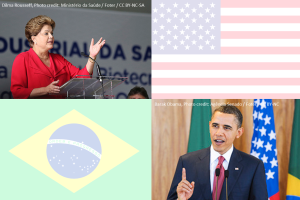
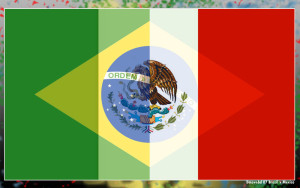
Both Brazil and Mexico have a full plate of domestic issues monopolizing political attention.  In Brazil, the middle class and elites remain upset about corruption surrounding the ruling PT, and many Brazilians continue to seethe over the scale of public expenditures that have constructed soccer stadiums rather than solid institutions for providing education and health.   The cost of preparations for the World Cup, set to start in three months, as well as the fortunes of the Brazilian team in that crucial tournament, have great implications for the fate of the Dilma administration.  Insofar as international issues reach the national agenda, Dilma appears most concerned with domestic political developments in Venezuela, where UNASUR has offered to play a mediating role.  In Mexico, President Peña Nieto and the media appear seized with security issues – ranging from the spectacular arrests of drug traffickers to the troubling emergence of “self-defense” groups – and the president’s ambitious economic reform agenda.  The Cold War-style East-West maneuvering over Ukraine hasn’t registered deeply in either country or elsewhere in Latin America.

Cuban Infrastructure and Brazilian State Capitalism: The Port of Mariel

By Eric Hershberg

Panamax Container Ship / Wikimedia Commons

Panamax Container Ship / Wikimedia Commons

The Port of Mariel – long associated with a boatlift in 1980 that brought more than a hundred thousand Cubans onto U.S. shores – could either help launch Cuba into a new regional role as a shipping/trading hub or be yet another white elephant project.  This irony was noted in a recent New York Times piece, which portrayed the venture in an optimistic light.  According to some observers, the massive port upgrading that is underway there at the moment, with Brazilian funds and a leading Singaporean port operator slated to operate the venture, is a ticket for Cuba to thrive in the 21st century as a vital logistics hub, funneling goods to Europe, the Greater Caribbean and, eventually, the United States.  All of this is on the agenda because of the Panama Canal expansion that will allow for post-Panamax ships to transit the canal.  These ships will have the capacity to carry over twice the amount of cargo than the current vessels that transit the canal, thus re-routing trade that now travels from the west coast of the U.S. by land to the east coast, and at the same time expanding traffic from Asia on to Western Europe.

The $957 million Mariel project entails a Brazilian investment of $682 million with the rest of the financing coming from Cuba.  The ambitious project goes well beyond the port itself, as the Cuban government has taken the exceptional step of authorizing a surrounding free trade zone – essentially an export processing zone along the lines of those that have housed maquilas throughout much of the Greater Caribbean as well as in regions such as Guangdong, in China, which became an export powerhouse.  The notion is that industries that locate within the special economic zone around Mariel will enjoy 50-year, renewable contracts and numerous beneficial tax treatments, including tax-free processing of imported inputs into products that will in turn be shipped out through the state-of-the-art port.

For some analysts of Cuba’s economic development prospects, this is a historic opportunity, one that will become even more relevant once the U.S. embargo finally goes away.  By this account, a combination of geographic location and a highly skilled workforce places Cuba in an ideal situation to take advantage of these massive investments.  If the Mariel initiative were to work as envisioned, the result would be a massive increase in industrial employment in Cuba which, under this scenario, could become a high value-added manufacturing hub and a distribution point for goods transiting from Asia to the greater Atlantic.  The opportunity may be all the more exciting given the failure of the U.S. federal government to invest in port upgrading of a sort that a well-functioning capitalist state would undertake.  At the moment, The Economist reports only Baltimore and Norfolk have the capacity to accommodate post-Panamax ships, leaving the field open for newcomers such as the Bahamas (already equipped) and Havana (about to be so).  Other analysts observe, however, that the project faces severe constraints, ranging from the institutional bottlenecks in Cuba to the reality of competition from other deep water ports (which do not suffer from the sclerotic institutional environment that plagues so much in Cuba), as well as competition from other countries with highly skilled workforces (Costa Rica, the Bahamas, and much of the English-speaking Caribbean).

Nevertheless, critics in Cuba and abroad question whether the massive Brazilian investment in the project – essential to its success – is driven not only by economic opportunities but also by the domestic political calculations of President Dilma Roussef. Loans provided to the Brazilian engineering conglomerate Odebrecht to build the port are from the Brazilian development bank, BNDES, and guaranteed by the Brazilian state, so unlike EU companies that eschewed investment in Mariel, Odebrecht incurs minimal risk.  Mariel represents both a geostrategic and a domestic political calculation by the Dilma government. Brazil is happy to take advantage of the U.S. absence in Cuba to build the port and its relationship with Cuba.  At home, it allows the government to reward the construction firms – such as Odebrecht – that are consistently the largest campaign donors in Brazilian politics.  It also helps to slake the passions of factions of the left that seek closer ties to Cuba, and have been disappointed by the Dilma and Lula administrations’ relative political moderation at home.  The fortunes of Mariel may in the end reveal as much about Brazil as about Cuba.

Brazilian Presidential Election: Challenging a Divided Society

By Luciano Melo

Dilma Rousseff | Photo credit: Office of Governor Patrick / Foter.com / CC BY-NC-SA Aécio Neves | Photo credit: Agência Senado / Foter.com / CC BY-NC Marina Silva | Photo credit: BrasilemRede / Foter.com / CC BY-SA

Dilma Rousseff | Photo credit: Office of Governor Patrick / Foter.com / CC BY-NC-SA
Aécio Neves | Photo credit: Agência Senado / Foter.com / CC BY-NC
Marina Silva | Photo credit: BrasilemRede / Foter.com / CC BY-SA

The Brazilian presidential elections are nine months off, but President Dilma’s adversaries are starting to present more clear and consistent visions of their values and positions.

  • Aécio Neves, from the main opposition PSDB, was a successful governor of the state of Minas Gerais and is currently a well-respected senator in Brasilia.  But his party has long suffered from “oppositional apathy” – the inability to position themselves as a real alternative.  This weakness appeared when former Ministry of Health José Serra was the party’s candidate in 2010.  Now, in opposition to the highly criticized welfare state represented by Dilmas’s Workers Party (PT), Neves has been defending a liberal (or more libertarian) state that will not stand in the way of people’s initiatives.
  • On the other side of the spectrum is the unlikely coalition represented by a former senator and minister in the Lula administration, Marina Silva.  She is a leader of the PSB party, and she earned a strong reputation for fighting for environmental protection alongside assassinated Brazilian hero Chico Mendes and for resigning as Minister of Environment over disagreements with the PT policies.  Marina Silva brings a certain gravitas and edge to the alliance, which, as a former ally of PT, has never differentiated itself well as a real competitor.

Neves and Silva are seen as possible game changers, but no one is under the illusion that it will be easy to surpass Dilma.  Her popularity has been steadily increasing since she stood up against the NSA’s spying activities, and she still benefits from the PT’s popular welfare policies.  The latest polls show that 67 percent of Brazilian Facebook users disapprove of the current government, but Dilma’s primary support remains from the poorer states located in the Northern and Northeastern regions, where the main beneficiaries of PT social programs live.  Neves is the clear representative of the frustrated middle class that was behind large protests in July, and it is behind the current social media campaigns attacking Dilma and the corruption perpetrated by PT’s leaders.  Marina Silva and coalition leaders, also representing those regions, would have to strategically target swing voters in order to obtain a larger margin in the next elections.  At this early moment, Dilma seems to have a good chance of obtaining a second term – but leading a highly divided society, with a middle class unwilling to accept excuses for poor results in the economy, education and security.

Brazil-U.S.: Implications of Postponed State Visit

By Luciano Melo

Picture2The postponement of Brazilian President Dilma Rousseff’s state visit to Washington was officially cast as the consequence of the lack of a good explanation for the National Security Agency’s cyber-espionage targeting her, the cabinet, Petrobras (the national oil company), and others.  Although the Brazilian Foreign Ministry issued a letter stating that both countries agreed to the postponement, Dilma’s remarks at the UN General Assembly on September 25 about NSA’s activities were so harsh that it was clear that frustration with the Americans’ widespread spying on Brazilians remains extremely high in Brasilia.

Experts agree that economically the postponement and bilateral tensions hurt the United States more than Brazil.  Contracts worth billions of dollars between Boeing and the Brazilian air force (FAB) are at stake, as are agreements that would favor cooperation in oil exploration and development of biofuels and others that would facilitate the transfer of “sensitive technologies.”  For Brazil, on the other hand, the postponement jeopardizes progress in talks to allow Brazilian citizens to enter the United States without visas – a project long-desired by Brazilians that was on the agenda for the state visit. Some observers in Brazil also speculate that, with the overall Brazilian economic slowdown, Dilma may actually prefer to have Brazilians spending their reais at home, not in the United States.

In a tactical sense, Dilma may have feared that Edward Snowden will leak more damaging information during her visit to the U.S., causing her even greater embarrassment at home and abroad.  In this way, fear and self-protection certainly played a role in her decision. On the other hand, the Brazilian president almost certainly saw domestic political advantages in a good old fight between the Brazilian David and the American Goliath.  She is desperately in need of boosting her popularity after the demonstrations against corruption in the country.  In fact, opinion polls show that public approval of her leadership increased from 45 to 54 percent just since the NSA dustup.

In strategic terms, the postponement fits Brazil’s strategy for claiming its position as a global player – and expressing unhappiness when it feels frustrated.  Dilma already had told President Obama in 2011 that Brazilians would seek a “more balanced relationship” with the United States. The postponement, like the speech at the UN, clearly reflects Brazilians’ desire to be treated better by the United States.  Obama’s speech at the General Assembly the same day, on the other hand, was interpreted by many Brazilians as emphasizing the United States’ traditional role as world policeman – not as the respectful neighbor in a new, multi-polar world order.  In this battle of self-images, Brazil sees itself as one of the global leaders, while the United States sees itself as the mighty one, considering only the European powers as full equals.  The broad base of Brazilians that Dilma is reaching out to is not “anti-American” in sentiment, and indeed wants a robust and respectful U.S.-Brazil relationship.  That is in the interest of both countries, but for this shared objective to be achieved, Washington will need to recalibrate its responses to Brazilian concerns.

Luciano Melo is a PhD candidate in the Department of Government at American University.

Brazilian Evangelicals: Stepping out into the Streets?

By Andrew Johnson

Kneeling in prayer. Photo by: Philip Anema

Kneeling in prayer. Photo by: Philip Anema

There is growing evidence of a potential shift in how Evangelicals engage in social issues in Brazil.  I witnessed their traditional approach recently inside a prison in one of Rio de Janeiro’s gritty peripheral suburbs.  Twelve men stood with their eyes closed and their arms draped around each other’s shoulders while an Evangelical pastor led the group in prayer.  After the final “amèm,” an inmate leader embraced the pastor and thanked him for his visit, to which the pastor responded, “I know that if I am ever in here in the future, you would come to visit me too.”  The pastor’s presence in the cellblock and his subtle pledge of solidarity with the inmates is typical of how Evangelicals have confronted pressing social problems through direct intervention and meeting the immediate needs of individuals in distress. They have been more likely to try to change the prison system by visiting inmates than by voting for a particular candidate or pushing for prison-specific legislation.  Theirs is a politics of presence.  But recently there have been signs that Brazilian Evangelicals’ intentional proximity to the needy is pushing some towards a different and more public strategy: street protest.

Even without an explicit political agenda, Brazilian Evangelicals have proven their ability to mobilize.  In early July, an estimated 2 million Evangelicals participated in the “March for Jesus” in the streets of São Paulo.  They sang hymns and prayed for the future of their country, but they did not use their collective voice to make demands of the government.  In contrast, just two weeks earlier, 65,000 people captured the global media’s attention by marching through the same avenues in São Paulo to protest increased public transportation fares, government corruption, and the fortune being spent on soccer stadiums for the 2014 World Cup.  The street protests gained momentum over the summer, but many Evangelical pastors and leaders were hesitant to offer public support, preferring to continue a strategy that relies on their direct service to the poor, the oppressed, and the imprisoned in their communities.

Antonio Carlos Costa and volunteers from Rio de Paz protesting in the streets of Rio de Janeiro asking the government for “FIFA Quality” Hospitals and Schools.  Photo by: Gabriel Telles

Antonio Carlos Costa and volunteers from Rio de Paz protesting in the streets of Rio de Janeiro asking the government for “FIFA Quality” Hospitals and Schools. Photo by: Gabriel Telles

Evangelical support of the street protests in Brazil has been minimal, but not completely absent. Some Evangelicals appear eager to move beyond a “politics of presence” approach and address the social structures and institutions they blame for many of Brazil’s social problems.  In Rio de Janeiro, the human rights NGO Rio de Paz – one of the most visible and vocal groups in the recent protests – is led by an Evangelical pastor, and the bulk of the volunteers are Evangelicals.  One such volunteer, a son of a Pentecostal pastor, joined the masses demanding governmental reform and, to encourage  others from his church to follow his lead,  posted Proverbs 29:4 to his Facebook page: “By justice a king gives a country stability, but those who are greedy for bribes tear it down.” He closed his appeal by writing that “in 30 years I want to tell my children that they live in a more dignified country because their parents didn’t sit at home waiting for a change.”  If that message resonates widely among Brazil’s 40 million Evangelicals, the Brazilian government will confront ever greater pressure from the streets to carry out long overdue reforms of corrupt institutions and practices.

Andrew Johnson is a Research Associate at the Center for Religion and Civic Culture at the University of Southern California and a contributor to a two-year project on Religious Responses to Violence in Latin America carried out by the AU Center for Latin American & Latino Studies with support from the Henry R. Luce Initiative on Religion and International Affairs.


Brazil Protests: Amorphous Causes, Unpredictable Consequences

By Matthew M. Taylor

Protestors in Brazil / Photo credit: Izaias Buson / Foter.com / CC BY-NC

Protestors in Brazil / Photo credit: Izaias Buson / Foter.com / CC BY-NC

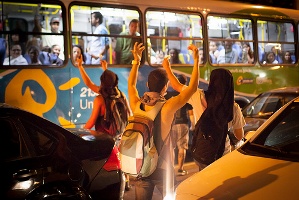
Hundreds of thousands of Brazilians hit the streets of a dozen state capitals this past week.  The initial trigger was a proposed hike in São Paulo bus fares, already among the world’s most expensive, but news media soon reported that the protests reflected anger with the rising cost of living, crime, corruption, impunity, and the high costs of hosting the World Cup. Lackluster public services haven’t helped, and widely televised police violence last week provided another rallying cry.  Polling by Datafolha shows that the protest is a middle class phenomenon, with 77 percent of the marchers in São Paulo claiming a university degree.  This growing demographic group is turning against President Dilma Roussef’s Worker’s Party (PT) but it is also weary of the opposition PSDB, especially in São Paulo state.

So far, the protests have been difficult for political parties to harness for their own ends.  Partisans who showed up at the marches on Monday waving party flags were reportedly forced to pull them down by indignant protestors.  Dilma’s popularity has been falling – she was recently booed at the opening match of the Confederations Cup – but the marchers don’t seem collectively exercised about her policies or those of any single party or politician.  Aecio Neves, Marina Silva and Eduardo Paes, her potential opponents in elections scheduled for late 2014, have yet to capitalize on her vulnerabilities, as the protestors seem to be casting “a pox on all their houses.”  An outside candidacy is a rising possibility, but Brazilians have been wary of supposed political saviors after the rapid rise and fall of Fernando Collor in 1990‑92.  Anger is directed at the political class as a whole because it is incapable of responding to public disgust with Brazil’s unsatisfactory public services.

It is quite possible that the protests may peter out on their own, especially if the renewed violence seen in São Paulo on Tuesday night alienates supporters.  If the protests continue and remain peaceful, they may result in increased social solidarity and a shared sense of patriotism in the face of an unsatisfactory political system.  Something similar happened during other mass protests in the past, especially the Diretas Já marches of 1985.  A renewed consensus in favor of a more robust and effective democracy would be salutary, but the concrete results arising from the protestors’ demands are difficult to predict.  One thing to be sure of: withdrawing the proposed bus fare increase proposal is too little, too late.

Brazil: The STF, Congress, and Checks and Balances

By Matthew M. Taylor

Supreme Federal Tribunal (STF), Brasilia / Photo credit: R. Motti / Foter.com / CC BY-NC-SA

Supreme Federal Tribunal, Brasilia / Photo credit: R. Motti / Foter.com / CC BY-NC-SA

Brazil’s last resort for political minorities and opposition parties – the Supreme Federal Tribunal (STF) – is facing growing pressures on its independence.  In Brazil’s famously hyper-presidential system, the executive branch dominates Congress through an elaborate system of presidential decrees, budgetary pork, and cabinet appointments.  Since 1990, no president’s party has ever held more than one-fifth of the seats in Congress, yet presidents – using a diverse array of carrots and sticks – have routinely been able to rely on support from coalitions that surpass three-quarters of the Chamber and Senate.  As Brazil’s high court, the STF has been the only channel through which majoritarian decision-making has been contested.

In recent weeks, Congress has bluffed its way onto the scene: the constitutional committee in the lower house voted to curb the courts via a proposed – but ultimately shelved – constitutional amendment that would restrict the STF’s powers of constitutional review, subjecting decisions that Congress finds objectionable to public consultation.  The reaction has been deafening.  The press has drawn parallels to similar moves in neighboring Argentina and Venezuela.  Eminent political analyst Sérgio Abranches claimed that this was further evidence that an “oligarchic civil coup” was under way.

Some judicial actions have indeed been provocative, such as decisions on contentious issues such as political party formation and the distribution of oil royalties. But the Congress’ effort to curb the court has left a bitter taste – because it points both to the increasing politicization of judicial decision-making and its potentially destabilizing effects on the political system.  The fact that the amendment proposal had support even from some members of the opposition underscores the depth of congressional resentment of the STF’s proactive role.  The Court appears likely to face continued pushback from Congress, with overwhelmingly political objectives.  But some elements of the proposed reform may be worth thinking about, such as restrictions on the issuance of injunctions by single members of the Court.  Too often these injunctions have been seen as high-handed and lacking in the legitimacy that decisions by the full Court carry.

Mexico-Brazil: Competing Economic Models?

The divergent economic performances of Mexico and Brazil over the past few years have again thrust upon analysts the difficult task of estimating which factors – public policies, market trends, geographic location, financial market managers’ perceptions, or something else – are responsible for the different results.  Brazil was everyone’s favorite two years ago, but Mexico is now being hailed as the hot performer – and praise is being heaped on Mexico City for making things happen.

Former Chilean Finance Minister Andrés Velasco, writing for Project Syndicate (click here for text), explores why the Brazilian economy today is “stagnating” while Mexico, written off as a “lost cause” just two years ago, is “expanding at a steady clip.”   Among Velasco’s key points:

  • Financial markets’ behavior says more about investor perceptions than about the countries in question.  Analysts focus on short-term figures rather than on structural trends.
  • Mexico’s economy is much more open than Brazil’s because of NAFTA and other agreements with Europe and Asia, while Brazil’s is limited by the “strictures of Mercosur.”  (Velasco was a strong advocate of free-trade policies while serving on President Bachelet’s cabinet.)  Mexico’s “export basket” has expanded dramatically – to include car parts, electronics, telecommunications equipment – while Brazil’s exports are increasingly commodity-based.
  • After both implemented anti-crisis fiscal packages in 2009, Velasco praises Mexico for having reduced its stimulus sooner – enabling it to keep interest rates much lower, controlling inflation better, and thereby contributing to a more robust private-sector role.

At the same time, Velasco urges wariness “about jumping to definitive conclusions” and notes that Mexican exports have been slowing in recent months, while domestic consumption is picking up as a source of demand.  He also cautions that Brazil’s potential to sell its products around the world “should not be underestimated.”

However thoughtful, analyses like Velasco’s may neglect the impact of another long-term factor:  the steady rise in wages in Brazil and their stagnation in Mexico.  At a seminar in Washington hosted by CLALS last week, Mexican economist Luis Felipe López Calva (click here for news article) noted that the strength of the middle class continues to be a vulnerability in Latin America, and he said that the ability of the middle class to be a “lever of growth” argued for policies that emphasized economic mobility.  A thriving middle class and increased domestic consumption can be a more reliable engine for growth (and for the consolidation of democratic institutions necessary for growth) than short-term market trends.  The increasing wellbeing of the bottom two thirds of the income distribution pyramid in Brazil argues for tempering optimism that Mexico alone has found the holy grail of economic policies. 

What do you think?  Click on “leave a comment” below to contribute.

Brazil’s Counternarcotics Policy Challenges

By Tom Long

Minister Alexandre Padilha meeting to discuss policies against crack | Photo by: Ministério da Saúde | Flickr | Creative Commons

Long a significant market for cocaine – the second or third largest in the world according to estimates – Brazil is suffering a major increase in crack cocaine use.  Visible in the centers of major cities, drug abuse has become a more serious national concern as Brazil prepares to mount the world stage as host of the 2014 World Cup and the 2016 Rio Olympics.  Brazil was slow to recognize the problem as it grew to epidemic levels, surpassing the United States as the largest consumer of crack cocaine, according to a recent report from the Federal University of São Paulo.  While national and local authorities have emphasized their recent approach to drugs as focused on public health – in contrast with the U.S.-led, supply-oriented policies – Brazil also has increased control and interdiction efforts.  According to the UN, cocaine seizures by Brazilian security tripled between 2004 and 2010.

The effort to control the flow of cocaine into and through Brazil will test both the country’s diplomacy and state capacity.  Its long, undefended and sparsely populated borders touch every major narcotics-producing and ­transiting country in South America, and cooperation in addressing the problem varies widely for political reasons and disparities in capabilities.  For example, the government of President Evo Morales in Bolivia has declined Brazilian requests for crossborder eradication, InSight Crime reported.  Other countries’ counternarcotics focus is almost completely internal, such as in Colombia and Peru.  As a result, Brazil is increasing action on its own.  President Dilma Rousseff supports plans to spend some $400 million on an expanded fleet of unmanned aerial vehicles, or drones, to provide surveillance of its borders.  Military patrols have increased, albeit in necessarily limited areas.

Experts have long warned that the “balloon effect” of counter-narcotics policies – when successful drug operations push the trade into less-defended countries and regions – was going to worsen the flow and use of narcotics in Brazil, and Brazil has long sought ways, within its resources, to collaborate.  When U.S.-Bolivia cooperation deteriorated in 2009-2010, for example, Brasilia tried to fill some of the void.  Brazilian diplomats have usually tried to lead quietly, build consensus, and avoid obvious pressure on neighbors.  However, as concerns grow, domestic politics could push Brazilian leaders to be more assertive, with the potential benefits and risks that would entail.  The challenge will be for them to find ways to collaborate on a common drug strategy with often skeptical neighbors while making gains to reduce internal demand.  Four decades of U.S. experience provide a cautionary tale.