Haiti: Crisis as Usual

By CLALS Staff

World Bank Group President Jim Yong Kim and Haitian President Michel Martelly / Photo credit: World Bank Photo Collection / Foter / CC-BY-NC-ND

World Bank Group President Jim Yong Kim and Haitian President Michel Martelly / Photo credit: World Bank Photo Collection / Foter / CC-BY-NC-ND

Half way through his term, President Martelly and his opponents have shown the same weak leadership and shallow commitment to democracy and transparency that has long plagued Haitian politics.  The IMF recently reported preliminary data indicating that Haiti’s GDP grew around 4 percent in FY2013; that inflation dropped from almost 8 percent to 4.5 percent; and that, although the fiscal deficit was larger than planned, domestic revenues were in line with projections.  On the streets, however, popular suffering shows no sign of abating.  Some 170,000 remain homeless since the earthquake almost four years ago; hundreds of thousands still have no prospect of employment, and poverty rates remain sky-high.  Suspicions about the whereabouts of more than a billion dollars in foreign aid are growing.  The World Bank last week criticized the lack of government transparency regarding funds from Venezuela’s “Petrocaribe” program, worth about $300 million a year to Haiti, and repeated its call for an end to the government’s use of “non-compete” contracts.  Corruption, a perennial concern, was a main theme of several large protests last month, involving thousands of citizens demanding Martelly’s resignation.

United Nations officials have repeatedly called on Haiti to hold parliamentary elections originally scheduled for two years ago.  The lower house of parliament in November passed a bill protecting the tenure of certain members of the senate – which the UN Secretary General’s senior representative in Haiti praised as “an important step for the organization of inclusive, transparent, and democratic elections” – but myriad other preparations remain undone.  The UN last August found that failure to hold elections by next month “runs the risk of [the Parliament] becoming inoperative,” but the Security Council went ahead and renewed the MINUSTAH mission for yet another year, albeit with fewer troops and police.

Donor fatigue – when the international community tires of lending a hand – seems to have been overtaken by donor disinterest, and the Haitian political elite appears much obliged.  Martelly, whose stage name was Sweet Micky during his singing career, has failed to use his fame and charm to promote serious reform among Haitians, as he promised, nor has he weaned his government and its supporters off the lucre of corruption.  His detractors, like those organized against Presidents Préval and Aristide before him, are better at mobilizing opposition than they are at mustering support for any political alternatives.  The Obama Administration’s commitment after the earthquake to help Haiti “build back better” has faded.  A central element of its vision was construction of an industrial park in northern Haiti, which more than a year after its inauguration has created fewer than 2,000 of the 65,000 jobs it promised.  As long as Haitians and their international supporters are satisfied with bandaid solutions to systemic problems, the country will wallow in its misery until the next crisis makes things yet worse again.

Subnational Regimes Reveal Uneven Nature of Democracy

By Agustina Giraudy

Peruvian mayoral campaign poster / Photo credit: Pedro Rivas Ugaz / Flickr / CC-BY

Peruvian mayoral campaign poster / Photo credit: Pedro Rivas Ugaz / Flickr / CC-BY

Most Latin American countries have transitioned away from autocracy and authoritarianism over the past three decades, but much of their democratic advancement has been territorially uneven and mostly limited to the national level.  In Argentina, Peru, Brazil, Bolivia, Mexico and other countries, democracy has not trickled down to subnational levels of government.  Many provinces, states, and municipalities in these (and other) countries continue to be governed in ways that resemble the period of undemocratic rule.  In these subnational undemocratic regimes (SURs), the political and civic rights of regular citizens and the political opposition are severely curtailed.

In SURs such as Formosa, San Luis or La Rioja in Argentina; Oaxaca (pre 2010), Puebla (pre 2010), or Tabasco in Mexico; and Goiás in Brazil, provincial autocrats use a variety of undemocratic, illegal, and informal actions – such as electoral fraud, electoral violence, and changes in electoral rules and political institutions – to prevent the opposition from gaining access to state positions.  My research and others’ indicates that, to further protect their own power, these subnational rulers frequently and arbitrarily reshuffle provincial- and state-level supreme courts, capriciously remove opposition mayors from office, deny funding to municipalities controlled by the opposition, and arbitrarily commission provincial- and state-level audits to investigate contrived financial misdeeds of opposition mayors.  They also co-opt or divide local organized groups, such as small unions, social movements, and street vendors, to undermine potential opposition.

The existence of SURs within national democracies underscores the difficulty of assessing the quality of a democracy from a purely national perspective.  As recent research has shown, the continuation of SURs in national democracies requires that we take a different approach and, importantly, grasp how seemingly democratic national-level leaders benefit from and, in some circumstances, encourage the SURs as a reliable base outside the capital.  Subnational undemocratic rulers, who typically control voters and legislators in the national congress, are seen by national officials as key partners for crafting winning electoral and legislative coalitions.  To the extent that national democratic incumbents succeed at inducing and securing autocrats’ cooperation, the former have strong incentives to help the latter stay in power.  Ironically, the accepted practice of democratic coalition-building contributes to the obstruction of democratization at the subnational level.  In the second decade of the 21st century, the quality of Latin American democracies depends at least as much on subnational democracy – and reducing the influence of SURs – as on the quality of national-level institutions.

Mexican Judicial Reform: Example of the Need for a Closer Look

By Todd A. Eisenstadt

Foro: el Nuevo Sistema de Justicia Penal, a un Año de su Implementación en Baja California, con la ponencia: “Hacia una Justicia más Transparente” /Photo credit: Gobierno de Baja California  / Flickr / CC

Foro: el Nuevo Sistema de Justicia Penal en Baja California / Photo credit: Gobierno de Baja California / Flickr / CC

Mexico’s judicial reforms have proceeded at an uneven pace in each of the country’s 32 states since they were approved as a constitutional amendment in 2008.  The new and spacious “tower of justice” in Baja California shimmers in the desert sun, an outward sign of the $100 million-plus program that is the centerpiece of the state’s “law and order” administration.  However, halfway across Mexico, in the state of Puebla, litigators, police, and judges – untrained in the new judicial system they are implementing – watch their first important case, a manslaughter conviction, give way to a plea bargain after a series of errors.  Morelos, Oaxaca and other states do not have inter-connected computer systems for prosecutors and defenders, and Nayarit has not even passed a state-level criminal justice code to bring that state up to compliance with the 2008 reforms.  And Chihuahua, where Ciudad Juárez in 2011 held the distinction of being the most violent city in the world, a punitive “counter-reform” reducing the rights of the accused has set back that state’s reform efforts.

Progress on the reforms has been stymied by lack of a litigation tradition, a failure in interagency cooperation, a shortage of technology and resources, a lack of political will, and a lack of public support.  Mexico’s drug-related violence has put it at the center of hemispheric debate on judicial reform, but even heralded reforms of the 1990s, such as in Argentina, Bolivia, Panama, and Peru, have been unevenly implemented.  Chile’s reforms, widely seen as successful, were made possible by overcoming inertias, including judicial resistance to the creation of an adversarial relationship between defense and prosecution that moved judges into an institutionalized neutral position.  Legal scholar Mauricio Duce also argues that the retooling of Chile’s Ministerio Público – an autonomous body that functions as a fiscalía or justice ministry – was crucial because the institution became the “engine” of the reforms.

Each country brings its own history, culture and institutional strengths and weaknesses to the challenge of judicial reform. With the results of the first generation of reforms so mixed, a rigorous review of  what has worked – and not – in Latin America, Africa, or Eurasia and elsewhere can help overcome these dramatic shortcomings in the implementation of  reforms. The political commitment to reform is important, but understanding the political contexts and legal/administrative components in each case is also essential for improving the rule of law and accountability, deterring violent crimes, improving human rights recognition, economic development, and establishing security and law and order. When academics, program managers, and political leaders understand why a country like Mexico can have such vastly varying results from the same reforms, they can all take a giant step toward achieving more lasting and positive change.

Todd A. Eisenstadt is a professor of government at American University.

Honduran Election Crisis Marks New Phase in Country’s Agony

By CLALS Staff

Juan Orlando Hernández Photo credit: Tercera Informacion / wikimedia commons / and Xiomara Castro / Photo credit: hablaguate / Flickr / Creative Commons

Juan Orlando Hernández Photo credit: Tercera Informacion / wikimedia commons / and Xiomara Castro / Photo credit: hablaguate / Flickr / Creative Commons

Yesterday’s election in Honduras was peaceful and orderly – the 61 percent voter turnout forced polls to remain open an extra hour – but anomalies in the vote count have cast a dark shadow over the legitimacy of the results. Although most polls for months indicated that Libre candidate Xiomara Castro had a several-point lead over National Party candidate Juan Orlando Hernández (and a few polls showed they were in a dead heat), the Superior Electoral Tribunal (TSE) said the Nationalist beat Castro by more than a five percentage point  margin – 34.2 percent to 28.6 percent. Castro and other candidates had repeatedly claimed the National Party activist who heads the TSE (which has no representative from the nontraditional parties or Libre) would skew the results and, citing exit polls, she has alleged that fraud tainted up to 20 percent of yesterday’s votes. The TSE’s claim that, of more than 1.6 million ballots cast, there were no null or blank votes – when party poll watchers reported many – has also drawn attacks on its credibility. Nonetheless, the U.S. Ambassador and the European Union observer team hastily declared the process transparent and clean.

Hernández and Castro have both declared victory – promising high tensions in at least the short term. Castro is the wife of former President Mel Zelaya, who was ousted in a coup in 2009, and has assembled a broad and deep popular base in Libre outside of Honduras’s two traditional parties. The government, military, economy and, importantly, news media are all dominated by elites that have long resisted the sort of popular movement she has built.  Few observers believe that, particularly with U.S. endorsement of the election results, Castro’s demands for a recount or other review of the results will be heeded.

If the results had been seen as accurate and fair, the election could have helped Honduras close the dark chapter of tensions and violence that started when the military forced President Zelaya into exile three and a half years ago. If Hernández is allowed to take office, his low vote – barely a third of all votes cast – alone promises a prolonged crisis like that which has plagued current President Lobo since his inauguration, a period during which both criminal and political violence has skyrocketed, public finances have deteriorated alarmingly, and political polarization has reached unprecedented heights. Under a Hernández presidency, the crisis may become even worse. Castro ran a campaign explicitly committed to peace and reconciliation and consistently urged her supporters to give democratic process a chance. She has never shown even the slightest inclination to call her supporters to violence, but popular anger has festered since the 2009 coup and there’s no guarantee that some frustration will not spill into the streets.  The surge in right-wing violence in Honduras since the coup – reminiscent of death squad activities in other Central American countries in the 1980s – has persuaded many protesters to keep their heads down, but this election may lead to desperate acts which the death squads will be eager to respond to, threatening a spiral of violence the hemisphere’s second-poorest country can ill-afford.

Chile Elections: Bachelet’s Partial Victory

By Maribel Vasquez and Eric Hershberg

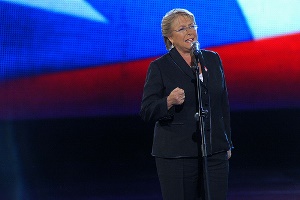
President Michelle Bachelet / Photo credit: Chile Ayuda a Chile / Flickr / CC-BY-NC-ND

President Michelle Bachelet / Photo credit: Chile Ayuda a Chile / Flickr / CC-BY-NC-ND

Elections last Sunday didn’t give former President Michelle Bachelet the strong mandate that she wanted but she appears well positioned to win the second round and the honor of serving a tough second four-year term. An underwhelming number of Chileans headed to the polls to cast their votes for the president of the republic, parliamentarians, and for the regional councilors. Polls had indicated that Bachelet would win convincingly in the first round but, with 46.7 percent of the ballots cast, she fell just short of the 50 percent needed to avoid a run-off election on December 15. Conservative Evelyn Matthei, from the governing right wing Alliance Party, received 25 percent of the vote in the first round and has little chance of winning the run-off: another 17 percent of Chileans voting in the first round opted for candidates running to the left of Bachelet, and observers predict they will either stay home in December or select the former president as a second best option.

A 2012 change in voting law appears to have hurt Bachelet’s percentages. Under the new norm, Chileans for the first time were automatically registered to vote in presidential and congressional elections upon reaching 18 years of age, instantly expanding the electorate from eight to 13 million potential voters. But also for the first time, voting was not compulsory, and that proved consequential. In a country where public opinion polls have long shown high levels of alienation from the political system, particularly among younger segments of the population, abstention reached unprecedented heights. Fewer than seven million Chileans turned out to vote on Sunday, representing only around half of those eligible to do so. Turnout was undoubtedly suppressed by the stubborn persistence of Chile’s binomial electoral system, a holdover from the Pinochet dictatorship’s 1980 Constitution that gives the losing party a bloated presence in Congress (in order to receive both seats in any given district, the winning party or coalition must win double the percentage of the vote received by the runner-up, so frequently even a wide margin between the two top vote getters generates an equal allocation of seats). Bachelet’s center-left coalition, the New Majority, has proposed amending the constitution to make the electoral system more reflective of public preferences. But the newly-elected Congress, selected according to the rules of the authoritarian regime, is unlikely to generate the super-majorities needed to achieve constitutional changes that would alter the system so as to democratize congressional representation.

Getting elected to a second four-year term as Chile’s president might prove to be the easy part for Bachelet.  Harder still will be pushing forward the ambitious policy reforms she has promised. An especially prominent issue in the campaign was the demand of a growing student movement to reform Chile’s privatized education system, and Bachelet responded with a pledge to guarantee free, quality higher education to all Chileans, to be funded by a proposed increase in corporate tax rates and elimination of tax deferrals used widely by Chilean companies. Yet while Bachelet’s bloc secured the simple majority needed to secure modest tax reform, it fell short of the super majorities needed to secure education reform or change the electoral system or constitution, and the rightist opposition is loath to cede ground on either of these issues, which are also legacies of the Pinochet constitution. To enact the key pillars of her agenda, Bachelet’s second presidency will need to calibrate difficult negotiations with Congress with popular pressures to fulfill democratic aspirations for political representation and a more social democratic approach to public services than has been possible to achieve during the first 23 years of post-authoritarian rule.

UNASUR Looking for Leadership and Direction

By Andrés Serbin

unasur meetingThe seventh UNASUR head of state summit, held in Suriname in August, failed to give the organization the shot in the arm that it needed to continue developing as an effective voice for South America. Despite grandiloquent declarations that it was a “historic event” for the region, the summit was in danger of being overshadowed by several incidents. The son of Suriname´s President and summit host, Desi Bouterse, (who himself has a checkered past) was detained in Panama the day before the summit and extradited to the United States, where he faced drug- and arms-trafficking charges.  (The son was subsequently charged with “attempting to support a terrorist organization” as well.)  Moreover, four of the 12 UNASUR heads of state didn´t attend the Summit, and bilateral tensions between some of the participants got the meeting off to a rough start:  Bolivia was irritated that Brazil gave asylum to a senator accused of corruption; Uruguay’s decision to expand a paper plant on the Paraná River peeved Argentina; Chile and Argentina were in a row regarding the Chilean airline LAN’s use of facilities in Buenos Aires; Chile and Peru continue a battle in the Hague about a territorial dispute; and Paraguay was still in limbo after being suspended from UNASUR (and MERCOSUR) after President Lugo’s removal last year by the Congress.

Even as the dust settled, however, UNASUR was unable to take on the most important task of the summit – appointing a new Secretary General for the organization.  Despite their contrasting styles – sometimes complementary and sometimes in open competition – Presidents Chávez and Lula de Silva had driven the creation and consolidation of UNASUR after the end of the FTAA project during the Mar del Plata Summit of the Americas in 2005, but that strong leadership is not there anymore.  Their absence laid bare the weak political will of most other South American leaders to consolidate the organization and to build a strong institutional basis for its development.  No one, except perhaps former (and controversial) Paraguayan President Lugo has expressed interest in the job of Secretary General.  It was no surprise, moreover, that the Summit was not able to advance other crucial decisions, such as the creation of the long expected Banco del Sur. A resolution condemning U.S. initiatives regarding Syria was one of the few relevant and consensual results of the Summit.

UNASUR started out as a political endeavor based on regional, instead of national, interests, and much of its earlier momentum was driven by rejection of earlier “neoliberal” attempts at regional integration and of the role of the United States in the region. Members’ new focus is clearly state-centric and political, as regional market and trade issues have been superseded by a new agenda focusing on infrastructure and communications development, energy and security agreements, global financial impact and environmental concerns. The absence of new leadership to move forward a regional agenda poses a series of challenges to this process.   In the meantime, other processes continue.  Paradoxically, some of the member countries are deeply involved in the creation of a new initiative – the Pacific Alliance (Alianza del Pacífico), clearly oriented towards free trade.

Iran in Latin America: An Exaggerated Threat

By Aaron Bell

Former Presidents Hugo Chavez and Mahmud Ahmadinejad / Photo credit: chavezcandanga / Foter.com / CC BY-NC-SA

Former Presidents Hugo Chavez and Mahmud Ahmadinejad / Photo credit: chavezcandanga / Foter.com / CC BY-NC-SA

During his campaign for the U.S. presidency, Republican Mitt Romney referred to Russia as the United States’ number one geopolitical foe, but in the Latin American context he and his fellow conservatives have focused much more on another perceived competitor – Iran. Alongside China and the EU, Russia has indeed taken greater interest in Latin America in the past decade, investing in energy, selling military hardware, and even offering an alternative to Washington’s counternarcotics programs. But Romney and major elements of his party have given more attention to the newer, more enigmatic go-to threat of Iran and its former president, Mahmoud Ahmadinejad. The 2012 Republican Party Platform warned that Venezuela had become “an Iranian outpost in the Western Hemisphere,” issuing visas to “thousands of Middle East terrorists” and providing a safe haven to “Hezbollah trainers, operatives, recruiters, and fundraisers.” This past spring, former Assistant Secretary of State Roger Noriega told a Congressional committee that Hezbollah was working alongside the Sinaloa Cartel to fund and organize terrorist activities. He claimed the organization had infiltrated the Venezuelan government so the Iranian government could launder money through Venezuelan banks to avoid international sanctions.

Relations between Iran and some members of ALBA expanded during Ahmadinejad’s presidency, during which he spent more time in Latin America than either Presidents Bush or Obama. He shared the stage with Hugo Chávez and Daniel Ortega in denouncing the United States and its policies toward both Iran and the ALBA nations, and he pledged to invest in Venezuela, Bolivia, and other countries. The warmth of that contact gave credibility to rumors that Iran has used elite Quds soldiers and Hezbollah agents to create a web of Latin American agents available for terrorist strikes in the United States.  As required by the Republican-sponsored “Countering Iran in the Western Hemisphere Act,” the State Department released a report this summer analyzing Iran’s regional activities. While it expressed concern over Iran’s political and economic links, it concluded that Tehran’s regional commitments had largely gone unfulfilled. Nonetheless, a handful of U.S. Congressmen and the media continue to warn of the looming Iranian threat along what conservative commentators call the “‘soft belly’ of the southern border.”

The Obama Administration has not dismissed entirely the negative impact that a country like Iran can have in Latin America, if nothing else by encouraging political leaders to sustain their anti-U.S. rhetoric campaigns. But the Administration has not subscribed to the right wing’s exaggerations about Iranian activity and indeed is seeking pragmatic agreements with Iran to resolve a series of concerns about its activities, particularly its nuclear program. A handful of members of Congress led by Rep. Ileana Ros-Lehtinen (R-FL), former Chairman of the House Foreign Affairs Committee, have accused the Obama administration of putting politics over national security by failing to challenge Venezuela and other Iranian allies, though the political advantage the president supposedly achieves with such a policy is unclear. Some xenophobic nationalists on cable TV believe the Iranian activities are part of Islamic imperialism, which poses a threat to Western civilization. Others see the threat as being embodied by Barack Hussein Obama, accusing the administration of hyping the Iranian issue as a pretext to justify the expansion of a U.S. military presence in South America. Today’s paranoia about Latin America is different from during the Cold War years, but only in the identity of the villain. Latin America’s role in the new narrative remains unchanged: it exists primarily as a base of operations for foreign enemies of the United States that must be monitored and pressured to ensure U.S. national security. While the rhetoric of ALBA leaders and their efforts to establish friendly relations with regimes like Iran fuel such paranoia, Washington would be wise to respond to actions rather than empty rhetoric. Fortunately, the Obama administration appears to be doing just that.

Costa Rica: Losing Faith in Democratic Institutions?

By Fulton Armstrong

Supreme Elections Tribunal President Luis Antonio Sobrado / Photo credit: izahorsky / Foter.com / CC BY-NC-ND

Supreme Elections Tribunal President Luis Antonio Sobrado / Photo credit: izahorsky / Foter.com / CC BY-NC-ND

Costa Rica is approaching February’s presidential and legislative elections with a distinct lack of enthusiasm, if not with dread.  Most international surveys present Costa Rica as the “world’s happiest country” (the Happy Planet Index), or in the elite club of the world’s “full democracies” (ahead of Japan and Belgium in The Economist’s list), or as the 48th least-corrupt country (out of 174 reviewed by Transparency International).  The economy is expected to grow about 3 percent this year, and the country’s access to foreign direct investment is blunting the impact of the government’s fiscal deficit of about 5 percent of GDP.  Crime is on the rise, but Ticos know that their pain is small compared to that wreaked by the narcos and maras in Guatemala, El Salvador and Honduras.

Reputable polls show, however, that Costa Ricans are gloomy about the state of their political institutions and specifically about their upcoming elections.  According to polls, about 32 percent of the country’s 3 million eligible voters say they plan to abstain, citing corruption, a lack of leadership, insensitivity to the average citizen, and unemployment as reasons to reject not just the candidates but also the political elite in general.  The President of the Supreme Electoral Tribunal (TSE), Luis Antonio Sobrado, acknowledged last month that the election was taking place in the context of “citizen uneasiness … and a lot of anger with politics and politicians.”  Abstentionism was high in 2006 (35 percent) and 2010 (32 percent), but commentators sense a much deeper and darker alienation this time around.  A columnist lamented that the “multiparty” system has been replaced by “atomization,” and another said the political parties have “disconnected themselves from the national reality.”

Further reflecting the malaise, President Chinchilla’s support has nosedived – a July poll showed only 9 percent of voters said she was “good” and none said “very good” – and pundits cite her ineffectiveness as the cause of collapsed highways, dengue outbreaks, and other calamities.  The nominee of her Partido de Liberación Nacional (PLN), Johnny Araya, is widely thought to have an edge in February, but his 12 years as mayor of San José have coincided with a deterioration in the city’s infrastructure and security, and his personal lifestyle (including five marriages) may be a factor in popular skepticism.  The government’s recent announcement that it will contract the services of 4,125 new employees in 2014, mostly in the education sector, drew immediate criticism as yet another example of political patronage to influence the race.

The self-doubt seems at this point indicative of concerns about Chinchilla and the crop of candidates, rather than a rejection of democracy.  Costa Ricans comparing themselves with the rest of Central America still feel good about themselves, and the green image that eco-tourists reinforce is comforting.  But crumbling infrastructure – including collapsing bridges and the exorbitant cost of repeated repairs – and shocking crimes, such as the recent assassination of an environmentalist protecting turtles on a Caribbean beach, fuel the sort of doubts that only effective political and economic leadership can quell. 

Replicating the U.S. Shale Gas Revolution in Latin America

By Thomas Andrew O’Keefe*

Photo credit: Energy Information Administration / Foter.com / Public domain

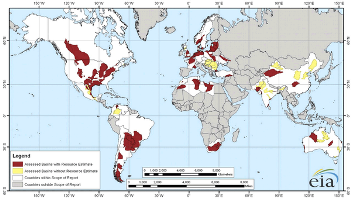
World Shale Gas Map / Photo credit: Energy Information Administration / Foter.com / Public domain

The shale gas revolution in the United States promises not only to soon make the country energy self- sufficient but also serve as the catalyst for a major revival of manufacturing.  Similar high hopes have been raised for Latin America, where some of the planet’s largest reserves of shale gas are found.  According to U.S. Energy Information Administration estimates, Argentina is said to have the world’s second largest reserves of technically recoverable shale gas (China is first).  The United States is currently in fourth place, followed by Canada and Mexico.  Brazil is in tenth place, with Chile and Paraguay not far behind.  The possibility that Latin America can pursue a successful shale gas strategy, however, is tempered by a number of important legal and/or geological differences that can serve as important bottlenecks.  In addition, the region’s tumultuous politics often get in the way of implementing policies that boost investment and encourage a highly productive energy sector.

The most important legal difference is that subsoil rights belong to the above ground property owner in the United States, while everywhere else in the Western Hemisphere the government (national, state or provincial) is the owner.  Developers have had an easier time purchasing access to shale gas deposits from individual landowners throughout the United States.  This explains, in great measure, why Canada’s significant shale gas reserves have not been as extensively exploited as in the United States, despite a hydrocarbons regime receptive to private-sector investment.  In addition, environmental protection legislation that impacts the shale gas industry is fractured among Federal, state, and local government authorities in the U.S.  That has facilitated developers extracting waivers and more lenient treatment in the United States that would be harder to obtain in most Latin American nations, where environmental protection is the exclusive or predominant prerogative of the central government.  Furthermore, current technology for extracting natural gas from shale reserves demands huge amounts of water, a resource that is scarce in those regions of Mexico, for example, where most of its extensive shale gas reserves are located.

Political realities are the most crucial (and often overlooked) factor that can easily undermine any effort to develop Latin America’s extensive shale gas reserves.  On paper, Argentina should be a regional energy powerhouse, supplying not only its own energy needs but those of its neighbors. However, the country has for years pursued policies that have scared off private-sector investment, heightened Argentine dependence on foreign energy imports, and led to a steady hemorrhaging of hard currency reserves.  To outsiders these policies appear illogical, but they make perfect sense to Argentine political leaders trying to consolidate their power base.  Mexico is an example of a country constrained by its Constitution from developing its extensive off-shore hydrocarbon resources.  Any political party that tries to make major amendments to those constitutional provisions, however, risks annihilation at the polls.  Brazil’s recent adoption of nationalistic legislation to encourage the domestic manufacturing of hydrocarbon-related technology could well impede exploiting its shale gas reserves if similar mandates are created for the highly specialized and capital-intensive hydrofracking equipment the industry utilizes.  In fact the only Latin American country where the stars seem aligned to repeat the U.S. shale gas success story is investor-friendly, politically-stable, energy-starved, and free-market oriented Chile, whose shale gas reserves are concentrated in the remote, under populated (and very wet) far south of the country that desperately seeks new opportunities to promote local economic development.  

*Thomas Andrew O’Keefe is the President of San Francisco based Mercosur Consulting Group, Ltd. and teaches at Stanford University.

Peru: Will Humala pursue deeper reforms?

By Marcela Torres

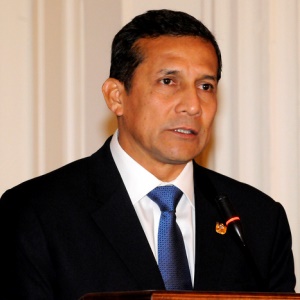
President Humala / Photo credit: OEA - OAS / Foter.com / CC BY-NC-ND

President Humala / Photo credit: OEA – OAS / Foter.com / CC BY-NC-ND

Facing growing public discontent, President Humala is attempting to navigate through yet another cabinet shuffle while struggling to advance reforms of the police, education, and health care.  The President’s approval rating has dropped from 65 percent soon after his inauguration in 2011 to an all-time low of 27 percent.  He swore in his fourth prime minister, César Villanueva, last week, after telling Prime Minister Juan Jiménez – in office for just 15 months – that it was time to “refresh” the cabinet.  Jiménez said he had been contemplating resigning for months, but recent polls suggest that growing crime and corruption, the two main issues citizens perceive to be afflicting the nation, forced him out.

Protests against Humala’s government have been growing.  In July, 8,000 demonstrators in Lima expressed their rejection not only of Humala’s government, but of the entire ruling political class.  Although still small compared with protests in other parts of Latin American, they were of a magnitude not been seen in the capital city since 2000, when protestors took the streets demanding President Fujimori´s resignation.  Unlike the rural indigenous protests over extractive industries, which have become commonplace under the administration, the participation of the middle class was evident and crucial in the July protests.  Social anger was sparked by a video showing members of the main political parties secretly negotiating highly controversial appointments involving individuals implicated in corruption.  Persons who had allegedly violated human rights were selected as the human rights ombudsman and as judges of the Constitutional Tribunal.  The uproar motivated Congress to immediately annul the secretly negotiated appointments, known as the repartija, which for many Peruvians resembled one of the traditional means by which the authoritarian government of Alberto Fujimori had avoided institutional checks and balances by placing regime-friendly officers in power.

The recent Peruvian protests are similar to social mobilizations taking place in Brazil, Chile and Colombia – other countries in which economic growth has not translated into broad public satisfaction.  While many protests in these countries have focused on the quality of social services, the recent Peruvian demonstrations have offered a critique of the country’s widespread corruption and backroom politics.  Peruvian demonstrators came from diverse sectors of society, including labor union members, students, artists, TV actors, gay rights activists, without clear leadership or coordinated demands.  This amorphous type of protest appears particular in Peru because civil society largely avoids political activism as a consequence of the stigmatization of collective social action after the defeat of Shining Path in the ‘90s.

Humala’s most recent cabinet reshuffle and his earnest but ineffective reform efforts suggest he appreciates the depth of the social discontent – now with middleclass support and the participation of youth.  Peruvians are not willing to tolerate the traditional corruption associated with the country’s politicians.  The lack of coordination among social movements that can connect rural and urban discontent, as well as the absence of political parties within the Peruvian landscape that can effectively mediate between citizens and the government, might limit the scope of social protests to isolated outcomes. If protestors come up with a clear agenda through legitimate leadership, however, President Humala will have to deepen his reforms or risk irrelevance through the remainder of his presidency.  Superficial changes appear unlikely to appease the middle class and civil society.