U.S.-Guatemala Relations: What Is Going On?

By Ricardo Barrientos*

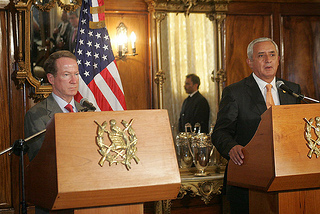
U.S. Assistant Secretary Brownfield and Guatemalan President Pérez Molina Photo credit: US Embassy Guatemala / Flickr / CC BY-NC-ND

U.S. Assistant Secretary Brownfield and Guatemalan President Pérez Molina
Photo credit: US Embassy Guatemala / Flickr / CC BY-NC-ND

Actions by the U.S. Congress, the U.S. Embassy in Guatemala, and the State Department have fueled speculation that something is askew in relations between Washington and Guatemala.  In January, the U.S. Congress passed the Consolidated Appropriations Act for 2014, with unusually severe measures for Guatemala.  Congress ordered the Treasury Department to direct its executive directors at the World Bank and the Inter-American Development Bank (Guatemala’s two main multilateral lenders), to support the reparations plan for damages suffered by communities during construction of the Chixoy Hydroelectric Dam in 1976-1983.  The project, funded by the two banks, resulted in numerous human rights violations, including the displacement of local communities, mostly of Maya Achi ethnicity, and the death of thousands in the Río Negro massacres perpetrated by the Guatemalan armed forces.  Additionally, the U.S. law conditioned U.S. assistance for the Guatemalan armed forces on credible advances in the Chixoy issue as well as the resolution of adoption cases involving Guatemalan children and U.S. adoptive parents since the end of 2007.

President Pérez Molina, a former army general, and his vice-president reacted with inflamed nationalistic rhetoric – just to be eclipsed by more U.S. actions.  After the Guatemalan Constitutional Court ruled that internationally acclaimed Attorney General Claudia Paz y Paz – a key actor in bringing to trial former Guatemalan Army General Ríos Montt on genocide charges – must step down in May (and not in December, as Paz y Paz supporters claim is the correct interpretation of the law), the U.S. Ambassador made a public statement supporting her.  A few days later, the U.S. Assistant Secretary for International Narcotics and Law Enforcement William Brownfield visited Guatemala, reiterating U.S. support to Paz y Paz and formalizing a $4.8 million donation supporting the UN International Commission Against Impunity in Guatemala (CICIG).  This further angered rightwing and pro-army sectors, dedicated detractors of both Paz y Paz and CICIG.  Brownfield tempered his message with praise for the “sensational” U.S.-Guatemala collaboration in counternarcotics.

These recent actions come from a combination of U.S. policy “hawks” and “doves” operating simultaneously.  U.S. Senator Patrick Leahy and his staff have the reputation in Guatemala as Capitol Hill hawks on human rights throughout Latin America, and acted accordingly by fostering the harsh legislative provisions for Guatemala.  U.S. Ambassador Chacón acted like a resident hawk, directly supporting Paz y Paz and praising her as a proven ally on the drugs issue.  Then, Mr. Brownfield, playing the role of the visiting dove balancing the harshness of the previous two actions, gave the badly needed financial aid to CICIG and supported Paz y Paz, consistent with his drug cooperation portfolio.  Guatemala’s role as a transit point for drug traffickers gives it leverage in the bilateral relationship, but that’s not enough.  Regional or global perspectives are important too: Guatemala recently completed its rotation on the UN Security Council, and the preliminary results of the elections in El Salvador and Costa Rica show that the region will continue under the influence of leftwing or left-leaning governments.  After Mr. Brownfield’s public statements, tension has eased and the angry rhetoric calmed down, but the chapter has not ended.  The bottom line is that Guatemala received an emphatic message: it must keep aligned with what the U.S. wants.  The problem for decisionmakers in the region is that it is not always clear what the U.S. wants.

*Ricardo Barrientos is a senior economist at the Central American Institute for Fiscal Studies (Icefi).

Update: Venezuela-U.S. Tensions Rise

By CLALS Staff

Photo credit: andresAzp / Foter / CC BY-NC-ND

Photo credit: andresAzp / Foter / CC BY-NC-ND

AULA BLOG lets policymakers’ own words characterize the state of relations between Washington and Caracas.

Venezuelan Government Statements

I have ordered the Foreign Minister of the Republic … to declare persona non-grata y to expel from the country these three consular officers from the United States Embassy in Venezuela. We have been watching them for two months already, holding meetings in universities. The story is that they’re offering visas. … Well, let them go and conspire in Washington. …

The demands [made in a statement delivered by Deputy Assistant Secretary of State Alex Lee to Venezuelan Ambassador to the OAS, Roy Chaderton] are unacceptable, insolent. I ordered a diplomatic response. In Venezuela, we are willing to accept all consequences in defense of democracy. I take orders from no one. …

The government of the United States should take responsibility, before the Venezuelan people and the world, for allowing U.S. institutions and individuals to finance, legitimize and promote the actions of persons and groups who attack Venezuelan society violently, and who look to twist the democratically expressed will of our people to build their sovereign destiny in peace.
—President Maduro, February 16
AP, EFE (CLALS translation)

The Bolivarian Republic of Venezuela forcefully rejects the statements made today, Wednesday, February 19, by the President of the United States, Barack Obama, insofar as they constitute new and crude interference in the internal affairs of our country, made worse by being based on false information and baseless accusations.

This is an offense to the heroic land of the Aztecs, of Juárez, of Villa, and of Zapata; to the noble and courageous people of Mexico, the sister nation from which President Obama continues attacking a free and sovereign nation of Latin America and the Caribbean because its policies, principles, and decisions are the result the democratic expression of popular will.

The statement that the independent governments and people of the world await is that in which the government of the United States of America explains why it finances, encourages, and defends opposition leaders who promote violence in our country, and clears up what right Deputy Assistant Secretary [of State] Alex Lee has in sending a message from his government that tries to impose conditions on and threaten the Venezuelan state for having taken judicial action against those responsible for the violent acts of recent days.

As a final point, the Venezuelan government reiterates that it will continue monitoring and taking the necessary actions to prevent U.S. agents attempting to cause violence and destabilization, and informs the world of the nature of the interventionist policies of the Obama administration in our country.
—Despacho de la Presidencia, February 20
(CLALS Translation)

I have just read recent statements by John Kerry – arrogant, interventionist and insolent – that confirm the terms of the threat that I denounced. John Kerry is threatening Venezuela with more violence through his statements giving the green light to violent groups to attack our people. Let the brutal and insolent imperialists know that we will continue defeating it with the force of our people, which is the force of Bolívar and Chávez.
—President Maduro, February 21
Tweets, via TeleSur (CLALS translation)

I call for a dialogue with you, President Obama. I call for a dialogue between the patriotic and revolutionary Venezuela and the United States and its government. Accept the challenge. Let’s initiate a high-level dialogue and let’s put the truth out on the table. … I say this, and some will say, ‘Maduro is naïve.’ No, we will always find a new situation through political dialogue – a change in the historic relations between the U.S. elite and Latin America and Venezuela. … I propose therefore a grand dialogue, and that we name ambassadors, since they haven’t been accepted so far, so they can sit down and talk.
—President Maduro, February 21
Various media (CLALS translation)

There’s a global campaign against Venezuela. It’s a campaign to justify an intervention in the domestic affairs of Venezuela. … [There is] a brutal manipulation campaign, [which] has created a perception in the world that Venezuela is on the verge of civil war, that here in Venezuela we have a group of docile students opposing an illegitimate government.
—President Maduro, February 22
CNN

U.S. Government Statements

In general, when it comes to Venezuela, we’ve made clear that we’re open to having a constructive relationship with the Government of Venezuela. Quite frankly, we haven’t seen that – we have not seen that reciprocated, to be clear. So we also, I think, see a lot of conspiracy theories or rumors out there in the press about how the U.S. is interested in influencing the domestic political situation in Venezuela, which is absolutely not true. It’s not up to us to comment on internal Venezuelan politics.
—State Department Spokesperson, February 13

So we are deeply concerned by rising tensions, by the violence surrounding these February 12th protests, and by the issuance of a warrant for the arrest of opposition leader Leopoldo Lopez. We join the Secretary General of the OAS in condemning the violence and calling on authorities to investigate and bring to justice those responsible for the deaths of peaceful protestors. We also call on the Venezuelan Government to release the 19 detained protestors and urge all parties to work to restore calm and refrain from violence.
—State Department Spokesperson, February 14

The United States is deeply concerned by rising tensions and violence surrounding this week’s protests in Venezuela. Our condolences go to the families of those killed as a result of this tragic violence.

We are particularly alarmed by reports that the Venezuelan government has arrested or detained scores of anti-government protestors and issued an arrest warrant for opposition leader Leopoldo Lopez. These actions have a chilling effect on citizens’ rights to express their grievances peacefully.

We join the UN High Commissioner for Human Rights, Secretary General of the Organization of American States, EU High Representative for Foreign Affairs, and others in condemning this senseless violence. We call on the Venezuelan government to provide the political space necessary for meaningful dialogue with the Venezuelan people and to release detained protestors. We urge all parties to work to restore calm and refrain from violence.

Freedoms of expression and peaceful assembly are universal human rights. They are essential to a functioning democracy, and the Venezuelan government has an obligation to protect these fundamental freedoms and the safety of its citizens.
—Secretary of State Kerry, February 15

The allegations that the United States is helping to organize protestors in Venezuela is baseless and false. We support human rights and fundamental freedoms – including freedom of expression and of peaceful assembly – in Venezuela as we do in countries around the world. But as we have long said, Venezuela’s political future is for the Venezuelan people to decide. We urge their government to engage all parties in meaningful dialogue.
—State Department Spokesperson, February 17

We have seen many times that the Venezuelan Government tries to distract from its own actions by blaming the United States or other members of the international community for events inside Venezuela. These efforts reflect a lack of seriousness on the part of the Venezuelan Government to deal with the grave situation it faces. … With the OAS and our regional partners, we are working to urge calm and encourage a genuine dialogue among all Venezuelans. There is no room for violence by either side.
—State Department Spokesperson, February 18

In Venezuela, rather than trying to distract from its own failings by making up false accusations against diplomats from the United States, the government ought to focus on addressing the legitimate grievances of the Venezuelan people. So, along with the Organization of American States, we call on the Venezuelan government to release protestors that it’s detained and engage in real dialogue. And all parties have an obligation to work together to restrain violence and restore calm.
—President Obama, February 19

Latin America Skeptical of U.S. Immigration Debate

By Aaron Bell

Photo Courtesy of Larry Engel

Photo Courtesy of Larry Engel

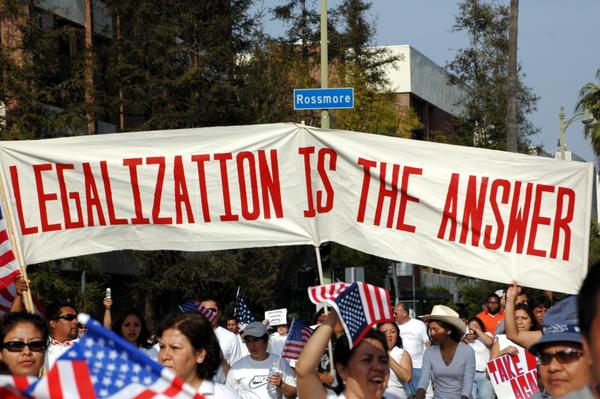
Latin America’s subdued response to the immigration reform debate in the United States reflects a region-wide skepticism buttressed by the recent history of unfulfilled expectations.  Mexican media and a handful of Central American counterparts across the board have identified the Republican Party as the primary impediment to progress.  Conservative editorialists in the region, many of whom denounce President Obama and the Democrats as political opportunists rather than legitimate advocates for immigration reform, have also expressed frustration with the Republicans for not coming up with a better approach.  In particular, they think the party’s digging its own political grave by failing to rein in members and supporters who smear Hispanic immigrants as a threat to the ethnic identity of the United States.  Some have fond memories of Ronald Reagan’s 1986 Immigration Reform and Control Act, which balanced security and enforcement with compassion and amnesty for undocumented migrants.

Mexico’s El Universal has been one of the most frequent contributors to the discussion of immigration reform, particularly with editorials giving greater attention to the human rights aspect of the debate.  They’ve called for reforms so that undocumented workers can “come out of the shadows,” so that families can stay together without fear of deportation, and so that harsh punishment meted out to undocumented workers caught crossing the border can come to an end.  The Mexican government has been relatively quiet on the issue of immigration reform in the previous decade, with the exception of a complaint lodged against Alabama’s HB 56, which requires police to take certain actions if they have “reasonable suspicion” that an immigrant is in the United States unlawfully.  But last summer Foreign Minister José Antonio Meade took to the pages of El Universal to complain that proposed enhanced border security measures were a detriment to regional development – and not a solution to immigration problems.

Public opinion data on Latin American views of the reform debate is limited, though circumstantial evidence suggests a connection between reforms and overall views of the United States.  Pew Research found that public opinion of the United States among Mexicans dipped sharply following the passage of Arizona SB 1070 in 2010, which laid the groundwork for HB 56.  Those numbers have since rebounded, with 66 percent of those polled holding favorable views of the United States in 2013, when many perceived that the Obama administration would achieve a positive outcome in the reform debate.  Although critical of Republican approaches, commentators who support reforms are not inherently in favor of the Democratic Party.  Only half of those Mexicans polled held a favorable view of the Obama administration, and some commentators have noted the high number of deportations on Obama’s watch.  For Latin American observers, humane and fair treatment for migrant workers and immigrants is the primary concern – and neither party appears poised to deliver.  The region’s skepticism that this round of debate over immigration reform will produce anything new appears at the moment to be warranted. 

Cuban Infrastructure and Brazilian State Capitalism: The Port of Mariel

By Eric Hershberg

Panamax Container Ship / Wikimedia Commons

Panamax Container Ship / Wikimedia Commons

The Port of Mariel – long associated with a boatlift in 1980 that brought more than a hundred thousand Cubans onto U.S. shores – could either help launch Cuba into a new regional role as a shipping/trading hub or be yet another white elephant project.  This irony was noted in a recent New York Times piece, which portrayed the venture in an optimistic light.  According to some observers, the massive port upgrading that is underway there at the moment, with Brazilian funds and a leading Singaporean port operator slated to operate the venture, is a ticket for Cuba to thrive in the 21st century as a vital logistics hub, funneling goods to Europe, the Greater Caribbean and, eventually, the United States.  All of this is on the agenda because of the Panama Canal expansion that will allow for post-Panamax ships to transit the canal.  These ships will have the capacity to carry over twice the amount of cargo than the current vessels that transit the canal, thus re-routing trade that now travels from the west coast of the U.S. by land to the east coast, and at the same time expanding traffic from Asia on to Western Europe.

The $957 million Mariel project entails a Brazilian investment of $682 million with the rest of the financing coming from Cuba.  The ambitious project goes well beyond the port itself, as the Cuban government has taken the exceptional step of authorizing a surrounding free trade zone – essentially an export processing zone along the lines of those that have housed maquilas throughout much of the Greater Caribbean as well as in regions such as Guangdong, in China, which became an export powerhouse.  The notion is that industries that locate within the special economic zone around Mariel will enjoy 50-year, renewable contracts and numerous beneficial tax treatments, including tax-free processing of imported inputs into products that will in turn be shipped out through the state-of-the-art port.

For some analysts of Cuba’s economic development prospects, this is a historic opportunity, one that will become even more relevant once the U.S. embargo finally goes away.  By this account, a combination of geographic location and a highly skilled workforce places Cuba in an ideal situation to take advantage of these massive investments.  If the Mariel initiative were to work as envisioned, the result would be a massive increase in industrial employment in Cuba which, under this scenario, could become a high value-added manufacturing hub and a distribution point for goods transiting from Asia to the greater Atlantic.  The opportunity may be all the more exciting given the failure of the U.S. federal government to invest in port upgrading of a sort that a well-functioning capitalist state would undertake.  At the moment, The Economist reports only Baltimore and Norfolk have the capacity to accommodate post-Panamax ships, leaving the field open for newcomers such as the Bahamas (already equipped) and Havana (about to be so).  Other analysts observe, however, that the project faces severe constraints, ranging from the institutional bottlenecks in Cuba to the reality of competition from other deep water ports (which do not suffer from the sclerotic institutional environment that plagues so much in Cuba), as well as competition from other countries with highly skilled workforces (Costa Rica, the Bahamas, and much of the English-speaking Caribbean).

Nevertheless, critics in Cuba and abroad question whether the massive Brazilian investment in the project – essential to its success – is driven not only by economic opportunities but also by the domestic political calculations of President Dilma Roussef. Loans provided to the Brazilian engineering conglomerate Odebrecht to build the port are from the Brazilian development bank, BNDES, and guaranteed by the Brazilian state, so unlike EU companies that eschewed investment in Mariel, Odebrecht incurs minimal risk.  Mariel represents both a geostrategic and a domestic political calculation by the Dilma government. Brazil is happy to take advantage of the U.S. absence in Cuba to build the port and its relationship with Cuba.  At home, it allows the government to reward the construction firms – such as Odebrecht – that are consistently the largest campaign donors in Brazilian politics.  It also helps to slake the passions of factions of the left that seek closer ties to Cuba, and have been disappointed by the Dilma and Lula administrations’ relative political moderation at home.  The fortunes of Mariel may in the end reveal as much about Brazil as about Cuba.

Venezuela: Racing to the Bottom

By CLALS Staff

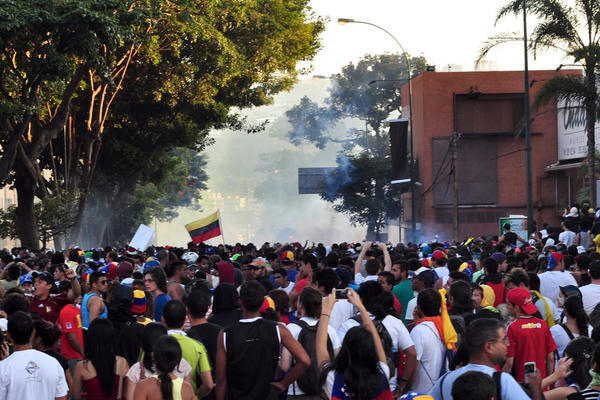
VenezuelaThe casualty figures from last Wednesday’s confrontation between government and opposition groups in the streets of Caracas – three dead, several dozen injured and many thousands angry – are clearer than the solutions to Venezuela’s current crisis.  The airwaves immediately flooded with the usual accusations of who provoked whom.  The protest leaders – who have shoved aside the opposition’s more moderate standard-bearer, Henrique Capriles – blamed toughs within the pro-government “colectivos.”  President Maduro blamed “small fascist groups” for the violence.  He has accused protest leader Leopoldo López of trying to orchestrate a coup, and a court is charging him with murder and “terrorism.”  López denies the coup-plotting, but he does state forcefully that, under the campaign slogan of “La Salida,” he wants to put millions in the streets to force Maduro to step down.  Failing that, he’s building a base from which to launch a referendum to remove Maduro when the Constitution allows in 2016.

As always, both sides in the dispute claim to have the support of “el pueblo” and to seek only to promote the people’s interests.  The people did speak, albeit by a small margin, in favor of Maduro in last April’s presidential election, but the opposition – especially the boisterous faction that’s orchestrating the current protests – has never officially acknowledged his legitimacy as president.  Maduro’s ad hoc reactions to Venezuela’s increasingly dire economic situation, including policies that he boasts are going to make the “bourgeoisie squeal,” appear desperate and counterproductive.  Confusing audacity for leadership, Maduro has signaled that if López and his followers want to take to the streets, he’s ready to accept the challenge.

Venezuelan politics has long been characterized by a vicious cycle in which each side strives to provoke the other into making mistakes that injure itself – and each side can’t resist rising to the provocation, fueling a downward spiral.  Maduro and the opposition hotheads have found soul mates in one another – feeding on each other’s extremism – and it’s happening just as Capriles and other opposition moderates were making progress in a decade-long effort to redefine political dynamics in the country.  Maduro’s tough talk and López’s battle calls for massive protests, for salida, and for recall referendums are reminiscent of 2002‑04, when Chávez grew steadily stronger as he survived a coup, a national strike, mysterious bombings and other clandestine operations by foes, a recall referendum and more.  For a young (42 years old) Harvard-educated man from the wealthy end of town to think that he can best Maduro in the streets shows the sort of questionable judgment that gives a little credibility to government allegations that his provocations are part of a bigger, externally directed plan.  The U.S. State Department spokesman insisted on Thursday that it “is absolutely not true” that Washington is interested in “influencing the domestic political situation in Venezuela.”  Whatever the merit of the allegations and denials,  Venezuelan elites on both sides of the deep divide seem ill-prepared to find a better way of doing politics.

Mexico: Policy on “Auto-defensas” Makes Things Worse

By Steven Dudley*

Photo credit: Pedro Fanega / Flickr / CC BY

Photo credit: Pedro Fanega / Flickr / CC BY

In a few short months, Michoacán’s “self-defense” groups have gone from being the Mexican government’s drunk uncle to being its strategic partner – underscoring what is wrong with the current government’s counterdrug strategy.  The vigilante groups are a multi-headed beast, born from sentiments that range from despair and frustration to opportunity.  Desperate small farmers and shopkeepers created some of the units because they’d been victimized by the “Knights Templar,” a splinter group with deep roots in the drug trade that has literally raped and pillaged their villages.  Frustrated agricultural and mining interests have funded their own “self-defense” groups.  And opportunistic rival criminal groups also seek to kill the Knights to take new, or reclaim old, territory.   Mexico’s federal and local governments are to blame for this chaos.  Drug-fueled corruption, ineptitude and lack of political will on the federal level have left the locals to fend for themselves, often leaving local politicians and security forces to align with the criminal interests, including the Knights Templar.

The federal government’s feeble and disjointed attempt to address the vigilantism is leading only to more confusion, chaos and most likely bloodshed.  In late January, it created a framework that legalized the organizations, placed then under one moniker – Rural Defense Units – and asked members to register themselves and their weapons.  But the framework makes no mention of their purview, jurisdiction, proposed length of service, nor does it clarify controls on their automatic and other sophisticated weaponry, which, under current Mexican law, requires military authorization.  Some of the groups accepted the government offer, including those that rode into the Michoacán city of Apatzingán last weekend to “take back” the city from the Knights.  More importantly, other vigilante groups have flat out refused the government.  Further fueling chaos, the federal government is applying a far harsher, more statist approach in the neighboring state of Guerrero, dispatching troops to stop the spread of “self-defense” groups that may have a longer history and more justifiable constitutional mandate than those in Michoacán.

Vigilante violence will undoubtedly continue to grow, as it becomes clearer that the federal government has no idea how to deal with it.  It is failing to address one of the root causes of the problem: illegal drugs have led to spectacular earnings that have made corrupting local and national officials easier; given criminal groups access to better training and weaponry to challenge the state and rivals; and created local, powerful criminal economies where perhaps they did not exist in the past.  In fact, no government official, vigilante group or other party in this conflict has even mentioned illegal drugs.  One vigilante told InSight Crime’s Mexico correspondent flat out: “We’re not against drug trafficking; we’re against organized crime.”  The causes of the violence are complex, but one cannot be addressed without addressing the others, and the Mexican government’s disjointed response is not pushing the country any closer to a solution.

* Steven Dudley directs InSight Crime and is a Senior Fellow at the Center for Latin American and Latino Studies.

Argentina: Yet another political cycle ends in crisis?

By Inés M. Pousadela

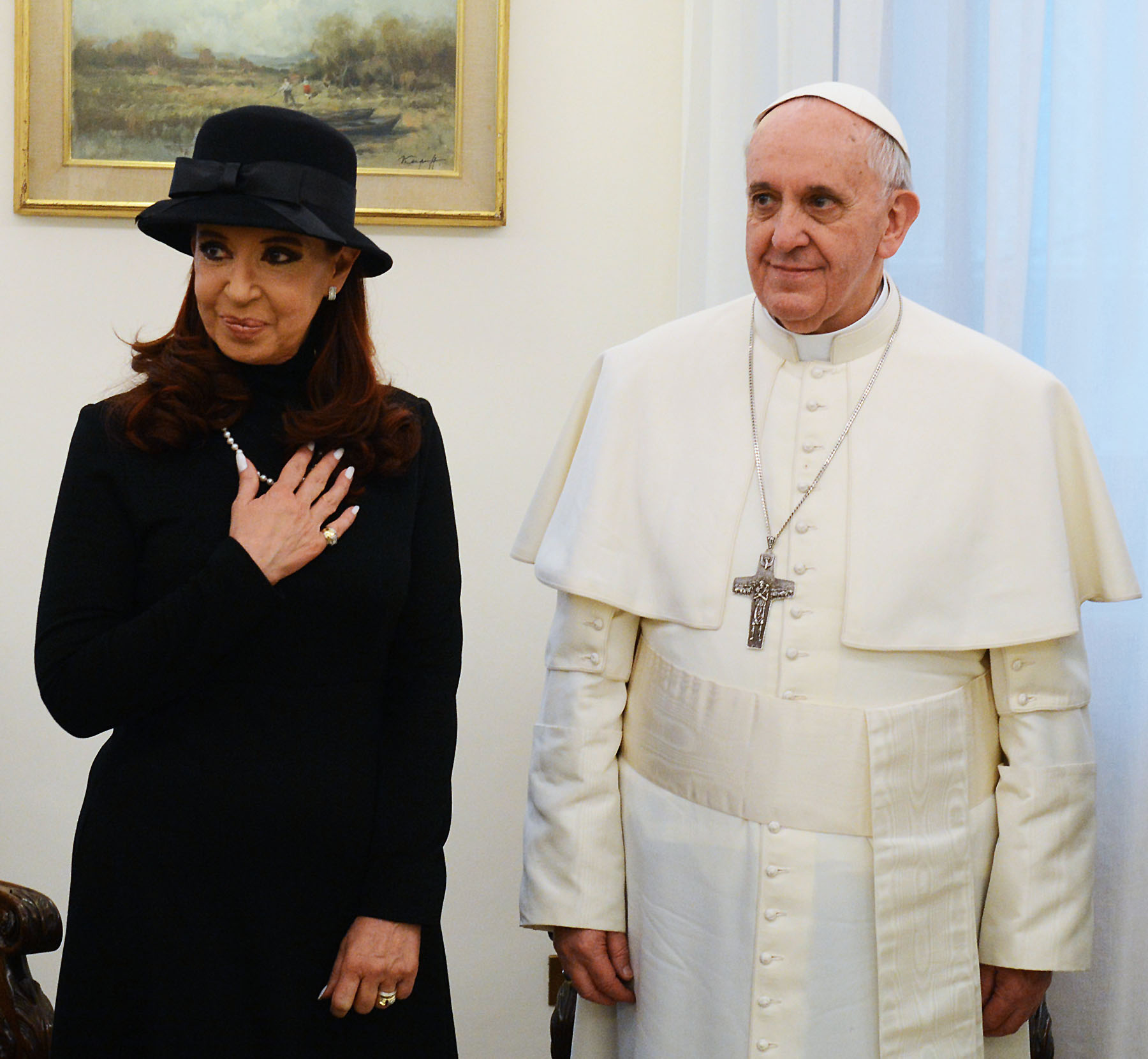
President Cristina Fernández de Kirchner / Photo credit: Expectativa Online / Foter / CC BY

President Cristina Fernández de Kirchner / Photo credit: Expectativa Online / Foter / CC BY

Another ismo born of peronismokirchnerismo, more recently reshaped as cristinismo – is coming to an end in Argentina.  President Cristina Kirchner and her government – reelected in 2011 with 54 percent of the vote – have lost support and burned political capital at an alarming pace. For most of the decade that she and her predecessor and late husband, Néstor Kirchner, have occupied the Casa Rosada, economic growth and favorable external conditions fueled both public expenditures and private consumption. The Kirchners’ administrations (Nestor’s in 2003-2007 and Cristina’s since 2007) renewed state intervention in the economy after the failure of the “neoliberal” experiment led by Carlos Menem (menemismo, another variant of peronismo), and implemented social policies that elicited widespread support from a population that was sympathetic to redistributive initiatives after the economic crisis in the early 2000s. Yet little progress was made in reducing inequality or increasing social cohesion, as was evident when inhabitants of poor suburban areas looted their own neighbors’ small businesses last Christmas. As the economy has weakened, corruption and the absence of efficient and transparent institutions have once again riled the middle class, as shown by both opinion polls and street protests.

The quick social fixes and improvised economics that have long characterized Argentine politics invariably have an expiration date – which in this case seems to be arriving soon.  High inflation – 5 percent in January alone despite repeated attempts at price controls – is eroding wages as the government keeps trying to fund expenditures by printing currency. Amidst inadequate investment and widespread corruption, commuter train crashes have killed dozens of people; massive electricity cuts have taken place over the summer, and gas supplies are expected to fall short as soon as the weather chills. Government denials of any intention to devalue the currency rang increasingly hollow as the official value of the peso dropped 19 percent in January – the biggest devaluation in 12 years. Leaders’ portrayal of the tendency of the population to hoard dollars as an ideological deviation, rather than a rational economic decision, rankled.

As the quality of life of Argentines declines, popular discontent mounts. The prevailing sentiment is one of uncertainty not just about the value of the currency, or even about the durability of policies that are typically announced one day and contradicted, modified or ignored the next. The deeper trepidation in popular feeling is that the future itself has yet again become uncertain.  No one doubts that a cycle is ending; the question – candidly posed even by some of the government’s allies – is how this will all end.  Will conditions become as bad as those that cut short the governments of Raúl Alfonsín in 1989 and Fernando De la Rúa in 2001?  And what comes next?  Unlike those two relatively recent debacles, this time it is the Peronistas who risk association with economic collapse.  With the president increasingly relying on her loyal inner circle, anxious peronista governors, mayors and labor leaders are trying to distance themselves from the Kirchnerista experiment.  Peronista candidates jockeying for position in the 2015 presidential race are as apprehensive as the broader population, while opposition forces lack incentives to cooperate towards developing a credible alternative. Across the spectrum, political leaders appear as clueless as the government regarding how to get out of this most recent mess. Judging from Argentina’s experience, mounting popular frustration is likely to find some expression in the streets as well as at the polls. It is still to be seen which combination of electoral politics and street protest eventually prevails.

Central America: Elections Send Different Messages

By CLALS Staff

Salvadoran Presidential candidat Salvador Sánchez Ceréne  Photo credit: Cancillería Ecuador / Foter / CC BY-SA

Salvadoran Presidential candidate Photo credit: Cancillería Ecuador / Foter / CC BY-SA

The two elections held last weekend reflected different states of mind in El Salvador and Costa Rica. In the former, FMLN candidate Sánchez Cerén didn’t win the majority necessary to avoid a runoff, but the rejection of the ARENA party was strong and almost nationwide. ARENA candidate Norman Quijano not only trailed by 10 percentage points; his party’s victory in only one of the country’s 14 departments – remote Cabañas – was a serious blow to its image.  According to press reports, party infighting is intensifying.

Costa Rican Presidential candidate Johnny Araya and Antonio Álvarez Desanti, Chief of the Araya Presidential Campaign  By Lcascante2000 (Own work) [CC-BY-SA-3.0 (http:/via Wikimedia Commons

Costa Rican Presidential candidate Johnny Araya (left) / By Lcascante2000 / CC-BY-SA-3.0 / Wikimedia Commons

In Costa Rica, the eleventh-hour surge of a left-leaning progressive – Legislator José María Villalta – gave rise to a unified effort by the traditional parties to cast themselves as essential to warding off “Chavismo” and even Communism. Commentators judged that Citizen Action Party candidate Luis Guillermo Solís ran a mediocre campaign, but he denied ruling National Liberation Party candidate Johnny Araya – whose large campaign coffers gave him a significant edge – a first-round victory, beating him by about 1.5 percent (but still far short of the 40 percent to avoid a runoff). Both candidates’ red-baiting tactics apparently got people out to vote – abstentionism was not higher than in the past as feared – and popular cries for change shifted to a mandate for the status quo.

Jockeying for the second- round elections – on March 9 in El Salvador and April 6 in Costa Rica – has begun in both countries.  The FMLN’s Sánchez Cerén appears likely to win even without a pact with former President Saca, formerly an ARENA standardbearer. In Costa Rica, Solís is widely believed likely to win, as Araya is burdened by a lackluster record as San José mayor for 21 years and by his party ties to President Laura Chinchilla, whose disapproval ratings have broken records in the history of polling in the country.

Neither new president will have an easy time governing. Their legislatures are deeply fractured, and corruption and weak Executive Branch institutions will plague them as they’ve plagued their predecessors. ARENA appeared as weak as ever and, already showing signs of crisis, will need to retool. As it loses its access to the lucre of government treasury, it’s going to lose the glue that holds it together and infighting will persist and intensify. Costa Rica’s legislators, including those of the majority National Liberation Party (PLN), have in recent years shown little willingness or ability to put aside venal interests and engage in the serious business of policymaking. Insofar as they construe voters’ last-minute rejection of Villalta as a rejection of change, Costa Rican politicians probably judge that the coast is clear for business as usual.


Mexico’s Situation after Peña Nieto’s First Year at the Helm

By Manuel Suárez-Mier

President Enrique Peña Nieto / Photo credit: World Economic Forum / Foter / CC BY-NC-SA

President Enrique Peña Nieto / Photo credit: World Economic Forum / Foter / CC BY-NC-SA

After Enrique Peña Nieto’s first full year in office, the situation and prospects for his country are mixed. On the positive side, his structural reforms encompassing labor, education, taxation, finance, telecommunications, anti-monopoly and energy – the crown jewel – are unexpected and sweeping successes. Three previous administrations had failed to get such reforms through Congress in the preceding 18 years. The reforms, the success of which will depend on the implementing legislation, have attracted worldwide attention, generating a “Mexican moment,” and increasing substantially the flows of foreign direct investment.

On the dark side, however, Peña Nieto’s performance has been less than stellar regarding the pacification of the country from the violent onslaught over the last decade at the hands of bands of narcotraffickers. He changed the emphasis of the war on drugs from the stubborn fixation that it had in the Calderón administration (2006-2012), and he altered the terms of cooperation with the United States on this issue.  But he has been unable to stem the violence, which in some cases has worsened.  In the southwestern state of Michoacán, a new actor has emerged besides the narco and government forces: self-appointed groups of armed citizens that are battling the criminals while denouncing the government’s ineffectiveness.  Simply declaring victory in the war on drugs and moving on to other issues has not stemmed the violence.  Many observers believe that Peña Nieto’s security team is not up to par and that tolerating, and more recently collaborating, with the paramilitary groups is not the solution to the problem – and indeed will only worsen it down the road.  Also the terms of cooperation with the United States on the war on drug trafficking organizations are not clear yet.

It is too soon, of course, to declare victory on the reform front since the way these changes are implemented will determine their success or failure. We have had “Mexican moments” in the past, especially after NAFTA was approved in 1994, just to see them wiped out by government mismanagement and crises. But it is also too early to declare the final failure of the campaign to pacify the country since there have been some bright spots – notably in Ciudad Juárez. Coordination among security agencies has improved and the gendarmerie, a special rural federal police force that would replace the army in restoring the peace where violence rages, is being trained and will begin operations with 5,000 men in July.  But the appearance of paramilitary “self-defense” groups and the apparent alliance that they are forging with the federal government are deeply troubling considering what we have seen in other latitudes – especially Colombia – when such groups thrived. These contradictory trends explain why many people are enthusiastic about Mexico’s economic future while Peña Nieto’s approval ratings remain soft after a year of slow growth, tax increases, and unabated violence.

*  Manuel Suárez-Mier is Economist-in-Residence and Director of the Center for North American Studies in American University’s School of International Service.

More Cracks in the EU’s “Common Position” on Cuba

By William M. LeoGrande*

eu cubaThe visit of Dutch Foreign Minister Timmermans to Cuba earlier this month marks yet another crack in the European Union’s 1996 Common Position on Cuba, which conditions normal relations with the island on democratic reforms. Days later, EU Commission President Barroso acknowledged that a number of member states were pressing for a reevaluation of the Common Position, and Spanish Foreign Minister García Margallo announced that the issue would be taken up at the EU foreign ministers meeting on 10 February – adding, however, that any new policy “would have, as a determining factor, respect for human rights.” Amending the Common Position will require unanimity among the EU’s member states, something conservative governments – especially in the former socialist countries – have thus far blocked.

The Common Position has severely constrained the ability of Brussels to respond creatively to rapidly changing conditions in Cuba today, but various European governments have expanded their bilateral economic and political ties with Cuba despite its strictures. Trade between Cuba and Europe, at 2.5 billion euros annually, has roughly tripled since 1996, and official development assistance to Cuba has quadrupled to nearly 60 million euros annually. Policies of engagement have proven more successful than policies of hostility and confrontation.  In 2010, quiet diplomacy by José Luis Rodríguez Zapatero’s government enabled Spain to play a crucial mediating role between the Cuban government and the Catholic Church, leading to the release of more than a hundred political prisoners – the largest such release since the 1970s.

Cuba today is moving in directions that the EU has long favored.  The “updating” of the Cuban economic model, begun in 2011, entails greater economic openness, reduced government regulation of private markets, and a larger role for private sector businesses. At the same time, although challenging Cuba’s one-party system or its socialist society is still out of bounds, there has been a very gradual opening of political space to debate the shape of Cuba’s future.  Replacing the Common Position does not mean that European states, individually or collectively, would abandon their commitment to encouraging greater human rights and democracy in Cuba.  But a warmer political climate would enable them to express their concerns more effectively through quiet diplomacy. What offends Cuba’s leaders is not that other states have different views on these issues; it is that the Common Position makes normal relations contingent on Cuba conforming to European norms, a litmus test that no other Latin American country is required to pass.

*Dr. LeoGrande is Professor of Government in the School of Public Affairs at American University.  This article is excerpted from an essay (click here) he wrote for the London School of Economics and Political Science blog.