Colombian President Santos’s Challenges Now … and Later

By Fulton Armstrong
Embed from Getty Images
Colombian polls continue to give President Santos a comfortable margin in a second-round re-election victory, but the gap is closing – and an array of issues plaguing his campaign suggest serious challenges ahead for a second term.  The economy grew 4.3 percent last year, and optimism about future growth is so strong that the central bank is implementing measures to keep inflation under control.  The peace process with the FARC has been tedious – yielding agreements on only two of five main agenda items over 17 months of talks – but the fundamental drivers of the talks, including fatigue on both sides, remain strong.  But a number of political messes are swirling around the President:

  • The Army was caught red-handed spying on Santos’s top advisors in the FARC negotiations, suggesting disloyalty to him as Commander in Chief.  (The intercept center that police last week [6 May] raided was not the Army’s.  It was staffed by contractors reporting to the Centro Democrático, the party of former President Uribe and Santo’s leading rival in the election, Óscar Iván Zuluaga.)
  • Uribe, who in March won a seat in the Colombian Senate, has been a relentless critic and drawn Santos into public spats.  Santos recently called on the former President to “stop causing the country harm” and to stop politicizing the Armed Forces.
  • An agricultural strike launched in late April has revived memories of a nasty confrontation last year and threatens food supplies in the run-up to the election.  Santos has mobilized police and military assets to keep highways open, but a political solution has eluded him.
  • In late April, the courts forced Santos to reinstate Bogotá mayor Gustavo Petro, whom he had removed a month earlier because the nation’s inspector general, an Uribe partisan, found that the mayor’s decision to cancel private garbage-collection contracts did not follow proper procedure.  Santos had gone ahead with the firing over the objections of a unanimous Inter-American Human Rights Commission.
  • Santos’s political message has been off target.  He has made the peace talks his top priority and proclaimed that “the second term will be about peace,” but polls indicate that only 5 percent of voters say the peace process is their top concern.

If the polls are correct, Colombians voting in the first round on May 25 and second round on June 15 feel little enthusiasm for Santos, but even less for Zuluaga and Uribe’s party.  A recent surge in support for former Bogota mayor Enrique Peñalosa suggests, on the other hand, that voters could turn on both candidates.  Behind the numbers is a country eager to consolidate its democracy, maintain stability and – probably – end the 50-year insurgency.  But the red flags – such as the security service’s continued penchant for spying on government officials – are not inconsequential.  Santos, who was Defense Minister during Uribe’s presidency, should have earned the military’s confidence, will have to decide how far to push the military to respect democratically elected civilian leadership.  The farmers’ demands, including relief from low-priced, low-quality imports facilitated by Colombia’s free trade agreements, will also be difficult to satisfy.  A peace deal with the FARC will be an historic achievement, but the political reality is probably that any assistance to demobilized combatants will be minuscule compared to that given to the former paramilitaries – increasing the likelihood that ex-insurgents, like the paramilitaries, will join the bandas criminales (BACRIM) who continue to maraud throughout large swaths of the country.  Santos’s second term, should he win one, will not be easy.

Equal Pay Day in Latin America

By Yazmín A. García Trejo*
Embed from Getty Images
For Latin American women, “Equal Pay Day” – observed on April 8 in the United States – would be in mid-May.  The day symbolically marks the time of year that women’s earnings finally catch up to men’s earnings during the previous year.  In the United States women make, on average, 77 cents for every dollar that men do.  Women have made great advances in Latin America, but they still earn 36 percent less than men, according to the International Labor Organization (ILO).  In many countries of the region, the gender gap in education has closed; now women and men have similar levels of education, and the World Bank’s Gender at Work report indicates that women increased labor force participation by 35 percent between 1990 and 2012.  Nonetheless, women have to work an additional four and a half months to catch up with men’s earnings.  According to an AmericasBarometer survey in 2012, this inequality also occurs within families; 54 percent of working women earn less than their partners.

The debate around the pay gap points to individual and institutional factors as the main causes.  For various personal and social reasons, according to “New Century, Old Disparities,” a 2012 co-publication of the Inter-American Development Bank and the World Bank, women tend to gravitate toward occupations with lower pay ascribed to traditional gender roles such as education (teachers) and healthcare (nurses).  Women are also more likely to settle for lower salaries when hired, and work more in part-time jobs due to their dual responsibilities as providers and caretakers of children or elderly parents.  Institutionally, women still experience pay discrimination and have less access to managerial occupations.  Public policies on women in the workplace reinforce the dual role of working women in Latin America.  According to the 2013 Global Gender Gap Report, Latin American and Caribbean women get an average of 14 weeks of maternity leave, but men get paternity leave in only 9 of the 15 countries – and then only for an average of about one week.

The social and political implications of the wage gap are far-reaching.  Women with lower earnings not only are unable to create wealth as men in similar positions can; they cannot secure a retirement plan that provides them and their families security.  Lower wealth, moreover, translates into lower political participation. According to the 2012 AmericasBarometer survey, wealthier people are more likely to vote, are generally more knowledgeable about how government works, feel they understand national politics, tend to participate more on leadership roles at the community level, and are more actively involved in electoral campaigns.  A disadvantage on wealth and longer work hours undermine women’s ability to invest in learning about or participating in politics.  “Equal Pay Day” in Latin America in the next two weeks would mark not just women’s reduced financial clout but an obstacle to their broader contributions to society as well.  With pay inequality, we all lose.

*Yazmín A. García Trejo is a PhD candidate at the University of Connecticut’s Department of Political Science and a Research Fellow at CLALS.

Is Affirmative Action in the U.S. Dead?

By Lázaro Lima*

Photo credit: commonwealth.club / Foter / Creative Commons Attribution 2.0 Generic (CC BY 2.0)

Photo credit: commonwealth.club / Foter / Creative Commons Attribution 2.0 Generic (CC BY 2.0)

The U.S. Supreme Court’s decision two weeks ago to uphold a law that prohibits colleges from considering applicants’ race in the admissions process underscored U.S. conservatives’ power on the issue – but also the forceful vision of Justice Sonia Sotomayor.  In the decision of “Schuette v. Coalition to Defend Affirmative Action,” six out of the nine Justices supported Michigan’s “Proposal 2”; Sotomayor and one other opposed it, and Justice Kagan, who had worked on the case as President Obama’s Solicitor General, recused herself.  Ironically named “Michigan Civil Rights Initiative,” MCRI was passed in a state referendum with the support of 58 percent of Michigan’s voters in 2006.  It outlawed the use of all race considerations in public college admissions, resulting in a decline of 25-30 percent of the minority population at universities and colleges in the state.  The majority argued that “there is no authority in the Constitution of the United States or in this court’s precedents for the judiciary to set aside Michigan laws that commit this policy determination to the voters.”  They cited it as a case of respecting states’ rights and claimed that “it is demeaning to the democratic process to presume that the voters are not capable of deciding an issue of this sensitivity on decent and rational grounds.”

In a 58-page dissent, Justice Sonia Sotomayor made the case against the law, arguing that Michigan schools were within their rights and responsibilities to society to take reasonable steps to encourage minority presence on state university and college campuses.  She plaintively stated the obvious: “The way to stop discrimination on the basis of race is to speak openly and candidly on the subject of race and to apply the Constitution with eyes open to the unfortunate effects of racial discrimination.”  She wrote: “Yet to know the history of our Nation is to understand its long and lamentable record of stymieing the right of racial minorities to participate in the political process. […] And race matters for reasons that really are only skin deep, that cannot be discussed any other way, and that cannot be wished away.”

The U.S. debate on affirmative action has deep roots and will surely continue.  The Supreme Court decision – and Sotomayor’s candid and necessary assessment of race relations – came over 35 years after the Court in 1978 ordered a University of California medical school to admit a white man who claimed that affirmative action unfairly led to the rejection of his application.  The “Bakke Decision” outlawed racial and gender quotas and delimited “race” to the managerial interests of academic institutions and employers.  Historical accounts of affirmative action policies often trace back to President John F.  Kennedy’s Executive Order 10925 of 1961, which required government contractors to “take affirmative action to ensure that applicants are employed and that employees are treated during employment without regard to their race, creed, color, or national origin.”  President Lyndon Johnson extended these mandates through the Civil Rights Act and with his own executive order.  But it was Sotomayor, decades later, who shined in her statement last month.  When she read her dissent from the bench, for the first time in her five years, her colleagues – who already had made up their minds – were not her intended audience.  Her audience was the democratic commons.

*Lázaro Lima is a professor of Latin American literature and Latino Studies at the University of Richmond, and a CLALS research fellow.

Downsides of Decentralization: Lessons from Peru

By Eric Hershberg
Embed from Getty Images
Decentralization – the buzzword among Washington-based specialists on governance during the 1990s and well into the first decade of the 21st century – failed to fulfill technocrats’ lofty expectations wherever it was implemented in the absence of a strong central government.  In one country after another, the World Bank, Inter-American Development Bank, and USAID prescribed political and administrative decentralization as a recipe for deepening democracy and boosting efficiencies in the delivery of governmental services.  An alliance of strange bedfellows united behind the “good governance” cause of decentralization, including grassroots democracy activists of the left who, in the aftermath of authoritarian rule, valued the notion of devolving decision-making authority to the citizenry.  Neoliberal economists, in turn, were attracted to virtually any initiative that would diminish the authority of central states, which they considered to be incorrigible bastions of inefficiency, rent-seeking and patronage.  Cautionary notes from skeptical political scientists were routinely dismissed as anachronistic.  At a seminar in Lima around a decade ago, USAID staff were utterly perplexed by the suggestion that, in the absence of central institutions holding the new regional authorities accountable, the headlong quest to political decentralization in Peru could bring extremely serious adverse consequences for democratic governance.  In their view, the capabilities of the central government had nothing to do with the success of decentralization.

Their enthusiasm was not entirely misplaced – but in many places the reforms eventually backfired.  The authoritarian regime of Alberto Fujimori (1990- 2000) had centralized power excessively, eliminating the handful of regional governments that had been created during the 1980s and ensuring that the social programs they had administered would be entirely dependent on the executive branch.  Fiscal decentralization, already minimal, was eliminated to make provincial municipalities completely dependent on transfers from the central government.  The few regional authorities who survived the Fujimori period were appointed by the president.  When President Alejandro Toledo (2001-06) and his Peru Posible party took office, the need to restore some decentralization was clear, but the two traditional parties – the APRA and Acción Popular –gradually coopted the movimientos regionales, creating clientelistic networks employing mafia-style tactics.  In the Ancash Department, for example, a rogue president is associated not only with corruption scandals – common in regional governments – but also with the assassination of his political enemies, including a political opponent murdered in March.  President Ollanta Humala has frozen the region’s assets, thereby putting a stop to some of the corruption but at the same time delaying needed infrastructure projects and social services.

The emergence of authoritarian enclaves was predictable of fledgling democratic regimes in Latin America, and the phenomenon is not unique to Peru (click here).  Sub-national authorities have access to vast resources to distribute to their clients (and themselves), and all too often the central state lacks the capacity or control over the purse strings to rein them in.  Social scientists have long been aware of the “paradox of decentralization,” and indeed at American University it is a concept that we typically teach freshmen in Comparative Politics – that decentralization only promotes democracy when it follows the consolidation of a strong central state.  This insight escaped the gaze of the technocrats so enamored of decentralization in Peru.  There, as elsewhere, the absence of horizontal accountability – that is, the ability of different branches of government to check one another’s authority – is aggravated by the inability of civil society to hold leaders accountable and allows for the emergence of local mafias in control of sub-national institutions.  Decentralization took on such steam at a time when Latin America’s national governments had been weakened by the economic crisis of the 1980s and the ideological assault on the central state that continued well into the current century.  It will take many years to rectify the damage.  

Caribbean Integration: Necessary but Elusive

By Victor Bulmer-Thomas*

Embed from Getty Images

The dream of Caribbean solidarity has never been in greater peril.  Norman Girvan, who died on April 9, was committed to the cause of Caribbean integration all his adult life, including during his time as Secretary-General of the Association of Caribbean States.  Born and raised in Jamaica, he saw no contradiction between Jamaican nationalism and Caribbean solidarity.  After steady progress from CARIFTA (a free trade area formed in the 1960s by a number of former British colonies) to CARICOM (a customs union formed in 1973 by all British ex-colonies and many colonies) to a commitment starting in 2006 to build a Caribbean Single Market and Economy (CSME), regional integration has gone backwards.  The CSME was never completed; a ‘pause’ in its implementation has been introduced by the Heads of Government and the famous Regional Negotiating Machinery (RNM) – itself formed to promote Caribbean unity in international agreements but then largely dismantled.  Suriname (in 1995) and Haiti (in 2002) have joined CARICOM, but the Dominican Republic is still outside after 25 years of discussions.  Cuban membership is still a distant dream, and the only non-independent state that participates today is the British colony of Montserrat, with a population of 5,000.  CARICOM may in theory represent much of the Caribbean population, but Haiti – its largest member by far – is not in the CSME.

Countries outside the Caribbean have reacted in very different ways to the region since the end of the Cold War.  The European Union (EU), three of whose member states – France, Holland and the United Kingdom – still have territorial ties to the Caribbean, has negotiated an Economic Partnership Agreement (EPA) with CARIFORUM (CARICOM plus the DR) that will in due course give the EU unrestricted access for almost all goods and services.  The agreement has generated very little enthusiasm in the CARIFORUM states despite the improved access for some of their goods and services in the European market.  Venezuela has persuaded most oil-importing countries to join Petrocaribe, but only a handful (Antigua & Barbuda, Cuba, Dominica, St. Lucia and St. Vincent & the Grenadines) have been attracted by the more ambitious ALBA.  The United States, a colonial power itself in the region thanks to Puerto Rico and the Virgin Islands, still offers asymmetrical trade privileges through the Caribbean Basin Initiative (CBI) and its related acts, but some of these provisions will end in 2020, and it is far from clear what will replace them.  Canada, which established CARIBCAN (similar to the CBI) in 1986, is negotiating its own version of the EPA with a broadly similar set of countries, but the negotiations have stalled recently.  Only China appears to have made huge advances in the region through increased exports and major foreign investments despite several of the countries that still recognize Taiwan.

All integration schemes, as Norman Girvan would have been the first to recognize, involve a balance between widening and deepening.  Through its premature commitment to a CSME, the member states of CARICOM took deepening too far.  At the same time, widening – necessary to negotiate with outside powers – has not gone nearly far enough.  It is a scandal that the Dominican Republic remains outside and that so little has been done to embrace Cuba despite the good political relations all states have with the island.  And the non-independent territories, as numerous as the independent states, should not be overlooked.  France and the UK have dropped their objections to closer ties between their territories and CARICOM, and the Dutch territories are largely autonomous already.  Even the U.S. territories would welcome closer links.  And when relations between Cuba and the United States are normalized, as could happen quite soon, it would be in the Caribbean’s interests to have fully embraced Cuba first.  That is an outcome that Norman Girvan would have strongly welcomed.

*Dr. Bulmer-Thomas is a professor at the University College London Institute of the Americas, fellow (and former director) at Chatham House, and author of numerous books, including The Economic History of the Caribbean Since the Napoleonic Wars (2012).

Brazilian Leadership and the Global Internet

By Sybil D. Rhodes and Leslie Elliott Armijo*

Photo credit: Blog do Planalto / Flickr / CC

Photo credit: Blog do Planalto / Flickr / CC

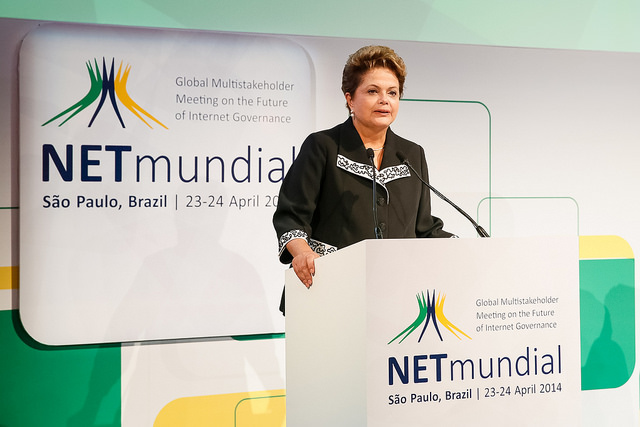
Brazil’s efforts as defender of internet privacy and rights may be effective even if it sparks criticism from all sides of the issue.  Along with German Chancellor Angela Merkel, President Dilma Rousseff has been among the most vocal protestors against spying by the U.S. National Security Agency (NSA).  She used her opening remarks at the United Nations General Assembly (UNGA) in September to criticize the spying.  Three months later, the UNGA passed a resolution initiated by Brazil and Germany in favor of the right to privacy in the digital age.  The Brazilian Chamber of Deputies and Senate have passed legislation, known as the Marco Civil da Internet, which web leaders and scholars consider a pioneering framework for internet governance.  Last week, Brazil hosted the international meeting NETMundial, focused on standards for name registration, domains, and IP addresses.  Rousseff and her Science, Technology, and Innovation minister, Cleio Campolina, emphasized that, as the first such event since U.S. intelligence contractor Edward Snowden leaked information about abuses, privacy concerns should be paramount at the meeting.

Brazil has considered itself an emerging leader in internet governance for at least the last fifteen years, although until 2013 “digital sovereignty” and the allocation of commercial benefits appeared to be more important goals than protecting civil liberties.  Brazil also has counted itself as an important member of a coalition — including India, China, Russia, Arab countries, and the United Nations Working Group on Internet Governance – that has called for less U.S. dominance of internet governance.  The group has proposed that the UN’s International Telecommunications Union (ITU) assume responsibility for the Internet Cooperation for Assigned Names and Numbers (ICANN), the non-profit organization in charge of distributing domain names since 1998.  An American creation, with headquarters in Los Angeles and a Board of Directors supervised by the US Department of Commerce, ICANN is seen by many as embodying U.S.-centric internet regulation.  Critics in Brazil and elsewhere claim that the private-sector and civil-society input into ICANN decisions is disproportionately pro-American.  The U.S. and its supporters, including Google, Microsoft, and civil associations like the Mozilla Foundation and the Electronic Frontier Foundation, argue that the existing regime promotes a “free and decentralized internet” – and that any changes must preserve these principles.

Since Snowden, President Dilma has also renewed emphasis on “digital sovereignty” measures.  For example, provisions in legislation passed in the lower house (but removed from the Senate version) required that Google, Facebook and other companies doing business with Brazilians store their data about Brazilians on local servers.  The government has also promoted building fiber optic cables connections that do not go directly through the United States as a way of preventing NSA espionage.  The economic and technical feasibility of some of these projects is not clear, and some of them have encountered important political opposition within Brazil – because, according to an informal survey of experts, many Brazilians are suspicious of their own government’s regulation of the internet as well.  Language in the new bill simply obligates business to obey national legislation regarding privacy.

Snowden’s revelations have given a boost to efforts to reduce U.S. dominance of internet governance, which previously was viewed as a technical issue for which the existing regulatory regime worked well.  Announcing that the U.S. Department of Commerce will not renew its contract with ICANN when it expires in September 2014, the Obama administration appears to recognize that U.S. credibility as the guarantor of a free and open internet has been undermined.  The exact technical and legal procedures through which privacy and national sovereignty might be better protected on the internet remain open questions in national and global debates.  But Brazil appears poised to play a leading role in setting a moderate middle-range course, one that allows for multipolar or global governance of the internet while protecting the liberal principles the U.S. has long claimed are core values.  Dilma could come in for criticism from both sides – U.S. conservatives who believe that only the United States can guarantee a free internet as well as “anti-imperialist” advocates who will accuse her of selling out to corporate interests.  Moderate heroes are sometimes the most unsung but also the most necessary.

*Sybil D. Rhodes is Director of the MA in International Studies at the Universidad del Cema in Buenos Aires.  Leslie Elliott Armijo is a Visiting Scholar at Portland State University and a Research Fellow at CLALS.  They are currently writing a book about international cooperation in the Western Hemisphere.

Guatemala: The War of Paz y Paz

By Steven Dudley*

CLALS Paz y Paz

Law professor and human rights attorney Claudia Paz y Paz’s selection as Guatemala’s first woman attorney general was a surprise, but strident opposition to her reappointment from the dark interstices of the political spectrum is not.  More hippy professor than government bureaucrat, she’s a woman who defied the odds when she took office in 2010.  Paz y Paz speaks with a soft, gentle tone to the point where she almost needs a microphone to run a staff meeting.  Yet, from nearly the moment she walked into the attorney general’s office, she made a difference.  She and her team arrested previously untouchable figures such Juan López Ortiz, alias Chamale, and dozens of members of the feared Mexican criminal group, the Zetas.  The country’s murder and impunity rates fell.  Paz y Paz also prosecuted former military officers, including former military dictator Ríos Montt and others allegedly involved in atrocities in the 1980s, and helped set up special offices to deal with violence against women.

Paz y Paz also demonstrated how, employing best practices, Guatemalan judicial institutions can excel.  Her office’s reliance on forensic evidence, telephone intercepts and video analysis made for stronger cases.  This took the onus off of eyewitness testimony, a notoriously unreliable means of fighting powerful criminal groups, especially those who have deeply penetrated the state.  Paz y Paz also widened the investigative net, looking at entire criminal structures, rather than focusing on single criminal acts.  She won praise from a broad array of international partners and pro-democracy forces inside Guatemala.  She was a 2013 Nobel Peace Prize nominee.

In spite of – or because of – these accomplishments, Paz y Paz is struggling to keep her job for another four-year term.  She has to be approved by a “postulation commission” made up of 14 lawyers who select the final six candidates, from which the president picks one.  Special interest groups, using shady brokers (some with ties to organized crime), are maneuvering to make sure that her attempt to reform Guatemala’s Attorney General’s Office ends sooner rather than later.  She has opened up many wounds and frightened Guatemala’s traditional elite, some of whose members worked with the Army during the civil war and believe they could be next on Paz y Paz’s list.  Efforts to block Paz y Paz’s second term underscore that Guatemala is a country that is still struggling to deal with its past civil war and its forever lopsided power structure.  Despite ending a nearly four-decade-old conflict in 1996, Guatemala is still at war –though the battles now take place in the courts – and the elites don’t want a formidable player like Paz y Paz to be in the game.

*Steven Dudley is co-Director of InSightCrime, which is co-sponsored by CLALS.  Click here for the full investigation of “The War of Paz y Paz.”

Obama’s Deportation Debacle: Time for Executive Action?

By Eric Hershberg and Dennis Stinchcomb

Embed from Getty Images

Amid fierce debate over the Obama administration’s record on the deportation of undocumented immigrants residing in the U.S. without serious criminal records, insiders confirmed to the Associated Press on Monday that the White House is seriously considering unilateral action to reduce deportations.  Preliminary reports suggest that a review of the policy by Homeland Security Secretary Jeh Johnson may result in executive action curbing deportations.  Rumors of White House movement on the issue surfaced last week, when members of the Congressional Hispanic Caucus presented Johnson with a memo outlining their demands.  Most notably, they recommended an expansion of the president’s Deferred Action for Childhood Arrivals (DACA) program and the elimination of “Secure Communities,” a program initiated during the Bush era that mandates that local law enforcement agencies enforce federal immigration laws and which has led to reported abuses.

The increased pressure on the president to further limit forced removals comes at a moment when deportations are on the decline and interior enforcement is at a five-year low.  New statistics released by the Department of Homeland Security (via FOIA requests from The New York Times) and the Department of Justice provide the most comprehensive view to date of an enforcement policy fraught with political miscalculations.  DOJ reports, for example, a 43 percent drop in the number of new deportation cases filed in federal immigration courts in the last five years.  In hopes of gaining credibility and leverage for Democrats in a potential immigration deal, the administration in 2011 reallocated massive enforcement resources to the U.S.-Mexico border.  The plan was to ease interior enforcement that disrupted established families and communities – and ran up deportation numbers in the past – while deporting higher numbers of recent border crossers, who under previous administrations would have been sent home without formal charges.  In the interior, workplace raids all but disappeared, but state and local police, under the Secure Communities program, continued to identify “high-priority offenders.”

The Obama administration’s five-year attempt to placate Republican lawmakers through record-setting deportations has backfired politically, and the collateral damage is high, with nearly 2 million deportations to date and an outraged electoral base.  Though current and former administration officials argue that concerns over public safety and border security have guided immigration enforcement since day one, the evidence suggests that political expedience has driven Obama’s deportation policy and – with midterm elections just around the corner and maneuvering toward the 2016 presidential elections already underway – is likely to continue to do so.  Obama’s eagerness to impress Republicans with his toughness, without any guarantee the maneuver would work, has alienated Hispanic and Asian communities who feel betrayed and whose turnout at the polls is crucial for a Democratic victory.  The leaks of executive action indicate a White House focused on damage control with those important constituencies, while essentially signaling the definitive end of any chance of bipartisan Congressional immigration reform.  Despite some handwringing among American conservatives that the Republicans’ position will lock out Hispanic voters for years to come, most of the party’s leaders appear to give priority to their nativist base.  Obama ultimately may be calculating that, with chances of passage of immigration reform nil anyway, his energy is best spent on rebuilding ties with constituents whose communities have been torn apart by policies pursued during his first five years in office.

The “Informal City” and Latin America’s Urban Future

By Robert Albro

Embed from Getty Images

Latin American cities are powerful engines for growth, but sustaining that progress will require moving workers from the informal into the formal sector.  Latin America is the most urbanized continent in the world, and its cities are now the region’s main economic engine.  Its ten largest cities account for about half of the region’s economic output, and their share of economic activity is projected to increase by 2025.  They are also increasingly aspiring to insertion in the global economy. And mayors often assume a CEO-like autonomy in attracting international capital, business, and talent to their cities, while pursuing policies designed to enhance their municipal standing as critical global nodes, hubs or platforms of innovation, manufacturing and services.  Strategies include international city-to-city cooperation, corporate and multinational partnerships to fund infrastructure, global policy forums for mayors to share best practices regarding sustainability or climate change, and new urban planning intended to increase connectedness to global information flows.  Citi and the Wall Street Journal in 2013 judged Medellín, Colombia, the “most innovative city” in the world.  San José, Costa Rica, has become a telemarketing outsourcing center, in large part because of its well-prepared workforce.  And cities like Monterrey, Mexico, and Curitiba, Brazil, are emerging tech hubs.

Over the last several decades, however, rapid urban growth in Latin America has also greatly expanded the urban informal sector.  With sub-Saharan Africa, Latin America has the largest informal sector in the world.  Of all workers in greater Bogotá, for example, 59 percent operate in the informal economy.  Low levels of technology, finance and job skills conspire to limit productivity and to distance Latin America from the frontiers of the global economy.  Along with low earnings and the lack of social benefits or income security, a large informal labor sector generates inadequate tax revenue for municipalities and chronic underinvestment and neglect of urban infrastructure.  Pervasive informality also contributes to social exclusion.  More than 80 percent of the top 50 most violent cities in the world are in Latin America, and this violence is concentrated along rapidly expanding urban margins.  In the absence of resources from municipal authorities, marginal urban dwellers turn to illicit actors and activities for unregulated or pirated services and protection.  Potentially competitive enterprises are hesitant to establish a presence in cities where property ownership is contested or where government voids leave land, money, governance and other resources, vulnerable to criminal capture.

Latin America’s cities aspire to effective insertion into the global economy while also struggling with very local and hard-to-change challenges of informality and unregulated urban growth.  Labor flexibilization and privatization, hallmarks of 1990s-era neoliberal policies, at once promote the growth of the informal economy and complicate urban planning intended to facilitate the development of assets necessary for global competitiveness.  Urban planners mistakenly continue to treat participants in the informal economy as a transient reserve army of labor composed of rural in-migrants not yet absorbed into the industrial sector.  Yet if cities want to develop their niche in the global economy, policy makers will also have to attend to the connections between urban informality and social exclusion. Large-scale and violent protests, such as last year’s flash mob protests in shopping malls by working-class Brazilian youth, are demanding their “right to the city.” The economic future and competitiveness of Latin America’s cities significantly depends upon their capacity to address the second-class citizenship of their informal workforce. Overcoming social exclusion is a first step to competing effectively in a global economy characterized by increasingly stiff competition among cities.

Central American Governments Face Tough Challenges

by Benedicte Bull*

CLALS last week convened a panel in San Salvador to discuss the findings of its multi-year project on “Elites, States and Reconfigurations of Power in Central America.”  Attended by over 120 people, the event analyzed how the evolving role of elites will affect the new administrations in El Salvador, Costa Rica, and Honduras.  The following day featured a daylong event to launch the Instituto Centroamericano de Investigación sobre el Desarrollo e Inclusión Social (INCIDE), a new think tank that aims to foster fresh thinking about the difficult challenges facing the region.  Here are some key conclusions:

The leftist FMLN in El Salvador and the centrist Partido Acción Ciudadana (PAC) in Costa Rica have won crucial elections, but their ideological labels don’t fully capture how they will relate to three decisive actors: legal capital (the private sector), illicit capital (organized crime) and the United States.  The elections of Salvador Sánchez Cerén and Luis Guillermo Solís do not signal a strong turn to the left in Central America, but rather show that the population in both countries increasingly questions the political elites and institutions.  Solís capitalized on the corrupt image of Costa Rica’s two traditional parties, and what tipped the elections in El Salvador were all those who feared the return of a corrupt and elitist right, whose dirty laundry was made public in feuding between ARENA and the breakaway party GANA.

The new governments’ ability to restore confidence will depend firstly on how they relate to business and private capital.  All the countries of Central America are included in the free trade agreement with the United States (CAFTA-DR) and have been generally pursuing market-oriented development strategies since the late 1980s, but economic elites are still dependent on the state for survival.  Many build their business primarily on contracts with the state; all depend on the state involvement in infrastructure and services; but few are willing to pay sufficient taxes to allow their governments to face important challenges.  Honduras, which has accommodated elites the most, may establish a free zone fully exempt not only from taxes but all government regulations.  Nicaragua’s approach, under Daniel Ortega, is to build an alliance between the presidency and business, facilitated by Venezuelan assistance and growing integration into ALBA trade networks.

Institutional weaknesses throughout the region make it difficult to bring organized criminal groups under control.  In Guatemala, where congressmen frequently jump between political parties, organized crime easily buys political control and influence.  Weak parties, weakened ideologies, and leaders’ unwillingness and inability to build a state capable of implementing policies for the common good also allow organized crime a strong grip over politics.  In both Honduras and Guatemala, criminalization of politics has blurred distinctions between legal and illegal elites.

Central America’s relations with the United States also tend to hold it back.  While South America has come a long way towards independence from the United States, many Central Americans believe the old hegemon does not intend to let go of their region.  U.S. policy has in many ways become more sophisticated, but former members of governments speak freely of various methods the U.S. uses – often with the support of Washington lobbyists representing Central American rightwing elites – to restrict Central America’s room for maneuver.  This overshadows debate in Central America over China’s influence and Brazil’s growing leadership.

Taken together, these factors contribute to the conclusion that, even with winds blowing slightly to the left in Central America, the new presidents will have little space to make new policies.  For former guerrilla Sánchez Cerén and former history professor Solís, their experience and wisdom may be their best assets to move forward their agendas.

*Dr. Bull is Associate Professor at the Center for Development and the Environment (SUM) at the University of Oslo.