Local Ownership in Peacebuilding, Colombian style

By Angelika Rettberg*

30182229095_5b894a1d05_k

“Colombian peace is our American peace.” / urban_lenny / Flickr / Creative Commons

Amid the increased political juggling in Colombia as the government’s peace deal with the Fuerzas Armadas Revolucionarias de Colombia (FARC) has advanced, one key lesson is that the nature of “local ownership” will have an impact on its success or failure. After the razor-thin victory of the agreement’s opponents in the referendum on October 2 propelled the country into uncertainty, its proponents – buttressed by the informal deadline created by the Nobel Peace Prize being awarded to President Juan Manuel Santos on December 10 – tried a different track. Instead of calling for a new referendum, as many expected, the government appears to have learned its lesson about the perils of direct democracy and sent the new agreement to Congress, where it was approved by an undisputed majority in both houses. A Constitutional Court ruling on December 13 gave Congress fast-track authority to approve required changes in the law, paving the way for implementation. Meanwhile, FARC fighters have begun moving toward the more than 20 camps in which complete disarmament is expected to conclude by June 2017.

The country’s shifting approach to the accord has been caused by uneven local ownership. As scholars and practitioners alike underscore, broad participation in transitional countries must be involved in order to achieve sustainable peace. To avoid difficulties such as those experienced by Guatemala, where many felt the agreement was imposed by international actors, societies need to feel that agreements and the resulting commitments have been developed bottom-up, or at least with domestic actors. The Colombian process was touted as one “by Colombians for Colombians.” International participation was intentionally kept to a low profile and key players in the negotiations were all Colombians. But when the results of the October referendum temporarily pushed the country back to square one – “Nada está acordado” – it became clear that local ownership in this case had a broader meaning: Paradoxically, submitting the agreement to the popular will did not cause collective responsibility behind it to surge but rather gave a boost to people’s sense that they had the democratic right to reject the deal altogether. Similarly, despite the actions of Congress and the Constitutional Court, debate on how the agreement will be translated into action is taking place within and among the domestic institutions, including the Presidency, Congress, the courts, and several control organisms.

Colombia’s peace deal has powerfully posed the question not of whether to include popular opinion in peace deals, but how to do so in the most constructive way. The result will be very much a reflection of the Colombian people’s and their institutions’ capabilities to negotiate and establish priorities and to design policy accordingly. After all, peace is a public policy. The Colombian case thus holds many lessons for peacebuilding in general, and for the potential tensions and dilemmas needed to balance peace, majoritarian democracy, public opinion, and justice. The agreement itself may turn into a moving target as different sectors on all sides of the debate seek to steer implementation toward their interests. Regardless of what happens, the quality of “local ownership” will be central to determining the shapes and contents – and the durability – of Colombian peace.

December 22, 2016

* Angelika Rettberg is a Professor of Political Science at La Universidad de los Andes in Bogotá.

Cuba: Preparing for President Trump

By Fulton Armstrong

15859186069_103bf8055c_b

Photo credit: Day Donaldson / Flickr / Creative Commons

Cubans are already calibrating their expectations for relations with the United States under President Trump – hoping the normalization process does not unravel but preparing for a return to a sanctions-based policy from Washington.  Conversations in Havana reveal deep concern that the President-elect’s tweets and statements about Cuba, Mexico, and Latinos in the United States will translate into efforts to slow, stop, or reverse normalization.  The past two years of dialogue have focused on mutual interests, without ignoring remaining differences between capitals but not allowing them to blot out hopes of mutually beneficial cooperation.  Cuba will interpret a return to bombastic rhetoric, exaggerated conditions to reach a “deal,” and the pressure tactics of the pre-Obama era as a sign of U.S. willingness to put bullying a small neighbor eager for improved ties ahead of its own national interests.

Cubans present the stiff upper lip in conversations and, not surprisingly, defiantly note that they’ve already survived decades of U.S. pressure, but their disappointment is palpable.

  • Most concerned are entrepreneurs in Cuba’s small but growing private sector, who depend on investment from U.S.-based relatives and friends. More than 100 Cuban private businessmen wrote a letter to Trump last week urging restraint.
  • Nationalism has precluded Cubans from saying that normalization would be a major driver of their long-promised economic reforms, but few deny that improving ties with the United States would eventually present Havana important opportunities. U.S. retrenchment will remove important incentives for the government to move ahead with its reform strategy.
  • Rumors about tensions between Cuban proponents of normalization and conservative opponents may have some merit, but Cubans across the spectrum will close ranks if Trump gets aggressive.

Cuba’s reactions to Trump’s election, including President Raúl Castro’s congratulatory message to him, so far suggest that it will hold its tongue and resist being provoked.  A U.S. return to full-bore Cold War tactics would not pose an existential threat to Cuba, even considering the country’s difficulties dealing with unrelated problems such as the crisis in Venezuela.  Popular reactions to the passing of Fidel Castro last month are being construed as evidence of residual political legitimacy for the government and support for it to deliver on promised improvements.  Moreover, Cuba’s progress in normalization; its effective contribution to the Colombia peace accord; its new political dialogue and cooperation agreement with the European Union; and the recent Havana visit of Japanese Prime Minister Abe have boosted the country’s international image – and blame for collapse of normalization will surely fall solely upon the United States.  However difficult it will be for the proud people of Cuba to resist rising to whatever bait the Trump Administration throws its way, showing forbearance in the bilateral relationship and moving “without hurry but without pause,” as Raúl Castro said, with its national reform plan would protect the investment that Cuba has already made in normalization.

December 19, 2016

China, Latin America, and the New Globalization

By Andrés Serbin*

31128355276_da6ad8d3a0_k

Chinese President Xi Jinping received a medal of honor from the Peruvian Congress during his tour of South America last month, which included the Asian-Pacific Economic Cooperation summit in Lima. / Ministerio de Relaciones Exteriores, Peru / Flickr / Creative Commons

In Latin America and elsewhere, the world is undergoing tectonic movements that indicate the birth of a new world order with new rules of play.  For much of the past decade, dynamism in world commerce and finance has been shifting from the Atlantic basin to the Pacific.  While the international economy has shown fragility and the developed economies – particularly the European Union and the United States – have shown slow growth since the crisis of 2008, China and the emerging economies of the Asian-Pacific region have experienced sustained growth.  China, now the second biggest economy in the world, has been the driver of that growth and, according to most projections, is poised to overtake the United States as the biggest.  After several centuries in which power has been concentrated in the West, the emergence of new powers in a multi-polar world will naturally bring about changes in the norms and rules governing the international agenda.

In Latin America and other regions, there is growing awareness of this process – with China and its own version of globalization at its center.  The region has witnessed the paralysis of the Transatlantic Trade and Investment Partnership (TTIP) between the EU and the United States as well as U.S. President-elect Donald Trump’s declaration that he will withdraw the United States from the Trans-Pacific Partnership (TPP) as part of a broader anti-globalization policy.  Trump’s announcement drew two different reactions from participants from TPP country leaders at the Asian-Pacific Economic Cooperation summit in Lima late last month.  One was the express decision to proceed with TPP even without the United States, and the other was a clear receptivity to Chinese President Xi Jinping’s invitation that they join regional economic groups that he is pushing – the Regional Comprehensive Economic Partnership (RCEP) and the Free Trade Area of the Asia-Pacific (FTAAP).

  • Both agreements explicitly exclude the United States and abandon norms customarily pushed in free trade by the West. They emphasize reducing tariffs and give no consideration to labor and environmental regulations and non-tariff measures.
  • They complement China’s “one belt, one road” initiative, a modern-day revitalization of the Silk Road creating trade links between China’s western regions with Russia, Central Asia, and eventually to Europe, developing land and maritime routes along the way. The Shanghai Cooperation Organization (SCO) – an economic and security pact linking China, Russia, four Central Asian nations, and now welcoming India and Pakistan – is explicitly linked to RCEP.

Washington’s pending rejection of TPP eliminates a central part of President Obama’s “pivot” strategy to counter China’s rapidly expanding influence in Southeast Asia and the South China Sea, but it also has implications for Latin America and the Caribbean as China moves in rapidly to fill the void left by U.S. withdrawal.  While President-elect Trump has pledged to “renegotiate” NAFTA – which he called “probably the worst trade deal ever agreed to in the history of the world” – China last month presented to Latin America a detailed document proposing a new era in relations with “comprehensive cooperation” in all areas and reaffirming a “strategic association” with the region.  In sharp contrast with the new U.S. President’s views of Latin America, Beijing calls Latin America and the Caribbean “a land full of vitality and hope,” praises the region’s “major role in safeguarding world peace and development,” and calls it “a rising force in the global landscape.”  While some analysts suggest that globalization is slowing if not ending, these developments more strongly indicate that it is rather taking on a new form within a new world order that clashes with the visions and values of the West.  We appear to be transitioning into a world that is genuinely multi-polar with globalization under new rules.

December 13, 2016

* Andrés Serbin is the president of the Coordinadora Regional de Investigaciones Económicas y Sociales (CRIES), a Latin American think tank.  This article is adapted from an essay in Perfil, based in Buenos Aires.

Success of the Implementation of the Peace Accord Depends on Real Participation

By Christian Wlaschütz*

30457706561_c969365b8c_k

A march for peace in Colombia after the failure of the October 2016 plebiscite. / Leon Hernandez / Flickr / Creative Commons

The same thing that caused the Colombian government to fail to win the plebiscite on its peace agreement with the FARC in October – a deficient understanding of participation – could complicate implementation of the version of the agreement approved by the Congress last week.  Congressional approval on November 30 is occasion for joy and expectation, but it is also a moment for reflection.  That failure was caused not only by disagreements about political participation and justice issues, but also by the government’s consistently deficient understanding of the meaning of participation in its broader sense, beyond politics, and an over-reliance on the desirability of “peace” in the absence of tangible benefits.  Since negotiations began in 2012, several partial accords on issues such as land reform, political participation, and victims were achieved and publicized.  Unlike the negotiations between the government of former President Uribe and the paramilitary groups a decade ago, there was clarity about the process, the results of the specific negotiations, and the way forward.  President Santos’s decision to submit the final accord to a plebiscite, however, changed the public dynamic significantly and revealed several shortcomings in the government’s strategy regarding communication and participation.

  • Participation has been inadequately understood as a space for the public to be informed and to listen – rather than for the government to listen. Massive public events gave the political elite the opportunity to speak about the process, with only a few moments for the listeners to ask questions.  While many written proposals were submitted to the negotiation process, no comment or feedback was ever given.  This one-way communication did not help the public balance the benefits and costs of the peace process, and there was an enormous gap between the informed, mostly urban circles of academics, organized civil society, and other political and economic actors and the people in the urban and rural peripheries of the country.
  • The distance between elites who negotiated “peace” and the very poor living conditions of many people on the ground transformed peace into an abstract term void of tangible significance. Talk of peace dividends lacked a real connection to people’s everyday experience of corruption, deficient state services, and increasing insecurity.  The high abstention rate in the plebiscite – 63 percent –is clear evidence of the disconnect.
  • Indeed, “peace” has remained a distant objective claimed by many generations of Colombians. Since almost nobody has real experience with what peace is like, how it feels and changes life, the motivation to make deals on things such as justice in exchange was limited.  In contrast, terms such as impunity or privileges for criminals have an authentic meaning based on experience, helping the NO campaign discredit the peace accord.

Despite the Congressional approval, enthusiasm for the peace process has waned in comparison to two months ago, when the first version was solemnly signed in Cartagena.  Even though no plebiscite was legally required on either version, the lack of a second plebiscite has left a bitter taste behind – as if the accord were pushed through despite popular rejection.  Also troubling is a wave of assassinations and threats against civil society leaders.  According to the Jesuit Research Center CINEP, 31 leaders have been killed in the last three months; the UN High Commissioner for Human Rights counts 57 assassinations in the course of this year.

The legitimacy and success of implementation of the accord will depend on more authentic participatory methods to plan and implement the politically controversial issues of reintegration, land reform, justice, and the creation of a political party by the FARC.  Real participation – with space for exchange, debate, and the certainty of having a stake in the process – would foster shared responsibility for the successful implementation of the accords.  It would also help the people to grasp the benefits of peace and, therefore, the need to make compromises.  The contents of the accord are sufficiently comprehensive to end the armed conflict; whether or not it also helps to transform a structurally unequal society will depend to a great extent on the way participation is defined.  Only with broad participation will the communities protect and support the peace process.

December 6, 2016

Christian Wlaschütz is an independent mediator and international consultant who has lived and worked in Colombia, in particular in conflict zones in the fields of disarmament; demobilization and reintegration; and reconciliation and communitarian peace-building.

Michel Temer’s Shrinking Presidency

By Matthew Taylor*

18906523753_b18572805f_k

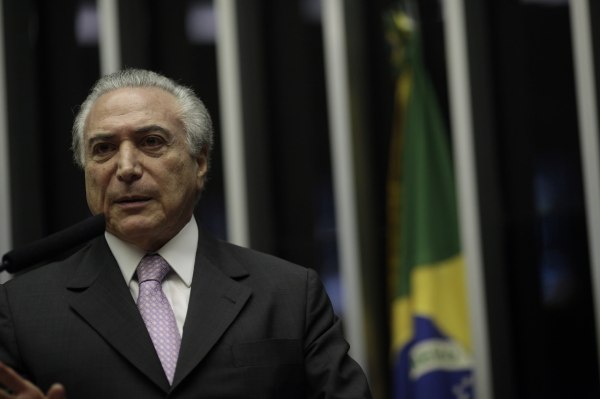
Brazilian President Michel Temer. / PMDB Nacional / Flickr / Creative Commons

Self-inflicted troubles are forcing Brazilian President Michel Temer into difficult choices between his party and an angry public.  When he became president three months ago, his game plan was simple and bold: undertake legislative reforms that would put the government’s accounts back on track, enhance investor confidence, stimulate an economic recovery, and possibly set the stage for a center-right presidential bid (if not by Temer himself, at least by a close ally) in the 2018 elections.  Allies in his Brazilian Democratic Movement Party (PMDB) would ensure that he had the backing of Congress to push through reforms that might not bring immediate returns, but nonetheless might improve investor confidence.  Sotto voce, many politicians also assumed that the PMDB would be well placed to slow the pace of the bloodletting occasioned by the massive Lava Jato investigation and stabilize the political system.

Last week, the public’s worst suspicions of the PMDB-led government were confirmed by a two-bit scandal that claimed Government Secretary Geddel Vieira Lima, who was putting pressure – with Temer’s help – on a historical registry office to authorize construction of a Salvador building in which he had purchased an apartment.  Temer sought to repair the damage by holding an unusual press conference Sunday in which he promised to veto a proposed congressional amnesty of illegal campaign contributions.  But Temer now faces another important ethical fork in the road: how to respond to Chamber of Deputies approval of anti-corruption legislation yesterday that – while originally intended to boost efforts to clean up government – neuters the reforms and prevents judicial “abuses,” a move widely seen as an effort to intimidate judges and prosecutors.  The bill now heads to the Senate, which seems unlikely to repair the damage and indeed, may further distort the bill in an effort to undermine Temer’s ability to resurrect the reforms through selective vetoes.  The reform package had been a poster child for the prosecutors spearheading the Lava Jato investigation, and it was pushed by a petition drive that gathered more than two million signatures.  Prosecutors have threatened to resign if Temer signs the severely mangled measure into law.

Despite Temer’s initial successes, the outlook for the remainder of his term remains grim.  The bad news is going to continue, causing the Congress and Temer even more sleepless nights.  A deal expected soon reportedly will require the Odebrecht construction firm to pay a record-breaking penalty for its corrupt practices (perhaps surpassing even the US$1.6 billion Siemens paid to U.S. and European authorities in 2008), and plea bargains by nearly 80 company executives might implicate as many as 200 federal politicians.  It threatens to paralyze legislators and further weaken the PMDB’s already decimated crew, undermining Temer’s ability to coordinate with Congress.  Economic forecasts now show economic growth of less than 1 percent in 2017 and, with 26 state governments facing budget crises, politically influential governors are begging for federal help.  A much-needed pension reform promised by Temer has not yet been made public, much less begun the tortuous amendment process in Congress.  Temer increasingly is being forced to choose between helping his allies and achieving reform, or satisfying a public fed up with politics as usual and baying for accountability and a political cleanup.  It will take all of Temer’s considerable political skills and knowledge of backroom Brasília to revise his game plan for these challenging times.

December 1, 2016

* Matthew Taylor is Associate Professor at the School of International Service at American University and Adjunct Senior Fellow for Latin America Studies at the Council on Foreign Relations.  This is adapted from this CFR blogpost.

Implications of Fidel’s Passing

By Fulton Armstrong

KODAK Digital Still Camera

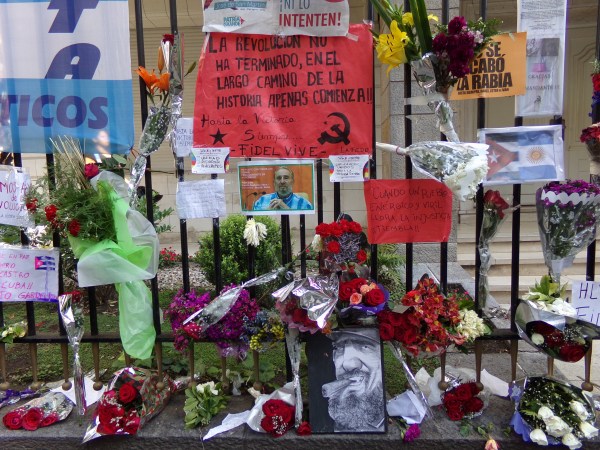
As a tribute to Fidel Castro, flowers and posters adorn the gates outside the Cuban Embassy in Buenos Aires. / Gastón Cuello / Wikimedia / Creative Commons

The death of Fidel Castro last Friday night has drawn largely predictable reactions from largely predictable quarters, but the analysis of the meaning of the comandante’s passing that matters most belongs to the Cuban people.  History may ultimately absolve Fidel of his most egregious excesses and errors over the last six decades, but Cubans are the ones who will decide which parts of his revolution to keep – and which to reject or allow to fade away.  By all accounts, Cubans want to preserve some of the gains of the revolution, including their sense of national dignity and some social benefits, while seeking a vastly improved living standard.  But no one can claim to know exactly what “the people” want – and how they want to achieve it.

  • The economic reforms that President Raúl Castro launched years ago have been halting and hampered by policy contradictions and bureaucratic obstacles rooted in elites’ fears of losing political control. Processes like the 7th Party Congress’ Conceptualización have been so muted as to undermine change and breed cynicism among the population.  Raúl and his team have a roadmap that, while as unorthodox as ever, will move the economy in the right direction.  Fidel’s departure is a signal that the old-timers, perennially blamed for slowing change, represent an eventually diminished threat.  The next generation of Party leaders knows full well that their legitimacy is going to have to come from concrete results, especially improving living standards, and it needs to move ahead with the hundreds of lineamientos, laws and regulations that have already been approved.  It’s their own plan, and the excuses for non-implementation of at least the easier measures are getting thin.  Major reforms such as unifying exchange rates will be a big challenge, as for any country, but the new team at some time will have to bite the bullet.
  • On the political side, Raúl lags even farther behind. Fidel’s passing puts a lot of pressure on him to flesh out his plan to step down as President in 15 months (a commitment that so far seems solid).  Some of Raúl’s actions indicate a desire to build institutions, perhaps even the National Assembly as it moves back into the Capitolio this month; improve decision-making processes; and reduce party intervention in day-to-day matters.  But his handover of power to a new generation won’t work if his policy team stays in the shadows forever.  His vision entails them learning how to do politics among themselves and, increasingly, with the Cuban people – which implicitly entails respect for the plurality of legitimate views across Cuban society.  The Cuban people have shown they’ll not form lynch mobs the moment political space opens up.

Cubans can find support for their evolutionary change in every corner of our Americas, except perhaps one.  Reactions throughout Latin America and the Caribbean differed in tone and effusiveness, but they uniformly showed respect for the deceased comandante and support for the Cuban people.  Regional leaders called him a “giant in history” and “a leader for dignity and social justice in Cuba as well as Latin America” and the like, while one merely tweeted “condolences to the Cuban government” and had staff explain he’d miss the funeral because the logistics of flying to Cuba were “not easy.”  But the region’s best wishes for Cubans to find a stable path from a Castro-dominated past into the future that they collectively – in the Party and “the people” – wish to find were strong.

The outlier is, again, the United States.  President Obama and Secretary Kerry’s messages were statesmanlike and consistent with Washington’s sensitivity toward any country in mourning even if it has different interests and values.  President-elect Trump took a different approach.  His condolence statement focused on issues from the past and his affiliation with combatants from the Bay of Pigs invasion who tried to oust Castro in 1961 and endorsed his own candidacy last month.  He tweeted that he will “terminate the deal” of normalization if Cuba is “unwilling to make a better deal for the Cuban people, the Cuban-American people, and the U.S. as a whole.”  Obama’s staff prematurely declared normalization “irreversible,” and Trump may be equally premature in threatening to reverse it.  Cuba’s changing on its own, and Fidel’s passing will probably give change on the island, if not in Washington, a push.  Efforts to return to a Cold War posture would probably put Cuba on the defensive and slow its transition processes – but not even Fidel could stop the march of time.

November 29, 2016

What Comes After TPP?

By Fulton Armstrong and Eric Hershberg

31117865785_a3bb9a557a_k

President Barack Obama and President Pedro Pablo Kuczynsky at the APEC 2016 summit / Ministerio de Relaciones Exteriores – Peru / Flickr / Creative Commons

The Obama administration’s failure to win U.S. approval for the Trans-Pacific Partnership is a disappointment for Latin American countries on the Pacific Rim – and such a big opportunity for China to expand its influence that President-elect Donald Trump, despite his theatrical pledge to withdraw from it, might eventually consider rescuing the accord. The Asia-Pacific Economic Cooperation (APEC) summit in Lima last weekend was the last chance for Latin American leaders to say goodbye in person to President Obama and to mourn the passing – for at least the short term – of his TPP-centered vision for trans-Pacific trade.  In a meeting with leaders of the 11 other TPP countries, Obama tried hard to convince them of “the United States’ continued strong support for trade” despite growing evidence to the contrary.  Both U.S. President-elect Donald Trump and Hillary Clinton, who was Obama’s Secretary of State for four years, firmly and repeatedly stated opposition to TPP.  The White House continued efforts all the way up to election day (November 8) to persuade the U.S. Senate to approve the deal in a lame-duck session, but the Republican leaders – like Clinton champions of free trade until it became a 2016 campaign issue — slammed the door on it.

With the collapse of TPP, several Asian countries have already signaled a willingness to sign on with China’s own free trade initiative, the Regional Comprehensive Economic Partnership (RCEP) – which Latin America is not yet part of. Malaysian Prime Minister Najib Razak, angry with the United States over trade and other issues, threw his lot with China during a visit to Beijing last month.  (The Philippines, which has also moved aggressively to ally itself with China in recent months, is not in TPP.)  Japanese Prime Minister Shinzo Abe met with Trump last week and said his country “could have great confidence” in the President-elect, but he has nonetheless warned his parliament that RCEP will prevail.

  • Latin Americans are also slowly but surely gravitating toward China as trans-Pacific leader in trade. Just days before the Lima summit, Peruvian Foreign Minister Eduardo Ferreyros announced that, while Lima still hoped TPP would become reality, his government has begun talks with China over accession to RCEP. His Chilean counterpart, Heraldo Muñoz, last Friday also expressed preference for TPP but told the Wall Street Journal that his country was leaning toward joining RCEP. Chinese President Xi Jinping, in Lima for the summit, was also making stops in Ecuador and Chile. (He’s visited Mexico, Argentina, Brazil and Venezuela on previous trips.) In an op-ed in Peru’s El Comercio just before the summit, Xi said, “United by the same dream, there isn’t a more timely moment for the deepening of our multidimensional cooperation.”

The APEC forum may have been trying to counter Trump and others’ criticism of the lopsided impact of global trade by issuing a statement – titled “Quality Growth and Human Development” – emphasizing the benefit of global trade to all citizens in all countries. It was certainly in this spirit that the host of summit, Peruvian President Pedro Pablo Kuczynski, warned that proponents of trade barriers would do well to revisit the history of the 1930s, singling out for unusually sharp criticism the stance taken by the U.S. President-elect.  On its face, Trump’s campaign rhetoric suggests TPP is totally dead; he’s many times called it a “disaster” being “pushed by special interests who want to rape our country.”  Free-traders found a glimmer of hope in an organizational chart reportedly leaked by the Trump transition team last week that listed a former lobbyist from the U.S. Chamber of Commerce, which has strongly supported TPP, as head of his “trade reform” team.   Yet if the new U.S. Administration is going to reengage on TPP, the primary reason would probably be to undercut China’s RCEP initiative.  Much of the U.S. foreign policy establishment of both parties believes fervently that the impact of U.S. disengagement with the Pacific Rim would be harmful to U.S. global and hemispheric leadership.  Should those concerns sway the incoming President, he could opt to set aside his caustic rhetoric on TPP, negotiate face-saving adjustments to the accord, and instead focus his tough talk on China. TPP’s flaws may ultimately appear minor and manageable compared to the competing scenario of Latin American governments seeking commercial prosperity through a Chinese-led Pacific economic bloc. That is certainly the hope of most Pacific Rim governments across Latin America, whose alarm at developments in the U.S. already has them eying alternatives across the pond.

November 22, 2016

Guatemala: Cheers for Trump?

By Ricardo Barrientos*

22441078334_df0b0beceb_k

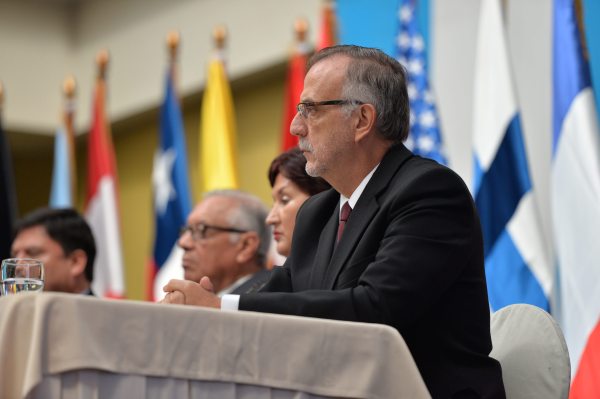
Iván Velásquez, head of the UN International Commission Against Impunity in Guatemala (CICIG). Velásquez and his team face a difficult task of bolstering Guatemalan anti-corruption efforts. / US Embassy Guatemala / Flickr / Creative Commons

Anti-corruption efforts in Guatemala have suffered serious setbacks in recent months, and the election of Donald Trump as U.S. president appears likely to hurt them further.  A number of media reports have already documented that efforts by right-wing Army veterans accused of crimes against humanity during the civil war, politicians, and campaign financiers are seriously threatening anti-corruption efforts started in 2015, which swept former President Pérez Molina from office.  President Jimmy Morales, who campaigned that he was “neither corrupt, nor a thief,” has failed to fulfill voters’ mandate to fight corruption, and instead has allowed Army friends to dominate his administration.  Called la juntita, Morales’s closest advisors are former military officers who operate in the shadows, are widely suspected of crimes against humanity during the war, and are alleged to be using their influence for personal enrichment.

  • The Supreme Court and Congress are also under pressure. Numerous media reports point to members of the Supreme Court, including its President, being tainted.  One magistrate, whose son has already been convicted of illicit use of public funds, is widely suspected as well.  In the legislature, the election of a new Directive Board increased the power of members long suspected of links with the mafias.  (Some local observers speculate that the internal voting was conducted on the U.S. Election Day because U.S. Ambassador Todd Robinson, an advocate of anti-corruption initiatives, and his staff would be too busy to care about what was going on in the Guatemalan Congress.)

With the Central Square in Guatemala City empty and only memories remaining of the citizen mass demonstrations of 2015, the last line of defense against the “re-capture” of the Guatemalan State are Iván Velásquez, head of the UN International Commission Against Impunity in Guatemala (CICIG), and Guatemalan Attorney General Thelma Aldana.  They have already started investigations and are prosecuting corrupt members of Congress, including members of the new Directive Board.  U.S. government support has been crucial.  Ambassador Robinson may have crossed the thin line between active diplomacy and intervention at times, but many observers note that – quite unusual in Latin America for a U.S. ambassador – he enjoys strong support and sympathy from Guatemalans, and he is disliked by the Army veterans and others who are part of what in Guatemala is known as the “old politics.”

Corrupt Guatemalans appear to believe that their first hope – to neutralize the U.S. Embassy – moved one step closer to reality with the election of Donald Trump last week.  Politicians and commentators opposed to U.S. support for CICIG celebrated.  One proclaimed that “Democrats shriek; Republicans vote,” while another interpreted the message of Trump’s victory for Ambassador Robinson: “You’re fired!”  The mafias would not expect a Trump Administration to support them, but rather – interpreting the President-elect’s campaign statements – simply adopt a policy of indifference toward Guatemala and its internal affairs.  The corruption networks of the “old politics” in Guatemala hope that Trump will stay focused on nothing in Latin America except stopping migration.  Analysts who say that everyone in Latin America is regretting Trump’s victory are wrong.  Trump’s election may help the corrupt win a battle or two, but the war against corruption in Guatemala is far from over.

November 18, 2016

*Ricardo Barrientos is a senior economist at the Central American Institute for Fiscal Studies (Icefi).

Latin America: Wait-and-See Reaction to Trump – For Now

By Catie Prechtel and Carlos Díaz Barriga*

trump-effigy

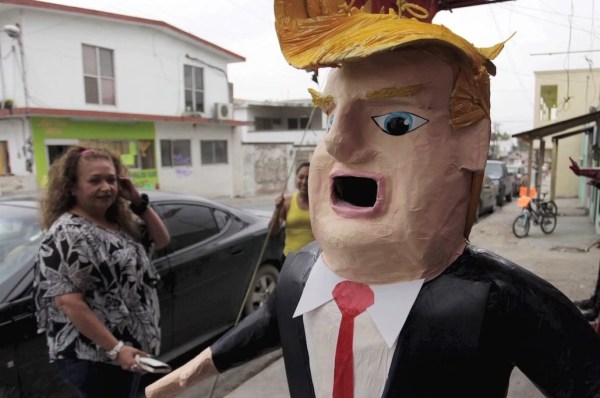
An effigy of Donald Trump in Mexico City. / Sequence News Media / Daniel Becerril / Wikimedia / Creative Commons

Most Latin American leaders publicly reacted with caution to Republican presidential candidate Donald Trump’s victory in last week’s U.S. elections, but reactions will sharpen quickly if Trump tries to make his campaign rhetoric about the region and Latino immigrants into policy.  Mexico and Central America showed clear anxiety over the implications for their economies and regional migration pressures.  Some South American presidents expressed mild enthusiasm and voiced hope for a positive relationship with the new administration, although Trump’s avowed opposition to the Trans-Pacific Partnership trade accord – under discussion at the APEC summit in Lima this week – has fueled concerns about the future of free trade.  Fear that the new U.S. President, who takes office on January 20, will deport millions of undocumented migrants from Mexico and Central America and force U.S. firms to shut factories in those countries has seized the media there.

  • Mexican newspapers headlines screamed “Be afraid!” and warned of a “Global shakedown.” Reports recited the many promises Trump had made against Mexico, including his proposal to build a border wall (and make Mexico pay for it); revising NAFTA and raising taxes on Mexican imports, putting conditions on remittances, and charging more for visas. The peso suffered three consecutive days of losses before recovering slightly following interviews by Trump and his team suggesting a softer stand on the wall and free trade.  President Peña Nieto phoned Trump with congratulations and agreed to meet soon to discuss bilateral issues, including presumably the wall.
  • Guatemala’s Prensa Libre reported businessmen are worried Trump’s rejection of free trade could have a direct impact on the economy and described the possible mass deportations as a “social bomb” for the country. In Nicaragua, newspapers speculated that Trump’s victory will give a boost to U.S. legislation, the Nicaragua Investment Conditionality Act (NICA), which calls for economic sanctions if President Daniel Ortega doesn’t take “effective steps” to hold free and fair elections.  In El Salvador, the main concern is the deep economic stresses of mass deportations of Salvadorans in the United States.  Honduras shares those concerns but apparently was more wrapped up in President Juan Orlando Hernández’s announcement confirming his intention to make a controversial bid for reelection.
  • Venezuelan President Nicolas Maduro, often given to bombastic rhetoric, has focused on working with Washington in the closing months of the Obama Administration. In a phone conversation with Secretary of State John Kerry, he stressed the need to establish an agenda with the next administration that favors bilateral relationships, but he specifically called on Obama to “leave office with a message of peace for Venezuela” and rescind a determination that Venezuela is a “threat to the United States.” Obama himself last April said the designation was exaggerated.
  • Media in Colombia speculated that Trump will be less committed to aid and support for finalizing and implementing a peace accord with the FARC. Argentina, Brazil, and Chile offered calm reactions to the news.  For Buenos Aires and Santiago, the biggest concern was potentially strained commercial relationships and free trade agreements with the United States, according to press reports.  Brazil offered little reaction to the news, but Trump’s win brought four consecutive days of losses for the real – weakening 7.6 percent since the election.

The political leaders’ cautious reactions conceal a broad and deep rejection for President-elect Trump’s values and intentions as he stated them during the campaign.  Former Mexican President Vicente Fox once again tweeted his disapproval for Trump, while José Mujica, former President of Uruguay, expressed dismay on Twitter, summing up the situation in one word: “Help!”  Press reports and anecdotal information indicate, moreover, that large segments of Latin American society have shown a widespread distaste for Trump’s win.  Their general wait-and-see attitude will end when and if Trump proves himself the unpredictable and reactionary he seemed on the campaign trail.  Latin American leaders have a lot of work ahead as they navigate a new relationship with the United States.

November 15, 2016

* Catie Prechtel and Carlos Díaz Barriga are CLALS Graduate Assistants.

The Cataclysm that the Latino Vote Couldn’t Stop

By Eric Hershberg

ft_16-11-09_exitpolls_race_ethnicity

Presidential candidate preference, by race or ethnicity / Pew Research Center

In unprecedented numbers, Latino voters flexed their muscles in the bitter and destructive U.S. presidential campaign, but that wasn’t enough to elect a competent but mistrusted centrist and block an erratic TV showman espousing policies anathema to their interests.  Former Secretary of State Hillary Clinton lost in the electoral college, which in the American system is what actually matters, but she won the popular vote by a slim margin – little consolation to Latinos.  Donald Trump and the forces that will accompany him into the Executive branch have pledged to begin efforts to deport millions of undocumented immigrants, build walls to keep Latin Americans out of the country, and reverse decades of policies meant to strengthen ties among the Americas.  The election highlighted deep cleavages in U.S. democracy:

  • An inclusive coalition of the well-educated, urban dwellers, youth, and racial and ethnic minorities lost to a bloc of angry white working-class, rural, and small-town voters rallied by a man whose behavior and rhetoric were called repugnant by leaders of even his own party. The outcome testifies to the degree to which vast segments of the American population feel ignored and denigrated by political and cultural elites and alienated by profound social changes that accelerated during the Obama administration, including shifts regarding such issues as gender and sexual identity and, particularly, racial diversity and empowerment.
  • The Trump-led “whitelash” has been largely rhetorical up to this point, but it will soon be manifested in public policies with life-changing consequences for immigrants, minority populations, and impoverished citizens. There’s a possibility that, once charged with running the country, the Trump faction will moderate on some issues, but it’s frightening to recall that no fewer than 37 percent of German voters mobilized behind an analogous cocktail of racial resentment and violent impulses in 1932.  In 2016, nearly half of the American electorate did just that, with profound implications for civil discourse, tolerance, and respect for sometimes marginalized sectors of the country’s population. If Trump’s exclusionary rhetoric becomes translated into concrete policies that diminish the country’s diversity, the U.S. will lose its status as among the most dynamic and creative places in the world.

The Latino vote was expected to be among the decisive factors that would sweep Clinton into the White House and swing the Senate back to Democratic control, albeit by the slimmest of margins.  But while it was influential, diminishing Trump’s margin of victory in reliable Republican strongholds such as Arizona and Texas, and enabling the Democrats to eke out victories in states such as Nevada, New Mexico, and Colorado, the Latino vote was insufficient to rescue Clinton’s fortunes in the pivotal states of Florida and North Carolina.  Whereas in 2012 Obama had an estimated 71-27 percent advantage among Latinos against his opponent, Clinton failed to match that total – exit polls indicate roughly a 65-29 percent split – even against a candidate explicitly targeting Latino interests.  Trump called for mass deportations of the country’s 10 million undocumented Latino residents and a rollback of the Obama administration’s efforts to provide safe haven and legal status for at least half of this vulnerable segment of American communities.  Whatever the reasons for their low participation, these communities now confront existential threats.

  • If Trump follows through on his promises, the impact will be manifested in numerous domains beyond immigration and related human rights that have profound implications for the welfare of U.S. Latinos, including the composition of the Supreme Court and its commitment to voting rights; protection against discrimination in employment, housing, and financial services; access to health care for 20 million people who for the first time gained coverage through the Affordable Care Act (“Obamacare”); opportunities for pre-school and tertiary education; and environmental regulations needed to protect public safety and health.

Political scientists and informed citizens must now revisit their assumptions about the impact that a growing Latino population may have on the outcome of presidential elections.  The gap separating the two parties in terms of Latino preferences is vast and increasingly consolidated, suggesting an enormous and enduring disadvantage for the Republicans.  But whether the Latino vote can become a decisive, rather than merely influential, component of the electorate is much less certain.  The anger among white voters – at least this time around – carried the day.  This “whitelash” may or may not be a transitory phenomenon, but the prospects for efforts to make the United States a force for good in the world, and to make government an agent for social and economic justice for all, will depend in large part on the future mobilization of the Latino community.  Arguably, the future of the United States – and by extension the world’s – hinges on the capacity of Latino voters to make America great again.

November 10, 2016