By Maggie McMahon
Sexual violence during migration journeys is rarely addressed in the current political climate. Yet this issue is rampant for many migrants, especially those making the journey from Latin America to the United States. The personal experiences and testimonies from those who completed this journey provide valuable insight into the dangers that migrants face in this region. This problem demands more attention, as it is one of the many dangers that migrants face while attempting to reach the U.S.
In her late 20’s and from Ecuador, Verónica details her lengthy and dangerous journey to the United States, where she walked many miles to the US-Mexico border and experienced rough traveling conditions, including falling off a train.
Ay me están esperando llorar. Bueno, sufrí mucho, pasé mucha hambre, dormí en parque—muchas cosas feas…Bueno, después de eso, yo cambié de tren y me subí a otro tren que ese sí era el que me traía, pero ese tren se quedó 3 días en el desierto. Ahí entonces yo como que le daba gracias a Dios de no haberme subido a ese tren porque yo me pude subir, pero me dio miedo y no me subí, pero mucha gente se subió y algunos se cayeron, incluidos niños. Bueno, ese tren me avanzó hasta la frontera, de ahí yo me bajé y camine bastante. Yo llegué a este país con los pies podridos ensangrentados porque yo caminé artístico.[1]
Oh, this is making me want to cry. Well, I suffered a lot. I went very hungry, slept in a park—many ugly things… Well, after that, I changed trains and got on another one, the one that was supposed to bring me here. But that train stayed stranded in the desert for three days. At that point, I felt like thanking God for not getting on the earlier train. I could have boarded it, but I was scared and didn’t. Many people did get on, and some fell off, including children. Well, that train took me to the border, from there I got off and walked a lot. I arrived in this country with rotten feet, bloodied because I walked a tremendous amount.
When asked if she felt in danger during her trip, Verónica shared her experience in Guatemala:
Uh no yo siempre diré que Guatemala es el peor país que yo pude conocer ahí, así que no te digo. A mi en bus me tocaron los senos, las partes íntimas. Me sacaron todo el dinero.
Oh no, I will always say that Guatemala is the worst country I could have known there, so I tell you. They touched my breasts and private parts on the bus. They took all my money.
After arriving in the United States, Verónica’s friend provided her a place to stay and food for a few weeks. She now works as a delivery driver.
Another woman, Mariana, also shared her experience with sexual violence during her journey. In her fifties and from El Salvador, she has been in the US for over two decades. During her journey from El Salvador, she recalls that:
Fíjese que yo fui víctima de eso. No llegar al acto sexual porque gracias a Dios no me llegaron a violar, pero en el camino para acá si fui tocada por los hombres. Puedo recordar de que no sé si todas percibirán eso, pero yo sí lo viví. Sí. Sería porque yo cuando venía ya venía …, pero yo parecía… yo era bien delgadita, parecía una niña de 14 años. No sé si por eso es que abusaron de mí de esa manera. Pero sí pudeir tocada por más de 2 hombres en el camino.
I remember that I was a victim of that. Not in a sexual act, thanks to God, they did not rape me, but on the way here I was touched by men. I can remember that I didn’t know if anyone else sees that, but I did experience that…it must have been because when I came…I seemed to be very thin, I looked like a 14-year-old girl. I don’t know if that’s why they abused me in that way. But I was touched by more than 2 men on the way.
Mariana’s story demonstrates how persistent the dangers of migration have been for women over the years.
These instances of sexual assault are not isolated. Samuel, born in Colombia in the late 1990s, migrated to Venezuela as a child due to political violence and the unfavorable economic situation. He moved to Brazil as a young teen to work in the mines after his parents separated and migrated to the US in 2024.
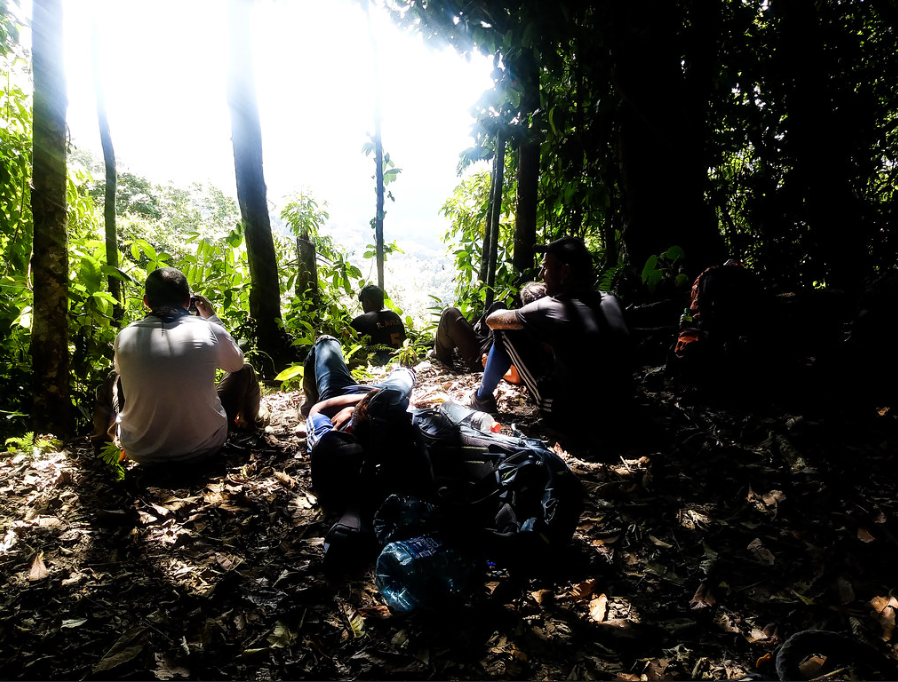
While traversing the Darién Gap, a remote thick jungle crossing between Colombia and Panama, David witnessed many violent situations. The Darien Gap is known for its dangerous and difficult conditions, with many people experiencing gang violence, crime, sexual violence, disease, and death.
David reported that while on the Panamanian side of the Darien Gap, he witnessed a group of Indigenous men rape a woman traversing the crossing. He also saw this group of men shoot the woman’s husband.
Hay indios que agarraron a una mujer y se la violaron. Y al esposo… viendo que están pasando eso, el esposo se le baten o se levanta, le pegan un tiro. El indio agarró con una escopeta y le pegó el tiro. Puso, se lo pegó aquí… Así, puff, le pegó el tiro aquí …. Ahí quedaron los dos y salieron los indios. Antes habían robado y todo, pero después estaban violando a la mujer ahí ante el grupo.
There are Indians who grabbed a woman and they raped her. And the husband … seeing that they are going through that, the husband fights him or gets up, they shoot him. The Indian grabbed a shotgun and shot him. He put it, he stuck it here… So, poof, he shot him here…. The two of them laid there and the Indians left…Before, they had robbed and everything, but after they were raping the woman there in front of the group.
Sexual violence is unfortunately a common experience in the Darién Gap. Other migrants we interviewed also reported witnessing instances of it, as with the case of Mauricio. Born in Venezuela, Mauricio migrated to the US four years ago to find better opportunities for his three young children. He traveled to Caracas, Venezuela and then on to Colombia and Peru. During his migration, Mauricio faced many dangerous situations, such as sleeping on the streets and crossing the jungle. As he recounts:
En Panama fui testigo una violencia que pasó pero eso fue ya entrando en la selva. Violaron una niña y alguna mujer. Entonces yo estuve ahí, o sea, fui vi todo con mis ojos y fui testigo de eso.
In Panama I witnessed violence that happened, but that was already deep in the jungle. They raped a girl and a woman. So, I was there, that is, I saw everything with my eyes and witnessed that.
Instances of sexual violence were then increasing in the Darién Gap since Panamanian authorities were not monitoring the crossing. Additionally, many instances of sexual violence go unreported due to stigma and shame. With the absence of policing in these remote largely uninhabited areas, armed criminal groups are able to take advantage of vulnerable people traversing the crossing. Though lately, the Panamanian government has mobilized the army to patrol those areas, as movement north has decreased and now many people are heading south.
Sexual violence have long-term psychological and physical impacts for those who experience and witness it. Victims of rape can suffer sexually transmitted infections, unwanted pregnancies, and physical trauma. Sexual violence can also cause feelings of depression, anxiety, PTSD, and social isolation, as well as heighten an individual’s risk of substance abuse.
Given the ongoing instability faced by many Latin American countries, migration through the Darién Gap is likely to increase. Panamanian authorities must take further action to closely monitor the dangerous conditions in the crossing and provide support for the vulnerable populations crossing it. Greater support for the physical, psychological, and financial needs of migrants should also be implemented in the United States.
Maggie McMahon is a research intern at the Immigration Lab. She is a senior majoring in international studies.
Edited by Elizabeth Angione and Vincent Iannuzzi-Sucich
[1] This and the following accounts have been taken from interviews conducted with recent arrivals to the Washington DC-metro region and New York City as part of an ongoing research project of the Immigration Lab in American University’s Center for Latin American and Latino Studies. This project received IRB approval. Given the vulnerability of this population, we have taken steps to ensure the human subjects involved are protected, including eliciting the consent of all research subjects, the use of pseudonyms, and elimination of any individually identifying information.


 AULA Blog