
Ernesto Castañeda, Edgar Aguilar and Oscar Alberto Ibarra*
September 20, 2024

In addition to contributing to the economy in their home country, Salvadoran migrants also boost the U.S. economy.
El Salvador is one of the smallest countries in Latin America, with a population of 6.3 million inhabitants, which is expected to decrease in the next few years. More than 1.3 million people born in El Salvador live in the United States, along with more than 1.2 million born to at least one Salvadoran parent. The more than 2.5 million people of Salvadoran origin living in the U.S. are equivalent to 40 percent of El Salvador’s total population. According to our calculations, there are around 1.8 million Salvadorans who work in the United States and send remittances. These people are an important part of both economies.
In 2023 alone, El Salvador received $8.18 billion dollars in remittances, which represented 24 percent of the country’s Gross Domestic Product (GDP).
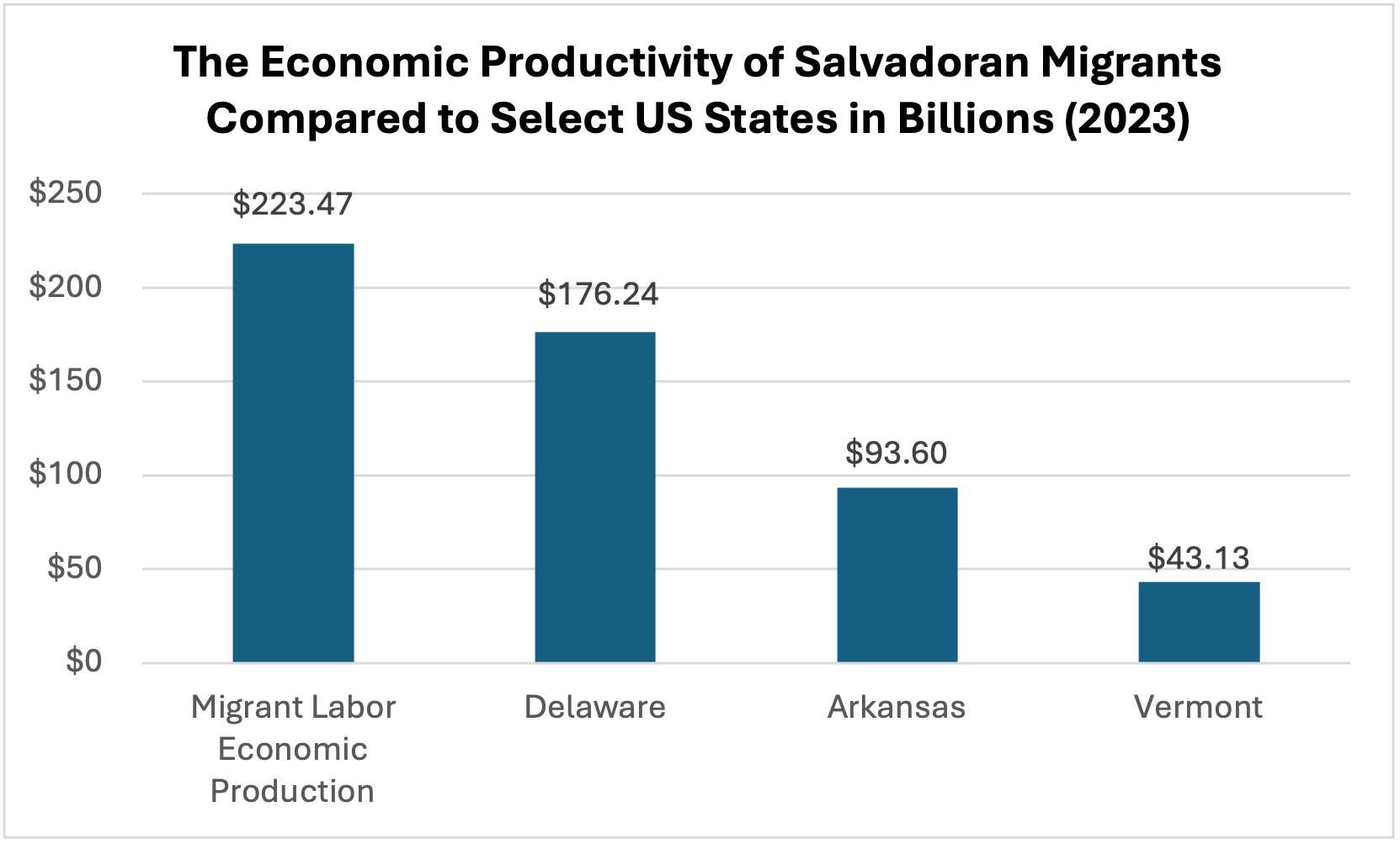
Some believe that remittances are a cash drain on the U.S. economy. However, a novel calculation by the Center for Latin American and Latino Studies (CLALS) and Immigration Laboratory at American University in Washington, DC, demonstrates that remittances are an important indicator of the contributions that migrants make to the US economy. Based on this calculation, we find that just in 2023, Salvadoran migrants in the United States who sent remittances contributed $223.47 billion dollars to the US economy, including significant contributions to such industries as construction, restaurants, gardening, agriculture, and domestic services, as well as automotive mechanics, health, science, and education, among others.

Here, we also offer an additional novel means of calculating the economic contribution of all Salvadoran immigrants in the United States, not just those who send remittances. For this analysis, we started again with the total remittances sent to El Salvador in 2023, which was $8.18 billion. Using a monthly average of $330.30 dollars per remittance and an estimated frequency of 14 annual remittances, one per month plus additional ones for both Mother’s Day and Christmas, we calculated the number of migrants who send money to be approximately 1,769,344.
According to a study by USAID, IOM, and the Central Reserve Bank of El Salvador, around 79.7 percent of Salvadoran migrants send remittances. Therefore, we can estimate that there are more than 2.2 million Salvadorans working in the United States. This estimate is higher than that of the American Census Bureau, which is not surprising since many migrants do not participate in the census. Multiplying the number of migrants (both those who send remittances and those who do not) by the average annual salary of $26,523.00 estimated by the Census Bureau, the aggregate income of these migrants was calculated to be about $59 billion. Finally, considering that the salaries received by migrants after taxes and deductions represent 21 percent of their productivity, we estimated their contribution to the GDP of the United States to be more than $280 billion. This reveals the profound impact Salvadoran migrants have on the U.S. economy. In the previous graph, only the impact of migrants who send remittances was presented. The following graph shows the economic contribution of all Salvadoran migrants in the United States who earn an income.

The contribution of Salvadoran migrants to the United States economy is greater than that of entire states. If all the Salvadoran migrants who send remittances were a state, it would have a GDP five times larger than that of Vermont and more than twice as big as that of Delaware.
Conclusion
The 1.8 million Salvadoran migrants in the United States who sent remittances in 2023 contributed $223.47 billion to the US economy. The 2.2 million Salvadorans working in the US generated more than $280 billion dollars. Given that El Salvador’s GDP is US $34.02 billion, our estimate demonstrates that Salvadoran migrants, through their economic activity, generate eight times more economic value in their country of residence (that is, the U.S.) than does the entire population in their country of origin. This also means that Salvadorean immigrants and their adult children contributed around 1% of the United States GDP in 2023.
Beyond sending remittances, Salvadoran migrants also play a crucial role in the economic growth of the United States through their participation in various productive sectors. In addition to their impact on production, Salvadoran migrants contribute to the economy by paying taxes and, above all, by meeting labor demand in key areas of need for the US. In general, studies show that immigrants not only support the economies of their countries of origin, but also function as economic engines for their countries of residence.
Sources
Pew Research Center – U.S. Hispanics: Facts on Salvadoran Origin Latinos. https://www.pewresearch.org/fact-sheet/us-hispanics-facts-on-salvadoran-origin-latinos/
Banco Central de Reserva de El Salvador – Las remesas familiares superaron los US$8,000 millones en 2023. https://www.bcr.gob.sv/2024/01/26/las-remesas-familiares-superaron-los-us8000-millones-en-2023/#:~:text=Las%20remesas%20familiares%20superaron%20los%20US%248%2C000%20millones%20en,respecto%20a%202022%2C%20equivalente%20a%20US%24362.2%20millones%20adicionales
World Bank – Personal remittances, received (% of GDP) – El Salvador. https://data.worldbank.org/indicator/BX.TRF.PWKR.DT.GD.ZS?locations=SV
Encuesta sobre salvadoreños en EE.UU. – Organización Internacional para las Migraciones (OIM). https://infounitnca.iom.int/wp-content/uploads/2022/12/encuestasalvadorenosenEEUU.pdf
SSRN – Economic Contribution of Salvadoran Immigrants (2023). https://papers.ssrn.com/sol3/papers.cfm?abstract_id=4740925
U.S. Bureau of Economic Analysis (BEA) – National GDP and Personal Income. https://www.bea.gov/itable/national-gdp-and-personal-income.
Ernesto Castañeda PhD, Director of The Immigration Lab and Center for Latin American and Latino Studies (CLALS), Professor, American University in Washington DC.
Edgar Aguilar is an International Economics Master’s student at American University, a research assistant at the Center for Latin America and Latino Studies, and a consultant for the World Bank. He specializes in migration, human security, sustainable energy, finance, and environmental policy.
Oscar Alberto Ibarra Coordinator of the Migration and Transparency Observatory of the Research Center for Democracy (CIDEMO) of the University of Oriente (UNIVO), El Salvador.
This piece can be reproduced completely or partially with proper attribution to its authors.
Spanish version available at: https://aulablog.net/2024/09/18/un-motor-invisible-como-los-inmigrantes-propulsan-la-economia-estadounidense-el-caso-de-los-salvadorenos/


 AULA Blog