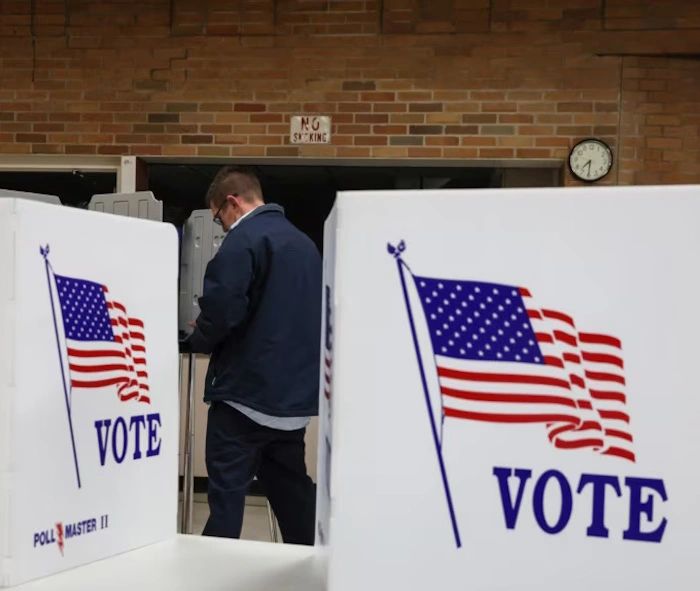
What Does It Mean to Provide Sanctuary? 

by Ernesto Castañeda, PhD. Director of CLALS and the Immigration Lab, American University

Photo Credits to Jeff Haynes/AFP/ Getty Images in “Churches have a long history of being safe havens — for immigrants and others.”

The term “sanctuary” dates back to late-imperial Rome and pre-16th century Western Europe, when temples, monasteries, and churches were places where victims, run-away serfs, and fugitive criminals were provided protection from local or remote government authorities. Religious houses would provide temporary protection to walkers who wanted to protect themselves from crooks or lords based on the Christian traditions of intercession between persecuted individuals and political authorities, and the ability of religious authorities to provide penance and to rehabilitate people through faith, prayer, and sometimes communal labor or what we would call now “community service.” Churches and hostels along pilgrimage routes welcomed strangers, who were protected due to their participation in religious rituals en route to shrines and sacred places. Think of today’s walking pilgrimages on the road to Santiago de Compostela in Spain and the hostels and inns along the way. Authorities would then recognize this practice. Emperor Constantine, “guaranteed sanctuary in Christian churches in 324 C.E.” (Rabben 2011: 55). Pope Leo I also wrote about sanctuary and gave Bishops the role of intercessors and advocates in favor of fugitives (Rabben 2011: 56).  

The early practice of providing sanctuary in Europe is similar to how churches, along with religious and activist networks, were used to construct the Underground Railroad in the United States during slavery. This secret network helped enslaved people escape the South to free states, Canada, or Mexico. Harriet Tubman, a key figure in this movement, was deeply motivated by her religious faith and played a crucial role in freeing others. Her mission to help free enslaved people would not have succeeded without the support of White allies, who were less likely to raise suspicion. 

Starting in the 1980s, a group of U.S.-based religious activists, State Department workers, journalists, and human rights activists helped people fleeing political persecution in El Salvador and Guatemala. These individuals were escaping U.S.-backed dictatorial regimes and sought safety in American cities like Los Angeles, San Francisco, and Washington, D.C. James Cobert, an activist Quaker, would call it a “pro bono coyote operation … the activists would help Salvadorans cross into the U.S., then hide people’s homes and in churches until it was safe to interior of the country” (Blitzer 2024:60). Soon after immigration agents dragged a Salvadoran teenager from a Lutheran Church in LA after an outcry by parishioners, the local INS Director produced an order, “in essence, saying the church is a sanctuary, but it is not established in law” (Blitzer 2024:69). This marked the birth of the modern sanctuary movement in the United States. Individuals acted because the U.S. government was unwilling to accept people from these countries as refugees, all while helping the regimes that caused their migration.  

These actions partly merged with a nascent immigrant rights movement in the U.S., paralleling movements in France, where undocumented immigrants sought protection from deportation by living inside churches in Paris and other cities. With media coverage, public support, and pressure, some of them were able to legalize their status after months of living in sanctuary.  

At some point, larger jurisdictions, including cities, started declaring themselves “sanctuary cities.” However, this is largely a symbolic self-declaration. There is no federal legal definition because there is no federal ‘sanctuary’ law that specifies what this entails or what protection it guarantees. The practical meaning happens on a case-by-case basis. Though generally, these cities are places where there is tolerance for foreign-born, minority, and undocumented populations. 

After the end of the Obama administration, authorities in major cities such as New York and Los Angeles began adopting policies more friendly to undocumented migrants. One of the most important policies and practices is the type of collaboration they have with federal immigration agencies. When the local police arrest a person, their immigration status may come up, and with it the question of whether to notify federal immigration authorities, such as ICE, automatically or only in cases involving major crimes. When ICE finds that an undocumented person has been arrested, they may ask local authorities to hold them so that ICE can pick them up. Under agreements following Section 287(g) of the Immigration and Nationality Act, many jurisdictions, particularly in Republican-led Southern states, actively cooperate with ICE to seek the prosecution of undocumented people through federal agencies. In these areas, local police and sheriffs can become deputized to work as immigration law enforcement agents. Most sanctuary cities do not automatically cooperate in this way; what matters is whether they prioritize prosecuting actual crimes or primarily focus on identifying individuals who are circumventing immigration law, which is part of civil law, not criminal law. 

The key issue is whether local police wait for federal immigration authorities to intervene and sometimes initiate deportation proceedings, or release individuals who have not committed a serious crime. This is where local discretion is crucial and where being in a sanctuary city or not can make a significant difference. 

Because each state or local authority has its own laws, policies, and practices, local police departments, even those within the same metropolitan area, may or may not collaborate with federal immigration agencies. 

While living in a sanctuary city may offer some protection, there is no guarantee that local or federal authorities will not verify immigration status. Most immigrants understand this reality, so they try to limit their activities to home and work as much as possible, keep a low profile, and are extra careful not to commit crimes or violate any laws. This is partly why crime rates are significantly lower for immigrants than for U.S.-born people. Many immigrants distrust the police, so they avoid standing out and may refrain from driving or leaving home unnecessarily. 

But the Trump administration, like other Republican administrations in the past, is seeking maximum possible coordination and collaboration. The number of 287(g) agreements has increased, and Florida is the state with the most of these agreements.  

Zoom in and see more details on the ILRC’s interactive map here

In the contemporary United States, there has not been a true ‘sanctuary’ city, where federal agencies like ICE cannot arrest and initiate deportation proceedings. It is not true that an undocumented person can simply arrive in a sanctuary city, request asylum, and be protected from deportation. 

ICE agents have the authority to conduct raids in factories, stores, restaurants, as well as in public places and private residences, with certain limitations. ICE can do so with or without court orders, and they often do not inform local authorities in sanctuary cities ahead of time. 

Nevertheless, Trump and other Republican politicians have verbally targeted sanctuary cities and accused them of “protecting” undocumented people. They also say that sanctuary means immigrants abusing social programs. In reality, this is rarely the case as immigrants use welfare programs at lower rates than other groups. They pay more taxes and receive retirement benefits than others, even after retirement, because they cannot access Social Security payments, despite having contributed to the system. Immigrants often don’t ask for tax returns for overpaid, and many do not access assistance programs that they have the right to, so as not to be seen as a public charge. 

The refusal of sanctuary cities to cooperate with federal immigration agencies does not render these cities more dangerous or unlawful. Nonetheless, the federal government has threatened to withhold resources from sanctuary cities. 

The White House is currently trying to favor state and local authorities that align with its immigration policies. Republican administrations, such as those of George W. Bush and Donald Trump, have attempted to incentivize local authorities with resources to perform federal tasks, including reviewing immigration status and signing 287(g) agreements. 

On his first day in office, President Trump signed a series of executive orders on immigration that permitted federal agents to search for undocumented people in churches, schools, and hospitals—places that were previously considered “sensitive” and that should be exempt from immigration enforcement and raids. Even a church stopped offering masses in Spanish in fear that Latino migrants would be targeted. 

“Border czar,” Tom Homan openly spoke of targeting Chicago because of its sanctuary policies. Chicago and the state of Illinois are both governed by Democrats. Mayor Brandon Johnson and Gov. JB Pritzker have defended their support for sanctuary city laws known as “Welcoming City” ordinances. Tom Homan, along with the Secretary of Homeland Security, Kristi Noem, occasionally accompany immigration enforcement agents in field operations—often for media coverage and to put pressure on local authorities to collaborate with federal authorities.  

Even with sanctuary status, there is not much a mayor can do to prevent ICE from conducting raids or apprehensions. In addition to Chicago, other cities that have recorded raids or operations by federal agents include Denver, Houston, San Antonio, Miami, and Atlanta, and increasingly around the country

A college campus that calls itself a sanctuary campus does not provide any legal protection from deportation to people within its community. The important thing is that administrators, faculty, and university members treat everyone with respect and good intentions. Undocumented people have the right to attend public schools and attend college as well as graduate and professional schools, but unless they are under DACA, they are not protected from deportation under current laws. Something that is long overdue for Congress to fix. 

Mass deportations happened during the Biden and Obama administrations, but there was less day-to-day media follow-up of these deportations. Now, there is much more attention from the public to what is happening and how it is being done. 

This is partly because of the central role that Trump has given to mass deportations in his political agenda. Along with Homans, Noem, and Stephen Miller, Trump wants to conduct deportations on a larger scale, at a faster rate, and more aggressively than ever before in the United States. While doing so, they are violating many rules, including immigration law procedures, due process, and other constitutional rights. 

Going back to the beginning of the tradition of sanctuary, if citizens want to protect undocumented members of their communities from deportation, asking their city, town, or campus to declare themselves a sanctuary is not enough. They must call for amnesty in the mid- and long-term, and in the short term, they would have to take matters into their own hands, as monks and priests have done in the past. They have to revive underground railroads and do what the families hiding Anne Frank and others did to protect them from Nazi roundups, as depicted in the powerful series “A Small Light.”   

Edited by Katheryn Olmos. This piece builds on a piece published in Spanish on BBC News World, 28 January 2025, based on an interview with Castañeda by Darío Brooks. 

You can republish for free if you keep it whole and include the author’s name, or quote a section, crediting the author.

The U.S. Helped Destroy El Salvador—Now It’s Supporting Its Authoritarianism

By Valeria Chacon

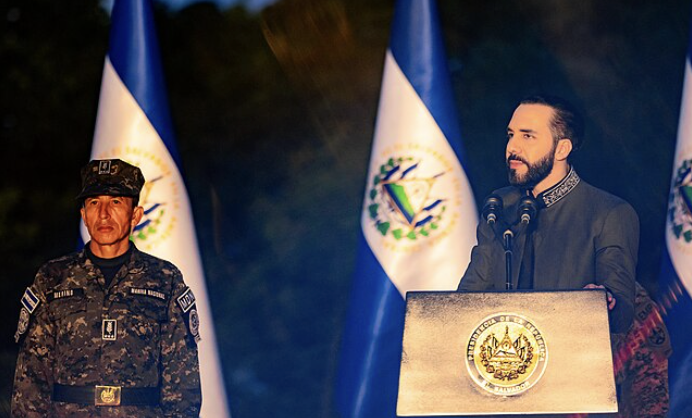
El Salvador’s President Nayib Bukele speaks during a press conference before casting his vote in a parliamentary election in San Salvador, on February 28, 2021 (REUTERS / Jose Cabezas)

El Salvador’s President Nayib Bukele speaks during a press conference before casting his vote in a parliamentary election in San Salvador, on February 28, 2021 (REUTERS / Jose Cabezas)

When President Ronald Regan distributed billions of dollars in economic and military aid to El Salvador during its civil war in the 1980s, it fueled the displacement of roughly one million Salvadorans and the slaughter of thousands. Years later, many Americans forgot this chapter in U.S. history, as American politicians smeared the image of this small Central American country.  Senator Marco Rubio once described El Salvador’s suffering as “the result of bad leaders, rampant crime and natural disasters.” However, many Salvadorans—myself included—have not forgotten.

President Nayib Bukele was reelected in February of last year and has been credited with transforming El Salvador from one of the most dangerous countries in the world into the safest—despite growing concerns regarding human rights violations. Now, the U.S. government and President Trump bear responsibility for the current crisis of criminalized migration, as evidenced by the agreement between the U.S. and El Salvador to imprison migrants from multiple countries in the mega-prison CECOT. This development echoes the violence the U.S. once supported during El Salvador’s civil war, as the country now becomes the face of U.S. immigration hell.

U.S. Involvement in the Civil War

Between 1980 and 1990, during the brutal 12-year Salvadoran civil war, the United States provided over $1 billion in military assistance to El Salvador—including approximately $996 million for military education and training. That training was later used to terrorize and kill Salvadoran civilians.

One female participant interviewed by The Immigration Lab, from El Gavilàn, El Salvador, describes the horrors she witnessed during the war:

“Sometimes the guerrilla would pass by and force us to give them food, and the armed forces would realize what had happened. The problem was that if they [the guerrillas] passed by and forced us to give them food, we had to. My two uncles were killed that way—because they came to us asking to give them food, and when the armed forces realized that, they kidnapped and murdered them.”

It was U.S.-trained Salvadoran military, such as the Atlacatl Battalion, that were responsible for the El Mozote Massacre—one of the worst massacres in Latin American history. On December 11, 1981, residents of El Mozote were rounded up to be killed, dismembered, and raped. Nearly half of the victims were under 10 years old.

But why would the US government support such horrific acts of mass murder? During the Cold War, the left-wing militia Farabundo Martí National Liberation Front (FMLN), was at war with the Atlacatl Battalion. The guerrillas, influenced by left-wing politics and Catholicism, were one of the country’s most prominent political forces. President Ronald Reagan’s fear that El Salvador’s authoritarian government might fall to communism led the U.S. to excuse and cover up atrocities in the service of anticommunism and defeating the guerrillas.

A mother from Ayutuxepeque told us her reason for migrating to the U.S. was her fear that the Salvadoran armed forces would target civilians for their political beliefs.

“The fear was overwhelming, just because you had an affinity towards a certain group. The armed forces would come and murder you. That’s why people mainly fled.”

Misinformation about the massacre and its aftermath spread, as the U.S.-trained Salvadoran military denied responsibility for the deaths of hundreds of civilians, claiming that the massacre was “totally false.” However, the Truth Commission for El Salvador issued a report documenting human rights violations from 1980 to 1991. It found that 85% of the cases reported to the Truth Commission involved state agents or death squads allied with Salvadoran armed forces.

Another female participant from La Union, El Salvador, described her immense fear of the Salvadoran armed forces:

“One had so much fear. There was no sense of security at all. Dead people would appear in alleyways. I couldn’t even sleep because I was scared they [armed forces] would knock on my door. I suffered a lot.”


Aftermath

Due to the civil war, more than a million Salvadorans were displaced, and half a million fled to the United States during the 1980s. However, just 2% of asylum applications filed by Salvadorans were approved, making it incredibly hard to legally stay and work in the U.S. This stemmed from U.S. aid to the Salvadoran government—extending protection would have contradicted its own foreign policy. However, in 1990, Congress created a program and legal immigration status called Temporary Protected Status (TPS), providing temporary permission to reside in the U.S., a work permit, and protection from deportation for foreign nationals of designated countries that are facing an ongoing armed conflict, environmental disaster, or extraordinary and temporary conditions.

The growing Salvadoran Population in Los Angeles during the early 1980s led to the formation of Mara Salvatrucha (MS-13), a Salvadoran street gang formed to navigate life in impoverished neighborhoods and defend its community members from other gangs. However, mass deportations of young Salvadorans involved with MS-13 led to the further destabilization of El Salvador, contributing to the gang’s expansion.

By 2005, Salvadoran authorities estimated the gang population at 40,000, with MS-13 having significant control of the country, and Salvadorans were living in fear, once again. The gang recruited older children and teenagers, many of whom were vulnerable targets as they lacked the means to survive in a country suffering from economic turmoil and educational limitations.

By 2015, El Salvador had become the most dangerous country in the world, with 103 murders per 100,000 residents—many linked to MS-13 or its rival, the 18th Street gang. The brutality of MS-13 is often characterized by not just killing but also by torturing, maiming, and dismembering victims. This gang funded itself through extortion, and in 2019, MS-13’s estimated revenue was $31.2 million.

Salvadorans saw a glimmer of hope in February 2019 when Nayib Bukele won the presidency, as he pledged to combat the gangs in El Salvador. He began addressing the country’s high crime rate by increasing police and military presence in gang-dominated areas to diminish their control, declared a state of emergency in prisons, and placed them on lockdown to prohibit visitors in order to block out communication with the outside world. By 2022, El Salvador’s homicide rate dropped to 7.8 per 100,000 residents—due in part to the imprisonment of more than 50,000 gang members.

It’s no surprise that President Nayib Bukele’s actions have caused him to be highly popular. You can even walk through parts of the Washington metropolitan area with Salvadoran populations, such as Columbia Heights or Hyattsville, and see merchandise with Bukele’s face. But with many discrepancies in detainees dying and rampant due process violations, it is clear that the improvement on El Salvador’s gang problem came at the expense of massive human rights violations.

El Salvador now surpasses the U.S. as having the world’s highest incarceration rate. In 2022, as many as 3,000 children have been arrested without any connection to criminal activity—many imprisoned solely based on their appearance or anonymous tips. These detainees are being sent to CECOT, which held Kilmar Armando Abrego Garcia, and holds many Venezuelan and Salvadorian immigrants sent by the United States government. But beyond its most notorious facility, El Salvador has 25 prisons across the country, where people have been vanished to and have not been heard of again.

Inmates dying under suspicious and unexplained circumstances being buried in mass graves, mirrors the events from the Civil War. Ramón Abraham Vargas Ávila died in Santa Ana on April 14 and Lorena Abigail Escobar Mejía died in Apanteos prison on April 18. The lack of coverage surrounding their deaths speaks volumes about the unimaginable things occurring inside Salvadoran prisons. Many of the detainees come from impoverished communities, highlighting policies rooted in eugenic ideologies aimed at eliminating the country’s poor through mass incarceration, gentrification, and the expedited naturalization of white tourists. President Bukele offers free visas under the guise of boosting the country’s economy, yet fails to address the needs of Salvadorans living in impoverished neighborhoods with limited access to employment or educational opportunities.

It is nauseating to see other Americans visit and revel in the beauty of the land I’ll never fully know because of the atrocities of the 1980s and the need for my family to flee. It pains me to hear elder Salvadorans fall victim to the propaganda and misinformation about what El Salvador has become. History has conditioned Salvadorans to favor strong, authoritarian leaders, and the country has never truly been given a chance to heal from the Civil war.

The U.S. has made a $15 million deal with El Salvador to imprison deportees. Some 278 men deported by the Trump administration to El Salvador have been accused of being members of the Venezuelan gang Tren de Agua or Salvadorans allegedly affiliated with MS-13—often on baseless connections such as simply having tattoos. The current U.S. administration sees El Salvador as nothing more than a remote place to detain people in what is essentially a concentration camp, where people sit without being found guilty or provided due process. What Bukele is doing to these kidnapped men is what he has been doing to Salvadorans for years—and only now is the Salvadoran diaspora beginning to wake up.

Valeria Chacon is a former research assistant and recent graduate of American University.

Migration policies of the current US administration

By Ernesto Castañeda

Although the xenophobic discourse has not changed much, Trump’s second administration has been much more aggressive in its goal of reducing the number of immigrants arriving at the U.S./Mexico border and within the United States. New executive orders eliminate some of the modest practical achievements of the Biden administration, put in place to handle the search for asylum, safety, and stability in a more orderly and humane way. The new administration is planning to end many of the humanitarian “paroles” and temporary protected status (TPS) for people from many countries, including Venezuela, Haiti, Cuba, Nicaragua, and other places in Latin America and the Caribbean, as well as Afghanistan and Ukraine. So, more than reducing the number of undocumented immigrants, Trump is creating hundreds of thousands of new undocumented immigrants in the interior of the country with his executive orders. An amnesty would do the reverse. Which reminds us that immigration status is the result of legislative decisions and that with the signing of an official law or document by the legislative and executive powers, this status can be changed for millions of people almost immediately.

Unfortunately, Trump is not interested in negotiating with Democrats for a comprehensive immigration reform that includes regularizations, as well as more border security measures and pathways to immigrate legally in the future. On the contrary, Trump’s second administration is in the process of hindering and making legal migration much harder, and foreigners’ ability to stay, more tenuous.

Trump is obsessed with carrying out mass deportations. So, Trump’s DHS is being much more aggressive not only by deporting newly arrived people at the border, where the numbers are very low due to changes made during the last months of the Biden administration, and because Mexico is preventing more foreigners from reaching the US border through internal enforcement and the US military being deployed at the border — but deporting people from large cities, especially democratic-majority ones. Against precedent, authorities have entered churches and universities a few times looking for people to deport. Faith helps many to lower their anxiety and the fear of being deported, but does not give them a foolproof sanctuary, not even in their churches.

Studying, having a visa, DACA, or even a Green Card, are no longer as much of a protection from deportation as before. It is false that Trump 2.0 focuses on deporting violent criminals; the vast majority of deportees have no criminal record. Many men have been deported, but also women and children. If closed borders and mass deportations continue, the U.S. will surely enter a recession because of a decrease in workers.

Another development is how much Trump is pressing other countries to stop the arrival of migrants and asylum petitioners to the US and to receive national deportees from other countries. Venezuela and Colombia are sending their own airplanes to transport them back. Mexico, El Salvador, Honduras, Costa Rica, Panama, Ecuador, among others, are collaborating with the Trump government to divert migratory flows. This opens opportunities for the cities and countries of the region that actively receive and allow people who have to flee their homes for major reasons to settle down and work legally. Local growth due to an immigration population bonus can easily exceed revenue from remittances in large economies (Mexico, Brazil, Colombia). The smallest countries, where remittances are a significant part of GDP, will have to make more adjustments and sacrifices to look for organic economic growth alternatives. In both cases, the returning human resources could compensate or even exceed the portion of their salaries (less than 20%) of what they earned and spent abroad. Comprehensive research and public education are required to dispel anecdotes that portray immigrants as a threat. Legislation like that in France or Germany could be passed to disincentivize opportunistic politicians from weaponizing immigration, increasing xenophobia, and anti-immigrant animus for short-term political gain. The richest countries in the world have over ten percent of their population born abroad. This is an opportunity for Latin America to do so in a way that increases opportunities for everyone.

Poverty, violence, and organized crime will continue to force some people to move internally and across borders, but migration will be increasingly within the same country or region and not so much to the United States or Europe. In the medium term, this exogenous shock can produce a more local, sustainable economic growth with less family separation across borders.

Ernesto Castañeda, Director, Center for Latin American and Latin Studies, and The Immigration Lab, American University, Washington, D.C.

HANDS OFF SANCTUARY CITIES

By Anthony Sandoval

April 25, 2025

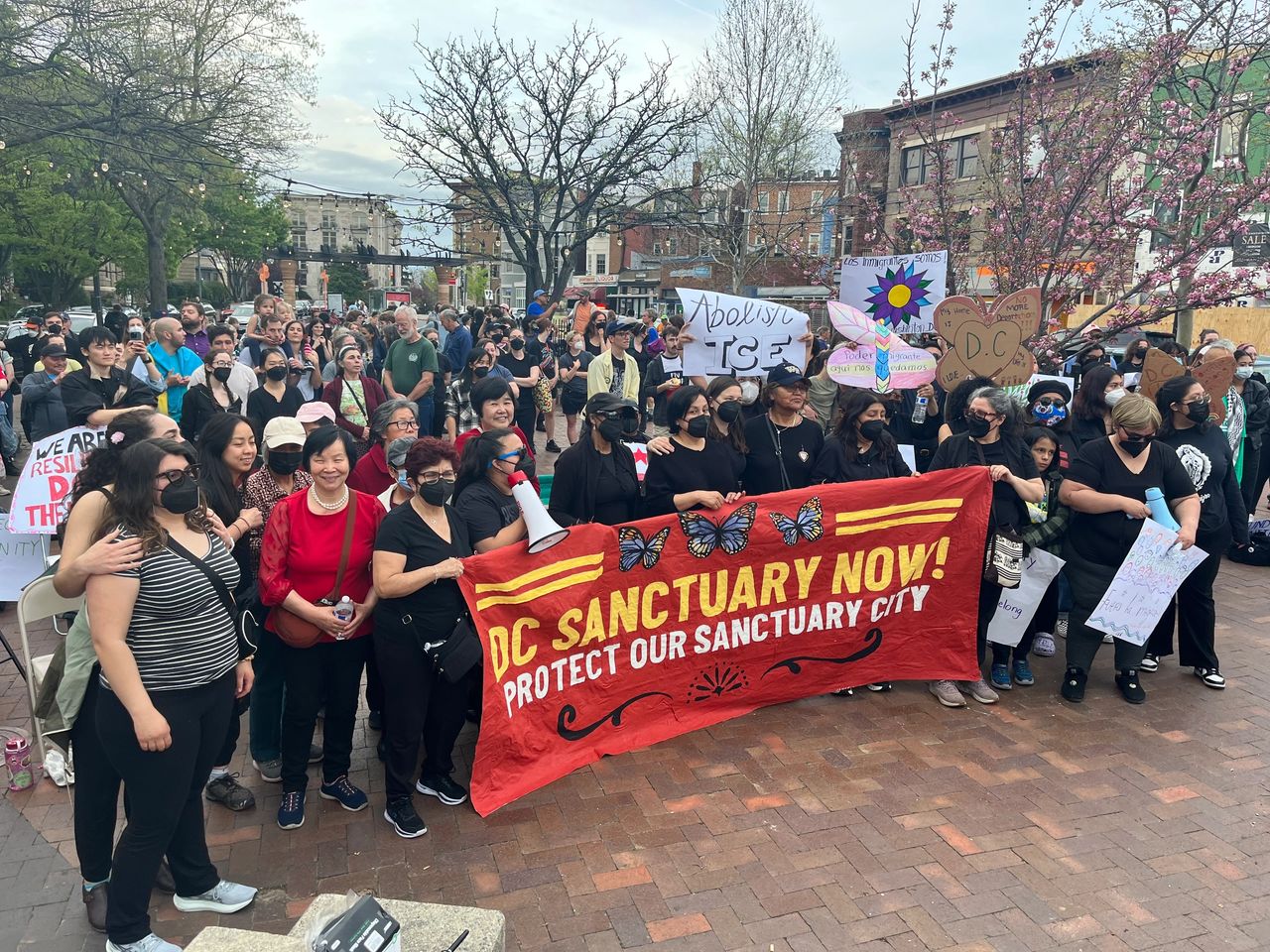
Image from Save Chinatown Solidarity Network DC

On January 25th, 2017, President Trump signed an Executive Order, called Enhancing Public Safety in the Interior of the United States, to attack sanctuary jurisdictions all over the U.S. Although this Executive Order was blocked by a judge, the side effects were seen. More cities became sanctuary jurisdictions, even colleges.

But what is a “Sanctuary Jurisdiction”? First, we have to understand that there isn’t one full definition of a “Sanctuary Jurisdiction,” nor does each one have the same laws. Generally, being a ‘Sanctuary Jurisdiction’ means to “have policies in place designed to limit cooperation with or involvement in federal immigration enforcement actions.” There is a range of how each policy works, but it keeps the immigrant communities safe. 

In 2017, Illinois became a sanctuary state through the TRUST Act, and on December 15th, 2020, the D.C. District Council voted on the Sanctuary Values Amendment Act of 2020, establishing Washington, D.C. as a Sanctuary jurisdiction. On the opposite end, some states banned Sanctuary Cities straight out during the first Trump administration, including Arkansas, Florida, and Texas

On the 1st day of the Biden-Harris Administration, President Biden signed an Executive Order called, Revision of Civil Immigration Enforcement Policies and Priorities, which undid Trump’s 2017 Executive Order. Since then, the republican party has attacked Sanctuary Jurisdictions again and again. 

At a March 5th, 2025, hearing with the mayors of Boston, Chicago, Denver, and New York City, the Chair of the House Oversight Committee Rep. James Comer (R-KY-1) stated, “These reckless sanctuary policies also force federal immigration officers to go into local communities to apprehend criminal illegal aliens.” We keep hearing that sanctuary policies are bad for the United States, but that is not true.

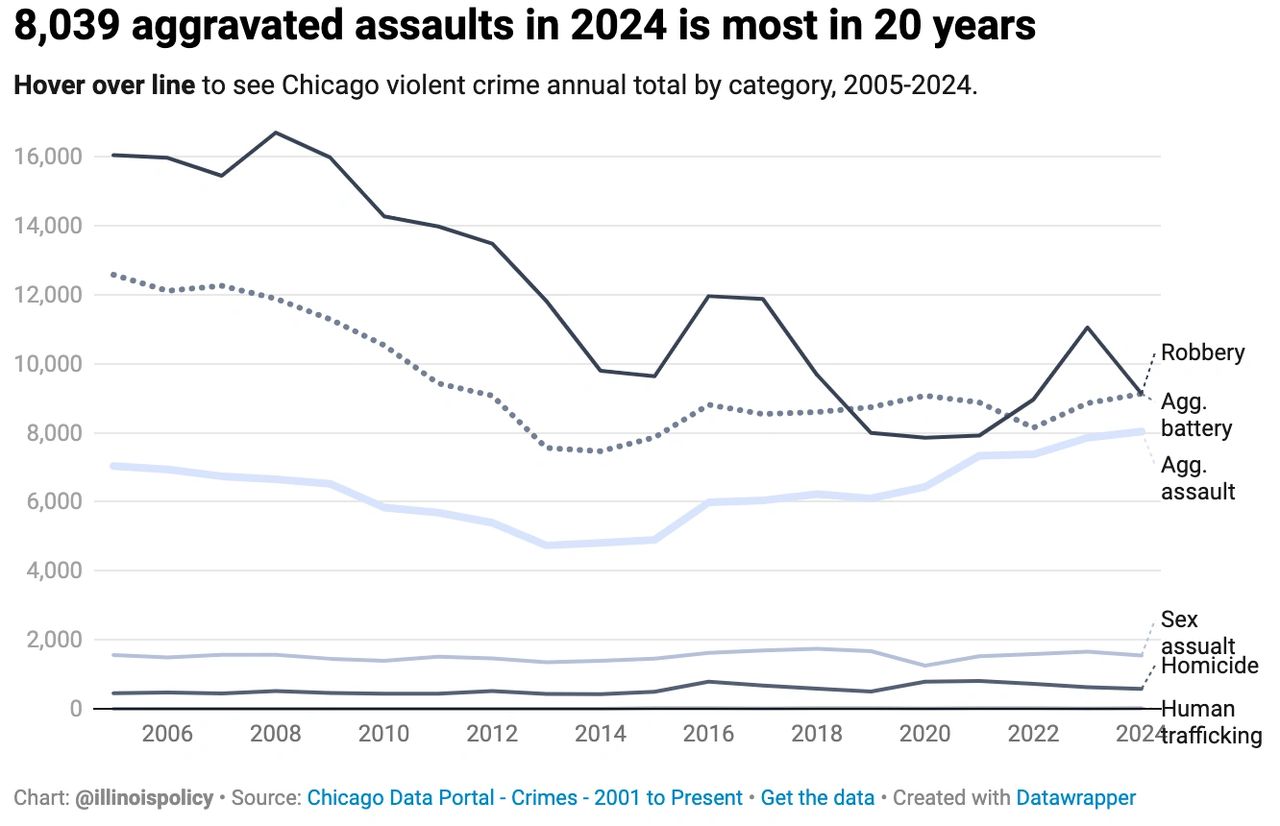
The National Immigration Law Center (NILC) posted on the same day of the hearing that a study found a “decrease in crime in cities and states that prioritize welcoming instead of targeting immigrants.” Looking at my home city of Chicago, crime keeps going down, even at a time when immigration has increased.

Graph from Illinois Policy

In 2025, Trump’s first day in office signed an Executive Order, called “PROTECTING THE AMERICAN PEOPLE AGAINST INVASION,” which, on its 17th section, calls for Sanctuary Jurisdictions to be punished until they get rid of the laws that make them sanctuary, or else they will not receive any federal funding. On April 24th, a judge ruled that it was unconstitutional

Other related bills to look out for include 1) HR. 32 No Bailout for Sanctuary Cities Act; 2) HR. 205 No Congressional Funds for Sanctuary Cities Act; 3) HR. 1879 No Tax Breaks for Sanctuary Cities Act; 4) HR. 2056 District of Columbia Federal Immigration Compliance Act.

UPDATE APRIL 29TH  

On April 28th, Trump signed a new Executive Order, called “Protecting American Communities from Criminal Aliens.” Under this order, any Sanctuary Jurisdictions will be stripped of any federal funding in 30 days. Additionally, this order will eliminate in-state tuition for undocumented and DACA students across the United States. Laws that help undocumented college students pay for college, for example, in Illinois, the Retention of Illinois Students & Equity (RISE) Act will be eliminated.

Anthony Sandoval is a research assistant with The Immigration Lab

Edited by Enresto Castañeda, Director of The Immigration Lab and Katheryn Olmos, Research Assistant

Anti-Immigrant Rhetoric Doesn’t Win Elections

 By Joseph Fournier, Bennett Donnelly, and Ernesto Castañeda

April 22, 2025

Image from Flicker
Image from Flicker

Anti-immigrant sentiment has been a salient theme in both American political and social discourse. Nativism enjoys periodic spikes in popularity. Legislation such as the draconian Immigration Act of 1924 dot the immigration policy landscape. One hundred years later, we find ourselves in an eerily similar position.

A successful political party, movement, or organization must have clear messaging in order to garner public support. Republicans have incarnated themselves as the party of contemporary nativism. This has resulted in a shift rightward regarding public discourse on immigration. Some Democrats have followed suit, with for example, some candidates supporting border wall construction as elections drew nearer.

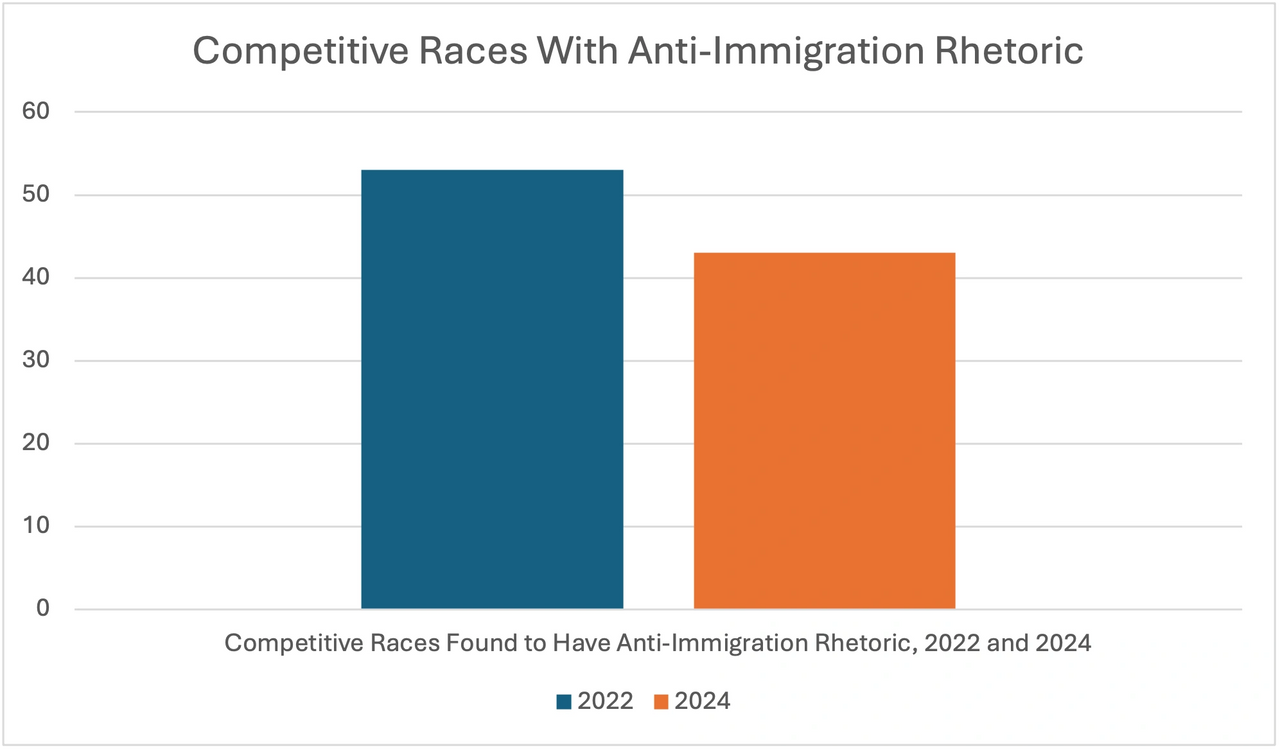
In 2022, there were 77 competitive races (where either party won by less than 10%). In 2022, there were 53 campaigns with anti-immigrant rhetoric in their official materials (campaign websites, social media posts, and TV and YouTube ads). In 2024, there were also 77 competitive elections, with 43 having anti-immigrant rhetoric in their campaign materials. So, anti-immigrant discourse as a main campaign issue dropped from 69% to 56% among Republican candidates in competitive races (see Figure 1).

Figure 1. “Anti-Immigration Rhetoric in Republican Campaigns in Competitive Races”

In 2024, campaigns that employed anti-immigrant rhetoric had a win-loss ratio similar to 2022.

The presence of anti-immigrant sentiment among Republican campaigns fell from 2022 to 2024. While such rhetoric flourished in Trump’s presidential campaign, it was less present in House, Senate, and gubernatorial races. When anti-immigrant rhetoric was present, it ended in failure more often than victory. From this, we could deduce that people are less concerned about immigrants in their communities. Instead, they seem to be more concerned about border security and immigration on the national scale.

Figure 2, “Republicans Who Used Anti-Immigration Rhetoric with Election Results, 2022 and 2024”

In 2024, the Republican message emphasized migration as a security issue, rather than an economic or humanitarian one, arguing that immigration should be treated with the same urgency as any other potential foreign enemy. Migration is framed as a security issue through negative rhetoric surrounding the supposed criminality of migrants, such as the newly coined term “migrant crime,” used extensively by Republicans on the campaign trail. This term is a clear attempt to predetermine the culpability of migrants coming into the US and frame them as criminals, or even as invaders and terrorists, though not so much in competitive races. 

Many Republican campaigns may disguise nativist sentiments under the guise of national security concerns. Border security narratives help reinforce anti-immigrant ideas that historically portray migrants, especially Latinos, as criminals or invaders. This ambiguous messaging may explain why many Trump voters did not believe he would legitimately carry out many of his campaign promises regarding mass deportations. 

Republican parties promote border security and anti-immigrant discourse from the top down, reducing the need for individual House candidates to explicitly state their views towards immigration.  With border securitization becoming a mainstream policy promoted by figureheads on both sides, down-ballot candidates can avoid directly addressing issues like immigration and border walls in their campaigns. By aiming to associate immigration with national defense, the “border crisis” is fabricated to be an existential threat. Oftentimes incendiary rhetoric is used to obfuscate what is real from unreal. 

We identify a pattern across the Republican tickets, where candidates with military backgrounds tend to use anti-immigrant rhetoric justified by their experience in the military as evidence for their security concerns (Jay Furman TX–28, Laurie Buckhout NC–1, Mike Garcia CA-27). Evidently, using the facilities at Guantanamo Bay to house migrants reinforces the misconception many Republican candidates echo in their campaigns that migrants are security threats. This also contributes to why top party members, such as Ted Cruz and Donald Trump, used exceptionally strong anti-immigrant rhetoric to make down-ballot candidates more acceptable and mainstream where necessary, while maintaining the same broader party message. 

For moral, ethical, and strategic reasons, Democrats should speak openly against anti-immigrant rhetoric. The threat of anti-immigrant rhetoric itself is a real threat, but data shows that the average American voter tends to be indifferent or in favor of immigration, especially at the local and state levels. The political mechanisms that produce this rhetoric have a firm grip on the mediascape that influences national elections, but when it comes to their own communities, voters trust their own eyes and lived experiences about how the immigrants they know are not that much different from themselves.

Joseph Fournier and Bennett Donnelly are Research Assistants at the Immigration Lab. Ernesto Castañeda, PhD is the Director of the Immigration Lab at American University.

Where Does Refugee Resettlement Stand?

By Reilly Phelan

April 22, 2025

Image from Unsplash
Image from Unsplash

In a world where less than 1% of refugees are ever permanently resettled, the United States has chosen to suspend all refugee admissions indefinitely. The Trump Administration has ordered significant changes to the U.S. refugee resettlement apparatus. The fallout from these executive actions has caused significant turmoil for resettlement agencies and the populations they serve.

The United States Refugee Admissions Program (USRAP) was established in 1980. Since then, including through wartime and the COVID-19 pandemic, the United States has accepted refugees in the wake of international crises and suffering, without fail. That is, until President Trump’s Executive Order “Realigning the United States Refugee Admissions Program.” Asserting that the United States has been “inundated” by immigrants and refugees, the Executive Order issued a 90-day pause on all refugee arrivals. This pause has now been extended to an indefinite suspension of arrivals. 

In the wake of this Executive Order, flights with vetted refugees chosen to be resettled in the United States were canceled, lifelines were abruptly severed, and families were left separated. 

The suspension of USRAP marks a stark juxtaposition not only to the approval designation of 125,000 refugee admissions in 2024 under the Biden Administration but also to the 15,000 approved refugee admissions under Trump’s final year in his first term. The USRAP is a pathway towards safety and stability for families facing persecution and a sometimes decades-long backlog to receive permanent resettlement. 

Ahead of the suspension, 22,000 refugees were “approved for departure” and awaiting their flight to the United States. Refugees with this designation only have a certain amount of time to travel to the United States before they must restart the screening process, which often takes years to complete. These thousands of individuals fleeing violence and turmoil are watching their opportunity for resettlement slip away.

Another sweeping action affecting refugee resettlement in the United States is the January 24th Stop Work Order to programs funded through foreign assistance. While refugee resettlement operates in the United States, much of its international apparatus and funding are tied to foreign aid— namely, the funding that supports refugees in their first 90 days post-arrival. This period in refugee resettlement is called Reception & Placement (R&P). 

R&P funding supports early-resettlement needs, including rental assistance, cultural orientation, and case management. It also subsidizes the salary of refugee staff. Since the Stop Work Order was issued, resettlement agencies could not incur new costs for services under the R&P period. Mass layoffs have become commonplace across U.S. resettlement agencies.

With the indefinite pause of USRAP, the R&P program in the U.S. became obsolete on April 20, as all admitted refugees hit the 90-day mark. However, the consequences of this funding loss will continue far beyond. There is legitimate concern across U.S. resettlement agencies because many refugee clients face housing insecurity and uncertainty surrounding the continuation of benefits like SNAP (food stamps) and Medicaid. 

Image from Unsplash
Image from Unsplash

The actions of the Trump Administration have devastated refugee resettlement. The program’s international infrastructure is currently being dismantled, which, in turn, curtails the possibility of the program’s revival under current or future administrations. On February 26th, President Trump terminated contracts with major U.S. resettlement agencies, marking an attempt to end federal support of refugee resettlement definitively.

The future of refugee resettlement in the United States hangs in the balance of court cases like Pacito v. Trump, which are fighting for the return of both refugee resettlement funding and infrastructure. Through two separate rulings from a Washington District Court, U.S. District Judge Jamal Whitehead enjoined the Trump administration’s suspension of refugee admissions and termination of resettlement agency contracts. No tangible change has resulted from these rulings as the appeals process continues. Judge Whitehead’s Order has been appealed to the Ninth Circuit Court of Appeals.

The future of the program is uncertain, but the pain caused to specific refugees and the weakening of refugee resettlement worldwide are clear. 

Reilly Phelan is a Research Assistant for the Immigration Lab. A 2024 American University’s School of International Service graduate, she now works in refugee resettlement.

Edited by Enresto Castañeda, Director of The Immigration Lab

Constitutional Crisis: Donald Trump’s Immigration Policies Put Us All in Danger

By Caryalyn Jean

Photo by Anthony Sandoval

President Donald Trump’s executive orders surrounding immigration have sparked fear amongst marginalized groups and controversy amid those who hold America’s policy process dear. On January 20, 2025, Trump signed the Protecting the Meaning and Value of American Citizenship order which proposes the end to birthright citizenship. Although several judges have blocked the order and several other lawsuits have been filed, this specific executive order has caused concerns surrounding the integrity of the Constitution.

One major issue with Trump’s birthright citizenship order is his interpretation of the 14th Amendment. While he recognizes that the 14th amendment was originally intended to extend citizenship to formally enslaved African Americans during Reconstruction, his argument misinterprets the phrase “subject to the jurisdiction of the United States.” In this order, a mother’s and father’s immigration status at the time of birth determines if a federal department or agency can grant or recognized documents recognizing the United States citizenship of their child. However, there is no recent legal precedent supporting the use of a parent’s citizenship status to determine if a person born within the United States is a proper interpretation of the Amendment or any immigration law. Although Trump acknowledges the historical context in which the 14th Amendment was written, his interpretation would not be applicable to historical context Trump is supposedly intending to preserve. Ironically, Trump’s call for a stricter interpretation of the 14th Amendment calls into question how case law has broadened our understanding of how we view citizenship, even for corporations, which the law considers “artificial people” [see Santa Clara Co. v. Southern Pac. Railroad, 188 U.S. 394 (1886); Citizens United v. Federal Election Com’n, 588 U.S. 310 (2010)].

As a result of this Executive Order and many other policies which have led to the recent increase in ICE activity around the nation. President Nayib Bukele of El Salvador proposed a deal with the Trump Administration to allow for the United States to transport both deportees and imprisoned U.S. citizens to El Salvador for a fee. Despite some praise of El Salvador’s President Nayib Bukele’s “tough on crime” approach, this deal raises concerns about the conditions of these prisons. Since 2020, organizations such as Human Rights Watch and Amnesty International have reported on the lack of due process, deaths under custody, and living conditions that are below international standards. Although American immigration law would allow El Salvador to accept deportees in an instance in which a deportee returning to their country of origin is “impracticable, inadvisable, or impossible,” those factors are not the basis of President’s Bukele’s offer. Likewise, the deportation of American citizens in unconstitutional and violates the rights of incarcerated people. Nonetheless, on April 8, 2025, Press Secretary Karoline Leavitt affirmed that President Trump discussed the possibility and legality of deporting American citizens deemed “violent repeat offenders.”

The offer to accept American prisoners further cements the controversial slave status placed upon incarcerated people in the United States and El Salvador. The 13th Amendment abolishes slavery except for punishment for a crime within the United States and territories within its control. This manifests as the use of prison labor in both the public and private sector in exchange for pennies an hour. Similarly, Salvadoran prisoners make use of prison labor through their Cero Ocio program where prisoners were used to renovate schools, hospitals, and police headquarters under the guise of rehabilitation of prisons. Through this deal, El Salvador is on pace to economically benefit from accepting deportees and American prisoners in exchange for a fee as well as potentially increasing their prison labor force in a system reminiscent of slavery.

The relationship between the Trump Administration and El Salvador has already manifested into negative consequences for deportees and documented immigrants. Despite a U.S. District Judge ordering a temporary halt of the deportation of alleged Venezuelan gang members under the Alien Enemies Act, the flight continued anyway. This decision to disregard the order was a move cosigned by President Bukele on his official X account. Furthermore, Kilmar Abrego Garcia, a permanent resident living in Maryland was deported to El Salvador due to an “administrative error” and his return is being delayed due to pending litigation.

Trump’s birthright Executive Order and El Salvador’s proposal should be cause for concern for everyone regardless of immigration or citizenship status. These actions serve as a reminder of the Trump administration’s total disregard for the law and that solidarity is necessary for preserving human rights. Marking undocumented people and incarcerated citizens as undesirable leads us to overlook the harm being done and what is to come if we do not speak out against it.

Caryalyn Jean is a Research Assistant at The Immigration Lab at American University

Disappearances Amid Immigration Stops and Profiling

By Ernesto Castañeda

March 21, 2025

After speaking on TV about the flights arriving from the U.S. to El Salvador on March 15, 2025, I was contacted by family members of Julio Zambrano, asking if I had any idea where he could be. He has a wife and two young daughters. His sister also lives in the United States. They report the facts to be that Julio Enrique Zambrano Pérez, born in June 2000, was detained on January 29, 2025, during his check-in appointment at the ICE office in North Carolina. His family was let go, but he was not.

Julio Zambrano working in a kitchen in North Carolina

They separated him from his pregnant wife and young daughter and held him in detention because of a tattoo on his hand with his name and a generic crown —He got the tattoo when he was only 15. Hours later, the ICE agent told his wife that they suspected he was a member of the Tren de Aragua gang. He was born in Maracay, State of Aragua, Venezuela. Clearly, not all people born in the state of Aragua are members of this gang. His wife, sister, mom, and people from Davidson, North Carolina, affirm that he is not a member of the Tren de Aragua, nor has he committed any crimes. He is in the United States with authorization and has a work permit.

ICE transported him from the ICE office in North Carolina to the Stewart Detention Center in Georgia. He had his first court appearance on February 26 when he was denied being released on bail. His second daughter was born while he was under ICE detention. His next immigration court appointment was set for March 26, 2025. Friends, neighbors, and people from the daughter’s school wrote letters about him being a good, upstanding person working in the U.S. with a work permit so he could present them at the hearing. But now, it will be unlikely to take place  — and not because Julio would skip or refuse to attend the hearing.

He called his family on Saturday, March 15, 2025, at 8 am, letting them know that he had heard they would remove him from the country by plane that day. For six days, we could not find him in the detention databases anymore. Agents at the place where he was last detained in Texas said he was no longer in the United States but would not give more details. There are no records of him being in Venezuela, so his family suspected he was one of those sent to the CECOT high-security prison in El Salvador, or if not to Honduras, in a similar though less covered arrangement. But the family did not know for sure. That is why it is appropriate to talk about state-led disappearance, the violation of due process inside the United States, and the offshoring of people previously living in the U.S. with a weak claim of gang-belonging —turned into potential terrorists— not proven in court.

Even if people are not in U.S. territory anymore, the government that expelled them has to be held responsible for their well-being abroad and for being deprived of their freedom extra-legally and even being subject to forced labor and other vexations. 

On late Thursday, March 20, Julio Zambrano Perez appeared on the list of people deported to El Salvador, including non-Salvadorians, shared then for the first time with the public and family members.

Julio Enrique Zambrano Pérez and his wife Luz left Venezuela in 2018 because of the tough social, political, and economic conditions. They moved to Piura, Peru, where the community gave them some land, but they were targeted as Venezuelans and then extorted for monthly payments, which they could barely pay. Julio worked in construction full-time and as a barber on the side for extra income. Their first daughter was born in Peru, but they were targeted by organized crime, and because of security reasons, they moved to Chile in 2023. Julio would drive and make deliveries, but he would be assaulted often, so after 8 months, they decided to head north. Julio Enrique Zambrano Pérez entered the United States with permission from Matamoros on November 30, 2023, along with his wife and daughter. They applied for asylum and were given alien numbers and work permits. He worked in a hotel and then in a restaurant, preparing food and as a dishwasher in Cornelius, North Carolina. The boss attests to this and shows no disciplinary or conduct issues or hints of gang belonging. Julio has no criminal record in Venezuela, Peru, Chile, or the United States. ICE or DHS never told him otherwise. Nonetheless, he is being treated and punished as if he were a dangerous criminal in the CECOT in El Salvador. 

Trump Halts Immigration Application for Migrants Welcomed under Biden Administration

By Valeria Chacon

March 4th 2025

USCIS Application Support Center, retrieved from wikimedia

A memorandum was issued on February 14 by  U.S. Citizen and Immigration Services (USCIS) acting Director Andrew Davidson that has effectively paused all pending immigration applications filed by migrants already living in the United States. The USCIS cited fraud and security concerns as the reasons for the halt, and the application freeze will remain in place indefinitely as government officials investigate and identify potential fraud cases

Thousands of Migrants Left in Limbo

Changes announced by the Trump administration directly impact a number of migrants, including from Latin America and the Caribbean as well as Ukraine, who have received legal entry and stay in the United States from categorical parole programs established under the Biden administration. Among them includes beneficiaries under Uniting for Ukraine, created in 2022 to provide Ukrainian citizens fleeing from Russia’s invasion legal entry to the United States. Applicants under the Cuba, Haiti, Nicaragua, Venezuela (CHNV) Parole Program are also affected. Initiated in 2023, this humanitarian parole program allowed nationals from these countries to seek stability and refuge in the U.S. In the first six months of the program, nearly 160,000 Cubans, Haitians, Nicaraguans, and Venezuelans arrived lawfully under this legal process. The latest data from USCIS shows that in December 2024, right before Trump’s inauguration, 27,340 migrants arrived in the United States with parole grants.

Applicants under the Family Reunification Parole (FRP) Program will also be affected. This program was made to reunite eligible individuals from El Salvador, Guatemala, Honduras, Colombia, and Haiti with family in the United as they wait for a family-based green card. It was created, in part, to discourage migrants from making dangerous crossings at the southern border by instead offering a legal migration pathway.

Lastly, those who have pending applications for Temporary Protective Status (TPS) from certain countries, including Haiti, Ukraine, and Venezuela, will also be impacted. The TPS program allows individuals to seek protection in the United States from ongoing armed conflict, environmental disasters, or extraordinary conditions. A TPS designation can be granted in 6, 12, or 18 months increments and recipients will need to re-register to keep their protection. However, Venezuelan and Ukrainian beneficiaries have had their protections extended until October 2025, while Haitian beneficiaries are covered through February 2026. As of March of 2024, there were 863,800 people living in the U.S. with TPS.

Legal Pathways Shut Down, Deportation Risks Rise

The programs previously mentioned provide work permits, travel authorization, protection from deportation, and legal migration channels to individuals from designated countries seeking a better life away from persecution and poverty or to reunite with family members in the U.S. However, under this policy shift, officials will no longer process any pending applications for these programs. Effectively, impeding applicants’ ability to transition to another legal status and making them vulnerable to deportation from the country.

In just his first month in office, President Trump has deported 37,660 people, and this number is expected to rise in the coming months due to the halts on the programs above that leave those already in the U.S. without legal status. It is evident that while Trump aggressively targets undocumented immigrants, he also has little regard for those who arrive under excruciating circumstances through legal migration processes.

Valeria Chacon is a research assistant with the Center for Latin American and Latino Studies at American University in Washington, DC

Edited by Katheryn Olmos, and Ernesto Castañeda

Green, Red, and Gold. I Need Only Blue to Play Uno

By Anthony Sandoval

March 3rd, 2025

The United States is where migrants come for that golden opportunity. To live a better life. To work, to be safe, to get an education. But once one leaves “La Jaula de Oro,” (“The Golden Cage”) they can’t return. All they have might be a green or red card, or maybe no card at all.

The U.S. has a visa program for temporary workers in “specialty occupations” called the H1-B visas. During Trump’s first term, he claimed the H1-B visa program was “very, very, bad for workers” and Suspended the H1-B visa program in 2020. Trump has switched his stance on H1-B visas, claiming “it’s a great program.” After Elon Musk showed his support for H-1B visas, nothing has happened to support  H-1B Visas meaning we might still see the reform that was outlined in Project 2025 to make the program ‘better.’

Other types of visa programs might be affected within the next couple of months, student visas, and visas for survivors of human trafficking and other crimes. Another program that is getting attacked is Deferred Action for Childhood Arrivals (DACA). All visas get a card and DACA gets a work permit card. Just another card to keep ahold of.

A migrant factory worker from Chicago said, “I have been waiting for my daughter to turn 21 so I can get my green card.” This working migrant applied to the Diversity Immigrant Visa Program (DV) 15 years ago and is still waiting for a Green Card. The DV program is a lottery. In 2023, the DV program had nearly 9.6 million qualified entries and only 50 thousand recipients.

The cost of green cards is already so high, that the filing cost for a family-based green card is approximately 3 thousand dollars for an applicant applying from within the United States. Other categories of green cards may have different costs depending on which one the person is aiming for, not including legal service fees. For DACA it costs $555 to renew online. The most expenses being EB-5 visas, which are for foreign investors that has made investments within the United States around one million dollars and created 10 permanent full-time jobs. For these pathways are not accessible to everyone due to the cost. While some immigrants may not have green cards, visas, or DACA, one thing that they might have are Red Cards ━which can make a difference in whether a person stays in the U.S. or gets deported. Red Cards were made back in 2007 by the Immigrant Legal Resource Center. Red cards are used to protect undocumented immigrants from U.S. Immigration and Customs Enforcement (ICE) or U.S. Customs and Border Protection (CBP). They can come in 19 different languages, including Ukrainian, Spanish, Chinese, Arabic, and Tagalog.

Trump’s “Border Czar,” Tom Homan stated, “For instance, Chicago—very well-educated, they’ve been educated on how to defy ICE, how to hide from ICE.”

On February 25th, President Trump talked about a new type of pathway to citizenship, he calls it a Gold Card. For years, many groups have been asking for an improved way for citizenship or an easier way to come into the United States. The answer was simple: a card that’s worth five million dollars. Ask your friends and family to help cover the cost. It’s that simple… but few people have that type of money. This new card is for investors. The gold card would just replace the EB-5 program.

We don’t need this. Not a 5 million dollar pathway that very few people can pay for. We need another way for citizenship, another way to come into the United States, a faster program that allows people to get green cards and not wait for years. We must remember these people are not “aliens;” they are people. One action that can help is supporting the Dream & Promise Act of 2025 that offers some DACA recipients, immigrant youth, Temporary Protected Status holders, and Deferred Enforced Departure holders a pathway to citizenship.

Anthony Sandoval is a research assistant with the Center for Latin American and Latino Studies and the Immigration Lab at American University in Washington, DC.

Edited by Katheryn Olmos, Ana Gaston, and Ernesto Castañeda,