U.S.-Cuba: You Can’t Get There from Here

By William M. LeoGrande

ventas en cuba

Small Business in Cuba / Alberto Yoan Arego Pulido / https://www.flickr.com/photos/albertoyoan/8775169259

U.S. President Donald Trump’s new economic sanctions against Cuba, imposed earlier this week, include limits on travel and family remittances aimed at crippling the Cuban economy and causing regime collapse, but the biggest losers are the small entrepreneurs, intellectuals, and artists who have been agents of change on the island. Senior administration officials, foremost among them National Security Adviser John Bolton, have been explicit that the goal is to rid the hemisphere of “socialism,” starting with the government of Venezuela and proceeding to Cuba and Nicaragua. Bolton previewed the new sanctions in Miami on April 17  – the anniversary of the failed Bay of Pigs invasion. Now we know the details.

  • Remittances, which were unlimited under President Barack Obama, will be limited to $1,000 per recipient household every quarter – enough to supplement a family’s meager state salary, but not enough to start and sustain a business. The new limits will hit Cuba’s nascent private sector hardest because funds from the United States were the start-up capital for many small businesses, and their supply chains reach back through Miami.
  • Trump has eliminated the people-to-people category of educational travel, which Bolton denounced as “veiled tourism.” This category covered educational tours not involving academic credit – tours run by organizations like National Geographic, the National Trust for Historic Preservation, and the Smithsonian. Authorized originally by President Bill Clinton in the 1990s, people-to-people travel was eliminated by President George W. Bush in 2003, in response to complaints from conservative Cuban-Americans in South Florida. President Obama restored it in 2011. Trump, like Bush, appears to be pandering to the Cuban American Republican base in Miami in the run-up to the next presidential election. Last year, 638,000 U.S. residents who were not Cuban Americans traveled to Cuba – at least two-thirds if not more under a people-to-people license, mostly on cruises, which Trump also banned. These new travel restrictions will cost Cuba upwards of $300 million dollars annually in lost revenue.

Cuba’s private sector will suffer disproportionately from these measures. In addition to losing start-up capital and access to supplies, these businesses will lose their principal client base. U.S. travelers arriving by air are more likely stay in Airbnb rentals and eat at private restaurants than the Canadians and Europeans who come on tourist vacation packages and stay at the big hotels on the beach. Trump’s first restriction on people-to-people travel in 2017, banning individuals from designing their own people-to-people trips, caused a 44 percent slump in private B&B occupancy. The new restrictions will wipe out many of them.

  • U.S. business and people will take a hit too. In 2017, Engage Cuba, a coalition of business groups favoring trade, released an analysis concluding that U.S. visitors to Cuba generated $1.65 billion in revenue annually for U.S. businesses and accounted for more than 12,000 U.S. jobs in the hospitality sector, most of which would be lost if Trump cut off travel. Most importantly, the new restrictions deprive most U.S. citizens of their constitutional right to travel, a right affirmed by the Supreme Court in 1958 in Kent v Dulles. The Court said the right should be limited only in cases of dire threats to national security.

As usual, tougher economic sanctions will make life tougher for ordinary Cubans, but sanctions won’t bring down the Cuban government, which has survived the U.S. embargo for half a century. Economic hardship and U.S. hostility will heighten Cuban leaders’ sense of being besieged, making them less likely to reform the economy or allow any expansion of free expression. Economic, professional, educational, and cultural ties between people in the United States and their counterparts in Cuba will be harder to sustain, impoverishing both. Cuba’s private entrepreneurs, who could be an engine for economic transformation and who Trump claims to support, will suffer from the loss of business from American travelers. U.S. travel companies will lose access to one of the biggest and fastest-growing tourism markets in the Caribbean. But maybe, just maybe, this latest assault on the liberties of Americans by the Trump administration will motivate Congress to finally pass a “Freedom to Travel” bill, assuring that no president can take away the constitutional right to travel just because he thinks it will help him win re-election.  

June 6, 2019

* William M. LeoGrande is Professor of Government at American University.

South America: Can it Navigate the Changes Ahead?

By Leslie Elliott Armijo*

Latin america

Latin America / Google Images / Creative Commons

Venezuela is the latest example of how Latin America, especially South America, has missed an opportunity to demonstrate the sort of hemispheric leadership it has long striven for – and instead has ceded that role to the United States and even Russia and China.  Although the United States, and the rest of the hemisphere more generally, have been slow to realize it, economic drivers are making the world more multipolar.  In a recent article by two colleagues and myself, we analyze international financial statistics covering 180 countries from 1995 to 2013 that reveal the slow relative decline of the United States as the reigning financial hegemon.  U.S. influence, although still formidable by some margin, is eroding.

  • The Trump Administration’s activities in the larger world are also undermining Washington’s influence. Policies in the WTO and other trade actions writ large – such as withdrawing from the Trans-Pacific Partnership (TPP) and threatening and implementing trade sanctions with little apparent logic – have brushed even allies back. Positions on the Paris climate accord, at the United Nations, and in the President’s relations with North Korean leader Kim Jung Un and Russian President Vladimir Putin have left many around the world increasingly reluctant to follow the U.S. lead.

In this increasingly multipolar world, Latin America, especially South America, is going to find itself not so much freed of U.S. influence – as intellectuals in the region have often stated their wishes – as exposed to new pressures.  The change will be manifest mostly in the economic arena.  New research by McKinsey Global Institute suggests that global value chains are ever more concentrated within multinational corporation networks, which tie major markets (essentially the United States, Western Europe, China, and Japan) to geographically contiguous countries.  This is arguably good for closer neighbors, such as Central America and the Caribbean in our hemisphere, but potentially harmful to those left out – including Sub-Saharan Africa, possibly the Mideast, and South America.

South America has diversified its trade – generally a good thing – among the United States, EU, and East Asia, with the latter having become the major trading partner for a number of countries. Chile and others have been pushing hard to build the Pacific Alliance, as well as to institutionalize the alliance’s relationship with Mercosur. This strategy will be put to the test if, as early trends indicate, the world regionalizes and South America comes under great pressure to refocus on its relations with the United States. To protect and advance their interests in the future, South American countries probably will try to find the right balance between embracing and rejecting the declining yet still dominant hegemon to the north and, as in the case of Venezuela, developing their own strategic vision, forging unity among themselves, and putting some muscle behind an agenda that prepares them for the future.

March 18, 2019

* Leslie Elliott Armijo is an associate professor at the School for International Studies, Simon Fraser University, Vancouver. She is the co-author, with Daniel C. Tirone (Louisiana State University) and Hyoung-kyu Chey (National Graduate Institute for Policy Studies, Tokyo), of The Monetary and Financial Powers of States: Theory, Dataset, and Observations on the Trajectory of American Dominance.

Mercosur: Diversifying Partnerships

By Andrés Serbin*

Mercosur Summit

A seminar at the 53rd Mercosur Summit. / Sabrina Pizzinato / UCIM / Creative Commons

Mercosur’s signing of a memorandum to increase economic and commercial cooperation with the Eurasian Economic Commission (EAEU) signals the trading bloc’s interest in diversifying its trade and political relationships beyond the western hemisphere.  The presidents of the Mercosur countries – Brazil, Argentina, Uruguay, and Paraguay –signed the agreement at the 53rd Mercosur Summit, held last month in Montevideo.  At a ceremony at which he accepted the rotating presidency from Uruguay, Argentine President Mauricio Macri emphasized the need for Mercosur to open not just to the Pacific Alliance, but also to Central America, Asia, and Africa.

  • Proposals for closer cooperation with the EAEU have been under study for many years, since Russia first created the Commonwealth of Independent States (CIS) from among the former Soviet republics (except the Baltic countries) after the end of the Soviet Union in 1991. The CIS was intended as a post-Soviet space under Russia’s leadership that would reconnect its members within a “Eurasian” geopolitical region distinct from both Europe and Asia.  The EAEU, formalized in 2015 under the leadership of Russia and Kazakhstan, now also includes Belarus, Kyrgyzstan, and Armenia.  Mercosur ministers agreed to sign the memorandum during meetings immediately before the summit, stating that enhanced cooperation and coordination with the EAEU – with which Mercosur would account for a combined 6.5 percent of world GDP – was consistent with efforts to strike a similar arrangement with the European Union.
  • Mercosur’s decision comes amid international tensions over trade and protectionism, but it cannot be divorced from the ideological, cultural, and geopolitical elements of the vision for “Great Eurasia” of which Russian President Vladimir Putin has spoken (and which Chinese President Xi Jinping has shared). The tensions between Russia and Ukraine, and Western pressures in retaliation, were a key driver of Moscow’s push for formalization of the EAEU as a potential interlocutor with the European Union while at the same time putting a brake on U.S. presence in the region.  Western analysts have debated the power of “neo-Eurasian” identity as a tool of geopolitical projection beyond the creation of a new economic bloc.  China is also a factor in Russia’s calculations.  The “Shanghai Cooperation Organization” (OCS) fostered by both countries and Beijing’s “New Silk Road” project, through Central Asia and to the EU, have also increased the salience of “Great Eurasia.”  Russia and China have increased cooperation in trade, in technology (including military) and against terrorism and extremism.  Through the EAEU and OCS mechanisms, they have extended contacts all the way to India and Pakistan and, potentially in the future, Iran and other countries.

Mercosur’s trade with the EAEU is asymmetrical in favor of the Latin American countries, with the exception of Brazil (with which it is more balanced), according to EAEU officials.  The EAEU has high internal tariffs and limited internal trade – except in bilateral trade between Russia and Belarus – but there are already tariff exemptions for Mercosur members.  Food appears to be the biggest Mercosur export to the region.  Experts believe that trade between the two blocs can be significantly increased, and that a free trade agreement can be signed before the completion of the EU-Mercosur FTA, which has been under negotiation for 20 years.

Although many Western analysts remain doubtful about the success of efforts to form a “Great Eurasia,” Mercosur apparently has determined that engagement with it is low-cost and potentially beneficial.  Beyond the possibility of expanded trade, the memorandum of cooperation signed in Montevideo suggests Mercosur sees a geostrategic interest in signaling openness to such collaboration.  The right-leaning governments of Latin America and the Caribbean are likely to remain generally aligned with the United States, but they have learned the importance of trade diversification over the past two decades.  Setting tradition and ideology aside, most are trying to interact with whomever can bring good deals to their countries in terms of trade, investment, and cooperation.  In the context of Russia and China’s interest in a “Great Eurasia,” Mercosur’s increased outreach to EAEU also reflects an important piece in a strategy to undertake the necessary diversification of its foreign policy in a changing world.

  •  The United States may not appreciate the wisdom of Mercosur’s approach. Eurasia is a blind spot for Washington, which focuses on Russia’s actions in Europe and China’s in Asia – but not in Central Asia itself or as a bridge to India, Pakistan, Iran, Turkey, and the Arab world.

January 7, 2019

* Andrés Serbin is an international analyst and president of the Regional Coordinator of Economic and Social Research (CRIES), a network of more than 70 research centers, think tanks, NGOs, and other organizations focused on Latin America and the Caribbean.  This article is adapted from one published by Perfil.com.

Trump on NAFTA: An Offer Canada Can’t Refuse?

By Malcolm Fairbrother*

Chrystia Freeland meets with Mexican President Enrique Peña Nieto

Canadian Foreign Minister Chrystia Freeland meets with Mexican President Enrique Peña Nieto in July 2018. / Presidencia de la República Mexicana / Flickr / Creative Commons

U.S. President Donald Trump’s threat last week to abrogate free trade with Canada while signing a new bilateral agreement with Mexico alone has led many to think that NAFTA – which will be 25 years old on January 1, 2019 – has no future.  But the likeliest outcome remains just a set of fairly modest changes to the agreement.  Much of Trump’s bluster on NAFTA does not reflect the facts in U.S.-Canada-Mexico trade, though Canadian officials will still have to take his threats seriously.  Canadian Foreign Minister Chrystia Freeland, whose government sat out the United States’ renegotiation of NAFTA with Mexico this summer, rushed to Washington after the bilateral accord was announced, launching new talks with U.S. counterparts.  While Trump has said he will make no concessions, Freeland has continued seeking common ground, and looks ready to compromise on at least some issues.

  • The best econometric studies suggest that North American free trade has had disappointingly modest benefits – nowhere near advocates’ earlier projections. But the transition costs of moving to a world without free trade would still be enormously costly for Canada.  The economic and political risk of the highly unlikely, but not completely inconceivable, scenario of losing NAFTA entirely are just too great for the Canadian government to bear.

Canada, which in past negotiations stood up for Mexico on some key issues, now finds itself in the ironic position of looking to Mexico for support.  The two countries are often in a position to benefit from working together, but Trump’s wrath has tempted each to throw the other under the bus – a classic prisoner’s dilemma.

  • In the last few weeks, Mexico decided to give the U.S. what it wanted: most importantly, protectionist rules of origin for autos and textiles, and some enhanced intellectual property rights. Mexico calculated that, compared to Trump’s threats not long ago to kill NAFTA in its entirety, these concessions were a modest price to pay to keep the agreement alive.  Also importantly, Mexican leaders appear to have avoided a national humiliation of epic proportions – putting an end to Trump’s dream of getting Mexico to pay for the wall he wants to build on the border.
  • Looking for a much-needed “win,” Trump has now made an offer he thinks Canada can’t refuse. His wish list covers things Canada specifically fought hard for in the original free trade talks back in the 1980s and 90s, including protections for Canada’s cultural industries and agricultural supply management programs, and what Canada’s trade minister said in 1992 were “the vitally important dispute settlement provisions” of Chapter 19.  Now, just as Canadian opponents of free trade forewarned in the 1980s, Canada’s economy has become so enmeshed with that of its much larger neighbor that the government cannot say no to the demands of an aggressive administration in Washington.

Yet the situation does not spell disaster for U.S.-Canada trade or for Canada itself.  Trump’s claims notwithstanding, the U.S. Congress has final say over U.S. trade policy, and most of its members (with business lobbyists whispering in their ears) recognize that severing the many economic ties built up between Canada and the United States over the last quarter-century would be unnecessarily disruptive and costly.  Freeland and her negotiators will know that Trump’s threat to kill free trade is not really credible.

  •  Even caving on all of Trump’s demands would not be catastrophic for Canada. Contrary to Trump’s zero-sum perspective on trade (like on everything else) as an international battleground, most of the important conflicts with respect to trade are actually within countries.  Canada’s supply management system favors the country’s producers at the expense of consumers, for example, just as do strict rules of origin for U.S. textiles manufacturers.  So while the transition costs of dismantling free trade in North America would be substantial, the impacts of the changes Trump is proposing would be tolerable to all three countries – even if some make no sense (the sunset clause); are just giveaways to specific industries (stricter patents for pharmaceuticals); or favor some industries at the expense of others (U.S. lumber producers and U.S. home builders, respectively, as regards the possible elimination of Chapter 19).  For Canada’s government, the heaviest costs of compromise will be political: Justin Trudeau’s Liberal government will have to choose which bitter pill to swallow, as any concessions will lead to angry recriminations from one domestic constituency or another.

September 7, 2018

* Malcolm Fairbrother is Professor of Sociology at Umeå University and a researcher at the Institute for Futures Studies, both in Sweden.  He is originally from Vancouver, and has been a visiting researcher at multiple institutions in all three countries of North America. He has also participated in the Center’s North America Research Initiative.

U.S.-Mexico: Trump’s Misguided Approach to NAFTA Renegotiation

By Robert A. Blecker*

Three people stand at podiums with flags behind them

Canadian Foreign Minister Chrystia Freeland, U.S. Trade Representative Robert Lighthizer, and Mexican Minister of Economy Ildefonso Guajardo (L to R) participate in the fourth round of NAFTA negotiations in Washington, DC in October 2017. / State Department / Flickr / Creative Commons

President Trump has characterized NAFTA as a “win” for Mexico and a “loss” for the United States; his administration is currently working on a renegotiated “deal” that would allegedly reduce the U.S. trade deficit and recapture lost manufacturing employment, but his nationalistic approach fails to recognize the fundamental causes of both U.S. and Mexican economic problems.  In fact, NAFTA was a huge success for President George H.W. Bush and his administration, as it achieved their fundamental goal of enabling U.S. corporations to make products in Mexico with low-cost labor – without fear of expropriation, regulation, or other loss of property rights – and export them to the United States duty-free.  The Mexican government went along because it thought NAFTA would bring in desperately needed foreign investment and provide a growth stimulus, while U.S. and Canadian workers rightly feared that they would lose jobs as a result.  While much discussion has focused on which country “won” or “lost” in NAFTA, that is the wrong way to evaluate a trade agreement.  The two key criteria for judging the accord are which sectors, groups, or interests won and lost in each country, and how it, in conjunction with other policies, has affected long-term growth, development, and inequality in each.

  • Under NAFTA, U.S.-Mexican trade in goods and services has grown exponentially, reaching $623 billion (with a U.S. deficit of $69 billion) last year. However, NAFTA (along with other causes and policies) has contributed to worsening inequality in both the United States and Mexico.  Less-skilled U.S. workers definitely lost, with wage losses up to 17 percent in local areas most exposed to NAFTA tariff reductions.  In Mexico, although consumer gains from trade liberalization were widespread, upper-income groups and the northern region benefited the most.  Real wages for Mexican manufacturing workers have stagnated since 1994.  Labor shares of national income have fallen in both countries since the late 1990s.
  • Domestic policies, exchange rates, financial crises, and the impact of China can make the impact of NAFTA difficult to identify, but effects in some sectors are clear. Mexico gained jobs in automobiles and parts, appliances, electrical and electronic equipment, and seasonal produce.  The United States gained in basic grains, soybeans, animal feed, and paper products.  Although about a half million jobs in automobiles and related industries have “moved” to Mexico, total U.S. job losses in manufacturing (5 million since 2000) have been much more affected by China and technology than by Mexico.  What Trump’s nationalistic rhetoric ignores is that U.S. companies capitalized on these dislocations to raise their profit margins and increase their bargaining leverage over workers and governments both within North America and globally.

Trump’s aggressive posture about NAFTA exploits political discontent with these sectoral effects and the overall worsening of inequality, but the U.S. Trade Representative (USTR)’s key demands in the renegotiation appear unlikely to remedy either problem.  USTR Lighthizer is focused on protection for the auto sector, by requiring higher U.S. content (or higher wages for Mexican auto workers), and on changes to dispute resolution procedures that would favor investment in the United States instead of in Mexico.  At best, these measures could bring back a small number of U.S. jobs; at worst, they could make some U.S. industries less competitive (if costs increase).

All of this debate in the United States ignores the fact that NAFTA has been a huge disappointment for Mexico.  Although export industries like automobiles have prospered, the gains to domestic sectors of the Mexican economy have been limited, resulting in sluggish growth (only 2.5 percent per year since 1994, far below the 7.6 percent achieved in East Asia) and leaving millions in poverty while millions more emigrated to the United States.  Of course, other policies and events (including Chinese competition) played into these outcomes, but NAFTA (and related liberalization policies) didn’t turn out to be the panacea for the Mexican economy that then-President Carlos Salinas promised in 1993.  Yet, in the short run the Mexican economy remains highly dependent on foreign investment and exports to the U.S. market, so Trump’s demands for a revised NAFTA and his threats to withdraw are undermining Mexico’s current economic prospects.  Instead of following Trump’s nationalistic approach, the three NAFTA members should focus on making all of North America into a more competitive region with rising living standards for workers in all three countries.  This would start with policies at home, such as public investment in infrastructure, education, and R&D, that could foster industrial growth, along with redistributive measures like higher minimum wages consistent with each country’s economic conditions.

May 11, 2018

* Robert A. Blecker is a Professor of Economics at American University.

U.S.-Latin America: Lack of Vision from Washington Didn’t Start with Trump

By Thomas Andrew O’Keefe*

A group of representatives from Latin America and China stand in a group

The Community of Latin American and Caribbean States (CELAC) hosted representatives from China in late January 2018. / Cancillería del Ecuador / Flickr / Creative Commons

U.S. leadership in the hemisphere has declined significantly over the past two decades – manifested in Washington’s inability to implement a comprehensive environmental and energy strategy for the Americas; conclude a hemispheric trade accord; revitalize the inter-American system; and stem the rising tide of Chinese influence.  In a recently published book, I argue that Washington under Presidents George W. Bush (2001-2009), Barack Obama (2009-2017), and now Donald Trump has lacked vision in Latin America and the Caribbean, and has allowed a narrow security agenda to dominate.  The most noteworthy accomplishment – the assertion of central government control in Colombia – was largely bankrolled by the Colombians themselves who also devised most of the strategy to achieve that goal.

  • President Obama’s rhetoric was the loftiest, and his opening to Cuba in 2014 changed regional perceptions of Washington. But he got off to a slow start, entering office when the United States was engulfed in the worst economic crisis since the Great Depression.  His ability to devise a bold new policy for the Western Hemisphere was further stymied by an intransigent Republican majority in both the Senate and House of Representatives after the 2010 mid-term legislative elections.

Washington’s inability or unwillingness to act is most obvious in four key areas.

  • The Energy and Climate Partnership of the Americas (ECPA) represented an opportunity for leadership on environmental issues. The United States proposed many ECPA initiatives but did not fund them, expecting the private sector or other governments to step up to the plate – which failed to happen in any significant manner.  Failure to ratify the Kyoto Protocol or enact meaningful national climate change legislation also undermined its moral authority on the issue.  Carbon offset programs would have provided an important boost to ECPA.
  • Although the United States played a predominant role in devising the parameters for a Free Trade Area of the Americas, its own positions caused it to fail. It refused to give up the options to re-impose tariffs in response to alleged dumping even if there were alternative means (such as competition policy) to redress the impact of unfair trade practices.  Washington kept discussion of the highly distortive impact of its agricultural subsidies out of the talks.  As a result, the United States was unable to offer meaningful concessions.
  • The Organization of American States (OAS) has also been a victim of U.S. neglect. Washington has pulled back from exerting leadership and, on occasion, has delayed payments of its dues.  The most effective component of the inter-American system relates to the promotion and protection of human rights, but the U.S. Senate has never ratified the American Convention on Human Rights.  The United States also rejects the binding character of decisions from the Inter-American Commission on Human Rights, opening the way for governments with deplorable human rights records to question its work.  Latin American and Caribbean governments have also shown enthusiasm for forming alternative institutions to the OAS, such as the Community of Latin American and Caribbean States (CELAC), which purposefully exclude the United States.
  • China is now the largest trading partner for many South American nations, and it could conceivably replace Washington’s influence and leadership in at least some areas, including models for economic and political reform. The boom in South American commodity exports to China allowed governments to build up their reserves, pay off debts, and liberate themselves from dependence on multilateral lending agencies centered on Washington.  Chinese banks now contribute more money, on an annual basis, to economic development projects in Latin America and the Caribbean than do traditional lenders such as the World Bank and the Inter-American Development Bank.  Moreover, this lending comes free of the conditionalities often attached to capital provided by Washington based multilateral institutions.  China’s role in building ports and telecommunication systems gives it an intelligence advantage, and arms sales have given China military influence as well.

While broad policies and political commitment behind them have been lacking, Washington has run a number of security programs in the region.  This focus, however, has often turned out to be problematic.  The Mérida Initiative, the Central American Regional Security Initiative (CARSI), and the Caribbean Basin Security Initiative (CBSI) did not resolve the myriad root causes of the drug trade and escalating violence in the beneficiary countries.  They were myopically fixated on a narrow, short-term security agenda with precarious and uncertain funding streams.  While Pathways to Prosperity and 100,000 Strong in the Americas exemplify American liberal idealism at its best, the lack of an overarching sense of purpose and political consensus behind them have led to both being woefully underfunded.  A vision for the Americas doesn’t guarantee Washington will have positive influence, but the lack of one will indeed prolong its decline.

March 16, 2018

*Thomas Andrew O’Keefe is the President of Mercosur Consulting Group, Ltd.  This article is based on his new book, Bush II, Obama, and the Decline of U.S. Hegemony in the Western Hemisphere (Routledge, 2018).

Canada and Mexico Face Uncertainty of NAFTA Renegotiation

By Daniela Stevens*

Two men stand at podiums with Mexican and Canadian flags behind them

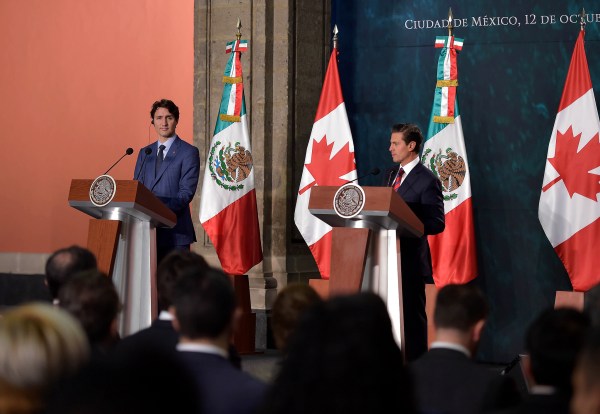
Canadian Prime Minister Justin Trudeau gives a presentation with Mexican President Enrique Peña Nieto during an official visit to Mexico in October 2017. / Presidencia de la República Mexicana / Flickr / Creative Commons

Facing the growing possibility that the Trump Administration is walking away from the North America Free Trade Agreement (NAFTA), Mexico and Canada are beginning to look for trading partners beyond the United States.  The interdependencies binding the three are strong.  Both Mexico and Canada have deep commercial ties with the United States, which imports about 80 percent of Mexico’s exports and about 70 percent of Canada’s.  Both have significant leverage vis-à-vis the United States as well.  U.S. auto and agriculture industries have a major stake in free trade with Mexico, which also provides important cooperation on security issues and controlling Central American migration.  Liberalization measures within the energy sector by the current Mexican administration make Mexico a strategic partner in terms of energy security.  Canada buys about 19 percent of U.S. exports.

But these ties are fraying as conversations drag on.  Trump Administration proposals are hurting the talks; especially contentious are changes in the “rules of origin” (since the United States proposed increasing the U.S. content of autos to 85 percent from the current 62.5 percent) as well as the inclusion of a “sunset clause” that would make NAFTA expire unless it is renegotiated every five years.  NAFTA’s Article 2205 lets either of the three member countries announce its withdrawal from the accord with six months’ notice.  Canadian and Mexican trade officials have not given such notice yet, but they show signs of heading in that direction.  Both have held high-level meetings with counterparts from South America and Europe, according to official and non-government sources.

  • Mexican President Peña Nieto’s administration has expressed a preference for leaving the negotiations over accepting “a free trade agreement that ceases to promote free trade.” President Trump has said that his administration would be willing to negotiate a free trade agreement with Canada alone if the NAFTA talks fail.  However, Canadian Prime Minister Trudeau’s government has stated a preference for keeping the trilateral alive rather than resorting to bilateral agreement, since the terms of the U.S.-Canada deal were more outdated than the NAFTA’s.  The two presidents have been reluctant to take these actions because they apparently believe, as do many experts, that dismantling NAFTA would inevitably create uncertainty and inefficiencies for the three economies.  For example, the auto sector relies on three-way product flows that move several times across borders to be assembled into finished products.  Canadian and Mexican auto parts makers have a direct stake in each other’s dealings with the United States.  Even small duties would add up.
  • Nonetheless, some increased trade and a bilateral free trade agreement between just Mexico and Canada is possible. The two countries originally joined NAFTA to protect their access to the U.S. market, not to obtain access to each other’s.  Canadian public opinion and media reflect continued disinterest in Mexico, which is viewed as unstable due to drug-related criminality and corruption.  However, as the completion of a satisfactory NAFTA renegotiation is unlikely, Canadians are exploring deepening the bilateral link.  Mexican interest in Canada is also growing, according to some specialists.  Beyond North America, moreover, Canadians and Mexicans are exploring trade and investment diversification.  Canada is looking for increased cooperation with Latin America, in particular within the Pacific Alliance, a free trade partnership that includes Mexico, Chile, Peru and Colombia, and of which Canada is already Associate Member.  Mexico started a renegotiation last January of its free trade agreement with the European Union, which parties hope to finalize in the next few days.  It has begun warming up neglected ties with the Southern Cone and has already pledged to deepen ties with China.

Trade experts convened recently within the framework of American University’s Robert A. Pastor North America Research Initiative (NARI) were unanimous that that a trilateral agreement that protects the interests of all three partners would be the optimal outcome, but few observers of the NAFTA talks are confident that the Trump Administration will soften its position.  Canada’s commitment to a trilateral renegotiation should exert more pressure on the U.S. to compromise while strengthening both Canada and Mexico’s negotiating positions.  In the event of U.S. withdrawal from NAFTA, however, the two can expand their trade and investment relationship by lowering barriers further through modernization and e-commerce.  In addition, trade can potentially expand between the two since they have similar approaches to achieving various commitments of the Paris Accord involving energy projects and greenhouse gas emissions reductions.  Pastor Scholars concluded that both countries will have to carry out public campaigns to explain to their constituencies the benefits of continued cooperation, either trilateral or bilateral, if the United States significantly alters or abandons NAFTA.  Mexico and Canada have options outside North America in the quest for trade and investment diversification – even though their preferred scenario is a stronger NAFTA.  China, South America, and the European Union arise as the most readily available partners.

December 21, 2017

*Daniela Stevens is a Ph.D. Candidate in the American University School of Public Affairs and a Pastor Scholar.  Her research focuses on national and subnational policies that put a price on carbon emissions.

Latin America: End of “Supercycle” Threatens Reversal of Institutional Reforms

By Carlos Monge*

Monge graphic

By Eduardo Ballón and Raúl Molina (consultores) and Claudia Viale and Carlos Monge (National Resource Governance Institute, América Latina), from Minería y marcos institucionales en la región andina. El superciclo y su legado, o las difíciles relaciones entre políticas de promoción de la inversión minero-hidrocarburífera y las reformas institucionales, Reporte de Investigación preparado por NRGI con colaboración de la GIZ, Lima, Marzo del 2017. See blog text for high-resolution graphic

Policies adopted in response to the end of the “supercycle” have slowed and, in some cases, reversed the reforms that moved the region toward greater decentralization, citizen participation, and environmental protection over the past decade.  Latin American governments of the left and right used the commodities supercycle to drive growth and poverty reduction at an unprecedented pace.  They also undertook institutional reforms aimed at improving governance at large.

  • Even before demand and prices for Latin American energy and minerals began to rise in the early 2000s, some Latin American countries launched processes of decentralization (Colombia and Bolivia); started to institutionalize mechanisms for citizens’ participation in decision making (Colombia and Bolivia); and built progressively stronger environmental management frameworks (Colombia and Ecuador). Peru pressed ahead with decentralization and participation at the start of the supercycle, and when it was in full swing, created a Ministry of the Environment.
  • Implementation of the reforms was subordinated by governments’ overarching goal of fostering investments in the extractive sector. Indigenous consultation rights in Peru, for example, were approved in the second half of 2011, but implementation was delayed a year and limited only to indigenous peoples in the Amazon Basin.  President Ollanta Humala, giving in to the mining lobby, claimed there were no indigenous peoples in the Andes and that no consultations were needed around mining projects.  Local pressure forced a reversal, and by early 2015 four consultation projects on mid-size mining projects were launched.

These reformist policies have suffered setbacks since the decrease in Asia’s and particularly China’s appetite for Latin American energy and minerals has caused prices to fall – and the value of exports, taxes, and royalties, and public incomes along with them.  The latest ECLAC data show a decline in economic growth and a rebound of poverty both in absolute and relative figures.  The gradual fall in the price of minerals starting in 2013 and the abrupt collapse in oil prices by the end of 2015 reversed this generally favorable trend.

The response of the governments of resource-dependent countries has been “race to the bottom” policies, which included steps backward in fiscal, social, and environmental policies.  Governments’ bigger concern has been to foster investments in the new and more adverse circumstances.  In this new scenario, the processes of decentralization, participation, and environmental management have been negatively impacted as local authorities and citizens’ participation – as well as environmental standards and protocols – are perceived by companies and rent-seeking public officials as obstacles to investments.

  • Peru’s Law 30230 in 2014, for example, reduced income tax rates, weakened the oversight capacity of the Ministry of the Environment, and weakened indigenous peoples’ claim public lands.

The correlation between the supercycle years and the progress and regressions in reforms is clear. (click here for high-resolution graphic).  During the supercycle – when huge amounts of money were to be made – companies and government were willing to incorporate the cost of citizen participation, decentralization and environmental standards and protocols.  But now, governments are desperate for new investments to overcome the fall in economic growth and extractive rents, and extractive companies are not willing any more to assume these additional costs.  Those who oppose the “race to the bottom strategy” are fighting hard to restore the reforms and to move ahead with decentralization, increased participation, and enhanced environmental management, to achieve a new democratic governance of the territories and the natural resources they contain.

April 7, 2017

* Carlos Monge is Latin America Director at the Natural Resource Governance Institute in Lima.

U.S.-Mexico Trade: The Numbers and the Real Issues

By Robert A. Blecker*

30986371735_f660fc42e9_k

Two maquiladoras in Tijuana, Mexico. The low percentage of Mexican value-added in Mexico’s exports is a key reason why the country has not gotten nearly as much employment growth as it hoped for when it joined NAFTA. / Anthony Albright / Flickr / Creative Commons

Officials in the Trump administration are proposing a new way of measuring the U.S.-Mexican trade deficit that, by making the deficit look larger than it currently appears, will likely be spun to support efforts to impose high tariffs or dismantle NAFTA.  According to press reports, the President’s senior advisors, including the head of his new trade council, Peter Navarro, are proposing to include only “domestic exports” (exports of U.S.-produced goods) in calculating bilateral trade balances with Mexico and other countries.  This would exclude “re-exports” – goods that are imported into the United States from other countries (such as Canada or China) and transshipped into Mexico – which are currently counted in total U.S. exports.

  • In spite of its political motivation, the proposed new accounting would render a more accurate measure of U.S. exports. In fact, it would make the U.S. deficit with Mexico look closer to what Mexico reports as its surplus with the U.S.  For 2016, the U.S. reports a deficit of $63.2 billion with Mexico, while Mexico reports almost twice as big a surplus of $123.1 billion with the U.S.  If the U.S. excluded re-exports, its trade deficit with Mexico for 2016 would be $115.4 billion, which is much closer to the Mexican number.

Nonetheless, this recalculation fails to correct for another bias, which makes the U.S. deficit with Mexico look artificially large.  Imports are measured by the total value of the goods when they enter the country, from the immediate country of origin.  But in today’s global supply chains only part of the value-added in imported goods comes from any one country.  A television, for example, can be assembled in Mexico with components imported from Korea and other East Asian nations.  As a result, the reported U.S. imports from Mexico (especially of manufactured goods) greatly exaggerate the Mexican content of those goods.  Although data limitations do not permit an exact calculation of the Mexican content of U.S. imports from Mexico, it is likely relatively low.  (My own estimates suggest it is on the order of about 30-40 percent for manufactured goods).  Indeed, the low percentage of Mexican value-added in Mexico’s exports is a key reason why the country has not gotten nearly as much employment growth as it hoped for when it joined NAFTA.

The Trump Administration’s aggressive rhetoric and action on other issues related to Mexico, including immigration and the wall, suggest a political motivation for the proposal to adopt a new measure of exports, regardless of its merits.  But the real problem is not the “correct” number for the U.S.-Mexican trade deficit; it is why NAFTA has not lived up to its promise of supporting high-value added exports and high-wage job creation in both countries.  This promise was based on the idea that the United States would export capital and intermediate goods to Mexico for assembly into consumer goods, which would then be exported back to the United States.  But especially since China joined the WTO in 2001, Mexico has increasingly become a platform for assembling mostly Asian inputs into goods for export to the United States (and secondarily Canada).  Even if “re-exports” are excluded, Mexico remains the second largest export market for the United States (after Canada) – and U.S. exports to Mexico are 65 percent greater than U.S. exports to China.  Focusing too much on measuring the U.S.-Mexico trade imbalance only distracts attention from the need to reform NAFTA so as to encourage more of the “links” in global supply chains to be produced in North America generally.  If the Trump administration is serious about making the U.S. more competitive vis-à-vis China, it should think about viewing Mexico as a partner instead of as an enemy.  In the larger context of Trump’s many objectionable policies on migration and in other areas, a long-overdue correction of U.S. export statistics is not worth getting upset over.  The real issue is whether Trump’s trade policies – with Mexico and beyond – will bring the promised gains to U.S. workers, or will further enrich corporate billionaires and Wall Street tycoons.

February 23, 2017

* Robert A. Blecker is a Professor of Economics at American University.

What Will Trump Do About NAFTA?

By Malcolm Fairbrother*

trump-nafta

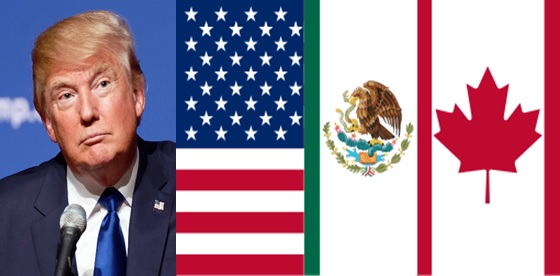
U.S. President-elect Donald Trump and the flag of the North American Free Trade Agreement (NAFTA). / Flickr and Wikimedia / Creative Commons / Modified

Despite his campaign rhetoric repeatedly attacking the North American Free Trade Agreement, U.S. President-elect Donald Trump probably won’t touch it, except in superficial ways.  He has called NAFTA the “worst trade deal ever,” and promised to pull the U.S. out unless Mexico and Canada agree to renegotiate it.  Last week, he suggested renegotiation of NAFTA will include provisions for Mexico to repay the U.S. government for the wall he wants to build along the border.

Dismantling or even significantly rewriting the accord is unlikely for a couple reasons:

  • First, the billionaires, chief executives, and friends he is choosing for his cabinet are hardly people inclined to dismantle an agreement whose contents largely reflect what American business wanted from the U.S.-Mexico relationship when NAFTA was being negotiated in the early 1990s. Corporate preferences weighed heavily against any big deviation from the status quo after the last political transition in Washington, in 2008.  Barack Obama too said that “NAFTA was a mistake,” though his criticisms were a little different.  He railed against lobbyists’ disproportionate influence over trade policy, and promised big changes to international trade agreements, including better protections for workers and the environment.  Even so, he didn’t touch NAFTA, and the Transatlantic Trade and Investment Partnership (TTIP) and the Trans-Pacific Partnership (TPP) he negotiated included – like NAFTA – shady provisions for investor-state dispute settlement.
  • It would be near-impossible, or least massively expensive, to get what Trump seems to want most: a big drop in imports from Mexico. In his eyes this would make NAFTA a better deal for America, though of course serious economists disagree.  Realistically, reopening the agreement would be very messy, and if he tried to throw up massive new trade barriers business leaders would strongly object.  NAFTA could include some additional measures to make it easier for goods and/or people to get around among the NAFTA countries, but that’s not what Trump has promised.

His economic nationalism makes the Republican Party establishment squirm, but it’s clear it also helped Trump win several Midwestern states, tipping the electoral college in his favor.  Insofar as agreements like NAFTA entrench rules friendly to business, and generate market efficiencies and economies whose benefits accumulate in the hands of the few, voter hostility is no mystery.  But economics is only part of the reason.  The bigger issue is what the backlash against globalization – embodied also by Brexit and the rise of neo-nationalist parties in Europe – means more broadly.  The average Democratic voter has a lower income than the average Republican voter, but Democrats are more supportive of trade agreements because they are more internationalist, more open to other cultures, younger, more educated, and more urban.  Throughout his presidency, Trump will therefore be squeezed between his working class rhetoric – appealing to the distrustful – and his business class milieu.  He is an extreme case of the politicians’ mercantilist thinking on trade, wherein exports are good and imports are bad, and “trade deals” like NAFTA are somehow like deals in the business world, where it’s possible to out-negotiate someone.  The reality is that this thinking – which flies in the face of basic economics – doesn’t point to any clear course of action.  This is why Trump won’t actually do much about NAFTA.

January 10, 2017

* Malcolm Fairbrother is social science researcher and teacher/mentor in the School of Geographical Sciences at the University of Bristol (UK).  This article is adapted from a recent blog post for the American Sociological Association.