OAS Secretary General’s Third Way Stumbles

By Stefano Palestini Céspedes*
34627298223_325ea7fb41_k

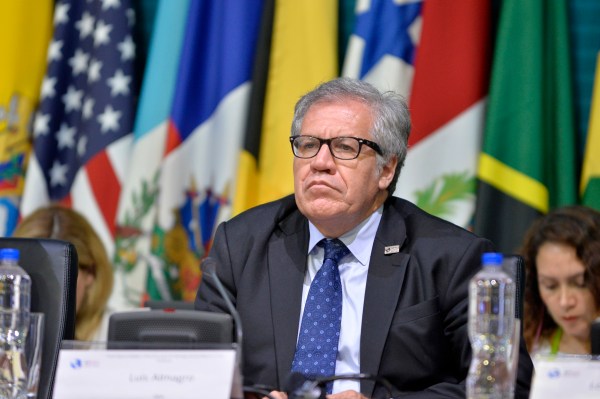
Luis Almagro, OAS Secretary General, at the first day of General Assembly in Cancún, June 2017. / Juan Manuel Herrera / OAS / Flickr / Creative Commons

OAS Secretary General Luis Almagro’s effort to drive the organization’s actions on Venezuela through international mobilization appears to have run its course without success during the recent General Assembly.  From the outset, Almagro faced the tough dilemma of what to do when OAS members did not want to fulfill their commitments and were reluctant to invoke the Inter-American Democratic Charter against the Venezuelan government.  As in most international organizations, the OAS Secretary General does not have strong authority to enforce its legal instruments and essentially had two options to cope with the dilemma:

  • To admit his lack of authority – and thereby signal to the world that the organization’s commitments, such as the Democratic Charter, are not credible. In the international system, there are plenty such non-credible and non-enforceable commitments, ranging from the EU Treaty (Article 7) to the Kyoto Protocol.
  • To use his limited powers to persuade member states from within – persuading national representatives to take action. This approach risks to be perceived from outside as inaction.  If persuasion succeeds and member states decide to enforce their commitments, the credit will most likely go to the member state playing the role of leader, and not to the institution.

Faced with Venezuelan President Maduro’s rejection of the OAS’s good offices and with member states’ preference to assign diplomatic leadership to UNASUR (over which Maduro had influence), Almagro chose a third way:  to drive OAS internal processes by pressing member states from outside via international public mobilization.  Through a series of actions in his own name – issuing reports, statements, and posts on social networks – Almagro called the attention of the international community and media to the OAS’s naming and shaming of Venezuela.  By doing so, he indirectly raised the cost of inaction of member states reluctant to take a strong stand.  Maduro’s increasingly undemocratic behavior, and the election of new governments in some key states, particularly Argentina and the United States, improved the odds of success.  Indeed, the OAS gave the Venezuela crisis unprecedented salience, and on April 3 the Permanent Council passed a resolution (approved by consensus but with only 17 states in the room) that, for the first time in OAS history, demonstrated that a democratically elected government could be condemned because of “unconstitutional alterations of the constitutional order.”  A core group of 14 countries – representing more than 90 percent of the hemisphere’s population – coalesced to back up the activist Secretary General.

  • The 47th General Assembly in Cancún was supposed to crown the strategy’s success by moving the OAS from a condemnation of Venezuela towards a common plan for engagement – specifically one embracing the anti-Maduro opposition’s demands. Venezuelan diplomats managed to convince some Caribbean states – dependent on Venezuela’s Petrocaribe program to withhold support of the resolution, causing the OAS-14’s plan to fail to achieve the two-thirds majority by only three votes.  (An alternative resolution put forward at the last minute by San Vicente also failed.)

Secretary General Almagro’s “third way” approach was risky, made under the assumption that the two traditional options would fail.  Reasonable observers can second-guess him, but there is little evidence that either of the other options would have fared any better.  The crisis in Venezuela is a hard case for the Inter-American Democratic Charter, and the OAS’s strict intergovernmentalism militates against decisive action.  Almagro’s public relations pressure from outside arguably worked with the larger states, but alienated the smaller.  A more cautious approach (as I argued here) perhaps would have helped to bring CARICOM states on board.  For now, what is clear is that the OAS will not play a major role in managing Venezuela’s democracy crisis – unless the already severe situation in the country shakes even the OAS fence sitters.  A pending question is whether the OAS might succeed in inventing a role for itself in post-crisis Venezuela.

June 30, 2017

Stefano Palestini Céspedes is a former CLALS Research Fellow and Postdoctoral Fellow at the Department of Political and Social Sciences at the Freie Universität Berlin, where he specializes in international organizations and regional governance.
Venezuela- OAS: New Chapter in a Long Story

By Stefano Palestini Céspedes*

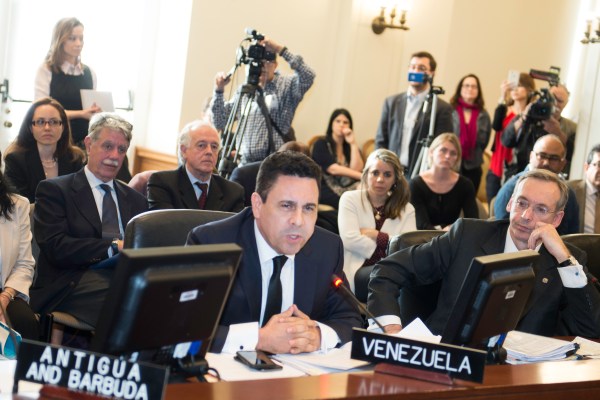
Special Meeting of the Permanent Council, April 3, 2017

On April 3, a special meeting of the OAS Permanent Council voted to condemn Venezuela’s action that allows the Tribunal Supremo de Justicia (TSJ) to take over the functions of the National Assembly. / Juan Manuel Herrera/ OAS / Flickr / Creative Commons

Venezuelan President Nicolás Maduro seems determined to validate critics’ claims that the separation of powers in Venezuela has been breached, thereby strengthening diplomatic efforts to force him to reverse course.  After the OAS Permanent Council met for two days to discuss Secretary General Almagro’s call for Caracas’ suspension, Venezuelan courts on March 29 authorized the Tribunal Supremo de Justicia (TSJ) to take over the functions of the National Assembly, and to limit the immunity of the members of the parliament.  The action reinvigorated an exhausted domestic opposition and further infuriated international observers.  Two days later, the TSJ overturned the two rulings after Maduro, casting himself as a mediator between competing constitutional powers, requested it.  These erratic actions signaled the worsening erosion of the rule of law as well as the divisions in the government and the Bolivarian movement.

  • The reversal did not take the edge off OAS General Secretary Almagro’s and others’ condemnation of the power grab as an autogolpe or “self-coup.” The Inter-American Democratic Charter was designed in 2001 precisely to provide the OAS with instruments to deter self-coups in the aftermath of those carried out by Alberto Fujimori (Peru) and Jorge Serrano (Guatemala) in the 1990s.

The TSJ decisions and Venezuela’s defiance didn’t put Almagro’s suspension efforts over the top, but the Permanent Council is now much more actively involved in the crisis.  Venezuela has isolated itself within the Permanent Council.  Speaking at the Council, its delegation severely criticized individual member states the day before the TSJ decisions.  Chile and Peru recalled their ambassadors for consultation after it.  Ecuador, an ally since the time of Hugo Chávez, distanced itself from Maduro.  On April 1, MERCOSUR invoked the Protocol of Ushuaia – the group’s democracy clause – against Venezuela, and it joined Colombia and Chile in a forceful public statement on behalf of UNASUR.  Mexico, historically a jealous guardian of the principle of non-intervention, has assumed the leadership in holding Venezuela accountable for its undemocratic practices.  As a result, the Permanent Council on April 3 approved a resolution condemning the TSJ decisions and committing to “undertake as necessary further diplomatic initiatives to foster the restoration of the democratic institutional system,” including convening a ministerial meeting.

Building a consensus for tougher action in the Permanent Council will be difficult, however.  Last week’s resolution was approved by 19 member states, but four abstained and 10 were absent.  Any proposal to suspend Venezuela will require two-thirds of the members’ affirmative votes.  Although there is still a long way to go to make the OAS part of the solution of the Venezuelan crisis, the General Secretary’s activism has set an important precedent in rallying a majority of states in the Americas to come together to discuss a member’s erosion of democratic principles and institutions – and to condemn the non-democratic actions of a democratically-elected government.  This is a first for the organization, and it is a big step toward fulfilling the original purpose of the drafters of the Inter-American Democratic Charter.

April 10, 2017

* Stefano Palestini Céspedes is a CLALS Fellow and Postdoctoral Fellow at the Department of Political and Social Sciences at the Freie Universität Berlin, where he specializes in international organizations and regional governance.

Nicaragua: Shirking Obligations on Gender-based Violence

By Pamela Neumann*


15265768473_2316590a31_k

March against violence in Managua, November 2014. Oxfam en Nicaragua / Flickr / Creative Commons

Recent actions by the Nicaraguan government directly conflict with its obligations under accords on gender-based violence, but regional mechanisms, including the OAS, have not been effective at holding Managua to account. The 1994 Inter-American Convention on the Prevention, Punishment, and Eradication of Violence against Women (Belém do Pará), which Nicaragua ratified in 1995, defines violence against women as any act of physical, sexual, or psychological violence occurring in either the public or private sphere (Article I, III) and obligated state signatories to establish fair and effective legal procedures to address crimes against women (Article VII). The Convention also stipulated that States report steps taken to prevent and prohibit gender-based violence (Article X). In 2004, the OAS introduced a Follow-up Mechanism (MESECVI) to provide additional technical assistance and more closely monitor state actions.

Nicaragua has not submitted information to MESECVI since 2008, and its performance has become even more problematic in subsequent years. In 2012, the government passed a comprehensive law on gender-based violence (Law 779), which significantly advanced women’s legal rights and protections. Over the last three years, however, the law has been substantially undermined by legislative reforms and executive decrees. For example, mediation, an informal practice police historically used to resolve cases, was first eliminated and then reinstated. Mediation puts women’s lives at significant risk because there are no legal consequences for violating the non-binding agreements it produces. In addition, beginning in 2014, women seeking to file a legal complaint for gender-based violence were sent to neighborhood councils or the Ministry of the Family for counseling instead. Police units charged with handling domestic violence cases have been closed for over a year.

The OAS has been leaning hard on Nicaragua to address threats to its electoral process – forging an agreement last month allowing the OAS to send a team to observe municipal elections in November – but its performance as arbiter of signatories’ adherence to the Belém do Pará Convention has been less effective. The convention’s enforcement mechanisms are limited; the main recourse that individuals or organizations have is to submit a petition to the Inter-American Commission on Human Rights, which can forward it to the Inter-American Court of Human Rights (IACHR). But action is inhibited by the stipulation that cases are only admissible when “remedies under domestic law have been pursued and exhausted” and because current regional agreements do not allow for any specific OAS-IACHR action to be taken on the basis of legislative action or inaction. The OAS’s existing instruments, moreover, put the burden on individual aggrieved parties to demonstrate the state’s intentional complicity in denying women due process. This requires showing evidence of state officials actively impeding one particular investigation or engaging in violent acts themselves. Numerous studies, including my own research, have shown that such behavior is in fact ubiquitous, but less than 1 percent of cases even make it to trial. Despite good intentions, the legal remedies afforded by the OAS tend to individualize and privatize the problem of gender-based violence – and the Nicaraguan government is not being held accountable for its failure to prevent or punish fundamental violations of women’s human rights.

March 30, 2017

*Pamela Neumann is a Post-Doctoral Fellow at the Stone Center for Latin American Studies, Tulane University.

OAS-Venezuela: Almagro Ups the Ante

By Stefano Palestini Céspedes*

32009916073_0a79dea9a2_k

Luis Almagro, OAS Secretary General, met with Freddy Guevara, First Vice President of the National Assembly of Venezuela, in Washington, DC in early February 2017. / Juan Manuel Herrera, OAS / Flickr / Creative Commons

OAS Secretary General Luis Almagro’s second report on Venezuela, issued on March 14, reflects his personal commitment to enforce the principles enshrined in the Inter-American Democratic Charter, but risks getting ahead of the organization’s member states and could ultimately hurt the credibility of the charter and OAS.  The 73-page document states that the government of Venezuelan President Nicolás Maduro has become a “dictatorial regime” that violates “every article” of the Charter; concludes that all attempts at dialogue have failed; and essentially calls for the OAS to suspend Venezuela’s membership in accordance with the charter’s democracy clause.  Almagro said the UNASUR negotiation (supported by the Vatican) has failed to achieve any of its proposed objectives and has become “a tool for reinforcing the regime’s worst authoritarian features domestically and, externally, for not engaging in international condemnation and pressure.”

  • The report concludes with an ultimatum: If the government does not call for general elections, release all political prisoners, restore all laws it has annulled, and select a new electoral authority and a supreme tribunal in the next 30 days, Venezuela should be suspended from the OAS. Few observers believe Maduro could meet these conditions even if he wanted.

Almagro’s actions, including his forceful call for application of Article 21 of the Charter – the “democracy clause” – moves his office and the OAS into uncharted territory as it would be the first time it is applied against an elected government.  Article 21 was applied against the government in Honduras that came to power in a coup in June 2009, but the sanctions were initiated at the request of ousted President Zelaya and strongly supported by Latin American governments – including Hugo Chávez – and Washington.  To enforce Article 21 against an incumbent government, a strong consensus needs to be built.

The Secretary General’s showdown with President Maduro presents a test for the Charter and, ultimately, for the OAS, as it pushes the organization beyond its traditional institutional limits.  Any decision on suspension must be approved by a two-thirds majority of member states, whose delegates represent executive branches that traditionally have shied from intervening in each other’s affairs.  Some insiders also grumble that the Secretary General has fallen short in his consultation with the member states; instead he seems to take a partisan position such as by inviting Maduro’s opposition to OAS headquarters this week for a press conference.  If the members back Almagro’s call for suspension, he will have demonstrated that principled arguments can break even strong institutional barriers – moving OAS into a new phase.  In that case, the Secretary General together with the member states will need to come up with a post-suspension plan; only then will OAS become part of the solution to Venezuela’s crisis.  If member states do not support the Secretary General’s call, Almagro will be respected as a leader moved by convictions, but the OAS will probably move one step down towards irrelevance.

March 21, 2017

Stefano Palestini Céspedes is CLALS Fellow and Postdoctoral Fellow at the Department of Political and Social Sciences at the Freie Universität Berlin, where he specializes in international organizations and regional governance.

MACCIH: An Early Progress Report

By Chuck Call*

31246077021_af5b37fcce_k

Juan Jiménez Mayor, Spokesman of the MACCIH Mission in Honduras, presented an update about MACCIH at the OAS in December 2016. / Juan Manuel Herrera, OAS / Flickr / Creative Commons

The OAS “Mission to Support the Fight against Corruption and Impunity in Honduras” (MACCIH) approaches its first anniversary in April with some gains and many challenges.  Launched after months of negotiations with the government of President Juan Orlando Hernández, MACCIH was created partly in response to widespread street protests by the Indignados (the “Outraged”), angered that the president’s campaign had benefitted from $300 million embezzled by officials of the Social Security Institute (IHSS).  Hernández was widely believed to accept the mission only because his tenure in office – and a possible second term – were in danger.

  • MACCIH was inspired by Guatemala’s CICIG, the UN-backed commission supporting that country’s judicial institutions, but Hernández insisted on major differences. He consented only to a mission of the OAS, generally seen as weaker than the United Nations.  MACCIH is weaker than CICIG in that it cannot initiate its own case investigations and must channel all its investigative and prosecutorial work through Honduran authorities.  (CICIG enjoys full investigative police powers and can initiate its own wiretaps and surveillance.)  MACCIH is headed in-country by a “spokesman” for the OAS Secretary-General, who nominally leads the mission from Washington, and its $2 million first-year budget has been only about one-sixth that of CICIG’s annual budget.

As a result, MACCIH opened to skepticism that its slow start hasn’t dispelled.  Its investigations have produced virtually no corruption-related arrests or prosecutions.  Setting up the office took much of 2016.  The head of criminal investigations only arrived in the summer, and the public security office only opened this month.  In contrast, a Honduran Police Reform Commission has sacked over 3,000 police officers.  Civil society organizations complain of MACCIH’s lack of impact, and a novel “observatory” comprising academic institutions and civil society groups remains ill-defined.  MACCIH’s decision not take up the investigation of the high-profile murder of environmental rights activist Berta Cáceres has seemed to sideline the mission from a case that emblemizes impunity, even if it seems not to involve far-reaching corruption.

  • However, MACCIH has scored some wins. It has embarked on a handful of complex corruption cases, including the IHSS case that sparked its creation.  The mission helped Honduran prosecutors prepare charges of arms possession against Mario Zelaya, the highest-profile suspect in the IHSS case, which kept him in jail long enough for more serious charges to be brought.  It helped secure two laws – to regulate campaign financing and to create a nationwide anti-corruption jurisdiction with its own selected judges and prosecutors.  MACCIH’s in-country leader, former Peruvian Prime Minister Juan Jiménez Mayor, has been forward-leaning in acting on his mandate.
  • MACCIH gained support in an early test late last year. In November, its concerns about several Hernández nominees to the Tribunal Superior de Cuentas, an audit court with special powers over corruption investigations, earned the ire of Honduran senior officials who complained to Secretary General Almagro.  The appointments were not altered, laying bare the mission’s limitations.  But Almagro stood by his organization’s analysis and role, with Jiménez Mayor emerging stronger as his special representative, not just his spokesman.
  • That same month, the board chair of Transparency International, José Ugaz, visited Honduras and urged civil society organizations to help ensure MACCIH’s success. Since then, they have showed a more positive attitude toward MACCIH, and more witnesses are now cooperating with the mission.

Comparisons between MACCIH with CICIG may arguably be unfair just one year out.  Observers recall that CICIG had difficulty showing impact in its initial investigations and was criticized as ineffectual.  Delivering on its ambitious mission to help curb corruption and impunity – in a country notorious for both – will be even harder.  However, the mission has accomplished as much as CICIG did in its first year in case investigations and legal reform.  Despite its limitations and slow start, MACCIH’s performance does not preclude obtaining far-reaching corruption convictions and strengthening the Honduran judicial system in coming years.  As civil society groups seem to be getting past their disappointment that their country did not get a CICIG, their collaboration will be crucial to the mission’s success.

March 13, 2017

* Chuck Call teaches International Peace and Conflict Resolution at American University.

Almagro’s Freshman Year: Bold Actions or Unnecessary Risk?

By Maria Carrasquillo*

Luisito

Photo Credit: Juan Manuel Herrera (OAS)/Flickr/Creative Commons

Secretary General Luis Almagro’s quest to revitalize the Organization of American States (OAS) seems premised on being an “activist” Secretary General in what could be a make-or-break gambit to assert the organization’s hemispheric leadership.  Only 13 months in office, Almagro has taken an approach that is a clear departure from the low-key, consensus-building ways of former Secretary General José Miguel Insulza.  In his 2015 inaugural address, Almagro laid out his plans for the rejuvenation of the OAS, including internal changes to “adapt it to the realities of the 21st century” and “insert [it] into a world different from the one in which it was developed and has grown and operated.”  Almagro underscored the need for the OAS to promote transparent and inclusive elections throughout Latin America and, in regard to democratic governance, “lend a hand to countries that are going through moments of tension and conflict.”

Almagro has taken a number of positions that confirm his desire to redefine the OAS’s role in the region.

  • In 2015, Almagro took the lead in developing a plan to fight corruption in Honduras, resulting in the formation of the Support Mission Against Corruption and Impunity (MACCIH) – a watered-down version of the successful UN-backed CICIG in Guatemala. The jury is still out on whether MACCIH will have a serious impact, but Almagro has staked his reputation on its credibility.
  • He has claimed that the impeachment of Brazilian President Dilma Rousseff lacked sufficient justification and that accusations against her were politically driven. Almagro also called for anticorruption investigations under Operação Lava Jato to continue as essential for the rule of law.
  • Prior to the Peruvian elections, Almagro warned that the disqualification of two candidates reflected unequal application of the law and raised concerns that the contests would be “semi-democratic.” Following a meeting with disqualified frontrunner Julio Gómez, Almagro called for the reinstatement of both candidates’ right to participate in the elections.
  • Perhaps Almagro’s most controversial action has been his attempt to invoke the OAS Democratic Charter against the government of Venezuela, without a finding by the Permanent Council, as required under Article 20 of the Charter, that the situation there amounts to “an unconstitutional alteration of a constitutional regime.” The Permanent Council implicitly rejected his appeal by urging more dialogue between the OAS and Venezuela.  Almagro then sent a strongly worded letter to Venezuelan President Nicolas Maduro accusing him of lying and “betraying his people,” and calling for the release of political prisoners, restoration of legitimate powers to the National Assembly, and a referendum to recall Maduro in 2016. (The Permanent Council is set to discuss the situation in Venezuela again on June 21.)

Almagro has taken on some very difficult issues, and explanations for his motivations are varied but not mutually exclusive.  Some observers perceive a personal embrace of OAS principles, others detect a desire to avoid the sort of U.S. criticism that plagued Insulza and constrained U.S. support and funding, and still others speculate about his future political ambitions as a reformist on the non-radical left of Latin America.  The democratic principles he is defending are clearly enshrined in OAS documents, but his activism has so far not reversed adverse situations: Rousseff was impeached, the Peruvian candidates were forced to sit out the election, and Maduro has yet to soften.  Being an “activist” Secretary General in the case of Venezuela entails great risks; his predecessors were criticized both for getting too directly involved in the country’s internal affairs and for remaining passive in the face of growing authoritarianism in Caracas.  It seems, moreover, as though Almagro has often acted alone, and the tone of his letter to Maduro was uniquely strident.  A great deal is on the line for the OAS.  If Almagro’s activism works, it will enhance the organization’s leadership on a range of issues confronting the hemisphere, but it may also put the OAS in the middle of future conflicts in which failure would bring a loss of institutional credibility. 

June 16, 2016

* Maria Carrasquillo is a recent graduate of the M.A. Program in American University’s School of International Service and a research assistant at the Center for Latin American and Latino Studies.

Honduras: No Solution in Sight

Photo Credit: OAS / Flickr / Creative Commons

Photo Credit: OAS / Flickr / Creative Commons

CLALS and the Inter-American Dialogue this week hosted a conversation on the crisis in Honduras with experts Hugo Noé Pino, of the Instituto Centroamericano de Estudios Fiscales, and Carlos Ponce, of Freedom House, and about a dozen of some 80 participants spoke up.  The following are key analytical points that were broadly accepted during the 90-minute session.

Honduras is experiencing a multi-faceted crisis – economic, political, judicial, and security– that has grown steadily worse since the 2009 coup and shows no sign of abating.

  • Economic growth (1.5 percent per capita) is too low to alleviate the country’s severe employment problem (affecting half of the working-age population) and poverty (62 percent). Recent polls indicate that some 63 percent of all Hondurans would leave the country if they could.

Violence, corruption scandals, and the steady weakening of institutions dim prospects for a turnaround.

  • The over-concentration of power in the Executive, the remilitarization of law-enforcement and other security services, and the politicization of the judiciary have undermined what democratic foundation Honduras had built since the last military government stepped down in 1980. The economic and political elites, as well as the media they control, have further stifled political discourse.
  • The Sala Constitucional of the Supreme Court and the National Electoral Tribunal have been stacked to tightly control preparations for elections scheduled for November 2017, apparently with the intention of ensuring the reelection of President Juan Orlando Hernández.

The Honduran political class lacks the will to root out corruption, and is united in resisting developing the capacity and programs to do so.

  • The embezzlement of more than $300 million from the Social Security Institute – funneling part of these funds to the ruling National Party and a variety of fronts – led to the flight of the investigating fiscal (who left the country because of death threats to himself and his family) but little else. Indeed, the most significant law-enforcement actions, such as the indictment of members of the Rosenthal family on money-laundering charges, have come from the United States. Some 80 percent of crimes in Honduras go uninvestigated and unpunished; some reports put the figure as high as 96-98 percent.
  • A Comisión Internacional Contra la Impunidad en Honduras (CICIH), adapted from the successful CICIG model in Guatemala, would be a healthy way of addressing ongoing impunity while building investigative and prosecutorial institutions. The economic and political elites solidly oppose it.  Even if Honduras accepted a CICIH, alone it probably would not be a silver bullet.
  • The OAS’s planned “Mission to Support the Fight Against Corruption and Impunity in Honduras” (MACCIH) – announced in late September jointly with Honduran President Juan Orlando Hernandez – shows little promise of success. Its mandate will be to diagnose problems and write reports, not take action or facilitate a serious, inclusive national dialogue.

Opposition to the current Honduran government is strong and growing, but it has not yet institutionalized.

  • Peaceful marches organized by the Indignados and other organizations have mobilized tens of thousands of citizens outraged by government corruption and its inability to provide even basic citizen security. Among the masses have been an unprecedented number of middle-class and upper-middle-class persons – not seen during previous crises.
  • Opposition groups are still struggling, however, to coalesce into a viable, institutionalized political force. Sustaining effective leadership and overcoming pressure from the government and Honduras’s two traditional parties are difficult challenges for them.

There are no magic or quick solutions to the crisis.

  • Any solution would have many moving parts, including recognition by elites that their own assets are threatened by the deepening chaos. The government will have to be held accountable for corruption.  The judiciary will have to be strengthened and made independent.  The military will have to return to the barracks.  The media will have to be professionalized.  Civil society will have to be empowered.
  • The U.S.-sponsored “Alliance for Prosperity” is unlikely to help Honduras – and could make things worse if it doesn’t challenge the status quo. Honduran observers believe that the $250-plus million dollars from the program should focus on deep change – the product of a broad national dialogue – and should be conditioned on deep reforms, rather than working with just the sitting government, which has shown no willingness to reform.
  • U.S. cooperation in counternarcotics and other security operations might in some cases expose partnered services to U.S. respect for human rights and democratic institutions, but the resources transferred in the process also serve to strengthen them and make them more independent of civilian authority.

October 15, 2015

* Correction: The first sentence of the article originally stated “CLALS and the Inter-American Dialogue this week hosted a conversation on the crisis in Honduras with experts Hugo Noé Pino, of the Instituto Centroamericano de Estudios Fiscales, and Carlos Ponce, of Freedom House, and a dozen speakers from among over 80 participants.” It was edited to clarify that “about a dozen of some 80 participants spoke up.”

OAS: Almagro’s Challenges

By Fulton Armstrong and Eric Hershberg

Photo Credit: OEA – OAS / Flickr / Creative Commons

Photo Credit: OEA – OAS / Flickr / Creative Commons

The OAS’s new Secretary General, Luis Almagro Lemes, appears to be steering his organization toward a coordinating role that, he hopes, places it above the fray of hemispheric tensions.  He has not chafed at Washington’s version of democracy promotion, and indeed has embraced elements of it.  He has readily admitted the “inexorable conclusion” that the OAS needs to be “revamped and modernized”; that it needs to “reinforce its legitimacy”; and that its structure and resources need to be better realigned with the four pillars of its mission—democracy, human rights, security, and integral development.  His promises of internal reform so far have not been radically different from those put forth by his beleaguered predecessor, José Miguel Insulza, or even diverged from proposals embodied in U.S. legislation passed in 2013.  They have been articulated, however, in the sort of Washington consultancy language that might help his cause in the U.S. capital, such as references to evolving “from the OAS’s traditional command and control toward an organization that operates like a matrix geared to results in which the hemispheric and national dimensions feed into and enrich each other.”  Elected in March and inaugurated in May, in June Almagro received a mandate from the OAS General Assembly to restructure the General Secretariat, reorganize old offices into new ones, and implement other aspects of his plan.

Regional reactions to Almagro’s election and reform plan have been positive if sometimes not overly enthusiastic.  At the General Assembly meeting, U.S. Deputy Secretary of State Blinken spoke of a “new chapter … in the history of the OAS” and said, “We have a new secretary general, a new strategic vision statement, and renewed attention to genuine reform.”  South America’s preeminent power has been generally aloof toward the OAS, but the Brazilian Senate in mid-July approved a new OAS permanent representative, and last week Brasilia paid $3 million of its $18 million in late dues—modest relief from the slow strangulation caused by dire cash-flow issues because of non-payment by several key countries.  Almagro has also won support in Latin America through his repeated signals of a desire to work more closely with other hemispheric bodies—even CELAC, which was created in 2011 as a direct challenge to the OAS and supposed U.S. influence over it.  He pledged to “seek out areas where we can complement the work of other bodies,” citing by name CELAC, UNASUR, SICA, CARICOM, and MERCOSUR.  According to press reports, his close cooperation with UNASUR as Foreign Minister of Uruguay in 2010‑15 lends credibility to that promise.  Almagro also has won regional praise for pledging to continue efforts for bring Cuba back into the OAS as a full member—building on the success of the Summit of the Americas in April driven by the Washington-Havana rapprochement.

Outgoing Secretary General Insulza was a relatively easy act to follow because, often unfairly, his image was tattered after 10 years in the crossfire between Washington and the countries pushing to undermine U.S. influence in Latin America.  Almagro appears eager to push the re-set button, and the success of the Summit of the Americas and his pledges on democracy, reform, and hemispheric cooperation have given him a good start.  But leading the OAS is going to take more than artful rhetoric, internal restructuring, and a few reforms.  President Obama’s move on Cuba removes one major irritant from hemispheric relations, but an effective Secretary General is going to have to navigate the shoals of longstanding North-South tensions.  The “spirit of genuine and equal partnership” that Deputy Secretary Blinken spoke of wanting with the OAS will be difficult to achieve, and the supporters of CELAC, UNASUR, and other alternatives to the OAS will find it equally tough to accept the OAS as a valid venue for debate and compromise.  Almagro will also have to show that he can run the organization in a professional and modern way to overcome the perception left by his predecessor of weak management of the institution.  He has declared himself a man of practical solutions, not ideology, but pleasing everyone—trying to be a coordinator who threatens no one’s interests—may not be a workable strategy for long.  If the OAS is to fulfill its mission, moreover, the United States and others will have to give Almagro the space to do his job.

July 27, 2015

OAS: New Leadership, Old Challenges

By Aaron Bell and Fulton Armstrong

José Miguel Insulza and Luis Almagro Lemes Photo Credit: OEA - OAS / Flickr / Creative Commons

José Miguel Insulza and Luis Almagro Lemes Photo Credit: OEA – OAS / Flickr / Creative Commons

Uruguayan diplomat Luis Almagro, elected secretary general of the Organization of American States (OAS) last week, says he wants to revitalize the hemispheric organization – a herculean, if not impossible, task.  Almagro was the only candidate remaining after Guatemalan Eduardo Stein and Peruvian Diego García-Sayán withdrew from the race – the former for health concerns, and the latter due to a perceived lack of support from his government.  Almagro previously served as Foreign Minister under former president José Mujica and is a member of his Movimiento de Participación Popular, whose left-leaning sympathies led observers to wonder whether Almagro could draw sufficient backing even running unopposed.  But Almagro received formal support from several prominent nations ahead of time, including Brazil, Argentina, Mexico, and the United States, and he got 33 of 34 votes (Guyana abstained) to secure his election.  Following the election, U.S. Deputy Secretary of State Antony Blinken called for the new Secretary General to “lead the OAS through this genuine reform process by helping to refocus the OAS on its core pillars – democracy, human rights, sustainable development, and citizen security,” all while resolving its fiscal challenges.  “We look to [him] for his leadership, but we want him to know that he does not stand alone.”  His five-year term begins in May.

In his acceptance speech, Almagro stated that he intends to rise above the role of crisis manager and facilitate “the emergence of a revitalized OAS,” but major challenges await him:

  • The political crisis in Venezuela has long challenged the OAS, and an escalation in sanctions and rhetoric from the United States has made its balancing act harder. Current Secretary General José Miguel Insulza criticized the Obama administration’s national security warnings while also calling out the Maduro government for the arrest of opposition leader Antonio Ledezma and its resistance to dialogue with the opposition.  Almagro has been critical of U.S. sanctions as well, and quietly worked behind the scenes to encourage negotiations between political opponents in Venezuela, but his public silence on abuses by the Maduro government worries his critics.
  • The Cuba issue will also put Almagro in a tight spot. Havana’s participation in the Summit of the Americas is likely to build pressures for its readmission to the OAS, and Almagro’s record shows he’ll be sympathetic.  But the process could be fraught with risks for the new Secretary General.  Outgoing Secretary General Insulza bears scars attesting to U.S. Senators’ penchant for personalizing attacks when the OAS doesn’t go their way.
  • Any reform agenda is going to get battered from both sides. The OAS mandates are broad and expensive, and members don’t agree on priorities.  As Deputy Secretary Blinken’s comments suggest, Washington wants the organization to focus on its agenda, but much of South America, particularly the ALBA countries, wants the OAS to pull away from U.S. influence.  Nor do differences lie strictly along North-South lines, as made clear by protests during last year’s general assembly against Brazil’s resolution condemning discrimination based on sexual orientation and gender identity.

Almagro seems to have the experience and temperament to be an excellent choice for the job, and his coming from Uruguay, whose good offices have credibility virtually everywhere, may serve the OAS well.  But the challenges will be daunting.  He faces several ongoing crises, particularly in Venezuela, and ongoing splits within the region over the OAS’s role.  One tempting option would be for Almagro to try to distance himself and the organization from Washington – a difficult task at best.  Not only is his headquarters several hundred meters from the White House and the State Department, but the United States government (and to a lesser extent Canada) provides substantially more funding for the OAS’s general fund and through special donations than any other member state.  Almagro’s actions will also be watched closely by U.S. conservatives who, stung by President Obama’s move toward diplomatic relations with Cuba, are looking for a fight over Venezuela, Ecuador, Argentina, and even on some issues with Brazil.  Whatever Almagro does, it will be with the black cloud of the OAS’s financial difficulties over him, and the possibility that failing to successfully balance all of these issues may weaken the OAS and benefit regional organizations like CELAC and UNASUR, which are smaller and less well established, but independent of North American influence.

March 23, 2015

Who Will Attend the OAS Presidential Summit in Panama?

By Fulton Armstrong and Eric Hershberg

OAE-OAS & tgraham / Flickr / Creative Commons Attribution-NonCommercial-ShareAlike 2.0 Generic (CC BY-NC-SA 2.0)

OAE-OAS & tgraham / Flickr / Creative Commons Attribution-NonCommercial-ShareAlike 2.0 Generic (CC BY-NC-SA 2.0)

The Summit of the Americas isn’t until next April, but interest in how Panama as host handles near-unanimous pressure from Latin America to invite Cuban President Raúl Castro, and how the United States and Cuba will respond, is growing fast.  Speaking to reporters at the United Nations last week, U.S. Assistant Secretary of State Roberta Jacobson answered several questions on the U.S. position.  Key excerpts follow:

  • Asked “if the United States is still opposed to Cuba attending.”  On the Summit of the Americas, I think we’ve been pretty clear in our position on the summit, which is that obviously Panama is the host country for the summit, and as the host country they will make the decisions on invitations to that summit.  …  And the fact of the matter is we have said from the start that we look forward to a summit that can include a democratic Cuba at the table.  We also have said that the summit process, ever since Quebec in 2001, has made a commitment to democracy, and we think that’s an important part of the summit process.  But the decision about invitations is not ours to make, and obviously there’s been no invitations formally issued to the United States and other countries. And so there is no acceptance or rejection yet called for or made. …
  • Asked “is there a chance that the U.S. might refuse going.”  Again, I think you won’t be surprised to hear me say that we’re really not going to answer hypotheticals in the future yet.  Obviously, the Summit of the Americas is in April and that’s not a situation that we can answer, although I think we have made clear that we believe the summit process is committed to democratic governance and we think that the governments that are sitting at that table ought to be committed to the summit principles, which include democratic governance. And therefore that’s our position at this point.  Obviously, we have a position on Cuba which does not at this point see them as upholding those principles.

Panama’s likely invitation to Cuba – reflecting the consensus of 32 hemispheric nations at the last Summit – will draw protests from official quarters in Washington.  But it’s far from certain that the Obama Administration would risk blame for torpedoing the 20-year Summit process.  Obama survived a handshake with Raúl Castro at Nelson Mandela’s funeral last December, and being in the same room with him again as a President in the second half of his second term will have little political consequence.  A workshop in Mexico City in June, in which CLALS researchers participated, and another in Ottawa in September, sponsored by the Center and the University of Ottawa, explored likely outcomes.  Mexican international relations specialists speculated that a reasonable outcome was for the United States to show up like a polite guest, and thus avoid having the anachronism of U.S. antagonism toward Cuba overshadow its broader relations with Latin America.  Canadian experts were deeply concerned that Cuba’s inclusion might undermine the centrality to the OAS of the Inter-American Democratic Charter, but they agreed that failure to convene a Summit would constitute a serious blow to the OAS and to the regular summits that provide Canada a seat at the inter-governmental table.

The reality is that Cuba does not conform to the Democratic Charter or to the broader OAS criteria of democratic rule, but equally real is that Latin America sees Cuba as a full member of the hemisphere and has lost all patience with those in Washington who would deny that.  Either Washington — and Ottawa — set aside their objections to Cuba’s inclusion or they bid farewell to such fora and their constructive impact on regional relationships that ought to matter to them.  Moreover, if they acquiesce to Cuban participation but then try to commandeer the agenda and make the Summit a seminar on democracy and human rights, it will only reinforce the widespread sense in the region that Washington cannot move beyond its obsession with the trivial matter of Cuba and get on with a serious conversation among equal partners.  They would thus sacrifice an opportunity to discuss issues on which significant, substantive advances are possible through dialogue among leaders of countries throughout the hemisphere.  The value of the Summit rests with the capacity of all involved to act like grownups.  President Obama did so at Mandela’s funeral, and it will be telling whether he can do it again in Panama this coming April.

October 2, 2014