What does the New Year hold for Latin America?

We’ve invited AULABLOG’s contributors to share with us a prediction or two for the new year in their areas of expertise.  Here are their predictions.

Photo credit: titoalfredo / Foter.com / CC BY-NC-SA

Photo credit: titoalfredo / Foter.com / CC BY-NC-SA

U.S.-Latin America relations will deteriorate further as there will be little movement in Washington on immigration reform, the pace of deportations, narcotics policy, weapons flows, or relations with Cuba.  Steady progress toward consolidating the Trans-Pacific Partnership (TPP), however, will catalyze a shared economic agenda with market-oriented governments in Chile, Mexico, Peru and possibly Colombia, depending on how election-year politics affects that country’s trade stance.

– Eric Hershberg

The energy sector will be at the core of the economic and political crises many countries in the Americas will confront in 2014.  Argentina kicked off the New Year with massive blackouts and riots.  Bolivia, the PetroCaribe nations, and potentially even poster child Chile are next.

– Thomas Andrew O’Keefe

Unprecedented success of Mexico’s Peña Nieto passing structural reforms requiring constitutional amendments that eluded three previous administrations spanning 18 years, are encouraging for the country’s prospects of faster growth.  Key for 2014: quality and expediency of secondary implementing legislation and effectiveness in execution of the reforms.

– Manuel Suarez-Mier

Mexico may be leading the way, at least in the short term, with exciting energy sector reforms, which if fully executed, could help bring Mexico’s oil industry into the 21st Century, even if this means discarding, at least partly, some of the rhetorical nationalism which made Mexico’s inefficient and romanticized parastatal oil company – Petróleos Mexicanos (PEMEX) – a symbol of Mexican national pride.  Let’s see if some of the proceeds from the reforms and resulting production boosts can fortify ideals of the Mexican Revolution by generating more social programs to diminish inequality, and getting rid of the bloat and corruption at PEMEX.

– Todd Eisenstadt

Brazil is without a doubt “the country of soccer,” as Brazilians like to say.  If Brazil wins the world cup in June, Dilma will also have an easy win in the presidential elections.  But if it loses, Dilma will have to deal with new protests and accusations of big spending to build soccer fields rather than improving education and health.

– Luciano Melo

Brazilian foreign policy is unlikely to undergo deep changes, although emphasis could shift in some areas.  Brazil will insist on multilateral solutions – accepting, for example, the invitation to participate at a “five-plus-one” meeting on Syria.  The WTO Doha Round will remain a priority.  Foreign policy does not appear likely to be a core issue in the October general elections.  If economic difficulties do not grow, Brazil will continue to upgrade its international role.

– Tullo Vigevani

In U.S.-Cuba relations, expect agreements on Coast Guard search and rescue, direct postal service, oil spill prevention, and – maybe – counternarcotics.  Warming relations could set the stage for releasing Alan Gross (and others?) in exchange for the remaining Cuban Five (soon to be three).  But normalizing relations is not in the cards until Washington exchanges its regime change policy for one of real coexistence.  A handshake does not make for a détente.

– William M. LeoGrande

A decline in the flow of Venezuelan resources to Cuba will impact the island’s economy, but the blow will be cushioned by continued expansion of Brazilian investment and trade and deepened economic ties with countries outside the Americas.

– Eric Hershberg

In a non-election year in Venezuela, President Maduro will begin to incrementally increase the cost of gasoline at the pump, currently the world’s lowest, and devalue the currency – but neither will solve deep economic troubles.  Dialogue with the opposition, a new trend, will endure but experience fits and starts.  The country will not experience a social explosion, and new faces will join Capriles to round out a more diverse opposition leadership.  Barring a crisis requiring cooperation, tensions with the United States will remain high but commerce will be unaffected.

– Michael McCarthy

Colombia’s negotiations with the FARC won’t be resolved by the May 2014 elections, which President Santos will win easily – most likely in the first round.  There will be more interesting things going on in the legislative races.  Former President Uribe will win a seat in the Senate.  Other candidates in his party will win as well – probably not as many as he would like but enough for him to continue being a big headache for the Santos administration.  Colombia’s economy will continue to improve, and the national football team will put up a good fight in the World Cup.

– Elyssa Pachico

Awareness of violence against women will keep increasing.  Unfortunately, the criminalization of abortion or, in other words, forcing pregnancy on women, will still be treated by many policy makers and judges as an issue unrelated to gender violence.

– Macarena Saez

In the North American partnership, NAFTA’s anniversary offers a chance to reflect on the trilateral relationship – leaving behind the campaign rhetoric and looking forward. The leaders will hold a long-delayed summit and offer some small, but positive, measures on education and infrastructure. North America will be at the center of global trade negotiations.

– Tom Long

The debate over immigration reform in Washington will take on the component parts of the Senate’s comprehensive bill. Both parties could pat themselves on the back heading into the mid-term elections by working out a deal, most likely trading enhanced security measures for a more reasonable but still-imposing pathway to citizenship.

– Aaron Bell

The new government in Honduras will try to deepen neoliberal policies, but new political parties, such as LIBRE and PAC, will make the new Congress more deliberative. Low economic growth and deterioration in social conditions will present challenges to governability.

– Hugo Noé Pino

In the northern tier of Central America, despite new incoming presidents in El Salvador and Honduras, impunity and corruption will remain unaddressed.  Guatemala’s timid reform will be the tiny window of hope in the region.  The United States will still appear clueless about the region’s growing governance crisis.

– Héctor Silva

Increased tension will continue in the Dominican Republic in the aftermath of the Constitutional Tribunal’s decision to retroactively strip Dominicans of Haitian descent of citizenship.  The implementation of the ruling in 2014 through repatriation will be met with international pressure for the Dominican government to reverse the ruling.

— Maribel Vásquez

In counternarcotics policy, eyes will turn to Uruguay to see how the experiment with marijuana plays out. Unfortunately, it is too small an experiment to tell us anything. Instead, the focus will become the growing problem of drug consumption in the region.

– Steven Dudley

Eyeing a late-year general election and possible third term, Bolivian President Evo Morales will be in campaign mode throughout 2014.  With no real challengers, Morales will win, but not in a landslide, as he fights with dissenting indigenous groups and trade unionists, a more divisive congress, the U.S., and Brazil.

– Robert Albro

In Ecuador, with stable economic numbers throughout 2014, President Rafael Correa will be on the offensive with his “citizen revolution,” looking to solidify his political movement in local elections, continuing his war on the press, while promoting big new investments in hydroelectric power.

– Robert Albro

Determined to expand Peru’s investment in extractive industries and maintain strong economic growth, President Ollanta Humalla will apply new pressure on opponents of proposed concessions, leading to fits and starts of violent conflict throughout 2014, with the president mostly getting his way.

– Robert Albro
Replicating the U.S. Shale Gas Revolution in Latin America

By Thomas Andrew O’Keefe*

Photo credit: Energy Information Administration / Foter.com / Public domain

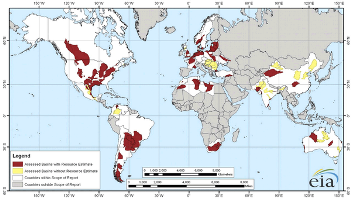
World Shale Gas Map / Photo credit: Energy Information Administration / Foter.com / Public domain

The shale gas revolution in the United States promises not only to soon make the country energy self- sufficient but also serve as the catalyst for a major revival of manufacturing.  Similar high hopes have been raised for Latin America, where some of the planet’s largest reserves of shale gas are found.  According to U.S. Energy Information Administration estimates, Argentina is said to have the world’s second largest reserves of technically recoverable shale gas (China is first).  The United States is currently in fourth place, followed by Canada and Mexico.  Brazil is in tenth place, with Chile and Paraguay not far behind.  The possibility that Latin America can pursue a successful shale gas strategy, however, is tempered by a number of important legal and/or geological differences that can serve as important bottlenecks.  In addition, the region’s tumultuous politics often get in the way of implementing policies that boost investment and encourage a highly productive energy sector.

The most important legal difference is that subsoil rights belong to the above ground property owner in the United States, while everywhere else in the Western Hemisphere the government (national, state or provincial) is the owner.  Developers have had an easier time purchasing access to shale gas deposits from individual landowners throughout the United States.  This explains, in great measure, why Canada’s significant shale gas reserves have not been as extensively exploited as in the United States, despite a hydrocarbons regime receptive to private-sector investment.  In addition, environmental protection legislation that impacts the shale gas industry is fractured among Federal, state, and local government authorities in the U.S.  That has facilitated developers extracting waivers and more lenient treatment in the United States that would be harder to obtain in most Latin American nations, where environmental protection is the exclusive or predominant prerogative of the central government.  Furthermore, current technology for extracting natural gas from shale reserves demands huge amounts of water, a resource that is scarce in those regions of Mexico, for example, where most of its extensive shale gas reserves are located.

Political realities are the most crucial (and often overlooked) factor that can easily undermine any effort to develop Latin America’s extensive shale gas reserves.  On paper, Argentina should be a regional energy powerhouse, supplying not only its own energy needs but those of its neighbors. However, the country has for years pursued policies that have scared off private-sector investment, heightened Argentine dependence on foreign energy imports, and led to a steady hemorrhaging of hard currency reserves.  To outsiders these policies appear illogical, but they make perfect sense to Argentine political leaders trying to consolidate their power base.  Mexico is an example of a country constrained by its Constitution from developing its extensive off-shore hydrocarbon resources.  Any political party that tries to make major amendments to those constitutional provisions, however, risks annihilation at the polls.  Brazil’s recent adoption of nationalistic legislation to encourage the domestic manufacturing of hydrocarbon-related technology could well impede exploiting its shale gas reserves if similar mandates are created for the highly specialized and capital-intensive hydrofracking equipment the industry utilizes.  In fact the only Latin American country where the stars seem aligned to repeat the U.S. shale gas success story is investor-friendly, politically-stable, energy-starved, and free-market oriented Chile, whose shale gas reserves are concentrated in the remote, under populated (and very wet) far south of the country that desperately seeks new opportunities to promote local economic development.  

*Thomas Andrew O’Keefe is the President of San Francisco based Mercosur Consulting Group, Ltd. and teaches at Stanford University.

ALBA’s Future: Continuity or Break Down?

By Marcela Torres

ALBA Emblem | public domain

ALBA Emblem | public domain

The death of Hugo Chávez last March and the increasingly severe economic dislocations inside Venezuela have raised serious questions about the sustainability of the Bolivarian Alliance for the Peoples of the Americas (or ALBA).  Born out of an agreement between the Venezuelan and Cuban governments in 2004, the alliance was intended as a response to the U.S. goal of a Free Trade Area of the Americas (FTAA), as well as a vehicle for Chávez to project his Bolivarian vision for Latin American solidarity around a socialist project.  The regional bloc won its first symbolic battle at the Fourth Summit of the Americas in 2005, where Argentina, Brazil, Uruguay, and Paraguay definitively halted negotiations led by U.S. allies to create a single hemispheric free trade area (excluding Cuba, of course).  Over time, ALBA and its oil-based extension, Petrocaribe, have had a significant impact on economies in the region, providing crucial underpinning for presidents who signed on to Chávez’s vision for ideological or pragmatic reasons.  Among the greatest beneficiaries have been the Castro government in Cuba and the Ortega government in Nicaragua, which have received petroleum in exchange for food, in the case of Nicaragua, and doctors and teachers, in the case of Cuba. Ecuador and Bolivia, along with several states in the greater Caribbean, have also become key players in the ALBA network.

Venezuela’s leadership of ALBA, frequently described as “petro diplomacy,” has repeatedly come under fire from the country’s political opposition and from government critics in other ALBA-friendly nations.  The critiques in Venezuela rarely acknowledge the degree to which petro diplomacy has been a recurring feature of that country’s foreign policy, most notably during the governments of Carlos Andrés Pérez in the 1970s and 1980s.  Critics inside Venezuela and beyond frequently accused Chávez of building dependent clientelistic networks with countries desperate for energy resources. However, ALBA activities have transcended ideological divides, a fact demonstrated by Misión Milagro in Colombia, where Cuban doctors indirectly supported by Venezuela provide medical services in conflict zones.  If Chavez’s oil and charisma initially defined ALBA’s possibilities, the alliance has also fostered economic ties and investments among member countries, independent from Venezuela.

Though the election of Nicolás Maduro as Chávez’s successor might appear to guarantee political continuity, lacking Chávez’s charisma, Maduro might not be able to continue Chávez’s level of oil-fueled investment in ALBA.  Public spending in Venezuela continues to increase dramatically, with the fiscal deficit at 9-12 percent, inflation exceeding 40 percent, and the scarcity of dollars contributing to shortages of basic consumer goods.  To sustain its financial backing for ALBA, Maduro will have to stabilize the economy at home lest he lose the  popular legitimacy — no simple challenge.  Following the Twelfth Presidential Summit of ALBA in July, the presidents of Ecuador, Bolivia and Nicaragua joined Maduro in reaffirming their shared commitment to a socialist project in the region and a desire to maintain the international exchanges initiated by Chávez, suggesting that the alliance will not disappear at least in rhetoric in the medium term.  It is possible, however, that Maduro’s leadership will be challenged.  After the airplane in which Bolivian President Evo Morales was traveling was not allowed to land in France and Portugal this summer,  he proposed creating an ALBA army and convening another anti-imperialist summit.  Recently re-elected Rafael Correa of Ecuador has also hinted he might want to lead ALBA.  Without Venezuelan oil and sweeteners like Petrocaribe, it’s hard to see how ALBA will amount to more than a platform for personalistic agendas.


Mexico: Peña Nieto’s Big Push

By CLALS Staff

President Enrique Peña Nieto / Photo credit: Eneas / Foter / CC BY

President Enrique Peña Nieto / Photo credit: Eneas / Foter / CC BY

President Peña Nieto’s reformist agenda wins kudos from the business and financial class, but both a recalcitrant leftist opposition and mass organizations previously aligned with his party are taking to the streets in protest – raising serious doubts about its prospects.  In his first state of the nation speech, delivered last week, Peña Nieto pledged to plow ahead with “transformational” reforms, giving flesh to the PRI’s slogan that it is Transformando a México. In education, he’s proposed a more rigorous system for hiring, evaluating, promoting and firing teachers who have resisted change despite evidence that the current system is not equipping Mexican youth for employment.  In the energy sector, he wants to open up the oil and gas industry to foreign investment, an idea that was strictly off-limits in the past even though lagging investment has caused production in Mexico’s leading export industry to decline steadily.  He is also pursuing tax reforms that, although watered down when announced on Sunday, entail political risk and, tellingly, raise marginal rates by 2 percent for higher earners and impose a levy on capital gains.  In June, he picked a fight with powerful business leaders over control of the country’s telecommunications industry, an oligopolistic structure that imposes excess costs on consumers and producers alike, diminishing Mexico’s economic competitiveness.

The teachers unions, whose symbiosis with the PRI in the past ensured cooperation, mobilized huge protests in Mexico City, forcing Peña Nieto to delay his speech by a day and then causing monstrous traffic jams during it.  The President cloaked his announcement of the energy reform in nationalistic rhetoric, and PEMEX, the oil company, followed it up with predictions of positive results – huge increases in oil investment and production that purportedly would help to create 500,000 new oil-sector jobs by 2018 and 2.5 million by 2025. But opposition to the reform has been strident, and tens of thousands filled the Zócalo on Sunday to protest it as a “covert privatization.”  Opposition leaders are already pledging demonstrations to oppose taxes, though the likelihood of this may be diminished because the long rumored reform unexpectedly left untouched the value-added tax exemption for food and medicines, which would have been a major rallying point for the Left.

Some Mexican commentators say Peña Nieto’s leadership is already losing its shine and that his Pacto por México, the loose coalition he engineered in Congress, is at risk of falling apart.  He prevailed in his congressional showdown over the long overdue education reforms, but success in transforming the underperforming education sector appears uncertain, as the teachers are threatening more protests.  The arrest of narco bosses from the Gulf Cartel and the Zetas have not given him a bounce on the security front; indeed, Mexican press reports indicate that kidnapping, extortion and other crimes that more directly affect citizens’ lives continue to rise. Further complicating Peña Nieto’s life is news last month that the economy is slowing down.  The first contraction in four years has forced the government to cut its 2013 GDP growth forecast in half, to 1.8 percent.  The administration will undoubtedly point to data showing that PEMEX production has fallen by about a quarter in the past decade because of low investment, and will emphasize that this makes modernization of the oil sector all the more imperative.  But Mexicans have heard promises before, during NAFTA debates and since, that economic reforms and greater openness to trade and investment will massively improve their lives.  Whether there is any fuel left in that rhetorical tank remains to be seen.