OAS Continues to Dodge Accountability for Actions in the 2019 Bolivian Election

By Francisco Rodríguez and Jake Johnston*

A march in favor of Evo Morales / Santiago Sito / Flickr / Creative Commons license

The failure of the Organization of American States (OAS) to explain false claims of fraud it made during the Bolivian elections in 2019 – allegations that played a key role in the military ouster of President Evo Morales – continues to fuel doubts about its ability to monitor elections fairly and objectively.

  • Shortly after Bolivian electoral authorities announced preliminary first-round results showing that Morales had surpassed the 10 percentage point margin of victory necessary to avoid a runoff, an OAS electoral observation mission released a statement expressing “deep concern and surprise at the drastic and hard-to-explain change in trend.” It said the updated vote count “drastically modifies the fate of the election and generates a loss of confidence in the electoral process.” An audit report later published by the OAS claimed to uncover evidence of “a massive and unexplainable surge in the final 5 percent of the vote count” without which Morales would not have crossed the 10 percent margin. 
  • OAS Secretary General Luis Almagro publicly supported the Bolivian Army’s decision, after three weeks of civil protests, to coerce Morales and much of his government into resigning, paving the way for a caretaker government of questionable legitimacy. Almagro stated that “Yes, there was a coup d’état in Bolivia; it occurred on the 20th of October when electoral fraud was committed.” He said, “The Army must act in accordance with its mandate. No one has exceeded their power so far.” 

The OAS has not responded to requests for information about its analysis. Academic and media studies, however, have shown that the OAS analysis was marred by incorrect methods, coding errors, and misrepresentation of results. In a peer-reviewed paper forthcoming in the Journal of Politics, Nicolás Idrobo, Dorothy Kronick, and Francisco Rodríguez (a co-author of this post) show that, rather than “inexplicable” as the OAS alleged, the final results were predictable. They identified mistakes that, if corrected, would have erased the alleged “surge in the final 5 percent of the vote count.”

  • The “change in trend” the OAS claimed to have identified was essentially a matter of votes from certain geographic areas being processed and counted before votes from other areas that were more favorable to Morales. The OAS finding was due to a statistical method that misrepresents data at the “breakpoint” at which fraud is tested for. 
  • When it released its final audit a month after the election, the OAS claimed it confirmed evidence of fraud, but it did not reveal that its calculation excluded the last 4 percent of tallies. These votes were presumably the most likely to be tampered with, but they were among the less pro-Morales. If included, there is no “break in trend” as alleged.
  • Research by David Rosnick of the Center for Economic and Policy Research (CEPR) shows that a coding error caused the OAS to incorrectly sort time stamps by alphabetical instead of chronological order. An earlier CEPR study showed that the OAS audit withheld information from its comparison of physical vote tallies with those in the online database that did not support the allegations of fraud. 

These mistakes would have likely been identified rapidly by experts had the OAS followed basic standards of transparency. The OAS’s lead researcher has acknowledged at least some of these mistakes, but the flawed analysis remains on the OAS website, and the OAS has not issued a retraction nor amended the sections of the report that present the incorrect results. Mexico and Argentina have tried to discuss the issue within the organization, but Almagro’s office has refused to address the rebuttals. 

  • In March, the U.S. Congress, which provides the majority of the OAS’s budget, passed language in an omnibus spending package that requires the State Department to consult with independent experts and produce a report on the “legitimacy and transparency” of the 2019 Bolivian election within 120 days. The report, due last month, is expected to address the role of the OAS in that election.

OAS technical experts and political leaders’ role in what amounted to a military coup against a democratically elected president has raised questions about their competence and commitment to the democratic values the organization espouses. Errors in coding and calculations may have been merely technical, but political interference cannot be ruled out without a proper investigation. The Secretary General’s explicit support for the removal of Morales was clearly a political decision. 

  • With threats against democratic processes intensifying in many countries, the need for truly independent and neutral observer missions has never been greater. The lack of OAS accountability in Bolivia opens the door for others in the region to levy false allegations of electoral fraud in hopes of receiving international support.  

August 18, 2022

*Francisco Rodríguez is a visiting senior economist at the Center for Economic and Policy Research (CEPR) in Washington, DC, and Professor at the Korbel School of International Studies of the University of Denver. Jake Johnston is a Senior Research Associate at CEPR. 

Chile: Constitutional Process Has Settled Little

By Carlos Cruz Infante and Miguel Zlosilo*

Demonstrators in Santiago, Chile call for a new constitution / www.jpereira.net / Creative Commons license

The Chilean Constitutional Convention handed its proposed draft to President Gabriel Boric on July 4 – in preparation for the “exit” referendum on September 4 that will approve or reject country’s new magna carta – but it hasn’t achieved the national unity, social cohesion, or popular support envisioned when 78 percent of Chileans voted for the convention in 2020.

Historical center-left leaders are publicly supporting the nay option, and opinion polls show support is declining.

  • Former President Eduardo Frei Ruiz-Talge (1994-2000), a Christian Democrat who played a key role after the Pinochet dictatorship, has urged rejection because he sees “insurmountable disagreements with contents [of the draft] that compromise peace, democracy and the prosperity of our country.” He said the proposed reduction in presidential power and creation of an omnipotent new Senate could lead to dangerous populism. Former President Ricardo Lagos (2000-06) has not rejected the draft, but he has pulled back from his expected endorsement of it – a blow to the Boric government strategy for approval.
  • Leading opponents of the Pinochet-era Constitution, including former senior government officials, have criticized the proposed replacement, writing that “the electoral system is distorted with reserved seats, which reminds us of the institutional [appointed] senators of Pinochet’s Constitution.” Like Frei, they believe that the proposed system would incite conflict rather than cooperation.
  • The eight most reliable polls in the country show likely yay votes for the draft are dropping – from around 50 percent in February to about 35 percent this month. Nay votes rose from a third to roughly 50 percent in the same period. Activa Research has found that 62 percent reject the draft, while 38 percent approve of it. The 30 percent who were “undecided” last month has dropped to 20 percent, with most now rejecting the draft.

Five major factors – not all of which are the Constitutional Convention’s fault – appear to be driving this shift.

  • The Convention majority rejected pleas for greater fiscal responsibility as it wrote in a series of expensive new entitlements and nationalizations. Sponsors’ reactions to the criticism also alienated voters by saying “you stand with us, or you stand with Pinochet’s dictatorship.”
  • Favoritism and strident ideological positions undermined consensus. Most of almost 80 percent of Chileans who voted for the constitutional process in 2020 believed the new Constitution would be, for good, a “casa de todos” in terms of the social contract. The tense and confrontational debate during the process and its outcomes establishing group rights rather than universal policies let them down. 
  • Economic uncertainty since the social upheaval of 2019 – aggravated by the COVID‑19 pandemic and war in Ukraine – has undermined popular support as well. Inflation has risen steadily, and the Chilean peso has plunged to a historical low.
  • People feel insecure. The government’s performance in managing crime, drug trafficking, and the armed conflict in the south of the country against Mapuche extremist factions has not been satisfactory. Boric’s emphasis on a negotiated settlement has failed and may have worsened the problem.
  • Approval for Boric, sworn in less than five months ago amid great expectations, dropped to 34 percent this month, the lowest of his mandate. Poor communications have pushed the First Lady (who serves as head of Sociocultural Coordination) and Minister of Interior Izkia Sichesto to have the lowest approval ratings of the cabinet. Although Boric has repeatedly denied that his administration backs the yay option, his General Secretary of the Presidency affirmed earlier this year that Boric’s program requires the new Constitution to be approved.

No matter how the plebiscite on September 4 turns out, the Constitutional process now appears far from ending – and threats to political stability seem likely. If Chileans approve the draft, both sides will seek significant changes. If they reject it, changing the 1980 Constitution will still be essential to avoid tumult in the streets like rocked the country in 2019. Boric recently suggested starting a new Constitutional process from scratch, fueling further uncertainty.

  • While frustrations appear likely to grow and the chance of instability is not negligible, the Constitutional Convention process has shown that – so far – Chilean institutions have been able to maintain Rule of Law. Compared to Venezuela (1999), Bolivia (2006), and Ecuador (2007-08), Chile has followed an open and relatively stable track. But if the plebiscite does not deliver a clear, workable verdict in September, the country will again be at a crossroads – either build on what it’s accomplished since 2019 or try to start anew.

July 27, 2022

*Carlos Cruz Infante is a sociologist and has served in several senior strategic planning positions in the Chilean government. Miguel Zlosilo is a sociologist and former chief of research of the Secretary of Communications in the second Sebastián Piñera government (2018-21). This updates their recent AULABLOG articles (here and here) on the topic.

Costa Rica: The First Months of an Atypical President

By Ilka Treminio*

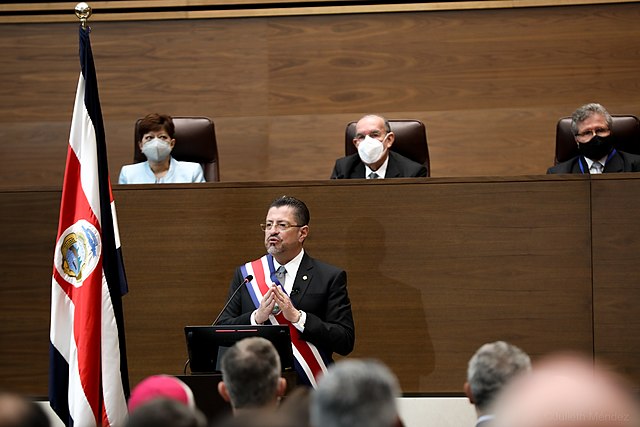
President Rodrigo Chaves Robles speaking before the Costa Rican Legislative Assembly / Julieth Méndez, Office of the President of Costa Rica / Wikimedia Commons / Creative Commons license

Costa Rica’s new President, in office for less than 90 days, is struggling to establish his credibility and launch his agenda. A political neophyte, Rodrigo Chaves Robles presented himself as the candidate of the recently created Progreso Social Democrático (PSD) party. He had no political career beyond serving as Minister of Finance for six months. He studied economics and was a professional on the staff of the World Bank, where he held senior positions for 27 years.

  • The Costa Rican elections were characterized by several key factors, including the lowest voter participation (56.76 percent) since the country’s return to democracy in 1948; the highest number of political parties (25); and a campaign aggressively focused on allegations of abuse by candidates. Chaves was accused of sexual harassment during his time at the World Bank. His main opponent, José María Figueres of the Partido Liberación Nacional (PLN), was alleged to have participated in various acts of corruption as President in the 1990s. Chaves’s PSD is accused of creating a parallel campaign finance tool that the Tribunal Supremo de Elecciones (TSE) is now investigating.  

Chaves assumed office in May with several immediate challenges. As happened in the 2014 and 2018 elections, the President — who won only 10 of the 57 seats — took office with a parliamentary minority. The strongest party, with 19 congressmen, remains the PLN, and another four parties have members of the Legislative Assembly as well. Of all of them, only the Frente Amplio (FA) is left-of-center; the others are in the center and on the right, which augurs a significant shift of the social and economic models of the country.

  • The Legislative Assembly in May held an historic vote to name Rodrigo Arias as its legislative director — a PLN operator who’d served twice as Minister of the Presidency to his brother, popular ex-President Óscar Arias Sánchez (1986-90 and 2006-10). At the top of the new legislative director’s priorities is a state reform law drafted by a special commission headed by Eliécer Feingzaig, widely known for his anti-state agenda. The commission is expected to draft legislation that will reduce or close public institutions and advocate other policies to diminish government.

Chaves’s style suggests that he wants to even out the competing powers between the Executive and Legislative, although at the risk of showing a propensity for emitting decrees.  

  • His most important measures so far have dealt with economic matters, such as one that made the so-called regla fiscal— a complex budget rule that limits government spending to GDP growth and controls on national debt — more flexible, so that he can pursue programs he ran on. He has been criticized because such flexibility was why he resigned as Finance Minister in the past. Another measure was to double senior government officials’ salaries at a time of austerity and reduced spending.
  • Chaves hasn’t been very effective with the Judiciary either.  In an exchange with the President of the Supreme Court of Justice about a ruling on citizens’ rights to speak out against him, his words prompted the court to admonish him for failing to respect the separation of powers.

President Chaves in his first months has been different from his predecessors. His speeches and actions seem guided more by impulse than the deployment of government strategies, which is odd for a technical expert from the World Bank. That approach might appear attractive to certain sectors of the population, but it entails risks for the country’s institutions by appearing personalistic and critical of established institutional procedures. The leadership of Rodrigo Arias in the legislature can be key for the country’s more conservative and traditional sectors — and undermine Chaves’s agenda.

  • Chaves himself is a conservative, but he is more prone to talk with non-traditional sectors and to listen to them. His unusual Presidential style is provoking expectations that he will perform. He seems to be seen by many Costa Ricans as caring about institutional actors, human rights defenders, and some communications media. Over time, however, he will have to watch out that he does not get blamed by disgruntled sectors of society as the man responsible for their unhappiness. Even if his political opponents push the policies that undermine people’s livelihoods — slow government institutions, economic decline, ineffective pacts between political forces, slow progress for the rights of women, LGBTQI+, immigrants, and others — he is the one who would pay the biggest price.

July 6, 2022

Ilka Treminio Sánchez is the director of La Facultad Latinoamericana de Ciencias Sociales (FLACSO) in Costa Rica, and a lecturer and researcher at the University of Costa Rica, specializing in electoral processes, political behavior, presidential reelection, and Latin American comparative politics.

Peru: Castillo Surviving Against All Odds – So Far

By Cynthia McClintock*

Demonstrators clash with police officers during a protest against Peru’s President Pedro Castillo after he had issued a curfew mandate / Angela Ponce / Sunday Times / Creative Commons License

Peruvian President Pedro Castillo has prevailed in two impeachment votes, but new impeachment threats are almost certain – and the President may continue to prevail but is unlikely to consolidate his administration. Castillo and the Congress have been at loggerheads since Castillo’s inauguration in July 2021. The reasons for the severe impeachment threat are manifold.

  • From the start, many Peruvians hoped for a “do-over” of the 2021 elections. In a field of 18 presidential candidates, Castillo won only 19 percent of the first-round vote, and many observers speculated that he would have lost the runoff to any of the other candidates except the actual runner-up, Keiko Fujimori, whose organized base was much smaller than in previous years due to corruption revelations. In the Congressional vote, Castillo’s party tallied only a tad less than one-third of the seats, with the rest split evenly between hard-right parties and non-programmatic, “centrist” parties.
  • While impeachment requires a two-thirds Congressional vote, the grounds for impeachment – in particular, “moral incapacity” – are vague. Since 2000, three Peruvian presidents have left office upon impeachment or imminent impeachment.

Castillo has steadily lost popular support; his approval rating has fallen to about 25 percent. Skyrocketing prices for food and fuel have taken a toll. Last week, a strike led by truckers paralyzed much of Peru’s highlands. This week’s massive protests are another sure indicator. Although the government continues to claim leftist credentials, it has not spearheaded significant new initiatives for social justice.

  • A large number of Castillo’s cabinet ministers have been unqualified. For example, a recent health minister, Hernán Condori, promoted “micro-cluster” water as a remedy for COVID‑19 without scientific evidence; the Peruvian Medical Federation repeatedly asked for his resignation – and he was finally ousted. Castillo’s first set of hapless appointments was widely attributed to his inexperience, but when he appointed his fourth cabinet last month, it appeared that he prioritizes loyalty, not competence.
  • Evidence of government corruption is considerable. Against Peru’s rules, Castillo holds irregular meetings with VIPs outside the Presidential Palace. As part of an expected plea bargain in late March, lobbyist and one-time friend Karelim López gave prosecutors information supporting charges against Castillo’s former chief aide (Bruno Pacheco) and two of Castillo’s nephews for illegal gains from state contracts in the Transport and Communications Ministry.

The President has survived through wily tactics and through legislators’ self-interest.

  • A key figure in Castillo’s party is its founder, Vladimir Cerrón, who recruited him to be the party’s 2021 candidate. Cerrón has been dubbed “El Otro Vladi,” in reference to Vladimiro Montesinos, the spymaster behind the crimes of former President Alberto Fujimori. Through promises of projects in their home areas or government positions, the government has co-opted numerous legislators. The perceptions of government guile are such that, after Peru’s Constitutional Tribunal last month pardoned Fujimori’s corruption and human rights charges, a prevalent rumor was that the government had made a backroom deal with pro-Fujimori leaders for their Congressional votes.
  • For the most part, the government has retained the votes of Peru’s “modern left” – legislators concerned not only about poverty but also gender rights, indigenous rights, and climate change, and committed to democracy – who hold about 5 percent of Congressional seats. At the start, dismayed by the hard-right’s hasty calls for Castillo’s impeachment and assuming that he would appoint a broad-based cabinet, the modern left supported the President. Now they are worried about the President – and also about whether or not their fate is linked to the government’s.
  • Peru’s Congress is as unpopular as Castillo. In particular, the Speaker of the Congress (next in line for succession to the presidency after the Vice-President), María del Carmen Alva of Acción Popular, is unpopular; she is perceived as arrogant and rude. In opinion polls, 80 percent of Peruvians say that, if Castillo is impeached, they want new elections not only for President but also for Congress. However, Peruvian law does not allow re-election of legislators, meaning that all the current legislators would lose their jobs and would fight the move.

While Castillo seems likely to continue to stumble and face challenges, there is some chance that Peru’s political impasse can be broken and a semblance of stable, effective governance restored. One possibility is that, at the end of Alva’s term in July, she is succeeded by a more capable and palatable Congress Speaker, and Castillo could be replaced without a popular demand for new Congressional elections. In its second search for a successor to an impeached president in November 2020, the Congress identified Francisco Sagasti, who was excellent. A second possibility, proposed by Sagasti himself, is a citizens’ initiative for a Constitutional reform that would shorten the terms of the President and the Congress – an initiative that would require only a simple majority in a Congressional vote.

  • Peru’s 2021 elections were held despite a devastating pandemic that obstructed campaigns and opinion polls. Last week’s ferocious protests in Huancayo – hometown of Presidential mentor Cerrón – and this week’s in Lima indicate that Peruvians are frustrated and angry as the war in Ukraine drives up fuel costs and Castillo’s agenda stalls. New elections may be the only way ahead.

April 7, 2022

* Cynthia McClintock is Professor of Political Science and International Affairs at George Washington University.

Brazil: Hoping for Better Times

By Fábio Kerche*

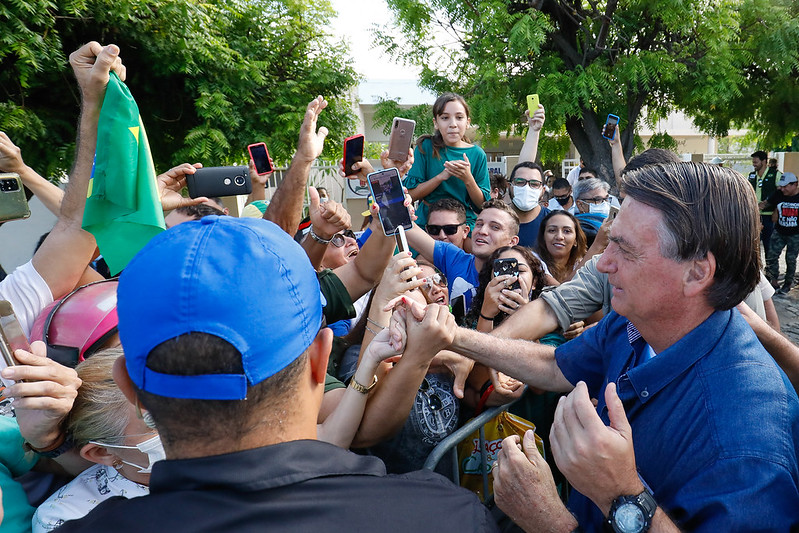
Brazilian President Jair Bolsonaro with a crowd of supporters/ Palácio do Planato/ Flickr/ Creative Commons License

Brazilian former President Lula da Silva begins his campaign for the October 2022 elections seeking to broaden his support beyond the left-wing – not just to win the election but to rebuild democracy and create a stronger base for a future administration. Cleared of the lawsuits that kept him out of the 2018 elections (which brought President Jair Bolsonaro to power), Lula leads all polls by a wide margin and could even win the 50 percent of votes necessary for a first-round victory.

  • In second place, albeit with a high level of voter rejection in surveys, appears Bolsonaro. Polls show that he has very faithful supporters – enough to survive the first round of voting – but that he will have problems attracting others in a second round. Much lower in the polls are Sergio Moro, the former judge who arrested Lula in conjunction with the Lava Jato case and prevented him from running in 2018, and Ciro Gomes, a former Lula ally who today variously presents himself as a left-wing or right-wing candidate.
  • The situation is so favorable for Lula that some political analysts speculate that Bolsonaro, Moro, and Gomes, unless their ratings turn around soon, could withdraw their candidacies and run for Congress instead. In Brazil, being a congressperson ensures protection from the Judiciary; members cannot be tried by lower court judges. Being out of office can be dangerous, especially for Bolsonaro, who faces an avalanche of corruption allegations (along with his sons) and possible charges related to policies stemming from the government’s handling of the COVID pandemic.

Lula’s ambitions include building political support in a Congress traditionally fragmented among multiple political parties. His strategy is to dialogue with all, from the moderate right-wing to those who supported his imprisonment for more than 500 days and the impeachment of his successor, President Dilma Rousseff.

  • He has surprised supporters by signaling that he will offer the vice presidency to former São Paulo Governor Geraldo Alckmin, positioned on the center-right in Brazilian politics. Alckmin, who was a member of the PDSB, a party historically opposed to the PT, ran for president against Lula in 2006. Observers believe an alliance with him does not give Lula a significant boost – historically vice-presidential candidates don’t bring in a substantial number of votes – but its symbolism is strong, signaling that a priority is to protect the democracy threatened by Bolsonaro. What is at stake in this perspective are not public policies, as in a normal political campaign, but rather ensuring democracy itself.

Lula’s outreach and emphasis on building a moderate unity government seem intended both to win the election and set a new tone in Brazilian politics – leaving speechless those who accused him of being radical. There is little cost in terms of policies; the platform is not very different from what he did in his past administration: social policies with moderation in the economy. The market is already responding positively and lessening its aversion to the former president. Lula is trying to remind them that in his administration the poor improved their lives, but the economy was in very good shape as well.

  • If Lula should become the new president in 2023, as appears likely, he will still face many arduous tasks. The Bolsonaro government has dismantled many public policies without presenting alternatives. Cuts in the budgets for health, education, science, technology, and more have significantly reduced capabilities. In addition, Bolsonaro appointed unqualified heads in important agencies, disorganizing public services. The economy is bad; inflation is back (10 percent last year); and unemployment is high (11‑13 percent). The International Monetary Fund has forecast a 0.3 percent GPD increase in 2022. Lula is remembered as a great president – he left with 87 percent approval ratings – but he can’t work miracles. In any case, Lula seems to be the hope of better times for more and more Brazilians.

February 17, 2022

* Fábio Kerche is a professor at UNIRIO in Rio de Janeiro. He was a CLALS Research Fellow in 2016-2017.

Honduras: Is the Coup Finally Over?

By Fulton Armstrong*

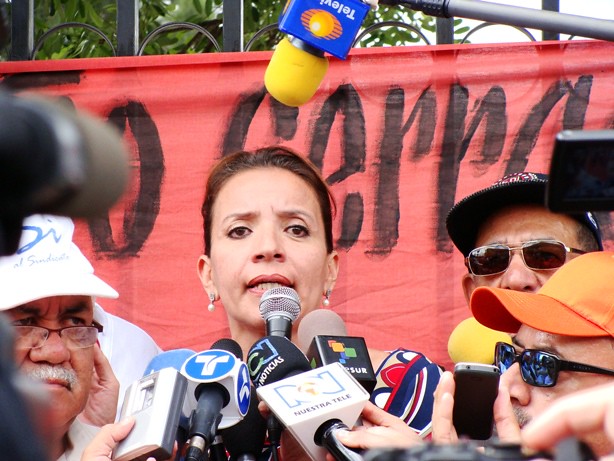
Honduran President-elect Xiomara Castro/ hablaguante/ Flickr/ Creative Commons License

Honduran President-elect Xiomara Castro’s actions since her election on November 28 reflect optimism that the country can turn the page on the 12 tumultuous years since the military coup that forced her husband out of the country at gunpoint – and realism about the monumental tasks ahead. The voter turnout (69.28 percent) and her 15-point victory over the incumbent party’s candidate were historic. So was the level of violence – 23 candidates murdered – during the campaign.

A similarly historic basket of problems awaits Xiomara when she’s inaugurated on January 27.

  • Experts say that the government is bankrupt because of corruption, mismanagement, downturns in commodities on which the country has traditionally depended, two major hurricanes last year, and the COVID-19 pandemic. The country’s foreign debt burden is more than $16 billion (nearly 60 percent of GDP), and the economy contracted 9 percent last year. Former Finance Minister Hugo Noé, Xiomara’s senior policy advisor during the campaign, says his team is already dialoguing with the IMF on a new debt deal.
  • U.S. investigations into outgoing President Juan Orlando Hernández (JOH) are reportedly very close to seeking his extradition for trial – which would thrust Xiomara’s young administration into a potentially major political crisis. JOH’s broad network of accomplices are not likely to go quietly either.

Most of the President-elect’s early actions have centered on building an effective transition to what she calls un estado solidario – drawing positive feedback even from potential opponents so far.

  • A transition commission is beginning a national consultation on priorities, especially “the elimination of poverty and hunger” among the 74 percent of Hondurans who are poor and 53 percent extremely poor. Noting that corruption is a major root cause of the country’s economic mess, Xiomara is calling for vigorous anticorruption efforts, including some with UN support, and for repealing the “impunity laws” and “secrecy laws” that have allowed illegal dealing that saps government resources. To address the violence that terrorizes citizens and drives them to migrate, she says she “will fight narco-trafficking head-on.”
  • She has pledged to fight for the protection of women and their rights. Honduras has the highest rate of femicide (4.7 cases per 100,000 women last year, according to CEPAL) and gender violence in the hemisphere – an ugly reality that analysts say is another root cause of migration. She’s advocated an unspecified loosening of restrictions on abortion, which is currently forbidden even in rape cases.
  • Potential opponents have so far gone along. The military high command, whose loyalty JOH worked hard to win, has released a statement committing to working with Xiomara and stating that “she will be the President and commander of the Armed Forces.” JOH allies in the business sector and traditionally conservative media such as the country’s largest newspaper, El Heraldo, have welcomed her.

Rhetoric that the 2009 coup reversed a flourishing democracy is exaggerated – it has always been a flawed democracy and ousted President Mel Zelaya, like his peers, was a flawed leader. But this vote and early reactions indicate broad agreement that the past 12 years have exhausted the country. Xiomara’s Partido Libertad y Refundación (LIBRE) has soundly thumped the country’s two traditional parties, sending both back to re-think their strategies.

  • Governing is likely to be a learning process for Xiomara. Some of her early foreign policy statements – such as repeating her pledge to normalize relations with China (a sovereign decision the United States and most in the hemisphere have taken) and issuing unvarnished praise for Venezuelan Presidents Chávez and Maduro – have drawn unwelcome attention, but she pulled back and quickly put the focus back on her top domestic priorities. She also has to continue finessing coalition politics; her vice president, right-of-center sportscaster Salvador Nasrala, seemed to wander during the campaign but turned out to be a good asset. Her husband, to whom she’s referred as her “best advisor,” still has a reputation that will require some managing.

The U.S. reaction to her government will be crucial. Xiomara’s agenda, with its focus on the “root causes” of the country’s multiple crises, could make her an ideal ally to U.S. Vice President Kamala Harris, who’s worked hard to focus U.S. policy on those drivers. Neither woman can be expected to do magic, but stopping Honduras’s slide, which started under the putschist regime in 2009 and continued under the two National Party presidents who came after, would be a major victory in itself. The surge in Hondurans encountered on the U.S. border – up to about 300,000 in the past 12 months – has grabbed Washington’s attention, but the real test will be whether the Administration and the Honduran government can seriously address the root causes as promised.

December 9, 2021

Five Questions About Nicaragua’s Predicament

By A Long-time Observer*

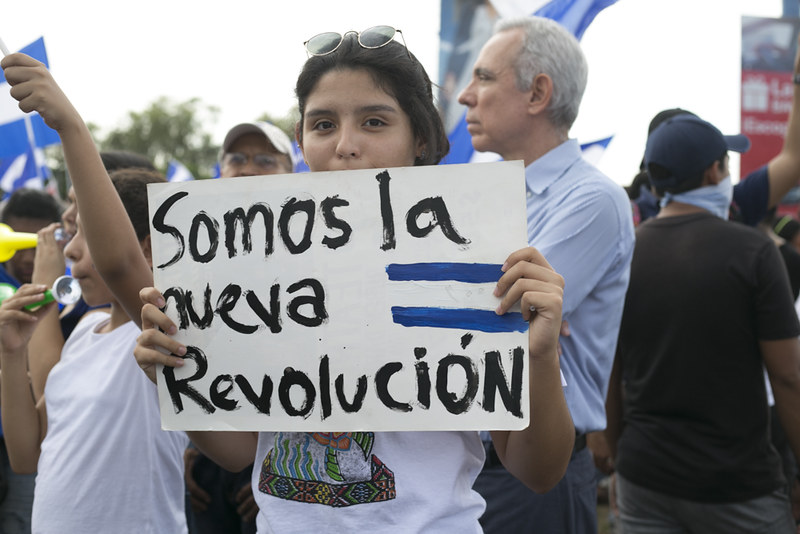
Students protesting against President Ortega/ Jorge Mejía Peralta/ Flickr/ Creative Commons License

As the people of Nicaragua prepare for presidential elections on November 7, they are a nation that sought to overcome dictatorship, revolution, and civil war by accepting and practicing democracy – just to find itself back at square one. The following questions address the recent past for an understanding of Nicaragua’s current predicament.

  1. How to explain President Daniel Ortega’s presence on the front lines of Nicaraguan politics for the last 40 years? Ortega has been head of government or head of the opposition in Nicaragua since 1979, when he led a coalition government of Sandinista guerrillas and independent civilians and then became President in his own right after elections in 1984. During the 1980s, the other main Sandinista leaders were busy running ministries and representing the country abroad, while Ortega started building a party structure loyal to himself. After losing the next election in 1990, his grip on the party increased as dissident Sandinistas left in protest over the transfer of public assets (mostly confiscated from Somoza and his cronies in 1979) as private property to the party leadership that remained loyal to Ortega.
  2. What is the Sandinista party (FSLN) today in terms of numbers, structure, and historical significance? The importance of the party structure has dwindled as the government relies more on alliances with non-Sandinista economic groups and Ortega becomes the great decider assisted by a small circle of confidants and family members. The party with a mass following is no more. Less able to mobilize people to counter or cower opposition as it might have done during, for example, the critical months of the 2018 uprising, it has resorted to outright repression (killings, imprisonments, exile).
  3. What was/is the role played by Venezuelan assistance during the latest Ortega governments? When Ortega returned to the presidency in 2007, Nicaragua was still recovering from the Contra War of the 1980s, which had drained the country of productive resources, and three neoliberal administrations, which cut social spending and sought to attract private investment. The 2008 worldwide economic downturn was an early challenge. President Hugo Chávez of Venezuela immediately stepped in to assist by providing Nicaragua with oil on credit and by purchasing foodstuffs for his own country. From 2010 to 2014, Venezuela provided more than $500 million yearly in petroleum. Venezuelan aid also altered the composition of the Nicaraguan business class by allowing Sandinista entrepreneurs to access credit and subsidies from semi-private companies set up to handle Venezuelan oil imports, as well as supporting social programs for their base in the countryside and urban barrios.
  4. What role does the private sector play in Ortega’s Nicaragua? Outside of the new Sandinista-owned businesses, the principal beneficiary of Venezuelan assistance was the traditional private sector headed by the country’s large agribusiness and banking concerns. Ortega mostly abandoned his revolutionary rhetoric and embarked on a new national development policy defined as “socialist, Christian, and caring,” while Nicaraguan companies exported meat and cereals to Venezuela at market prices. COSEP, the largest private-sector interest group, gave legitimacy to the alliance of convenience between Ortega and his public-private hybrid model. The economy grew at respectable annual rates of 4.5 percent to 6.0 percent from 2010 to 2017, but Venezuelan assistance declined after 2015, as did the Nicaraguan economy shortly afterwards. The last three years have witnessed negative economic activity, compounded by COVID‑19 and political unrest.
  5. What is the nature of the opposition to Ortega and how does it resemble opposition to the Somoza regime of decades past? It is difficult to estimate what proportion of the electorate would still support Ortega in an open election. There are no recent trustworthy polls, nor has the opposition been allowed to mobilize in public gatherings or participate in open political debate. However, the manner in which the regime has declared most, if not all, opposition candidates ineligible to run, and arrested many others, would suggest that it fears even the most timid of rivals. Nor does it have the economic resources to fund a large-scale campaign with even token opposition candidates akin to the “loyal” opposition that the Somoza dictatorship cobbled together to provide a veneer of legitimacy.

Ortega finds himself bereft of strong international support – even from a Latin American left that historically sided with the Sandinistas in their struggle against imperialism and interventionism – and must rely increasingly on the police and the army as a line of last defense. The army chief since 2010, General Julio César Avilés Castillo, has presided over a noticeable increase in the strength of the Nicaraguan Army, including the purchase of T-72 tanks and armored personnel carriers – cementing its political loyalties. The police, too, are now equipped with late-model pickups purchased from a dealership owned by a close business apologist of the regime.

  • Nicaragua’s current political landscape has a lot more to do with power – political, economic, military – than with the wishes of the electorate or the respect for human rights. No one doubts that Ortega will win his fourth consecutive election – by hook or by crook – come November 7, and Nicaragua’s predicament will not be over until at least one of the legs of the Ortega alliance gives way.

October 20, 2021

South America: Mounting Tensions, Few Solutions

By Christopher Kambhu*

Protest in Colombia/ Oxi.Ap/ Flickr/ Creative Commons License (modified)

Across South America, calls for structural change have re-emerged on the streets and at the ballot box, but governments face many obstacles to constructively address them. These calls are a continuation of region-wide protests in 2019, when citizens demanded reforms or rewrites of the existing social contract to address various political, economic, and social inequities. While government pandemic measures pushed protestors off the streets throughout 2020, the pandemic has highlighted and exacerbated the inequities that prompted protests.

  • Inequities in Colombia have sparked nationwide social conflict. Protests against a proposed tax reform have broadened into demands for a basic income and accountability for security forces accused of killing dozens of protesters. Most protests have been peaceful, but radical groups have created “autonomous zones” free of police presence and established roadblocks, causing goods shortages in major cities. Negotiations between the government and protest leaders have yet to gain traction. President Ivan Duque’s approval rating has plummeted to historic lows as he appears unable to meet the moment. Backlash against demonstrators is emerging, with some wealthier residents violently repelling protestors from their neighborhoods.
  • In Ecuador and Peru, citizens have used the ballot box to voice their frustrations, leading to surprising electoral outcomes. Guillermo Lasso, Ecuador’s new center-right president, has formed a governing coalition with indigenous and social-democratic parties that are the second and third largest in the national legislature (Lasso’s party is the fifth largest). In Peru, provincial teacher and union leader Pedro Castillo has narrowly won June’s presidential runoff over Keiko Fujimori, the daughter of a controversial former president convicted of corruption and human rights abuses. Castillo’s far-left party, which began contesting national elections only last year, is now the largest in Peru’s legislature, but needs to forge complex alliances to govern effectively.
  • Chile took a different path. Under intense pressure, the government acceded to popular demands for a constitutional rewrite. A national plebiscite last October assented to the rewrite by a wide margin, and elections for the Constituent Assembly in May demonstrated widespread rejection of the current elites. Most members are political independents or newcomers; a sizable number rose to prominence during the initial wave of protests in late 2019. The membership has gender parity, a first for such a body, with 11 percent of seats reserved for representatives of indigenous groups.

Efforts to forge new social contracts are difficult at best and each path faces obstacles to success. Colombia’s current political leadership appears unable to calm tensions, and voters must wait until national elections next year to elect new leaders. While demands for change in Ecuador and Peru have elevated some candidates and parties to unprecedented success, sharp ideological divisions and partisan fragmentation in both legislatures appear likely to limit potential reforms. Castillo’s mandate is tenuous and weakened by Fujimori’s rather Trumpian allegations of fraud and attempts to throw out ballots. In Chile, the ideological diversity of the Constituent Assembly could very well preclude it from reaching the required two-thirds majority needed for any proposal to enter the new Constitution, which will be put to a national referendum in 2022.

  • The inequities exacerbated by COVID-19 and a busy electoral schedule will keep reform issues at the forefront of political discourse; these debates will likely intensify with 11 countries across Latin America holding national elections over the next 18 months. While upcoming elections offer a timely opportunity for citizens to push their countries in new directions, governments will face political, fiscal, and social challenges which threaten implementation of any proposed reforms. At this early stage in the region’s electoral supercycle, political leaders have yet to capably address their citizens’ demands.

July 7, 2021

* Christopher Kambhu is a Program Coordinator at CLALS.

Peru: Approaching Ungovernability?

Voting in Peru during the presidential election/ Presidencia Perú/ Flickr/ Creative Commons License

Disputes over the final vote count in Peru’s June 6 presidential runoff are likely to drag on, but those promoting fear and mistrust in the political system already appear to be the clear winners, with grave consequences for the future of the country’s democracy. The two leading candidates – leftist Pedro Castillo and rightist Keiko Fujimori – both represent significant threats to liberal democracy, and the country’s elites and media are complicitous in moving the country closer to ungovernability.

  • Castillo and his Perú Libre party ran on an unapologetically non-democratic platform, promising a Leninist government and suggesting an end to the democratic alternation of power. Fujimori defended the corrupt dictatorship of her father, Alberto Fujimori (1990-2000), and as leader of Fuerza Popular has fought a constant battle against the rule of law.
  • First-round voting in April showed that neither of them won many hearts and minds – 18.9 percent voted for Castillo and 13.4 percent for Fujimori – but they advanced because the other 17 candidates were even worse, deeply divided, and weak. Preparing for the second round, rather than reach out to the 70 percent of voters who rejected them, they showed the arrogance of immoderation and left citizens wondering which would be less likely to tyrannize them.

Other political leaders and the country’s elites, instead of demanding that the two candidates commit to democracy, made things worse. Unlike the elites in other countries, Peru’s do not seek to take over the levers of political power; rather, they are most comfortable maintaining a mediocre status quo. The left showed unconditional enthusiasm for Castillo, and conservatives like author Mario Vargas Llosa embraced Fujimori – while the two candidates proceeded to tear the country apart with fear-mongering, scare tactics, and empty promises.

  • Fujimorismo based its campaign on causing panic by feeding people’s fear of communism and terrorism, and linking Castillo to them. By mid-May, politicians who had said they’d hold their nose while voting for Keiko began casting her as a national savior. Her allies filled the streets with posters warning of the “Communist invasion.” Business leaders said they would fire employees if Castillo won. Castillo resorted to similar tactics to stir panic about a return of a Fujimori to the Palacio de Gobierno.
  • The media shed all pretense of independence and hyped these warnings as if truth, exhuming stories of terror from the past to drive home the point. Polls and vote results show, however, that the media’s gross bias prompted many voters who had intended to cast empty or unmarked ballots to vote for Castillo.

Peru may well be entering a period of ungovernability. Five years of political turmoil, corruption scandals, and institutional decay, under four different Presidents, had already wounded the country before this election, but fear – which, as Martha Nussbaum said, is the feeling that controls people, not liberate them – now runs even deeper and stronger. Well-founded questions about both Fujimori and Castillo’s commitment to democracy will keep tensions high, and the political, business, and media elites have created a climate in which allegations of fraud will persist despite international observers’ conclusions that the elections were clean. The forceful rejection of Fujimori by half of the population, and the Castillo’s utter lack of even basic governing skills are real risks. Arbitrary manipulations of the Constitution will be attempted to strengthen or weaken whichever government takes office. Calls for military intervention are certain. Political opposition will radicalize. The historic split between mestizo-dominated Lima and the rest of the country, vulgarly called la Indiada, is worsening.

  • But this is not Peru’s inescapable fate. Its democracy still gives the people the weapons with which to impede an authoritarian project. They do not have to believe that Fujimori’s backers are all corrupt anti-patriots, nor that all of Castillo’s are anti-Peruvian Communists. It’s true that the country has been wracked by the pandemic like no other, and that it is hindered by debt and other challenges. While neither of the candidates and their forces have demonstrated the greatness and humility needed to lead through these crises, rescuing Peruvian democracy requires accepting that the one with the most votes will be President, even if purely by chance, and deserves an opportunity to govern without calls for a coup to remove them. A country decimated by the pandemic needs the hope of being able to move into the future together.

June 18, 2021

*  This article is a synthesis and translation of commentaries and interviews by Alberto Vergara, who teaches at la Universidad del Pacífico in Lima and was co-editor of Politics after Violence: Legacies of the Shining Path Conflict in Peru.

Chile: Will the Constitutional Assembly Move Democracy Forward?

By Patricio Navia*

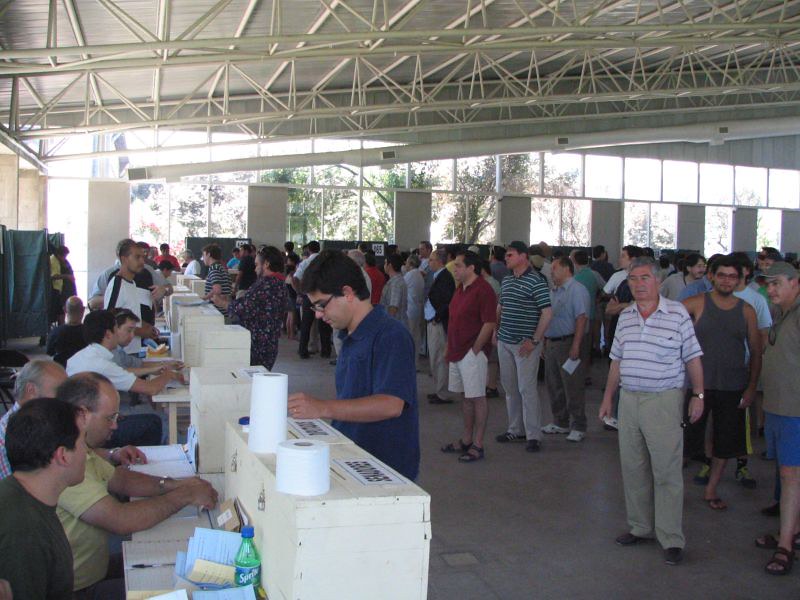
Polling place in Chile/ Atina Chile Elecciones 2005/ Flickr/ Creative Commons License

Chileans go to the polls this weekend to elect members of a constitutional assembly – empowered to write a new Constitution by a plebiscite last October – but unrealistic popular expectations in a highly political year appear likely to complicate its work and could result in a flawed document.

  • Almost 80 percent of the Chileans who voted last October (i.e., 80 percent of half of the country’s eligible voters) supported a rewrite of the Pinochet-era Constitution, promulgated in 1980. Voters also chose to elect a new 155-member assembly for the task, rather than form one from among prominent political and social leaders. The assembly will have nine months to draft the document (with an option for one three-month extension), which will be voted on in mid-2022.
  • Chile’s busy election calendar is likely to complicate the assembly’s work. Saturday and Sunday’s voting will also choose governors, mayors, and city councilors, and there are elections in November for Congress and a new President – threatening to create tensions and a perfect political storm that undermine the quality of the new magna carta. Some parties have already held internal primaries for their presidential candidates, and coalition primaries are scheduled for July 18. If no candidate receives at least 50 percent plus one of the votes in the first round of voting on November 21, the two leading candidates will compete in a runoff on December 19.

The flaws of the constitutional process itself are clear. One is that the guaranteed gender-parity condition (50 percent representation for men and 50 percent for women) risks a situation in which higher vote-getters are not seated. The assembly’s mandate also includes guaranteed representation for the indigenous – a noble goal that nonetheless could lead to distracting recriminations in a convention that, per the plebiscite, will require approval by two-thirds of delegates for every element of the new Constitution. The objective is to achieve what Chilean authorities have called “a high degree of consensus” but could actually put agreement out of reach.

  • In addition, the assembly will begin deliberations in late June, when the Presidential and Legislative campaigns will be underway. The new government will take office in March 2022, but the new Constitution will not be ready until the second half of 2022 – and ratified by an exit plebiscite even later. The new government will have to wait for over six months after its inauguration for the new Constitution to be finalized before it can begin to govern, and, even worse, the offices of those elected might not exist.
  • Another major challenge is disunity and, in some cases, a lack of vision in the traditional political parties. Parties of the right, which finally got out from under the shadows of the Pinochet dictatorship and problematic market reforms, now appear ill-prepared to lead as Chile enters a transition period. Despite two terms in office (2010‑14 and 2018‑22), President Piñera has not constructed a new model for the right in Chile and now, having lost much momentum, is unable to lead rightist parties sorely lacking leadership.
  • Polls indicate, however, that Chileans do not embrace the more state-oriented options espoused by the left. Citizens want robust social rights and a reliable social safety net – which the assembly will find easy to give them without having to identify funding sources – but studies show they strongly prefer a society based on competitive markets with the protections they get as consumers, preventing abuses and guaranteeing individual rights. The right has been unable to capitalize on these views and, ironically, has never been in such a position of weakness as it is now. When Chileans realize that the many promises of the Constitution cannot be materialized, they will feel cheated.

The plebiscite creating the constitutional assembly increasingly appears to have been an effort to exorcise the Pinochet government that wrote the 1980 Constitution – rather than a mandate for a new left-leaning model of governance. Neither will the new magna carta be a magic pill that will solve all of Chile’s problems, including inequality and deficient public health and private pension systems, as many voters undoubtedly wish. These unfulfillable expectations will weigh heavily on the assembly throughout this political year.

  • Failure of the assembly is not a foregone conclusion, of course. Even after we analyze the results of this weekend’s votes, we cannot rule out that the political parties and civil society might rise to the occasion of making the debate and drafting into a healing process. If President Piñera commits all his energy to leading his government and party until he steps down 10 months from now – a historic but difficult task for a lame duck with a checkered legacy – one challenge will be the balancing act between promoting his base’s agenda and reassuring others that their interests will be respected and included. For now, however, it’s hard not to conclude that Chileans underestimated the complexities that writing a new Constitution would entail, especially producing one that meets the high expectations of a people hungry for solutions.

May 14, 2021

* Patricio Navia is a sociologist and political scientist at New York University and professor of political science at Universidad Diego Portales in Santiago.