Cuba: Facing a Tough New Year

By Eric Hershberg, William M. LeoGrande, and Max Paul Friedman*

Intensified U.S. sanctions and the crisis in Venezuela are forcing renewed belt-tightening in Cuba and hindering the government’s ability to undertake even its modest economic reform agenda, but the country is not entering a new “special period” and significant instability does not appear likely in 2020 despite some increased social tensions. The big losers from U.S. sanctions are the small private-sector businesses — B&Bs, restaurants, and entrepreneurs — providing services to U.S. visitors, an estimated 638,000 a year before the Trump Administration clamped down over the course of 2019. But the government has also been forced to make major cutbacks.

  • To cope with fuel shortages caused by U.S. sanctions against oil companies shipping Venezuelan oil to Cuba, the government reduced production in many factories to maintain energy supplies to consumers and avoid overly straining the power grid. Public transportation also faced drastic cuts, largely because of a lack of diesel fuel needed to distribute gasoline. Only some of the affected bus routes have since been restored.
  • Shortages of an array of necessities — from bread, coffee, meat, and many basic medicines to all energy products — have been severe and show no sign of abating as the economy sputters. Domestic demand for products that Cuba can produce, including electric bicycles and appliances, is strong, but financing is too tight. The government is phasing out the convertible peso (CUC) that it artificially pegged to the dollar and is establishing new hard-currency stores to capture dollars now flowing abroad as Cubans buy both consumer goods and inputs for domestic private enterprises in Panama and elsewhere at the rate of $25 million per month — hard currency the government desperately needs. Those dollars the government captures will supposedly be made available for domestic producers to import essential inputs. Cubans expect the CUC to become worthless paper sooner as some vendors now accept only foreign currency, and the street value of a dollar is now more than 1.15 CUC (compared to the official rate of 0.87 CUC).

One leading economist deemed 2019 to have been the worst year since 1993 — with growth essentially flat — and said the forecast for 2020 looks no better. State-owned enterprises are failing to perform efficiently despite years of rhetoric about rationalization and improvements. Foreign purchases, long hindered by a lack of hard currency, have been made even harder by the U.S. sanctions, as suppliers increasingly fear Washington’s scrutiny. The government has not responded to growing pressures by accelerating the sorts of meaningful reforms that have long been needed to increase production and efficiency.

  • Its strategy focuses on import substitution, according to a senior economic official, to reduce the need for hard currency by producing more consumer goods and inputs domestically. The tourism sector has boomed over the past decade, but more than half the hard currency revenue it generates goes to imported inputs. Cuba spends some $2 billion importing food while more than half its arable land lies fallow.
  • Financing investment needed to make import substitution a viable strategy is difficult. Cuban government officials speak of doubling domestic investment, now only 11-12 percent of GDP, but without increasing indebtedness — a huge task for such an inefficient economy. In addition to encouraging tourism enterprises to substitute local for imported inputs, the government hopes to improve conditions during 2020 by implementing a decades-old proposal to establish a closed dollar-based system in which companies retain a portion of revenues to finance investment and imports.
  • Foreign direct investment is the other potential but a largely elusive source for capital. Government fact sheets continue to emphasize the importance of the Mariel Special Export Zone, which has some 50 promised users, $2.5 billion in promised activity, and 7,000 promised jobs. Actual activity in the Zone, however, falls far short of that. The Trump administration’s activation of Title III of the Cuban Liberty and Democratic Solidarity Act (“Helms-Burton”), which allows the previous owners of property expropriated after the 1959 revolution to sue anyone benefiting from it, has made new investors hesitant.

While the economic outlook looks difficult indeed, there are few signs that the government is anxious about social frustrations and tensions becoming a serious challenge, much less an existential threat. The government continues to resist obvious (and relatively easy) reforms, such as allowing cuentapropistas licenses for multiple lines of business. Allowing the CUC to disappear gradually may be a precursor to addressing the years-old distortions caused by the country’s multiple currencies and exchange rates, but there’s still no sign that the government is ready to implement a unified peso. Havana apparently calculates that the country is hardly the pressure-cooker that U.S. policy aims to create by, as U.S. Secretary of State Pompeo reportedly told EU diplomats recently, “starving” the population so as to bring about a regime collapse.

  • Young independent journalists say that public organizing via social media is at times successfully pressing the government, which they deem largely ignorant of popular concerns, to revoke unpopular measures. Yet growing access to the internet may also serve to distract youth from more threatening forms of organizing. Giving people a sense of input on issues like the arts, animal rights, and sexual identity that do not threaten core government policies and processes is probably taking an edge off discontent.
  • The new year is likely to be difficult, particularly as the Venezuela crisis drags on, but, as observers say, “Cuba does ‘bad’ pretty well.” Hope is never a plan, but virtually everyone in Havana expresses hope that U.S. elections in November might bring back a pro-engagement U.S. policy that helps grow Cuba’s private sector and relieving pressure on sources of financing for Cuba to move ahead with its modest reform strategy.

January 7, 2020

*AU Professors Hershberg, LeoGrande, and Friedman traveled to Cuba in December.

Argentina: End of the “Right Turn”?

By Santiago Anria and Gabriel Vommaro*

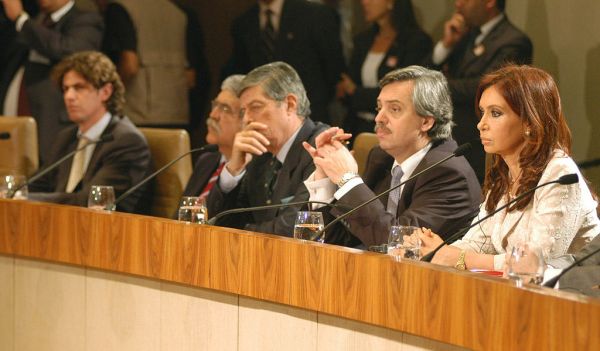
From right to left, Cristina Fernandez de Kirchner and Alberto Fernandez, and other ministers

From right to left, Cristina Fernández de Kirchner, Alberto Fernández, and other ministers / Wikipedia / Creative Commons / https://es.wikipedia.org/wiki/Archivo:Ministros_de_Cristina.jpg

The inauguration of Argentine President Alberto Fernández and Vice President Cristina Fernández de Kirchner last week confirms that the pronouncements of the death of Latin America’s “left turn” were premature — and that, rather than turning in any clear direction, political winds in the region appear to be blowing in all sorts of directions, with the only discernible underlying pattern being anti-incumbent votes following periods of economic crisis or economic downturns.

  • Obituaries for the “left turn,” which started in 1998 with the election of Hugo Chávez in Venezuela, have been appearing for years, particularly since the election of former President Mauricio Macri in 2015 and other right-leaning politicians in the region. Macri was widely seen as a bellwether of a broader “right turn” in the region — a turn that spread to Brazil, Chile, and elsewhere. For the very first time since the country’s democratic transition, a right-wing political party, in alliance with other parties, gained national power via democratic elections. To avoid the fate of other non-Peronist presidents, none of whom were able to finish their terms of office, Macri built a national coalition with broad societal bases of support.
  • The victory of left-Peronism in October, however, was formidable. The team of Fernández and Fernández obtained 48.1 percent of the votes, well above the 40.3 percent of the incumbent Macri. With two antagonistic camps capturing almost 90 percent of the vote, the elections were probably the most polarized since Argentina entered its democratic transition in 1983.

Rather than represent systemic shifts to either the right or left, the Fernández-Fernández victory is further evidence that Latin American electoral politics follow a routine alternation-of-power explained by retrospective, anti-incumbency voting driven by broad societal discontent — a sharp repudiation of incumbents that couldn’t deliver growth, adequate social services, and security. The left-right axis in Argentina is marked by high levels of polarization, with two major rival coalitions — Peronists and non-Peronists — structuring the electoral supply and disputing the center.

  • The defeat of Macri and his Cambiemos coalition revealed the center-right’s failure to carry out its desired free-market reforms aimed at dismantling the statist economic model based on the domestic market, wide social protections, and state intervention in the economy. Macri’s coalition lacked the unity to achieve pension reform and other difficult measures. Instead, Macri resorted to a “gradualism” that did not work in policy terms or politically. Similarly, his conciliatory approach to foreign creditors did not result in the expected capital inflows and economic growth. That fiscal gradualism was financed with a high rate of external indebtedness that made the Argentine economy even more fragile and ended in a massive financial crisis, after which the Macri government changed its approach towards greater economic orthodoxy.
  • The legacies of the previous Kirchnerist governments, including constraints on the government’s ability to cut spending, were also severe obstacles. Trade unions and social movements retained a high mobilization capacity and blocked attempts to remove state protections, effectively blocking labor reform and other Macri priorities. Once the government lost access to international credit and asked the IMF for a bailout — the largest in IMF history — it began to lose the support of social sectors that had been important to its rise, including business and large segments of the middle-class.

Center-left Peronism may also be unable to escape the left-right alternation. Widely discredited a few years ago and seen as a retreating force, especially due to corruption allegations and mismanagement, it kept strong connections with its societal core not only through the memory of the good old days of redistributive policies associated with the commodity boom, but also because there was no major shift in the political orientation of its main leader, Cristina Fernández. She broke with the conventional wisdom of Peronism that would have anticipated more leadership pragmatism and ideological eclecticism. As in the past, it has made promises that may eventually undermine its popular support.

  • The Fernández-Fernández formula will look and govern differently than it did during the Kirchnerist governments. It will be a broader center-left coalition formed by the Peronists and backed by a wide array of progressive parties and movements. But in addition to facing a hostile regional and global environment, Fernández will face many domestic challenges in a society that accumulated so many pressing demands during the ongoing Argentine economic crisis. Fernández inherits extraordinarily high levels of debt, soaring inflation, and rapidly rising unemployment and poverty levels. The “honeymoon” period, as some of his allies openly say, will be short, and Macri’s Cambiemos is likely going to provide strong opposition. The new government will unlikely escape the routine alternation-of-power dynamics explained by anti-incumbency voting in contexts of deep economic crises after the end of the “commodity boom,” strong inflationary pressures, and broad societal discontent. Polarization and mood swings are likely to remain persistent features of Argentine politics.

 December 17, 2019

*Santiago Anria is Assistant Professor of Political Science and Latin American Studies at Dickinson College. He is the author of When Movements Become Parties: The Bolivian MAS in Comparative Perspective (Cambridge University Press, 2018). Gabriel Vommaro is Full Professor of Political Sociology at the National University of San Martín and Researcher at CONICET. His most recent book is La Larga Marcha de Cambiemos (Siglo XXI Editores, 2017).

Honduras: Facing the Budget Challenges?

By ICEFI and CLALS*

Honduran Lempiras

Honduran Lempiras/ Alex Steffler/ Flickr/ Creative Commons

Honduras’ proposed budget for 2020 reduces support to the country’s most needy – while protecting the military and security agencies – and, particularly if the debate on priorities is not made more inclusive, risks exacerbating already high political tensions and chronic economic mismanagement. On the revenue side, the draft budget shows a drop in tax revenues from 18 percent of GDP in 2019 to 16.5 percent – which, ICEFI has found, is not justified by technical analysis of the circumstances. Government spending – excluding payment on the national debt but including transfers to funds and trusts – equaled 19.7 percent of GDP, compared to 21.5 percent in 2019. (ICEFI estimates that the average government spending in Central America in 2019 will be 18.5 percent.) This drop will affect most public entities, particularly in social spending.

  • Education faces deep cuts. The budget of the Secretariat of Education, for example, will drop from 4.85 percent of GDP in 2019 to 4.49 in 2020. Transfers to public universities are slated to be reduced 23.1 percent from 2019 levels, and scholarships are also on the chopping block – cut 27.5 percent for national and 37.5 percent for international scholarships.
  • Health spending in Honduras – the country with the highest poverty rates in Central America – will decline from 2.39 percent to 2.37 percent at a time that inflation is more than 4 percent. The budget for Infrastructure and Public Services will be hit hardest – cut from 0.82 percent of GDP to 0.40 percent. Capital expenditures or investment will decline 33.5 percent year on year, including 38.5 percent from machinery and equipment and 34.6 percent for construction.
  • One of the only government sectors seeing increases is in the military and security, according to ICEFI. The 2020 budget proposes a 39.6 percent increase from 2019 on military and security equipment.

At first glance, the budget would appear to produce a surplus in 2020 of about 0.4 percent of GDP, which is double that ICEFI estimates for 2019. But factoring in the transfer of resources to the funds and trusts – a more reliable way of tracking fiscal behavior – the deficit will actually be 1.5 percent of GDP. That’s lower than ICEFI’s estimate of the deficit this year (1.9 percent), but it is achieved at the expense of the wellbeing of a majority of the Honduran population.

If approved and implemented as proposed, the budget will set back several strategic goals that the Honduran government itself has set. The budget confirms the government’s desire to reduce the public deficit principally through cuts to social spending and some capital expenditures – even though the approach contravenes commitments made under the UN Convention of the Rights of the Child and General Comment No. 19 (2016) on public budgeting for the promotion of children’s rights, which establishes that states should not deliberately adopt regressive measures that undermine child’s rights.

  • Although some provisions of the budget in principle could expand production of goods and services, they do not clearly point to either social inclusion, especially in terms of gender, age, and ethnicity. Budget allocations dedicated to attention to women are very low, equaling barely 0.19 percent of all spending. Neither does the budget focus on achieving any particular Sustainable Development Goals (SDGs).

The transparency and inclusiveness of the budget debate in the Honduran Congress will be crucial to determining the longer-term impact of this budget on human rights and the provision of public goods and services to the most vulnerable Hondurans, including children, adolescents, and women. Executive and Congressional decisions on the budget will shift the country’s path toward prosperity and governance – or continue down a path of instability and tension. More breaks for those capable of paying taxes, while cutting essential services to those who cannot, will be a step in the wrong direction. At a minimum, Honduran leaders should demonstrate the benefits of such moves will outweigh the costs. The legitimacy and effectiveness of the Honduran budget will depend on a broad, inclusive, and honest debate.

November 26, 2019

* The Instituto Centroamericano de Estudios Fiscales conducts in-depth research and analysis on the region’s economies. This is the second in a series of summaries of its analyses on Central American countries.

Latin America: Total Chaos?

By Carlos Malamud*

47389747662_9be46749b5_z

South American Presidents waving to the cameras in Santiago, Chile / Flickr / Creative Commons

Democracy and democratic values are in crisis throughout South and Central America, but the causes – and solutions – vary across the region, with rays of hope that at least some countries will find their way forward. The Bolivian elections, plagued by suspicions of fraud, reflect some of the problems that affect all of Latin America. The previously unbeaten President Evo Morales, in government since 2006, has now shown his limits and, even if his election is confirmed, will govern without the parliamentary majorities he enjoyed in the past.

  • Latin America witnessed violent protests almost simultaneously in Ecuador and Chile; Mexico blinked during a confrontation with the son of narcotics kingpin Chapo Guzmán; the Congress was dissolved in Peru; an ex-President in the Dominican Republic denounced as fraudulent the primary election he lost and joined another party to be its candidate; and a massive exodus continued pouring out of Venezuela, whose crisis is terminal but without an expiration date.
  • The Argentine and Uruguayan elections on October 27 marked the end of a three-year cycle of elections during which 14 countries voted to elect or re-elect their presidents. Speculation was originally that a swing to the right would counteract the Bolivarianism of the previous swing to the left. That shift never happened. In its place, a more heterogeneous and divided Latin America emerged, reflected in the outcome of the Argentine and Uruguayan elections, and in the not-insignificant fact that Mexico is governed by Andrés Manuel López Obrador while Brazil, the other regional power, has Jair Bolsonaro.

The causes of this wave of divisiveness are the subject of different theories. Many observers speak of a Castro-Chavista conspiracy, orchestrated by Venezuelan President Nicolás Maduro and the leftist São Paulo Forum. Others think it’s a popular reaction to the drastic adjustment programs of the IMF. Yet others argue about a contagion factor and the impact of social networks, which enable real-time communication and the transfer of vivid images of events. Nonetheless, any theory that tries to harness all of these theories will be flawed because each national reality is responding to different logic and dynamics.

  • All of the countries of the region are experiencing inequality, poverty, corruption, violence and narco-trafficking, unhappiness with democracy and its institutions, rejection of politicians, and the impact of the “new politics” of social media and fake news. But they are not present to the same proportions.
  • Neoliberal, Bolivarian, and populist governments are all suffering from rebellions. The Chilean protests over transportation fees under neoliberal President Piñera were preceded by protests in Brazil in 2013 under progressive President Dilma Rousseff. If Piñera resorts to military force to stop the protests, Nicaraguan President Daniel Ortega did something similar in 2018, killing more than 300. The IMF might have been behind the reduction of fuel subsidies in Ecuador, but it had no role in Chile. While elections went as normal in Argentina and Uruguay, in Bolivia, like in Venezuela, the allegations of fraud have been constant.

The solutions to each country’s challenges will have to be as different as their causes. While one country needs deeper economic adjustment, another needs to fix its political institutions. Each is going to have to find its way through the crises. Latin America will find little solace, moreover, in the fact that this high level of conflict is not exclusive to its region. From Hong Kong to Cataluña, or in Libya and Lebanon, similar challenges are disrupting national life.

  • Amid the many indications that representative or liberal democracy is under direct attack – that we may be facing the end of an era with potentially dire implications – some positive notes are visible in Latin America. In addition to the orderly contests in Argentina and Uruguay, the local and regional elections in Colombia in late October were an effective exercise in democracy – won by the center and lost by the extremes. Uribismo on the right and Gustavo Petro on the left were the big losers. The emerging symbol was Claudia López, the first woman elected mayor of Bogotá, who is also a lesbian, environmentalist, and leader against corruption. The path ahead is certainly not going to be easy for Latin America, but there is evidence that, with a big dose of tolerance and respect for each other’s reality, Latin Americans can do a lot better.

November 5, 2019

* Carlos Malamud is Senior Analyst for Latin America at the Elcano Royal Institute and Professor of Latin American History at the Universidad Nacional de Educación a Distancia (UNED), Madrid. A version of this article originally was published as Turbulencias latinoamericanas in El Clarín of Buenos Aires.

Chile: Can Piñera Contain Popular Rage Against Liberal Capitalism?

By Irina Domurath and Stefano Palestini Céspedes*

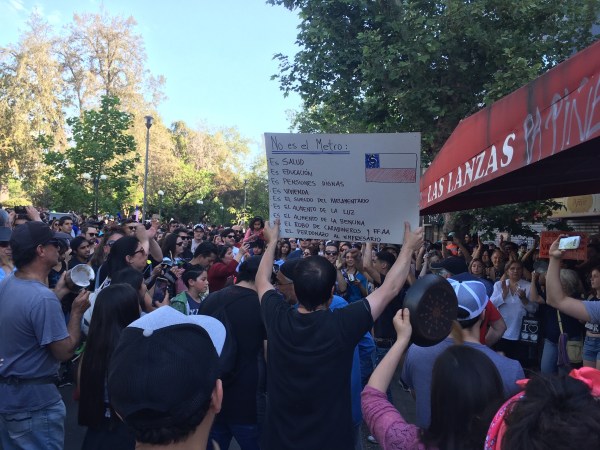
Protesters in Chile

Protesters in Chile/ Photo by the Authors

Chilean President Piñera’s declaration of a state of emergency and public statements last weekend suggest he is prepared to suppress demonstrations rather than deal with social and political demands. On Saturday, the center-right president also delegated control of public order to Army Commander General Iturriaga and declared nighttime curfews. What started as citizen disobedience – groups of students entering the subway without paying – quickly developed into a massive, albeit uncoordinated, mobilization. Protesters destroyed several subway stations, forcing closure of the transport system that 2.8 million people rely on daily. Despite the government controls, protests spread to other Chilean cities on Sunday, reaching a scale unseen since the end of the military regime.

While the immediate trigger of the protests was an increase in subway prices, underlying the unrest is a deep social discontent over the results of decades of neoliberal policies. Most of them were implemented during the Pinochet era and largely preserved by successor democratic governments. While they were successful in reducing extreme poverty, they have also led to high levels of socioeconomic inequality.

  • The private pension system has yielded huge market revenues instead of dignified pensions; the health sector is split into an underfunded public system and a privatized system that discriminates against women and the elderly; the public education system fails to deliver social mobility; and the public transport system has not helped to overcome extreme socio-geographic segregation in the capital and beyond. Consumer markets are rigged by anti-competitive practices and collusion. The oligarchic political elite sees social policy not as a matter of citizen rights, but as a matter of charity. Parliamentarians refuse to discuss their salaries, which amount to 33 times the minimum wage. Trust in the police and the military has plummeted due to scandals of corruption and abuse of power.

Although some of the protesters targeted symbols of neoliberalism, the government’s response has reflected a lack of awareness of these underlying issues – or, worse, is trying to lay blame on individual vandals. In a televised address from Army headquarters on Sunday night, Piñera sounded a dark note: “We are at war against a powerful enemy, who is willing to use violence without any limits.” Suggesting he does not distinguish between social protesters and groups of vandals, he said, “We are ready to do everything to not fall into populism.” Piñera had previously shown a tin ear on Friday night, when shortly after eating at a high-class restaurant, he admonished citizens for evading subway fares. His remarks fueled social discontent coming just days after two businessmen were sentenced to take ethics classes as “punishment” for involvement in tax-evasion schemes and irregular payments to political allies of Piñera’s coalition.

The Piñera government is addressing the crisis as it has done it before with the student movement and the Mapuche conflict over indigenous lands in the south: treating what are indeed political issues and social discontent as a security threat. The president is playing deaf to the legitimate social and political demands of Chilean citizens, undermining the government’s credibility as a political interlocutor while also fueling an escalation of violence.

  • Chile now joins Argentina, Ecuador, Peru, and others in facing serious pressure to deal with an array of problems that incumbent governments have failed to address – reminiscent of the social mobilizations in Brazil in 2013 that culminated in impeachment and the rise of a reactionary president, Jair Bolsonaro, whose commitment to democracy is seen by many as questionable at the very least. In this context, the Chilean political elite has a huge responsibility to avoid a breakdown of democracy and the rule of law. The government cannot ignore popular desires for a plan to overhaul the neoliberal Chilean model – and it would be wise not to cast opposing views as a security threat.

* Irina Domurath is a legal researcher at the School of Governance, Catholic University of Chile and external fellow at the University of Amsterdam, and Stefano Palestini Céspedes is an assistant professor at the Institute of Political Science, Catholic University of Chile.


Ecuador: President Moreno’s Pyrrhic Victory

By John Polga-Hecimovich*

President Lenín Moreno greets an indigenous leader on September 12, 2019.

President Lenín Moreno greets an indigenous leader on September 12, 2019/ Asemblea Nacional del Ecuador/ Flickr/ Creative Commons

Ecuadorean President Lenín Moreno’s agreement with opponents to rescind the austerity measures that sparked the recent crisis has restored calm but leaves his government irreparably weakened. The immediate trigger of the crisis was the president’s announcement on October 1 of a package of austerity measures aimed at reducing the fiscal deficit as part of his government’s $4.2 billion credit agreement with the International Monetary Fund. The key measure was elimination of a $1.3 billion gasoline subsidy expected to result in a 25-75 percent increase in the price of gasoline. Transport unions, student groups, and thousands of members of the country’s largest indigenous organization, the Confederación de Nacionalidades Indígenas del Ecuador (CONAIE), took to the streets, paralyzing roads around the country and demanding Moreno step down.

  • Moreno declared a 60-day state of siege, temporarily suspended the right to freedom of association; and on October 7, flanked by the military high command, said he would not back down against what he called a “destabilization plan” orchestrated by his predecessor, Rafael Correa, and Venezuelan President Nicolás Maduro. Perhaps cognizant that a combination of social pressure and legislative and military action removed all three of Ecuador’s democratically elected presidents from 1996 to 2006, Moreno temporarily moved the seat of government from Quito to Guayaquil and imposed a curfew in Quito.
  • CONAIE President Jaime Vargas and other indigenous leaders, encouraged by the United Nations and the Catholic Church, agreed to direct negotiations on October 12. Two days later, the president signed a decree rescinding the austerity measures and reinstating fuel subsidies, and CONAIE decamped. Moreno removed the head of the military Joint Command and the commander of the army, and on October 15 returned to Quito. (He has so far resisted calls to replace Interior Minister María Paula Romo, a possible 2021 presidential aspirant, and Defense Minister Oswaldo Jarrín.)

The crisis has deeply altered prospects for the Moreno presidency.

  • Moreno survived a degree of social protest and political resistance that toppled previous presidents, but he failed to anticipate the popular reaction to lifting energy subsidies, employed a heavy-handed response to protestors, and ultimately backed away from one of the few significant political decisions his government has made. As a result, Moreno lost an opportunity to make structural economic changes and suffered irreparable damage to his political capital and credibility.
  • Indigenous groups and a resurgent CONAIE – after largely disappearing from national political decision-making under Correa – are once again a key national political actor and informal public policy veto player. They not only forced Moreno and the government to reverse course on energy subsidies, but also literally and figuratively earned a seat at the negotiating table. CONAIE appears more unified than it has been at any moment since the early 2000s and may be emboldened to seek further concessions from the government.
  • Correísmo may well be the biggest political loser. Moreno remains in power despite calls from ex-President Correa and his Revolución Ciudadana party to debate the possibility of impeachment and early elections. Correístas were excluded from discussions over the executive decree that restored the gas subsidies. Moreover, CONAIE tweeted a stinging rebuke of Correa, accusing him of opportunism and holding him responsible for the deaths of three indigenous leaders under his government.

Moreno is a lame duck just a little over halfway through his presidency. It is difficult to imagine any policymaking of consequence in his remaining 18 months in office. The government is severely handicapped politically and economically, and the political space for negotiation until elections is almost nonexistent. Moreno’s government is likely to resemble the interim governments of Fabián Alarcón (1997-1998) or Alfredo Palacio (2005-2007), which essentially served as placeholder administrations without ambitious policy agendas. Against all odds, Moreno – with a legislative minority – neutralized Correa and shifted government policy to the right during his first two-plus years in office, which throws his failure to remove the subsidy into sharper relief.

  • Economically, the picture is not much different. The protests forced Moreno to kick the can down the road on energy subsidies, while making it more difficult for the government to close its fiscal deficit. The weight of these necessary reforms will therefore fall to whoever wins the 2021 elections. The failed implementation of this economic reform and subsequent reversal of policy show the limits of Moreno’s political acumen while laying bare the country’s governability challenges.

October 17, 2019

*John Polga-Hecimovich is an Assistant Professor of Political Science at the U.S. Naval Academy. The views expressed in this article are solely those of the author and do not represent the views of or endorsement by the Naval Academy, the Department of the Navy, the Department of Defense, or the U.S. government.


Argentina: Market Meltdown Can Be Halted

By Arturo Porzecanski*

From right to left, then-president Cristina Ferdandez de Kirchner, then-minister Alberto Fernandez, and other then-ministers

Ministers of Cristina de Kirchner / Wikipedia / Creative Commons / https://es.wikipedia.org/wiki/Archivo:Ministros_de_Cristina.jpg

The unexpectedly strong performance of the Alberto Fernández-Cristina Fernández de Kirchner (FF) ticket in Argentina’s August 11 presidential primaries has triggered a stampede out of the country’s currency, stocks, and bonds, but FF hold the key to staving off a full-fledged crisis. If the confidence of local and foreign investors is not recovered soon, the market rout has the potential to induce runaway inflation, plunge the economy into a deep recession, and cut off domestic and international financing for both the outgoing and incoming governments, potentially leading to a default.

  • The FF Peronist ticket’s 15.6 percentage-point margin of victory over President Mauricio Macri and his companion was foreseen by none of the pre-election polls. The wide gap shocked investors because it indicates the Fernández duo could win in the first round in the October 27 general election, avoiding a second-round ballot on November 24 in which the pro-market Macri was thought to have a better chance. The coattail effect of FF helped allies in provincial and local primaries around the country. With likely majorities in one or possibly both houses of congress, FF would have a powerful government that could implement much of its agenda, for better and for worse.

Now the challenge is to stop the vicious cycle of capital flight, currency depreciation, accelerating inflation, and plunging economic activity sparked by the electoral results. Failure to do so sooner rather than later will make it very difficult for the government to refinance its maturing short-term debts, and the Central Bank will likely experience a steady drain of its international reserves. In that scenario, the IMF, which has been sending big checks to Argentina every three months, would probably not send the next one in late September.

  • The Macri administration has announced some palliative measures (e.g., a 90-day freeze in gasoline prices and a tax exemption for food purchases), and the Central Bank has tightened marginally monetary conditions. But the government leadership team is powerless to restore the investor confidence that has evaporated.

Given his clear frontrunner status, Alberto Fernández could play a crucial role in reversing the trend. During eerily reminiscent circumstances in Brazil in mid-2002, local and foreign investors were increasingly worried that Luiz Inácio “Lula” da Silva, who was running strong in the polls in his fourth presidential campaign, would end the market-friendly policies of the outgoing Fernando Henrique Cardoso – including a break with the IMF, from which Brazil had been borrowing.

  • Worried about potentially inheriting an economic and financial mess, Lula made a public statement – he called it a “Letter to the People” – making clear his commitment to sound fiscal and monetary policies and the rule of law. He wrote about a “new social contract capable of assuring economic growth with stability,” one of whose premises was “naturally, a respect for the country’s contracts and obligations.” He followed those words with concrete actions. Two months before the elections, he gave his blessing to a new IMF program committing the next government to maintain, with minor modifications, Cardoso’s austere fiscal and monetary policies.

Lula’s actions after his election, including putting a market-friendly and popular mayor in charge of his transition team and choosing a career private-sector banker to run the Central Bank, provide a path that Alberto Fernández could follow as well. Under Lula, the Brazilian Central Bank felt supported in its all-out effort to extinguish the flames of inflation and to buttress the currency. Interest rates were thus hiked as needed before and after the October 2002 elections. He initiated confidence-building meetings with investors before taking office and reassured lenders and investors, both in Brazil and abroad.

  • So far, Alberto Fernández is denying any responsibility for the developing financial and economic crisis, blaming Macri for all that’s gone wrong. But unless he makes announcements that give confidence to local and foreign investors, he will inherit a mess.

August, 22, 2019

*Dr. Arturo C. Porzecanski is the Distinguished Economist in Residence at American University and a member of the faculty of the International Economic Relations Program at its School of International Service. This article is adapted from an essay he wrote in Americas Quarterly.

Puerto Rico: A Mess with Structural Causes

By Eric Hershberg and Fulton Armstrong

Roselló and Trump

Puerto Rico Gov. Ricardo Roselló, U.S. President Donald Trump and First Lady Melania Trump discuss relief efforts during a cabinet meeting at Muñiz Air National Guard Base, Carolina, Puerto Rico, Oct. 3, 2017 / U.S. Air National Guard photo by Staff Sgt Michelle Y. Alvarez-Rea / Public Domain

Puerto Rico’s ongoing political and economic crises are similar to those in many other Latin American systems – but with the additional burden of lacking the sovereignty or U.S. support to act independently in pursuit of solutions. Two weeks of spontaneous, massive protests over vulgar on-line chats and evidence of corruption forced Governor Ricardo Rosselló to resign on August 2. In the nearly 900 pages of “Rickyleaks” published by Puerto Rico’s Center for Investigative Journalism, Rosselló and his aides are quoted as exchanging misogynistic and homophobic messages about fellow politicians and leaders across society. Protestors accused him of mismanagement and malfeasance in the wake of Hurricane María, which devastated the island in September 2017 (nine months into his term), and of mishandling the territory’s relationship with Washington. The Puerto Rican Supreme Court found his hand-picked successor, Pedro Pierluisi, constitutionally ineligible to take the job, and Justice Secretary Wanda Vázquez was sworn in on August 7.

The success of the mobilization in the streets and in social media is a hopeful sign for democracy and good governance in Puerto Rico, according to many observers. But the island’s complex economic challenges, including a massive debt crisis, and a legal relationship with the mainland United States that is vulnerable to shifting political trends make attaining that vision especially hard.

  • The island’s economy has been in recession for 13 years and is severely handicapped by a $124 billion debt crisis caused by irresponsible decisions by its government, private lenders, and Washington policies – driving a loss of productive population, erosion of the tax base, and a downward spiral of public finance and services, akin to that seen in U.S. cities such as Detroit. Hurricane María further plunged the island into misery. An estimated 3,000 people died directly or indirectly because of the storm, often because poor maintenance resulted in much of the island’s electricity and water supplies being disrupted for many months. (Carpetbaggers from the mainland are reestablishing some basic services but at exorbitant prices.) A fundamental problem for the island is that in the 1990s Washington took away tax incentives, such as for the island’s formidable pharmaceutical industry, that had fueled strong growth for several decades. These conditions have accelerated the outflow of citizens to the mainland – an estimated 4 percent of the island’s 3.5 million inhabitants in just 2018.
  • Further complicating matters, the Governor must submit all budget decisions to a Financial Oversight and Management Board established by the U.S. Government in 2016, which has seven members appointed by the U.S. President and one non-voting member appointed by the Governor. The board can block spending, institute hiring freezes, and take other measures when it does not approve of an expenditure. Puerto Rico’s proposed package of measures to climb out from under the debt, result of three years of negotiations, has been derailed by the political crisis.
  • Numerous experts have demonstrated that the U.S. Administration’s claim that it has sent $91 billion of aid to the island is false. As of early this summer, about $11.4 billion in Federal Emergency Management Agency funds had been approved, and only about $5.72 billion disbursed (including assistance to individuals and families). Puerto Rico has only a single representative in the U.S. Congress – a non-voting delegate – and its relations with Washington depend on the goodwill and expertise of a host of bureaucracies that often have conflicting agendas. As a U.S. territory, it cannot easily receive international assistance directly.

Corruption, bad policies, weak institutions, and vulgar leaders are obviously not unique to Puerto Rico (or Latin America), but the behavior that resulted in Rossello’s ouster underscores the toxic, bankrupt nature of much of Puerto Rico’s political class despite years of lip-service to democracy, transparency, and accountability. Full sovereignty, of course, is no guarantee that any of the territories, protectorates, and “special” jurisdictions in the Caribbean would fare better if they weren’t dependent on a protector nation. But Washington’s ability to give – and take away – benefits without dealing with San Juan as an equal partner, and then judging the island’s performance and meting out sanctions, further complicates efforts to find solutions to Puerto Rico’s many problems. Puerto Ricans have shown that they can take to the streets to dump venal leaders, but, made vulnerable by multiple crises, there’s little they can do to wake up the U.S. Congress from its neglectful slumber.

August 14, 2019

U.S.-Cuba: You Can’t Get There from Here

By William M. LeoGrande

ventas en cuba

Small Business in Cuba / Alberto Yoan Arego Pulido / https://www.flickr.com/photos/albertoyoan/8775169259

U.S. President Donald Trump’s new economic sanctions against Cuba, imposed earlier this week, include limits on travel and family remittances aimed at crippling the Cuban economy and causing regime collapse, but the biggest losers are the small entrepreneurs, intellectuals, and artists who have been agents of change on the island. Senior administration officials, foremost among them National Security Adviser John Bolton, have been explicit that the goal is to rid the hemisphere of “socialism,” starting with the government of Venezuela and proceeding to Cuba and Nicaragua. Bolton previewed the new sanctions in Miami on April 17  – the anniversary of the failed Bay of Pigs invasion. Now we know the details.

  • Remittances, which were unlimited under President Barack Obama, will be limited to $1,000 per recipient household every quarter – enough to supplement a family’s meager state salary, but not enough to start and sustain a business. The new limits will hit Cuba’s nascent private sector hardest because funds from the United States were the start-up capital for many small businesses, and their supply chains reach back through Miami.
  • Trump has eliminated the people-to-people category of educational travel, which Bolton denounced as “veiled tourism.” This category covered educational tours not involving academic credit – tours run by organizations like National Geographic, the National Trust for Historic Preservation, and the Smithsonian. Authorized originally by President Bill Clinton in the 1990s, people-to-people travel was eliminated by President George W. Bush in 2003, in response to complaints from conservative Cuban-Americans in South Florida. President Obama restored it in 2011. Trump, like Bush, appears to be pandering to the Cuban American Republican base in Miami in the run-up to the next presidential election. Last year, 638,000 U.S. residents who were not Cuban Americans traveled to Cuba – at least two-thirds if not more under a people-to-people license, mostly on cruises, which Trump also banned. These new travel restrictions will cost Cuba upwards of $300 million dollars annually in lost revenue.

Cuba’s private sector will suffer disproportionately from these measures. In addition to losing start-up capital and access to supplies, these businesses will lose their principal client base. U.S. travelers arriving by air are more likely stay in Airbnb rentals and eat at private restaurants than the Canadians and Europeans who come on tourist vacation packages and stay at the big hotels on the beach. Trump’s first restriction on people-to-people travel in 2017, banning individuals from designing their own people-to-people trips, caused a 44 percent slump in private B&B occupancy. The new restrictions will wipe out many of them.

  • U.S. business and people will take a hit too. In 2017, Engage Cuba, a coalition of business groups favoring trade, released an analysis concluding that U.S. visitors to Cuba generated $1.65 billion in revenue annually for U.S. businesses and accounted for more than 12,000 U.S. jobs in the hospitality sector, most of which would be lost if Trump cut off travel. Most importantly, the new restrictions deprive most U.S. citizens of their constitutional right to travel, a right affirmed by the Supreme Court in 1958 in Kent v Dulles. The Court said the right should be limited only in cases of dire threats to national security.

As usual, tougher economic sanctions will make life tougher for ordinary Cubans, but sanctions won’t bring down the Cuban government, which has survived the U.S. embargo for half a century. Economic hardship and U.S. hostility will heighten Cuban leaders’ sense of being besieged, making them less likely to reform the economy or allow any expansion of free expression. Economic, professional, educational, and cultural ties between people in the United States and their counterparts in Cuba will be harder to sustain, impoverishing both. Cuba’s private entrepreneurs, who could be an engine for economic transformation and who Trump claims to support, will suffer from the loss of business from American travelers. U.S. travel companies will lose access to one of the biggest and fastest-growing tourism markets in the Caribbean. But maybe, just maybe, this latest assault on the liberties of Americans by the Trump administration will motivate Congress to finally pass a “Freedom to Travel” bill, assuring that no president can take away the constitutional right to travel just because he thinks it will help him win re-election.  

June 6, 2019

* William M. LeoGrande is Professor of Government at American University.

Nicaragua: Can Ortega Circumvent the Talks?

By Fulton Armstrong

Presidente de El Salvador participa en Cumbre SICA-Nicaragua.

President of Nicaragua Daniel Ortega / https://www.flickr.com/photos/fotospresidencia_sv/30962278823 / Flickr / Creative Commons

While the Nicaraguan government continues to stonewall in negotiations with its broad-based opposition, it is taking a series of unilateral actions that seem intended to preempt the talks – and leave the opposition behind. President Daniel Ortega and his team have flatly rejected key opposition demands, including early elections to replace him (instead of waiting for general elections in 2021) and the immediate, unconditional release of hundreds of political prisoners. They have, however, issued declarations pledging several actions on their own terms.

  • Last week, the Foreign Minister said the government “is complying, and will continue to comply, with all of [its] commitments toward understanding and peace.” Calling itself the “Government of Reconciliation and National Unity,” Managua has issued a “work program” that includes the “definitive release” by June 18 of 100-plus more political prisoners and several hundred others under house arrest. It pledged to work toward a “culture of peace” and “cooperate” with the OAS on reforms of the Supreme Electoral Tribunal to prepare for the 2021 elections. It promised legislation that supposedly will help victims of government violence during the April 2018 protests, although apparently with conditions that offend opposition leaders.

The opposition Civic Alliance for Justice and Democracy, which left the negotiating table last week, continues to enjoy widespread support, but press reports suggest mobilization fatigue is undermining its effectiveness and unity. Sympathetic media judged a hastily called national strike last week – protesting government intransigence in the talks – as effective, but they hinted at reduced enthusiasm. The Superior Council of Private Business (COSEP), a leading opposition force, recently released its assessment that the economy is “in a free fall,” with plummeting domestic and foreign investment. COSEP analysts note that the loss of 100,000 private-sector jobs and a similar number of informal-sector jobs is taking a heavy toll on society. The Catholic Church, which remains consistently critical of the Ortega government, has had a lower political profile since Pope Francis reassigned Managua Auxiliary Bishop Silvio Báez, its most outspoken critic of the government, to a Vatican job.

  • The opposition has also been stung by criticism from OAS Secretary General Luis Almagro, who’s led diplomatic pressure on Ortega to loosen up. In April, Almagro accused both sides in the negotiations of “lying” but listed untruths he attributed specifically to the opposition, claiming that “lying is the most antidemocratic practice.” Although the OAS last week approved a resolution, drafted by Canada with Almagro’s support, calling for Ortega to take concrete steps on human rights and election preparations, some 14 small opposition groups the day after accused the Secretary General of a “double standard” – allegedly being lenient toward Ortega but tough of Venezuelan President Maduro.

Government repression and intransigence in the negotiations are the primary causes of the crisis, but the opposition is, once again, showing a lack of focus and discipline. Ortega’s unilateral moves on political prisoners and electoral reform, after the opposition left the negotiation, suggest an effort to render the opposition and negotiation process irrelevant. By making the release of political prisoners its top priority in recent rounds of talks, opponents have given Ortega an area in which concrete and relatively cost-free steps can give the government momentum. Last week’s strike may have done more to show opponents’ weakness than strength inside Nicaragua, and Almagro’s swipe at “liars” – while possibly a reflection of his own personality and personal beliefs – cannot be helping outside. Some of the “liars” that have irritated him may indeed be mere troublemakers or government shills, but any dilution of international interest will be a victory for the government. The Trump Administration, which has pledged regime change in Nicaragua as well as Venezuela and Cuba, has been relatively quiet. Diplomats at the OAS are working hard to muster the four additional votes to reach the 24 necessary to invoke the Democratic Charter against Nicaragua, but Ortega seems to think he can end-run a negotiated settlement and undermine his opponents at home and abroad.

May 29, 2019