Impasse in U.S.-Cuba Relations Enters 54th Year

Three American University professors recently traveled to Cuba for research and discussions on Cuba’s reform process – called “Updating Socialism” – and the island’s relations with the United States.  Today’s entry looks at the bilateral relationship.
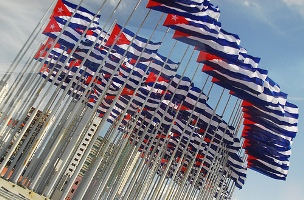
Flags in front of U.S. Interests in Malecón.  By: Luiza Leite "Luiza" | Flickr | Creative Commons

Flags in front of U.S. Interests in Malecón. By: Luiza Leite “Luiza” | Flickr | Creative Commons

U.S. and Cuban experts at a conference in Havana in December observed that, despite important areas of mutual interest, the Obama Administration has so far shown little inclination to accept a dialogue.  Some experts opined that the imprisonment of USAID contractor Alan Gross has become a convenient excuse for Obama to avoid any serious engagement.

Other key points:

  • There is no effective political channel for resolving bilateral problems – indeed, no contacts at all at political levels.  The Interests Sections in each other’s capitals handle routine matters, but Washington has rejected Cuban requests to continue semi-annual migration talks.  Cuba gave the United States a proposal for resolving the Gross situation, which the State Department has not even acknowledged receiving.
  • In addition to reiterating longstanding frustration that U.S. policy is stuck in the regime-change mode forged by President George W. Bush, Cuban experts lamented that many Americans latch onto every challenge Cuba faces – such as whether the passing of Venezuelan President Chávez will lead to reductions in oil supplies – as evidence that the Cuban government will “collapse” and therefore that dialogue with it would be foolish.
  • Cuban rhetoric espousing the swap of the “Cuban Five” for USAID contractor Alan Gross has fueled powerful political expectations in Cuba, but Havana’s bottom line on the elements of a humanitarian release is far from clear.  Experts from both countries are perplexed that Washington will not have a dialogue at any level to discuss whether a deal is possible.
  • Many Cuban and American experts believe that one incentive for the United States to improve relations is to rebuild its image in Latin America.  But they note – ruefully – that Latin American does not seem to be a priority for the Obama Administration anyway.

The Gross situation is merely the most recent of a long string of issues blamed for the dysfunctional relationship.  The real causes of the impasse at this point are whether Washington can shift away from policies and well-funded programs fashioned to achieve regime change in Cuba, and whether the two governments can manage the influence that both have given ultra-conservatives unprepared to broach compromise – be it Cubans opposed to releasing Alan Gross while four of the “Cuban Five” remain in U.S. jail, or Cuban-Americans benefiting from the sort of regime-change operations that Gross was conducting.  The lack of a reliable channel for political leaders above both bureaucracies to talk creates the risk of manageable problems spinning out of control, to the detriment of both countries’ interests.

Obama and Peña Nieto: Turning the same page?

By Tom Long
CLALS doctoral research fellow

Official White House photo by Pete Souza | public domain

Official White House photo by Pete Souza | public domain

On Saturday, Mexico’s new president Enrique Peña Nieto took office and the country’s oldest party, the Partido Revolucionario Institucional, returned to power. After six years dominated by an exhausting and bloody war against drug cartels, Mexico seems ready to turn the page on outgoing President Felipe Calderón. During the last few months, Peña Nieto has tried to steer the attention of the world—and the United States—away from a disproportionate focus on drug violence. In a recent article published in The Economist, the new president downplayed drug cartels, focusing instead on plans for the economy and to “recover our leadership in Latin America.” Security was just one of thirteen proposals in his inaugural speech. In part, Calderón has given Peña Nieto a head start as he begins his term, leaving behind strong economic growth and a dip in violence. Although Calderón himself started the switch to a violence-reduction strategy, his name is likely to remain closely associated with the frontal military assault on the cartels launched at the beginning of his administration and recalibrated only in his final year; Peña Nieto is positioned to gain credit for a return to normalcy.

This desire to turn the page also marked Peña Nieto’s s pre-inaugural meeting with President Barack Obama. Both leaders seemed to be playing the same tune.  Mexico has become the front line in the war on drugs, and the U.S. has spent billions on military, police, and other projects lumped under a “Merida Initiative” label. After their meeting, Obama and Peña Nieto promised to expand the bilateral agenda to include an expansion of trade, cooperation on energy, and discussions of immigration that go beyond border fences. Obama spoke effusively of Mexico’s importance as a partner, while Peña Nieto said the two had a “shared vision” of how to create jobs in both countries. On the stage with Obama as elsewhere, Peña Nieto reiterated calls for the United States and Canada to build on NAFTA and further regional integration to improve competitiveness.

It would be a healthy change if the two presidents could restore balance between economic and security aspects of U.S.-Mexico relations. Image matters – and the deterioration of Mexico’s brand has undermined both investment and tourism. The military approach to drug trafficking has inflicted enormous costs in economic and human terms with questionable payoffs, but Mexico cannot go back to old patterns of accommodation. Domestically, the new president needs to attack the culture of impunity by building a stronger and more independent judiciary in order to reduce the frightful percentages of crimes that are never investigated or prosecuted. Accountability remains weak, especially at state and local levels; improving it would require Peña Nieto to take on powers in his own party. Placing all these objectives under a “Merida plus” framework would counterproductively squeeze broad reforms into the drug-war box. If the two presidents are sincere about rebuilding a balanced partnership, they need to take action quickly on immigration and commerce. Otherwise, the gravitational pull of the war of drugs will again consume bilateral ties.