Structural Reforms in Chile: Moving Forward in Midst of Political Crisis

By Claudia Heiss*

Bachelet Chile

Photo Credit: Chile Ayuda a Chile / Flickr / Creative Commons

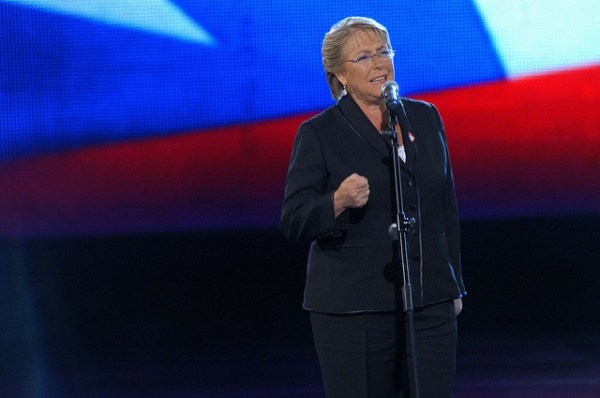
Chilean President Michelle Bachelet has done well pushing her reform agenda despite a series of scandals regarding the illegal financing of political campaigns and abuse of power by her daughter-in-law.  Bachelet started with 58 percent support and the highest electoral margin of victory since Chile’s return to democracy in 1990.  Her New Majority coalition incorporated the Communist Party and replaced the Concertación, the center-left coalition defeated in 2010 at the end of her first period, and after 20 years in power.  Bachelet’s current program reflected a left-turn and an intention to correct perceived flaws of a transition criticized for assuming too many features of the model imposed by the dictatorship.  The program included a tax plan to finance education reform introducing free university in a commoditized market of superior education.  This project was the offspring of massive student protests in 2011.  Another proposal was to replace the dictatorship-era 1980 Constitution through an “institutional, democratic, and participatory” process.

The scandals have hurt Bachelet’s popularity – she ended her first term in 2010 with 80 percent support and is now at historical lows below 30 percent – undermined the legitimacy of the political parties and Congress, and prompted a surge of social mobilizations.  (Slower economic growth, owing to the low price of copper, has contributed to the government’s unpopularity.)  But the President has scored some big wins.  In addition to the tax and education reforms she sought, the government has achieved important advances in the direction of its political program:

  • In 2015, a proportional system replaced the Binomial electoral system, which severely distorted popular will in the election of representatives and granted veto power in Congress to the political heirs of the dictatorship.
  • The campaign finance scandals led to the recent approval of a “Probity Agenda,” including higher transparency, forbidding corporate donations to political campaigns, and establishing a new law to regulate political parties.
  • A bill to make the main regional authority, the Intendente, elective rather than appointed by the President – a major step toward decentralization – has passed the Senate.
  • The decriminalization of therapeutic abortion, currently punished in only five countries, was approved by the Chamber of Deputies.
  • Congress is in the final steps of approving a labor reform meant to increase the negotiating power of workers towards their employers.
  • A complex constitutional reform process was launched last year, and this month the government selected 216 “facilitators” to assist the process and initiated a series of local meetings to discuss constitutional principles, rights, duties, and institutions. The process, the first of its kind ever in Chile, will lead to a presidential proposal to be presented to Congress.

The road ahead will not be easy for President Bachelet and her allies.  The political climate is pessimistic, and China’s economic troubles suggest the commodity bubble is over – to the detriment of the Chilean economy.  While rejected by conservatives, the changes appear as insufficient to those who want more radical reforms.  The labor bill has been criticized by union leaders as not allowing enough collective bargaining, and the proposal for constitutional change falls short of a binding participatory process like a Constituent Assembly or a referendum would be.  Bachelet, however, has deftly channeled anger about the scandals into the constructive reforms of the Probity Agenda, and she changed the perception of what is achievable in Chile in terms of progressive political and social transformations.  While public opinion is currently harsh with the government and with political elites, her second term, which ends in 2018, could in the long run consolidate her legacy as an effective reformer even in the face of adversity.

April 14, 2016

*Claudia Heiss is Assistant Professor at Universidad de Chile’s Instituto de Asuntos Públicos and researcher at the Centre for Social Conflict and Cohesion Studies, COES.

The Panama Papers: Damning Evidence Against Latin American Elites?

By Emma Fawcett* and Fulton Armstrong

Panama Papers

Photo Credit: Pixabay / CC0 Public Domain

The “Panama Papers” have revealed the reputed secret accounts and tax-evasion strategies of a number of Latin American leaders, but preexisting widespread perceptions that political and economic elites are corrupt may reduce the immediate shock value of the revelations.  More than 11 million documents leaked from the Panama-based law firm Mossack Fonseca – given an initial review by the Süddeutsche Zeitung and International Consortium of Investigative Journalists (ICIJ) – provide evidence of 215,000 arrangements by which 14,153 powerful and wealthy clients from around the world hid their money from the prying eyes of the media, tax collectors, and public-accountability experts.  Early reports already indicate Latin Americans – small-time players compared to the Russians and some Europeans – are among those mentioned.

  • The Petrobras scandal that has paralyzed Brazil will find further fuel in these files. Investigators in Operation Car Wash apparently had no knowledge of many accounts held by Petrobras officials.  A secret company linked to House Speaker Eduardo Cunha, who’s leading the charge to impeach President Rousseff, reportedly figures prominently.
  • Argentine President Macri, his father, and brother reportedly had an offshore company for 10 years. They closed it in 2009, two years into Macri’s term as Buenos Aires mayor, but he did not report it.  The government says he was only “circumstantially” the CEO.
  • The president of the Chilean branch of Transparency International, Gonzalo Delaveau, resigned because he was linked to at least five offshore companies.
  • Mexican President Peña Nieto’s association with tycoon-contractor Juan Armando Hinojosa, who reportedly had a massive array of shelters worth US$100 million, is once again a liability. The President was dragged through the mud – and eventually exonerated of personal involvement – over a mansion that Hinojosa allegedly gave to his wife.  The Mexican government is investigating several dozen others named in the documents.
  • Many other cases are in the wings. Pedro Delgado (former governor of Ecuadorian Central Bank and cousin of President Correa); financial backers of Peruvian Presidential candidate Keiko Fujimori; and an array of former central bank and intelligence officials – Peruvians, Venezuelans, Panamanians, and others – are all being looked at.  In El Salvador, the Attorney General, already criticized for his investigative zeal, has raided Mossack Fonseca’s offices, suggesting more revelations to come.

Allegations of tax evasion, hidden income, and other forms of corruption are a mainstay of Latin American political lifeand the Panama revelations will only aggravate the oft-held opinion that rich, powerful people play by their own rules to maintain wealth and power.  Ramón Fonseca, one of the founders of the law firm, claims that the publicity is part of “an international campaign against privacy,” which he called “a sacred human right [and] there are people in the world who do not understand that.”  The backlash against someone like Argentine President Macri may not be too great, especially because his family ended the tax haven years ago.  But what makes the allegations potentially disruptive is the number of people implicated – across public and private sectors – in so many countries, in an investigation that has only just begun.  Further revelations are sure to come and, although themselves a sign of transparency, challenge people’s faith that leaders will come clean.  The revelations will fuel popular cynicism and discontent in the short term, but renewed demands for transparency may eventually help rekindle popular confidence in government.

April 11, 2016

*Emma Fawcett is a PhD candidate in International Relations at American University.   Her doctoral thesis focuses on the political economy of tourism and development in four Caribbean case studies: Haiti, Dominican Republic, Cuba, and the Mexican Caribbean.

Brazil: Daring to Look at Succession Scenarios

By Silvio Levcovitz*

Lava Jato

Photo Credits: Instituto Liberal (Brasil) and Brasil 247 / Google Images / Labeled for noncommercial reuse

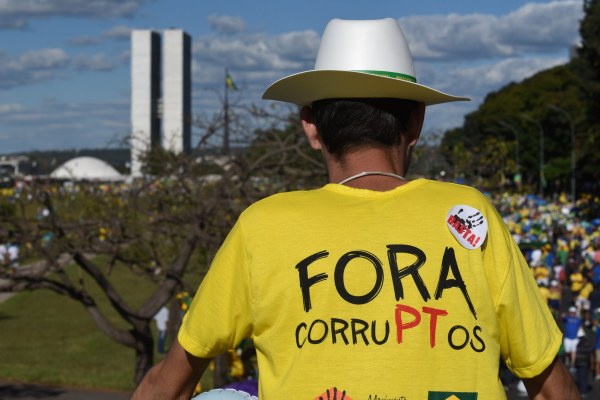
Brazil’s snowballing scandals are generating a high level of uncertainty regarding the country’s political future.  “Operation Car Wash”—a two-year investigation by a task force of the Federal Police and the Federal Prosecutors—has already led to the conviction and 20-year imprisonment of several senior officials from Petrobras and prominent construction companies, and others are likely to follow.  In Brazil, congressmen, cabinet ministers, and the President can be criminally charged only by the Supreme Court, through a long, difficult process called “privileged forum.”  On March 17, former President Lula, under investigation for allegedly receiving two properties as a bribe from construction companies, was designated a Minister of State in President Dilma Rousseff’s administration, an appointment that would have afforded him that protection.  The judge pursuing him released a recording of a call from Dilma offering him immunity as well as Lula’s calls on family and other private matters.  Many in the Brazilian legal community have disapproved of the judge’s disclosure of the calls as disrespecting the rule of law and the right to privacy, but the damage to Dilma and Lula was done.

Calls for the President’s impeachment are surging—and she repeatedly rejects the pressure to resign.  On Sunday, March 13, a half-million people protested in São Paulo, and the press estimates that another 1-2 million demonstrated elsewhere around the country.  (Demonstrations supporting Dilma have attracted 100,000 citizens in São Paulo.)  The PMDB, party of Vice-President Michel Temer and President of the House Eduardo Cunha, is officially quitting the government this week, and other minor parties appear likely to do the same, definitely cracking the presidential support.  The impeachment process in Brazil has two steps.  In the House, two-thirds of its 513 members (342 votes) are required for “admission” or approval, in which case the Senate can decide by majority vote to take up the charges, resulting in the President being suspended for up to 180 days.  Conviction requires the votes of two thirds of the 81 senators.  Although press reports indicate the mood is for the impeachment, the government is offering positions and funds individually to Congressmen and in hopes of achieving a low turnout to stop the process in the House.

Predicting the outcome of such a volatile situation is inherently risky, but discussion of post-Dilma scenarios is growing increasingly common.  Should she step down or be removed from office, Vice-President Michel Temer would be her constitutional successor.  Like Dilma, however, Temer is being charged by the Superior Electoral Court on suspicion of illegal campaign financing and, if convicted, would not be allowed to take office.  The next two in line to succeed her—President of the House Eduardo Cunha and President of the Senate Renan Calheiros—have been snagged by Operation Car Wash and face charges by the Supreme Court, suggesting that they too could be disqualified.  (The Federal Attorney General has already asked the Supreme Court to issue a preventive order to remove Cunha because of evidence that he has received US$5 million in secret Swiss bank accounts, without any justification.)  That leaves Supreme Court President Ricardo Lewandowski as a possible successor for a maximum period of 90 days, at which point elections would be called.  As Brazil faces crisis after crisis, the press have taken to commenting that the country’s fast-paced, dramatic events make the American series House of Cards look slow and boring. 

March 30, 2016

* Silvio Levcovitz is a CLALS Fellow and political science PhD candidate at the Universidade Estadual de Campinas, São Paulo.  He has been a public lawyer in Brazil and is researching criminal cases of corruption and civil claims of administrative misconduct from 1991 to 2014.

Hope Fading for Guatemalan Spring

By Ricardo Barrientos*

Jimmy Morales

Photo Credit: Publinews Guatemala / YouTube / Creative Commons

The high hopes created by Guatemala’s peaceful, democratic change of government last year are hitting the shoals of reality.  Guatemalans managed a major political crisis in 2015 in an exemplary way: massive citizen demonstrations against authorities accused of corruption lasted four months without a single incident of violence.  Acceptably free and fair elections took place just three days after disgraced President Pérez Molina resigned, and a transition government was formed as mandated by the Constitution to govern until Jimmy Morales, the new Guatemalan President, was sworn in on January 14.  Although lacking experience, a cabinet, and a plan, Morales inspired confidence with a very good slogan (that he was “neither corrupt, nor a thief”) and good communication skills honed as a former TV comedian.  Voters had rejected and punished the “old politics” and felt hope that honesty would prevail.

Since Morales took office, however, serious mistakes have caused confidence to dim.

  • His reluctance or inability to answer questions from journalists and to refrain from underestimating audiences by telling silly jokes and childhood stories are raising concerns among observers of an emerging authoritarian personality.
  • Secrecy surrounding his cabinet selection process has led to missteps. His Minister of Communications, Infrastructure, and Housing was forced to resign after just 11 days in office – in the face of evidence of tax fraud and a serious conflict of interest.
  • His first approach to Congress was only to reverse the position on 2016 public debt cuts that his representatives advocated last November. Asking Congress to reduce debt proved popular back then, but now transfers to the Public Prosecutor Office or to the public university can be made only if the original debt amount is restored by Congress.  That condition is not only unpopular; it risks hampering the effort to prosecute corruption.
  • Instead of asking Congress for an urgently needed budget increase to solve ongoing shortages of medicines and equipment in public hospitals and clinics – almost a humanitarian tragedy, he accepted pharmaceutical company donations of expired medications – in a deal redolent of past corruption.
  • Morales’s political party, Frente de Convergencia Nacional (FCN), has grown substantially in Congress by receiving “turncoat” congressmen, directly contradicting an important campaign promise. “Turncoating,” jumping from party to party in Congress (always for a “price”), is one of the practices condemned in 2015 as part of the “old politics” and was strongly rejected by voters who trusted Morales.  The Public Prosecutor Office has received complaints denouncing bribes, government jobs, and contracts offered to “turncoats” now affiliating with the FCN.

Events in Guatemala over the past year present a huge contrast with what the country was a couple of decades ago – triumph for a society deeply marked by civil war, poverty, and brutal inequality, with the fresh hope of a new democratic spring.  Jimmy Morales appears to be squandering a historic opportunity to harness this democratic momentum.  Voters who set aside concerns about his links to right-wing Army veterans accused of crimes against humanity during the civil war could soon feel deceived because the “old politics” is still in place.  Guatemala’s democratic spring may fade before it blooms, sowing the seeds of crisis and instability in the future.

February 22, 2016

*Ricardo Barrientos is a senior economist at the Central American Institute for Fiscal Studies (Icefi).

Honduras: President Hernández’s Mission

By Fulton Armstrong

Hernandez honduras 2

Photo credit: Public domain

Honduran President Juan Orlando Hernández, who last month passed the half-way point in his four-year term, has scored some important political gains, with uncertain implications for his country.

  • The Obama Administration has embraced him as a partner in the “Alliance for Prosperity,” to which it has committed $750 million year to “build a safer and more prosperous future for [Northern Triangle] citizens.” It represents a doubling of U.S. assistance.
  • In a decision Hernández said he “would respect,” last April the Honduran Constitutional Court – key members of which the Congress elected under circumstances of questionable legality when he was Congress President – allowed him and other former presidents to run for reelection. The Chairman of the Congressional budget committee last week said there “should be no doubt” that the party is committed to Hernández serving a second term.
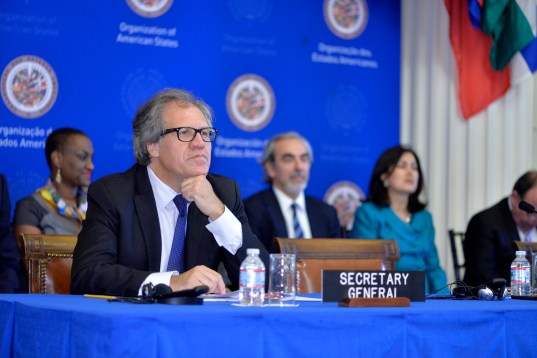
  • He successfully parried efforts to create a copy in Honduras of the International Commission against Impunity in Guatemala (CICIG), the UN-sponsored body with extensive powers in that country. The final terms of reference of the OAS-sponsored “Mission to Support the Fight against Corruption and Impunity in Honduras” (MACCIH) aren’t as loose as he had proposed, but many of its key definitions, personnel, and funding remain highly uncertain.  OAS Secretary General Almagro’s public blessing of it was a public relations coup.
  • The Honduran Congress’s approval last week of a new 15-member Supreme Court took numerous rounds of voting – presidents traditionally get the slate approved in one vote – but his party did well enough. Allegations of bribery arose immediately.  Praising the new court, he said last Friday that he would soon launch a national dialogue on additional Constitutional reforms and on “revising the social contract of Honduras” and building “a new Honduras.”

Hernández is not without critics in Tegucigalpa and Washington – even if their attacks have not thwarted him.  Opponents claim that his desire to overturn Constitutional prohibitions on a second term was more blatant than that of former President Mel Zelaya, whose removal by the military in 2009 Hernández supported claiming that Zelaya violated the prohibition.   Hernández has admitted that his party received funds embezzled from the national Social Security agency.  The Indignados, a grassroots opposition, doesn’t have the lobbying resources that the government has, but they have mobilized massive peaceful demonstrations, and veteran Honduras watchers praise their idealism, discipline, and maturity beyond their youthfulness.

Hondurans and foreign governments often favor leaders whose appearance of power promises stability, rather than favor processes and values – such as transparency and inclusiveness – that promise more effective democratic institutions.  Hernández was elected with barely 35 percent of the vote, but his growing power, coinciding with the weakening of legislative and judicial institutions, has concentrated power on the executive.  The country arguably faces one of the most complex situations in its history, on the cusp of either difficult change, such as reducing shocking levels of impunity, or a deepening of the current crisis.  The economic and political elites who control the nation have driven it into a rut from which “more of the same” does not appear a viable way out.  Hernández won praise from the international financial community by pushing through fiscal adjustments, yet these measures increased inequality in a country where half the population lives on less than $4 a day.  Preliminary data show that austerity has brought about an increase in unemployment and underemployment, which already affected roughly half of the labor force.  A U.S. and Mexican crackdown on Central American migration has reduced one of the only options that young Hondurans fleeing poverty, violence, and impunity thought they had.  While many Hondurans may wind up accepting a President’s reelection to a non-consecutive term, Hernández’s big push for a consecutive one and his talk of a “new social contract” understandably fuels skepticism if not angst.

February 16, 2016

Lobbying Washington: Does it Work?

By Aaron T. Bell*

LatAm Lobbying

Photo credits: Jack Says Relax & AlexR. L., respectively / Flickr and Wikimedia Commons / Creative Commons

Latin American governments, political parties, and business associations have a long history of turning to U.S.-based lobbying, legal, and public relations firms to advance their interests in the United States – with mixed results.  Both national and multinational groups have been utilizing lobbyists since at least the 1940s, when the U.S. government began registering foreign agents.  Their most consistent goal over the decades has been to influence U.S. policy on foreign trade and investment, but they have also aimed to improve governments’ sagging reputation and protect them from adverse policies.  In the 1970s, a number of military regimes and right-wing political groups in Central and South America hired lobbyists to devise and implement strategies to counter criticism of their human rights record – to preserve trade and military assistance.

  • Some 30 Latin American countries and interests groups in 2010-14 registered foreign agents to influence U.S. policies. The Bahamas Ministry of Tourism spent the most, paying $128.9 million to promote tourism – as well as to monitor and speak with Congressional representatives about U.S. legislation related to transnational financial activities in which they are involved, such as the regulation of offshore tax havens and online casinos.
  • In 2013, Mexico ranked fifth worldwide, at $6.1 million. Both federal and local governments pay firms to burnish the image of their respective constituencies.  From 2010-12, for example, Mexico City worked with a firm to “enhance the image of Mexico City in light of recent negative media reports.”  In 2014, the Consejo de Promoción Turístico de México hired another company to “make Mexico an attractive destination.”
  • Ecuador, which at $1.1 million ranked twenty-second in 2013, spent nearly half a million dollars lobbying in support of the ultimately failed Yasuni rain forest oil drilling initiative.
  • More recently, the government of Honduras – burdened with the image as one of the most violent, corrupt, and crime-ridden countries in the world – hired lobbyists to “provide ongoing strategic counsel, media relations (proactive and reactive outreach), and third-party relations.” The firm, winning an initial one-year contract for $420,000, had just completed a nine-year relationship representing Russia.

A review of the U.S. Foreign Agents Registration Act (FARA) records indicates that foreign lobbyists represent almost exclusively governments, state agencies, and the private business sector, and that more popular civil-society actors – such as labor unions and indigenous organizations – are notably absent.  Even though foreign governments obviously judge the investment worthwhile, the impact of foreign-funded lobbyists is difficult to measure.  The Honduran government’s new push to burnish its image has paid off on Capitol Hill, according to observers, but a new initiative to reduce Honduran corruption doesn’t appear to have gone exactly as Tegucigalpa hoped.  Forced to respond to a protest wave calling for the creation of an independent investigative body similar to the Comisión Internacional contra la Impunidad en Guatemala (CICIG), the Honduran government agreed with the OAS to create the Misión de Apoyo Contra la Corrupción y la Impunidad en Honduras (MACCIH) as a collaborative effort.  MACCIH indeed lacks the independence – and the potential bite – that CICIG had, but it is significantly tougher than the Honduran President Juan Orlando Hernández initially proposed.  In this case at least, lobbyists have helped the government gain access and public relations points in Washington but didn’t get it off the hook entirely.

January 22, 2016

* Aaron Bell is an adjunct professor in History and American Studies at American University.

Brazil: Not-so-Happy New Year

By Matthew Taylor*

Brazil Basta

Photo Credit: Antonio Thomás Koenigkam Oliveira / Flickr / Creative Commons

A vicious combination of corruption scandal and economic malaise suggests a troubled new year awaits Brazil.  Economists estimate gross domestic product has contracted 3 percent this year and will decline a similar amount in 2016, while inflation and weak government finances hamper efforts to stimulate growth.  Two of three big rating agencies have cut Brazilian debt from investment grade to junk. Unemployment has risen from under 7 percent a year ago to nearly 10 percent, with forecasts of 12 percent on the horizon.  Efforts to reform fiscal policy are getting nowhere, and the champion of fiscal reform, Finance Minister Joaquim Levy, has just resigned.  The bonanza launched by the 2003-2010 presidency of Lula da Silva – seemingly setting Brazil on a unique path of state capitalist development – is long over.

The country’s interconnected scandals cast shadows on many of the leading players on the national stage, including President Dilma Rousseff.

  • Petrobras, the crown jewel of Brazil’s state capitalist model, is at the center of allegedly massive corruption schemes. Rousseff, who was chair of the Petrobras board at the time of the alleged wrongdoing, has claimed absolute ignorance.  But the charges implicate Brazil’s leading political and business elites, many of whom have been jailed in recent months.
  • A feud between Dilma and the president of the Chamber of Deputies, Eduardo Cunha, reached a new low this month after Cunha’s approval of impeachment proceedings against her. (His own ethics problems continue to fester.)  The charge against Dilma is not of personal corruption but rather that Rousseff flouted budget laws by using public banks to cover up unauthorized debt issuance and off-books spending.  Rousseff supporters have argued that the impeachment charges represent the worst of golpismo, or coup-mongering, and a constitutional overreach that threatens to undermine democracy.

For Brazil, 2016 will be dramatic and unpredictable – as the country weathers the most dangerous political crisis since the impeachment and resignation of President Fernando Collor in 1992.  Dilma’s opponents will have difficulty convincing two-thirds of the Chamber and Senate to oust her, but the crisis is already creating significant fissures in the democratic system.  The parties have been turned upside down.  Even if Dilma survives in office, she faces nearly impossible odds in restoring the credibility of her administration and party, the Partido dos Trabalhadores, or PT.  There are early indications that the PT will face a bloodletting in the 2016 municipal elections, and former President Lula, the party’s once-ironclad standard-bearer, has the highest rejection rate (55 percent) of any potential candidate in the 2018 presidential contest.  The PMDB, Dilma’s coalition partner, is threatening to break with the government, but is internally divided. The opposition PSDB is facing scandals, protests, and troubles of its own in the states it governs.  The newfound proactivity of prosecutors and judges is making democratic checks and balances work as never before – and is largely welcomed by Brazilians – but Brazil’s old party system may not be able to keep pace.  Rumblings for a rethinking of the political system will grow louder in the new year, as the crisis deepens.

December 21, 2015

*Matthew M. Taylor is associate professor at the School of International Service at American University.

Tax Reform or Governance Revolution?

By Andrew Wainer*

Photo Credit: Reuniones Anuales GBM / Flickr / Creative Commons

Photo Credit: Reuniones Anuales GBM / Flickr / Creative Commons

Taxation to fund development is becoming central to U.S. foreign assistance policy, but it would be a mistake for USAID and other foreign assistance agencies to view tax reform solely through the technical lens of financing for development.  In September, USAID Assistant Administrator Alex Thier penned an article subtitled, “Why Taxes Are Better than Aid.”  This follows the announcement in July of the Addis Tax Initiative at the UN Financing for Development Conference, where the United States and other donors pledged to double the amount of technical assistance for taxation in developing nations.  By most accounts, the potential fiscal benefit of increasing taxation –“domestic resource mobilization” (DRM) in development parlance – is huge.  The World Bank and International Monetary Fund estimate that in 2012 DRM in emerging and developing nations generated a combined $7.7 trillion.  This dwarfs average annual foreign assistance outlays, which in recent years have averaged about $135 billion.  One of many examples cited by USAID is El Salvador, where a $660 million increase in annual tax revenues has been channeled to health, education, and social services, as well as other development programs.

The issues of fair and transparent taxation are often a secondary component in discussions of DRM but – as events in Guatemala and elsewhere demonstrate – can also generate revolutionary transformations in governance.   Even as U.S. agencies emphasize the technical side of DRM assistance, organizations that monitor taxation are sparking historic citizen revolutions through revelations of governmental tax corruption.

  • The UN-sponsored International Commission against Impunity in Guatemala (CICIG) was created in 2006 to strengthen the rule of law through “investigation of crimes committed by members of illegal security forces and clandestine security structures.” But it was CICIG’s revelations of a customs tax corruption network that brought 100,000 Guatemalans into the street in a single day.  The protests led to the forced resignation and jailing of President Pérez Molina as well as a surge in citizen engagement unseen in the country’s modern history.

The intimate link between taxation and governance should be a central factor in how the U.S. government and others think about DRM.  As the OECD states, “The payment of tax and the structure of the tax system can deeply influence the relationship between government and its citizens.”  DRM should place a high premium on the governance impact of tax reform, where appropriate.  Tax reform not only increases government revenues, but as the case of Guatemala demonstrates, it can also strike at the heart of ossified structures of governance and can spark revolutionary changes in the relationship between citizens and states.   

November 12, 2015

* Andrew Wainer is the Director of Policy Research in the Public Policy and Advocacy Department of Save the Children USA.

Honduras: No Solution in Sight

Photo Credit: OAS / Flickr / Creative Commons

Photo Credit: OAS / Flickr / Creative Commons

CLALS and the Inter-American Dialogue this week hosted a conversation on the crisis in Honduras with experts Hugo Noé Pino, of the Instituto Centroamericano de Estudios Fiscales, and Carlos Ponce, of Freedom House, and about a dozen of some 80 participants spoke up.  The following are key analytical points that were broadly accepted during the 90-minute session.

Honduras is experiencing a multi-faceted crisis – economic, political, judicial, and security– that has grown steadily worse since the 2009 coup and shows no sign of abating.

  • Economic growth (1.5 percent per capita) is too low to alleviate the country’s severe employment problem (affecting half of the working-age population) and poverty (62 percent). Recent polls indicate that some 63 percent of all Hondurans would leave the country if they could.

Violence, corruption scandals, and the steady weakening of institutions dim prospects for a turnaround.

  • The over-concentration of power in the Executive, the remilitarization of law-enforcement and other security services, and the politicization of the judiciary have undermined what democratic foundation Honduras had built since the last military government stepped down in 1980. The economic and political elites, as well as the media they control, have further stifled political discourse.
  • The Sala Constitucional of the Supreme Court and the National Electoral Tribunal have been stacked to tightly control preparations for elections scheduled for November 2017, apparently with the intention of ensuring the reelection of President Juan Orlando Hernández.

The Honduran political class lacks the will to root out corruption, and is united in resisting developing the capacity and programs to do so.

  • The embezzlement of more than $300 million from the Social Security Institute – funneling part of these funds to the ruling National Party and a variety of fronts – led to the flight of the investigating fiscal (who left the country because of death threats to himself and his family) but little else. Indeed, the most significant law-enforcement actions, such as the indictment of members of the Rosenthal family on money-laundering charges, have come from the United States. Some 80 percent of crimes in Honduras go uninvestigated and unpunished; some reports put the figure as high as 96-98 percent.
  • A Comisión Internacional Contra la Impunidad en Honduras (CICIH), adapted from the successful CICIG model in Guatemala, would be a healthy way of addressing ongoing impunity while building investigative and prosecutorial institutions. The economic and political elites solidly oppose it.  Even if Honduras accepted a CICIH, alone it probably would not be a silver bullet.
  • The OAS’s planned “Mission to Support the Fight Against Corruption and Impunity in Honduras” (MACCIH) – announced in late September jointly with Honduran President Juan Orlando Hernandez – shows little promise of success. Its mandate will be to diagnose problems and write reports, not take action or facilitate a serious, inclusive national dialogue.

Opposition to the current Honduran government is strong and growing, but it has not yet institutionalized.

  • Peaceful marches organized by the Indignados and other organizations have mobilized tens of thousands of citizens outraged by government corruption and its inability to provide even basic citizen security. Among the masses have been an unprecedented number of middle-class and upper-middle-class persons – not seen during previous crises.
  • Opposition groups are still struggling, however, to coalesce into a viable, institutionalized political force. Sustaining effective leadership and overcoming pressure from the government and Honduras’s two traditional parties are difficult challenges for them.

There are no magic or quick solutions to the crisis.

  • Any solution would have many moving parts, including recognition by elites that their own assets are threatened by the deepening chaos. The government will have to be held accountable for corruption.  The judiciary will have to be strengthened and made independent.  The military will have to return to the barracks.  The media will have to be professionalized.  Civil society will have to be empowered.
  • The U.S.-sponsored “Alliance for Prosperity” is unlikely to help Honduras – and could make things worse if it doesn’t challenge the status quo. Honduran observers believe that the $250-plus million dollars from the program should focus on deep change – the product of a broad national dialogue – and should be conditioned on deep reforms, rather than working with just the sitting government, which has shown no willingness to reform.
  • U.S. cooperation in counternarcotics and other security operations might in some cases expose partnered services to U.S. respect for human rights and democratic institutions, but the resources transferred in the process also serve to strengthen them and make them more independent of civilian authority.

October 15, 2015

* Correction: The first sentence of the article originally stated “CLALS and the Inter-American Dialogue this week hosted a conversation on the crisis in Honduras with experts Hugo Noé Pino, of the Instituto Centroamericano de Estudios Fiscales, and Carlos Ponce, of Freedom House, and a dozen speakers from among over 80 participants.” It was edited to clarify that “about a dozen of some 80 participants spoke up.”

Transparency in Brazil: More Progress than Meets the Eye

By Vanessa Rodrigues de Macedo*

Photo Credit: Antonio Thomás Koenigkam Oliveira / Flickr / Creative Commons

Photo Credit: Antonio Thomás Koenigkam Oliveira / Flickr / Creative Commons

Amid all the corruption scandals shaking Brazil in recent months, positive signs about future prospects for accountability – in a country where it has historically been lacking – are easy to overlook.

  • The judicial system is improving and – since the historic conviction of 25 of 37 defendants in the notorious mensalão bribery case in 2012 – has shown commitment to meaningful outcomes in corruption cases.  Prominent offenders who in the past would have been untouchable today face a significantly higher probability of conviction and imprisonment.  In March, the Supreme Court authorized investigations into more than 50 high-ranking officials, including the leaders of both legislative houses.  In July-August, prosecutors launched investigations into former President Lula da Silva (as an informant) and senior Petrobras officials.
  • Important transparency initiatives are also taking hold. On paper, these are some of the most demanding standards in the world.  The Freedom of Information Act (FOIA) enacted in 2011 ranks among the top 20 FOIA laws in the world, according to the Global Right to Information Rating.  Since 2012, more than 300,000 FOIA requests have been made through the online request system (e-sic) created by the law. No fewer than 98.34 percent of these requests have been replied to, with an average response time of 14 days.
  • Brazil has been at the forefront of promoting transparency globally.  Together with the United States, it was the founding co-chair of the Open Government Partnership (OGP), a multi-stakeholder partnership that now involves more than 60 countries.

The impact of such initiatives has been limited, however, because they were launched as a result of the mobilization of a handful of NGOs, journalists and international actors, rather than broad societal pressure.  Street protests against government policies have had massive turnouts over the past couple years, but mobilizations in favor of concrete transparency measures and similar reforms have not involved wide swaths of citizens.  Cultural change at the popular level has been slow, reflecting a lack of social maturity to accept responsibility to monitor public policy and demand transparency.  Nonetheless, some important initiatives, such as joint government-citizen policy conferences to discuss public policies, are attracting significant citizen participation. Between 2003 and 2010, 70 such conferences drew 6.5 percent of the Brazilian population, according to academic tallies, and from 2010 to 2014 there were 26 more conferences.

That these achievements haven’t ended corruption is not a sign that they’re useless. Rather, the consolidation of transparency norms and institutions; the continued assertiveness of Brazilian prosecutors and judges; and the expanding opportunities for citizen engagement suggest that the prospects for inculcating a culture of accountability in Brazil are not as bleak as might appear in the almost-daily headlines about endemic corruption in politics and big business. Having transparency initiatives in place has the potential over time to make corruption less frequent, and the more engaged that Brazilian society becomes in the implementation of transparency norms the more likely it is that massive scandals such as those around Petrobras and Lava Jato will become the exception rather than the rule.

*Vanessa Macedo is a CLALS research fellow and political science PhD candidate at the Instituto de Estudos Sociais e Políticos at the Universidade do Estado do Rio de Janeiro (IESP/Uerj).