The Anticorruption Imperative for Latin America

By Matthew Taylor*

Bar graph showing accountability in Latin America

Graphic courtesy of author. For a larger version, please click here.

Latin America’s reactions to the massive transnational scandals involving the Brazilian construction giant Odebrecht and its subsidiary Braskem are an important sign of progress in anticorruption efforts.  But across the region, courts’ reluctance to challenge elites remains a major obstacle to deeper accountability.  Brazilian, Swiss, and U.S. authorities’ announcement in December 2016 of a multibillion dollar global corruption settlement with the Brazilian firms – valued at $3.5 to 4.5 billion – was remarkable for being the largest in history.  It was also shocking for its revelations: Odebrecht admitted using a variety of elaborate subterfuges to launder bribe payments and corrupt proceeds, including by setting up a bribe department and buying an offshore bank.  Graft allowed executives to rewrite laws in their own favor, and guaranteed that the right officials were in the right place when public contracts were up for bidding.  The firms netted $3.60 for every $1 they spent on bribes in Brazil, and admitted to paying $788 million in bribes across twelve countries, including ten in Latin America.

The political salience of the charges is roughly similar in all ten Latin countries, muddying the reputations of presidents or former presidents in Argentina, Colombia, the Dominican Republic, Peru, Panama, Venezuela and, of course, Brazil.  Ministers and high-level officials have been implicated in the remaining countries: Ecuador, Guatemala, and Mexico.  Nearly one year after the settlement, it is time to ask how well law enforcement and judicial processes are resolving the allegations against these high-powered public and private sector elites.

  • In a paper forthcoming in Daedalus, I argue that accountability can be thought of as the outcome of a basic equation – A = (T + O + S) * (E – D) – combining transparency (T), defined in its most essential sense as public access to information about the government’s work; oversight (O), meaning that government functions are susceptible to surveillance that gives public or private agents the right to intensively evaluate the government’s performance; and sanction (S), effectively punishing wrongdoing and establishing societal norms to their rightful place. These are tempered by institutional effectiveness (E) – understood as the outcome of state capacity, relevant laws and procedures, and citizen engagement – and political dominance (D), which diminishes the incentives for active oversight or energetic sanction.  The graph above uses a combination of data points from the World Justice Project to measure each of the five variables.
  • The comparison yields mixed findings. On average, the nations implicated in the Odebrecht settlement do quite well on transparency, effectiveness, and political dominance – the outcome of a generation of democratic rule (with Venezuela being the obvious outlier).  But all ten countries perform comparatively poorly when it comes to oversight, and abysmally when the criterion is sanction.  This does not bode well for accountability, especially if we consider that among the Odebrecht Latin Ten, the highest-scoring country on the sanction criteria is Argentina, whose score is still below the middle-income country average.  In Brazil, where trial courts have led the way in imposing sanctions on business elites, political leaders are nonetheless protected against meaningful sanctions by an arcane system of privileged standing in the high courts.

Latin American judicial systems – long rigged to protect local economic and political elites – remain the principal obstacle to accountability.  The Odebrecht settlement signaled that a new day has arrived: new international norms and law enforcement across multiple jurisdictions are likely to continue to upset the cozy arrangements that have protected the region’s elites from corruption revelations for decades.  But true accountability will only come when local courts and prosecutors are empowered to effectively punish corrupt elites.  That implies changes in legal procedure, new laws, and most importantly, political will.  Perhaps the Odebrecht case will galvanize domestic public opinion and mobilize policymakers about the need to improve local justice systems.  The enormous costs of corruption revealed by the Odebrecht settlement suggest that change cannot come soon enough.

November 6, 2017

* Matthew Taylor is Associate Professor at the School of International Service at American University.  His forthcoming article in Daedalus is entitled “Getting to Accountability: A Framework for Planning and Implementing Anticorruption Strategies.”

Brazil’s Foreign Policy:  A Regressive Path?

By Gilberto M.A. Rodrigues*

36028591940_8475019dc8_b

Brazilian Foreign Minister Aloysio Nunes speaks at a MERCOSUR meeting regarding the situation in Venezuela. / Divulgação / Flickr / Creative Commons

President Dilma Rousseff’s foreign policy was less active than President Lula’s, but Brazil has lost prominence in international politics even faster since her impeachment almost exactly one year ago.  According to the Soft Power 30 survey, Brazil now ranks 29th in international influence, having ranked 24th in 2016.  One reason is both domestic and political:  President Temer’s government has had to struggle to be recognized as legitimate.  The other is strategic: a wrong bet made by the new heads of Brazil’s foreign affairs.

  • Temer left the Ministry of Foreign Relations in the hands of the Social-Democratic Party (PSDB), appointing São Paulo Senator Jose Serra – at that stage a potential presidential candidate – as foreign minister. Temer and his PSDB partners’ most important project was to align Brazil more closely with the United States.  In parallel, they sought to progressively dismantle the South-South international policy that President Lula championed and President Rousseff continued, with its focus on the BRICS countries.
  • Their approach was based, however, on the expectation that Hillary Clinton would win the U.S. election, and they had no “Plan B” for collaboration with the Trump Administration and its significantly different view toward Latin America and Brazil. Unable to rescue the heart of his policy, Serra resigned after nine months, claiming health issues, and another PSDB senator and political ally, Aloysio Nunes, took the job with a clear plan to align Brazil with the international market.  Brazil’s application to the OECD was done fast and without controversy.

At the same time, several important issues have been disempowering Brazil’s foreign policy.

  • MERCOSUR and UNASUR. The most important diplomatic capital Brazil built in the past 20 years – launched by President Cardoso, deepened and revamped by Lula, and maintained by Dilma – was the broad South American cooperation built in MERCOSUR and, later, UNASUR.  Temer has refocused the former on trade and essentially abandoned the latter.  The country’s vision for broad integration has fallen prey to ideological suspicions.
  • Venezuela. By shaming President Maduro as a dictator, Brazil essentially disqualified itself as a possible neutral player in efforts to resolve the Venezuela crisis, the most important challenge in South America today.  Many Brazilian observers believe Brasilia’s absence could mean a blank check to a still unknown and unpredictable White House policy on Latin America.  President Trump’s recent suggestion of a possible military intervention in Venezuela has deepened those concerns.
  • Corruption. The Temer Administration is poorly positioned to push for the sort of initiatives that many governments and societies need to combat corruption.  The problem has deep roots, but Temer’s rise to power in the wake of a campaign attacking alleged corruption by Lula and Dilma gives greater salience to his own shortcomings.  The Attorney General’s Office and the Lava Jato investigators have accused him and most of his ministers of corruption.  This makes Brazilian foreign policy fragile and contradictory in this field despite the government’s efforts to cast itself as a champion of integrity.  It is much more like “a saint with feet of clay,” according to a Brazilian saying.

President Temer and his Foreign Ministers’ two-pronged approach to foreign policy entails risks for Brazil’s international clout.  By deconstructing the so-called “ideological diplomacy” of Lula, Dilma, and their Workers Party, the new team is eliminating an agenda that has achieved unity, albeit in fits and starts, of the continent around a series of issues relevant to them all.  Their efforts to refocus policy on trade and financial issues – essentially a neoliberal agenda that most of the region has rejected – may ultimately yield them economic and political benefits at home, but at the cost of moving Brazil off center stage and reducing its ability to provide regional leadership in the future.  The country’s inability to drive a regionally-supported resolution in Venezuela is already being felt.  Even if this reorientation of foreign policy is ultimately successful, the political capital that gave Brazil a higher international profile as a major world democracy will be difficult to rebuild. 

September 6, 2017

*Gilberto M.A. Rodrigues is Professor of International Relations at the Federal University of ABC (UFABC) in Brazil, and was a CLALS Research Fellow in 2017.

Guatemala: Anti-Corruption Still Losing Momentum

By Ricardo Barrientos*

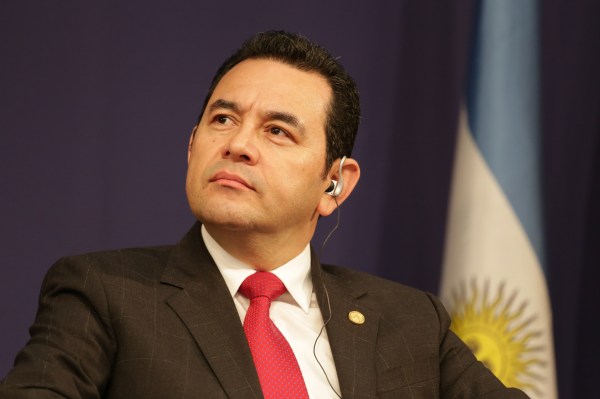
President Jimmy Morales of Guatemala looks upward

President Jimmy Morales of Guatemala. / OECD / Andrew Wheeler / Flickr / Creative Commons

Although the International Commission Against Impunity (CICIG), Attorney General, and civil society remain bulwarks in efforts to combat corruption and impunity in Guatemala – and occasionally score big hits – the Administration of President Jimmy Morales is slowly grinding them down and generating opposition to much-needed reforms.  In a speech at the signing of the National Development Agenda last month, the President attacked provisions in the law requiring transparency in public procurement and budgeting as counterproductive, while also lashing out at the judges, congressmen, general comptroller, and civil society leaders who support such measures.  He claimed on that occasion and others that anti-corruption measures have hindered his ability to govern.

  • The Morales Administration has not just complained; it has tried to remove anti-corruption controls. On July 14, CICIG and the Ministerio Público (MP) made the first of dozens arrests of persons involved in a corruption network run by former Communications, Infrastructure and Housing Minister (CIV) and potential presidential candidate in the 2015 elections, Alejandro Sinibaldi.  Three days later, the government responded to the case, known as “Corruption and Construction,” with a Presidential Decree declaring a “State of Emergency” on conditions of the nation’s roadways.  The order would allow the government for 30 days to sign new contracts and modify existing ones with companies involved in the scandal, including Brazilian contractor Odebrecht, free of all anti-corruption controls.  Congress not only rejected the Decree, but also impeached current CIV Minister, Aldo García, and forced him to take the blame for decrepit road conditions.

Despite such high-profile cases, Guatemalan anti-corruption advocates are concerned the MP and CICIG could still lose the war against corruption.  In addition, CICIG Commissioner Iván Velásquez has publicly lamented that structural reform – the Commission’s other mandate – has been too slow.  Last month, he said that “with current [circumstances] it is very difficult to defeat corruption and impunity.”  Some local observers believe that Velásquez’s focus on constitutional reforms to enhance the Attorney General’s powers is overly ambitions, and that other important initiatives are more attainable, but they acknowledge the generally hostile political environment he faces.  Advocates also believe that the Morales Administration is waiting out the term of fiscal general (attorney general) and head of the MP Thelma Aldana, who steps down next year.  The President even excluded her from his delegation attending a summit in June with U.S. Vice President Pence and Central American counterparts.

The strident complaints of some Guatemalans about U.S. support to CICIG and other anti-corruption initiatives has fueled perceptions that external support for clean government is more important than local demands for good governance – and coincided with a decline in the civic engagement that helped bring down the corrupt government of President Pérez Molina in 2015.  Much attention in Guatemala City has focused on outgoing U.S. Ambassador Todd Robinson and is now naturally shifting to the man confirmed by the U.S. Senate on August 3 to replace him:  Luis Arreaga – most recently a deputy assistant secretary of state for narcotics and law enforcement – is a Guatemala-born naturalized U.S. citizen who, nominated to the post by President Trump in June, is expected to distance himself from the Obama Administration’s strong commitment to anti-corruption programs.  Even though Attorney General Aldana was bumped from President Morales’s delegation at the June summit, Pence publicly praised Morales’s “personal dedication” to fighting corruption.

August 21, 2017

*Ricardo Barrientos is a senior economist at the Central American Institute for Fiscal Studies (ICEFI).

The Brazilian Roller Coaster … Still Heading Down

By Fábio Kerche*

34976737542_8c2ede46de_k

Rodrigo Maia (center), Speaker of the House of Representatives, gives an interview to the Brazilian press. If President Temer loses the House, Maia may replace him as President.

The political situation in Brazil is dramatic and shows no prospect of improving in the short term.  The Supreme Court has received an indictment against President Michel Temer on corruption charges.  A close adviser of his was caught on video receiving money in a suitcase.  The Chief Prosecutor, who had been playing a minor role in the anti-corruption Car Wash Operation, saw an opportunity to grab the limelight.  Rede Globo, Brazil’s most powerful media group, made Temer’s fall from power seem likely in a matter of days.

  • But Temer did not surrender. As Supreme Court action against a president must be authorized by the House of Representatives, the battle turned to Parliament.  Using means denounced as unethical, such as giving administration positions to people appointed by congressmen, the President won the first round in the committee with jurisdiction over the case.  The next step, in August, will be a full House vote, which could reverse the committee decision.

Regardless of the outcome of House proceedings, political turmoil appears certain to continue – and Temer’s conservative policies will continue to aggravate social divisions.  If Temer loses and the House gives a green light to a Supreme Court investigation, the Constitution foresees that he must be removed from the presidency during the trial (for up to 180 days) – with little chance of regaining the post, according to analysts.  In this scenario, his most likely successor would be Rodrigo Maia, Speaker of the House of Representatives, and a member of a small right-wing party that supported the military dictatorship.  He has little experience in electoral terms; many attribute his victories in legislative elections to the reputation of his father, a former mayor of Rio de Janeiro.  His attempt to run for the executive branch in Rio de Janeiro, a more difficult kind of election than for the Congress, proved to be a huge failure.  He is signaling that he would keep Temer’s conservative economic team and continue an agenda that cuts workers’ rights – proposals that are music to the market’s ears but likely to further rile opponents.

  • An alternative pushed by social movements – a constitutional amendment calling for direct elections right now – would seem to offer a chance for Brazil to break its downward spiral. Protesters show little sign, however, of breaking the roadblocks that the mainstream press has created against the proposal.  The popular mobilizations involve thousands of people but are having little resonance on television, in newspapers, and on websites.  The government, press, and market do not wish to delegate to citizens the right to choose their president, at least not now.

By default, general elections scheduled for October 2018 still appear to be the country’s best hope for putting democracy on track again.  The chance that the elections will end the crisis will be undermined, however, if former President Lula da Silva is barred from running.  Convicted of corruption in a process that many observers claim lacked evidence, the matter is now in the court’s hands.  If the conviction is confirmed, the legitimacy of the elections will be in jeopardy.  Brazil’s political institutions will be further weakened as confidence in election results will plummet –more than in a healthy democracy – and the democratic game itself, as expression of popular rights and will, will be threatened.  There is no hope of improvement in the short term.  The impeachment without a crime of former President Dilma Rousseff continues to take its toll.

July 31, 2017

* Fábio Kerche is a Researcher at Casa de Rui Barbosa Foundation, Rio de Janeiro, and was a CLALS Research Fellow in 2016-2017.

Lula Convicted: End of an Era?

By Anthony W. Pereira*

35075875073_62df9e06f4_k

Former Brazilian President Luiz Inácio “Lula” da Silva / Jeso Carneiro / Flickr / Creative Commons

Former Brazilian President Luiz Inácio “Lula” da Silva’s conviction last week on corruption charges was more than a legal decision and could mark a political watershed – the beginning of the end of “Lula-ism,” a political and redistributive pact that lasted from 2003 until 2010 which Lula has been offering to revive as a candidate in the 2018 presidential elections.  On July 12, Federal Judge Sergio Moro found Lula guilty of taking a bribe and laundering money, sentenced him to nine years and six months in prison, and banned him from taking public office for seven years.  This judgment, the first to convict an ex-president in Brazil, was the result of the Carwash anti-corruption investigations begun in March 2014.

  • The decision will be appealed to the Federal court for the Fourth Region in Porto Alegre. This court will probably rule on the case before the 2018 filing deadline for presidential candidates (yet to be decided, but usually in mid-August), and is expected to uphold the conviction.  Lula would be legally barred from being a candidate at that point, although he might mount some sort of challenge to such a ruling.  Lula’s strategy for now is to press on with his campaign, to criticize his conviction as political persecution that was not based on evidence, and to portray himself as a man of the people capable of taking on the “elite.”

Lula still has great strengths.  The basis of Lula-ism has been his personal appeal – he captured twice as many voters as did his political party, the Partido dos Trabalhadores (PT), in 2002 and 2006 – boosted by economic forces and public policies that raised the living standards of the poor.  With his finely-tuned ability to communicate to ordinary people, he showed that it was possible to both grow the economy and redistribute its fruits.  His government reduced poverty significantly, offered the poor inclusion in the consumer society and the chance of social mobility, and even achieved a modest reduction in income inequality – while promoting the interests of big companies.

  • But he may not have achieved the long-term realignment his supporters claim. Lula-ism proper only lasted for eight years, the length of his two presidential terms.  His hand-picked successor, Dilma Rousseff, ruled for almost six more years, but by the last year of her first term, poverty had stopped declining.  The current government of President Michel Temer has passed a constitutional amendment freezing federal spending in real terms for 20 years; the measure does not automatically reduce spending on social programs, but in the absence of tax increases that is what it has produced.  Temer’s own bribery scandal may take him down, perhaps within the next couple of weeks, but his policies raise a more fundamental question:  whether Brazil can return to economic redistribution, diminishing the severe inequality that still marks its society, without Lula-ism.

The organs of anti-corruption investigation and control that have challenged Lula, Dilma, and Temer – the media, the Federal Police, the Public Prosecutor’s Office, and the judiciary – are neither consistently politically neutral nor free of corruption themselves.  They are not a Deus ex machina that can free the Brazilian polity of corruption all by themselves.  For that, Brazil needs political reform, further changes in at least some of the rules that regulate elections and governance, a realignment of incentives faced by elected officials, state bureaucrats, business people, trade unions, and the electorate.

  • The PT and the other two most important parties, however, seem incapable of renovation despite leaders’ awareness of the low level of legitimacy with which they are viewed by voters. The PT has few viable new leaders and is clinging to Lula’s candidacy as its only hope of a return to power.  The Brazilian Social Democratic Party (PSDB) still nominally supports Temer.  And Temer’s own party, the Brazilian Democratic Movement Party (PMDB), is torn between defending the president in an act of self-preservation, and fearing the wrath of the voters in 2018.

Brazilians face a “trilemma”: they yearn for the three long hoped-for goals of sustained and successful anti-corruption investigations, political reform, and a return to economic redistribution.  Achieving two of those goals at the same time, let alone three, seems impossible.  The 2018 elections therefore will reveal a country in which anti-corruption investigations continue to knock major figures out of the political game, while political reform and economic redistribution are postponed.  The old cliché that Brazil is the country of the future takes on a new meaning in light of this somber possibility.

July 17, 2017

*Anthony W. Pereira is a Professor and Director of the Brazil Institute at King’s College London.

Macri in the Next 100 Days

By Nicolás Comini*

32919903642_2bd30877a1_k

Argentine President Mauricio Macri. / Casa de América / Flickr / Creative Commons

Everybody seems to love President Mauricio Macri outside Argentina – it’s not hard to understand why – but he faces tough challenges at home.  Foreign supporters have plenty of reasons to believe in him.  First, he is not Cristina Fernández de Kirchner, the former president whom they branded a populist too close to Venezuela, Bolivia, or Ecuador.  Like many conservatives inside Argentina itself, they see Macri as the person who avoided the “Venezuelization” of the country, and his market-friendly credentials were sealed through his campaign promise of a “rain of investment” and his government’s implementation of a package of measures aimed at financial liberalization, regulatory flexibility, liberalization of foreign trade, and stronger fiscal discipline.  He has been less confrontational in diplomacy.  “Return to the world,” “de-ideologization,” “pragmatism,” and “transparency” are the continuous slogans that draw the foreign accolades.

Things look different at home, however.  The federal government confronts a convoluted scenario in the next 100 days, during which it will face at least three sets of sensitive issues in the run-up to Legislative primaries in August and elections in October.

  • Domestic issues. The government will have to deal with a hostile internal front.  One challenge will be resolving a long-running pay dispute with teacher unions – especially in the province of Buenos Aires.  Another is quelling complaints about steep increases in the costs of government services and deep slashes in funding for Science and Technology, Culture, Human Rights, Health, Production, and Energy.  Macri’s failure to meet inflation reduction targets (prices rose by 40 percent in 2016); the need to stimulate the economy; and debates on tax reform are a daunting agenda.
  • Controversy over human rights and immigration. One of the Achilles’ heels of the current administration is the imprisonment of social activist Milagro Sala in the northwestern province of Jujuy.  An ally of former President Fernández de Kirchner, Sala was arrested in January 2016 – one month after Macri took office – on highly contested charges: initially of “instigate criminal activity disorder” and later of “illicit association, fraud, and extortion.”  Pope Francis, Canadian Prime Minister Trudeau, and UN officials have expressed concern, fueling tensions inside Argentina.  An immigration reform decree facilitating deportations and restricting access at border crossings has been rejected by social movements, international organizations, and much of the Argentine political opposition.  The repudiation is not only felt in the formal political arena but also on the streets.
  • External dynamics with internal consequences. Brazil’s Lava Jato scandal is splashing as much onto Macri’s government as his predecessor’s.  Officials from both administrations are being accused of receiving bribes from Odebrecht, the largest Brazilian construction company, and no one knows how this process will develop hereafter.  Congresswoman and Macri ally Elisa Carrió claims the whole political elite is complicit in the Odebrecht mess.  The “Panama Papers” – leaked from the law firm Mossack Fonseca, which allegedly was involved in helping companies hide bribes paid to a number of South American leaders – has so far not touched Macri, whose family has links to firms cited in the documents.

The August primaries, followed by full legislative elections in October, are a potential inflection point for both Macri and his opponents.  Neither side has yet announced its slate of candidates, but one essential factor is already clear: the candidacy (or not) of Cristina Fernández de Kirchner.  The primary election will define how the pieces of the political chessboard are placed, and Macri’s handling of his economic, political, and social challenges will be decisive.  Achievement of his reform agenda – including the overhauling the National Institute of Statistics and Census (INDEC, accused of cooking data during previous governments), an ambitious “Plan Belgrano” infrastructure program, and the end of currency controls – may not be enough.  The potential reunification of his key Peronist opponents, increased social unrest, splits in his own coalition, and the spillover from the Brazilian crisis suggest a sobering future.  True love cannot be achieved from one day to the next, but in the domestic political arena it is simple to lose it suddenly.

June 8, 2017

* Nicolás Comini is Research Fellow at CLALS; Director of the Bachelor and Master Programs in International Relations (Universidad del Salvador, Argentina); and Professor at the New York University-Buenos Aires.

Brazil: The Day after Temer

By Marcio Cunha Filho*

34622412041_b5ddcca3d7_k

Demonstrators in São Paulo demanded the resignation of Brazilian President Temer on May 17, 2017. / Mídia NINJA / Flickr / Creative Commons

Brazil’s political turmoil has reached new heights with the leaking of audio recordings of President Temer allegedly authorizing bribes to prevent the former Speaker of the House, Eduardo Cunha, from concluding a plea bargain arrangement with investigators.  Although the recordings were inconclusive and Temer alleges that they were fabricated, their emergence was enough to push an already fragile government to the verge of collapse in less than 24 hours.  The day after the leak, according to press reports, four of Temer’s ministers were already discussing his replacement at a closed meeting with current Speaker of the House Rodrigo Maia, who is the next in line for succession. Some parties, such as the PPS, have already left Temer’s coalition. The PSDB, Brazil’s largest center-right party and Temer’s main coalition partner, is also discussing a possible withdrawal from government.  (The party’s former President and one of Temer’s closest allies, Senator Aécio Neves, was removed from office by a Supreme Court decision as part of Operation Car Wash.  (See here and here for previous articles about the Lava Jato investigations.)

  • Temer has denied the possibility of resigning, but there are a few ways he could be forcefully removed from office. Most observers argue that, however he departs, the Constitution would require his successor to be indirectly elected by Congress within 30 days.  Others posit, however, that if the Superior Electoral Court condemns Dilma and Temer together for illicit funding in the 2014 Presidential campaign – the trial is in early June and is likely to be the fastest possible way to remove Temer – then the electoral code dictates that new direct popular elections be held (as long as annulment is not declared within the last six months of their term, which ends in December 2018).
  • Key political actors seem to be favoring the scenario in which Congress indirectly elects the successor. Although very fragmented, the Brazilian Congress is mostly conservative or right-leaning, and many of its members fear that former President Luis Inácio Lula da Silva, who polls currently indicate would easily defeat any other candidate, might be elected in a popular election.

In this context, indirect election would put Brazil’s political system on the very edge of legality.  During a similar crisis in 1964, Congress’s ousted left-wing acting Vice President João Goulart and elected another itself, without popular approval, in an act almost universally seen today as illegal.  That act ended up throwing Brazil into a violent military dictatorship that lasted for more than two decades.  In the current political crisis, if Congress were to act against the current rules of the electoral code and without popular approval, this could again be another step towards the establishment of an illegal regime, which could further curtail accountability and democratic mechanisms in the country.  Placing the destiny of the country in the hands of a Congress, with many of its members under investigation themselves, might be a mistake with profound consequences.  Popular elections would also entail great uncertainty as well, but the uncertainty of elections is an inherent element of democratic systems.  When political actors try to limit or manipulate electoral outcomes in the name of predictability or security, this is when democracy dies.

May 19, 2017

* Marcio Cunha Filho is a Ph.D. candidate at the University of Brasília; federal auditor in Brazil’s Office of the Comptroller General; and CLALS Research Fellow.

Can the 2018 Election Overcome Brazil’s Crisis of Legitimacy?

By Fabio Kerche*

15339579215_b1be246cee_k

The Brazilian flag. / Club Med UK / Flickr / Creative Commons

The political and economic crisis punctuated by the impeachment of Brazilian President Dilma Rousseff in 2016 persists unabated under the troubled administration of Michel Temer.  Stagnation is fueling unemployment, and the government’s efforts to rein in pensions and limit public spending are reinforcing the perception that the principal objective of those who ousted Dilma is to cut back on social rights promised in the 1988 Constitution and deepened by Dilma and her predecessor, Luiz Inácio Lula da Silva.  Even more ominously, the continuing cascade of corruption allegations is also undermining support for the new government.

  • Surveys show that only 10 percent of Brazilians rate the Temer government as “good” or “great,” and that its legitimacy is further undermined by whistleblowers alleging that the president and nine of his ministers are corrupt.

The notorious “Car Wash” anti-corruption campaign is hurting more than Temer and his men.  Zealous prosecutors and judges are essentially criminalizing not only politicians’ behavior but, through aggressive interpretations of the law, the practice of politics itself.  The targeting of Dilma’s leftist PT is most obvious, but the deluge of charges is now buffeting all the major political parties.  Leaders of the center-right PSDB, including former President Fernando Henrique Cardoso, have been accused of corruption as well.  Except for some miniscule political parties, virtually the entire political system now faces corruption charges.

The 2018 presidential election offers the most plausible avenue for emerging from the crisis, but even that remains highly problematic.  There is a relative consensus among the political class and political analysts that a new, legitimate, and directly elected president could reverse, or at least limit, the deterioration of the political system.  With just over a year remaining for candidates to register, the likely roster is very uncertain, in part because a basic feature of constitutional democracy – that citizens are allowed to compete for office – is increasingly in jeopardy amid the current anti-corruption fever.  Early polls place Lula as the strongest among the likely candidates, and he remains in first place even when surveys include Sérgio Moro, the most important judge in the Car Wash saga, who has not declared himself to be in the running.  But it is unclear whether the courts will let Lula stand for office.  Right-wing media are hammering Lula’s alleged corrupt practices while downplaying those of Temer and his cabinet.  Potential candidates of PSDB have been denounced for receiving bribes and having overseas bank accounts, and their numbers are shrinking in the polls.  An alternative now being floated as a potential PSDB candidate is João Dória, the newly elected mayor of São Paulo who, like U.S. President Donald Trump, is a non-mainstream politician and businessman who formerly hosted the Brazilian version of the TV show The Apprentice.)

  •  This uncertainty – even if the parties resist the continuing wave of Car Wash denunciations and take back some political space from the unelected judicial branch of government – raises the question whether, over the next 18 months, Brazil’s 32 year-old democracy proves itself to be irreversible or to have been an all too brief interlude in the country’s political history. The apparent appeal of outsiders in an environment that is criminalizing politics is a worrisome sign.

April 24, 2017

* Fabio Kerche is Research Fellow at CLALS and Researcher at Casa de Rui Barbosa Foundation, Rio de Janeiro.

Colombia Reconciliation: A Multi-faceted Task

By Christian Wlaschütz *

U.S._Special_Envoy_for_the_Colombian_Peace_Process_Bernard_Aronson_Addresses_Conflict_Victims,_Ex-_Combatants,_and_At-Risk_Youth_Speak_About_a_Job-_Training_Program_at_the_Escuela_Taller

Last September, a U.S. delegation addressed conflict victims and ex-combatants in Cartagena, Colombia, as part of a transnational effort to encourage the peace process. Many Colombians are distrustful of the “transnational justice” provisions of the peace accord. / The U.S. State Department / Wikimedia / Public Domain

The term “reconciliation” is now omnipresent in Colombia’s post-conflict strategies – and helps attract tens of millions of dollars in aid – but its meaning is still vague.  The intention is more than rebuilding interpersonal relationships and bringing former enemies together to embrace in public.  Political reconciliation is predominantly about social change, and in Colombia that means mending relations between the state and its citizens.  Pablo de Greiff, a Colombia human rights advocate now serving as a UN Special Rapporteur, highlights the importance of “civic trust,” by which he means the realistic expectation that state actors have to act within the law’s boundaries.

Congressional debate on aspects of the peace accord has already demonstrated broad discord on and aggressive resistance from multiple sectors of society.

  • Causing most tensions are the “transitional justice” and “special jurisdiction” provisions, which deal with allegations of rights abuses by both the FARC and the state. It is the centerpiece of efforts to achieve political reconciliation but is also the most hotly contested.
  • Even more difficult will be overcoming the widespread distrust of citizens toward the political system, as expressed by the huge rates of abstention in momentous decisions such as the peace plebiscite in October (63 percent). This distrust is caused by a sense of a lack of representation, a lack of government efficiency, and, more generally, the perception that political actors lack the will to change a system that suits the needs of a privileged elite.
  • The assassination of dozens of social leaders so far this year further fuels citizen distrust, as it reminds them of the initial phase of the extermination of the Patriotic Union – the last attempt to transform the FARC into a political actor some 30 years ago. The violence has raised questions about the state’s willingness or ability to protect civilians who are committed to social change.  It further fuels fear that the territories evacuated by the FARC will simply be taken by other armed actors.
  • Corruption poses a vexing challenge. The peace accord seems to leave open the possibility that corruption will be within the mandate of the Truth Commission, but the result is unclear.  Corruption gets to the root of the armed conflict and its persistence.  It includes the use, or abuse, of public money for private benefit.  For people in rural areas and those who live in marginalized areas of the major cities peace has simply no tangible meaning when there is no basic health system because the social insurance company collapsed because of the flow of resources into private pockets.  The same applies to education and the public transport system, most notably in Bogotá.

In an almost prophetic intervention at the Congress in late November, Todd Howland, the representative of the UN High Commissioner for Human Rights, stressed the urgency of implementing the peace accord in areas previously controlled by the FARC, where 2 million citizens depend on social investment and measures to increase security in these areas.  In a country characterized by enormous estrangement between the citizens and the state, reconciliation depends on representatives being willing to pursue policies based on people’s needs.  The result of this responsiveness is new trust.

March 28, 2017

Christian Wlaschütz is an independent mediator and international consultant who has lived and worked in Colombia, in particular in conflict zones in the fields of disarmament; demobilization and reintegration; and reconciliation and communitarian peace-building.

MACCIH: An Early Progress Report

By Chuck Call*

31246077021_af5b37fcce_k

Juan Jiménez Mayor, Spokesman of the MACCIH Mission in Honduras, presented an update about MACCIH at the OAS in December 2016. / Juan Manuel Herrera, OAS / Flickr / Creative Commons

The OAS “Mission to Support the Fight against Corruption and Impunity in Honduras” (MACCIH) approaches its first anniversary in April with some gains and many challenges.  Launched after months of negotiations with the government of President Juan Orlando Hernández, MACCIH was created partly in response to widespread street protests by the Indignados (the “Outraged”), angered that the president’s campaign had benefitted from $300 million embezzled by officials of the Social Security Institute (IHSS).  Hernández was widely believed to accept the mission only because his tenure in office – and a possible second term – were in danger.

  • MACCIH was inspired by Guatemala’s CICIG, the UN-backed commission supporting that country’s judicial institutions, but Hernández insisted on major differences. He consented only to a mission of the OAS, generally seen as weaker than the United Nations.  MACCIH is weaker than CICIG in that it cannot initiate its own case investigations and must channel all its investigative and prosecutorial work through Honduran authorities.  (CICIG enjoys full investigative police powers and can initiate its own wiretaps and surveillance.)  MACCIH is headed in-country by a “spokesman” for the OAS Secretary-General, who nominally leads the mission from Washington, and its $2 million first-year budget has been only about one-sixth that of CICIG’s annual budget.

As a result, MACCIH opened to skepticism that its slow start hasn’t dispelled.  Its investigations have produced virtually no corruption-related arrests or prosecutions.  Setting up the office took much of 2016.  The head of criminal investigations only arrived in the summer, and the public security office only opened this month.  In contrast, a Honduran Police Reform Commission has sacked over 3,000 police officers.  Civil society organizations complain of MACCIH’s lack of impact, and a novel “observatory” comprising academic institutions and civil society groups remains ill-defined.  MACCIH’s decision not take up the investigation of the high-profile murder of environmental rights activist Berta Cáceres has seemed to sideline the mission from a case that emblemizes impunity, even if it seems not to involve far-reaching corruption.

  • However, MACCIH has scored some wins. It has embarked on a handful of complex corruption cases, including the IHSS case that sparked its creation.  The mission helped Honduran prosecutors prepare charges of arms possession against Mario Zelaya, the highest-profile suspect in the IHSS case, which kept him in jail long enough for more serious charges to be brought.  It helped secure two laws – to regulate campaign financing and to create a nationwide anti-corruption jurisdiction with its own selected judges and prosecutors.  MACCIH’s in-country leader, former Peruvian Prime Minister Juan Jiménez Mayor, has been forward-leaning in acting on his mandate.
  • MACCIH gained support in an early test late last year. In November, its concerns about several Hernández nominees to the Tribunal Superior de Cuentas, an audit court with special powers over corruption investigations, earned the ire of Honduran senior officials who complained to Secretary General Almagro.  The appointments were not altered, laying bare the mission’s limitations.  But Almagro stood by his organization’s analysis and role, with Jiménez Mayor emerging stronger as his special representative, not just his spokesman.
  • That same month, the board chair of Transparency International, José Ugaz, visited Honduras and urged civil society organizations to help ensure MACCIH’s success. Since then, they have showed a more positive attitude toward MACCIH, and more witnesses are now cooperating with the mission.

Comparisons between MACCIH with CICIG may arguably be unfair just one year out.  Observers recall that CICIG had difficulty showing impact in its initial investigations and was criticized as ineffectual.  Delivering on its ambitious mission to help curb corruption and impunity – in a country notorious for both – will be even harder.  However, the mission has accomplished as much as CICIG did in its first year in case investigations and legal reform.  Despite its limitations and slow start, MACCIH’s performance does not preclude obtaining far-reaching corruption convictions and strengthening the Honduran judicial system in coming years.  As civil society groups seem to be getting past their disappointment that their country did not get a CICIG, their collaboration will be crucial to the mission’s success.

March 13, 2017

* Chuck Call teaches International Peace and Conflict Resolution at American University.