Mexico: Peña Nieto’s Big Push

By CLALS Staff

President Enrique Peña Nieto / Photo credit: Eneas / Foter / CC BY

President Enrique Peña Nieto / Photo credit: Eneas / Foter / CC BY

President Peña Nieto’s reformist agenda wins kudos from the business and financial class, but both a recalcitrant leftist opposition and mass organizations previously aligned with his party are taking to the streets in protest – raising serious doubts about its prospects.  In his first state of the nation speech, delivered last week, Peña Nieto pledged to plow ahead with “transformational” reforms, giving flesh to the PRI’s slogan that it is Transformando a México. In education, he’s proposed a more rigorous system for hiring, evaluating, promoting and firing teachers who have resisted change despite evidence that the current system is not equipping Mexican youth for employment.  In the energy sector, he wants to open up the oil and gas industry to foreign investment, an idea that was strictly off-limits in the past even though lagging investment has caused production in Mexico’s leading export industry to decline steadily.  He is also pursuing tax reforms that, although watered down when announced on Sunday, entail political risk and, tellingly, raise marginal rates by 2 percent for higher earners and impose a levy on capital gains.  In June, he picked a fight with powerful business leaders over control of the country’s telecommunications industry, an oligopolistic structure that imposes excess costs on consumers and producers alike, diminishing Mexico’s economic competitiveness.

The teachers unions, whose symbiosis with the PRI in the past ensured cooperation, mobilized huge protests in Mexico City, forcing Peña Nieto to delay his speech by a day and then causing monstrous traffic jams during it.  The President cloaked his announcement of the energy reform in nationalistic rhetoric, and PEMEX, the oil company, followed it up with predictions of positive results – huge increases in oil investment and production that purportedly would help to create 500,000 new oil-sector jobs by 2018 and 2.5 million by 2025. But opposition to the reform has been strident, and tens of thousands filled the Zócalo on Sunday to protest it as a “covert privatization.”  Opposition leaders are already pledging demonstrations to oppose taxes, though the likelihood of this may be diminished because the long rumored reform unexpectedly left untouched the value-added tax exemption for food and medicines, which would have been a major rallying point for the Left.

Some Mexican commentators say Peña Nieto’s leadership is already losing its shine and that his Pacto por México, the loose coalition he engineered in Congress, is at risk of falling apart.  He prevailed in his congressional showdown over the long overdue education reforms, but success in transforming the underperforming education sector appears uncertain, as the teachers are threatening more protests.  The arrest of narco bosses from the Gulf Cartel and the Zetas have not given him a bounce on the security front; indeed, Mexican press reports indicate that kidnapping, extortion and other crimes that more directly affect citizens’ lives continue to rise. Further complicating Peña Nieto’s life is news last month that the economy is slowing down.  The first contraction in four years has forced the government to cut its 2013 GDP growth forecast in half, to 1.8 percent.  The administration will undoubtedly point to data showing that PEMEX production has fallen by about a quarter in the past decade because of low investment, and will emphasize that this makes modernization of the oil sector all the more imperative.  But Mexicans have heard promises before, during NAFTA debates and since, that economic reforms and greater openness to trade and investment will massively improve their lives.  Whether there is any fuel left in that rhetorical tank remains to be seen.

Egypt Policy – Latin America Style

By Fulton Armstrong

U.S. Department of State Headquarters | Wikimedia Commons

U.S. Department of State Headquarters | Wikimedia Commons

We who follow U.S. policy in Latin America shouldn’t be surprised to see Washington’s policy toward Egypt drift from support for democracy to support for the status quo ante.  President Obama’s 2009 speech in Cairo reaching out to Muslims – calling for an end to the “cycle of suspicion and discord” – came just six weeks after he told the Summit of the Americas that he wanted “an equal partnership” with the hemisphere and sought “a new beginning with Cuba.”  When 30-year President Hosni Mubarak stepped down in 2011, the Administration eagerly linked Egypt to the “Arab Spring” and, despite concerns about the Muslim Brotherhood roots of Egypt’s first democratically elected president, tried to make the relationship with Mohamad Morsi work.  Over time, however, Morsi – successor to an undemocratic regime in an undemocratic country with no democratic traditions and no democratic institutions – was accused of being undemocratic.  The estrangement grew so deep that the Obama Administration still cannot bring itself to call the July 3 coup against Morsi a coup, and Secretary of State Kerry saw fit to refer to the military takeover as “restoring democracy” even as the Army was firing on unarmed crowds.

To Latin America watchers, this chronology is reminiscent of U.S. policy in our own hemisphere.  The case of Honduran President Mel Zelaya is clearest.  The Honduran military removed Zelaya– in his pajamas – from his home and country in June 2009 for proposing a referendum that, the putschists claimed, violated the Honduran constitution.  The Obama Administration’s nominee to be Assistant Secretary of State at the time, Arturo Valenzuela, testified that the action was, in his opinion, a coup, but the State Department never categorized it as such and, despite rhetoric committing to restore Zelaya, the Administration let the interim regime consolidate power.  Amidst a state of emergency, media closures, and other irregularities, the State Department also gave its blessing to elections held several months later.  Zelaya’s rhetoric before the coup was caustic, and he squandered political capital in needless confrontations, but he never threatened Honduran “democracy” or violated human rights as the interim regime did.  Nor did he preside over a steady deterioration of security, civil rights, and the economy as the current government has.  Yet, ironically, the Obama Administration has never set the history of the coup straight – just as the Bush Administration never rectified its disastrous support for the 2002 coup against Chávez in Venezuela.

The excesses of some leaders, like Zelaya and Chávez, make supporting or turning a blind eye to a coup very tempting.  But Washington has also shelved its moral outrage when much less provocative presidents – democratically elected but progressive-leaning – have been removed from power, if not with a gun at their head.  The “constitutional coup” against President Lugo in Paraguay last year is the most recent example.  The gap between U.S. rhetoric about democracy, rule of law, and due process on the one hand and its tangible actions on the other has a number of causes. 

  • American “exceptionalism” – the sense that U.S. success gives it a right to judge others and intervene even when national interests are not at stake – sometimes leads Washington to over-extend and make rash decisions.
  • Eagerness to act quickly – to appear decisive – often makes policymakers confuse the symptoms of problems, which seem amenable to quick solutions, and the essence of the problems themselves.  Policies address the short-term while neglecting the strategic.
  • Washington lobbies – the pro-Israel lobby in the case of any matter in the Middle East and the Cuban-American lobby in Latin America – are able to dominate U.S. perceptions of events, pushing administrations into a corner. 
  • Administrations embarrass themselves when they throw around words like “Arab Spring” and “democracy.”  When the inevitable bumps in the road occur, they act betrayed rather than admit they got carried away by wishful thinking. 
  • Double-standards –the expectation that progressives succeeding authoritarians will be perfectly democratic and flawlessly inclusive – make it difficult for Washington to avoid prematurely throwing a potential ally overboard. 
  • Another factor, and potentially the most important, is that the U.S. government builds deeper relationships with elites and the security services that do their bidding than with any other forces.  During the Bush Administration’s “War on Terror,” the U.S. Government entrusted Egypt with extremely sensitive operations, including the interrogation (and alleged torture) of suspected terrorists, and Washington relies on Latin American security services to prosecute the “war on drugs.” 

When U.S. interagency committees discuss how to respond to crises, the departments and agencies with the deepest ties in the country under discussion claim more influence over events there than anyone else – and win most policy debates.  The problem is that their ties are mostly to political and economic elites – or the military and intelligence services that back them – which are rarely agents of change.  Washington winds up allied with forces that suppress the new voices essential for the “springs” and “democracies” that it says it wants.


Will the U.S. Support Controls on Security Contractors in Latin America?

Photo by: Charles Atkeison / flickr / Creative Commons

Photo by: Charles Atkeison / flickr / Creative Commons

An upcoming conference in Switzerland will test U.S. willingness to make good on its rhetorical support for greater control over private contractors involved in wars or similar circumstances.  The “Montreux plus five” conference in December will discuss implementation of the Montreux Document, which lays out legal obligations and “best practices” for countries that hire “Private Military and Security Companies” (PMSCs) during armed conflict.  The process emerged in 2008 to reiterate state responsibilities after contractors were found to be deeply involved in incidents in Iraq – including the torture of detainees at Abu Ghraib prison and a confrontation at Nissour Square in which 17 civilians were killed.  The United States, which participated in discussions of the Document and endorsed it, has been developing its own “standards” based on it.

Although the PMSCs in Iraq and Afghanistan – and their alleged involvement in human rights abuses – are most widely known, security contractors are deeply engaged in U.S. efforts in Latin America related to the “war on drugs.”  In the 2005-2009 period, DynCorp, Lockheed Martin, Raytheon, ITT, and ARINC collectively received counternarcotics contracts in Latin America worth a total of $1.8 billion.  The contracts include provision of intelligence, surveillance, reconnaissance, information technology, and communications equipment.  Lockheed Martin received contracts for training, equipment, and other services in Colombia and Mexico. Yet the majority (Democratic) staff of the subcommittee on contracting oversight of the U.S. Senate Committee on Homeland Security and Governmental Affairs concluded in 2010 that neither the State Department nor the Department of Defense had adequate systems to track the implementation of counternarcotics contracts.  Referring to contract and accounting errors, the Bureau of International Narcotics and Law Enforcement Affairs told the subcommittee chairman that it “does not … maintain discrete records of such occurrences since these challenges routinely occur at the embassies.”

The subcommittee’s focus was on contracting anomalies, but publicly acknowledged incidents – such as DynCorp’s violation of guidelines governing coca eradication in Colombia – suggest oversight over operations is also lacking.  In Colombia, for example, two cases of rape of a minor involving U.S. contractors were reported yet remain uninvestigated, and in Mexico a contractor appears to have been involved in torture training.

PMSCs often carry out their work within the dark interstices of sensitive operations – beyond the government’s immediate operational control but functioning with its imprimatur and expecting its protection when things go wrong.  The U.S. Senate’s acknowledgement of the need for better management and oversight over them has not driven significant reforms yet.  If the Iraq and Afghanistan experiences are any guide, problems with the monitoring of expenditures are the tip of the iceberg.  Security contractors tend to run rough over human rights, and they are often a source of tensions with both governments and the population in host countries.  The use of security contractors without effective monitoring is a source of diplomatic tension within the region as well.  DynCorp’s aerial eradication operations, for example, provoked Ecuador to file suit against Colombia in the International Court of Justice, arguing that Colombia dispersed toxic herbicides into Ecuadoran territory, damaging human health, property and the environment.  The two countries recently resolved the dispute, but the case illustrates the risk of outsourcing sensitive operations to contractors without careful monitoring.

What’s Up with Cuba Policy?

By William M. LeoGrande

Photo by Rinaldo W. / Flickr / Creative Commons

Photo by Rinaldo W. / Flickr / Creative Commons

A little over six months into President Obama’s second term, the administration is giving hints that something is afoot in relations with Cuba.  Back in 1994, Fidel Castro told a group of former U.S. ambassadors that he needed a two-term U.S. president to normalize relations with Cuba because no first-term president would have the political courage to do it.  Could Barack Obama be that president?  Efforts to engage with Cuba during his first term were frozen after the 2009 arrest of USAID subcontractor Alan Gross.  Despite evidence that Gross had violated Cuban law, the administration insisted that Gross had done nothing improper and demanded that he be freed immediately.  When he wasn’t, the U.S. position hardened: there would be no improvement in relations with Cuba, not even on issues of mutual interest, until Gross was released.  Gross is still in jail four years later; the non-negotiable demand strategy failed utterly.

The second Obama administration appears to be trying something new.  In May, the Department of Justice dropped its insistence that René González, a member of the “Cuban Five,” serve out his probation in Miami rather than Cuba.  Shortly thereafter, Cuba granted Alan Gross’ request to be examined by his own doctor.  In late May, Josefina Vidal, the Cuban Foreign Ministry official in charge of relations with the United States, met in Washington with Assistant Secretary of State for Western Hemisphere Affairs Roberta Jacobson – the highest-level U.S. official to meet with a Cuban diplomat in several years. After this reportedly constructive encounter, the State Department announced the resumption of bilateral talks on immigration (suspended since January 2011), and on re-establishing direct postal service. Working-level diplomats have resolved most points of disagreement on a postal accord, a Coast Guard search and rescue accord, and an oil spill containment protocol – although the U.S. side is loath to use the word “agreement,” lest it stir up trouble with a small but loud contingent in Congress.

Although U.S. policy is no longer completely paralyzed by the predicament of Alan Gross, it remains tentative, cautious, and incremental – far from the bold stroke that Fidel Castro was hoping for from a second-term president.  In May, the State Department again listed Cuba as a “state sponsor of terrorism” in its annual report, although the rationale read more like a justification for removing Cuba from the list—a move reportedly under discussion by the Obama team.  When the administration sent its FY2014 budget request to Capitol Hill, it again requested $20 million for “democracy promotion” in Cuba, continuing programs like the one that got Alan Gross arrested.  Radio and TV Martí, which cost U.S. taxpayers $28 million a year, continue to beam programs below Voice of America standards to a shrinking radio audience and non-existent TV viewers.  (Cubans call TV Martí “la TV que no se ve” —No-See TV.)  If Obama had the mettle to make the bold stroke, these provocative, ineffectual programs  would be on the chopping block in tough budgetary times.  More positively, the president could take the initiative by appointing a special envoy to talk turkey with Havana, and he could promote a U.S. policy debate on Cuba that’s long overdue.  Incrementalism will only take us so far.  Real change in U.S.-Cuban relations requires vision and courage – qualities Obama displayed on comprehensive health care and immigration reform.  After all, as Lyndon Johnson once said, “What the hell’s the presidency for?”

Dr. LeoGrande is Professor of Government in the School of Public Affairs at American University.

Resource Extraction and Ecuador’s Fragile Ecological Sustainability

By Peter Redvers-Lee

Yasuní National Park /Photo credit: joshbousel / Foter / CC BY-NC-SA

Yasuní National Park /Photo credit: joshbousel / Foter / CC BY-NC-SA

The world has failed Ecuador again.  That, at least, is the sentiment of Ecuador’s president, Rafael Correa, explaining his decision to discontinue an innovative environmental plan to save sections of the Yasuní National Park, a UNESCO Biosphere Reserve on the border with Peru.  The 2010 plan was for Ecuador to refrain from granting oil concessions in the park if it could raise $3.6 billion from other countries and international organizations.  To date, only $13 million has been raised.  Correa’s about-face comes a few months after another environmental U-turn.  In June, Ecuador’s legislature passed a new mining law that, while not garnering new friends among large mining companies, rolls back taxes and other regulations to favor smaller and medium-size mining ventures.

Both developments heighten the likelihood of further environmental degradation in Ecuador.  Increased mining and drilling is likely to have an immediate and negative impact on the sustainability of local ecosystems upon which communities depend.  The rivers that make up the Mataje-Cayapas watershed have been an important means of livelihood for the local indigenous and African-descendent communities that dot the river banks from the mangroves on the coast to the foothills of the Andes.  Environmental degradation accelerated in the 1990s, when the first major roads reached the area and mining, logging, shrimp farming and other industries moved in.  Mercury, used in mining, is already present at unacceptable levels in populations of blue crabs in the lower reaches of the watershed, where the crab forms a staple in local diets.  The destruction of the mangrove forests to make way for shrimp ponds has increased.  The roads allowed for more efficient logging, and increasing numbers of internal migrants flooded the area.  Once the Chocó forest was cleared, palm plantations took root, further displacing African-descendent communities that made up the bulk of the local inhabitants.  The African palm, used for biofuels and other purposes, often entails liberal use of toxic chemicals.

The failure of the Yasuní proposal and Ecuador’s new mining laws have ominous implications for Ecuador and, perhaps, beyond.  Toxins in the Mataje-Cayapas watershed have contaminated the water supply on which thousands of mainly African-descendent communities rely for their livelihoods.  The recent setbacks will also accelerate commercial exploitation of the watershed for gold, exposing it to even more toxic chemicals, and the ever-increasing palm plantations will add to the existing brew of fertilizers, pesticides, and fungicides sprayed liberally on the crop.  It’s unclear whether the world “failed” Ecuador or that President Correa’s proposal – protecting preserves in return for cash – is not viable.  Skepticism that the $3.6 billion would be put to good use, rather than for politically gratifying short-term programs, is also reasonable.  Either way, the country’s long-running pattern of resource extraction and environmental destruction continues in one of the most diverse ecological spots on earth.  And now Yasuní faces a similar fate.

Peter Redvers-Lee is CLALS Faculty Affiliate and Professorial Lecturer in American University’s School of International Service.  He has worked in the Mataje-Cayapas watershed since 2004.

U.S.-Mexico: Border Liaison Groups—the Bread and Butter of Cooperation

By Carolyn Gallaher and David Shirk

"Little Road, Big Intersection" Photo credit: “Caveman Chuck” Coker / Foter / CC BY-ND

“Little Road, Big Intersection” Photo credit: “Caveman Chuck” Coker / Foter / CC BY-ND

Drug traffickers often find ingenious ways to get their product across the U.S.-Mexico border, but cooperation among Border Liaison Officers can often stop them.  In Mexicali, one trafficker used a pneumatic cannon attached to his truck bed to shoot packages of marijuana across the border for pickup.  After some surveillance, Border Patrol caught the truck in action.  Agents took down the license plate number and called an officer in the Mexicali police department, who looked up the number, tracked down the truck’s owner, and made an arrest.  Border Patrol agents knew who to call in Mexicali because they belong to the same border liaison group.  Although they receive little public attention, border liaison groups are a crucial part of the cooperative infrastructure between the two nations.  They allow cooperation to continue during, and in spite of, political transitions, diplomatic imbroglios, and other shifts in bilateral relations.

Border liaison groups are semi-formal organizations in which officers cooperate on policing cross-border crimes such as auto theft, low-level drug crimes, and smuggling.  They are usually organized and maintained by law enforcement officials.  The San Diego Police Department, for example, used to have a full team of officers whose full-time job was to liaison with officers in Mexico.  Membership in border liaison groups is not compulsory, however, and there are no restrictions on which agencies for which a member must work.  Groups usually include a mix of local, state, and federal officials. And meetings are typically held in informal places like restaurants, barbeques at members’ homes, or at organized events, such as boxing matches and softball games.

Border liaison groups facilitate cooperation in a number of ways.  In a structural sense, they help individuals navigate the other side’s bureaucracy – i.e. identifying which agency is in charge of a particular issue, and who in the agency you should call.  They are also fundamental for establishing trust.  In a context where corruption is an ever-present concern, border liaison groups give members a chance to get to know one another, and to discern potential partners’ trustworthiness.  A member of the Baja state’s preventive police force (known by its Spanish acronym PEP) told us, for example, that officers often use the “gut test.”  You only work with someone your gut says is “ok.”  (A California law enforcement officer told us it was similar to the “gut check” he used when meeting his teenage daughters’ suitors.)  Officers also use more tangible tests.  It is not uncommon to share a piece of information and track what happens with it.  If the information is used appropriately, the agent initiating the test may decide to share more substantial information.

One of the biggest threats facing border liaison groups is funding.  Budget cuts in California, for example, have led several law enforcement agencies to reduce liaison positions, or they have grafted liaison duties onto established jobs.  Another problem is replicating these groups in non-border areas.  The Cook County Special Investigations Unit in Chicago, for example, told us “we are the border,” noting that perpetrators and victims of crime in the city are often Mexican.  Without contacts on the other side, however, the unit can only communicate through official conduits in Washington (e.g., the FBI or Immigration and Customs Enforcement, ICE) – a cumbersome process that most officers avoid.  Indeed, the sorts of information border liaison group members share – drivers’ license numbers, last known addresses, known associates – are too time-sensitive for formal channels to be of use.  The recent arrests of high-level kingpins in the Zetas and Gulf cartel tend to get widespread media attention, but the daily work by law enforcement officers is often just as important. 

Carolyn Gallaher is a professor in the School and International Service at American University.  David Shirk is a professor in the Political Science Department at the University of San Diego.

This project was supported by Award No. 2011-IJ-CX-0001, awarded by the National Institute of Justice, Office of Justice Programs, U.S. Department of Justice. The opinions, findings, and conclusions or recommendations expressed in this publication/program/exhibition are those of the author(s) and do not necessarily reflect those of the Department of Justice.

Ben Kohl: The Loss of a Scholar-Activist who Taught About Bolivia

By Eric Hershberg

This AULA blog post does not follow our standard format, but it is one that I hope will motivate readers to seek out some singularly insightful analyses of contemporary Bolivia.

Los marchistas del TIPNIS llegan a La Paz (19/10/2011) Photo credit: Szymon Kochanski / Foter / CC BY-NC-ND

Los marchistas del TIPNIS llegan a La Paz (19/10/2011) Photo credit: Szymon Kochanski / Foter / CC BY-NC-ND

I was terribly distressed to learn that Temple University Professor Ben Kohl, a noted expert on Bolivia, passed away suddenly in late July, at the age of 59. I had the privilege of meeting Ben briefly on two occasions, on both of which he struck me as charming and intellectually lively. But I already knew of Kohl through his writings, which had taught me, and many of my students, a great deal about how and why Bolivian politics and society have evolved in such remarkable ways in recent years.  Faculty, students and non-academic audiences in Washington and beyond would be well served by surveying his writings, in part because of how effectively they make sense of a country with which the U.S. government has often related unproductively.

Most of Kohl’s work was co-authored with his journalist wife, Linda Farthing (he also collaborated with my CLALS colleague Rob Albro on a fine collection of articles on Bolivia that was published by Latin American Perspectives). Among their prolific writings on Bolivia, two books stand out as especially significant. Impasse in Bolivia and From the Mines to the Streets: an Activist’s Life in Bolivia established Kohl and Farthing as pivotal voices in shaping understanding of that Andean country’s politics and society.  Their work is unusual in the effectiveness with which it speaks simultaneously to advanced scholarly readers and to students and people in advocacy and policy circles who are engaged sympathetically with that country’s remarkable social movements and transformations.

What stands out for me about Impasse, aside from its deep and nuanced understanding of the fault lines dividing Bolivian society, is that it successfully blends attention to social dynamics and political mobilization at the micro-level with an appreciation for how those phenomena interact and reflect larger scale, deeply embedded social structures.  Written on the eve of Evo Morales’ rise to the Presidency, in the wake of several years of social and political “impasse,” the study combines ethnographic insight with sophisticated interpretation of macro-level historical and sociological processes.  Impasse in particular highlights how and why Bolivia took a decisively “indigenous turn” in its national politics beginning around 2000, and ably portrays the resistance that this elicited from long dominant elites. The book was an especially novel and eloquent contribution to the literature on Bolivia at a crucial juncture in the country’s history, a juncture that ushered in fundamental changes in the political system.

Mines, like Impasse, was written for more than a strictly scholarly audience, but it is a very different sort of monograph.  The autobiographical story told to Kohl and Farthing by labor activist Félix Muruchi Poma, and very intelligently framed for a foreign audience, brings to life aspects of contemporary Bolivia (and other parts of Latin America) that are rarely presented in such a compelling and readable form.  As noted in the brief bibliographic note at the conclusion of the book, several previous books provide historical accounts of issues and events covered in Muruchi’s story, but none of the English language literature does so in this “testimonial” genre.  That genre is difficult to pull off well, as Kohl acknowledged in an insightful article for the Journal of Latin American and Caribbean Anthropology, but this work is up to the task, and points to the activist side of Kohl and Farthing’s scholarship.  One is reminded, inevitably, of the classic I, Rigoberta Menchu, which focused on the life and politicization of an indigenous Guatemalan woman during a period that overlaps in part with that covered by Muruchi’s chronicle.  The many university faculty who assign the Menchu book for introductory Latin American Studies courses would do well to consider assigning this one alongside of it.

A number of Kohl’s recent articles and book chapters were aimed more strictly at scholarly audiences than were either Impasse or Mines. A 2012 essay published in Political Geography is the most insightful analysis I have encountered of the contradictions between what Kohl and Farthing label “resource nationalist imaginaries,” articulated in practice by strong social movements in Bolivia and more disparate actors in neighboring countries, and the circumstances of economies that remain as dependent as ever on revenues derived from natural resources. The study’s use of the theoretical concepts of “imaginaries” and “framing” strikes me as an especially valuable lens through which to understand the roots of social movement resistance to an economic model that has persisted despite the rise to power of Bolivia’s first indigenous President. Re-reading that piece as I was drafting this blog post, I am reminded of how Kohl’s passing is a great loss to those of us for whom innovative scholarship motivated by concerns about fairness and justice in Latin America is to be treasured, not unlike tin or gas or water for many Bolivians, as a precious commodity.

Is Obama Declaring “Mission Accomplished” on Drugs?

By Kevin Gatter

Photo Credit: Ministerio de Seguridad Argentina / Foter / CC BY-NC-ND

Photo Credit: Ministerio de Seguridad Argentina / Foter / CC BY-NC-ND

The Obama Administration is claiming major progress in the war on drugs, but the evidence is subject to challenge – and the good news surely hasn’t reached Latin America yet.  On July 9, the Office of National Drug Control Policy (ONDCP) released an annual report that asserted a significant decline in the U.S. cocaine market, with sizable decreases in both the number of deaths caused by cocaine overdose and the rate of people testing positive for cocaine in the workplace.  It also suggests that potential pure cocaine production capacity in the Andes has fallen by approximately 41 percent since 2001, including 10 percent last year alone.  The report credits this decrease to numerous factors, including U.S.-Colombia partnership, “strengthened democratic institutions,” an increased commitment to counternarcotics cooperation and citizen security in Peru, alternative development, enhanced law enforcement efforts, and focused and persistent education about drug abuse.

Other experts say the picture may not be as rosy.  The UNODC has yet to find what it considers accurate data on coca cultivation since 2011 and, importantly, asserts that declines in past years were offset by an increase in efficiency in the manufacturing chain from coca bush to cocaine hydrochloride.  Additionally, the UNODC estimates that while the estimated total area of coca cultivation in 2011 was only three-quarters of the level in 1990, the quantity of cocaine manufactured in 2011 was at least as high as in 1990.  In any event, it is important to recognize that even if the U.S. is consuming less cocaine, demand for other drugs remains high.  Some analysts speculate that the U.S. market is moving away from Andean cocaine and toward marijuana and methamphetamines from Mexico.  Furthermore, some experts say that growing cocaine demand in Europe and elsewhere is driving prices up and reducing U.S. consumption.

ONDCP’s report has a self-congratulatory tone that – combined with Obama’s clear de-emphasis of counternarcotics at his Central American Summit in San José in May – suggests eagerness to declare victory in a 40-year war against a scourge that continues to have dire implications for every country touched by the drug trade, especially those in Central America and Mexico.  The data are extremely difficult to corroborate.  Cultivation estimates, based on satellite studies of a sampling of possible growing areas, have been notoriously suspect, and the UNODC’s concerns about ignorance of leaf-to-cocaine yield are valid.  Many of the flow estimates are based on interdictions, but U.S. agencies have openly acknowledged that interdiction operations have been significantly reduced for budgetary reasons.  A drug flow that Washington doesn’t detect is not a drug flow that has disappeared.  Moreover, the National Survey on Drug Use and Health is based on self-reporting in interviews and omits significant populations, including the homeless and incarcerated. Policy makers around the hemisphere surely hope that ONDCP’s triumphalism is warranted, but the key indicators of success will be a decline in drug-related violence, a weakening of transnational criminal groups, an end to the southbound flow of arms from the United States, the flourishing of alternative economic options for coca farmers, and reversal a pervasive popular suspicion that governments and security agencies have been corrupted by the billions of drug dollars flowing through the region.

Health Reforms in Latin America: Lessons for the U.S.?

Photo credit: World Bank Photo Collection / Foter / CC BY-NC-ND

Photo credit: World Bank Photo Collection / Foter / CC BY-NC-ND

While Washington struggles to implement modest health care reforms, a number of Latin American countries over the past decade have been changing their health systems in ways that may offer encouragement to advocates of progressive change in the United States.  Reforms in Brazil, Chile, Colombia, Mexico and others strive to provide universal care in circumstances that are, in some cases, much tougher than those facing proponents of Obamacare.  Some challenges and accomplishments include:

  • In Chile, after years of investment, about 73 percent of the population now uses the public health care system.  A Family Health Plan in Brazil, which accounts for US$2 billion of the US$3.5 billion of the government’s health budget each year, has contributed to expansion of health care participation to 70 percent of the population.  When Colombia passed a health care law in 1993, only 24 percent of its citizens had coverage; in 2007, it had reached 80 percent.  Mexico has gone from 40 percent in 2004 to about 70 percent.  (In the U.S., about 83 percent had access to health insurance as of 2010.)
  • Latin American elites, like their U.S. counterparts, have long resisted providing the resources needed to cover health care costs, either through workplace insurance or through paying taxes to support state provision of health services.  But Latin American experience shows that this reticence can be overcome.  Substantial taxes have been levied in recent years – such as a 7 percent health care tax in Chile – and, according to various databases, health-related spending has grown to almost 7 percent of GDP in Mexico, about 7 percent in Colombia, about 7.5 percent of GDP in Chile, and around 8 or 9 percent in Brazil.  (Health care spending accounts for about 18 percent of the U.S. GDP – about half from public spending.)

These Latin American governments have demonstrated that, Sí, se puede when it comes to reforming health care and challenging entrenched interests wary of change.  Spending is rising as a percentage of GDP, but expenditures remain a fraction of those in the U.S. – and the gap in quality of care is narrowing.  Latin Americans have expanded coverage at a time that access to good care in the United States remains a challenge for tens of millions of people.  The U.S. economy generates more than sufficient resources to guarantee health care for the entire population, but the Obama administration seems too weak to implement its tepid reforms on schedule – recently postponing an important mandate that large employers provide insurance coverage.  Health care providers in Latin America appear to be adapting to the new playing field, but their U.S. counterparts are lagging.  If Latin American leaders had advice for their U.S. counterparts on how to slay this dragon, it would probably involve taking note that reforms in the region invariably emerged from decisive leadership from the executive branch and, with the exception of Mexico, a willingness to increase tax burdens to expand coverage.  They would also note that, much like is evident in public opinion polling of Latino populations in the U.S., citizens of Latin American countries are overwhelmingly in favor of public guarantees of health services for all.

Moving Toward Religious Unity in Response to Violence?

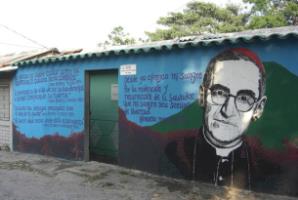
Bishop Oscar Romero mural, El Salvador / Photo credit: alison.mckellar / Foter / CC BY

Bishop Oscar Romero mural, El Salvador / Photo credit: alison.mckellar / Foter / CC BY

Many Latin American churches are struggling to address the criminal violence challenging their societies – and are finding new ways of promoting peace in ways reflecting each country’s different conditions.  As part of American University’s multi-year project (click here) on religious responses to violence in Latin America, 40 grassroots activists representing two-dozen faith-based ministries in seven countries gathered in Guatemala City in mid-July to share experiences ministering to victims of the region’s rampant violence.* Their ministries in Mexico, Central America and Colombia ranged from programs for at-risk youth, to rehabilitation centers for former gang members, to shelters for Central American migrants crossing through Mexico.  Just as they developed a range of responses to the threats posed by authoritarian governments in the past, religion-based activists today are adapting strategies to a wave of “new” violence, a battery of social ills that includes gang violence, gender-based violence, and violence against migrants, as well as the persistent violence in states that have formally democratized but failed to deliver basic security.

Conflicting interpretations of the Church’s message of peace affect how churches define victims, how they emphasize or downplay the structural causes of violence, and how they respond to human suffering.  Thus, while many of the participants characterized the current crisis in terms of structural or institutional violence, such convictions were not always reflected in churches’ proposed solutions to the crises facing their communities.  There was no consensus, for example, on how faith-based organizations can effectively engage state institutions and policies, particularly where governments are perceived as corrupt and ineffective:  some participants believe the church’s role is to condemn corruption, while others saw no alternative to holding elected and appointed authorities accountable by pressing them to deliver justice.  One of the participating ministries based in Honduras, for example, provides legal aid for victims and their families, encouraging them to press charges, provide testimony, and follow-up with police and courts until they obtain a conviction.

For many of those in attendance, the ecumenical meeting was a first – in the words of a Mexican participant, “historic” – by offering a unique opportunity for religious practitioners to learn about the realities of neighboring countries, exchange ideas about best practices responding to violence, and discuss possible means of collaboration across borders.  Despite diverse traditions and circumstances, the churches are becoming a more visible and potentially more unified force in the struggle against violence in Latin America. In a region marked by ecclesiastical competition, they are challenging traditional understandings of “accompaniment” and are recognizing their shared responsibility to respond to violence with concrete action.  Indifference, passivity, fear, and silence received the greatest condemnation from the meeting’s participants.  These churches are realizing that their diverse activities are in fact complementary, and that they have a critical role to play – both to mitigate existing suffering and to eradicate root causes of violence.  

*The seminar “The Role of the Church in the Face of Violence in Mesoamerica: Models and Experiences of Peace in Contexts of Conflict and Violence” was co-organized by AU’s Center for Latin American and Latino Studies and the Latin American Anabaptist Seminary (SEMILLA) based in Guatemala City.