
By Thomas Andrew O’Keefe*
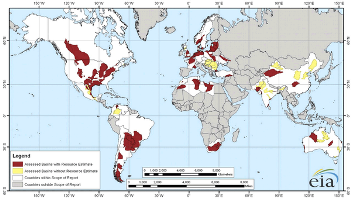
World Shale Gas Map / Photo credit: Energy Information Administration / Foter.com / Public domain
The shale gas revolution in the United States promises not only to soon make the country energy self- sufficient but also serve as the catalyst for a major revival of manufacturing. Similar high hopes have been raised for Latin America, where some of the planet’s largest reserves of shale gas are found. According to U.S. Energy Information Administration estimates, Argentina is said to have the world’s second largest reserves of technically recoverable shale gas (China is first). The United States is currently in fourth place, followed by Canada and Mexico. Brazil is in tenth place, with Chile and Paraguay not far behind. The possibility that Latin America can pursue a successful shale gas strategy, however, is tempered by a number of important legal and/or geological differences that can serve as important bottlenecks. In addition, the region’s tumultuous politics often get in the way of implementing policies that boost investment and encourage a highly productive energy sector.
The most important legal difference is that subsoil rights belong to the above ground property owner in the United States, while everywhere else in the Western Hemisphere the government (national, state or provincial) is the owner. Developers have had an easier time purchasing access to shale gas deposits from individual landowners throughout the United States. This explains, in great measure, why Canada’s significant shale gas reserves have not been as extensively exploited as in the United States, despite a hydrocarbons regime receptive to private-sector investment. In addition, environmental protection legislation that impacts the shale gas industry is fractured among Federal, state, and local government authorities in the U.S. That has facilitated developers extracting waivers and more lenient treatment in the United States that would be harder to obtain in most Latin American nations, where environmental protection is the exclusive or predominant prerogative of the central government. Furthermore, current technology for extracting natural gas from shale reserves demands huge amounts of water, a resource that is scarce in those regions of Mexico, for example, where most of its extensive shale gas reserves are located.
Political realities are the most crucial (and often overlooked) factor that can easily undermine any effort to develop Latin America’s extensive shale gas reserves. On paper, Argentina should be a regional energy powerhouse, supplying not only its own energy needs but those of its neighbors. However, the country has for years pursued policies that have scared off private-sector investment, heightened Argentine dependence on foreign energy imports, and led to a steady hemorrhaging of hard currency reserves. To outsiders these policies appear illogical, but they make perfect sense to Argentine political leaders trying to consolidate their power base. Mexico is an example of a country constrained by its Constitution from developing its extensive off-shore hydrocarbon resources. Any political party that tries to make major amendments to those constitutional provisions, however, risks annihilation at the polls. Brazil’s recent adoption of nationalistic legislation to encourage the domestic manufacturing of hydrocarbon-related technology could well impede exploiting its shale gas reserves if similar mandates are created for the highly specialized and capital-intensive hydrofracking equipment the industry utilizes. In fact the only Latin American country where the stars seem aligned to repeat the U.S. shale gas success story is investor-friendly, politically-stable, energy-starved, and free-market oriented Chile, whose shale gas reserves are concentrated in the remote, under populated (and very wet) far south of the country that desperately seeks new opportunities to promote local economic development.
*Thomas Andrew O’Keefe is the President of San Francisco based Mercosur Consulting Group, Ltd. and teaches at Stanford University.









 AULA Blog