Venezuela: Trying to Stay Afloat

By Michael McCarthy* and Fulton Armstrong

Venezuela Oil Maduro

Photo Credit: Democracy Chronicles and Charles Henry (modified) / Flickr / Creative Commons

Venezuelan President Nicolás Maduro continues to receive increasingly bleak economic news, and his modestly positive policy responses seem unlikely to help.  Oil revenues dropped 293 percent from 2014 (US$37 billion) to 2015 (US$12.5 billion).  The value of oil exports, which account for 95 percent of the country’s export earnings, has dropped to a 30-year low ($30 a barrel), accelerating a recession, paralyzing shortages, and soaring inflation.  The Central Bank reported that inflation reached 180.9 percent in 2015, and that the GDP contracted for the second consecutive year (5.7 percent).  Maduro blamed an “imperialist strategy in a petroleum war” aimed at destroying OPEC.  He also asserted that Venezuela suffered from an “international financial blockade” that – by obstructing the country’s efforts to refinance its debt – was intended to force it “to its knees” and to “take over” its wealth.

Several days after celebrating a Supreme Court decision reaffirming his authority to declare an “economic emergency,” which the opposition challenged last month, Maduro this week announced several modest economic measures aimed at stemming the slide.

  • He ordered a 60-fold increase in gasoline prices – dramatic-sounding but preserving Venezuelan gas (about US$0.23 per gallon at the black-market exchange rate) as one of the cheapest in the world – but the decision is significant as the first increase in about 20 years. An increase in 1989 triggered riots – the famous Caracazo that most analysts cite as the beginning of the end of the old order that Hugo Chavez toppled definitively when elected President in 1998.  In allusion to this past, Maduro said he “hoped people on the streets would understand.”  (Caracas-based consultancy Ecoanalítica estimates that the existing fuel subsidy costs the Venezuelan government US$12 billion a year.)
  • Maduro also announced a 37 percent devaluation of the bolívar – from 6.3 to 10 to the U.S. dollar – for official exchange rates used for the essential goods like food and medicine. The bolívar trades at about 1,000 to one on the black market, but the decreased subsidy implicit of the official rate for necessities is nonetheless significant.
  • Venezuela’s proposal for an OPEC freeze in oil production, in hopes of driving oil prices back up, drew supportive remarks from Qatar, the United Arab Emirates, Russia, Saudi Arabia, and even Iran, but the scheme has lacked traction. Industry observers said one reason is that Tehran is eager to increase exports to regain market share as sanctions against it are lifted.
  • Maduro replaced economic czar Luis Salas – known as a hardline leftist – just five weeks after appointing him, and appointed in his place a more business-friendly economist, Miguel Pérez Abad, who had been serving as Minister of Commerce. Pérez Abad, whose appointment the President of the Venezuelan Chamber of Commerce described as a “friendly sign,” has publicly (and accurately) said that Venezuela must simplify its byzantine exchange rate system.
  • These changes come amid Maduro’s increasingly frank self-criticism about state corruption. He recently described a government food distribution company as “rotten” while calling for a restructuring of state-run food import and distribution outlets.

In a four-hour speech replete with foul language and insults against opposition leaders, the President argued that the measures are “a necessary action to balance things,” and he said, “I take responsibility for it.”  But his measures are piecemeal at best.  As opposition leaders have pointed out, he has not explained how he is going to pay Venezuela’s debt, obtain the foreign exchange to import sufficient amounts of basic goods, and guarantee food for the people.  With US$10 billion in bond payments coming due this year, the country has no clear path for avoiding default.  However painful for the population and politically costly for the government, measures such as gasoline price increases will have little impact.  The government wanted the opposition to share some of the costs for economic policy changes, but opposition politicians say that the gas price increase and devaluation are too little, too late. Most believe economic revival depends on dismantling the entire chavista system.  They are once again talking about removing Maduro through a referendum or other means – with one leader, Henrique Capriles, openly calling for a presidential recall, and another, Henry Ramos, the President of the National Assembly, calling for a constitutional amendment to cut the presidential term from six to four years.  The government’s measures suggest a welcome change from Maduro’s previous strategy of buying time through diversionary tactics.  However, the economic measures are likely to fail and, moreover, they increase the chances political temperatures will surge once again.

February 19, 2016

* Michael McCarthy is a Research Fellow with the Center for Latin American & Latino Studies.

Honduras: President Hernández’s Mission

By Fulton Armstrong

Hernandez honduras 2

Photo credit: Public domain

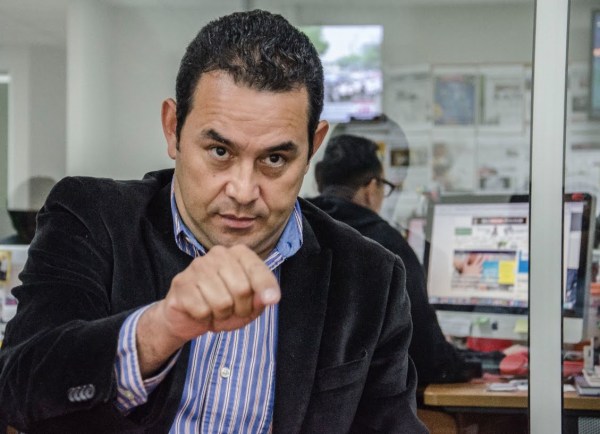
Honduran President Juan Orlando Hernández, who last month passed the half-way point in his four-year term, has scored some important political gains, with uncertain implications for his country.

  • The Obama Administration has embraced him as a partner in the “Alliance for Prosperity,” to which it has committed $750 million year to “build a safer and more prosperous future for [Northern Triangle] citizens.” It represents a doubling of U.S. assistance.
  • In a decision Hernández said he “would respect,” last April the Honduran Constitutional Court – key members of which the Congress elected under circumstances of questionable legality when he was Congress President – allowed him and other former presidents to run for reelection. The Chairman of the Congressional budget committee last week said there “should be no doubt” that the party is committed to Hernández serving a second term.
  • He successfully parried efforts to create a copy in Honduras of the International Commission against Impunity in Guatemala (CICIG), the UN-sponsored body with extensive powers in that country. The final terms of reference of the OAS-sponsored “Mission to Support the Fight against Corruption and Impunity in Honduras” (MACCIH) aren’t as loose as he had proposed, but many of its key definitions, personnel, and funding remain highly uncertain.  OAS Secretary General Almagro’s public blessing of it was a public relations coup.
  • The Honduran Congress’s approval last week of a new 15-member Supreme Court took numerous rounds of voting – presidents traditionally get the slate approved in one vote – but his party did well enough. Allegations of bribery arose immediately.  Praising the new court, he said last Friday that he would soon launch a national dialogue on additional Constitutional reforms and on “revising the social contract of Honduras” and building “a new Honduras.”

Hernández is not without critics in Tegucigalpa and Washington – even if their attacks have not thwarted him.  Opponents claim that his desire to overturn Constitutional prohibitions on a second term was more blatant than that of former President Mel Zelaya, whose removal by the military in 2009 Hernández supported claiming that Zelaya violated the prohibition.   Hernández has admitted that his party received funds embezzled from the national Social Security agency.  The Indignados, a grassroots opposition, doesn’t have the lobbying resources that the government has, but they have mobilized massive peaceful demonstrations, and veteran Honduras watchers praise their idealism, discipline, and maturity beyond their youthfulness.

Hondurans and foreign governments often favor leaders whose appearance of power promises stability, rather than favor processes and values – such as transparency and inclusiveness – that promise more effective democratic institutions.  Hernández was elected with barely 35 percent of the vote, but his growing power, coinciding with the weakening of legislative and judicial institutions, has concentrated power on the executive.  The country arguably faces one of the most complex situations in its history, on the cusp of either difficult change, such as reducing shocking levels of impunity, or a deepening of the current crisis.  The economic and political elites who control the nation have driven it into a rut from which “more of the same” does not appear a viable way out.  Hernández won praise from the international financial community by pushing through fiscal adjustments, yet these measures increased inequality in a country where half the population lives on less than $4 a day.  Preliminary data show that austerity has brought about an increase in unemployment and underemployment, which already affected roughly half of the labor force.  A U.S. and Mexican crackdown on Central American migration has reduced one of the only options that young Hondurans fleeing poverty, violence, and impunity thought they had.  While many Hondurans may wind up accepting a President’s reelection to a non-consecutive term, Hernández’s big push for a consecutive one and his talk of a “new social contract” understandably fuels skepticism if not angst.

February 16, 2016

Ignoring MERCOSUR and UNASUR at Your Peril

By Thomas Andrew O’Keefe*

Mercosur map

Participating countries in MERCOSUR. Image Credit: Immanuel Giel (modified) / Wikimedia / Creative Commons

Pundits who dismiss MERCOSUR and the Union of South American Nations (UNASUR) as failed attempts at Latin American economic integration should look again.  MERCOSUR has presided over an explosion in intra-regional trade among its four original member states (Argentina, Brazil, Paraguay, and Uruguay) from just over US$ 5 billion at its launch in 1991 to US$ 43 billion by 2014.  UNASUR, for its part, is credited with thwarting a coup attempt against Evo Morales in 2008 and putting a damper on continental arms races.

  • MERCOSUR and UNASUR member countries have taken additional important steps toward convergence since 2014, when MERCOSUR’s highest governing body adopted “CMC Decision 32,” which allows initiatives pursued by either collective to be binding on both if they arise from a set of goals and objectives common to both. The document reaffirms the UNASUR founding treaty stipulation that “South American integration shall be achieved through an innovative process that includes all of the achievements and advances by the processes of MERCOSUR and CAN [Andean Community].”  Chile has spearheaded this effort as a means of reducing duplication of efforts, and is also attempting to bridge ideological differences between the Pacific Alliance (Chile, Colombia, Mexico, and Peru) and MERCOSUR to further build Latin American unity.

Given the relentless negative assessment of both integration projects, multinational pharmaceutical companies were caught off guard when MERCOSUR and UNASUR forced them late last year to make substantial price cuts for public-sector purchases of Darunavir, an antiretroviral to combat HIV-AIDS, as well as Sofosbuvir, used with other medications to treat Hepatitis C.  Both drugs are on the World Health Organization’s List of Essential Medicines.  As a result of CMC Decision 32/14, the Ministers of Health of all the South American nations met in Montevideo on September 11, 2015, and launched a joint MERCOSUR/UNASUR committee to negotiate with multinational pharmaceutical companies on the prices for bulk purchases of certain high-priced drugs.  The committee, made up of representatives from each government’s agency responsible for purchasing medicines, won major price cuts last November – a steep reduction for Darunavir from Hetero Labs as well as lower prices with Gilead for Sofosbuvir.  The new costs were premised on the lowest amount charged to any one of the member governments, and enabled Chile’s Ministry of Health to pay 90 percent less than what it previously paid for Darunavir.  The South American governments as a whole are expected to save US$ 20 million in 2016 on purchases of this anti-retroviral.  A proposed 14 percent reduction in the cost of the combination Sofosbuvir-Ledispaver drug for Hepatitis C – if accepted by the MERCOSUR/UNASUR committee – would enable further savings.

The South American governments have their eyes set on several additional high-priced medications, with a particular focus on drugs used to treat cancer.  In order to aid the committee’s work, UNASUR is creating a data bank of the prices charged by the multinationals for specified medicines purchased by the public health sector in each member state.  The fact that the purchases are made jointly through the Pan American Health Organization’s already existing Strategic Fund opens the possibility that countries in Central America and the Caribbean can benefit as well.  It also means that all these countries can access the Fund’s capital account and do not need to have the cash in hand to acquire medications required to address public health emergencies.  MERCOSUR and UNASUR – often dismissed as ineffective – are demonstrating that integration produces tangible results.

February 11, 2016

* Thomas Andrew O’Keefe is President of San Francisco-based Mercosur Consulting Group, Ltd. and is former chair of Western Hemisphere Area Studies at the U.S. State Department’s Foreign Service Institute (2011-15).

Correction: Due to an editing error, an earlier version of this post mistakenly stated that “a 14 percent reduction in the cost of its combination Sofosbuvir-Ledispaver drug for Hepatitis C will enable Chile’s Ministry of Health to pay 90 percent less than what it previously paid for Darunavir.”  The outcomes of the cost negotiations for the two medications are unconnected.

U.S.-Colombia: Launching “Peace Colombia”

By Eric Hershberg and Fulton Armstrong

Kerry Santos

Photo Credit: U.S. Department of State / Flickr / Public Domain

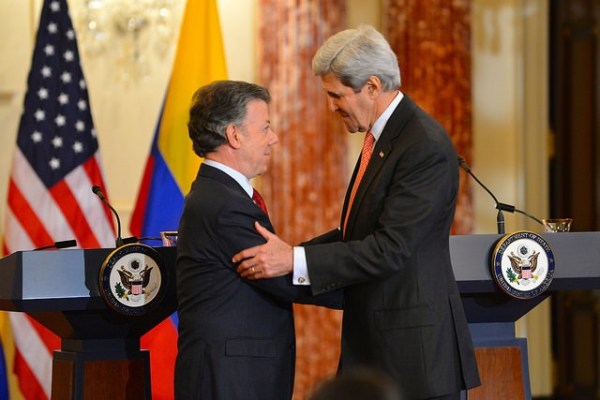
The United States, buoyed by good feelings about what President Obama called Colombia’s “remarkable transformation,” last week pledged $450 million a year in continued aid for the next five years, but it’s not clear yet whether “Peace Colombia” will be very different from Plan Colombia, to which the United States contributed some $10 billion.  The new spending includes unspecified amounts to support the reintegration of FARC combatants who lay down their arms as part of a peace accord expected next month, but much of the emphasis appears to be on old priorities, such as “consolidating and expanding progress in security and counternarcotics.”

  • Obama and Colombian President Santos announced the new program in Washington events marking the 15th anniversary of the launch of Plan Colombia. Amid the many remarks about Colombia’s progress, indicators such as homicide rates (down 50 percent since 2002), kidnapping rates (down 90 percent), economic growth (averaging 4.3 percent), and poverty and unemployment (down slightly) stand out.  By most accounts, moving around core regions of Colombia is easier and safer than it’s been in decades.

Some of these gains of the past 15 years remain tenuous, and “Peace Colombia” will face new challenges as well.  In speeches and backgrounders, government officials have acknowledged that coca eradication and crop substitution programs have failed to reverse Colombia’s role as the world’s biggest producer of coca.  Moreover, programs supporting the demobilization of the FARC will be more difficult to implement than those given to the rightwing paramilitaries in 2002-2006.  Tens of thousands of former paramilitaries are now active in bandas criminales (BACRIMs), which President Santos recently referred to as “2,500 miniscule criminal organizations scattered throughout the country.”  Changing economic circumstances could also complicate efforts to advance peace.  During the years of Plan Colombia, the country got a healthy bump from both domestic and foreign investment – because of the improved security environment as well as the external economic environment, including the U.S.-Colombia Free Trade Agreement and Chinese demand for commodities.  Investment remains strong, but the export boom is over, which is lowering growth and squeezing government budgets.

The creation of economic opportunity is at least as important to the success of Peace Colombia as continued support for the Colombian military and security system, although last week’s speeches and press releases did not shed much light on that.  Achieving peace and building democracy will also require addressing infrastructure deficits, educational inequality, inadequate job training, and poverty.  Several Florida congressmen, arguing that “Peace Colombia” supports an accord that’s overly generous to the FARC, say they’ll oppose Obama’s pledged aid.  The assistance will almost certainly advance, however, because of the strong Washington consensus that Colombia is its biggest (if not only) success worldwide in beating back irregular armed groups.  Moreover, as President Santos and U.S. Secretary of State Kerry emphasized in a press conference, there are no conditions on the new assistance – which should assuage Congressional opponents’ concerns that the relationship will get held up by investigations into alleged human rights violations in the past.  The Presidents spoke of pulling Colombia back from the “verge of collapse” in the 2000s to the “verge of peace” now.  A broadening of strategies in both capitals, including a reassessment of the emphasis on military options, could push the country toward becoming a more inclusive democracy, which ultimately may be what is required in order to achieve lasting peace.

February 8, 2016

U.S.-Cuba: Migration Policy Growing Tortuous, Dangerous

By Fulton Armstrong

Cuban migrants

Photo Credit: Coast Guard News / Flickr / Creative Commons

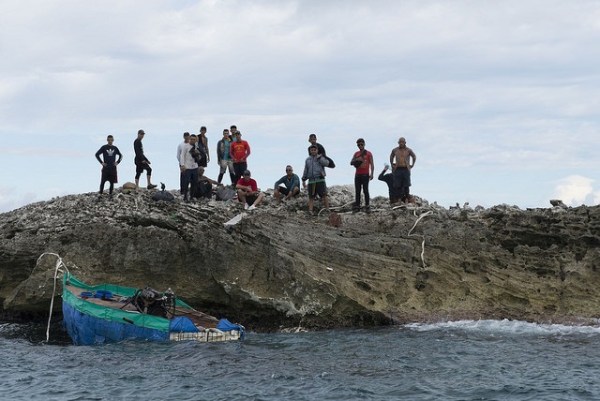
The surge in Cuban migration – prolonged at this point by U.S. policy paralysis – may show a dip soon but is growing tortuous and dangerous.  Since January 12, chartered aircraft and buses have been carrying about 360 Cubans a week from Costa Rica to El Salvador, and then through Guatemala and Mexico to the United States, where they are admitted with special status.  The US$550 cost of the trip is being paid by the migrants or unidentified “donors.”  The air bridge has begun relieving pressure on Costa Rica, which has been caring for 8,000 Cubans since Nicaragua in October halted the underground railway transporting them up the Central American isthmus.  (Three thousand more are reportedly stuck in Panama.)  Despite the progress, an estimated 1,500 migrants have left holding facilities and turned to alien-smugglers to take them to Mexico (for $800) or to the United States ($1,500), according to press reports.

  • Cubans’ fear of a change in U.S. migration policy since reestablishment of U.S.-Cuba diplomatic relations is most often cited as causing the surge, estimated at some 40,000 in 2015. It does not explain the estimated 20,000 who crossed into Texas in 2014 and before, when alien-smuggling networks were less developed.
  • Ecuador’s agreement to establish visa requirements for Cubans promises to slow the immediate flow, but the crisis has revealed corruption among migration authorities throughout the region, which will make stopping it difficult.
  • Central American resentment of the welcome Washington gives illegal migrants from Cuba is growing – aggravated in part by the arrival of airplanes from the United States full of deported citizens in the same timeframe. Senior officials from Costa Rica, El Salvador, and Guatemala have blamed the surge in trafficked Cubans on the preferences the United States gives them.

The U.S. Coast Guard reports an increase in the volume and violence of seaborne migration.  Migrants interdicted in Fiscal Year 2015 (ending September 30) grew to almost 3,000 – 900 more than the previous year – and, according to press reports, surged to 1,500 in the last quarter of 2015.  The Coast Guard says the migrants have concluded that Cuba’s economy will not improve even after U.S.-Cuba normalization, and they want to go before U.S. migration policy changes.  The service has reported a spike in violent confrontations with Coast Guard officers, violence against fellow migrants, and even suicide threats..

The U.S. government’s mantra that it will not change policy toward either overland or seaborne migrants is not working – and could even be backfiring by reminding Cubans of the special treatment they receive upon arrival.  The airlift and bussing of thousands of migrants from Costa Rica to the United States helps Costa Rica deal with its crisis, but also signals yet again to Cubans remaining on the island how far the United States will go to bring them in.  Violence among seaborne migrants has traditionally been rare, but the increased aggressiveness suggests that migrants have the impression that they can act with impunity and still be welcomed into the country.  Overland migrants’ preference to use coyotes, known for violence, is another red flag.  The United States has expended political capital by washing its hands of the Cuban migrant mess in Central America, and grumbling among the region’s leaders suggests that options like airlifts will disappear soon.  U.S. law, including the Cuban Adjustment Act, fully empowers the President to turn off the green light to undocumented Cuban migration – and reality could very well nudge him in that direction soon.

February 4, 2016

The Zika Virus and a New Debate on Reproductive Rights

By Rachel Nadelman*

Zika Women

Photo Credit: Day Donaldson and PresidenciaRD / Flickr / Creative Commons

The call by half a dozen Latin American and Caribbean governments for women to put off pregnancies – as the World Health Organization warns the feared Zika virus is “spreading explosively” – is stimulating a new debate on reproductive rights in the region.  El Salvador’s Health Ministry has urged women to “avoid becoming pregnant this year and next,” and Brazil, Jamaica, Colombia, and others are issuing similar advisories.  A mosquito-borne disease spreading rapidly in the Western Hemisphere for the first time, Zika is blamed for causing devastating neurological birth defects in newborns whose mothers contract the virus during pregnancy.  The U.S. Center on Disease Control has advised pregnant women to avoid travel to the more than 20 Latin American and Caribbean countries now hosting the disease.

Named for the Uganda forest where it was discovered in the late 1940s, Zika is carried and transmitted by the Aedes Aegypti mosquito, best known as the vector for life-threatening viruses like yellow fever and dengue.  Within the Western Hemisphere, the Aedes population has increased drastically in recent years, linked by scientists to changes in climate.  Yet Zika’s arrival in Latin America last year, first documented in Brazil, and subsequent expansion did not attract major attention until the pattern of birth defects emerged.  Zika’s symptoms are sometimes imperceptible or typically mild, including fever, joint aches, and conjunctivitis, so health officials did not consider it a major threat to the general population.  Although definitive clinical proof is still lacking, Zika is now linked to microcephaly, a rare neurological condition that causes children to be born with small heads because of abnormal brain development in the womb or immediately after birth.  The emergence of Zika in Latin America has coincided with a more than 20-fold increase in the incidence of microcephaly.  (Brazil has reported 4,000 cases in the past year, a drastic increase from just 150 in 2014).  The babies suffer from poor brain function and reduced life expectancy.  Doctors are finding traces of the virus in the brains of microcephaly-inflicted babies who were stillborn or died soon after birth.

Warnings and advisories offer no help to the millions of women who live in afflicted countries.  Governments are launching fumigation programs to reduce the Aedes mosquito population and thereby limit disease transmission.  Asking populations to refrain from having children appears a bit facile, if not cynical, in a region with low levels of access to birth control for reasons that range from religious dictates to economic obstacles.  Severely restrictive abortion laws also complicate potential parents’ options.  Five Latin American countries (including Honduras and El Salvador, hard hit by Zika) ban abortion without exception, even to save the mother’s life.  Others criminalize abortion with few allowances.  According to the Guttmacher institute, 95 percent of abortions in Latin America are unsafe, contributing to high maternal mortality rates. It’s not surprising, therefore, that Zika’s link to these devastating birth defects has generated unprecedented public discussion throughout Latin America about women’s and families’ rights and responsibilities for taking control of reproduction.  It is far too early to know if the health advisories will have practical impact on the incidence of microcephaly – or on attitudes toward reproductive rights over the longer term.   

February 1, 2016

* Rachel Nadelman is a PhD candidate in International Relations at the School of International Service.  Her dissertation research focuses on El Salvador’s decision to leave its gold resources unmined.

Haiti: Postponed Elections, Ever-Deepening Crisis

By Emma Fawcett*

Haiti Elections 2016

Photo Credit: mackendy mentor, Kurious, and KeshtoKar (modified) / YouTube, Pixabay, and Wikimedia Commons / Licensed for noncommercial reuse

Postponement of Haiti’s protracted electoral process has triggered a seemingly existential crisis.  The January 24 vote, a runoff to select a president, was postponed indefinitely in the face of violent protests challenging the legitimacy of the first round in October.  Those elections trimmed the field of 54 presidential candidates down to two: President Martelly’s hand-picked successor, banana exporter Jovenel Moïse, and opposition candidate Jude Célestin.  While that round was mostly peaceful and the vote tallies were upheld by most outside observers (including the OAS), Haitian human rights groups and dissidents cited widespread cases of fraud and other irregularities.  Célestin disputed the count and boycotted the runoff, which he says Martelly rigged to install Moïse.  Martelly has dismissed the accusations, and the embattled Provisional Electoral Council has been unable to assuage the opposition alliance’s concerns.  Last week’s postponement of the runoff was the second, but the clock is ticking louder now because Martelly is scheduled to, and reaffirmed his intent to, step down on February 7.

  • The postponement triggered international pleas for a speedy resolution. The U.S. State Department condemned “electoral intimidation, destruction of property, and violence”; while the OAS, the UN, and the EU all issued calls for Haitians to come together to end the crisis.

International efforts to foster elections as a means of laying groundwork for political and economic stability in Haiti have repeatedly stumbled, even when stretching the rules to accommodate Haitian reality.  The OAS and the State Department intervened on Martelly’s behalf in the 2011 election by pushing him into the runoff and asking opponents to stand down.  In addition to providing up to $4 billion dollars in economic and reconstruction aid, the United States has since spent more than $30 million on the elections, and continued to push for them to go ahead as recently as January 21.  But these efforts have backfired, as members of opposition parties, the Haitian private sector, and the Catholic Church regard the electoral process as illegitimate and increasingly resent what they feel is U.S. interference.  The political crisis also jeopardizes economic development that Washington has encouraged.  Royal Caribbean, a cruise line that leases a recreational area on Haiti’s northern coast, skipped its port call in Labadie several times over the past week because small boats of protesters approached its ships. Protesters also threw rocks at the windows of the new Marriott hotel in Port-au-Prince.

Haitian democracy is – yet again – at a perilous juncture.  Martelly’s departure from office on February 7 will be disruptive, but his strong-arm tactics and entourage of shady characters threatened a peaceful transition of power anyway.  (His critics point out that an extension of his term in office is what he has sought all along.)  U.S. officials have spoken publicly of a transitional government emerging, but selecting one and imbuing it with credibility will be a massive task.  Business leaders have proposed that a “consensus” prime minister head an interim government for six months, during which a new Electoral Council would coordinate new elections, but the negotiations lack transparency.  If the government, the protesters, and the business community are unable to reach an agreement – as seems likely at this point – Haiti will face a power vacuum with increased violence that will be even more difficult to resolve. 

January 28, 2016

*Emma Fawcett is a PhD candidate in International Relations at American University.  Her doctoral thesis focuses on the political economy of tourism and development in Haiti, Dominican Republic, Cuba, and the Mexican Caribbean.

El Chapo’s Recapture: A Fictionalized Reality Show

By Núria Vilanova*

Chapo Kate Penn Film

Photo Credit: Abd allah Foteih, Fanpage.- & Sachyn Mital – (modified) / Flickr & Wikipedia / CC BY-SA 3.0

A recent interview granted by Mexican drug kingpin El Chapo and his subsequent re-arrest validate yet again the observation of Mexican writer Carlos Fuentes that no matter how hard fiction strives to emulate reality, reality always surpasses it.  Narco-lives and deeds have attracted myriad fiction writers, filmmakers, and musicians giving way to a successful narco-literature and narco-cinema that has fascinated the general public, journalists, and scholars alike.  A recent example is the popular Netflix series Narcos, based on one of the most notorious drug traffickers, Pablo Escobar.  Well known also are the corridos in Northern Mexico that sing the adventures and prowess of powerful drug lords (often in exchange for large payments).  The narco-corridos are today the epical portrayal of criminal lords whose lives straddle glory and vileness.

In the interstices between reality and fiction rest the publicity-mongering and recapture this month of Joaquín “El Chapo” Guzmán, the subject of an intense six-month manhunt following his escape last July from a high-security prison.  No film would have been sufficiently credible and convincing had it attempted to stage El Chapo’s flight, but the reality is that the most prominent narco-lord since Escobar was able to vanish through a highly sophisticated tunnel whose construction required great engineering expertise.  The final seconds of his stay in his cell before entering his path to freedom were recorded by a security camera.  Megalomania – his eagerness to have his life and deeds taken to the big screen – apparently led to his undoing.  He reached out through intermediaries to soap-opera and film actress Kate del Castillo, whose role as narcotress in the popular show La reina del sur apparently captivated his heart, to set up a meeting with Hollywood star Sean Penn to present his version of his reality to the world.  Playing the role of an adventurous and intrepid journalist, Penn produced a 10,000-word report-interview for Rolling Stone magazine.  Thus, the three main characters of this story – El Chapo, Kate del Castillo, and Sean Penn – traveled from reality to fiction and back in a fictional-yet-real encounter.  The three characters straddled between two dangerous dimensions in complicity – reality and fiction – unaware that their secret meeting would somehow provide the clue that enabled Mexican security to shut El Chapo down again.

The reality-fiction play brings a much higher toll than just El Chapo’s return to prison.  Dozens of the corrido singers who extol the narcos’ lifestyle have been kidnapped, tortured, and killed in Mexico since the late 1990s.  Mexico is also at the international forefront on the number of journalists assassinated since 2006, when former President Calderón launched a bloody (and failed) war on drugs.  While the Mexican actress has not made any substantial comments on her apparent role in El Chapo’s return to prison, Penn has blustered his innocence as a courageous journalist-star whose mission was to make his countrymen reflect and make a self-critique of the bloodthirsty, futile war on drugs.  We, the audience, would probably wish this reality show would have brought about a less trivial outcome, but the last episode is not yet written.

January 25, 2016

* Núria Vilanova is Assistant Professor and Associate Chair of World Languages and Cultures.

Lobbying Washington: Does it Work?

By Aaron T. Bell*

LatAm Lobbying

Photo credits: Jack Says Relax & AlexR. L., respectively / Flickr and Wikimedia Commons / Creative Commons

Latin American governments, political parties, and business associations have a long history of turning to U.S.-based lobbying, legal, and public relations firms to advance their interests in the United States – with mixed results.  Both national and multinational groups have been utilizing lobbyists since at least the 1940s, when the U.S. government began registering foreign agents.  Their most consistent goal over the decades has been to influence U.S. policy on foreign trade and investment, but they have also aimed to improve governments’ sagging reputation and protect them from adverse policies.  In the 1970s, a number of military regimes and right-wing political groups in Central and South America hired lobbyists to devise and implement strategies to counter criticism of their human rights record – to preserve trade and military assistance.

  • Some 30 Latin American countries and interests groups in 2010-14 registered foreign agents to influence U.S. policies. The Bahamas Ministry of Tourism spent the most, paying $128.9 million to promote tourism – as well as to monitor and speak with Congressional representatives about U.S. legislation related to transnational financial activities in which they are involved, such as the regulation of offshore tax havens and online casinos.
  • In 2013, Mexico ranked fifth worldwide, at $6.1 million. Both federal and local governments pay firms to burnish the image of their respective constituencies.  From 2010-12, for example, Mexico City worked with a firm to “enhance the image of Mexico City in light of recent negative media reports.”  In 2014, the Consejo de Promoción Turístico de México hired another company to “make Mexico an attractive destination.”
  • Ecuador, which at $1.1 million ranked twenty-second in 2013, spent nearly half a million dollars lobbying in support of the ultimately failed Yasuni rain forest oil drilling initiative.
  • More recently, the government of Honduras – burdened with the image as one of the most violent, corrupt, and crime-ridden countries in the world – hired lobbyists to “provide ongoing strategic counsel, media relations (proactive and reactive outreach), and third-party relations.” The firm, winning an initial one-year contract for $420,000, had just completed a nine-year relationship representing Russia.

A review of the U.S. Foreign Agents Registration Act (FARA) records indicates that foreign lobbyists represent almost exclusively governments, state agencies, and the private business sector, and that more popular civil-society actors – such as labor unions and indigenous organizations – are notably absent.  Even though foreign governments obviously judge the investment worthwhile, the impact of foreign-funded lobbyists is difficult to measure.  The Honduran government’s new push to burnish its image has paid off on Capitol Hill, according to observers, but a new initiative to reduce Honduran corruption doesn’t appear to have gone exactly as Tegucigalpa hoped.  Forced to respond to a protest wave calling for the creation of an independent investigative body similar to the Comisión Internacional contra la Impunidad en Guatemala (CICIG), the Honduran government agreed with the OAS to create the Misión de Apoyo Contra la Corrupción y la Impunidad en Honduras (MACCIH) as a collaborative effort.  MACCIH indeed lacks the independence – and the potential bite – that CICIG had, but it is significantly tougher than the Honduran President Juan Orlando Hernández initially proposed.  In this case at least, lobbyists have helped the government gain access and public relations points in Washington but didn’t get it off the hook entirely.

January 22, 2016

* Aaron Bell is an adjunct professor in History and American Studies at American University.

Bolivia: Implications of Referendum for Democracy and the MAS

By Santiago Anria*

Evo Referendum

Photo Credit: zak / Flickr / Creative Commons

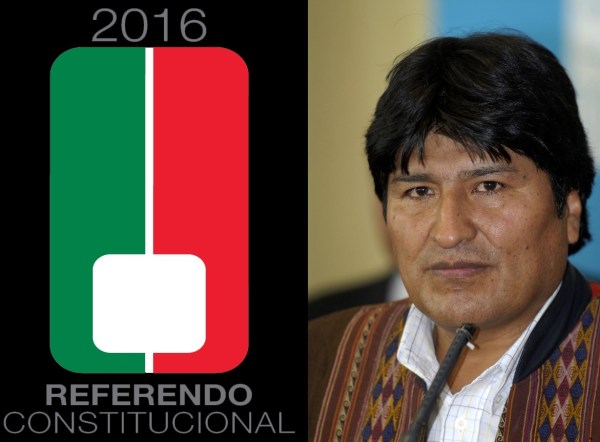
A Bolivian referendum on February 21 – one month after the 10th anniversary of President Morales’s rise to power – threatens a break with the country’s tradition and the democratic principle of power alternation.  A “Yes” vote on the constitutional amendment up for approval would allow Morales and Vice President García Linera to run in 2019 for a fourth consecutive term – a scenario that the fragmented opposition claims would mean not only greater concentration of power in a personalistic leader but also a shift toward authoritarianism, similar to that in Venezuela.  The government claims that a “No” vote would mean the end of an era of unprecedented economic and democratic stability, the end of measures that have empowered subordinate groups in society, and the return of the right and neoliberalism.  Opinion polls so far show the vote will be close.

Morales’s efforts to extend his time in office are consistent with his tendencies to dominate politics and the policy process.  Yet my research shows that increased political incorporation during his government has also given previously marginalized groups enhanced influence over agenda-setting and policy-making and led to important shifts in domestic power relations.  In today’s Bolivia, well-organized interest groups typically belonging to the “informal” labor sector (such as coca growers, cooperative miners, and transportation unions) have greater influence over policy from within the state (in representative institutions and state bureaucracies at all levels) and from without (direct pressure in the streets).  This has resulted in greater regime responsiveness to the groups’ interests and in policies that expand economic and social benefits, as well as improvements in poverty and inequality reduction – even without meeting some of their fundamental needs such as employment and health care reform.  While in some instances newly empowered groups have mobilized and served as a check on state power, their role is founded on a highly particularistic relationship of the MAS and allied groups and, as such, can actually be an obstacle for governing in the interest of broader segments of society.

An intense government campaign in favor of the constitutional amendment is already under way and will likely deepen in the coming weeks.  The Morales government lacks the kind of epic framing it had when it first won the presidential election in 2005.  Citizens today express concerns similar to those voiced during previous governments – concentration of power, widespread corruption, inefficient institutions, weak protection of liberal rights, politicization of courts, and hostility to opponents and the press.  A “Yes” victory on February 21 would not automatically mean a shift to an authoritarian regime as core features of authoritarianism (i.e., power exercised by a small group overriding the will of the citizens) are not currently evident.  In addition, Morales’s tendencies to dominate often meet strong checks from a relatively autonomous civil society.  Comparative evidence suggests, however, that a fourth Morales term might lead to further power concentration and decreased political input from below — which could mean a weakening of the MAS as an organizational actor for the empowerment of subordinate groups independent of its undisputed leader.  A “No” victory, on the other hand, would not necessarily mean the end of the social and political transformations carried out by the MAS.  If nothing else, Bolivia’s “process of change” over the past decade has given rise to a “new normal” of more inclusive institutions and basic social programs that benefit large sectors of the population and will be difficult for any future government to reverse.

January 19, 2016

* Santiago Anria is a postdoctoral fellow at Tulane University’s Center for Inter-American Policy and Research.