Mexico: Deepening Credibility Crisis

By Fulton Armstrong

Buitrago GIEI

Expert Angela Buitrago during the presentation of the initial GIEI report last October. Photo Credit: Comisión Interamericana de Derechos Humanos / Flickr / Creative Commons

Last week’s report on the disappearance of 43 Mexican students from the tiny village of Ayotzinapa left many questions unanswered about events on the bloody night of September 26-27, 2014, but it left no doubts about the depth of the corruption at the local and national level swirling around the youths’ tragic deaths.  The Mexican government – recipient of more than $2 billion in U.S. security assistance in the last eight years – not only produced a bogus report last year, based on tortured and otherwise impugnable sources, to divert attention from the tragedy; it also actively impeded the work of the Interdisciplinary Group of Independent Experts (GIEI), operating under the aegis of the Inter-American Commission on Human Rights, that produced the new report.  GIEI members documented the witness-tampering, obstructionism, and overall lack of cooperation of the administration of President Enrique Peña Nieto.  As the public presentation of the report wrapped up, the massacre victims’ families and supporters – some holding signs demanding to know ¿Dónde están?” – made clear their fear that the government will again sweep the case under the carpet and chanted to the experts, ¡No se vayan!”

Many details of the kidnapping, torture, and execution of the 43 youths, who were studying to be teachers, probably will never be known because much of the evidence has been tainted or destroyed.  The GIEI, however, pieced together a largely verifiable explanation of events in which local police, Federal Police, and the Army went on a bloody rampage after the students commandeered buses, as they had on other occasions with the tolerance of their owners, to transport classmates to a protest the following day.  The authorities tracked the students’ movements, set up roadblocks, systematically terrorized them, and summarily executed those who escaped and tried to tell of the atrocities.  The cover-up started immediately, culminating four months later in a report by the Office of the Attorney General (PGR) – one of Washington’s closest partners in curbing narcotics-related crime and violence – falsely claiming the students were mixed up in struggles among narcotraffickers.  The GIEI demonstrates that there is no way a serious PGR investigation did not know otherwise.

  • International and domestic reaction to the report has been strong, but Peña Nieto’s reaction has been low-key. (He also made headlines last week in proposing the decriminalization of marijuana.)  In several Tweets, the President thanked the GIEI; promised that the PGR will “analyze the complete report to improve its investigation of the tragic events”; and pledged that the PGR “will continue working so that there is justice.”  The U.S. Department of State issued a statement saying that “we trust the Mexican authorities will carefully consider the report’s recommendations.”

Peña Nieto cannot escape personal responsibility for the scandalous cover-up and obstructionism – he promised a full accounting long ago – but the GIEI report indicts much more than the presidency.  From the rural police and Army officers on the scene to the highest levels of law enforcement and the military command in Mexico City, the violence against the students has been neither admitted, condemned, nor punished, reinforcing Mexico’s longstanding culture of impunity.  The PGR’s report was tainted by deliberate falsehoods as well as the vicious forms of torture employed to exact false testimony from “witnesses.”  (Other torture stories, including an incident in which the Minister of Defense apologized for Army and Police torture of a woman in prison, are increasing in frequency.)  The U.S. Department of State’s human rights report, released two weeks ago, criticizes Mexico for its “impunity for human rights abuses,” but Washington also needs to ask whether the $2.1 billion of “Mérida Initiative” assistance it has provided to “help Mexico train and equip its law enforcement agencies, promote a culture of lawfulness, [and] implement key justice reforms” has been a good investment.  The U.S. Senate has finally confirmed the new U.S. Ambassador to Mexico, one of the architects of State Department’s implementation of the Mérida Initiative, and it stands to reason that she will demand some accountability.

May 2, 2016
The Critical Role of Universities in Latin America’s Future

By Rodrigo Arocena*

Tec de Monterrey

University students in Monterrey, Mexico. Photo Credit: ·júbilo·haku· / Flickr / Creative Commons

As the latest commodity boom winds down, universities in Latin America can play a leading role in helping the region rebound from the resulting economic slowdown and build itself a more prosperous and equitable future.  The consequences of the boom for economic, political, and social conditions in the region are hotly (and rightly) contested.  But one inescapable conclusion is that inadequate attention was paid to raising societies’ knowledge and qualifications in the production of goods and services.  This matters greatly, because knowledge gaps and skill deficits lie at the heart of what underdevelopment means today.  If the focus in the decades following World War II was on addressing disparities in industrialization, one of the challenges now is over-specialization in productive activities with low added-value of knowledge and qualifications.  When such specialization persists, social and environmental problems are not manageable in the long term.  Differences concerning knowledge and higher education are also one of the main factors behind inequality, in both North and South.  In Latin America, traditionally considered the most unequal region in the world, inequality in recent years has been reduced in a handful of countries and so has poverty in almost all of them.  But such social progress may be jeopardized soon not only because of economic and political changes but also because of quite weak progress made expanding knowledge capabilities and applying them to collective problems.

Universities are at the heart of the solution.  In the knowledge-based and innovation-driven economies that emerged in the North during the last decades of the 20th century, universities obviously made a difference.  They were fundamental actors in the accelerated expansion of advanced education that is closely connected with that type of economy.  They generated new scientific and technological knowledge and often channeled its use into productive activities.  Even then, in the advanced economies of the North private sector firms perform a quite larger proportion of total research and development than universities.  Moreover, Northern universities are mainly oriented by market demand, meaning that actors who are already knowledge-strong obtain most of the benefits of what universities do, fostering what could be called knowledge-based inequality.  This is different from Latin America in several ways:

  • Public universities in Latin America are the main generators of new knowledge, which is why they should get priority when thinking about the future of the region’s development.
  • They are frequently well plugged into National Innovation Systems, the web of actors and institutions responsible for upgrading productivity through the generation and effective use of new knowledge.
  • They represent a continuation, although at a weakened level, of the tradition of the socially committed university forged by the Latin American University Reform Movement.

In any country of the world, knowledge democratization deserves high priority in every progressive agenda – and Latin American universities are, at least potentially, fundamental actors in this task.  Democratizing access and success in higher education, and thus trying to overcome an ancient social divide that stymies development, is key.  The task also means fostering research in all disciplines and applying it to collective problems, as has occurred with research and innovation oriented to social inclusion.  The Latin American ideal highlights merging the modern university’s two long-established missions – teaching and research – with a third one, called “extension,” which entails cooperation with external actors in knowledge generation, cultural creation, and problem-solving, with priority given to the situation of deprived sectors.  As motors for knowledge expansion, and thus for social inclusion, Latin American universities make an invaluable contribution to development and the deepening of democracy.

April 28, 2016

* Rodrigo Arocena served as Rector of the Universidad de la República, Uruguay, from 2006 to 2014.


Latin America (Overall) Embraces Paris Climate Accord

By Fulton Armstrong

cop21 paris accord 2015

Heads of delegations at the 2015 United Nations Climate Change Conference in Paris. Photo Credit: Presidencia de la República Mexicana / Flickr / Creative Commons

Latin American support for the landmark climate agreement signed at the United Nations last week may not have been enthusiastic during the negotiations, but all but Nicaragua seem eager for early ratification and implementation of measures to mitigate the harm of global warming.  A record-breaking 175 countries signed the accord in one day, including a number from Latin America, committing them to take concrete steps to keep the increase in global temperatures from rising 2 degrees Celsius (or, ideally, 1.5 degrees) over preindustrial levels.  To take effect, at least 55 countries producing 55 percent of global emissions must ratify the agreement.  Fifteen small island nations, including several in the Caribbean, already presented their ratification papers last Friday.  China and the United States, the two greatest emitters of greenhouse gasses, have said they’ll ratify this year – as have France and other EU countries.

The region’s leaders have made significant contributions to the accord over the years.  Mexico and Peru, which were hosts of crucial international conclaves leading up to it, have given it a Latin American imprint, and others supported the final round of talks in Paris last December.  Brazilian President Dilma Rousseff’s reference in her speech to her political troubles back home overshadowed Brazil’s leadership, including its commitment to reduce its greenhouse gas emissions by 43 percent of 2005 levels by 2030.  In the past, ALBA countries complained loudly that the wealthy, developed nations, which produce the vast majority of climate-harming gasses, should shoulder the burden of reducing them and should compensate poorer countries for harm that environmental measures cause them.  All but Nicaragua, however, have submitted national plans (called an Intended Nationally Determined Contribution, INDC) required for full participation in international efforts under the Paris Accord.  Nicaraguan Representative Paul Oquist told the media that “voluntary responsibilities is a path to failure” and that wealthy countries should compensate Nicaragua for the $2 billion cost the measures would entail.

Latin America has clear incentives to support the accord.  Various scientific studies underscore the impact of global warming on the region, with potentially dire consequences.  The World Bank and Intergovernmental Panel on Climate Change have reported that failure to act would cause further extreme weather threatening agriculture; rapid melting of Andean glaciers that provide much-needed fresh water; erosion of coastal areas; catastrophic damage to Caribbean coral reefs; and dieback of Amazon forests.  ALBA demands for compensation may be overstated but contain a grain of truth – they aren’t prodigious producers of greenhouse gasses – and skepticism that the big guys will meet their targets isn’t entirely unwarranted.  President Obama has repeatedly demonstrated his personal commitment to addressing the problem, but obstacles posed by the U.S. Senate (which must ratify the agreement), Supreme Court (which in February stalled implementation of his Clean Power Plan), and politicians seeking the Republican Presidential nomination (who have sworn opposition to deals like the Paris Accord) have all but shut down U.S. movement toward ratification.  The ALBA outliers, on the other hand, have made their complaints heard and appear likely to join the rest of Latin America and the Caribbean in pushing for ratification and quick implementation – and probably will soon renew the push for even tougher measures by industrialized nations.

April 25, 2016

Cuba: Raúl Clarifies the Lack of Clarity on Future

By Fulton Armstrong

raul pcc congress

Photo Credit: Alexandre Seltz and Sarumo74 (modified) / Google Images / Creative Commons

The report that Cuban President Raúl Castro delivered to the 7th Party Congress last weekend walked a tightrope between pressing harder for change – embracing the importance of the small, emerging private sector – and reassuring party conservatives that the basic tenets of the revolution will not be touched.  He reiterated his commitment to step down in 2018 and promote younger cadre, but he left unclear what he proposes the Cuban system look like in the future.  He defended his decision to normalize relations with the United States, but used Washington’s continuation of the embargo and “democracy promotion” and immigration policies as a rationale for not letting down the Party’s guard.  Among key points:

On Conceptualización.  Castro said this Congress was basically to give “confirmation and continuity” to policies set five years ago to update Cuba’s economic and social model,  but it kicks off a process of consensus-building around a conceptualización, which he said “outlines the theoretical bases and essential characteristics of the economic and social model that we aim for as result of the updating process.”  Private property is a major topic, and Raúl sought to reassure the party that respect for it does not mean – “in the slightest bit” – a return to capitalism.

On reforms approved previously.  The road has been difficult, he said, held back by “an obsolete mentality that gives rise to an attitude of inertia and an absence of confidence in the future.”  He referred to the foot-draggers as “having feelings of nostalgia for other, less-complicated moments in the revolutionary process,” such as when the USSR and socialist camp existed.  But he insisted that the reforms have continued advancing at a steady pace – “without hurry but without pause.”

On upcoming reforms.  Castro talked more about what will not happen rather than any new vision.  He firmly ruled out “shock therapies,” and he said that “neoliberal formulas” to privatize state assets and health, education, and social security services “will never be applied in Cuban socialism.”  Economic policies can in no case break with the “ideals of equality and justice of the revolution.”  But he confirmed that one of the potentially most disruptive reforms – unifying currencies and exchange rates – must be done as soon as possible to resolve and many distortions.  On foreign investment, he called on the party “to leave behind archaic prejudices about foreign investment and to continue to advance resolutely in preparing, designing, and establishing new businesses.”

On Cuba’s economic model.  Castro acknowledged “the introduction of the rules of supply and demand” and claimed they didn’t contradict the principle of planning, citing the examples of China and Vietnam.  “Recognizing [the role of] the market in the functioning of our socialist economy,” Castro said, does not imply that the party, government, and mass organizations stand by and watch abuses occur.

On private and state enterprises.  He said the “non-state sector” – which includes “medium, small, and micro-enterprises” – is providing very important goods and services, and expressed hope for its success.  This sector will continue to grow, he said, “within well-defined limits and [will] constitute a complementary element of the country’s economic framework.”  Castro also called for greater reform efforts to strengthen the role of – and, simultaneously, the autonomy of – state companies, telling managers to overcome “the habit of waiting for instructions from above.”    He noted that the creation of cooperatives outside agriculture “continues in its experimental phase,” with some achievements and shortfalls.

On U.S. policies and intentions.  Castro criticized Washington’s efforts to drive political change in Cuba, which he called “a perverse strategy of political-ideological subversion against the very essence of the revolution and Cuban culture, history, and values.”  He said, “We are neither naive nor ignorant of the desires of powerful external forces that are betting on what they call the ‘empowerment’ of non-state forms of management as a way of generating agents of change in hopes of ending the revolution and socialism in Cuba by other means.” Castro said that U.S. officials recognize the failure of past policy toward Cuba but “do not hide that the goals remain the same and only the means are being modified.”

Rhetoric about forever rejecting capitalism (and multi-party democracy) is standard, especially for a Party event meant to assuage anxieties of conservative factions reluctant to give up their familiar, if failed, models.  The re-election of 85-year-old Vice President Machado Ventura is another sop to the aging right as the country inches each day to its biologically imposed transition, as Fidel Castro made explicit in his closing remarks.  The pace of change in Washington is also slow in some areas, particularly the embargo and the Administration’s “democracy promotion” strategies,  but pro-normalization voices cannot be faulted for lamenting that Cuba could more effectively influence U.S. policy through simple regulatory measures encouraging business deals that will give momentum to embargo-lifting initiatives in the U.S. Congress.  All politics is local, however, and both governments seem content holding off on changing their paradigms for now.

April 21, 2016

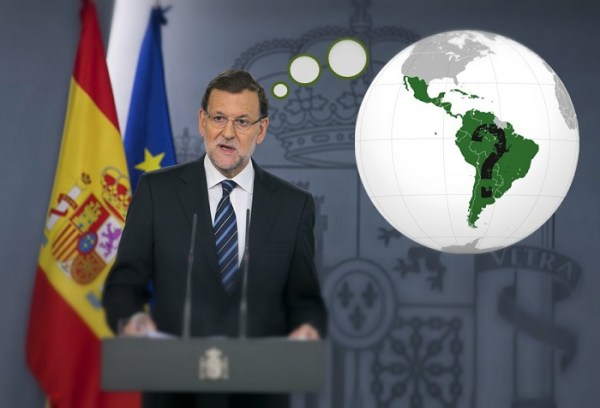
Spain: Too Distracted to Play in Latin America?

By An Observer*

Rajoy Latin America

Photo Credit: La Moncloa Gobierno de España and Heraldry (Modified) / Flickr & Wikimedia / Creative Commons

Spain’s political crisis and problems facing the European Union have undermined Madrid’s ability to pursue interests in Latin America at a time of new opportunities.  Amidst countless months of lameduck government and the failure of either the Partido Popular (PP) or the Partido Socialista (PSOE) to form a government, the country is also tied in knots over corruption scandals, including some touching a Cabinet member and the royal family, and Cataluña’s persistent challenges to central authority.  Even before the current mess, Prime Minister Rajoy had shown only modest interest in Latin America, and King Felipe hadn’t yet demonstrated the mettle of his father, who once famously told Venezuelan President Chávez to shut up at an Ibero-American Summit.  Adding to Spain’s distractions are a series of EU challenges, ranging from refugee crises to terrorism and the Mediterranean countries’ debt overhang.  Spanish elites, who remain committed to the EU vision, are seized with concerns about Brexit, the UK’s flirtation with withdrawal, and perplexed by the absence of a renewed integration project.

Madrid’s declining role coincides with changes in Latin America that would normally grab its attention.  President Obama and Raúl Castro’s historic normalization of diplomatic relations has opened the door to at least one major U.S. hotel firm signing contracts to refurbish and manage several Cuban hotels – an industry in which Spain previously had extraordinary advantages.  Having played “good cop” with Cuba for many years, compared to Washington’s “bad cop,” Madrid’s future role on the island is at most uncertain.  The election of market-friendly President Macri in Argentina, where the previous government nationalized a Spanish energy company and adopted other policies causing bilateral estrangement, also represents an opportunity for Spain.  The near-completion of peace talks between the Colombian government and guerrillas should be the crowning jewel of a foreign policy in which Spain made a strong political investment early on, but Madrid has receded to the role of bit player.  At a time that Latin Americans continue to espouse support for CELAC and other regional organizations that exclude Spain (and the United States), Spain-sponsored Cumbres Iberoamericanas since 1991 have – even more than the U.S.-sponsored Summit of the Americas – lacked dynamism and produced little as the beacon of the Spanish transition was dying down

By turning inward, Spain risks losing what remains of its special cachet as Latin America’s link to Europe and as a country that made a successful transition to democracy with inclusion, human rights, vibrant media, and increasing transparency.  Its political capital in the region is running low, and budgetary constraints have diminished its aid budgets (from 0.5 percent of GDP to 0.13 percent).  But opportunities remain.  Big Spanish companies – Telefónica, Banco Santander, BBVA, Repsol, and others – and numerous mid-sized firms have shown interest in Latin America.  Cuba’s reluctance to embrace U.S. ties too tightly and too fast gives Spain important space to play a role if it wants.  Moreover, Spain’s diplomatic skills, critical for Central America’s peace processes and elsewhere, could still be a positive force in that subregion.   If it weren’t for former Spanish Prime Ministers’ contradictory roles in Venezuela, where U.S. baggage undermines Washington’s approach to political, economic, and security problems, Spain could be active there too.  But the Prime Minister and his cabinet have not given the Foreign Ministry the green light to get more deeply involved.  It’s not too late for Spain to turn things around and get back into the game in Latin America.  For that to happen Spain needs more consistent governance.

April 18, 2016

* The writer is long-time non-academic observer of Spanish foreign policy in Latin America.

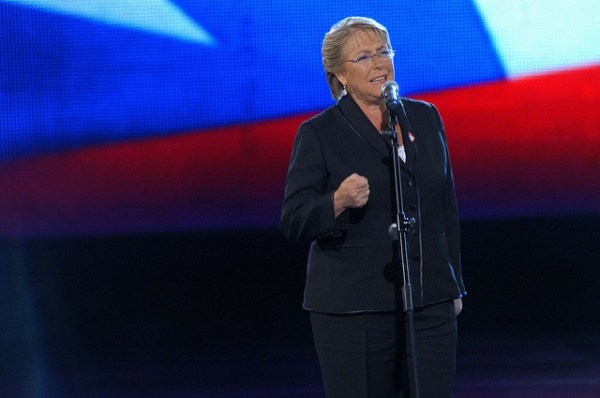
Structural Reforms in Chile: Moving Forward in Midst of Political Crisis

By Claudia Heiss*

Bachelet Chile

Photo Credit: Chile Ayuda a Chile / Flickr / Creative Commons

Chilean President Michelle Bachelet has done well pushing her reform agenda despite a series of scandals regarding the illegal financing of political campaigns and abuse of power by her daughter-in-law.  Bachelet started with 58 percent support and the highest electoral margin of victory since Chile’s return to democracy in 1990.  Her New Majority coalition incorporated the Communist Party and replaced the Concertación, the center-left coalition defeated in 2010 at the end of her first period, and after 20 years in power.  Bachelet’s current program reflected a left-turn and an intention to correct perceived flaws of a transition criticized for assuming too many features of the model imposed by the dictatorship.  The program included a tax plan to finance education reform introducing free university in a commoditized market of superior education.  This project was the offspring of massive student protests in 2011.  Another proposal was to replace the dictatorship-era 1980 Constitution through an “institutional, democratic, and participatory” process.

The scandals have hurt Bachelet’s popularity – she ended her first term in 2010 with 80 percent support and is now at historical lows below 30 percent – undermined the legitimacy of the political parties and Congress, and prompted a surge of social mobilizations.  (Slower economic growth, owing to the low price of copper, has contributed to the government’s unpopularity.)  But the President has scored some big wins.  In addition to the tax and education reforms she sought, the government has achieved important advances in the direction of its political program:

  • In 2015, a proportional system replaced the Binomial electoral system, which severely distorted popular will in the election of representatives and granted veto power in Congress to the political heirs of the dictatorship.
  • The campaign finance scandals led to the recent approval of a “Probity Agenda,” including higher transparency, forbidding corporate donations to political campaigns, and establishing a new law to regulate political parties.
  • A bill to make the main regional authority, the Intendente, elective rather than appointed by the President – a major step toward decentralization – has passed the Senate.
  • The decriminalization of therapeutic abortion, currently punished in only five countries, was approved by the Chamber of Deputies.
  • Congress is in the final steps of approving a labor reform meant to increase the negotiating power of workers towards their employers.
  • A complex constitutional reform process was launched last year, and this month the government selected 216 “facilitators” to assist the process and initiated a series of local meetings to discuss constitutional principles, rights, duties, and institutions. The process, the first of its kind ever in Chile, will lead to a presidential proposal to be presented to Congress.

The road ahead will not be easy for President Bachelet and her allies.  The political climate is pessimistic, and China’s economic troubles suggest the commodity bubble is over – to the detriment of the Chilean economy.  While rejected by conservatives, the changes appear as insufficient to those who want more radical reforms.  The labor bill has been criticized by union leaders as not allowing enough collective bargaining, and the proposal for constitutional change falls short of a binding participatory process like a Constituent Assembly or a referendum would be.  Bachelet, however, has deftly channeled anger about the scandals into the constructive reforms of the Probity Agenda, and she changed the perception of what is achievable in Chile in terms of progressive political and social transformations.  While public opinion is currently harsh with the government and with political elites, her second term, which ends in 2018, could in the long run consolidate her legacy as an effective reformer even in the face of adversity.

April 14, 2016

*Claudia Heiss is Assistant Professor at Universidad de Chile’s Instituto de Asuntos Públicos and researcher at the Centre for Social Conflict and Cohesion Studies, COES.

The Panama Papers: Damning Evidence Against Latin American Elites?

By Emma Fawcett* and Fulton Armstrong

Panama Papers

Photo Credit: Pixabay / CC0 Public Domain

The “Panama Papers” have revealed the reputed secret accounts and tax-evasion strategies of a number of Latin American leaders, but preexisting widespread perceptions that political and economic elites are corrupt may reduce the immediate shock value of the revelations.  More than 11 million documents leaked from the Panama-based law firm Mossack Fonseca – given an initial review by the Süddeutsche Zeitung and International Consortium of Investigative Journalists (ICIJ) – provide evidence of 215,000 arrangements by which 14,153 powerful and wealthy clients from around the world hid their money from the prying eyes of the media, tax collectors, and public-accountability experts.  Early reports already indicate Latin Americans – small-time players compared to the Russians and some Europeans – are among those mentioned.

  • The Petrobras scandal that has paralyzed Brazil will find further fuel in these files. Investigators in Operation Car Wash apparently had no knowledge of many accounts held by Petrobras officials.  A secret company linked to House Speaker Eduardo Cunha, who’s leading the charge to impeach President Rousseff, reportedly figures prominently.
  • Argentine President Macri, his father, and brother reportedly had an offshore company for 10 years. They closed it in 2009, two years into Macri’s term as Buenos Aires mayor, but he did not report it.  The government says he was only “circumstantially” the CEO.
  • The president of the Chilean branch of Transparency International, Gonzalo Delaveau, resigned because he was linked to at least five offshore companies.
  • Mexican President Peña Nieto’s association with tycoon-contractor Juan Armando Hinojosa, who reportedly had a massive array of shelters worth US$100 million, is once again a liability. The President was dragged through the mud – and eventually exonerated of personal involvement – over a mansion that Hinojosa allegedly gave to his wife.  The Mexican government is investigating several dozen others named in the documents.
  • Many other cases are in the wings. Pedro Delgado (former governor of Ecuadorian Central Bank and cousin of President Correa); financial backers of Peruvian Presidential candidate Keiko Fujimori; and an array of former central bank and intelligence officials – Peruvians, Venezuelans, Panamanians, and others – are all being looked at.  In El Salvador, the Attorney General, already criticized for his investigative zeal, has raided Mossack Fonseca’s offices, suggesting more revelations to come.

Allegations of tax evasion, hidden income, and other forms of corruption are a mainstay of Latin American political lifeand the Panama revelations will only aggravate the oft-held opinion that rich, powerful people play by their own rules to maintain wealth and power.  Ramón Fonseca, one of the founders of the law firm, claims that the publicity is part of “an international campaign against privacy,” which he called “a sacred human right [and] there are people in the world who do not understand that.”  The backlash against someone like Argentine President Macri may not be too great, especially because his family ended the tax haven years ago.  But what makes the allegations potentially disruptive is the number of people implicated – across public and private sectors – in so many countries, in an investigation that has only just begun.  Further revelations are sure to come and, although themselves a sign of transparency, challenge people’s faith that leaders will come clean.  The revelations will fuel popular cynicism and discontent in the short term, but renewed demands for transparency may eventually help rekindle popular confidence in government.

April 11, 2016

*Emma Fawcett is a PhD candidate in International Relations at American University.   Her doctoral thesis focuses on the political economy of tourism and development in four Caribbean case studies: Haiti, Dominican Republic, Cuba, and the Mexican Caribbean.

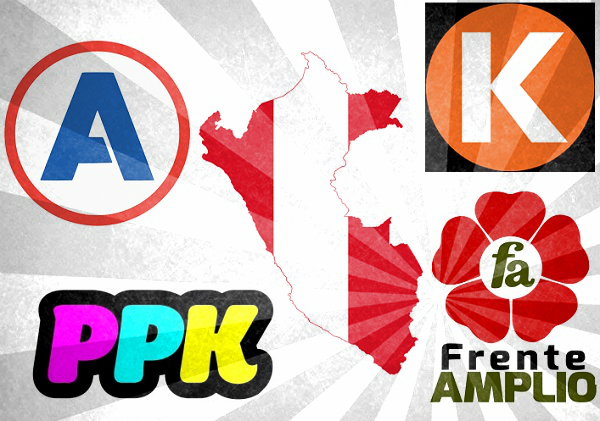
Peru Elections 2016: Back to the Future?

By Jo-Marie Burt*

Peru Elections 2016

Photo Credits: Huhsunqu, Alex Albornoz, Alianza para el Progreso, Fuerza 2011, and Peruanos por el Kambio (modified) / Wikimedia / Creative Commons

Peruvian electoral authorities’ decision last month to disqualify two candidates in this weekend’s first-round presidential election has conjured up the ghosts of one of the most disputed elections in recent Latin American history: the “re-re-election” of Alberto Fujimori in 2000.  Large demonstrations this week against the candidacy of the strongman’s daughter, Keiko Fujimori, were a rejection of the corruption and authoritarianism of the past – as well as the electoral fraud that kept him in power.  The two candidates were disqualified for technical violations of campaign laws.  Newcomer Julio Guzmán, who polls indicated commanded around 20 percent of the vote, was punished because his party failed to follow certain registration norms, and the other, César Acuña, was accused of giving away gifts above newly set limits.  Local observers point out, however, that other leading parties are guilty of similar missteps but have faced no penalties.  Video and testimonials show, for example, Keiko Fujimori attended events where cash “prizes” were handed out.

The disqualifications have put the spotlight on the Inter-American Commission of Human Rights (IACHR), which disqualified candidate Julio Guzmán asked to investigate the decisions.  Postponing the election would be extremely disruptive, particularly because other political groups in Peru, which have benefited from Guzmán’s exclusion, have seized on the immediate political advantage.  The possibility that uneven application of the electoral rules might taint the credibility of the eventual winner is not their immediate concern.

  • The two immediate beneficiaries are Pedro Pablo Kuczynski (known by his initials PPK, which also identify his party, Peruanos por el Kambio), and Verónica Mendoza of the left-wing Frente Amplio. At 15-20 percent each, they are jockeying for second and third place behind Fujimori (30-35 percent), but the real race is in the runoff on June 5 that will take place in the likely event that no candidate wins 50 percent of the vote.  In the 2011 elections, Fujimori won the first round, but lost in the runoff vote to Ollanta Humala.  Fujimorismo has a hard-core following of 25-30 percent of the voting public, but a majority of the population also has a negative opinion of her.

Peruvian elections had come a long way since Alberto Fujimori fled office in 2000.  (In 2009, he was sentenced to prison for 25 years for human rights violations, corruption, and abuse of authority.)  Free and fair elections were held in 2001, 2006, and 2011 – marking the first time in Peruvian history that two democratically elected presidents consecutively handed the presidential sash over to successors.  Whether politically motivated or merely the result of incompetence, electoral authorities’ apparently one-sided handling of this year’s campaign has created an appearance of favoritism discrediting the electoral process itself.  The Secretary General of the Organization of American States, Luis Almagro, has already referred to these elections as “semi-democratic.”  Others speak openly of fraud.  The potential damage is compounded by popular concerns that Keiko Fujimori represents a return to the authoritarian and corrupt tactics that characterized her father’s decade in power.  Her detractors say that she is not simply her father’s daughter; she served as his First Lady and benefited from the corruption of his regime (for example, she testified before Congress that she accepted cash from intelligence chief Vladimiro Montesinos to pay for her college education).  Keiko has acknowledged “errors” (but not “crimes) were committed during her father’s government, and she continues to say her father’s regime was the “best” Peru has ever had.  These were bound to be contentious elections due to the divisive legacy Keiko Fujimori represents, as the massive nationwide demonstrations marking the April 5 “self-coup” on Tuesday made clear.  But the uneven application of the law by electoral authorities raises even more serious questions about Peru’s democratic institutions.

 April 7, 2016

*Jo-Marie Burt is Director of Latin American Studies and Associate Professor of Political Science at George Mason University and a Senior Fellow at the Washington Office on Latin America (WOLA).

Nicaragua: Where’s the Canal?

By Fulton Armstrong

Canal Nicaragua

Coming soon to Nicaragua? Photo Credit: tryangulation / Flickr / Creative Commons

The Nicaraguan government and Chinese investment group leading the Nicaragua Grand Canal project continue to claim enthusiasm for their dream, but enough fundamental problems remain unresolved to suggest that prospects for its eventual construction are dimming – and the principals are maneuvering to avoid picking up the tab for the expenditures made so far.  In a year-end statement last December, President Ortega’s office said the canal project would be one of his government’s top 25 priorities this year and emphasized its benefits to the Nicaraguan people.  Hong Kong-based HKND Group had announced in November that it was “fine-tuning” the canal design to address problems raised in an environmental impact study, which would delay the beginning of major excavations and lock-building until the end of 2016.  Company officials have since said, however, that construction of a fuel terminal and wharf on the Pacific coast –necessary to bring in the massive equipment the project requires – could start as early as this August.  The company still claims that it will complete the canal in 2020 – a prediction that few, if any, outside experts see as feasible.

The project faces massive obstacles, with no solutions in sight.

  • The estimated US$50 billion in financing is nowhere to be seen. Chinese investor Wang Jing, who has already spent US$500 million of his own money on the project, lost some 85 percent of his US$10 billion personal fortune in last year’s Chinese stock market correction.  (Bloomberg named him the worst performing billionaire of 2015.)  Observers believe his losses as well as the problematic environmental impact study have cooled his and other private investors’ support.  An initial public offering of shares has been postponed indefinitely.
  • Project managers have yet to demonstrate the need for the canal and propose solutions to significant engineering challenges, such the need for construction able to withstand earthquakes made likely because of seismic faults along the route. HKND says the canal will handle 3,500 cargo ships a year, including ones bigger than those transiting the Panama Canal, but industry experts say there’s no demand for more than will be accommodated by the expansion of the existing canal – and that the United States has no ports capable of receiving the larger vessels.  Global warming, moreover, could soon open a faster and cheaper route north of Canada.
  • Public protests have diminished during the hiatus in canal-related news and activities, but opponents remain strident and are gaining international support. Detractors’ resolve to fight has been strengthened by the environmental report, by a credible UK firm, determining that the project will “have significant environmental and social impacts,” including dislocation of at least 30,000 Nicaraguans.  Indigenous and Afro-Nicaraguan groups on the Atlantic Coast are upset about disruptions to traditional territories, including cemeteries and holy places.  Amnesty International has condemned the treatment of affected persons as “outrageous” and “reckless.”

The “biggest earth-moving project in history” is still looking like one of the biggest boondoggles in history – yet another in a long series of chimera canals in Nicaragua since early last century.  The government says that popular support for the project remains about 81 percent, but a survey by Cid Gallup, published in the Nicaraguan newspaper Confidencial in January, showed that 34 percent of 1,000-plus respondents consider the canal to be “pure propaganda.”  One quarter believe technical studies have been inadequate and that funding will not materialize.  Those sentiments could be reversed somewhat by the appearance of massive excavation equipment and creation of related construction jobs, but support will still be tempered by concerns about persons whose lives are disrupted by the project – and by perennial and profound suspicions that corruption will take the lion’s share of benefits.  Some opposition leaders believe HKND’s big push to appear optimistic is to build a case for collapse of the project to be Nicaragua’s fault, so that the company can demand that Managua repay the $500 million that Wang has reportedly spent.  The lack of transparency surrounding the project only fuels such speculation. 

April 4, 2016

Brazil: Daring to Look at Succession Scenarios

By Silvio Levcovitz*

Lava Jato

Photo Credits: Instituto Liberal (Brasil) and Brasil 247 / Google Images / Labeled for noncommercial reuse

Brazil’s snowballing scandals are generating a high level of uncertainty regarding the country’s political future.  “Operation Car Wash”—a two-year investigation by a task force of the Federal Police and the Federal Prosecutors—has already led to the conviction and 20-year imprisonment of several senior officials from Petrobras and prominent construction companies, and others are likely to follow.  In Brazil, congressmen, cabinet ministers, and the President can be criminally charged only by the Supreme Court, through a long, difficult process called “privileged forum.”  On March 17, former President Lula, under investigation for allegedly receiving two properties as a bribe from construction companies, was designated a Minister of State in President Dilma Rousseff’s administration, an appointment that would have afforded him that protection.  The judge pursuing him released a recording of a call from Dilma offering him immunity as well as Lula’s calls on family and other private matters.  Many in the Brazilian legal community have disapproved of the judge’s disclosure of the calls as disrespecting the rule of law and the right to privacy, but the damage to Dilma and Lula was done.

Calls for the President’s impeachment are surging—and she repeatedly rejects the pressure to resign.  On Sunday, March 13, a half-million people protested in São Paulo, and the press estimates that another 1-2 million demonstrated elsewhere around the country.  (Demonstrations supporting Dilma have attracted 100,000 citizens in São Paulo.)  The PMDB, party of Vice-President Michel Temer and President of the House Eduardo Cunha, is officially quitting the government this week, and other minor parties appear likely to do the same, definitely cracking the presidential support.  The impeachment process in Brazil has two steps.  In the House, two-thirds of its 513 members (342 votes) are required for “admission” or approval, in which case the Senate can decide by majority vote to take up the charges, resulting in the President being suspended for up to 180 days.  Conviction requires the votes of two thirds of the 81 senators.  Although press reports indicate the mood is for the impeachment, the government is offering positions and funds individually to Congressmen and in hopes of achieving a low turnout to stop the process in the House.

Predicting the outcome of such a volatile situation is inherently risky, but discussion of post-Dilma scenarios is growing increasingly common.  Should she step down or be removed from office, Vice-President Michel Temer would be her constitutional successor.  Like Dilma, however, Temer is being charged by the Superior Electoral Court on suspicion of illegal campaign financing and, if convicted, would not be allowed to take office.  The next two in line to succeed her—President of the House Eduardo Cunha and President of the Senate Renan Calheiros—have been snagged by Operation Car Wash and face charges by the Supreme Court, suggesting that they too could be disqualified.  (The Federal Attorney General has already asked the Supreme Court to issue a preventive order to remove Cunha because of evidence that he has received US$5 million in secret Swiss bank accounts, without any justification.)  That leaves Supreme Court President Ricardo Lewandowski as a possible successor for a maximum period of 90 days, at which point elections would be called.  As Brazil faces crisis after crisis, the press have taken to commenting that the country’s fast-paced, dramatic events make the American series House of Cards look slow and boring. 

March 30, 2016

* Silvio Levcovitz is a CLALS Fellow and political science PhD candidate at the Universidade Estadual de Campinas, São Paulo.  He has been a public lawyer in Brazil and is researching criminal cases of corruption and civil claims of administrative misconduct from 1991 to 2014.