Cuba: Trump Actions Strengthening Hardliners

By Fulton Armstrong and William M. LeoGrande

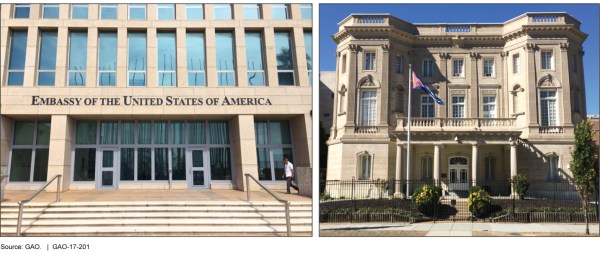
Two buildings in a composite photo

On the left, the U.S. Embassy in Havana; on the right, the Cuban Embassy in D.C. / U.S. Government Accountability Office / Flickr / Creative Commons

As the end of Raúl Castro’s presidency approaches, Trump Administration actions halting, if not reversing, the process of normalizing relations with Cuba have tilted debate in Havana in favor of hardliners trying to keep the brakes on economic reform and on constructive relations with Washington.

  • In retaliation for alleged “sonic attacks” against U.S. diplomats in Havana, Secretary of State Rex Tillerson’s ordered departure of staff from the U.S. Embassy in Havana, the closure of the U.S. consulate, and the expulsion of Cuban consular and commercial staff in Washington –has put a chill on bilateral relations that ratifies Havana hardliners’ contention that Washington cannot be trusted. By halting the issuance of visas to Cubans in Havana, the Trump Administration will almost certainly violate the 1994 migration accord committing the United States to issue at least 20,000 immigrant visas to Cubans annually.  That would rupture the longstanding bipartisan consensus in Washington that bilateral cooperation on migration serves an important U.S. interest in safe and orderly migration.
  • The State Department’s unwillingness to share meaningful information on the U.S. diplomats’ mysterious symptoms – underscored by the Embassy’s refusal to use a hotline established for Cuba to investigate alleged attacks real-time – has frustrated pro-normalization Cubans, who face conservatives’ claims that Washington is cynically exploiting the incident to embarrass Cuba and return to a policy of hostility and regime change.
  • Other Trump measures reinforce Cuban conservatives’ efforts to limit the growth of the country’s nascent private sector, particularly entrepreneurs who profit from U.S. visitors and need easy travel to import inputs from the United States. A travel warning issued in conjunction with the withdrawal of U.S. diplomats is causing a sharp drop in U.S. travelers, and new regulations abolishing individual people-to-people educational travel are channeling people into large hotels, away from private bed and breakfast rentals.  A prohibition on doing business with companies and hotels allegedly linked to the Cuban military is not pushing new clients to cuentapropistas’ businesses but instead is discouraging travel and commerce in general.  Cuban reformers are further dispirited by the perception that Washington is shifting back to the erroneous view that it can promote regime collapse by tightening the economic screws on the government, thereby reinforcing a siege mentality among senior leaders and discouraging needed economic reforms as too risky in the current environment.
  • Trump’s actions have so closely dovetailed with the agenda of Cuban hardliners that some people speculate it was opponents of reform inside the Cuban government who perpetrated the mysterious “sonic attacks” to provoke a confrontation with Washington. But there is no evidence whatsoever in support of that theory, and for anyone to sabotage Raúl Castro’s opening to Washington – one of the signal achievements of his presidency – would be to commit political (if not literal) suicide.

Implementation of Raúl Castro’s road map for economic change, embodied in the 311 lineamientos approved in 2011 and the Conceptualización of Cuba’s socialist model approved by the Communist Party congress last year, had already slowed before Trump’s sanctions due to Cuban concerns about growing income inequality during a period of poor economic performance, uncertainty about energy imports, and perhaps the 86-year-old president’s own level of energy and state of mind after the passing of his two brothers (Ramón and Fidel both died in 2016).  Widely discussed political reforms, such as the Electoral Law and the Law on Associations, that were expected months ago have yet to be unveiled.  The Trump Administration’s efforts to expedite regime change by curtailing financial flows to the government and by promoting private sector growth at the expense of state enterprises make it easy for Cuban hardliners to rally support for slowing reforms.  Ever since he launched the reform process in 2011, Castro has insisted it would move ahead, “Without haste, but without pause.”  Lately, in part because of the Trump Administration’s actions, there’s a lot more “pause” than “haste.”

The election of First Vice President Miguel Díaz-Canel to succeed Raúl as president seems to be a foregone conclusion of the ongoing multi-tiered election process that culminates in February, but no one outside the two men’s inner circle seems to know how or when next steps on reforms will be sequenced.  Raúl’s focus has been on creating processes and institutions for governing after he steps down, rather than achieving particular results between now and the formalities confirming Díaz-Canel.  One thing that is near-certain, however, is that the successor’s legitimacy will be determined by performance, not his surname or soaring oratory.  Tackling the really big reforms that loom ahead, such as currency and exchange rate unification, will require political will from a relatively unified leadership.  Cuba has long been adept at dealing with U.S. sanctions and pressure, so Trump’s policies are more an irritant than a threat, but the effect they have in Havana is to slow the implementation of changes that would improve the standard of living of ordinary citizens and to reduce the willingness of Cuba’s leaders to engage with Washington in ways that would serve the interests of both countries.

 December 18, 2017

Colombia: Effective Transitional Justice?

By Ana Isabel Rodríguez Iglesias*

A large open square surrounded by buildings in Colombia

A view of the Colombian Congress building. / Fernando Garcia / Flicr / Creative Commons

Just hours before its “fast-track” authority for such legislation expired, the Colombian Congress in late November approved legislation establishing the Special Jurisdiction for Peace (JEP) with a weaker mandate than envisioned in the peace accord.  It covers only armed combatants – and excludes the civilians who financed the paramilitaries and other irregular forces – and falls short of enshrining the authority of the JEP magistrates.  This outcome was the result of obstructionism not only by the opposition parties led by the Centro Democrático of former President Álvaro Uribe and its Conservative Party allies; current President Juan Manuel Santos’ political partners in Cambio Radical, including leader Germán Vargas Lleras, broke with the government several months ago and made criticism of the peace agreement a centerpiece of the presidential campaign.  After much wrangling, the watered-down proposal for JEP passed on November 29.

  • The Constitutional Court still has to rule on the constitutionality of the new law, but most provisions apparently face no opposition. The Court unanimously approved the law giving Congress the authority to form the JEP and ruled on some sensitive measures.  It confirmed, for example, that members of the FARC could participate in politics without first being judged by the JEP as long as they promise to submit to the tribunal.  The Court also said that the JEP will determine on a case-by-case basis if FARC politicians’ responsibilities are compatible with fulfilment of their sentences.  It left many details, however, to the Tribunal.
  • The most controversial point in the Court’s decision that provided the framework for the Congressional vote is that civilians and state agents outside the armed forces will not be under the JEP’s jurisdiction unless they opt to be (such as when they expect more leniency than from the ordinary judicial system). That includes businessmen and politicians who financed paramilitarism – a provision that the opposition and Cambio Radical fought hard for.  (During legal proceedings involving demobilized paramilitaries under the Justice and Peace Law, former combatants mentioned their civilian sponsors more than 11,000 times.)  Victims and human rights organizations have called the decision an attack on their interests and stated it will bring only more impunity in the post-conflict era.

The Congress also took steps that, on balance, weakened the JEP’s authorities.  It excluded from JEP processes any FARC members accused of sexual crimes against minors.  The ordinary judicial system will have greater difficulty investigating and corroborating facts and, combined with delays and problems with impunity, could very well fail to satisfy the rights of either victims or perpetrators.  Another change made by Congress was to disqualify JEP magistrates who had worked as lawyers on cases involving human rights and armed conflict during the last five years.  Critics claim this article is illegal because it changes the rules of the game months after the magistrates were selected based on specific requirements such as knowledge and professional experience in human rights law.  Even though the Constitutional Court most likely will declare the provision unconstitutional, the fact that Cambio Radical proposed these disqualifications raises the prospect of more tensions in coming months and the continued stigmatization of human rights defenders at time that many face security threats in the country.

Rhetoric during the peace negotiations and subsequent political skirmishes that the victims were front and center in the formation of the JEP is proving to ring hollow.  The JEP starts its mission weakened both by the Constitutional Court and now by Congress.  The magistrates will face strong political pressures, and the exclusion from proceedings of the sponsors of paramilitary violence, which during the war at times surpassed by far that of FARC combatants, already complicates matters.  Ensuring the rights of the victims, providing justice, and determining the appropriate role for former guerrillas in politics and their reincorporation into society will be no easy task.  It will be up to the Colombian people, through popular vote in elections next March, whether a successor government will improve implementation of the peace agreement and the administration of justice, truth, and reparation to the war’s eight million victims.

December 13, 2017

* Ana Isabel Rodríguez Iglesias is a Ph.D. Candidate in International Politics and Conflict Studies at the University of Coimbra (Portugal) and a CLALS Fellow.

How Will Cuba Update its Drug Policy?

By Isabella Bellezza-Smull*

A graffiti street sign

A “Say no to drugs” sign spotted in Santiago de Cuba. / tgraham / Flickr / Creative Commons

Cuba – unlike neighbors long wracked by the drug trade and its violence – has one of the lowest drug-use and homicide rates in the Western Hemisphere, but national drug experts are debating how to adapt the country’s strategy to new challenges.  The debate is taking place amid positive evaluations by the Cuban government, the U.S. State Department, and others that indicate rates of illicit drug consumption, production, and retail in Cuba have been negligible, while reliable anecdotal information suggests a rise in drug use and transit as the country opens its doors to foreign trade, travel, and allows emergence of a domestic private sector.

  • Cuba credits its success to a comprehensive approach that includes confrontation, collaboration, prevention, and treatment. In conversation with U.S. drug enforcement counterparts, Cubans emphasize tough-on-drugs policies, including sanctions for drug possession, production, and trafficking, and to the effectiveness of the anti-drug police force, interdiction operations, and some 40 bilateral counternarcotics agreements.  To other partners, they stress multi-sector, humanistic prevention and treatment efforts directed by the Comisión Nacional de Drogas (CND).  The CND coordinates national health, education, justice, and community sectors to prevent and delay the initiation of drug use – and to treat it as a public health issue when it does occur.  Even though drug possession is a crime, the diversion of illicit drug users from the criminal justice system to health clinics has been an important element of national strategy.

Despite its successes, Cuba faces a number of challenges with respect to illicit drugs.  If Cuba continues to increase tourism and diversify its foreign trade, the possibility of drugs – and recreational drug cultures – reaching Cuban shores will increase, putting further stress on the country’s “just-say-no” approach.  The emergence of a class of Cuban entrepreneurs with increased disposable income could create a new appetite for drugs, and the possible exacerbation of economic inequality could make the illicit-drug market attractive, whether as producers or retailers.  A well-established context of informal markets and back-channel networks already exists that could be repurposed to distribute drugs.

Cuba’s robust public health, educational, and community-based institutions – the basis of protective factors related to drug abuse – afford the country an opportunity to adopt a more progressive approach to drug control.  The CND remains publicly committed to prohibition and fighting illicit drugs, but there are also signs that alternative strategies are being considered.  Cuba’s leading research center for drug treatment, the Centro para el Desarrollo Académico sobre Drogodependencias (CEDRO), is beginning to explore harm-reduction measures as an alternative to abstinence-based approaches – acknowledging, as its coordinator has said, that “not everyone who comes to consultation is willing to assume abstinence.”  Decriminalization of drug-use and possession appears extremely unlikely, even though studies in other countries show it reduces high-risk behaviors that increase the spread of infectious diseases and death from overdose, the diversion of law enforcement resources from serious criminality, and exploding prison populations.  More likely, Cuba’s debate probably will touch on adopting harm-reduction measures to treat and prevent problematic drug use, and investing in alternatives to incarceration for nonviolent, low-level participants in illicit drug markets involved in production, transport, and sale.

December 7, 2017

* Isabella Bellezza-Smull is Latin America coordinator for Global Exchange.  This article is adapted from a study – Will Cuba Update its Drug Policy for the Twenty First Century? – that she prepared for the Igarapé Institute in Rio de Janeiro.

Honduras: Hernández Stealing the Election Too?

By Eric Hershberg and Fulton Armstrong

Two men sitting in chairs looking at each other.

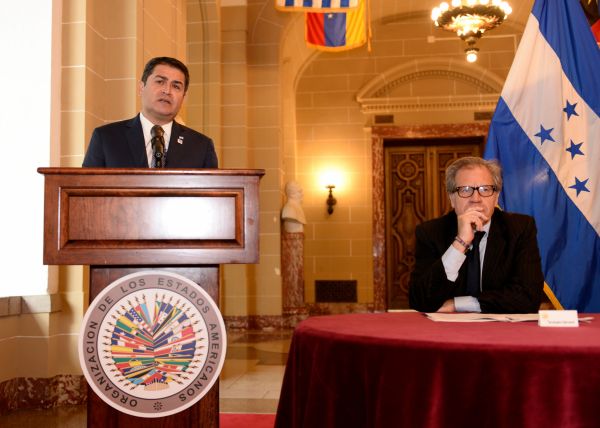
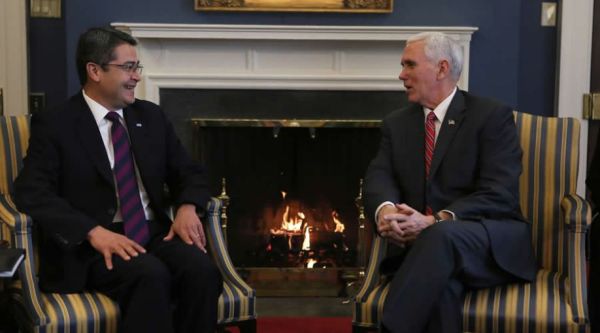
Honduran President Juan Orlando Hernández and U.S. Vice President Mike Pence. / Embassy of Honduras / Creative Commons

Honduran President Juan Orlando Hernández and the military have declared a “state of emergency” – tantamount to martial law – to ensure that the President wins a second term, but irregularities in the vote-counting and the harsh suppression of the opposition probably will poison political discourse and hinder democratic progress for years to come.  The government declared the emergency, which will run for 10 days, on Friday night after days of growing tensions over mysterious actions by the Supreme Electoral Tribunal (TSE) – heavily stacked in favor of Hernández – that erased opposition candidate Salvador Nasralla’s five-point lead earlier in the week and moved toward formalizing the incumbent’s victory by 1.5 percentage points.  Senior government officials themselves have characterized the action as a “suspension of constitutional guarantees.”  Hondurans are now living under a dusk-to-dawn curfew; radio and TV stations have been warned against publicizing opposition claims of fraud; and street confrontations are growing.  Media confirm several deaths, but opposition leaders say that more than a dozen demonstrators have been killed.  Opposition videos showing military and police violence, including chasing individual protestors and shooting them, have been removed from Facebook and other venues, although still photos of the victims can be found.

  •  The TSE has agreed to hand-count about a thousand ballot boxes with “irregularities” in three of 18 departments, representing about 6 percent of the votes, but the opposition claims that several thousand more boxes have been compromised and need to be reviewed.

International reaction has been mixed and generally muted.  The EU’s observers have held firm on demanding a full vote count and expressing, diplomatically, skepticism about TSE’s handling of it.  Observers for the “Grupo de Lima,” which has been active on the Venezuela issue, issued a “position” paper on election day (November 26) urging calm and patience with the vote count, but it has released no apparent updates since then.  OAS observers have taken a similar low-key position.

  • Although the Trump Administration may conceivably be working behind the scenes, neither the White House nor State Department has done publicly more than urge calm. Vice President Pence, who previously praised Hernández “for his leadership in addressing security and governance challenges,” has remained silent.  The U.S. chargé d’affaires has said Honduras is in “a new, unprecedented phase in the electoral process” but limited herself to calling for calm and a full vote count.

The audacity of this apparent election fraud and crackdown on Hernández’s opponents dwarfs the many other charges of corruption brought against the Hernández government, including some validated by the OAS Mission to Support the Fight against Corruption and Impunity in Honduras (MACCIH).  Although different in form from the coup in 2009, these events also threaten to undermine the nation’s political stability, economic wellbeing, and institutions necessary to building democracy.  The U.S. reaction suggests that Washington will acquiesce in the ongoing abuses and Hernández’s second term despite the obvious irregularities and rights violations.  The United States – convinced as in the past that political leaders who are “our SOBs” can make good partners – has often countenanced dubious elections.  Moreover, both the Obama and Trump Administrations were persuaded that Hernández has been their faithful, effective ally in combating the drug trade, despite evidence of official involvement in it, and the temptation to turn a blind eye to less-than-democratic political outcomes must be strong.

  •  The OAS, the “Lima Group,” and other intraregional groupings do not appear poised to weigh in despite their good intentions. Neither do Mexico, Guatemala, and El Salvador appear likely to condemn a neighbor for engaging in practices that are ongoing or fresh in their own near pasts.  The Inter-American Democratic Charter, a historic document laying out hemispheric values, is of little value in the absence of the political will and ability to enforce it.  Now is a crunch time both for the OAS and for those governments that advocate some teeth to the charter.  At this point, they appear likely to cave – to the detriment of democracy in Latin America.

 December 4, 2017

Trump’s Wall Funding Proposal Violates Conservative Principles

By Ezra Rosser*

A large border fence and the blue sky as seen from a street in California

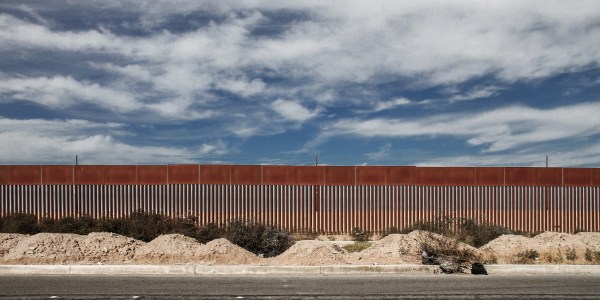
A portion of the existing border fence between Mexico and the United States in California. / Rey Perezoso / Flickr / Creative Commons

More than two years after U.S. presidential candidate Donald Trump first boasted that he would “build a great, great wall on our southern border and … make Mexico pay for that wall,” his main proposal to fund it appears to remain blocking transnational remittances  – in contradiction of neoliberal capitalist principles he embraces.  In a letter that now-President Trump sent last month to U.S. House and Senate Leaders he said the border wall was necessary to protect “our national security and public safety” because the “porous southern border … is exploited by drug traffickers and criminal cartels.”  He was ambiguous, however, about who was going to pay for the wall, simply arguing that the country must “ensure funding for the southern border wall and associated infrastructure.”  Trump offered to make a deal to protect the Deferred Action for Childhood Arrivals (DACA) program – the “Dreamers” – only if Congress passed harsh immigration policies and funded the wall.

  • Under pressure during the campaign to explain how he would make Mexico pay for the wall, Trump claimed he could hold remittances sent by Mexican immigrants to family members in Mexico hostage until Mexico agreed to pay. President Obama noted at the time that the implications of ending immigrant remittances would be “enormous,” difficult to implement, and likely push more people to leave Mexico for the United States.  Senders would likely resort to informal channels, and Trump’s proposed selective taxation of money sent to Mexico would raise legal issues because of the discriminatory nature of such a program.
  • Trump has been quietly backing away from his repeated campaign promise to make Mexico pay. When Mexican President Peña Nieto told him in a phone call last January that “my position has been and will continue to be very firm saying that Mexico cannot pay for that wall,” Trump responded with much less bluster.  He noted simply that “you cannot say that to the press.  The press is going to go with that and I cannot live with that.”  This acknowledgement that the issue was largely about political optics suggested that Trump knew that, in the memorable words of former Mexican President Vicente Fox, Mexico was “not going to pay for that f***ing wall.”

Trump has not withdrawn, however, his threat to block remittances.  Such a policy would cause hardship for millions; most remittances are spent on basic necessities such as food.  But by undermining the free flow of capital, a core feature of our modern globalized world, Trump is also attacking a central component of neoliberal capitalism.  Trump also takes positions that reflect anti-globalization and protectionism – such as his characterization of NAFTA as the “the worst trade deal ever signed in the history of our country” and his claim that globalization “left millions of our workers with nothing but poverty and heartache” – but tying capital flows with labor flows would arguably turn the values of the global order on their head.

  • The notion that there is an imbalance in the treatment of workers and capital is ordinarily associated with the radical left. Harvard Law Professor Roberto Mangabeira Unger, for example, highlighted this imbalance in his 1998 book, Democracy Realized: The Progressive Alternative, in which he wrote, “The architects of the new world economic order have built a system in which capital and goods can roam the world while labor remains imprisoned in the nation-state or in blocs of relatively homogeneous nation-states.”  For Trump and other Republicans, linking remittances and immigration would normally be anathema.  If the U.S. Congress decides not to fund the wall, we may discover that taxing cash transfers may be an autocratic strategy that crosses ideological lines.

 November 27, 2017

* Ezra Rosser is Professor of Law at the Washington College of Law, where he has taught Property, Federal Indian Law, Poverty Law, Land Use, and Housing Law.

Colombia: Truth Alone Will Not be Enough

By Christian Wlaschütz*

Several men and women sit in chairs at a table

Jesuit Francisco de Roux (center), who will lead Colombia’s truth commission, at a meeting with rural communities involved in the peace-building process. / Véala / Agencia Prensa Rural / Flickr / Creative Commons

The 11 members of Colombia’s “Commission for the Clarification of the Truth, Living Together and Non-Recurrence” were announced last week – a landmark in that country’s still tortuous reconciliation process.  Jesuit Francisco de Roux, who has worked for peace for decades, will preside over the commission as it undertakes its three-year mission (after a preparatory period of six months).  Presidential Decree No. 588, issued last April, broadly defines the Commission’s tasks as contributing to the truth of what happened; establishing the voluntary recognition of responsibilities; and promoting a culture of peace and dialogue throughout the country.  Like any truth commission, its mandate includes dignifying the victims and identifying the patterns of violence and the structures that perpetuated the armed conflict; and providing a differentiated account of the suffering of women, children, and ethnic minorities.  It will develop a list of recommendations for the future.

The truth commission faces a number of challenges and dilemmas that will not be easy to overcome.

  • The polarization of society regarding the peace process, personalized as the confrontation between President Santos and former President Uribe, will require de Roux to seek permanent dialogue and trust-building on all sides. In a first statement, Uribe said the appointment of de Roux was a positive sign.  But the current presidential campaign threatens to stymie political agreements and could potentially make the Commission a target to discredit the government.
  • The incapacity or unwillingness of the Congress to discuss legislation on the peace process, as seen this week when not even the quorum was reached, could be a major obstacle.
  • Corruption, drug trafficking, the concentration of land, and other endemic issues that fueled the armed conflict stand to endanger the peaceful future of the country – and will require the careful attention of the Commission. The security situation in several regions already leaves little space for people to present testimony to the Commission.
  • The Commission’s structural link with other elements of the “Comprehensive System for Truth, Justice, Reparation and Non-Recurrence” could cause some confusion. One element of the system is the Special Jurisdiction for Peace (JEP), which will have duties related to criminal justice that could discourage witnesses from providing testimony to the Commission.

All noble intentions aside, the “truth” alone may not be sufficient to effect the real transformation that lasting peace will entail.  There are plenty of versions of the truth in Colombia, and thousands of volumes of analysis of the conflict dynamics in every region.  The involvement of companies funding armed actors and the politicians giving them support have been documented.  Academic publications, civil society reports, international analyses, and oral histories abound.  But if the Commission wants to make a difference, it must go beyond the accumulation of knowledge.

  • Precedent suggests that the Commission’s effectiveness will depend on finding an efficient way to be present in the regions, thus moving toward citizens instead of waiting for them. A strong public dimension to the testimony of both victims and perpetrators will help give the truth meaning through the empathy that is often missing in abstract discussions on the numbers of the victims.  Probably most importantly, a diverse group of friends or supporters of the Commission – credible representatives of different social groups who will eventually push implementation of the Commission’s recommendations – will be key.  Colombia doesn’t need yet another analysis of the patterns of atrocities and a list of recommendations that will never be implemented.  Truth without follow-up and transformation will only create further frustration and, potentially, more violence.

 November 20, 2017

* Christian Wlaschütz is a political scientist, independent mediator, and international consultant who has lived and worked in Colombia, in particular in conflict zones in the fields of transitional justice, reconciliation, and communitarian peace-building.

Argentina: Excessive Optimism?

By Nicolás Comini*

Man delivers a speech on an airfield.

Argentine President Mauricio Macri. / Cancillería del Ecuador / Flickr / Creative Commons

Argentine President Macri’s Cambiemos coalition won an overwhelming victory in last month’s legislative elections – a step toward fulfilling his 2015 promise of a “revolution of joy” – but it’s not clear yet whether the administration’s optimism translates into national hope.  The coalition won in 15 of the 24 provinces of the country, including the five largest jurisdictions – the City of Buenos Aires, Buenos Aires, Córdoba, Mendoza, and Santa Fe.  Government officials and Macri’s supporters have expressed optimism that the economy will turn around and political confrontation will be overcome.  Macri won the presidency in 2015 with an alliance that made optimism – and the appearance of optimism – a central theme for overcoming what he called the polarization generated by his predecessor, former President Cristina Fernández.  His discourse was rooted in the ideas of change, happiness, efficiency, and meritocracy.

  • Even critics acknowledge that the government has generated innovation in terms of political discourse and representation, rooted in a greater horizontality of leadership and greater citizen access to public officials. News of some officials’ questionable business practices as revealed in the “Panama Papers” and “Paradise Papers” has caused little or no backlash.  Second, the idea of “normalization” of the country, supported by the media, has had a positive impact on part of society.  GDP growth at almost 3 percent this year and the lifting of exchange controls and imports have also buttressed this theme.  The unfavorable trade balance, with a deficit of US$765 million in 2017, has not been a factor.  Third, the government is still able to blame the country’s problems – including high levels of inflation and indebtedness – on the “received inheritance” from his predecessors, whose rule implied corruption, social polarization, and isolation from the world.
  • Rejection of the legacy of Cristina Fernández and her husband/predecessor, Néstor Kirchner, also seems to be one of the Macri government’s greatest assets. Even though Cristina is the most popular candidate in the opposition, her rejection among the broader population is greater; many of the votes that the government’s allies garnered were “anti-Kirchner” votes.  Cristina won a seat in the Senate, but in national politics, there’s a growing sentiment of “anyone but Cristina,” while a civil war simmers within the ranks of her Peronista base.  The political rise of Macri ally María Eugenia Vidal as governor of the Province of Buenos Aires – historic bastion of Peronismo and the country’s main electoral district – attests to these troubles.

Macri’s gains indicate a significant strengthening of the government, which is key to the reform package that the administration launched almost immediately after the election.  Proposals include aggressive changes in tax and labor matters.  While the tax reform has triggered battles with some large corporations, such as Coca-Cola, that will pay higher taxes, the labor reform has broad support from employers.  The latter faces strong resistance from a large part of society and, above all, of the union and opposition sectors, who fear that it, similar to one already carried out in Brazil, will contribute to job insecurity.  Macri’s increasingly forceful discourse on reducing public employment has also raised concerns despite his assurances that reducing state structures will help create private-sector jobs.

British theorist Terry Eagleton has said that an optimist is someone who thinks that things will improve even if there are no reasons for it.  The optimism of the government and its supporters is as easy to understand – there are some clear reasons for it – as it is palpable.  Macri has a strong government in a Latin America plagued by weak governments.  He not only has power in parliament; the country’s large corporations, mass media, security forces and, of course, an important part of the people are also behind him.  But Argentina is accustomed to living in cycles.  Expecting that in Argentina one or two or even three electoral victories will produce a durable revolution and fundamentally change those cycles, as the current government’s rhetoric suggests, may not be warranted by the facts.  Each administration usually assumes that the previous one did things absolutely wrong, and they will do better this time.  But this kind of impulse has an expiration date.  Joy and good vibes can have a positive impact on a society’s feelings about itself, but a real lasting solution will require addressing the underlying causes of the country’s polarization, poverty, and exclusion.  This implies, above all, state policies and continuity through different administrations.

November 15, 2017

* Nicolás Comini is Director of the Bachelor and Master Programs in International Relations at the Universidad del Salvador (Buenos Aires) and Professor at the New York University-Buenos Aires. He was Research Fellow at CLALS.

Guatemala: Simmering Under the Surface

By Ricardo Barrientos*

Three people stand on a dias with Guatemalan flags in the background

New U.S. Ambassador to Guatemala Luis Arreaga is officially welcomed to the country by President Jimmy Morales. / Flickr / Creative Commons

Guatemalan President Jimmy Morales has survived the backlash against his efforts in August to shut down corruption investigations by the Attorney General and the Comisión Internacional Contra la Impunidad en Guatemala (CICIG), but tensions remain intense.  Two days after Attorney General Thelma Aldana filed papers to suspend the President’s immunity from prosecution on campaign finance corruption charges in late August, Morales declared CICIG Commissioner Iván Velásquez “persona non grata” and ordered his expulsion from the country.  (The expulsion order was blocked by the Constitutional Court.)

  • On September 13th, more than two thirds of the Congress – driven by most of Morales’s party as well as opposition members accused of corruption – voted in favor of altering the Penal Code in ways that weakened accountability for all politicians (including Morales and themselves). Two days later, after massive protests akin La Plaza, the civic movement that achieved the removal of former President Pérez Molina and most of his administration in 2015, Congress backtracked.
  • The Morales Administration tried to curtail the CICIG’s activities again in October, when the Foreign Ministry renewed the Commissioner’s visa for one year with a stern warning to “refrain from interfering in the internal affairs” of the country. The Constitutional Court again intervened, ordering the Ministry to revoke the warning.

Despite the attacks, Commissioner Velásquez and Attorney General Aldana continue their efforts.  Last week Velásquez said publicly that illicit campaign finance is “the ‘original sin’ of the system of corruption that has captured the Guatemalan state … and the distortion of the democratic model.”  He and Aldana keep scoring points: former President Pérez Molina, his vice president, Roxanna Baldetti, and two dozen others were sent to trial last week on corruption charges originally brought to light by CICIG – the now-famous Customs corruption scheme called La Línea. 

  • They’ve also presented a new corruption case, nicknamed Pandora’s Box, which links Guatemala City Mayor and former President Álvaro Arzú Irigoyen with an illicit campaign financing network, speculation, misuse of public funds, and dirty business with former “King” of the Guatemalan prison system, Byron Lima Oliva. This news re-opened old wounds over issues such as the assassination of Bishop Juan Gerardi Conedera in 1998, when Arzú was President and Lima a member of the Presidential General Staff.  Arzú has been one of Morales’s most fierce defenders, so his travails hurt the President – even if it is uncertain that the Guatemalan justice system will withstand Arzú’s counteroffensive against CICIG, the Attorney General and La Plaza.

The arrival of a new U.S. Ambassador may be contributing to a momentary drop in open political warfare between reformers and corrupt politicians.  Compared to former Ambassador Robinson, incoming Ambassador Luis Arreaga has kept a low profile on the issue.  During his confirmation hearing last July, he restated “a commitment by both governments to fight corruption and build upon the successful efforts by President Morales, CICIG, and the Attorney General to end impunity.”  Since presenting his credentials in Guatemala last month, he has held familiarization meetings with a broad array of Guatemalan leaders in the executive, legislative and judicial branches, emphasizing the themes of friendship and partnership.  Meeting with Velásquez and Aldana together, he confirmed the “U.S. commitment to their efforts to fight corruption and impunity,” according to the Embassy’s website.  Arreaga’s honeymoon – during which he has the luxury of being friends to both reformers and their corrupt targets – will endure only until CICIG uncovers more blockbuster evidence of corruption or Morales, sensing his political support sinking with his credibility, tries to capture the hearts of other vulnerable politicians to further hem in the meddlesome reformers.

November 9, 2017

*Ricardo Barrientos is a senior economist at the Central American Institute for Fiscal Studies (ICEFI).

The Anticorruption Imperative for Latin America

By Matthew Taylor*

Bar graph showing accountability in Latin America

Graphic courtesy of author. For a larger version, please click here.

Latin America’s reactions to the massive transnational scandals involving the Brazilian construction giant Odebrecht and its subsidiary Braskem are an important sign of progress in anticorruption efforts.  But across the region, courts’ reluctance to challenge elites remains a major obstacle to deeper accountability.  Brazilian, Swiss, and U.S. authorities’ announcement in December 2016 of a multibillion dollar global corruption settlement with the Brazilian firms – valued at $3.5 to 4.5 billion – was remarkable for being the largest in history.  It was also shocking for its revelations: Odebrecht admitted using a variety of elaborate subterfuges to launder bribe payments and corrupt proceeds, including by setting up a bribe department and buying an offshore bank.  Graft allowed executives to rewrite laws in their own favor, and guaranteed that the right officials were in the right place when public contracts were up for bidding.  The firms netted $3.60 for every $1 they spent on bribes in Brazil, and admitted to paying $788 million in bribes across twelve countries, including ten in Latin America.

The political salience of the charges is roughly similar in all ten Latin countries, muddying the reputations of presidents or former presidents in Argentina, Colombia, the Dominican Republic, Peru, Panama, Venezuela and, of course, Brazil.  Ministers and high-level officials have been implicated in the remaining countries: Ecuador, Guatemala, and Mexico.  Nearly one year after the settlement, it is time to ask how well law enforcement and judicial processes are resolving the allegations against these high-powered public and private sector elites.

  • In a paper forthcoming in Daedalus, I argue that accountability can be thought of as the outcome of a basic equation – A = (T + O + S) * (E – D) – combining transparency (T), defined in its most essential sense as public access to information about the government’s work; oversight (O), meaning that government functions are susceptible to surveillance that gives public or private agents the right to intensively evaluate the government’s performance; and sanction (S), effectively punishing wrongdoing and establishing societal norms to their rightful place. These are tempered by institutional effectiveness (E) – understood as the outcome of state capacity, relevant laws and procedures, and citizen engagement – and political dominance (D), which diminishes the incentives for active oversight or energetic sanction.  The graph above uses a combination of data points from the World Justice Project to measure each of the five variables.
  • The comparison yields mixed findings. On average, the nations implicated in the Odebrecht settlement do quite well on transparency, effectiveness, and political dominance – the outcome of a generation of democratic rule (with Venezuela being the obvious outlier).  But all ten countries perform comparatively poorly when it comes to oversight, and abysmally when the criterion is sanction.  This does not bode well for accountability, especially if we consider that among the Odebrecht Latin Ten, the highest-scoring country on the sanction criteria is Argentina, whose score is still below the middle-income country average.  In Brazil, where trial courts have led the way in imposing sanctions on business elites, political leaders are nonetheless protected against meaningful sanctions by an arcane system of privileged standing in the high courts.

Latin American judicial systems – long rigged to protect local economic and political elites – remain the principal obstacle to accountability.  The Odebrecht settlement signaled that a new day has arrived: new international norms and law enforcement across multiple jurisdictions are likely to continue to upset the cozy arrangements that have protected the region’s elites from corruption revelations for decades.  But true accountability will only come when local courts and prosecutors are empowered to effectively punish corrupt elites.  That implies changes in legal procedure, new laws, and most importantly, political will.  Perhaps the Odebrecht case will galvanize domestic public opinion and mobilize policymakers about the need to improve local justice systems.  The enormous costs of corruption revealed by the Odebrecht settlement suggest that change cannot come soon enough.

November 6, 2017

* Matthew Taylor is Associate Professor at the School of International Service at American University.  His forthcoming article in Daedalus is entitled “Getting to Accountability: A Framework for Planning and Implementing Anticorruption Strategies.”

Chile: Election Likely to Show Big Political Shifts

By Kenneth Roberts and Eduardo Silva*

A presidential candidate stands in front of a crowd and a large Chilean flag

Ex-president Sebastián Piñera addresses his supporters at a campaign rally last month. / Twitter: @sebastianpinera

Chilean politics in the run-up to national presidential and legislative elections on November 19 have revealed that – within major lines of continuity – significant changes in the political alignments that have structured the country’s democracy since the end of the Pinochet dictatorship in 1990 are taking place.

  • Continuity is most pronounced on the conservative side of the political spectrum, where the two main conservative parties, Renovación Nacional (RN) and Unión Demócrata Independiente (UDI), have joined forces with smaller parties to sponsor the presidential candidacy of billionaire business mogul and former President Sebastián Piñera. In public opinion surveys of voter intentions, Piñera has maintained a healthy lead over a collection of centrist and leftist candidates.  He appears likely to come out on top in the first round of voting – and significant abstention (if fewer than 5.5 million registered voters vote) could push him over the top.  If he is forced into a run-off, the final outcome will rest heavily on the ability of his opponents in the divided center-left bloc to coalesce forces.
  • The center-left space is where most change is concentrated. The core parties in the Nueva Mayoría coalition that backed incumbent Socialist President Michelle Bachelet have won five of Chile’s six presidential elections since the transition to democracy in 1990.  For the first time, however, the main centrist party, the Partido Demócrata Cristiano (PDC), has opted out of the alliance to run its own candidate, Senator Carolina Goic.  With Goic languishing in the polls, however, the primary challengers to Piñera are located further to the left, including the Nueva Mayoría’s favorite, Senator Alejandro Guillier.  Although early speculation pegged him as an outsider, he is now firmly identified with the moderate reformist left and represents continuity with the current government.

A new left-leaning group, the Frente Amplio, has nominated Beatriz Sánchez, an independent journalist.  She arguably represents a larger challenge to the status quo, as her candidacy gives political expression to social actors who are sharply critical of Chile’s political establishment and the neoliberal economic model.  Even though the Broad Front’s electoral strength is untested, it brings together a number of small parties alienated from Nueva Mayoría and inspired by Chile’s massive student protest movement and other activist networks that have mobilized around labor, environmental, and pension reform issues in recent years.  Sánchez favors more redistributive taxation and greater state intervention in strategic enterprises and utilities, as well as in water property rights and forestry where social conflict has been high.  She is also for replacing the private pensions system with a mixed public-private one and getting private banking out of the student loan business.

This election will likely show that the broad center-left coalition that dominated Chilean politics since the 1990 transition has effectively splintered, with the Christian Democrats seeking to carve out an independent space in the political center and a movement-based alternative emerging on the mainstream parties’ left flank.  Uniting such disparate forces to compete against Piñera in a run-off election, should one be required, will clearly be a formidable task.  Nueva Mayoría candidate Alejandro Guillier, considered the strongest run-off candidate to take on Piñera, is already in conversation with Christian Democrats and Sánchez’s Frente Amplio.  In a run-off, he is thought likely to get around 60 percent of the Christian Democratic vote, with more conservative Christian Democrats voting for Piñera.  His appeal to Frente Amplio voters could suffer because of their unhappiness with Nueva Mayoría.

  •  The specter of high abstention looms large for second-round voting, too. President Bachelet’s low approval ratings for most of her second term in office, although recently reversed, signaled low enthusiasm despite her successful pushing through a series of major reforms, including a reform of the electoral law to enhance proportional representation, a tax reform to increase revenues for social programs, the initiation of free university education for low-income students, and a much-debated law to legalize abortions in limited circumstances.  Last, but not least, mainstream parties across the board have been weakened by a series of corruption and campaign finance scandals, leaving many citizens alienated from parties.

November 2, 2017

*Eduardo Silva is Professor of Political Science at Tulane University, and Kenneth Roberts is Professor of Government at Cornell University.