Fake News: Threat to Democracy

By John Dinges*

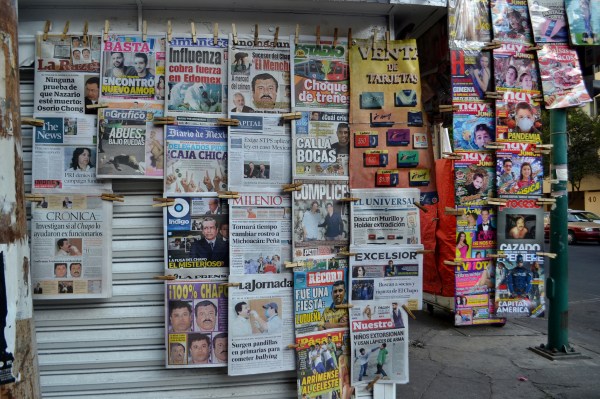
Newspaper stand in Mexico City

A newspaper stand in Mexico City. As traditional news media faces growing competition from social media and emerging technologies, fake news poses a threat to legitimate news media and democracy itself. / Pablo Andrés Rivero / Flickr / Creative Commons

Fake news threatens to destroy the fundamental values of a free press throughout the hemisphere, and only a redoubling of efforts to build and protect investigative journalism would appear to offer hope in stemming its growing influence.  Journalism faces a number of challenges, including violence, authoritarian pressure, manipulation by commercial interests, and competition from “social media.”  But the combination of fake news and new technologies to spread it pose an asymmetric threat to legitimate news media and to democracy itself.

  • In its strict – and now largely unused – definition, fake news is fabricated information that’s designed to look like journalistic content but whose real purpose is to twist the truth and manipulate people’s behavior. Also called “black propaganda” and “disinformation,” it was engendered principally by intelligence agencies.  The CIA used it during the Cold War in Chile and other Latin American countries.  The Soviet Union’s KGB disseminated fabricated documents with authentic-looking formatting and signatures from Chile’s secret police.  Cuba’s Radio Havana promoted the false narrative that socialist president Salvador Allende was murdered in the 1973 military coup – he actually committed suicide.
  • The phenomenon now is broader and more threatening. Fake news has evolved to include attacks on the legitimacy of independent media, and its agile use of social media spread rapidly through personal electronic devices enhances its impact.  U.S. President Donald Trump has alleged (as recently as July 15) that the “media are the enemy of the American people.”  Latin American politicians have used accusations of fake news to attack legitimate media.  In Venezuela, the Chavista government invented the concept of “media terrorism.”  Fake news techniques are found most commonly in campaigns by authoritarian parties and governments.  Russia’s intelligence services, under President Vladimir Putin, have weaponized the techniques and are now systematically using them to intervene in European and U.S. elections, notably in supporting the 2016 victory of Donald Trump.

There is no consensus among journalists on a solution.  Tough experiences have shown, for example, that government regulatory actions tend to backfire against a free press; political leaders all too easily resort to actions that lead to the imposition of political hegemony and control.  Media laws in Ecuador, Venezuela, and Argentina were hailed as progressive in some quarters – mandating fairer distribution of broadcast spectrum, for example.  But they were most effectively used to impose political control on opposition media.  Journalists, moreover, have been thrown off balance by the phenomenon of fake news.  They have struggled to respond to effective attacks on their credibility and so far have failed to develop the tools needed to mount an effective counterattack.

  • The double challenge is how to enable consumers of media information to distinguish between false and truthful information – especially because the fake news products are designed to resonate with their biases – and how to strengthen legitimate journalists’ ability to rebuild their beleaguered credibility. Talking Points Memo journalist Josh Marshall, speaking of politically motivated falsehoods in a memo published by the U.S. House Permanent Select Committee on Intelligence last February, said:  “Conventional news and commentary [are] incapable of handling willful lying in the public sphere.”  In the case of the committee’s misleading memo, most observers agree, the legitimate media published accurate fact checking, but apparently the accurate stories had little corrective impact on public perceptions of the memo – handing a victory to fake news.

The other serious threats that journalism faces – such as the murder of dozens of Mexican journalists with practically total impunity, and the consolidation of ownership of the media in the hands of very few owners in most countries – are not insignificant.  Fake news, however, presents a more serious, even existential, threat because it short-circuits all three of the main functions of journalism in the preservation and consolidation of democracy – as sources of information the public needs in voting, as forums for political debate, and as investigators to monitor and evaluate government and private power.  In the ongoing asymmetric war between journalism and fake news, investigative journalism, if protected and funded, would appear to offer the most efficient defense for democracy.  Digital platforms have created new tools and platforms for investigative journalism, and new organizations, such as ProPublica, the International Consortium for Investigative Journalism, among others, are raising the skill level of professional journalists and enhancing their best practices.  Investigative journalists have the methodology, international base, and decades of experience needed to be the guard dogs against fake news – to investigate its purveyors, lay bare their agendas, and, over time, re-establish the truth upon which all democracies depend.

July 24, 2018

*John Dinges is an emeritus professor of journalism at Columbia University and lectures frequently in Latin America on media and democracy and investigative journalism.

Honduras: Narcotics Trade Accelerating Deforestation

By Luis Noé-Bustamente*

Río Plátano Biosphere Reserve (Honduras)

Río Plátano Biosphere Reserve in Honduras. / UNESCO / Wikimedia / Creative Commons

The rapid increase in deforestation in Honduras is being driven to a significant degree by the narcotics trade’s use of logging, land purchases, and cattle operations to launder drug profits.  Honduras has lost approximately 30 percent of its total forest cover since 2000, according to the Food and Agriculture Organization of the United Nations.  Research indicates that the burgeoning drug trade connects businesses involved in illegal logging, timber sales, and the use of the cleared land for cattle ranching as a mechanism to launder drug trafficking money.  Criminal organizations insert illegal timber into the existing legal supply-chain, hiding illicit profits within legal revenue streams.

  • Drug traffickers’ access to capital gives them immense social, economic, and political influence in remote areas. Research published in the journal Environmental Research Letters shows that they are able to conduct unusually large, remote, and fast forest-clearing in areas where they also collaborate with illegal loggers to grab land, enabling them to later merge both activities through cattle ranching operations.  Last year, a spatio-temporal study led by Dr. Steven Sesnie, an ecologist at the U.S. Fish and Wildlife Service, estimated that as much as 25 percent of the annual forest loss in Honduras during the past decade can be linked to the drug trade.

Even though these emerging regional bosses are growing in influence and audacity, the Honduran government does not acknowledge the scope of their illicit activities – even in the Rio Plátano Biosphere Reserve (RPBR), the country’s largest natural forest reserve (approximately 800,000 hectares).  In 1997, the Honduran Congress designated three different zones in the RPBR to provide some long-term protection of its sparsely inhabited core zone and to promote sustainable development in its more populated buffer and cultural zones.  Available information indicates, however, that enforcement has been very spotty, with only very rare action against only low-level violators.

  • Parts of the RPBR have experienced what forestry experts call alarming levels of cleared forest patches – even in areas with limited or no road access, where only illicit traders go. The RPBR’s secluded “cultural zone” is experiencing forest clearing at an estimated rate of more than 100 hectares per year (50 times more than in 2005).  Sensie’s report directly correlates this with increased drug trafficking throughout the country.  Indeed, there is a positive and substantial correlation between the country’s recorded percentage of GDP from drug trafficking (based on the same study) and the amount of irregular forest loss.

Under current conditions, Honduras has limited ability to address the institutional, socioeconomic, and criminal factors that exacerbate deforestation.  Unemployment, corruption, weak law enforcement, and violence create an environment that facilitates the illegal triad attacking Honduran forests – the narcotics trade, illegal logging, and land grabs.  The country has shown little political will to use what few legal tools it has to keep illegal groups from bribing and, failing to buy them, intimidating the law enforcement and government officials who give them harvesting or transport permits.  High unemployment and poverty in rural Honduras also create a strong incentive for local residents to cooperate with criminal organizations to obtain income and protection for their families – and severely dissuading them from with what few investigations might be undertaken in their areas.

  •  The increasingly obvious link with the narcotics trade, however, offers a way to squeeze illicit logging and livestock operations. Earlier this year, two months after U.S. prosecutors indicted Honduran Congressman Fredy Najera Montoya for conspiring to import cocaine into the United States, Honduran courts finally – after years of allegations against Najera for “operational irregularities” – accused him of environmental crimes related to his illegal use of wood products and forging official documents.  Such actions, as well as a recent agreement to work with USAID to better enforce environmental laws, are good signs, but meaningful progress addressing deforestation must take into account the underlying causes: the country’s weak rule of law, lack of economic opportunity for most of its population, and the near-total lack of institutional presence in much of rural Honduras.

July 17, 2018

* Luis Noé-Bustamente is a CLALS research assistant.  He is on a team dedicated to a new two-year project by CLALS and InSight Crime investigating the clandestine wildlife trafficking and logging industries throughout the region.

Colombia: Duque Preparing to Turn the Clock Back

By Christian Wlaschütz *

Uribe and Duque

Former Colombian President Álvaro Uribe (left) and President-elect Iván Duque (right). / Centro Democrático (left), Casa de América (right) / Flickr, modified / Creative Commons

Colombian President-elect Iván Duque is not losing any time fulfilling campaign promises to take steps that will derail the peace process or at least put serious obstacles in its way, which will likely drive dissident FARC guerrillas back into the country’s already troubled rural areas.  Four weeks after his election and three weeks before his inauguration, Duque’s strong coalition in Congress has already passed legislation weakening the special peace courts (JEP) established for peace accord implantation.

  • Anyone who may have speculated that Duque would distance himself from his political godfather, former President Álvaro Uribe Vélez, as did outgoing President Juan Manuel Santos at his time, does not understand the president-elect’s dependence on Uribe. Santos had always belonged to Colombia’s elite and had his own standing, while Duque has no backing on his own.
  • As Duque assembles his first government, observers expect that he will tap into his campaign alliances – including individuals keenly opposed to the peace accords. Among them are Vivian Morales, a leading representative of the Christian churches, and Alejandro Ordóñez, a Catholic conservative and former Inspector General of the Republic (2009-17) who allied with Duque after losing to him in the primaries.  Morales and Ordóñez were among the main figures behind the negative campaign that led to popular rejection of the peace accord in late 2016, arguing that it promoted homosexuality and would weaken the traditional family.

The changing international context makes it easier for Duque to pursue his agenda.  When Santos assumed the presidency in 2010, he had strong support to pursue peace, led by U.S. President Obama and visibly demonstrated by the frequent presence of UN Secretary General Ban Ki-Moon.  He immediately issued the “victims’ law,” admitted that Colombia had an armed conflict, and moderated the violent discourse of his predecessor, Álvaro Uribe.

  • Now the United States has shifted away from international cooperation and reduced its support for “soft” issues. President Trump has signaled priority to rigid counternarcotics and security policies, and not negotiated settlements.  Since Duque’s agenda includes a strong stance against the “Venezuelization of Colombia,” – referring to the emergence of a left-wing authoritarian government allied with Cuba and Venezuela – he is widely believed to be confident of Trump’s support for initiatives against FARC and other members of the Colombian opposition whom he claims are aided by alleged allies in the neighboring country.  The European Union, for its part, is currently completely immersed in internal affairs regarding migration and its own future.  In general, international enthusiasm seems to be suffering from fatigue –undermined by perceptions of Colombia popular rejection of the accords coupled with frustration over the high number of assassinations of social leaders.
  • The number of threats and assassinations of those who either support the political opposition or defend human rights and victims’ rights is simply breathtaking. Colombia’s weekly Semana reports that, in addition to killings related to land restitution, those related to political vendettas are increasing, concluding that the “ghost of political extermination” – similar to that of the Patriotic Union, a leftist party exterminated in the 1980s and 1990s – is back.

Duque’s efforts to weaken the peace process appear likely to advance – to the detriment of Colombian security.  Former FARC combatants will have little incentive to remain demobilized in cities and towns where they have little hope of inclusion in political and economic life, and are likely targets for harassment and assassination.  More likely, they will return to rural areas, which have already been experiencing a resurgence in criminality in the last year, and align themselves with active criminal groups there.  The insecurity and selective killings may lead Colombia towards times that it already seemed to have overcome.  The new president’s coalition of people with a strong resentment against the policies of the last eight years is not likely to take the steps necessary to lead Colombia into a different future, laying the groundwork for more crises, as the United States, EU, and the international community in general stands by.

July 12, 2018

* Christian Wlaschütz is a political scientist, independent mediator, and international consultant who has lived and worked in Colombia, in particular in conflict zones in the fields of transitional justice, reconciliation, and communitarian peace-building.

U.S. Immigration Policy: New Obstacles to Asylum

By Jayesh Rathod*

U.S. Attorney General Jeff Sessions

U.S. Attorney General Jeff Sessions. / Glenn Fawcett / U.S. Customs and Border Patrol / Flickr / Creative Commons

The Trump administration’s decision to reverse established U.S. policy to grant asylum to certain victims of domestic violence increases the importance of – and challenges to – experts called on to demonstrate the credible threat applicants face if denied asylum and deported.  U.S. Attorney General Jeff Sessions on June 11 issued the opinion, which rescinded precedent that had paved the way for survivors of such violence to receive asylum.  More generally, the case – known as Matter of A-B- – creates additional legal roadblocks for asylum applicants who fear harm at the hands of private (non-state) actors, such as gangs and intimate partners.

  • Federal regulations permit the Attorney General to refer immigration cases to himself for decision, in order to revisit a decision of the Board of Immigration Appeals (BIA) and issue a new opinion that creates binding nationwide precedent. Sessions has made frequent use of this special procedure, certifying four cases to himself since the beginning of the year.  Each of these cases is poised to limit the rights and protections afforded to asylum seekers and others facing removal proceedings.  For example, Sessions vacated the BIA’s decision in Matter of E-F-H-L-, which had held that asylum applicants are entitled to a full merits hearing, including the opportunity to present oral testimony. The vacatur opens the door to summary denials by Immigration Judges.

In Matter of A-B-, Sessions explicitly overruled the BIA’s 2014 decision in Matter of A-R-C-G-, which provided a legal road map for asylum-seekers fleeing domestic and gang violence.  Under applicable case law, an applicant – such as a domestic violence survivor or target of gang violence – who fears persecution by a private actor may qualify for asylum, provided they can prove that their home country government is “unable or unwilling” to control the private actor.

  • Courts had previously expressed distinct views on how to interpret this standard, yet most embraced a plain-language reading of “unable or unwilling.” In Matter of A-B-, however, Sessions – in language that many legal scholars judge to be meandering and slightly inconsistent – suggests applicants must meet a higher standard and show “that the government condoned the private actions,” that those actions “can be attributed to the government,” or that the government “demonstrated a complete helplessness to protect the victims.”  Sessions opines that “[n]o country provides its citizens with complete security from private criminal activity,” implying that deficiencies in law enforcement efforts will not necessarily translate into a successful asylum claim.

The unclear language in Matter of A-B- has left some wondering about the precise legal standard that is now in place.  What is certain, however, is that Matter of A-B- presents a smorgasbord of reasons for skeptical immigration judges to deny asylum claims from the Northern Triangle of Central America.  While a CLALS-hosted workshop underscored that country conditions evidence has always been critical to these cases, adjudicators will now pay even closer attention to country experts, and will demand more evidence regarding efforts by home country governments to control private violence, and of the relationship between those governments and private actors.

  • The new requirements stack the deck against asylum-seekers. The governments in the Northern Triangle of Central America – with Washington’s strong financial and political support – have long argued they’re making efforts to curb gang violence.  Before Matter of A-B-, the “unable or unwilling” standard allowed asylum claims to succeed while permitting these governments to save face under the theory that they were trying, albeit imperfectly, to control violent private actors.  By demanding even more unfavorable evidence regarding these home country governments, Matter of A-B- sets up a likely conflict between the legal standard for asylum and the preferred messaging of those governments and the Trump administration.  Facing an array of entrenched interests, it will be difficult for country experts to show that governments commit or condone the violence against asylum-seekers or that authorities are “completely helpless” to protect victims.

July 10, 2018

* Jayesh Rathod is a professor at the Washington College of Law and founding director of the school’s Immigrant Justice Clinic.

U.S.-Latin America: “Zero Tolerance” Makes Zero Progress

By Ernesto Castañeda *

Children and adults stand in a line

Central American migrant children and their parents. / Pride Immigration Law Firm PLLC / Wikimedia

U.S. President Donald Trump’s family separation policies, despite his June 20 executive action ending them, will have long-term negative consequences and will do nothing to stem the flow of migrants into the United States.

  • Hundreds of families remain separated. Families are detained indefinitely for applying for asylum or crossing into the United States.  Political outrage in the United States may be new, but these policies are not.  Millions of families have been separated across U.S. borders for many years.  After growing up without their parents, children who did not originally accompany migrating parents often attempt to reunify with them in the United States, resulting in the increase of unaccompanied minors that we have seen since 2014 and the surge in violence in Central America.
  • The Trump Administration’s policies fail to address the underlying causes of migration – violence, impunity, corruption, and poverty in sending countries and high U.S. demand for low-cost workers – which show no sign of abating. Many Mexicans and Central Americans are fleeing kidnappings, extortions, and death threats as they explain during credible-threat interviews that give them valid claims for asylum.  U.S.-backed militarized responses to drug trafficking have produced much of the violence and corruption in Mexico and Central America, generating asylum-seekers.  Beyond the traditional economic and social reasons, many recent immigrants are escaping violence, as they did during the Mexican Revolution and the political violence in Central America in the 1980s.

Family separation and the detention of unaccompanied minors in shelters are not new practices either.  What was new in recent months was the separation of families that come to the United States seeking asylum.

  • These forced separations cause the children lifelong trauma. The American Psychiatric Association recently stated that “the evidence is clear that this level of trauma also results in serious medical and health consequences for these children and their caregivers.”  Separation inflicts trauma on adults too; parents suffer from being away from their children due to their decision to migrate.

The logic behind “zero tolerance” is to discourage migration by making conditions as miserable as possible for intending migrants – building psychological walls as well as the physical wall that Trump has pledged to build along the border with Mexico.  By ignoring the underlying causes of these movements of people, this approach is not only cruel but unlikely to be successful.  The concern is also misplaced, despite the increasing visibility of refugees and asylum-seekers in the media, as border apprehensions show a steep downward trend.

  •  The U.S. Congress has so far rejected solutions to the issue of family separation, such as creating larger guest worker programs, strengthening asylum courts, passing the DREAM Act, and demilitarizing responses to drug trafficking. Until the underlying causes of migration are addressed, Washington will be squandering its money prosecuting and causing lasting trauma for innocent children and parents.  Contrary to Trump’s claim that immigrants hurt U.S. culture, my research shows that immigrants are skillful at integrating into American life.  New pathways for legal immigration are the only way ahead to reduce undocumented migration.

 July 3, 2018

 * Ernesto Castañeda is an Assistant Professor of Sociology at American University and author of A Place to Call Home: Immigrant Exclusion and Urban Belonging in New York, Paris, and Barcelona (Stanford, 2018).

Peru: Wildlife Trafficking Poses Complex Challenges

By Ana Marrugo*

A large parrot shows its multi-colored wings

A red and green macaw takes flight in Manú National Park, Peru. / Bill Bouton / Wikimedia Commons

Peru – the fifth most “megadiverse” country in the world – is losing precious wildlife because of weak trafficking laws and even weaker enforcement of them.  Home to 10 percent of existing species of flora, Peru ranks between second and fifth worldwide in the number of species of birds, mammals, amphibians, and reptiles within its borders.  The illegal trafficking of wildlife, however, is threatening Peru’s biodiversity.  It now places second in the hemisphere in volume of trafficked wildlife, trailing only Mexico.

  • Growing threats are pushing species into endangered status at a rapid rate. In 2004-14, according to Peruvian government estimates, the percentage of endangered species increased rapidly: from 14.1 to 24.5 percent of mammals; 9.2 to 35.2 percent of amphibians; and up by 50 percent of reptiles.
  • Trafficking is one source of pressure on dwindling wildlife populations. The most-trafficked species in Peru are birds, especially the white-winged parakeet and the red and green macaw, and some small primates sold as pets or to illegal zoos.  Bigger animals, such as the Andean bear, vicuñas, monkeys, and various cats, are sold for their meat.  Animal parts and reptiles and amphibians are sold for medicinal or reputedly magic uses, and reptile skins for the fashion and leather industries.  Cattle ranching, agriculture, logging, and infrastructure construction also put major pressures on animal life.
  • Peru’s National Forest and Wildlife Service (SERFOR) estimates that three quarters of the country’s most frequently trafficked species are for domestic rather than international markets. Indigenous people and peasants in the Amazon region – seeking profits far above those that can be generated from agriculture – capture animals and sell them to middlemen who then sell them to retailers in local markets or to international collectors.

Investigations of traffickers are rare, and prosecutions almost nonexistent.  The director of Neotropical Primate Conservation told reporters that “few” of the 150 cases she reported to SERFOR, prosecutors, and regional authorities – including a trafficker caught carrying thousands of parakeets – have been investigated, and “almost all cases” are retired without ever reaching a judge.  The first conviction (and one of the few known), finalized in 2016, resulted when police caught two brothers red-handed driving a car carrying an ocelot to a local market.  Offenders are usually released after paying a minor fine.

  • Getting good information is a challenge. Most estimates come from seizures of exported animals, leaving unaccounted the large portion of illegal wildlife sold in local markets, and most research focuses only on particular species.  The flow to local markets of Titicaca frog juice (thought to have extraordinary health benefits), monkey meat (for traditional cuisine), and Andean bear parts (thought to have magical properties) has been impossible to track.  Internationally, owl monkeys are sent clandestinely to Colombia for malaria research, and Chinese markets sell dried seahorse powder and an array of other substances for medicine – without leaving a trace in Peru.
  • Corruption is a perennial problem. Low-paid officers take bribes to provide protection and forged documentation permitting the transport of illegally sourced animals.  Forestry and Wildlife Law 29763 delegates virtually all responsibility for environmental crimes to local governments with poor resources and serious conflicts of interest, including officials’ collusion in the trade and local inhabitants’ dependence on it for income.

International attention in wildlife trafficking has been limited.  Unlike the illegal timber trade, this trade does not involve hundreds of millions of dollars, nor does it harm the commercial interests of the nation or its trading partners.  Major industries have not been linked to this criminal enterprise as they have in the trafficking of narcotics and timber.  Thus, international support to tackle the demand side of the market appears likely to remain feeble.  At the local level authorities rely on educational programs to teach people about the environmental impacts of wildlife trafficking, ecosystem protection and the importance of denouncing environmental crimes.  Nevertheless, wildlife trade continues to be an important source of income for impoverished communities, as well as for traffickers who frequently count on ties to corrupt officials to ensure that they can evade prosecution.

  • The impact of wildlife trafficking is not as immediately obvious as logging, and it is therefore harder to marshal political pressure for comprehensive solutions. SERFOR is expanding port controls, but piecemeal efforts have had little impact.  Since most of the trafficked animals remain in Peru and neighboring countries, efforts to discourage local demand and increase cross border cooperation would seem to offer hope – if governments get serious about addressing the problem.

June 29, 2018

* Ana Marrugo is pursuing an M.A. in Public Anthropology at American University.  She is on the team dedicated to new two-year project by CLALS and InSight Crime investigating the clandestine wildlife trafficking and logging industries throughout the region.

Honduras: MACCIH at Two Years

By Charles T. Call*

Photo of MACCIH and OAS representatives holding a banner with OAS logo

MACCIH and OAS representatives /Flickr / Creative Commons

Halfway through its four-year mandate, the Mission in Support of the Fight against Corruption and Impunity in Honduras (MACCIH) has scored some important successes but confronts growing sabotage from segments of Honduras’s political elite determined to undermine the Mission’s work.

  • After months of negotiation, President Juan Orlando Hernández – under intense political pressure because of his campaign’s role in a scandal involving $330 million stolen from the country’s Institute of Social Security – and OAS Secretary General Luis Almagro agreed to form MACCIH, and the Honduran Congress approved it in April 2016. The broad purpose was “to pursue a comprehensive approach to fighting corruption and impunity in Honduras by strengthening the institutional system and increasing civil society participation.”
  • Although inspired by the UN-backed International Commission against Impunity in Guatemala (CICIG), MACCIH was not given the same power as CICIG to “co-prosecute” cases with the Attorney General’s office. In the name of strengthening national institutions, only Honduran prosecutors could indict and prosecute cases.  The OAS’s weakness (compared to the UN) and the configuration of MACCIH – with four in-country coordinators operating under confusing allegiances and with smaller staffs and budgets than CICIG – were also problems.  The organization’s dispersed mandates also detracted from the central outcome desired by the population – corrupt top officials in jail.

Nevertheless, MACCIH got off to a strong, if slow, start.  Just six months after its launching, it contributed to a new “Clean Politics Law” that increased transparency of election financing and created a unit within the Supreme Electoral Tribunal to monitor and report on infractions.  MACCIH also worked with the Inspector General to discontinue the practice of “conciliation” in corruption cases, whereby charges could be reduced or dropped if officials returned the stolen goods.

  • The Mission also made headway on high-profile cases that it selected, including the convictions of two ex-Vice Ministers, a Judicial Council magistrate, and nine others. It gained indictments in its two highest-profile cases – against five congressional deputies and against former First Lady Rosa Elena de Lobo.  These cases, and this month’s “Pandora” case implicating several current former legislators and officials, sent a message that top elected officials were not immune from prosecution.  The government’s new Special Prosecutorial Unit against Impunity for Corruption (UFECIC), reporting directly to Attorney-General Óscar Chinchilla, proved an effective partner.

Especially since elections last November – whose process and outcome were widely questioned – the government and political elites have redoubled efforts to clip MACCIH’s wings in multiple underhanded ways.  The Congress has failed to act on important laws and, more blatantly, passed what was dubbed the “Impunity Pact,” which effectively blocked MACCIH’s jurisdiction over congressional misdeeds and postponed any prosecutorial action for misuse of funds until the High Court of Auditors finishes an investigation likely to take three years.

  • President Hernández is part of the whole-of-government campaign to undermine MACCIH. For three months, he sat on the nomination of Brazilian former prosecutor Luis Antonio Marrey Guimarães, nominated by the OAS to head MACCIH after Special Representative Jiménez Mayor resigned in February, before approving it this week.  The future of MACCIH was further clouded by a ruling in May by the Constitutional Chamber of the Supreme Court, on a case brought by members of Congress, finding that a 2017 agreement creating UFECIC was unconstitutional.

Given the judicial, legislative, and executive assaults on its powers, MACCIH confronts serious challenges as it commences its third year of operations. Special Representative and Spokesperson, OAS Secretary General Almagro appears reluctant to permit an autonomous head of mission.  Despite declarations of support, the United States and other funders are showing skepticism over MACCIH’s viability, complicating efforts to move forward and recruit for many key positions.

Most importantly, even if MACCIH survives legal challenges and its powers to investigate congressional corruption are reinstated, its success depends crucially on the Attorney-General selected to succeed Chinchilla, whose five-year term expires in September. Now that the governing party has flexed its muscles in the courts and Congress, the Public Ministry remains one of the very few potential checks on executive power – and central to the success of MACCIH and other anti-corruption efforts.  If the United States and other donors continue to believe that Honduras needs to reduce corruption and give democratic rule a fighting chance, they need to step up their diplomatic support for an independent Attorney-General and functional MACCIH.

 June 21, 2018

* Chuck Call teaches International Peace and Conflict Resolution at American University, where he directs a Center for Latin American & Latino Studies project analyzing MACCIH and anti-corruption efforts in Honduras. A report from that project, launched at a public event in Tegucigalpa on June 21, is available HERE.

Venezuela: Maduro’s Ploy Backfires

By Michael McCarthy*

Maduro and the Venezuelan flag

Venezuelan President Nicolás Maduro. / President of Russia / Flickr / Creative Commons

Almost a month after Nicolás Maduro held a snap presidential vote to strengthen his political power, the ploy appears to have largely backfired and left him weaker.  The dynamics underlying the years-long crisis have not fundamentally shifted, but the deepening impact of the economic implosion on the oil industry poses a threat to vital state interests and regime stability.  Maduro’s crisis management will face another major stress test.

  • Even the government’s own dubious figures on voter turnout – 46 percent – were too low to give the election credibility, limiting Maduro’s ability to claim a strong mandate. Criticism of the government’s efforts to sway voters by distributing food, medications, and other necessities at polling places was intense.  All but a few loyal friends in the international community have been reluctant to congratulate Maduro.  China and Russia accepted the vote count, but Beijing appeared particularly cooler than in the past, while Ecuador and Uruguay issued statements aimed at depolarizing the situation.  The OAS General Assembly lacked the 24-vote threshold necessary to invoke the Inter-American Democratic Charter to suspend Venezuela’s participation in the regional body, but the Dominican Republic’s shift away from its previous support for Maduro must have been a blow.
  • Maduro’s victory is further overshadowed by the fact that as much as 85 percent of the pro-government vote went to the party of Diosdado Cabello, who leads a competing faction under the flag of the Partido Socialista Unido (PSUV), while Maduro’s Movimiento Somos Venezuela got only 5 percent. Longtime observers argue that a battle between Maduro and Cabello, an original member of the Chávez 4F movement that staged a failed coup in 1992, is heating up.  The PSUV will hold a party congress on July 28 – Chávez’s birthday – that promises to serve as venue for Cabello to pursue his leadership ambitions.

Maduro’s weakness appears to have motivated several actions he’s taken since the election.  Most observers believe that he directed a raft of prisoner releases to improve his sagging image, pacify the situation, and set the stage for dialogue.  He reportedly wanted to reshuffle his cabinet to shore up unity, but internal political difficulties apparently have delayed it temporarily.

  • He also released a U.S. national, Joshua Holt, who had been under arrest since 2016 on trumped up charges of espionage and conspiracy to undermine the constitution. Maduro’s goal may have been to disarm U.S. criticism and open a line of communication, but the day after the election he also expelled the U.S. Chargé d’Affaires and his deputy.  The U.S. State Department wasted no time in reciprocating by expelling two Venezuelan diplomats, and later, in the wake of the Holt release, it underlined that policy toward Venezuela “remains unchanged.”

More U.S. sanctions may be imposed, but Maduro’s self-destructive rule is doing his government even more harm.  A combination of increasing hyperinflation and a potential record drop in month-to-month oil production from May-June suggest a rapidly worsening economy.  Press reports suggest state oil company PDVSA will soon announce that it cannot honor its monthly production obligations with a number of key partners – a major blow for a government dependent on oil for 95 percent of its income.  After calling for a boycott of the May 20 vote, the traditional opposition breathed a collective sigh of relief that a majority of voters stayed home, but this does not give them the win they need to regain public trust.  Continually bleak prognoses once again stir speculation that the military will step in.  Yet it is not so simple.  The military seems to operate more according to informal networks and personality-driven hierarchies, creating divisions that make it hard for groups to credibly act in the name of the armed forces.  So far, senior officials seem to have determined that loyalties to a dysfunctional regime do not yet sufficiently threaten business and institutional interests for them to take action.

 June 14, 2018

* Michael McCarthy is a Research Fellow with the Center for Latin American & Latino Studies.  He publishes Caracas Wire, a newsletter on Venezuela and South America.

Colombia: Winners and Losers in First Round of Elections

By Julián Silva*

Iván Duque

Iván Duque addresses a crowd of supporters after winning the most votes in the first round of the presidential election on May 27, 2018. / @IvanDuque / Twitter / Creative Commons

Colombia’s first round of presidential elections on May 27 produced two contrasting candidates for the June 17 runoff – neoconservative Iván Duque and leftist Gustavo Petro – but also highlighted other winners and losers who will shape a new, but still undetermined, political landscape.

Winner:  Iván Duque, of Centro Democrático, won the most votes (39.14 percent).  A total stranger just a couple of months ago, the 42-year-old candidate focused on ensuring benefits for big companies and landowners; criminalization of drug use; restricting LGBTQ rights and blocking gay marriage; and “adjusting” the peace agreement with the FARC to include jail time for former guerrilla leaders.  Buoyed by the endorsement of popular former President Álvaro Uribe, Duque represents some of the most conservative interests on the political scene in Colombia, including those who preached against the peace process.  Considered an Uribe puppet by detractors, he will probably try to lure some moderate voters to consolidate his victory in the next two weeks.  Some of them may think that, just as President Santos was supported by Uribe but moved away from him after being elected, Duque may take an independent path as president too.  In the last few days he has been trying to reassure voters he will take care of the poorest of Colombians and will not extend retirement age.

Loser:  The Liberal and Conservative Parties.  Heads of Colombian bipartisanism throughout most of the 20th century, these parties now seem to be empty shells with no trace of their former glory days.  The Conservative Party didn’t present a candidate and couldn’t even agree on one to support in the first round.  The Liberals ran with Humberto de la Calle – former Minister, Vice President, and head negotiator of the Government with the FARC – who polled fifth (with only 2.06 percent).  They’ve entered an alliance with Duque in hopes of ensuring their relevance for the next four years.

Winner: Left-centered candidates.  Despite the 14-point spread between Duque and his runoff opponent, Gustavo Petro (25.08 percent), the left-leaning parties did very well in view of Sergio Fajardo’s 23.73 percent support – giving them combined almost half of all votes cast.  At least half of Colombian voters sent a clear message that they’re tired of traditional politics.  Fajardo has already announced he will not vote for Petro, ending speculation of an alliance, but support for both candidates’ strong anti-establishment messages and criticism of “politics as usual” will force a Duque government to listen to them.

Loser: Germán Vargas Lleras, former Vice President who has coordinated infrastructure projects for the last three years term and has been ubiquitous at inaugurations, construction projects, and charities – opening him to the accusation of paving his road to the presidency with public funds.  He won less than 1.5 million votes (7.28 percent).  He has forged an alliance with Duque, but his leverage will be considerably lower than he’d projected.

Winner: Juan Manuel Santos.  Not even his appalling poll figures will take one signature accomplishment from him:  Former FARC guerrillas participated in the election as voters –  not as saboteurs – and the image of Rodrigo Londoño (“Timochenko”) casting his vote for the first time will be one for the ages, even with the challenges the peace process has experienced in the last few months.  National and international media have called these “the most peaceful elections in the recent history of Colombia,” and not even Uribe and Duque have been able to tarnish this aspect of Santos’s legacy nor the relevance of the accords, changing their promise from “shredding” the document to “modifying” it once in the presidency.  Santos says he will leave politics when his term ends in two months, leaving his party and supporters free to ally themselves with whomever they want – even Duque, one of his most consistent critics.

If – as at this point appears likely – Duque wins the runoff, his various coalition-building efforts with the Liberal and the Conservative Parties, Cambio Radical (Germán Vargas’s party) and Partido de la U (President Santos’s party) suggest that basic governability won’t be an issue for Duque.  He will face new political challenges, however, as votes seem to be shifting from the stable traditional parties and the conservative side of the spectrum to less durable alliances and bureaucratic pacts.  Candidates focused on social issues, such as education and redistribution, are opposing these traditional structures.  Colombian elites, for their part, will face new challenges and be forced either to accept four years of progressive policies and efforts to reduce corruption and inequality, or keep sinking and pushing the voters away.

June 7, 2018

* Julián Silva is a CLALS Research Fellow, a Ph.D. Candidate in History at Universidad de los Andes, and Professor of International Relations at several Colombian universities.

Nicaragua:  Tensions Mount

By Kenneth M. Coleman*

1024px-Protestas_en_Managua,_Nicaragua_de_2018_(1)

Protesters convene in Managua, Nicaragua last month. / Voice of America / Wikimedia / Creative Commons

President Daniel Ortega’s increasing reliance on turbas, the masked and hooded supporters mobilized to beat back protests, suggests he’s confident that he can tough out the challenge posed by growing demands that he and his wife, Vice President Rosario Murillo, resign, or, at a minimum, agree to early elections – increasing the prospect of a prolonged, unequal struggle ahead.  According to Nicaraguan press reports, turbas and police sharpshooters killed at least 15 marchers in May 30 Mother’s Day protests.  Approximately 100 protesters have been killed in street protests since April 18.  A delegation of the Inter-American Human Rights Commission of the OAS issued a preliminary report after four days of in-country hearings expressing “shock” at the extent and depth of human rights violations.

  • An attempt at national dialogue mediated by the Nicaraguan Catholic Bishops Conference (CEN) was initially suspended after the government delegation, headed by Foreign Minister Denis Moncada, claimed an agenda proposed by the bishops was the route to a golpe de estado, and was once again suspended after the Mothers’ Day killings. Death threats have been issued over social media against Cardinal Leopoldo Brenes and the Auxiliary Bishop of Managua, Silvio Báez.  Báez in particular has pushed for discussion of democracy in the dialogue.  The government has firmly refused to discuss protesters’ demand – endorsed implicitly by the Church – for an expedited election calendar (sooner than the currently scheduled presidential election of 2021).  Bishop Abelardo Mata, the Secretary of the CEN, has taken the position that Daniel and Rosario must go – as popular anger is such their own lives may be at risk.

The protesters, who are generally university students, have refused to respond with force to the turbas’ aggression, although there have been isolated reports of burned vehicles and occasional use of home-made mortars.  They have established tranques (roadblocks) on national highways leading into and out of major cities, including Managua.  Initially opened every hour or two so that traffic could move – and even suspended when a tentative agreement with the government was reached – the tranques have been stiffened to include total blockages of traffic on major routes in response to turba attacks.  Some roadblocks have been thrown up by peasants still angry about the government’s now-defunct deal with Chinese investors to build the “Grand Canal” across the country.  Independent media reports indicate that citizens are blaming Ortega and Murillo for the resulting inconvenience, and previously unpoliticized people are calling for them to step down.

  • While resisting violence, protesters are not engaged in “civil disobedience” a la Gandhi or Martin Luther King, as no one willingly goes to jail. To be taken away by the turbas or the Policía Nacional is to greatly increase the probability that one’s body will turn up in the morgue, according to local observers.  Timely intervention by individual priests has saved some lives, but the Catholic Church increasingly finds itself threatened too.

The Catholic Church’s leadership has been key and benefits from the quiet but crucial support of the business community, including the strongest private sector organization, COSEP.  Many of the dynamics in today’s confrontation are similar to those leading to the collapse of the Somoza government 40 years ago, with one glaring difference: the lack of an opposition martyr on a par with revered journalist Pedro Joaquín Chamorro, who was assassinated in January 1978, 16 months before President Somoza fled into exile.  Ortega is clearly willing to escalate the intimidation of his opponents, but – should an oppositionist of Chamorro’s stature assume leadership of the current protests – the president would probably not wish to see him martyred, assuming the president still controls the forces he has unleashed. Given recent events, it is unclear if the president wishes to see any dialogue reconvened.  If he does, he will probably need to look outside the country for mediation, as the CEN has increasingly sided with protesters over the government.

  •  If the crisis drags on and on, Ortega could conceivably agree to early elections, but the opposition would still be leery of any deal that did not include a wholly new Consejo Supremo Electoral and a commitment to allow all parties to register, which are demands that probably cross a red line for Ortega. As Nicaragua mourns its dead, the anger is unlikely to subside – and an unequal struggle between the government and a generally nonviolent opposition is likely to fester if not explode.

June 1, 2018

* Kenneth M. Coleman is a political scientist at the Association of American Universities who directed the 2014 AmericasBarometer national survey in Nicaragua.