Argentina: End of the “Right Turn”?

By Santiago Anria and Gabriel Vommaro*

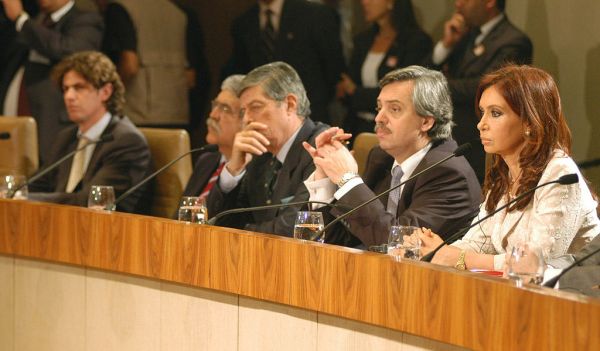
From right to left, Cristina Fernandez de Kirchner and Alberto Fernandez, and other ministers

From right to left, Cristina Fernández de Kirchner, Alberto Fernández, and other ministers / Wikipedia / Creative Commons / https://es.wikipedia.org/wiki/Archivo:Ministros_de_Cristina.jpg

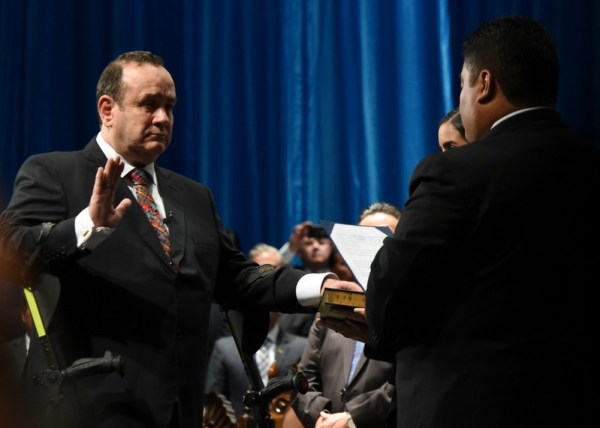
The inauguration of Argentine President Alberto Fernández and Vice President Cristina Fernández de Kirchner last week confirms that the pronouncements of the death of Latin America’s “left turn” were premature — and that, rather than turning in any clear direction, political winds in the region appear to be blowing in all sorts of directions, with the only discernible underlying pattern being anti-incumbent votes following periods of economic crisis or economic downturns.

  • Obituaries for the “left turn,” which started in 1998 with the election of Hugo Chávez in Venezuela, have been appearing for years, particularly since the election of former President Mauricio Macri in 2015 and other right-leaning politicians in the region. Macri was widely seen as a bellwether of a broader “right turn” in the region — a turn that spread to Brazil, Chile, and elsewhere. For the very first time since the country’s democratic transition, a right-wing political party, in alliance with other parties, gained national power via democratic elections. To avoid the fate of other non-Peronist presidents, none of whom were able to finish their terms of office, Macri built a national coalition with broad societal bases of support.
  • The victory of left-Peronism in October, however, was formidable. The team of Fernández and Fernández obtained 48.1 percent of the votes, well above the 40.3 percent of the incumbent Macri. With two antagonistic camps capturing almost 90 percent of the vote, the elections were probably the most polarized since Argentina entered its democratic transition in 1983.

Rather than represent systemic shifts to either the right or left, the Fernández-Fernández victory is further evidence that Latin American electoral politics follow a routine alternation-of-power explained by retrospective, anti-incumbency voting driven by broad societal discontent — a sharp repudiation of incumbents that couldn’t deliver growth, adequate social services, and security. The left-right axis in Argentina is marked by high levels of polarization, with two major rival coalitions — Peronists and non-Peronists — structuring the electoral supply and disputing the center.

  • The defeat of Macri and his Cambiemos coalition revealed the center-right’s failure to carry out its desired free-market reforms aimed at dismantling the statist economic model based on the domestic market, wide social protections, and state intervention in the economy. Macri’s coalition lacked the unity to achieve pension reform and other difficult measures. Instead, Macri resorted to a “gradualism” that did not work in policy terms or politically. Similarly, his conciliatory approach to foreign creditors did not result in the expected capital inflows and economic growth. That fiscal gradualism was financed with a high rate of external indebtedness that made the Argentine economy even more fragile and ended in a massive financial crisis, after which the Macri government changed its approach towards greater economic orthodoxy.
  • The legacies of the previous Kirchnerist governments, including constraints on the government’s ability to cut spending, were also severe obstacles. Trade unions and social movements retained a high mobilization capacity and blocked attempts to remove state protections, effectively blocking labor reform and other Macri priorities. Once the government lost access to international credit and asked the IMF for a bailout — the largest in IMF history — it began to lose the support of social sectors that had been important to its rise, including business and large segments of the middle-class.

Center-left Peronism may also be unable to escape the left-right alternation. Widely discredited a few years ago and seen as a retreating force, especially due to corruption allegations and mismanagement, it kept strong connections with its societal core not only through the memory of the good old days of redistributive policies associated with the commodity boom, but also because there was no major shift in the political orientation of its main leader, Cristina Fernández. She broke with the conventional wisdom of Peronism that would have anticipated more leadership pragmatism and ideological eclecticism. As in the past, it has made promises that may eventually undermine its popular support.

  • The Fernández-Fernández formula will look and govern differently than it did during the Kirchnerist governments. It will be a broader center-left coalition formed by the Peronists and backed by a wide array of progressive parties and movements. But in addition to facing a hostile regional and global environment, Fernández will face many domestic challenges in a society that accumulated so many pressing demands during the ongoing Argentine economic crisis. Fernández inherits extraordinarily high levels of debt, soaring inflation, and rapidly rising unemployment and poverty levels. The “honeymoon” period, as some of his allies openly say, will be short, and Macri’s Cambiemos is likely going to provide strong opposition. The new government will unlikely escape the routine alternation-of-power dynamics explained by anti-incumbency voting in contexts of deep economic crises after the end of the “commodity boom,” strong inflationary pressures, and broad societal discontent. Polarization and mood swings are likely to remain persistent features of Argentine politics.

 December 17, 2019

*Santiago Anria is Assistant Professor of Political Science and Latin American Studies at Dickinson College. He is the author of When Movements Become Parties: The Bolivian MAS in Comparative Perspective (Cambridge University Press, 2018). Gabriel Vommaro is Full Professor of Political Sociology at the National University of San Martín and Researcher at CONICET. His most recent book is La Larga Marcha de Cambiemos (Siglo XXI Editores, 2017).

Brazil: Will Lula Shake Things Up?

By Fábio Kerche*

lula

Former Brazilian President Lula Da Silva/ Flickr/ Creative Commons/ https://bit.ly/2TxyFJ7

Former Brazilian President Lula da Silva — out of prison but not acquitted of his alleged crimes — is stirring up the country’s political debate, but he faces tough challenges reestablishing his leadership and revitalizing his party, the Workers’ Party (PT).

  • After serving 580 days of a 12-year sentence, Lula was released from prison earlier this month when the Supreme Court ruled that, under the Brazilian Constitution, one can be imprisoned only after judicial appeals have been completed. The court did not explicitly say that prosecutors rushed Lula to prison in order to remove him from the presidential race that led to President Bolsonaro’s election in October 2018, but a number of Brazilian legal experts believe that to be the case. The good news for Lula is that the majority of the Brazilians support his release — 54 percent, according to Datafolha, Brazil’s most important survey center.
  • Even though he is out of prison, Lula will not be able to run for office again unless his previous convictions in lower courts are annulled or overturned by higher courts — which could take a long time. (The electoral law specifies that someone convicted at two different levels of the judiciary cannot run for office.) The former president is apparently hoping that leaks published last June by The Intercept revealing allegedly inappropriate contacts between prosecutors and the judge on Lula’s case, Sérgio Moro, are reason to overturn his convictions. Prospects of such a reversal appear poor, however, because Moro, currently Bolsonaro’s Justice Minister, has a clear incentive to put Lula back behind bars, and observers say he retains considerable influence in the Judiciary.

In the short and medium term, Lula’s strategy appears to be to erode the Bolsonaro Administration’s support and lay the groundwork for his own party’s next campaign, in next year’s municipal elections. His freedom allows him to travel around the country, make political talks, and build alliances.

  • His most ardent supporters remain loyal; he still has strong backing at a popular level; and still projects formidable charisma, according to many observers. While some of his speeches since his release have been more aggressive, his current political drive signals that he will seek to broaden alliances beyond the left.
  • But Lula faces huge political challenges. There are signs that his influence has diminished in recent years thanks to his legal baggage and economic mistakes made by the administration of his successor, former President Dilma Rousseff. Some is also due to unrelenting attacks on him and the PT by the media —portraying him as a radical. Splits in the left, including the lack of an identifiable candidate to replace Lula in the 2022 elections, are also a vulnerability.

Brazil has changed since Lula was arrested: Temer was president; the PT led in the polls; the economic elite’s candidate was from the Social Democracy Party (PSDB), and Bolsonaro was not widely considered a viable candidate. Lula’s challenges as he tries to rebuild his image and his party are huge. An immediate one is an effort by some members of Congress to modify the law that protects defendants from prison until all appeals have been heard, except if the defendant poses a threat to society or investigations. The goal is put Lula in prison again, to reduce his influence in the political game. For a number of jurists, however, this modification would be considered unconstitutional.

  • Next year’s local elections will be the first big test of Lula’s ability to negotiate widely and reorganize opposition to Bolsonaro, win control over the government in major cities, and prepare a PT alternative in the 2022 presidential election.
  • Bolsonaro is not without problems. His popularity is suffering due to the economy — high unemployment, low quality of jobs offered, and very low growth — and some unpopular policies, such as tougher rules for retirement. The president and his sons retain a major edge in social media, but Datafolha this week reported that 36 percent of respondents classified Bolsonaro’s government as “terrible.”

Lula’s best hope seems to convince the Brazilians that the corruption charges were political constructions by his adversaries — a tough task — and that PT and its allies can restore the pace of economic growth obtained during his administrations. Next year’s local elections are key for this project.

December 12, 2019

* Fábio Kerche is a professor at UNIRIO and IESP-UERJ in Rio de Janeiro. He was a CLALS Research Fellow in 2016-2017.


El Salvador: Draft Budget Confirms Structural Problems in Public Finance

By ICEFI and CLALS*

US banknote lot

U.S. Banknote Lot/ Creative Commons/ https://www.pxfuel.com/en/free-photo-jqchd

The budget that President Nayib Bukele submitted to El Salvador’s Legislative Assembly in September increases much-needed social spending appropriate for the country’s current socio-economic context, but it lacks clear objectives and benchmarks — and fails to address ongoing structural problems in public finance.

  • The proposed budget is based on revenues of US$5.466 billion, 92.7 percent of which will come from taxes. In gross terms — without considering tax rebates — that amounts to a tax burden of 18.2 percent of GDP, just below the 18.3 percent that ICEFI estimates for 2019. In net terms, the budget claims taxes will reach 18.1 percent of GDP (compared to 17.7 percent in 2019), but that figure is not realistic: it estimates tax refunds of only $16.5 million — compared to $117.4 million for the January-August period of this year. This error threatens to undermine serious Legislative debate.

Spending in the proposed 2020 budget reaches $5.774 billion — equal to 20.8 percent of GDP, compared to 22.3 percent estimated for 2019. Some areas that are already struggling, such as environmental programs, face significant cuts, while others will experience modest decreases and increases.

  • According to the draft, Central Government operating costs will decrease by 1.8 percent of GDP, driven by cuts in contracting of services and purchase of goods as well as in current transfers. Capital expenditures, on the other hand, will increase 0.3 percent over 2019 — that is, about 3.3 percent of GDP.
  • The Central Government’s spending on social development is slated to grow to its highest level in decades — about 10.5 percent of GDP ($2.921 billion), compared to 9.7 percent this year. The main beneficiaries of the increase will be municipal governments, pension systems, trusts for social security, and health care. With some 800,000 children and adolescents lacking schools to attend, the proposed increase in the education budget — from 3.73 percent (in 2019) to 3.75 percent — is minimal.

The budget anticipates a slight increase in the federal deficit. The non-financial public sector, including trusts to cover social security obligations, will experience a deficit of 3.1 percent of GDP (compared to the 2.7 percent that ICEFI estimates for 2019) — pushing total public debt to 70 percent of GDP. That’s less than the 70.7 percent estimated for 2019, but ICEFI cautions that the decline could easily evaporate as the government faces growing demands over the course of the year. Either way, debt servicing will remain the most significant item in the 2020 budget, reaching $1.102 billion (4 percent of GDP).

The perennial challenge that El Salvador’s leaders like their counterparts throughout the region  face is how to stimulate economic growth and reduce inequalities to make the state more democratic and effective. But this budget, if implemented as drafted, will achieve neither goal in politically significant ways. The fiscal data underscore that the fundamental structural problems low revenues, inadequate public spending, and high fiscal deficits and public debt remain unaddressed.

  • The increase in capital spending, while positive, is insufficient to have its desired impact of driving economic growth. ICEFI’s analysis indicates that the jump in social spending is certainly warranted by the growing unhappiness in various social sectors, but also falls far short of what’s needed to reverse ongoing negative trends. The cuts in environmental protection from a minuscule 0.07 percent of GDP (2019) to 0.05 percent seem outright foolish for a country that has already shown vulnerabilities, which could aggravate existing economic and social conditions. Rather than taking on the serious challenges El Salvador and its economy face, the 2020 draft budget kicks the can down the road, without credible expectation that the task will be easier in the future.

December 9, 2019

* The Instituto Centroamericano de Estudios Fiscales conducts in-depth research and analysis on the region’s economies. Data and charts supporting this article can be found by clicking here. This is the third in a series of summaries of its analyses on Central American countries.

Bolivia: Prospects for Post-Evo Transition

By Robert Albro*

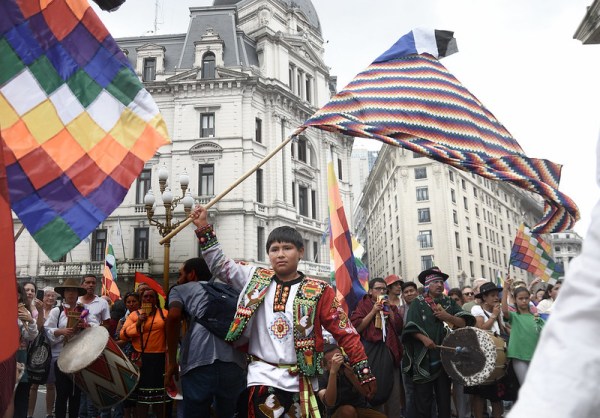
Crowd march with boy holding the pan-indigenous flag

March in favor of Evo Morales /Flickr/ Creative Commons/ https://www.flickr.com/photos/santiagosuburbano/49098960458/

Bolivia’s streets have been calmer in recent days, but actions by self-proclaimed President Jeanine Áñez have raised legitimate concerns about what sort of transition Bolivians face after the almost 14-year presidency of Evo Morales. The protests, marches, and violence that have characterized the aftermath of the disputed presidential election on October 20 have left at least 33 people dead – including 30 since Áñez took office and soon thereafter issued a presidential decree (since rescinded) giving security forces immunity from prosecution when engaged in restoring “order.” While Áñez has claimed she is a caretaker whose only charge is to organize new elections within 90 days, she has not behaved like one.

  • Previously an obscure backbencher and opposition senator from an inconsequential political party representing remote Beni, Áñez had planned to retire from politics at the end of her term. Her position as second vice-president of the Senate was largely ceremonial, with little control over budgets. Down the list of constitutional succession, she became acting president only after multiple Morales administration officials resigned.
  • Although unelected and lacking a mandate, Áñez has taken a series of decisive steps to undo Morales’s legacy. A conservative Christian and Morales critic, she has proclaimed Bolivia a “Catholic country” and disparaged its Indigenous majority as “irrational.” She has surrounded herself with a cabinet composed of like-minded critics from Bolivia’s eastern lowlands. This region includes the departments of Santa Cruz, Tarija, Pando and Beni, together often called the Media Luna (Half Moon), and is the heartland of economic elites whose political power was substantially diminished by Morales’s rise. In 2008 the Media Luna was for months in open revolt against Morales and his government, contending for control of the country’s considerable natural gas revenues. Often cast in racist terms, these elites consistently and categorically rejected Morales’s presidency.

As interim president, Áñez has replaced the military’s leadership, cabinet ministers, and heads of major state-owned companies with her own appointees. She reestablished ties with Washington, severed relations with Venezuela, kicked out Cuban doctors working in the country, and is considering Bolivia’s withdrawal from the largely-defunct UNASUR. Áñez has not sought conciliation with lawmakers from Morales’s MAS party, who still command a legislative majority. Instead, seeming to turn to the playbook of the country’s and the region’s dictatorial past, her administration has accused Venezuela and Cuba of supporting subversive groups in Bolivia, threatening to prosecute former government officials now in hiding and to charge MAS lawmakers and journalists critical of her policies with “sedition.”

These moves do not bode well for an orderly electoral do-over. Luis Fernando Camacho, the Santa Cruz civic committee leader who has emerged as Áñez’s vocal and controversial far-right supporter, already seems to be in campaign mode, despite his scant political credentials. Political moderate and second-place finisher in last month’s election, Carlos Mesa, appears to be largely sidelined. Morales himself has been legally barred from participating, and MAS, while still a political force in Bolivia, lacks an obvious figure to replace him. Meanwhile, Áñez and the far-right cabal gathering around her appear to be gearing up for hardball politics, although they lack legitimacy among Morales’s supporters and the many citizens who might have grown tired of Morales but view with alarm the actions and tone of the new caretaker government. The election may be technically wide open, but Bolivia’s far-right appears intent on seizing this opportunity to restore its influence.

  • By alienating the country’s Indigenous majority and exacerbating latent ethnic and class tensions, while signaling a commitment to reverse the gains made during the Morales years, Áñez is setting up conditions for a period of intense social conflict. If present trends continue, it is hard to imagine that in 90 days, and perhaps for a lengthy period thereafter, Bolivia won’t again experience more paroxysms comparable to what it has endured since October’s contested election.

December 6, 2019

* Robert Albro is the Research Associate Professor at CLALS.

Honduras: Facing the Budget Challenges?

By ICEFI and CLALS*

Honduran Lempiras

Honduran Lempiras/ Alex Steffler/ Flickr/ Creative Commons

Honduras’ proposed budget for 2020 reduces support to the country’s most needy – while protecting the military and security agencies – and, particularly if the debate on priorities is not made more inclusive, risks exacerbating already high political tensions and chronic economic mismanagement. On the revenue side, the draft budget shows a drop in tax revenues from 18 percent of GDP in 2019 to 16.5 percent – which, ICEFI has found, is not justified by technical analysis of the circumstances. Government spending – excluding payment on the national debt but including transfers to funds and trusts – equaled 19.7 percent of GDP, compared to 21.5 percent in 2019. (ICEFI estimates that the average government spending in Central America in 2019 will be 18.5 percent.) This drop will affect most public entities, particularly in social spending.

  • Education faces deep cuts. The budget of the Secretariat of Education, for example, will drop from 4.85 percent of GDP in 2019 to 4.49 in 2020. Transfers to public universities are slated to be reduced 23.1 percent from 2019 levels, and scholarships are also on the chopping block – cut 27.5 percent for national and 37.5 percent for international scholarships.
  • Health spending in Honduras – the country with the highest poverty rates in Central America – will decline from 2.39 percent to 2.37 percent at a time that inflation is more than 4 percent. The budget for Infrastructure and Public Services will be hit hardest – cut from 0.82 percent of GDP to 0.40 percent. Capital expenditures or investment will decline 33.5 percent year on year, including 38.5 percent from machinery and equipment and 34.6 percent for construction.
  • One of the only government sectors seeing increases is in the military and security, according to ICEFI. The 2020 budget proposes a 39.6 percent increase from 2019 on military and security equipment.

At first glance, the budget would appear to produce a surplus in 2020 of about 0.4 percent of GDP, which is double that ICEFI estimates for 2019. But factoring in the transfer of resources to the funds and trusts – a more reliable way of tracking fiscal behavior – the deficit will actually be 1.5 percent of GDP. That’s lower than ICEFI’s estimate of the deficit this year (1.9 percent), but it is achieved at the expense of the wellbeing of a majority of the Honduran population.

If approved and implemented as proposed, the budget will set back several strategic goals that the Honduran government itself has set. The budget confirms the government’s desire to reduce the public deficit principally through cuts to social spending and some capital expenditures – even though the approach contravenes commitments made under the UN Convention of the Rights of the Child and General Comment No. 19 (2016) on public budgeting for the promotion of children’s rights, which establishes that states should not deliberately adopt regressive measures that undermine child’s rights.

  • Although some provisions of the budget in principle could expand production of goods and services, they do not clearly point to either social inclusion, especially in terms of gender, age, and ethnicity. Budget allocations dedicated to attention to women are very low, equaling barely 0.19 percent of all spending. Neither does the budget focus on achieving any particular Sustainable Development Goals (SDGs).

The transparency and inclusiveness of the budget debate in the Honduran Congress will be crucial to determining the longer-term impact of this budget on human rights and the provision of public goods and services to the most vulnerable Hondurans, including children, adolescents, and women. Executive and Congressional decisions on the budget will shift the country’s path toward prosperity and governance – or continue down a path of instability and tension. More breaks for those capable of paying taxes, while cutting essential services to those who cannot, will be a step in the wrong direction. At a minimum, Honduran leaders should demonstrate the benefits of such moves will outweigh the costs. The legitimacy and effectiveness of the Honduran budget will depend on a broad, inclusive, and honest debate.

November 26, 2019

* The Instituto Centroamericano de Estudios Fiscales conducts in-depth research and analysis on the region’s economies. This is the second in a series of summaries of its analyses on Central American countries.

Costa Rica: Public Finance Plans are Not Sustainable

By ICEFI and CLALS*

President of Costa Rica Carlos Alvarado Quesada

Carlos Alvarado Quesada, President of Costa Rica, April 2018/ Wikimedia Commons/ Public Domain/ https://es.wikipedia.org/wiki/Archivo:Carlos_Alvarado_Quesada_CAQ_PAC_03.jpg

The Costa Rican government’s draft budget for 2020, presented to the Legislative Assembly on August 30, reveals that shortfalls in tax revenues, high deficits, and accelerated public debt endangers the country’s ability to continue its social services and maintain its traditional level of democratic governability. The fiscal reforms that Costa Rica has undertaken – Law 9635 on Strengthening Public Finances – have proven, at best, insufficient to correct the imbalances envisioned in the new budget.

  • The budget proposes a tax burden of 13.2 percent for 2020 – equal to that observed in 2018 before the tax reforms were implemented but below ICEFI’s estimate for the end of 2019 (13.5 percent). This rollback is alarming because it essentially erases the gains expected from the reforms. It is due to increased levels of tax evasion and avoidance, and illicit capital flows.
  • The government projects public spending to reach 8,475.5 billion Colones (US$14.0 billion), accounting for 22 percent of GDP – slightly below the 22.1 percent approved for this year but higher than ICEFI’s estimate for the end of 2019 (20.9 percent). The 2020 proposal implies cuts to public spending that will affect key ministries, including Education and Public Works and Transportation, the budgets of which will decline 1.4 and 0.4 percent from this year, respectively.

Costa Rica’s fiscal deficit poses another long-term challenge. The draft budget contemplates a deficit that would reach 7.8 percent of GDP, higher than ICEFI’s estimate of 6.1 percent for 2019. For Costa Rica’s fragile public finances, this would suggest an inability to achieve fiscal sustainability in the medium term despite the recent tax reform.

  • The proposed budget would grow national debt to 64.7 percent of GDP in 2020, which is double the debt level observed during the earlier years of the decade (29.9 percent).

The failure of the tax reform law underscores Costa Rica’s urgent need for a fiscal accord that responds to the challenges of economic growth, social development, and democratic governance. To avoid such a scenario, tax officials will have to devise and implement plans and strategies next year that will stop and reverse the steady loss of the Executive’s ability to collect taxes. The cuts to education, public works, and transportation could erode Costa Rican well-being. Public budgets reflect the priorities of a society, and both the Executive and Legislative authorities in San José have the obligation to expand debate to include input from affected sectors. Costa Rica will face even greater challenges if it fails to formulate a budget that includes a responsibly progressive tax regime; reduction in tax evasion and under-reporting; greater control over illicit capital flows, adoption of a principle of worldwide income; increase fiscal transparency and accountability, debt restructuring, and maintenance of spending levels that guarantee adequate universal services. 

November 18, 2019

* The Instituto Centroamericano de Estudios Fiscales conducts in-depth research and analysis on the region’s economies. This is the first in a series of summaries of its analyses on Central American countries.

The OAS and the Crises in Bolivia and Chile: Power Politics and Inconsistencies

By Stefano Palestini Céspedes*

Protests in Chile, October 2019

Protests in Chile, October 2019/ Carlos Figueroa/ Wikimedia Commons/ https://es.wikipedia.org/wiki/Archivo:Protestas_en_Chile_20191022_07.jpg

As political crises emerge one after the other in Latin America, the Organization of American States (OAS) is showing inconsistent behavior based on ideological rifts and power politics. This inconsistency – evidenced by the OAS’s role in the ongoing crises in Bolivia and Chile – undermines its mandate to protect human rights and democracy throughout the hemisphere.

In Bolivia, violence spread in the streets of various states after the opposition accused incumbent President Morales of manipulating the results of the October 20 elections. The OAS Electoral Mission reported possible irregularities, and both the Permanent Council and the Secretary General pressed the government to authorize an audit of the electoral procedures and a vote recount. Morales consented to both requests.

  • The same accusations of electoral irregularities were made two years ago in the Honduran presidential election, but a coalition of states headed by the United States swiftly recognized President Hernández – delegitimizing the OAS electoral mission and the Secretary General’s call for new elections. Those same countries have now pressed Morales, first for a recount of votes and later for new elections. When the OAS Electoral Mission confirmed the existence of electoral irregularities on November 10, the Bolivian military withdrew support for the government, prompting Morales’s resignation – an outcome radically different from that in Honduras.
  • Despite political violence and recurrent accusations by Morales of unconstitutional alterations to the constitutional order voiced by the Bolivian foreign minister at the OAS headquarters, neither the Secretary General nor OAS member states invoked the Inter-American Democratic Charter. President Morales did not explicitly invoke the Charter, thinking that the crisis would follow the same course as in Honduras, or that the military remained supportive. Either way, he was wrong.

In Chile, in contrast, the police have engaged in systematic violations of human rights since an unprecedented social uprising that started on October 18. Twenty-three people have been killed, 1,950 have been injured, and 180 have suffered eye injuries from rubber bullets fired upon protesters by police – many losing their sight. The Inter- American Commission on Human Rights issued a declaration regarding the violations of human rights during the State of Emergency imposed by President Sebastián Piñera in the aftermath of the uprising. But the OAS political bodies have remained silent.

  • Neither Secretary General Almagro nor the Permanent Council have issued a single declaration of concern or condemnation regarding the situation in Chile. Almagro has refrained from convening the Permanent Council or the General Assembly, but he has loudly claimed the existence of destabilization attempts organized by Cuba and Venezuela (which he called “Bolivarian breezes”). To be sure, issuing such a statement without providing evidence or convening the political bodies of the organization jeopardizes the credibility of the OAS and breeds conspiracy theories. In a recent interview, President Piñera also subscribed to the thesis of foreign intervention in Chile’s protests without providing any evidence. The Chilean Attorney General confirmed that the government has not provided any information about the action of foreign groups.

The inconsistency displayed by the OAS in the handling of the political crises in the region suggests that the OAS applies different standards to similar situations. In fact, the organization is split into two coalitions: a larger and stronger one composed of right-wing governments that embrace or accept the foreign policy of U.S. President Donald Trump based on a revival of the Monroe Doctrine; and a smaller, weaker one composed of states with leftist and centrist governments with an anti-imperialist or a non-interventionist rhetoric.

  • Breaches of democracy and human rights violations exist on both sides of the rift, but the OAS political bodies seem to focus only on the side that happens to be weaker. This is bad news for those that would like to see in the OAS an honest broker and mediator in political crises, no matter the ideological color or the power of the concerned state. If this trend continues, it is also bad news for the protection of human rights and democracy and for multilateralism in the region.

November 11, 2019

* Stefano Palestini Céspedes is an assistant professor at the Institute of Political Science, Catholic University of Chile.

Latin America: Total Chaos?

By Carlos Malamud*

47389747662_9be46749b5_z

South American Presidents waving to the cameras in Santiago, Chile / Flickr / Creative Commons

Democracy and democratic values are in crisis throughout South and Central America, but the causes – and solutions – vary across the region, with rays of hope that at least some countries will find their way forward. The Bolivian elections, plagued by suspicions of fraud, reflect some of the problems that affect all of Latin America. The previously unbeaten President Evo Morales, in government since 2006, has now shown his limits and, even if his election is confirmed, will govern without the parliamentary majorities he enjoyed in the past.

  • Latin America witnessed violent protests almost simultaneously in Ecuador and Chile; Mexico blinked during a confrontation with the son of narcotics kingpin Chapo Guzmán; the Congress was dissolved in Peru; an ex-President in the Dominican Republic denounced as fraudulent the primary election he lost and joined another party to be its candidate; and a massive exodus continued pouring out of Venezuela, whose crisis is terminal but without an expiration date.
  • The Argentine and Uruguayan elections on October 27 marked the end of a three-year cycle of elections during which 14 countries voted to elect or re-elect their presidents. Speculation was originally that a swing to the right would counteract the Bolivarianism of the previous swing to the left. That shift never happened. In its place, a more heterogeneous and divided Latin America emerged, reflected in the outcome of the Argentine and Uruguayan elections, and in the not-insignificant fact that Mexico is governed by Andrés Manuel López Obrador while Brazil, the other regional power, has Jair Bolsonaro.

The causes of this wave of divisiveness are the subject of different theories. Many observers speak of a Castro-Chavista conspiracy, orchestrated by Venezuelan President Nicolás Maduro and the leftist São Paulo Forum. Others think it’s a popular reaction to the drastic adjustment programs of the IMF. Yet others argue about a contagion factor and the impact of social networks, which enable real-time communication and the transfer of vivid images of events. Nonetheless, any theory that tries to harness all of these theories will be flawed because each national reality is responding to different logic and dynamics.

  • All of the countries of the region are experiencing inequality, poverty, corruption, violence and narco-trafficking, unhappiness with democracy and its institutions, rejection of politicians, and the impact of the “new politics” of social media and fake news. But they are not present to the same proportions.
  • Neoliberal, Bolivarian, and populist governments are all suffering from rebellions. The Chilean protests over transportation fees under neoliberal President Piñera were preceded by protests in Brazil in 2013 under progressive President Dilma Rousseff. If Piñera resorts to military force to stop the protests, Nicaraguan President Daniel Ortega did something similar in 2018, killing more than 300. The IMF might have been behind the reduction of fuel subsidies in Ecuador, but it had no role in Chile. While elections went as normal in Argentina and Uruguay, in Bolivia, like in Venezuela, the allegations of fraud have been constant.

The solutions to each country’s challenges will have to be as different as their causes. While one country needs deeper economic adjustment, another needs to fix its political institutions. Each is going to have to find its way through the crises. Latin America will find little solace, moreover, in the fact that this high level of conflict is not exclusive to its region. From Hong Kong to Cataluña, or in Libya and Lebanon, similar challenges are disrupting national life.

  • Amid the many indications that representative or liberal democracy is under direct attack – that we may be facing the end of an era with potentially dire implications – some positive notes are visible in Latin America. In addition to the orderly contests in Argentina and Uruguay, the local and regional elections in Colombia in late October were an effective exercise in democracy – won by the center and lost by the extremes. Uribismo on the right and Gustavo Petro on the left were the big losers. The emerging symbol was Claudia López, the first woman elected mayor of Bogotá, who is also a lesbian, environmentalist, and leader against corruption. The path ahead is certainly not going to be easy for Latin America, but there is evidence that, with a big dose of tolerance and respect for each other’s reality, Latin Americans can do a lot better.

November 5, 2019

* Carlos Malamud is Senior Analyst for Latin America at the Elcano Royal Institute and Professor of Latin American History at the Universidad Nacional de Educación a Distancia (UNED), Madrid. A version of this article originally was published as Turbulencias latinoamericanas in El Clarín of Buenos Aires.

Latin America: Grappling with Environmental Displacement

The Honduran refugee caravan crowds a bridge in October 2018

Honduran Refugee Caravan/ October 21, 2018/ Flickr/ Creative Commons/ https://www.flickr.com/photos/boyitchy/31600503428/

By Robert Albro*

Latin America and its faith-based organizations, seeking to expand the definition of refugee beyond just people forced to leave their countries in the face of political persecution, are making slow but steady progress promoting policies that deal with the increasingly serious issue of human displacement as a consequence of environmental change.

  • Since 1951, a large majority of Latin American countries have enshrined the right to asylum in their national constitutions, and the region emerged in the 1980s as a leader in efforts to broaden international standards for refugees and migrants. In 1984, the Cartagena Declaration on Refugees, for example, enlarged the concept of refugees to include people “who have fled their country because their lives, safety, or freedom have been threatened by generalized violence.” A series of conferences organized by the UN High Commissioner for Refugees (UNHCR) produced further breakthroughs during conferences in San José and San Salvador, including rights-based criteria involving, for example, gender and indigenous identity.

Over this decade, the coincidence of surges in migration from the “Northern Triangle” of Central America and international action on the environment – including Pope Francis’s 2015 encyclical on climate change, Laudato Si – have encouraged reassessment of the traditional distinction between “refugee” and “migrant.” Among similar initiatives in the Andean region, in 2014 Bolivia’s migration law introduced legal protections for “groups of people displaced from one country to another for climate reasons, when there exists a risk to life, as a result of nature, environmental, nuclear or chemical disaster, or famine.” What to do about people displaced across international borders as a result of life-threatening rapid-onset natural disasters has become an increasing focus of attention.

  • Discussions in conjunction with the Framework Convention on Climate Change (UNFCCC) – a major component of the 2016 Paris Accord – have given new momentum to addressing environmental migration. Participants called for greater understanding of “climate change induced displacement, migration, and planned relocation,” even though emphasis in multilateral deliberations has shifted to “disasters” and away from “climate change.” 
  • Observers have credited Latin American church groups – as “specialists in the language of ethics” and “sources of moral authority” – with playing an important role in normative deliberations during the UNFCCC processes. A hemispheric dialogue led by the Organization of American States, called the “Protecting Our Home” initiative, was jointly launched with the Holy See after the Pope’s encyclical.

Faith-based responses both to environmental conflict and to the plight of migrants have been significant. Religion’s impact upon international deliberations regarding environmental migration is likely to continue growing as long as religious values are translatable to secular humanitarian efforts. Even when members of religious communities are lumped in with the rest of “civil society,” their emphasis on moral values, their ability to intervene on behalf of affected populations, and their role as service providers serve them well as proponents of efforts to include victims of environmental disaster and climate change as deserving recognition and support from governments and the international community. The “moral authority of faith leaders” is also less about the introduction of alternative moral valuations than a strategic advantage in efforts to gain access to and build trust with victims of humanitarian emergencies. 

  • There is, however, an additional role that faith-based actors have yet to embrace as the international response to increasing numbers of environmental migrants evolves. As multilateral deliberations increasingly consider “loss and damage” as a result of environmental disasters, including climate change, they are unsurprisingly limited to accounting for the loss of livelihoods and material assets, such as farms or homes. To date, little attention has been given to the consequences of non-economic or intangible loss, including loss of community identity, social cohesion, and traditional knowledge. Religion’s focus on moral and cultural questions of meaning and value make it a potential resource in coming to terms with the consequences of intangible loss. 

November 1, 2019

* Robert Albro is the Research Associate Professor at CLALS.

Latin America: Freelance Journalists are Essential but Vulnerable

By Bill Gentile*

Bill on patrol with the Sandinista Army in the northern mountains of Nicaragua in the 1980s.

Gentile on patrol with the Sandinista Army in the 1980s/ Backpack journalism – copyright Bill Gentile

Freelance journalists are at the center of covering many of the most important news stories in Latin America but face increasing threats to their security and well-being. Tough economic realities and competition from the internet have forced most traditional U.S. and European media to close their bureaus across the region since the 1980s. Whereas maintaining a bureau may have cost $250,000 a year (and double that for a TV production team), these companies can now get reporting from freelancers for a small fraction of that cost. Consumers of news in and outside Latin America have become steadily more dependent on unaffiliated journalists for information on key developments.

  • Prize-winning journalist Jason Motlagh, for example, is a freelancer who has done groundbreaking stories on gang activities in El Salvador, even accompanying specialists exhuming the bodies of murder victims whose families yearn to give them proper burial. Independent reporter Frank Smyth has covered violence in Central America, and in Colombia he uncovered that U.S. counter-narcotics aid was being diverted to death squads run by Colombian military intelligence. Ioan Grillo has explored tunnels under the U.S.-Mexico border through which drugs and humans are smuggled. Stories such as these are rarely, if ever, reported by the “legacy media” that used to have full-time staffers in the region.

Although news consumers outside Latin America depend on them for ground truth, the freelancers lack the infrastructure and protections of their brethren in staff media positions. They hire local “fixers” to navigate complex places and gain situational awareness, but they depend mostly on their wits – and luck – to survive. Many report feeling exploited.

  • Security is their top concern. Criminal groups target any reporter looking into their activities, and freelancers – who often have the depth, language, and ideals to cover them aggressively – pose a particular threat. When journalists working as staff for traditional media have been kidnapped, their companies have helped get them released – something that freelancers can only dream of. Protection from governments is important too. The Committee to Protect Journalists has reported that 75 of the 251 journalists arrested for their work in 2018 were freelancers.
  • Some companies’ tendency to pay late, or never, is another problem. Even journalists with strong track records report having been assigned stories, submitting them on time, and then waiting months for payment. Overdue fees of up to $60,000 are not unheard of. Because of declining budgets, even excellent reporters working for serious news outlets have been forced to change careers.

Despite these trying conditions, freelancers still do solid journalism that supports the interests of the countries in which they work and the international community. But fairness dictates that the media who use them and the consumers of their news, including Latin America watchers like us, support ways to better protect them and their jobs. Some organizations, such as the Pulitzer Center on Crisis Reporting, provide assistance to reporters. The London-based organization ACOS Alliance is trying to “embed a culture of safety” throughout the industry. Its “Freelance Journalists Safety Principles” have been endorsed by nearly 100 news organizations, but the code lacks an enforcement mechanism. Some freelancers have proposed forming a trade union, but the mechanisms for binding media to contracts will be difficult to establish. The elements of a solution are not beyond reach, however. The staff foreign correspondent, representing a powerful media organization in North America or Europe, may be a dying breed, but the truth that they seek to report is not.

October 29, 2019

*Bill Gentile, a veteran news reporter, teaches journalism at American University. His video series, FREELANCERS with Bill Gentile, is available on multiple platforms including iTunes, Amazon, Video On Demand and Google Play.