
Honduras Adopting Failed Counternarcotics Model?

The rapid escalation of operations by U.S. and Honduran military and counterdrug teams against suspected drug-traffickers transiting Honduras suggests that Washington has persuaded Tegucigalpa to follow Mexico’s footsteps with a predominantly military strategy against the cartels.  The New York Times has published reports on the deployment of binational teams – patterned after U.S. operations in Iraq and Afghanistan – in remote areas of Honduras to disrupt clandestine aircraft dropping off Colombian cocaine for shipment by river to the north coast and then northward to the United States.  The aircraft, weapons, advisors, trainers, and intelligence used by the “Tactical Response Teams” are all provided by Washington.  U.S. Ambassador Lisa Kubiske said the Honduran units are “eager and capable partners in this joint effort.”

The units claim to have intercepted tons of cocaine, but the operations have also stirred up controversy.  In one operation near the northeastern town of Ahuas in May, a response team killed four citizens, including two pregnant women.  Although the circumstances of the victims’ presence in the area are not entirely clear, the mayor has protested the U.S.-inspired tactics, and local indigenous groups issued a statement that “declared these Americans to be persona non grata in our territory.”  One June 23, a DEA agent shot and killed a man during a raid in northern Honduras when the suspect reportedly pulled a gun on him.

This military-intensive strategy has yielded some 60,000 dead in Mexico – with negligible impact on cartel operations – and in Honduras, where institutions are much weaker, the violence probably will be proportionally even higher.  The U.S. Ambassador’s confidence in Honduran units notwithstanding, the military’s human rights record – never stellar – has steadily worsened since the coup that removed President Manuel Zelaya in June 2009.  Vetting units and keeping them clean when institutions are so weak and vulnerable to corruption and protecting operatives’ identities in Honduras’s “small-town” society all argue for an approach different from that which has failed in Mexico.

Washington Politics: Fast and Very Furious

Photo by Ryan J. Reilly via Flickr, using a Creative Commons license

The operation codenamed “Fast and Furious” remains a hot topic in Washington two years after it went awry.  Conducted by the Bureau of Alcohol, Tobacco and Firearms and Explosives (ATF), the operation was intended to monitor the flow of weapons – through a “controlled delivery” – from Arizona gun dealers into the illegal channels by which tens of thousands of arms clandestinely enter Mexico each year.  Tracking the arms would allow the U.S. Government to disrupt the network.  However, ATF lost track of the weapons – and they reached their intended buyers.  The failure was made worse when traces showed that two of the weapons were used to kill a U.S. Border Patrol agent near the Mexican border in December 2010.

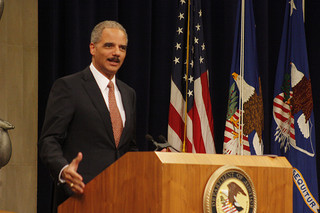
While both political parties in Washington have expressed disappointment, the Republicans have made the failed operation the centerpiece of efforts to weaken Attorney General Eric Holder (ATF is an agency of the Department of Justice, over which the Attorney General presides) and to discredit President Obama, according to numerous press reports.  The vote in the House of Representatives last week [[June 28]]to find Holder “in contempt” – for not handing over all of ATF’s internal documents on Fast and Furious that the Republicans demanded – was a party-line vote.  Many Democrats walked out of the chamber.

The political maneuvering around Fast and Furious has nothing to do with foreign policy, but the weakening of ATF undermines what modest efforts were under way to stanch the flow of illicit arms into Mexico and Central America.  “Controlled deliveries” are a standard operation for intelligence and law-enforcement agencies, and every agency involved in border issues has suffered similar mistakes.  ATF is the smallest such agency (2,500 special agents compared to FBI’s 13,400 and DEA’s 5,500) and is therefore more vulnerable to the internecine backstabbing.  In addition, ATF’s enforcement of laws relating to the use, manufacture, and possession of firearms often puts it at odds with American politicians who feel the agency threatens their interpretation of the gun rights under the Second Amendment of the U.S. Constitution.  The attacks on the ATF appear intended to weaken enforcement of U.S. law and embarrass the Attorney General and the President.  The obstacles to a sound policy of limiting the flow of weapons into Latin America are evidenced by the virulence of the debate over Fast and Furious.

The Demise of Partnership?

Graphic: Summit of the Americas organization; public domain.

The real news at the Summit of the Americas in Cartagena, Colombia, in April was the dissonance between the Obama administration – with its sincere but content-free rhetoric of partnership – and Latin American leaders across the political spectrum, even among the friendliest.  This was in sharp contrast to the Summit in 2009, when the region was palpably excited about the new American President.  This year, press reports portrayed President Obama as unaware that the hemisphere is changing, and noted that he oddly said that criticism of U.S. policy was reminiscent of the Cold War, while he put himself out on the fragile limb of defending a Cuba policy rooted in, precisely, the Cold War.

Most observers in the region judge that the main takeaway from Cartagena is that while Washington offers little and listens less, Latin America is moving away.  Over the past decade South America has sustained rates of economic growth higher than any since before the oil shock of 1973, and the U.S. is hardly an unchallenged source of trade and investment.  (Chinese and EU trade with South America has surpassed that with the United States.)  Chavez’s aid to Cuba and Nicaragua far exceeds Washington’s meager offerings to even best friends like El Salvador.  The Brazilian National Development Bank, BNDES, provides more loans in the region than the World Bank and Inter-American Bank combined.

Americans’ fascination with the Cartagena prostitutes dwarfs interest in the lessons of the serious regional dynamics that played out in the Summit.  Whether U.S. political leaders and pundits acknowledge it or not, failure to dialogue seriously with neighbors about the 50-year effort to change the Cuban regime or the failure of the 40-year “War on Drugs” will have consequences for the United States.  Washington rejects the region’s efforts to re-think issues, such as the wisdom of the current approach to narcotics, at its peril.  Central America was an unhappy front-page story in the 1980s and now threatens to reemerge as a major headache because of domestic crime (fueled by U.S. deportations) and the drug trade – while Washington fiddles with time-worn formulas and programs.  The Obama Administration still has time to make good on its pledge of “partnership” and get serious about listening to and working with our neighbors.