
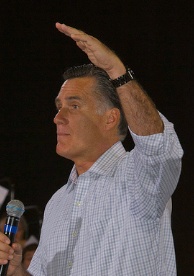
Photo by: Starley Shelton | Flickr | Creative Commons
Although Latin America has not been an issue in the U.S. presidential campaign, Republican presidential contender Mitt Romney has stated multiple times that he would promote hemispheric trade agreements. In the second debate, he said, “I’m also going to dramatically expand trade in Latin America. … I want to add more free trade agreements so we’ll have more trade.” Romney did not specify, however, with which partners he would conclude trade agreements. (A request to the Romney campaign for more information has not been answered.) President Barack Obama did not comment on Romney’s promise, suggesting the president’s lack of focus on the region or calculus that voters simply don’t care. Under Obama, the United States ratified pacts with Colombia and Panama, negotiated during the Bush administration. The U.S. already had FTAs with Central America and the Dominican Republic, Chile, Mexico, and Peru.
While that would seem to leave a number of large economies, nearly all of them are unlikely partners. The most important remaining economies – Brazil, Argentina, Venezuela, Uruguay, and Paraguay – are part of the Mercosur trading bloc. Washington has refused to negotiate with them as a group, and the group prohibits members from signing bilateral accords. Meanwhile, Venezuela, Bolivia, Nicaragua, Ecuador, Cuba, and several Caribbean nations have joined together specifically to counter U.S. proposals for free trade in the hemisphere. The few remaining countries have tiny trading relations with the United States.
The idea of adding FTAs in Latin America looks quixotic. Nevertheless, that is hardly an excuse for failing to improve trade relations short of comprehensive agreements. There are important opportunities to deepen the United States’ most important trade relations with Canada and Mexico, as AU Professor Robert A. Pastor has argued. Moreover, if the United States is willing to use the Andean Trade Preferences Act as a tool for development instead of a cudgel against Latin Americans it considers wayward, it could expand trade in ways that benefit all parties. Likewise, trade problems have become outsized irritants in U.S. relations with Brazil and Argentina – to say nothing of the broader implications of U.S. “trade policy” with Cuba. These problems have largely festered under Obama, and Romney’s promises of free trade agreements do not seem a serious proposal to correct them.


 AULA Blog