U.S.-Mexico: Trump’s Misguided Approach to NAFTA Renegotiation

By Robert A. Blecker*

Three people stand at podiums with flags behind them

Canadian Foreign Minister Chrystia Freeland, U.S. Trade Representative Robert Lighthizer, and Mexican Minister of Economy Ildefonso Guajardo (L to R) participate in the fourth round of NAFTA negotiations in Washington, DC in October 2017. / State Department / Flickr / Creative Commons

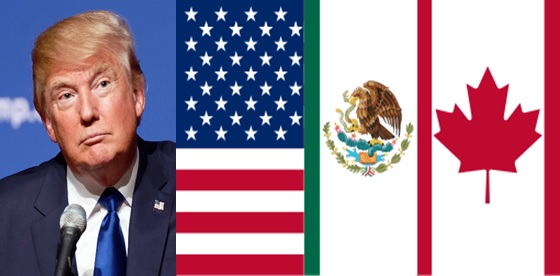
President Trump has characterized NAFTA as a “win” for Mexico and a “loss” for the United States; his administration is currently working on a renegotiated “deal” that would allegedly reduce the U.S. trade deficit and recapture lost manufacturing employment, but his nationalistic approach fails to recognize the fundamental causes of both U.S. and Mexican economic problems.  In fact, NAFTA was a huge success for President George H.W. Bush and his administration, as it achieved their fundamental goal of enabling U.S. corporations to make products in Mexico with low-cost labor – without fear of expropriation, regulation, or other loss of property rights – and export them to the United States duty-free.  The Mexican government went along because it thought NAFTA would bring in desperately needed foreign investment and provide a growth stimulus, while U.S. and Canadian workers rightly feared that they would lose jobs as a result.  While much discussion has focused on which country “won” or “lost” in NAFTA, that is the wrong way to evaluate a trade agreement.  The two key criteria for judging the accord are which sectors, groups, or interests won and lost in each country, and how it, in conjunction with other policies, has affected long-term growth, development, and inequality in each.

  • Under NAFTA, U.S.-Mexican trade in goods and services has grown exponentially, reaching $623 billion (with a U.S. deficit of $69 billion) last year. However, NAFTA (along with other causes and policies) has contributed to worsening inequality in both the United States and Mexico.  Less-skilled U.S. workers definitely lost, with wage losses up to 17 percent in local areas most exposed to NAFTA tariff reductions.  In Mexico, although consumer gains from trade liberalization were widespread, upper-income groups and the northern region benefited the most.  Real wages for Mexican manufacturing workers have stagnated since 1994.  Labor shares of national income have fallen in both countries since the late 1990s.
  • Domestic policies, exchange rates, financial crises, and the impact of China can make the impact of NAFTA difficult to identify, but effects in some sectors are clear. Mexico gained jobs in automobiles and parts, appliances, electrical and electronic equipment, and seasonal produce.  The United States gained in basic grains, soybeans, animal feed, and paper products.  Although about a half million jobs in automobiles and related industries have “moved” to Mexico, total U.S. job losses in manufacturing (5 million since 2000) have been much more affected by China and technology than by Mexico.  What Trump’s nationalistic rhetoric ignores is that U.S. companies capitalized on these dislocations to raise their profit margins and increase their bargaining leverage over workers and governments both within North America and globally.

Trump’s aggressive posture about NAFTA exploits political discontent with these sectoral effects and the overall worsening of inequality, but the U.S. Trade Representative (USTR)’s key demands in the renegotiation appear unlikely to remedy either problem.  USTR Lighthizer is focused on protection for the auto sector, by requiring higher U.S. content (or higher wages for Mexican auto workers), and on changes to dispute resolution procedures that would favor investment in the United States instead of in Mexico.  At best, these measures could bring back a small number of U.S. jobs; at worst, they could make some U.S. industries less competitive (if costs increase).

All of this debate in the United States ignores the fact that NAFTA has been a huge disappointment for Mexico.  Although export industries like automobiles have prospered, the gains to domestic sectors of the Mexican economy have been limited, resulting in sluggish growth (only 2.5 percent per year since 1994, far below the 7.6 percent achieved in East Asia) and leaving millions in poverty while millions more emigrated to the United States.  Of course, other policies and events (including Chinese competition) played into these outcomes, but NAFTA (and related liberalization policies) didn’t turn out to be the panacea for the Mexican economy that then-President Carlos Salinas promised in 1993.  Yet, in the short run the Mexican economy remains highly dependent on foreign investment and exports to the U.S. market, so Trump’s demands for a revised NAFTA and his threats to withdraw are undermining Mexico’s current economic prospects.  Instead of following Trump’s nationalistic approach, the three NAFTA members should focus on making all of North America into a more competitive region with rising living standards for workers in all three countries.  This would start with policies at home, such as public investment in infrastructure, education, and R&D, that could foster industrial growth, along with redistributive measures like higher minimum wages consistent with each country’s economic conditions.

May 11, 2018

* Robert A. Blecker is a Professor of Economics at American University.
Canada and Mexico Face Uncertainty of NAFTA Renegotiation

By Daniela Stevens*

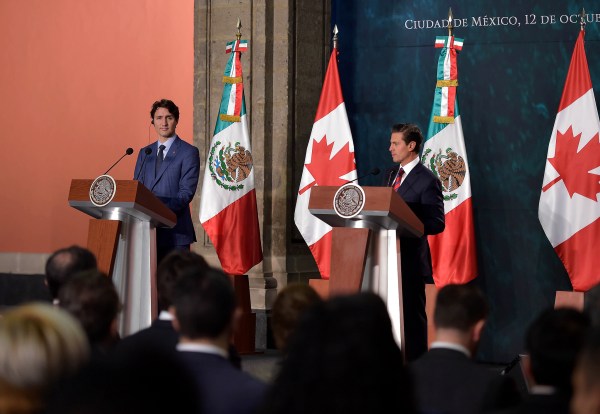
Two men stand at podiums with Mexican and Canadian flags behind them

Canadian Prime Minister Justin Trudeau gives a presentation with Mexican President Enrique Peña Nieto during an official visit to Mexico in October 2017. / Presidencia de la República Mexicana / Flickr / Creative Commons

Facing the growing possibility that the Trump Administration is walking away from the North America Free Trade Agreement (NAFTA), Mexico and Canada are beginning to look for trading partners beyond the United States.  The interdependencies binding the three are strong.  Both Mexico and Canada have deep commercial ties with the United States, which imports about 80 percent of Mexico’s exports and about 70 percent of Canada’s.  Both have significant leverage vis-à-vis the United States as well.  U.S. auto and agriculture industries have a major stake in free trade with Mexico, which also provides important cooperation on security issues and controlling Central American migration.  Liberalization measures within the energy sector by the current Mexican administration make Mexico a strategic partner in terms of energy security.  Canada buys about 19 percent of U.S. exports.

But these ties are fraying as conversations drag on.  Trump Administration proposals are hurting the talks; especially contentious are changes in the “rules of origin” (since the United States proposed increasing the U.S. content of autos to 85 percent from the current 62.5 percent) as well as the inclusion of a “sunset clause” that would make NAFTA expire unless it is renegotiated every five years.  NAFTA’s Article 2205 lets either of the three member countries announce its withdrawal from the accord with six months’ notice.  Canadian and Mexican trade officials have not given such notice yet, but they show signs of heading in that direction.  Both have held high-level meetings with counterparts from South America and Europe, according to official and non-government sources.

  • Mexican President Peña Nieto’s administration has expressed a preference for leaving the negotiations over accepting “a free trade agreement that ceases to promote free trade.” President Trump has said that his administration would be willing to negotiate a free trade agreement with Canada alone if the NAFTA talks fail.  However, Canadian Prime Minister Trudeau’s government has stated a preference for keeping the trilateral alive rather than resorting to bilateral agreement, since the terms of the U.S.-Canada deal were more outdated than the NAFTA’s.  The two presidents have been reluctant to take these actions because they apparently believe, as do many experts, that dismantling NAFTA would inevitably create uncertainty and inefficiencies for the three economies.  For example, the auto sector relies on three-way product flows that move several times across borders to be assembled into finished products.  Canadian and Mexican auto parts makers have a direct stake in each other’s dealings with the United States.  Even small duties would add up.
  • Nonetheless, some increased trade and a bilateral free trade agreement between just Mexico and Canada is possible. The two countries originally joined NAFTA to protect their access to the U.S. market, not to obtain access to each other’s.  Canadian public opinion and media reflect continued disinterest in Mexico, which is viewed as unstable due to drug-related criminality and corruption.  However, as the completion of a satisfactory NAFTA renegotiation is unlikely, Canadians are exploring deepening the bilateral link.  Mexican interest in Canada is also growing, according to some specialists.  Beyond North America, moreover, Canadians and Mexicans are exploring trade and investment diversification.  Canada is looking for increased cooperation with Latin America, in particular within the Pacific Alliance, a free trade partnership that includes Mexico, Chile, Peru and Colombia, and of which Canada is already Associate Member.  Mexico started a renegotiation last January of its free trade agreement with the European Union, which parties hope to finalize in the next few days.  It has begun warming up neglected ties with the Southern Cone and has already pledged to deepen ties with China.

Trade experts convened recently within the framework of American University’s Robert A. Pastor North America Research Initiative (NARI) were unanimous that that a trilateral agreement that protects the interests of all three partners would be the optimal outcome, but few observers of the NAFTA talks are confident that the Trump Administration will soften its position.  Canada’s commitment to a trilateral renegotiation should exert more pressure on the U.S. to compromise while strengthening both Canada and Mexico’s negotiating positions.  In the event of U.S. withdrawal from NAFTA, however, the two can expand their trade and investment relationship by lowering barriers further through modernization and e-commerce.  In addition, trade can potentially expand between the two since they have similar approaches to achieving various commitments of the Paris Accord involving energy projects and greenhouse gas emissions reductions.  Pastor Scholars concluded that both countries will have to carry out public campaigns to explain to their constituencies the benefits of continued cooperation, either trilateral or bilateral, if the United States significantly alters or abandons NAFTA.  Mexico and Canada have options outside North America in the quest for trade and investment diversification – even though their preferred scenario is a stronger NAFTA.  China, South America, and the European Union arise as the most readily available partners.

December 21, 2017

*Daniela Stevens is a Ph.D. Candidate in the American University School of Public Affairs and a Pastor Scholar.  Her research focuses on national and subnational policies that put a price on carbon emissions.

What Will Trump Do About NAFTA?

By Malcolm Fairbrother*

trump-nafta

U.S. President-elect Donald Trump and the flag of the North American Free Trade Agreement (NAFTA). / Flickr and Wikimedia / Creative Commons / Modified

Despite his campaign rhetoric repeatedly attacking the North American Free Trade Agreement, U.S. President-elect Donald Trump probably won’t touch it, except in superficial ways.  He has called NAFTA the “worst trade deal ever,” and promised to pull the U.S. out unless Mexico and Canada agree to renegotiate it.  Last week, he suggested renegotiation of NAFTA will include provisions for Mexico to repay the U.S. government for the wall he wants to build along the border.

Dismantling or even significantly rewriting the accord is unlikely for a couple reasons:

  • First, the billionaires, chief executives, and friends he is choosing for his cabinet are hardly people inclined to dismantle an agreement whose contents largely reflect what American business wanted from the U.S.-Mexico relationship when NAFTA was being negotiated in the early 1990s. Corporate preferences weighed heavily against any big deviation from the status quo after the last political transition in Washington, in 2008.  Barack Obama too said that “NAFTA was a mistake,” though his criticisms were a little different.  He railed against lobbyists’ disproportionate influence over trade policy, and promised big changes to international trade agreements, including better protections for workers and the environment.  Even so, he didn’t touch NAFTA, and the Transatlantic Trade and Investment Partnership (TTIP) and the Trans-Pacific Partnership (TPP) he negotiated included – like NAFTA – shady provisions for investor-state dispute settlement.
  • It would be near-impossible, or least massively expensive, to get what Trump seems to want most: a big drop in imports from Mexico. In his eyes this would make NAFTA a better deal for America, though of course serious economists disagree.  Realistically, reopening the agreement would be very messy, and if he tried to throw up massive new trade barriers business leaders would strongly object.  NAFTA could include some additional measures to make it easier for goods and/or people to get around among the NAFTA countries, but that’s not what Trump has promised.

His economic nationalism makes the Republican Party establishment squirm, but it’s clear it also helped Trump win several Midwestern states, tipping the electoral college in his favor.  Insofar as agreements like NAFTA entrench rules friendly to business, and generate market efficiencies and economies whose benefits accumulate in the hands of the few, voter hostility is no mystery.  But economics is only part of the reason.  The bigger issue is what the backlash against globalization – embodied also by Brexit and the rise of neo-nationalist parties in Europe – means more broadly.  The average Democratic voter has a lower income than the average Republican voter, but Democrats are more supportive of trade agreements because they are more internationalist, more open to other cultures, younger, more educated, and more urban.  Throughout his presidency, Trump will therefore be squeezed between his working class rhetoric – appealing to the distrustful – and his business class milieu.  He is an extreme case of the politicians’ mercantilist thinking on trade, wherein exports are good and imports are bad, and “trade deals” like NAFTA are somehow like deals in the business world, where it’s possible to out-negotiate someone.  The reality is that this thinking – which flies in the face of basic economics – doesn’t point to any clear course of action.  This is why Trump won’t actually do much about NAFTA.

January 10, 2017

* Malcolm Fairbrother is social science researcher and teacher/mentor in the School of Geographical Sciences at the University of Bristol (UK).  This article is adapted from a recent blog post for the American Sociological Association.

Mexico and NAFTA: Lessons Learned?

By Robert A. Blecker*

Photo credit: Alex Rubystone / Foter / Creative Commons Attribution-NonCommercial-ShareAlike 2.0 Generic (CC BY-NC-SA 2.0)

Photo credit: Alex Rubystone / Foter / Creative Commons Attribution-NonCommercial-ShareAlike 2.0 Generic (CC BY-NC-SA 2.0)

Twenty years after the North American Free Trade Agreement (NAFTA) went into effect, it is clear that the promises made by Mexican President Carlos Salinas and U.S. President Bill Clinton – that the accord would make Mexico “a first-world country” and halt the migration of Mexican workers to the United States – have not been fulfilled.  In Salinas’s famous words, Mexico would “export goods, not people.”  But the number of undocumented Mexican immigrants in the United States rose by a conservatively estimated 3 to 4 million during the first two decades of NAFTA, and millions more were apprehended at the border and deported.  The reasons why immigration flows accelerated post-NAFTA are not hard to discern.

  • NAFTA fostered integration of Mexican industries into global supply chains targeted at the U.S. market, accelerating Mexico’s transformation into a major exporter of manufactured goods.  Nearly one million manufacturing jobs were created there in the first seven years of NAFTA (1994-2000).  But this job growth was offset by similar job losses in agriculture, and manufacturing employment has fallen by about a half million since 2001.  The net increase in manufacturing employment from 1993 to 2013 was only about 400,000, less than half of the annual growth in the Mexican labor force.
  • Real hourly earnings in Mexican manufacturing were no higher in 2013 than in 1994, and Mexico’s per capita income has stagnated relative to that of the United States.  In 2012, typical Mexican manufacturing workers received only 16 percent as much per hour as their U.S. counterparts, down from 18 percent in 1994.  Even adjusted for the lower cost of living, workers without a college degree in Mexico still earn only about one-quarter to one-third of what they can earn by moving to the United States.

The benefits of NAFTA for Mexico have been attenuated by several factors.  First, Mexican export industries still largely follow the maquiladora model of doing assembly work using imported inputs, so their value-added is only a fraction of the gross value of their exports and they have few “backward linkages” to the domestic economy.  Second, the Mexican government has frequently allowed the peso to become overvalued, making Mexico less competitive and driving multinational firms to locate in other countries.  Third, the tremendous penetration of Chinese imports into all of North America (Canada, Mexico and U.S.), especially since China joined the World Trade Organization in 2001, has displaced significant amounts of actual or potential Mexican exports.  A revaluation of China’s currency, rising Chinese wages and increasing global transportation costs have recently led to some “reshoring” of manufacturing to Mexico, but employment in Mexican export industries has grown only modestly as a result.

The increased integration of North American industries through NAFTA has proved to be a mixed blessing for Mexico.  U.S. booms have helped Mexico grow, but only for temporary periods, and being dependent on the U.S. market has held Mexico back since the U.S. financial crisis of 2008-2009 and the ensuing “Great Recession” and sluggish recovery.  Of course, NAFTA is but one of Mexico’s constraints.  The country’s restrictive monetary and fiscal policies, frequent currency overvaluation, monopolization of key domestic markets and inadequate investments in physical and human capital have also held it back.  The Mexican economy still suffers from a profound dualism, in which only about one-fifth of all non-agricultural, private-sector workers are employed in large, highly productive firms, while the vast majority are employed in small- or medium-sized enterprises with low, stagnant or even falling productivity.  Mexico’s experience under NAFTA certainly argues against portrayals of international trade agreements, such as the proposed Trans-Pacific Partnership, as panaceas for the economic ills of Mexico or any other country.  Whatever one thinks of the “reform” agenda of President Enrique Peña Nieto – which is focused on areas such as energy, education, and telecommunications – these reforms are unlikely to help Mexico break out of its slow growth trap if the foundations of the country’s trade and macroeconomic policies remain untouched.

*Dr. Blecker is a professor of economics at American University.