As Mexico “Absorbs” Central American Refugees, Record Numbers Reach the U.S.

By Dennis Stinchcomb

uac-family-unit-apprehensions_aula-01

The meeting of world leaders that President Obama convened on Tuesday to rally support for refugee resettlement and inclusion across the globe was good diplomacy but contradicts Washington’s policies even in the Americas.  At a meeting on the margins of the UN General Assembly, Obama thanked Mexico for “absorbing a great number of refugees from Central America,” yet the data make clear that Mexico is hardly absorbing refugees.  During the first seven months of 2016, as WOLA has reported, Mexico granted asylum to just under 1,150 Central Americans but deported over 80,000 others.  Meanwhile, far greater numbers of Central Americans have reached the U.S., principally women with children (whom U.S. Customs and Border Protection labels “family units”) and minors traveling without a guardian (“unaccompanied children”).  With one month remaining in Fiscal Year 2016, apprehensions of Central American women with children total over 61,000 – up 79 percent from FY15 – and are on pace to surpass the FY14 record.  Likewise, apprehensions of unaccompanied children have already exceeded the FY15 total, and September numbers will likely push the current tally of 42,000 just shy of the FY14 record.

This renewed influx comes despite the Obama administration’s multi-pronged strategy to deter unauthorized migration from the Northern Triangle countries of El Salvador, Guatemala and Honduras:

  • U.S. support for Mexico’s Southern Border Program has resulted in unprecedented numbers of both detentions and deportations of Central Americans in Mexico, yet the dramatic increases in arrivals to the U.S. and shifting points of entry – including an upswing in seaborne trafficking – suggests that the exodus from the Northern Triangle continues and that human smugglers have adapted to stepped-up enforcement measures by forging new routes through Mexico.
  • Ongoing raids by U.S. Immigration Control and Enforcement (ICE) authorities, which under the banner of Operation Border Guardian aim to roundup unaccompanied youth who had been ordered deported from the U.S. and have recently turned 18, have not stemmed the tide of new arrivals fleeing untenable circumstances in their countries of origin.
  • Despite a July 2016 expansion of the CAM Program for in-country processing of youth applications for refugee status and for others in Central America asserting that they are at risk of harm, the pool of beneficiaries remains miniscule. Whereas the program had received 9,500 applicants by mid-year, only around 270 had been resettled in the U.S. With a six- to eight-month processing period and room for only 200 applicants at a time at shelters that have been set up in Costa Rica, desperate Central Americans continue to turn to more efficient human smugglers.
  • Public messaging campaigns launched in the region with U.S. government funding, to warn Central Americans of the dangers involved in irregular migration and to dispel misperceptions regarding U.S. immigration policies, also appear fruitless, as outlined in a recent American Immigration Council report).

President Obama’s efforts to galvanize international action in response to forced displacement worldwide highlight his own administration’s shortcomings in addressing refugee flows closer to home.  Expedited hiring of border patrol agents and an increase in the number of beds at contract detention facilities, among other domestic measures, have enabled the administration to process large volumes of Central American migrants while avoiding the appearance of a “border crisis” akin to 2014.  Meanwhile, an emphasis on curtailing outflows from Central America (without regard to the justification of people’s decision to flee), detention (rather than absorption) in Mexico, and deportation in both Mexico and the U.S. has not been matched with analogous investments to address the needs of Central American migrants already in the U.S. who may have legitimate claims for asylum or other forms of protection.  Central American families and unaccompanied children, for example, now account for over one-fourth (26 percent) of the 512,000-case backlog in immigration courts, yet only 53 percent of families and 56 percent of unaccompanied minors have access to attorneys.  In failing to guarantee legal representation for these vulnerable populations the administration is sidestepping the same moral obligation to thoroughly vet and provide safe, inclusive communities for refugees that President Obama challenges other governments to fulfill.  Perhaps funding that is supporting Mexico’s strategy of detention and deportation could be better allocated to programs that ensure proper adjudication of asylum claims – in both Mexico and the U.S. – and to genuinely seek to absorb individuals and families who, through due process, are judged to qualify as refugees.

September 22, 2016

Mexico: Environmental Initiatives Likely to Stir Things Up

By Daniela Stevens*

mexico-environment

Mexico City’s Reforma axis under a blanket of smog / Lars Plougmann / Flickr / Creative Commons

Mexico has made a big push on climate issues over the past month that could have far-reaching consequences internally and in the hemisphere.  On August 16, it announced a pilot Emission Trading System (ETS), also known as “cap-and-trade,” that will begin a simulation in November and officially initiate trading carbon permits in 2018.  Two weeks later, at the second Climate Summit of the Americas (CSA), the Mexican federal government signed a joint declaration with the Canadian provinces of Ontario and Québec to advance “cooperation activities on carbon markets.”  Mexico’s motives are not immediately clear.  For a middle-income nation, with annual growth (around 2 percent) compromised by the crash in oil prices, an ETS represents a potentially significant economic burden.  Mexican officials have not explained, moreover, how they might link their cap-and-trade to the Canadian provinces’ systems and to the Western Climate Initiative (WCI), North America’s largest carbon market and the second largest in the world.

The moves may be driven by increasing Mexican belief that more assertive, market-oriented approaches are necessary to meet its international commitments.

  • Mexico is dependent on fossil fuels for over a third of its total energy production, wreaking havoc with the country’s air quality. Over the last few months, Mexico City decreed several “environmental contingencies,” situations of abnormally high concentrations of ozone in the atmosphere.
  • Moreover, Mexico may be seeking the advantage that increased regional cooperation represents. Its international commitments on emission reductions are very ambitious, and a linkage to its North American partners lends itself almost as a natural solution to help in the advancement of its pledges.  Mexico could export sectoral offsets that American and Canadian partners need – contributing to Mexican revenues and to market stability.  Mexico would also benefit from the resulting transfer of information expertise, technology, training, and methodologies.
  • An important first step for the Mexican authorities would be to commit the resources to establish the robust institutional mechanisms and capacities to launch, monitor, enforce and sustain a system as intricate as a national ETS, and only after that, lend itself as a reliable partner in an internationally linked market.

The details of the pilot ETS have not been publicized, and the agreement with Québec and Ontario does not establish commitments beyond “identifying opportunities for linking systems as much as possible.”  Mexican companies already voluntarily buy and sell carbon bonds on a small national market – a system complemented by a carbon tax in place since 2013 – but an enforced and internationally linked market would highlight the disparities among the North American nations – and represent a challenge to Mexico.  Unlike its partners, Mexico is still an industrializing nation, with a thriving motor vehicle industry, and industrializing nations have traditionally been reluctant to pricing emissions.  Industrialized countries are the highest historical emitters and reached that status of development by polluting without paying the price.  Although the need to prioritize economic growth does not exempt Mexico from fulfilling its commitments as the eleventh highest global emitter, it does signal that besides opportunities, Mexico faces challenges with trading partners at different stages of development.  The Climate Summit of the Americas showed, however, that regional fora and of subnational partnerships can further environmental commitments beyond the global and national summits.  The CSA signaled an opportunity for the region to develop North American or, more ambitiously, hemispheric solutions to climate change.

September 15, 2016

* Daniela Stevens is a PhD candidate in the American University School of Public Affairs.  Her research focuses on national and subnational policies that put a price on carbon emissions.

Mexico: Repressing Organized Dissent

By Marcie Neil*

Mexico teacher protest

A photo from the protest on June 19. Credit: LibreRed / Google / Creative Commons

The Mexican government’s latest reaction to the country’s largest teachers union’s challenge to education reform is triggering accusations of gross human rights violations at a time that President Enrique Peña Nieto is already under severe pressure over the case of the missing 43 students from Ayotzinapa, even if the union’s reputation – and the government’s historical demonization of it – may undercut the teachers’ cause.  Protesters associated with the Coordinadora Nacional de Trabajadores de la Educación (CNTE) clashed with state and federal police in Nochixtlán, Oaxaca, on June 19, leaving eight dead, more than 100 wounded, and at least 25 detained.  The clashes culminated a series of CNTE-led protests over a 2013 reform that puts the onus on teachers for student success through government-mandated tests and teacher evaluations – akin to the U.S. “No Child Left Behind Act.”  CNTE members consider the reform disconnected from the realities of teaching in Mexico’s underprivileged, indigenous, and rural environments, and view it as a threat to their collective decision-making authority and hard-won benefits from the 1980s and 1990s.

  • The CNTE denounced Nochixtlán as another example of excessive police force, and press reports and citizen testimony have refuted the President’s claim that police met protesters unarmed. The administration subsequently offered to meet with union leaders to discuss the reform, but it was seen as offering too little too late.

The CNTE is not the country’s most respected institution, but its complaints about the brutal police reactions to its protests have merit and have stimulated a national debate on Mexico’s commitment to human rights.  The union’s reputation has been tarnished by repeated disruption of school schedules, internecine strife, recent arrests of leaders on corruption charges, and a recently eliminated, but oft-cited, benefit that allowed union members’ children to inherit their jobs regardless of merit.  But the state’s implicit culpability in the disappearance of the 43 students in Ayotzinapa and the death toll on June 19 seems to have tipped the perceptions of its dispute with the state momentarily in favor of CNTE.  That dispute and others with popular organizations have deep roots – going back to mobilizations in the 1960s, including the Tlateloco Massacre in 1968, and the brutal repression of a 2006 teachers strike in Oaxaca.  The historical pattern is one of state abuse against mostly harmless citizens who feel denied democratic participation.

The Peña Nieto administration’s reactions thus far do not suggest a desire to break with that pattern, even in the face of public outrage over this month’s killings.  The Mexico representative of the United Nations High Commissioner for Human Rights and others have called for an independent investigation into the Nochixtlán violence, but the government’s stonewalling of the Ayotzinapa investigation suggests these attempts at overcoming impunity face dim prospects.  Education Minister Aurelio Nuño’s statement the day after the confrontation confirming the government’s commitment to uphold the education reforms further fueled public anger.  Absent an independent evaluation, the bloody events of June 19 could remain as evidence that the Mexican government is simply unwilling to overcome its historical tendency to attack those it considers subversive. 

July 1, 2016

* Marcie Neil received her Masters in Latin American Studies at American University in 2015 and served as a Graduate Assistant at the Center for Latin American and Latino Studies.

Mexico: Deepening Credibility Crisis

By Fulton Armstrong

Buitrago GIEI

Expert Angela Buitrago during the presentation of the initial GIEI report last October. Photo Credit: Comisión Interamericana de Derechos Humanos / Flickr / Creative Commons

Last week’s report on the disappearance of 43 Mexican students from the tiny village of Ayotzinapa left many questions unanswered about events on the bloody night of September 26-27, 2014, but it left no doubts about the depth of the corruption at the local and national level swirling around the youths’ tragic deaths.  The Mexican government – recipient of more than $2 billion in U.S. security assistance in the last eight years – not only produced a bogus report last year, based on tortured and otherwise impugnable sources, to divert attention from the tragedy; it also actively impeded the work of the Interdisciplinary Group of Independent Experts (GIEI), operating under the aegis of the Inter-American Commission on Human Rights, that produced the new report.  GIEI members documented the witness-tampering, obstructionism, and overall lack of cooperation of the administration of President Enrique Peña Nieto.  As the public presentation of the report wrapped up, the massacre victims’ families and supporters – some holding signs demanding to know ¿Dónde están?” – made clear their fear that the government will again sweep the case under the carpet and chanted to the experts, ¡No se vayan!”

Many details of the kidnapping, torture, and execution of the 43 youths, who were studying to be teachers, probably will never be known because much of the evidence has been tainted or destroyed.  The GIEI, however, pieced together a largely verifiable explanation of events in which local police, Federal Police, and the Army went on a bloody rampage after the students commandeered buses, as they had on other occasions with the tolerance of their owners, to transport classmates to a protest the following day.  The authorities tracked the students’ movements, set up roadblocks, systematically terrorized them, and summarily executed those who escaped and tried to tell of the atrocities.  The cover-up started immediately, culminating four months later in a report by the Office of the Attorney General (PGR) – one of Washington’s closest partners in curbing narcotics-related crime and violence – falsely claiming the students were mixed up in struggles among narcotraffickers.  The GIEI demonstrates that there is no way a serious PGR investigation did not know otherwise.

  • International and domestic reaction to the report has been strong, but Peña Nieto’s reaction has been low-key. (He also made headlines last week in proposing the decriminalization of marijuana.)  In several Tweets, the President thanked the GIEI; promised that the PGR will “analyze the complete report to improve its investigation of the tragic events”; and pledged that the PGR “will continue working so that there is justice.”  The U.S. Department of State issued a statement saying that “we trust the Mexican authorities will carefully consider the report’s recommendations.”

Peña Nieto cannot escape personal responsibility for the scandalous cover-up and obstructionism – he promised a full accounting long ago – but the GIEI report indicts much more than the presidency.  From the rural police and Army officers on the scene to the highest levels of law enforcement and the military command in Mexico City, the violence against the students has been neither admitted, condemned, nor punished, reinforcing Mexico’s longstanding culture of impunity.  The PGR’s report was tainted by deliberate falsehoods as well as the vicious forms of torture employed to exact false testimony from “witnesses.”  (Other torture stories, including an incident in which the Minister of Defense apologized for Army and Police torture of a woman in prison, are increasing in frequency.)  The U.S. Department of State’s human rights report, released two weeks ago, criticizes Mexico for its “impunity for human rights abuses,” but Washington also needs to ask whether the $2.1 billion of “Mérida Initiative” assistance it has provided to “help Mexico train and equip its law enforcement agencies, promote a culture of lawfulness, [and] implement key justice reforms” has been a good investment.  The U.S. Senate has finally confirmed the new U.S. Ambassador to Mexico, one of the architects of State Department’s implementation of the Mérida Initiative, and it stands to reason that she will demand some accountability.

May 2, 2016

El Chapo’s Recapture: A Fictionalized Reality Show

By Núria Vilanova*

Chapo Kate Penn Film

Photo Credit: Abd allah Foteih, Fanpage.- & Sachyn Mital – (modified) / Flickr & Wikipedia / CC BY-SA 3.0

A recent interview granted by Mexican drug kingpin El Chapo and his subsequent re-arrest validate yet again the observation of Mexican writer Carlos Fuentes that no matter how hard fiction strives to emulate reality, reality always surpasses it.  Narco-lives and deeds have attracted myriad fiction writers, filmmakers, and musicians giving way to a successful narco-literature and narco-cinema that has fascinated the general public, journalists, and scholars alike.  A recent example is the popular Netflix series Narcos, based on one of the most notorious drug traffickers, Pablo Escobar.  Well known also are the corridos in Northern Mexico that sing the adventures and prowess of powerful drug lords (often in exchange for large payments).  The narco-corridos are today the epical portrayal of criminal lords whose lives straddle glory and vileness.

In the interstices between reality and fiction rest the publicity-mongering and recapture this month of Joaquín “El Chapo” Guzmán, the subject of an intense six-month manhunt following his escape last July from a high-security prison.  No film would have been sufficiently credible and convincing had it attempted to stage El Chapo’s flight, but the reality is that the most prominent narco-lord since Escobar was able to vanish through a highly sophisticated tunnel whose construction required great engineering expertise.  The final seconds of his stay in his cell before entering his path to freedom were recorded by a security camera.  Megalomania – his eagerness to have his life and deeds taken to the big screen – apparently led to his undoing.  He reached out through intermediaries to soap-opera and film actress Kate del Castillo, whose role as narcotress in the popular show La reina del sur apparently captivated his heart, to set up a meeting with Hollywood star Sean Penn to present his version of his reality to the world.  Playing the role of an adventurous and intrepid journalist, Penn produced a 10,000-word report-interview for Rolling Stone magazine.  Thus, the three main characters of this story – El Chapo, Kate del Castillo, and Sean Penn – traveled from reality to fiction and back in a fictional-yet-real encounter.  The three characters straddled between two dangerous dimensions in complicity – reality and fiction – unaware that their secret meeting would somehow provide the clue that enabled Mexican security to shut El Chapo down again.

The reality-fiction play brings a much higher toll than just El Chapo’s return to prison.  Dozens of the corrido singers who extol the narcos’ lifestyle have been kidnapped, tortured, and killed in Mexico since the late 1990s.  Mexico is also at the international forefront on the number of journalists assassinated since 2006, when former President Calderón launched a bloody (and failed) war on drugs.  While the Mexican actress has not made any substantial comments on her apparent role in El Chapo’s return to prison, Penn has blustered his innocence as a courageous journalist-star whose mission was to make his countrymen reflect and make a self-critique of the bloodthirsty, futile war on drugs.  We, the audience, would probably wish this reality show would have brought about a less trivial outcome, but the last episode is not yet written.

January 25, 2016

* Núria Vilanova is Assistant Professor and Associate Chair of World Languages and Cultures.

Mexico’s Petroleum Sector: Not Yet Out of the Woods

By Thomas Andrew O’Keefe*

Photo Credits: Ian Burt and Alex / Flickr / Creative Commons

Photo Credits: Ian Burt and Alex / Flickr / Creative Commons

The September 30 awarding of three contracts on five oil production blocks that the Mexican government opened for bidding has raised hopes that the Peña Nieto administration’s efforts to reform the country’s energy sector are back on track, but many challenges remain.  In contrast, an auction of leases on 14 blocks in July was a huge disappointment as contracts could only be issued for two of them.  The auctions are part of Mexico’s effort to reverse years of declining petroleum output by permitting private sector and foreign participation in an industry monopolized for decades by the state oil company, PEMEX.  Foreign and private sector firms are now allowed to enter into both profit- as well as production-sharing agreements with PEMEX and thereby retain a percentage of the gains on the oil they extract.  In some cases, outright concessions – termed “licenses” so as not to run afoul of the Mexican Constitution – are permitted.

A careful examination of the successful bids last month, however, leaves doubts as to whether the auction marks a change of fortune.  To entice a better response, the Mexican entity responsible for the auctions, the National Hydrocarbons Commission (CNH), relaxed many rules in a way that may be difficult to repeat and can be challenged politically.  Noticeably absent from the list of winning bidders are the major multinational oil giants.

  • The Italian state oil company, ENI International, won the block that attracted the most bids, while an Argentine-led consortium headed by Pan American Energy won a second block. They are well-known players in several South American countries – Argentina, Bolivia, Ecuador, and Venezuela – where the rules of the game are constantly changing and lack of transparency is a major issue.  The third block had only one bidder, a consortium made up of the U.S.-based Fieldwood Energy and Mexican Petrobal (whose director is PEMEX’s former director of exploration and production, Carlos Morales Gil).
  • The blocks awarded on September 30 are for already discovered shallow water fields, meaning lower geological risks for private operators. In order to make the auction attractive, the CNH lowered the fees required to bid and added the right to explore for new oil as well as pumping oil from existing reserves.

Mexican President Enrique Peña Nieto came to office in 2012 with an ambitious reform plan to revitalize the Mexican economy by focusing on structural reforms, including education, finance, telecommunication, transportation infrastructure, and energy.  While there have been noticeable changes in all five areas, the results have not yet led to significant improvements in Mexico’s economic performance.  The optimistic reform scenarios of three years ago are further clouded by corruption scandals – including one touching the President, his wife, and a finance minister who had houses built by prominent contractors who had won lucrative government contracts – the lack of progress investigating the Iguala Massacre (involving 43 students who disappeared), and high levels of citizen insecurity.  The real test for the Mexican energy reform – and the credibility of President Peña Nieto’s reform policies – will come next year when offshore deep water blocks in the Gulf of Mexico and extra-heavy oil fields are put up for auction.

October 19, 2015

* Thomas Andrew O’Keefe is President of San Francisco-based Mercosur Consulting Group, Ltd.

The Trans-Pacific Partnership: Early Reactions Mixed

By Luciano Melo*

Photo Credit: Bob Nichols, U.S. Department of Agriculture / Flickr / Creative Commons

Photo Credit: Bob Nichols (U.S. Department of Agriculture) / Flickr / Creative Commons

The Trans-Pacific Partnership (TPP) agreed to on October 5 is drawing both praise and criticism, but approval by legislatures in some signatory nations – particularly the United States – is not a foregone conclusion.  Negotiators representing the 12 Pacific-rim countries involved – including Mexico, Chile, and Peru – hailed the agreement as historic.  It is a far-reaching agreement that will expand countries’ access to a combined market that represents about 40 percent of global GDP, with 800 million consumers.  It seeks to reduce tariffs – including 18,000 on U.S. goods alone – and lower non-tariff trade barriers as well.  The negotiators claim the accord also creates a fair compromise framework for protecting intellectual property rights; adopts the strongest-ever labor and environmental protections; and in a novel feature, establishes assistance for small- and medium-sized businesses to navigate the complex regulations and red tape involved in trade.  Communist Vietnam is a party to the agreement.

Reactions in Latin America have been mixed:

  • El Comercio (Peru) wrote that the TPP will help companies to establish better partnerships with the U.S. and Canada, and to create value chains in which Peru will buy commodities from one country, process them, and sell the resulting product to another. How that long-sought and developmentally imperative objective would be achieved through TPP remains vague, however.
  • El Financiero (Mexico) similarly portrayed the agreement as a means to increase production and foster the specialization of economies. Other Mexican commentators, however, reminded readers that NAFTA and other agreements have not brought the expected results; previous accords have undoubtedly boosted Mexican integration into global and regional manufacturing networks but have actually hurt the agricultural sector – accelerating decades-long migration from the countryside to cities and to the U.S.
  • Mexican and Chilean experts on the pharmaceutical industry, along with Australian and Asian counterparts, claim that TPP provisions on intellectual property will hinder the generic medications sector. They are concerned the accord will allow large U.S. multinationals to expand into markets with products that cannot be replicated for extended periods time.  Chile had negotiated aggressively against Washington’s efforts to transplant its laws providing 12-year monopolies to manufacturers of biologic drugs – compromising on a five‑year period extendable under some conditions to eight.  The Fundacion Equidad Chile warned that the agreement could cost its health sector about $540 million year more due to such provisions.

Details of the agreement will be made public in coming weeks.  While criticism of the secrecy surrounding the accord will naturally fade, substantive debate on its provisions will almost certainly increase amid expensive campaigns by policy advocates on both sides pointing out flaws both real and imagined.  But opposition seems relatively weak in the three signatory countries in Latin America, and ratification there appears likely.  Chile has long been the region’s champion of free trade, and Mexican technocrats appear convinced that trade is key to the country’s eventual graduation to high-income status.  With the commodity boom waning, Peru is counting on TPP to open avenues into a broader array of industries.  In the U.S., however, the path seems rockier.  Congress gave Obama “fast-track” authority, which will allow him to submit the agreement to an up or down vote without congressional amendments that would rip it apart, but criticism of TPP persists.  Some argue that it strengthens ties with Asian countries with bad records in environment, human rights, and labor laws.  An odd twist to the domestic landscape came from presidential aspirant Hillary Clinton, who added her voice to the opposition – putting her on the same side, albeit for different reasons, with Republican opponents who have called TPP a “bad deal.”  President Obama will have to work hard to sell this new trade agreement to Capitol Hill and the nation. 

October 14, 2015

* Luciano Melo is a PhD candidate at American University’s School of Public Affairs specializing in comparative politics.

U.S. Government Abuse of Apprehended Migrants

By Michael S. Danielson*

Photo Credits: Larry Hanelin, Kino  Border Initiative, 2015.  All Rights Reserved.

Photo Credits: Larry Hanelin, Kino Border Initiative, 2015. All Rights Reserved.

The U.S. Customs and Border Protection (CBP) is not fulfilling its obligation to protect the civil and human rights of migrants apprehended, detained and deported back to Mexico.  A study released this week entitled “Our Values on the Line: Migrant Abuse and Family Separation at the Border” (full text) found that more than one-third of deported migrants experienced some type of abuse or mistreatment at the hands of U.S. immigration authorities.  The abuses included theft, physical abuse, verbal abuse, and inhumane detention conditions.  In violation of U.S. Department of Homeland Security (DHS) policy, these conditions include but are not limited to being held for over 12 hours in facilities without beds, overcrowding, excessively low temperatures, lack of adequate food, and denial of medical treatment.  Commissioned by the Jesuit Conference of Canada and the United States and the Kino Border Initiative (KBI), the report details the results of an in-depth survey of 358 Mexican migrants deported from the United States to the border city of Nogales, Mexico, from July 2014 to March 2015 – and corroborated by short-form surveys of 7,507 other migrants in the same area.

  • Since 2005 CBP has sought to deter Mexican migrants from attempting to enter the U.S. through a policy of “enforcement with consequences.” Formally launched in 2011 as the “Consequence Delivery System,” this package consists of measures against individual migrants that are so harsh as to be obviously intended to cause hardship and suffering.  In so doing, Border Patrol has abrogated its previous commitment, undertaken in 2004, to use its authorities to preserve family unity and ensure humane treatment of apprehended migrants.  Making things worse, Border Patrol agents often incorrectly enter names into computer databases, deny access to phone calls, and deny access to the individual’s consulate.
  • Two out of three migrants surveyed who crossed into the U.S. with immediate family members and apprehended together by the Border Patrol were separated from each other and deported to different ports of entry days, weeks, or months apart.
  • Twenty-eight percent of migrants surveyed were deported at night – to Nogales and other destinations with high levels of violence – making them particularly vulnerable to abuse by criminals and corrupt police and other public officials. One of every seven women was placed in this vulnerable position.
  • Migrants alleging abuse were unlikely to file a formal complaint. Less than one out of every 12 deported migrants in the survey claiming some type of abuse filed a complaint with U.S. immigration authorities.  Reasons for not filing a complaint include being unaware of the right to do so, fear of retaliation, and a belief that it would not make any difference.
  • The abuses were not carried out by “a few bad apples,” but rather reflected policies across Border Patrol and poor oversight of their implementation. The patterns of abuses are too extensive to argue otherwise.

Punitive border enforcement punishes people whose suffering in their home countries had already grown unbearable, and there is no evidence that these policies deter unauthorized immigration.  In fact, a recent report of the DHS Inspector General found that the CBP has failed to accurately measure the deterrent effect and the cost-effectiveness of the core policies of the Consequence Delivery System.  Evidence is much stronger of the negative and unintended consequences of these policies, both for migrants and border security.  In personal communication presented in the report, CBP’s former Assistant Commissioner of Internal Affairs James Tomsheck attests that an attempt to enhance the enforcement capacity of the agency through a hiring surge of some 12,000 new agents in just over two years was marred by a predictable deterioration of the vetting process and a sharp and consistent decline in “the quality and suitability of the Border Patrol applicant pool.”  This new report points to several key areas for reform to help limit abuse by Border Patrol agents, including stronger independent and internal oversight mechanisms to tackle misconduct and abuse; an accessible and accountable complaint process; an overhaul of CBP training; equipping CBP agents with body-worn cameras; and improving CBP short-term detention conditions.  The study also recommends that deportations to Mexican border towns occur only during daylight hours and that DHS, responsible for CBP, put in place a process to identify family relationships and preserve family unity upon deportation.  Such measures would begin to address the most pressing problems faced by migrants and their families – without triggering a spike in migrant traffic.

September 17, 2015

*Michael S. Danielson, a CLALS Research Fellow, was the principal researcher and drafter of the report.

Mexico Elections: Successful Balloting, Mixed Results

By Eric Hershberg and Fulton Armstrong

Preparing for elections in Chiapas, Mexico last week.  Photo Credit: Dimitri dF / Flickr / Creative Commons

Preparing for elections in Chiapas, Mexico last week. Photo Credit: Dimitri dF / Flickr / Creative Commons

Mexico’s mid-term elections last Sunday to select governors, mayors, and local and federal legislators confirmed popular engagement in the democratic process, but deep frustration with the country’s political parties.  Voter turnout – 47 percent of eligible voters cast ballots – was high  despite violence, isolated ballot-burnings, attacks on election board offices, and calls for boycotts.  The elections were carried out under highly adverse conditions. Some 1,400 murders were recorded nationwide in April – the highest rate in a year – and a clash between privately supported vigilantes and suspected cartel members left 13 dead in Guerrero state the day before voting.  Four assassinated candidates remained on Sunday’s ballots (and at least one won).  Pre-election polls showed that some 90 percent of citizens distrusted the political parties, and over half expressed disapproval for President Peña Nieto half-way into his six-year term.  According to press reports, voters were motivated by concern about the government’s inability to deal with the resurgence of violence or even satisfactorily explain massacres, such as the disappearance last September of 43 students who were last seen in police custody.  Mexico’s sluggish economy may have driven people to the polls as well; the government cut growth estimates in May because of lower than expected oil revenues and U.S. growth.

As predicted, the President’s Institutional Revolutionary Party (PRI) and its partners won a parliamentary majority – winning about 40 percent of the votes and, as a coalition, 260-plus seats in the 500-member Congress.  The PRI and the Party of Democratic Revolution (PRD) lost governorships in the country’s two most violent states – Guerrero and Michoacán – in what’s widely seen as a rebuke to both.  The opposition National Action Party (PAN) held largely steady, garnering about 20 percent of the votes.  By most accounts, the big winner on Sunday is Governor-elect Jaime Rodríguez of Mexico’s second-richest state, Nuevo León.  Running as an outsider, El Bronco took advantage of an electoral reform allowing independent candidacies and waltzed to victory with 48 percent of the vote despite a modest campaign and opposition from local media.  He has pledged that his election marks “the start of a second Mexican Revolution.”

El Bronco can legitimately claim to embody rejection of the traditional parties, and in that respect his rise to prominence is not unlike that of many charismatic politicians in Latin America’s recent and not-so-recent past.  Given his campaign’s lack of programmatic clarity, it is not clear that he or the votes cast in his favor represent anything more than that.  President Peña Nieto achieved important reforms during his first three years in office, particularly in energy and education, but these have neither generated enthusiastic support nor their anticipated benefits.  Whether the President has any new compelling ideas to offer for the remainder of his term remains to be seen.  The relatively high turnout last Sunday despite popular cynicism toward the parties and myriad security challenges does testify to Mexicans’ resilient democratic aspirations, but the election also reflects widespread public disillusion with the available options – incumbent as well as opposition.  The ruling PRI failed to offer (or even project) a credible agenda for Mexico during what are clearly times of trouble, and the country suffers from a lack of coherent alternative visions for either conservative modernization (the PAN) or progressive transformation (PRD or its former standard-bearer, Andrés Manuel López Obrador, with his newly established Morena party).  Across the ideological spectrum, Mexico’s politics are stuck, and it’s going to take more than one Bronco to drive out the dinosaurs.

June 11, 2015

A New Line of Defense: Trends at Mexico’s Southern Border

By Dennis Stinchcomb

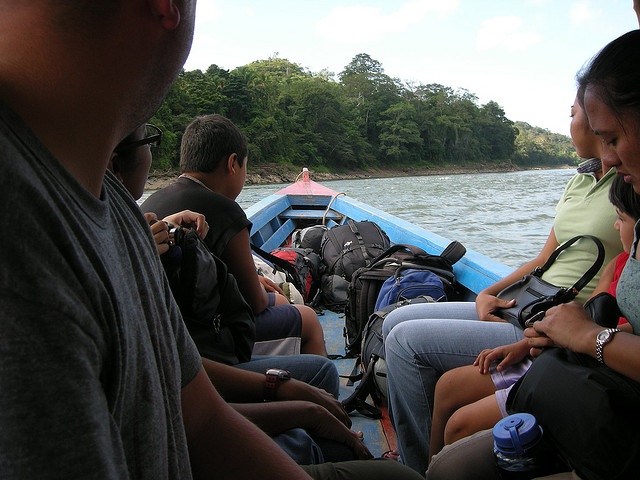
The boat to Mexico.  Photo Credit: einalem / Flickr / Creative Commons

The boat to Mexico. Photo Credit: einalem / Flickr / Creative Commons

Statistics show that the United States is relying on Mexico to do what U.S. immigration law and the Northern Triangle countries can’t: keep Central American children out of the U.S.  In 2014, the same year in which Mexico announced tightened security measures along its southern border with Guatemala and Belize, Mexican authorities deported over 18,000 children, up 117 percent from just over 8,000 the previous year, according to Mexican government figures.  A similar increase is already being registered in 2015.  During January and February of this year, deportations of minors from Mexican soil tallied over 3,200 – a 105 percent jump from the same period in 2014.  Since launching what U.S. officials have dubbed a “layered approach” to immigration enforcement, data reveal several noteworthy trends:

  • Mexico’s get-tough approach has prevented a significant number of migrants from reaching the U.S.-Mexico border. According to U.S. Customs and Border Patrol, the first seven months of Fiscal Year (FY) 2015 witnessed a 48-percent decrease in unaccompanied child apprehensions and a 35-percent decrease in family unit apprehensions along the U.S. border.  However, considered in light of the unprecedented number of deportations from Mexico, these figures suggest that child and family migration from Central America remain at historic highs. 
  • Central American children detained in Mexico are unlikely to be offered forms of humanitarian protection mandated by international law. Despite increases in child detention and deportation, a report by Georgetown University Law School’s Human Rights Institute points to inadequate screening and arbitrary detention as among the obstacles preventing tens of thousands of children from seeking and receiving relief from removal.
  • Both Mexican and U.S. data show that a growing share of child and family migrants are Guatemalan. According to analysis by the Pew Research Center, the number of Guatemalan children deported from Mexico during the first five months of FY15 doubled since the same period last year and now accounts for 60 percent of all child deportations from the country.  Meanwhile, the share of child deportees from Honduras dropped from roughly one-third to less than one-quarter, and those from El Salvador fell off slightly to just above 15 percent.  An analogous shift is also evident at the U.S.-Mexico border where Guatemalans now comprise 35 percent of unaccompanied child apprehensions compared to 25 percent during FY14.  Similarly, the proportion of Salvadoran and Honduran children has declined from roughly 25 percent each to 18 and 9 percent, respectively.
  • Smugglers and migrants are already adapting to heightened enforcement in Mexico and charting new, more dangerous routes north. Local media reports have covered migrants’ attempts to bypass border checkpoints by sea and traverse Mexico undetected on foot or in third-class buses.  Data show that successful migrants are crossing into the U.S. at less traditional and harder-to-access points.  At the height of last year’s crisis, the majority of migrants were surrendering themselves to border officials in the Rio Grande Valley along Texas’ southern-most border.  While apprehension in the Rio Grande control sector have decreased significantly this year, three sectors – Big Bend (Texas), El Paso (Texas and New Mexico), and Yuma (California) – have registered at least double-digit percent increases in both child and family apprehensions.

During Mexican President Peña Nieto’s recent visit to Washington, President Obama stated that he “very much appreciate[d] Mexico’s efforts in addressing the unaccompanied children [crisis].”  Despite applause from the White House, Mexico’s aggressive border enforcement – driven at least in part by U.S. encouragement and funding – has implications for Mexico’s already problematic human rights record.  While it is true that Mexico’s actions have largely staved off a repeat of last year’s crisis, it has yet to translate into the sort of political bargaining chip the Obama administration has hoped might sway the immigration policy debate in the U.S.  With comprehensive immigration reform legislation long dead and recent executive actions on indefinite hold, the administration apparently hopes that ramped-up enforcement will improve prospects for congressional approval of $1 billion in development assistance to the Northern Triangle.  But with Mexico’s clampdown blocking another surge of migrants into the U.S., many legislators are likely to question the prudence of pouring more money into corrupt, dysfunctional regional governments.  By backing the militarization of Mexico’s southern border, moreover, the administration is privileging political goals at the expense of humanitarian objectives and is indirectly complicit in blocking thousands of Central American children from accessing lawful forms of relief for which most are likely eligible.  Meanwhile, Mexico’s migrant extortion market continues to boom as vulnerable children and families seek new routes north at the mercy of increasingly brutal transnational networks.

June 4, 2015