U.S.-Guatemala Relations: What Is Going On?

By Ricardo Barrientos*
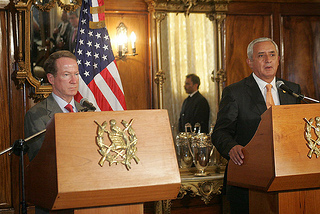
U.S. Assistant Secretary Brownfield and Guatemalan President Pérez Molina Photo credit: US Embassy Guatemala / Flickr / CC BY-NC-ND

U.S. Assistant Secretary Brownfield and Guatemalan President Pérez Molina
Photo credit: US Embassy Guatemala / Flickr / CC BY-NC-ND

Actions by the U.S. Congress, the U.S. Embassy in Guatemala, and the State Department have fueled speculation that something is askew in relations between Washington and Guatemala.  In January, the U.S. Congress passed the Consolidated Appropriations Act for 2014, with unusually severe measures for Guatemala.  Congress ordered the Treasury Department to direct its executive directors at the World Bank and the Inter-American Development Bank (Guatemala’s two main multilateral lenders), to support the reparations plan for damages suffered by communities during construction of the Chixoy Hydroelectric Dam in 1976-1983.  The project, funded by the two banks, resulted in numerous human rights violations, including the displacement of local communities, mostly of Maya Achi ethnicity, and the death of thousands in the Río Negro massacres perpetrated by the Guatemalan armed forces.  Additionally, the U.S. law conditioned U.S. assistance for the Guatemalan armed forces on credible advances in the Chixoy issue as well as the resolution of adoption cases involving Guatemalan children and U.S. adoptive parents since the end of 2007.

President Pérez Molina, a former army general, and his vice-president reacted with inflamed nationalistic rhetoric – just to be eclipsed by more U.S. actions.  After the Guatemalan Constitutional Court ruled that internationally acclaimed Attorney General Claudia Paz y Paz – a key actor in bringing to trial former Guatemalan Army General Ríos Montt on genocide charges – must step down in May (and not in December, as Paz y Paz supporters claim is the correct interpretation of the law), the U.S. Ambassador made a public statement supporting her.  A few days later, the U.S. Assistant Secretary for International Narcotics and Law Enforcement William Brownfield visited Guatemala, reiterating U.S. support to Paz y Paz and formalizing a $4.8 million donation supporting the UN International Commission Against Impunity in Guatemala (CICIG).  This further angered rightwing and pro-army sectors, dedicated detractors of both Paz y Paz and CICIG.  Brownfield tempered his message with praise for the “sensational” U.S.-Guatemala collaboration in counternarcotics.

These recent actions come from a combination of U.S. policy “hawks” and “doves” operating simultaneously.  U.S. Senator Patrick Leahy and his staff have the reputation in Guatemala as Capitol Hill hawks on human rights throughout Latin America, and acted accordingly by fostering the harsh legislative provisions for Guatemala.  U.S. Ambassador Chacón acted like a resident hawk, directly supporting Paz y Paz and praising her as a proven ally on the drugs issue.  Then, Mr. Brownfield, playing the role of the visiting dove balancing the harshness of the previous two actions, gave the badly needed financial aid to CICIG and supported Paz y Paz, consistent with his drug cooperation portfolio.  Guatemala’s role as a transit point for drug traffickers gives it leverage in the bilateral relationship, but that’s not enough.  Regional or global perspectives are important too: Guatemala recently completed its rotation on the UN Security Council, and the preliminary results of the elections in El Salvador and Costa Rica show that the region will continue under the influence of leftwing or left-leaning governments.  After Mr. Brownfield’s public statements, tension has eased and the angry rhetoric calmed down, but the chapter has not ended.  The bottom line is that Guatemala received an emphatic message: it must keep aligned with what the U.S. wants.  The problem for decisionmakers in the region is that it is not always clear what the U.S. wants.

*Ricardo Barrientos is a senior economist at the Central American Institute for Fiscal Studies (Icefi).
Guatemalan President’s Mid-term Exam: A Failing Grade?

By Ricardo Barrientos*

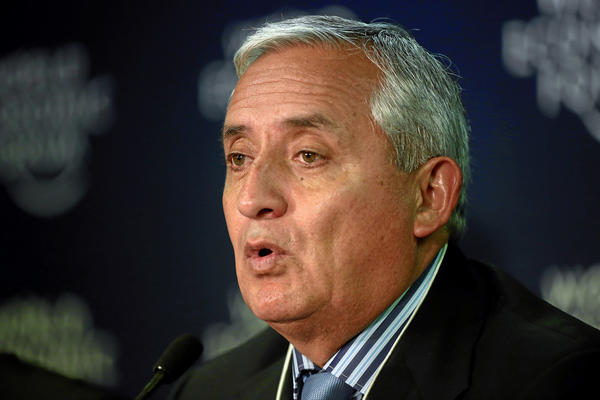
Guatemala Otto Pérez Molina President / Photo credit: World Economic Forum / Foter.com / CC BY-NC-SA

Guatemalan President Otto Pérez Molina / Photo credit: World Economic Forum / Foter.com / CC BY-NC-SA

President Pérez Molina’s second annual report to the nation last week at Guatemala’s National Theater featured statistics on the government’s progress, but it may be better remembered for an incident in which a protester threw white powder in the face of Vice President Roxana Baldetti.  A number of opposition deputies boycotted the session, and protestors outside drew headlines.  The President touted specific accomplishments, but his overarching plans –structured in three “pacts” welcomed even by the opposition – have fallen short of expectations.

  • The President in his speech said malnutrition has declined, but critics say that the Zero Hunger Pact is mostly unimplemented and chronic malnutrition persists. National surveys and several studies report that half of all Guatemalan children face a life with deficits in their abilities to learn and be competitive.
  • The Security, Justice and Peace Pact – expected to be a strong point for a former Guatemalan army general with a reputation as an “iron fist guy” – has fallen short.  Pérez Molina said the national homicide rate has dropped from 39 to 34 per hundred thousand inhabitants, but the National Institute of Forensic Sciences has reported a slight increase in murders in the capital and surrounding area.  Crime and insecurity remain a daily reality for Guatemalans, fueling popular frustration that Pérez Molina is not meeting one of his top campaign promises.
  • The Fiscal Pact for Change is also not delivering desired results.  According to Icefi, public finances are in crisis, not because of an external economic shock (2009-2010) or because tax reforms failed to increase revenues (corporate taxes rose 35 percent in 2013).  Rather, corruption is fueling fiscal shortfalls. According to President Pérez Molina and in Vice-President Baldetti’s own words, the influence of organized crime over the Customs System, whose duties and VAT on imports account for one third of Guatemalan tax revenues, is hampering collection.

For a student, a bad grade on a mid-term exam is an alert that things are not going well – but that a serious effort in the second half can save the course and achieve success.  For Pérez Molina, serious effort from now on is going to require more than a speech and applause at the National Theater.  The final exam for him and his government looms large on the horizon: elections will take place in September 2015, and campaigning will be well advanced in 2014. Voters are influenced by their daily reality, not an official report of success and accomplishments more reminiscent of Alice in Wonderland than real life Guatemala.  The President knows the clock is ticking.

Ricardo Barrientos is a senior economist at the Central American Institute for Fiscal Studies (Icefi).

Guatemala: One Step Forward, Two Steps Backward?

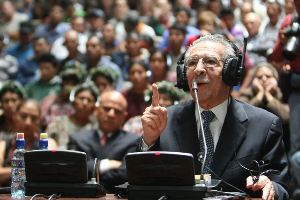
Efrain Rios Montt testifying at his genocide trial | Photo by the Guatemalan government | public domain

Efraín Ríos Montt testifying at his genocide trial | Photo by the Guatemalan government | public domain

The decision of Guatemala’s highest court to overturn the guilty verdict in the trial of former dictator Efraín Ríos Montt – found guilty of genocide and crimes against humanity – has raised serious questions about whether, as many had hoped, the country’s elites will ever allow justice, national reconciliation, and democracy to move forward.  What was a clear victory for many in and outside of Guatemala has evolved into a massive setback, at least for now.  For the victims and survivors of the atrocities, the trial was the first time that their tragic stories got an open and respectful hearing.  For the noble prosecutors and judges who pursued the case despite personal risk and beat back repeated maneuvers by Ríos Montt’s defense team to derail proceedings, it was a solid validation of their commitment to build rule of law.  For Guatemalan society, it meant unprecedented public discussion of the past – and the symbolism of the condemned dictator being taken away by bailiffs promoted closure.  For the international community, it proved that persistence could help a country with chronically weak and politicized institutions become the first in the world to put a former head of state on trial for genocide.  But now the outcome is cloudy.

From the beginning, the long-term impact of the trial would depend on the followup.  Immediately after the verdict was issued, President Pérez Molina, a former military commander, set aside his vehement denials that genocide occurred and said he respected the court’s verdict.  But he conditioned issuance of an official government apology, as ordered by the court, on the exhaustion of all defense appeals – which could take years – and was noncommittal in responding to the court’s call for more investigations of people involved in the atrocities.  While he personally has immunity from prosecution, allegations of his own activities during the Ríos Montt period would obviously be problematic for him.  The powerful business organization CACIF, long aligned with the military, rejected the verdict and began mobilizing resistance to further investigations.  Even moderate politicians, such as former Vice President Eduardo Stein, criticized the genocide ruling and calls for more investigations, apparently fearing that more ethnic groups will stake claims.  Like other dictators facing justice, Ríos Montt has already suffered a supposed health problem requiring that he be moved out of prison and into a military hospital – leaving observers wondering how much of his 80-year sentence he would serve.

The U.S. Government supported the trial process and proclaimed it a victory for Guatemalan judicial institutions.  But it appeared cautious on next steps even before the upper court overturned the verdict (on which U.S. comment is lacking).  Ambassador at Large for War Crimes Issues Stephen J. Rapp who visited Guatemala last month and gave the trial a push, and U.S. Ambassador to Guatemala, Arnold Chacon, attended some proceedings.  The U.S. Embassy pledged its continued support to “credible, independent, transparent, and impartial judicial processes,” but its statement also suggested a lack of enthusiasm for more.  “In these moments it is significant to remember that Guatemala, as a country, was not on trial, but rather two individuals, one of whom was absolved and the other convicted,” it said.  It added that “now is the opportunity to advance to real reconciliation” – a prospect that appeared premature even before the upper court action.  Neither the prosecution nor defense spoke much during the trial of Washington’s direct or indirect role in the 1980s violence – a situation that U.S. policymakers may prefer to continue.  If so, it’s a far cry from the position taken by President Bill Clinton, who during a visit to Guatemala in 1999 apologized for American support for security forces that committed “violent and widespread repression.