A Major Gig for Buena Vista

By Ana Serra* 

Photo Credit: OtherDrK / Flickr / Creative Commons

Photo Credit: OtherDrK / Flickr / Creative Commons

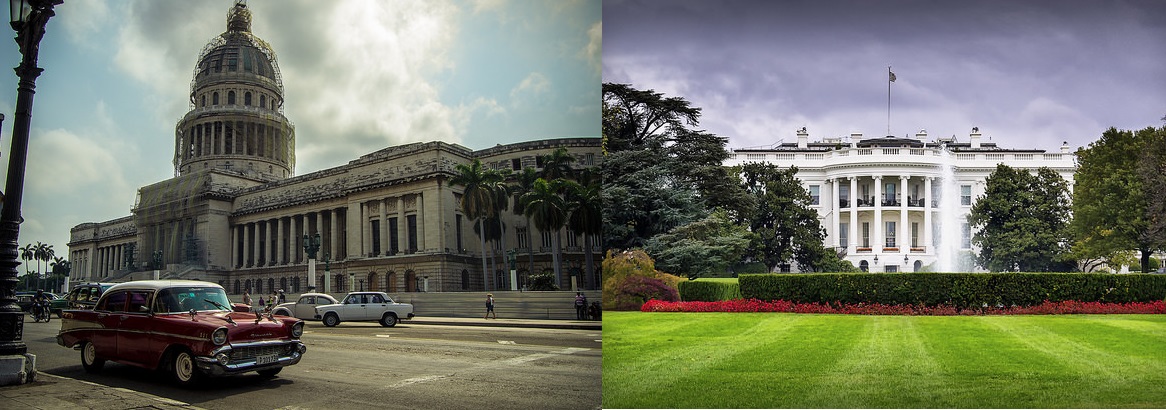
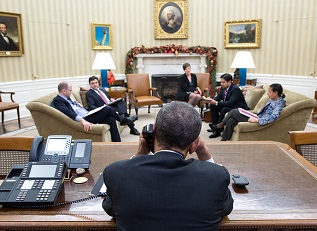
The Buena Vista Social Club Orchestra’s performance at the White House last week was a celebration of the ongoing normalization process between the United States and Cuba and of the musical collaboration – considered illegal at the time – that made this group possible.  Playing in commemoration of Hispanic Heritage month and the Educational Excellence of Hispanics, it was the first visit to the executive mansion by a Cuban band in more than 50 years, and part of its Adiós World Farewell Tour including a number of U.S. states before traveling to Puerto Rico and Latin America.  Buena Vista Social Club (BVSC) is a brand, starting as a 1940s club in Havana and revived by a 1997 album produced by Ry Cooder with Cuban and US musicians, a 1999 documentary film directed by Wim Wenders (chronicling concerts in Amsterdam and New York), and decades of fame-garnering recognition of Grammies and film awards.  At a time that the U.S. administration is taking steps to relax the terms of the embargo, the invitation auspiciously recognized Ry Cooder’s inaugural ice-breaker, which was investigated as a violation of the Trading with the Enemy Act.  While tied to the commercial success of the band, the concert inadvertently has progressive implications in a racial context.

The invitation to play at the White House amounts to a diplomatic gesture, and as such it was both cautious and optimistic.  The event resonated with many other people-to-people exchanges that have made thaw a reality, and highlighted the prominence of Americans of Cuban descent among Hispanics in the U.S.  The band is tried and true – if fully predictable – in its powerful evocations of a memorable past.  Its traditional musicians evoke the Havana music scene of the 1940s, a time of intense exchange and collaboration between Cuban and U.S. musicians.  In addition, it may cause for some a nostalgia for a supposedly harmonic relationship between the two countries, despite decades of strong U.S. intervention in political and economic affairs during the two administrations of Fulgencio Batista.  The album’s son, bolero, guajira, and danzón rhythms do not challenge expectations and the lyrics talk about love, beautiful women, and tropical landscapes.  Ry Cooder’s role in forming the original band – he apparently brought piano virtuoso Rubén González away from a shoe-shining job – represents the current dream of many art representatives hoping to go down to Cuba and “discover” or “bring to light” hidden talent.

Fans of Cuban music may be disappointed that far more interesting Cuban musicians – in terms of novel song styles or political messages – were not invited.  BVSC’s tunes have become so familiar as to make the minds of listeners numb: they have been played to exhaustion in tourist sites in Havana, and added to the ambiance of many a foreign venue aiming to evoke the irresistible rhythms of Latin American music.  A silver lining, however, are the progressive implications of what the band represents in a racial context.  The original Buena Vista Social Club was a so-called “club de negros” in the 1940s, in which the 1997 BVSC performer Compay Segundo had played.  These clubs were closed down after the 1959 revolution, since their emphasis on black identity was deemed divisive.  At the time of #blacklivesmatter in the United States, it is fitting that the first African-American president hosted this historic band in the White House.  Beyond the problematic background of a beautiful diplomatic gesture the event establishes a bridge between some of the common struggles in the U.S. and Cuba.

October 22, 2015

* Ana Serra is an Associate Professor of Spanish and Latin American Studies in the Department of World Languages and Cultures at American University.
U.S.-Cuba: Must “Democracy Promotion” Obstruct Normalization?*

By Fulton Armstrong

Photo Credit: Martin Burns / Flickr / Creative Commons

Photo Credit: Martin Burns / Flickr / Creative Commons

“Democracy promotion” has been one of the most contentious aspects of U.S. policy toward Cuba – and one of the most counterproductive – but it doesn’t have to be either.  The concept of democracy promotion is ingrained in U.S. policy culture, and the bureaucracies and programs they’ve been charged with conducting over the years are as bullet-proof as any in Washington.  Democracy promotion in different forms has been a main element of U.S. policy toward Cuba for decades. In the 1980s and early 1990s, the U.S. Interests Section conducted an array of outreach programs, engaging with Cuban academics, journalists, and officials – people tolerant if not deeply supportive of the Cuban government – as well as human rights activists and others “outside the system.”  These activities informed and nurtured the aspirations of Cubans in and outside the system who were eager to find Cuban solutions to their country’s mounting problems.  The Helms-Burton Act of 1996 moved democracy promotion into a more aggressive mode, explicitly linking it to regime change.  President Clinton spent token amounts on initiatives related to Cuba’s future transition, but the Bush Administration launched an expansion that has since cost U.S. taxpayers more than $250 million.  The arrest, conviction, and five-year imprisonment of USAID sub-contractor Alan Gross shed light on one such operation.  He smuggled sophisticated communication equipment onto the island to set up secret networks.  Associated Press investigative reporter Desmond Butler uncovered other programs involving communications and political operations against the Cuban government.

The investment has yielded some operational successes, but the impact toward promoting democracy has been negligible and, in important ways, counterproductive.  The program has delivered food, medicines, and other support to the families of imprisoned dissidents (many of whom have been released since Presidents Obama and Castro announced reestablishment of relations last December), but more provocative operations have arguably led only to arrests.  The amateurish clandestine tradecraft of the contractors and program activists, moreover, made it easy for Cuban counterintelligence to penetrate and manipulate their ranks.  The “private libraries” that U.S. taxpayers have paid for do not exist, and communications systems involving expensive satellite gear and satellite access fees have been compromised.  The secretive modus operandi of the operations has given credibility to draconian Cuban government measures, like Law 88 for “Protection of Cuba’s National Independence and Economy,” imposing prison terms for certain contact with foreigners “aimed at subverting the internal order of the nation and destroying its political, economic, and social system.”  Authentic people-to-people exchanges have been tainted as Cubans in the government and on the street are wary that any contact could be part of Washington’s regime-change efforts.

The democracy promotion ideology and bureaucracy seem unstoppable, but Presidents Obama and Castro can take the edge off this irritant with a little effort and flexibility, and even make it mutually beneficial.  The State Department and USAID have pledged to continue the Cuba democracy promotion programs and are asking Congress for $20 million to fund them again this year, but the President’s statement that “it is time for us to try something new” suggests acknowledgment that they need not be so ineffective and counterproductive.  For starters, the Administration could stop citing Helms-Burton authorities, which are explicitly for regime change, and establish criteria for operations in Cuba similar to those in other countries with whom the U.S. has diplomatic relations and is trying to improve bilateral ties.  It could restore and expand what worked in the past, such as the distribution of books and clippings; support for exchange visits; promotion of academic and cultural events; and other non-political activities that include people with government affiliation.  Perhaps most importantly, to decontaminate the programs, the organizations that have already spent millions trying to drive regime change should step aside and let a new generation – based on real people-to-people interests – try something different with the funds.  Both Presidents can trust their citizens to develop the historic roadmap that will define the relationship into the future.  Both the United States and Cuba stand to benefit.

September 25, 2015

*This article is excerpted from the second in a series of policy briefs from the CLALS Cuba Initiative, supported by the Christopher Reynolds Foundation. To read the full brief, please click here.

U.S.-Cuba Diplomatic Ties: Beyond Symbolism

By William M. LeoGrande*

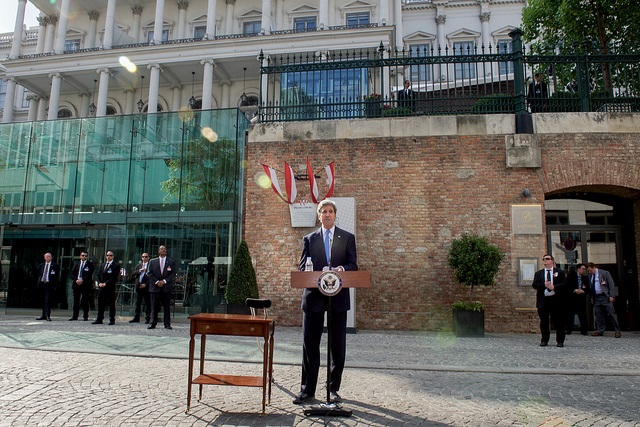
U.S. Secretary of State John Kerry delivers a statement to the international media after President Obama announced plans to re-open a U.S. Embassy in Cuba. Photo Credit: U.S. Government / Public Domain

U.S. Secretary of State John Kerry delivers a statement to the international media after President Obama announced plans to re-open a U.S. Embassy in Cuba. Photo Credit: U.S. Government / Public Domain

The reopening of embassies in Washington and Havana is symbolic of the change in U.S. policy that President Obama announced last December 17—replacing the hostility and subversion dating back to the break in diplomatic relations 54 years ago with engagement and cooperation.  As he declared on July 1, “This is what change looks like.”  Beyond symbolism, reopening the embassies has important practical benefits.

  • Cuba and the United States have had diplomatic representation in each other’s capitals since 1977, but those “Interests Sections” were restricted in their operations. Having full embassies will create better channels of communication between the two governments, facilitating negotiations on other issues that must be resolved before bilateral relations are fully normal.
  • Diplomats will have greater freedom to travel and speak with citizens of the host country.  Diplomats’ travel has been restricted to the capital regions of both countries since 2003, when the George W. Bush administration imposed controls on Cuban diplomats, and Cuba reciprocated.  Negotiations on opening the embassies were delayed by Cuban concerns that U.S. diplomats would travel around the island promoting opposition to the government—a common practice during the Bush administration.  The restoration of diplomatic relations returns to the pre-2003 status quo, when diplomats could travel freely upon simply notifying the host government.
  • For Washington, the move will have benefits beyond Cuba ties.  The policy of hostility persisted through ten U.S. presidential administrations, gradually isolating the United States from allies in Latin America and seriously endangering U.S. relations with the entire region.  It was no coincidence that President Obama noted that the new approach to Cuba would also “begin a new chapter with our neighbors in the Americas.”

Congressional opponents of the opening to Cuba can do nothing to stop the re-establishment of diplomatic relations, but they can slow down broader normalization processes.  The Constitution vests the power to recognize foreign countries with the president alone.  But whoever the president nominates as the new U.S. ambassador to Cuba will face tough sledding in the Senate Foreign Relations Committee, where Senators Marco Rubio (R-Fla.) and Robert Menendez (D-NJ) have declared unwavering opposition to normalizing relations.  In the House of Representatives, Republicans have introduced legislation to deny funds to upgrade the Interests Section to a full embassy—a move that only punishes U.S. diplomats in Havana, prospective Cuban immigrants, and visiting and U.S. citizens who need consular services.  Moreover, opponents will not allow any legislation in the next 18 months that would make Obama’s Cuba policy look like a success.  That means U.S. economic sanctions—the embargo and ban on tourist travel—will remain in place at least through the next presidential election since lifting them entirely requires changing the law.

Although full normalization—with robust trade, social, cultural, and political ties—will take a long time, there is more that can be done to expand government ties.  Washington and Havana have a half-dozen working groups on a wide range of topics, and we could soon see bilateral agreements on issues of mutual interest like law enforcement cooperation, counter-narcotics cooperation, environmental protection in the Caribbean, the restoration of postal service, and more.  President Obama also could use his licensing authority to further expand commerce with Cuba, in particular, licensing U.S. banks to clear dollar-denominated international banking transactions involving Cuba, a prohibition that is today one of the major impediments to Cuba’s international commerce with the West.  The president could restructure democracy promotion programs so that they support authentic exchanges in education, the arts, and culture, rather than promoting opposition to the Cuban government.  The issues between the United States and Cuba are complex and multi-faceted.  Resolving them will require overcoming half century of mutual distrust.  But the re-establishment of normal diplomatic relations constitutes the first necessary—symbolic and practical—step toward the future.

July 14, 2015

*William M. LeoGrande is professor of government in the School of Public Affairs at American University.  This blog is adapted from his op-ed on Fox News Latino.

Journalism in Cuba: Unstoppable Change

By John Dinges*

Jaume Escofet / Flickr / Creative Commons

Photo Credit: Jaume Escofet / Flickr / Creative Commons (modified)

Cuban journalism is changing rapidly – both in and outside the official media.  Developments in media reflect the dynamic changes taking place in Cuba and are likely to drive even deeper change in the future.  Journalists outside the system have long been seen as eager to create alternatives to the centrally controlled media that have dominated for decades.  Now, although many inside the government-run media still generally seek continuity of the Cuban revolution, a timid but slowly growing number of them are showing signs of openness to shifting away from their traditional role as a propaganda machine for a one-party state.  Together, the non-official and official journalists are part of a process of change that is robust, unstoppable, and healthy from the perspective of journalistic values.  Among the indicators:

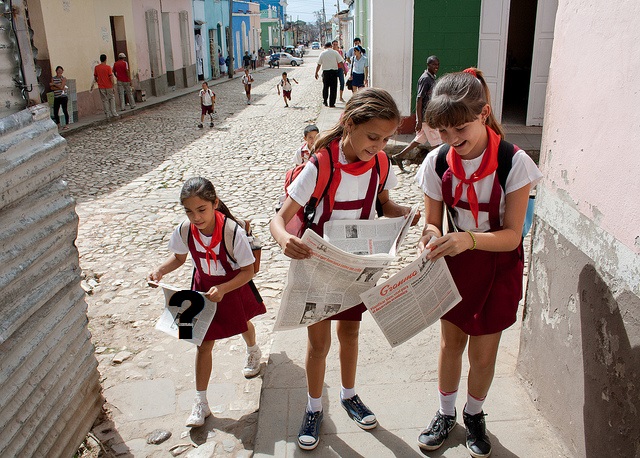
  • The official Communist Party daily, Granma, now dedicates a page each Friday to letters from readers with a host of complaints about daily life – inefficiency of government offices, long lines at stores, and delays in government benefits. In Cubadebate and other official blogs, there are been numerous analytical articles that could be called “loyal criticism.”
  • Yoani Sánchez – a star among the non-governmental bloggers – and others are sharp critics of the lack of political freedoms and proponents of radical but peaceful change. Their audience in Cuba is small, because of low connectivity on the island, but their voices occupy an important part of the spectrum of the country’s new journalism.
  • A new kind of media – individuals who identify as journalists and not as political dissidents – appears likely to have an even greater impact. The most successful of these, OnCuba, is a glossy bimonthly magazine distributed on the daily Miami-Havana charter flights.  It runs commercial covers – one recently featured a woman smoking a Cohiba – but also carries articles on sensitive political and economic issues.

OnCuba is an extraordinary experiment launched three years ago by Cuban-American businessman Hugo Cancio and employing 12 full-time Cuban journalists in a well-appointed Havana office – all with the necessary Cuban government approvals.  The editors say the publication’s only objective (other than paying its bills) is to serve as an intellectual bridge between Cubans in Cuba and Miami, casting a critical eye to both.

OnCuba and its nascent genre probably judge that walking the line between the two extremes – rejecting both “officialist” and “dissident” labels – increases their chances of landing on their feet if and when deeper change occurs in Cuba.  A recent episode involving leaked government documents, however, underscored the complexity of their balancing act.  An independent blog called La Chiringa de Cuba published a PDF of a sensitive Ministry of Communications plan to massively expand broadband access in Cuba by the year 2020, and OnCuba prepared a long article describing and analyzing its importance.  Despite the importance of broadband for the nation, the official media have so far neither reported on the leak nor – importantly – have they condemned it.  While the course of all these changes is uncertain, one thing beyond doubt is that, when it comes to journalism in Cuba, it’s now “Game on.”

June 19, 2015

*John Dinges teaches journalism at Columbia University and is the author, among other titles, of “The Condor Years: How Pinochet and his Allies Brought Terrorism to Three Continents” (The New Press 2004).

The Summit of the Americas: Important Progress

By Aaron Bell and Eric Hershberg

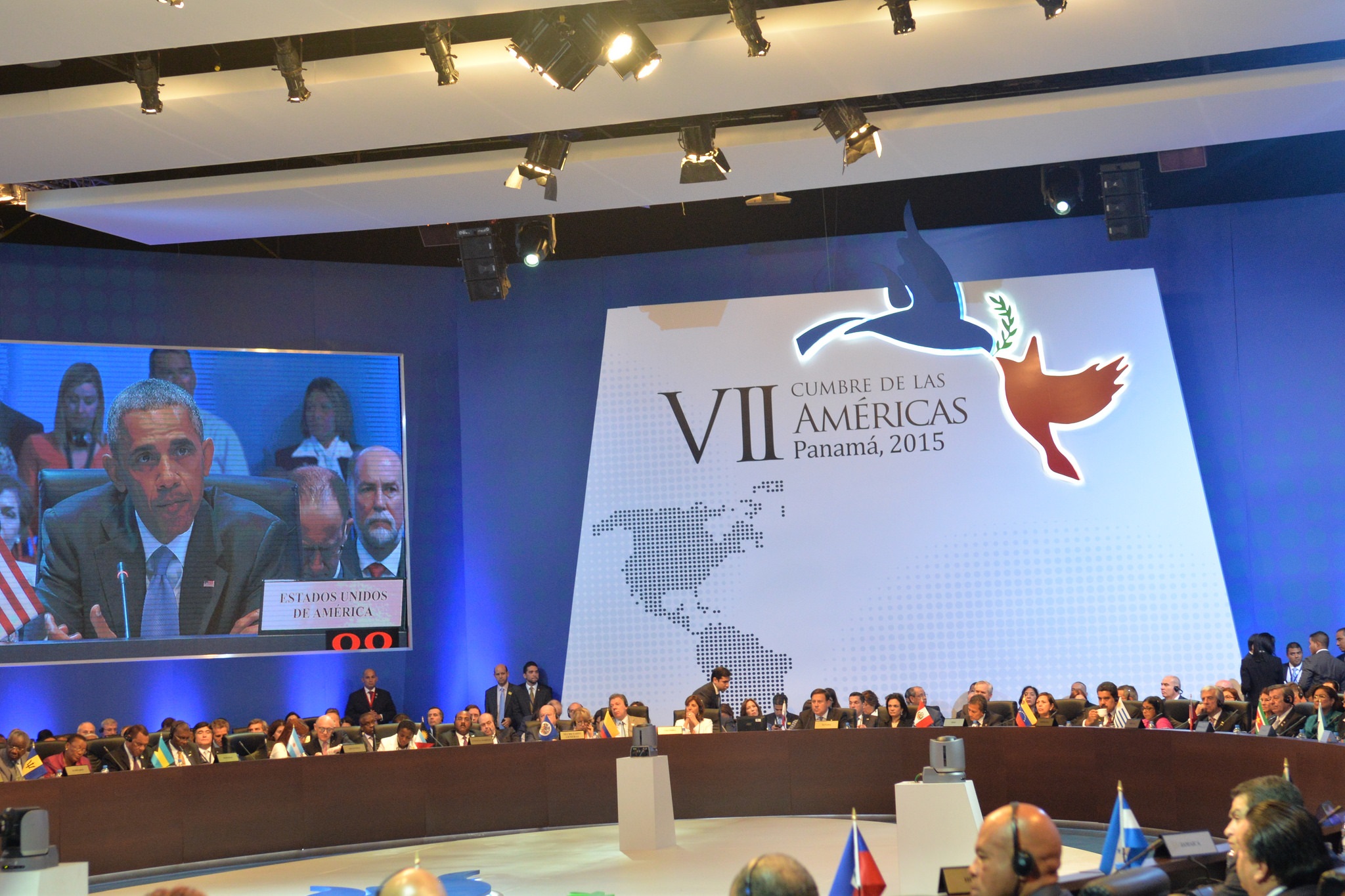
VII Summit of the Americas Photo Credit: OEA-OAS / Flickr / Creative Commons

VII Summit of the Americas Photo Credit: OEA-OAS / Flickr / Creative Commons

The U.S.-Cuba rapprochement has returned the Summit of the Americas (SOA) to the way it was before George W. Bush turned it into a forum in which the U.S. was increasingly isolated – a community of vibrant but respectful debate reflecting the varied perspectives of the hemisphere.  The event in Panama this past weekend was dominated by Cuba’s attendance at its first SOA and Presidents Raúl Castro and Barack Obama’s cordial public encounter and hour-long meeting, the first of its kind between the two nations’ leaders in over half a century.  The next step in improving relations will be for Obama to formally announce Cuba’s removal from Washington’s list of “state sponsors of terrorism,” which the State Department reportedly recommended last week.  Regrettably, the leaders did not take advantage of the Summit as an occasion to announce a target date for the formal restoration of diplomatic relations and the appointment of Ambassadors.  But that, presumably, will come soon, and regardless, in the plenary session Obama set a new tone for U.S. policy when he acknowledged that “the days in which our agenda in this hemisphere so often presumed that the United States could meddle with impunity — those days are past.”  Obama clearly articulated a desire to move beyond not only the legacy of U.S. intervention in the region but also the stale ideological debates that, he observed pointedly, pre-dated his birth.

Statements and activities surrounding the SOA also reaffirmed the broad range of perspectives in the hemisphere,  including in attitudes toward the United States.  The “People’s Summit,” held parallel with the SOA, provided a forum for left-wing critiques aimed primarily at U.S. meddling in the region, in particular its foreign military bases and its recent allegation – which it subsequently backed away from – that Venezuela poses an “extraordinary threat to U.S. national security.”  The sanctions it imposed on senior officials drew critiques from around the region, including from Argentina, Colombia, and from Brazil’s Dilma Rousseff, who summarized regional sentiment in characterizing them as “counterproductive and inefficient.”  The criticism was overshadowed, however, by widespread applause for changes in U.S.-Cuba relations.  Obama also won points from observers for meeting with Venezuelan President Nicolás Maduro, who used the Summit to denounce the 1989 U.S. invasion of Panama and present to Obama a list of 11,000 signatures opposing Washington’s sanctions.  Maduro praised the meeting as the “Summit of Truth” and even “cordial,” noting that it opened the door to further discussions on the bilateral relationship.  Obama also seemed to subscribe to a different role for civil society representatives – as opponents of sitting governments – at the summit, choosing to meet privately, for example, with Cuban dissidents opposed to the Raúl Castro and his government.

Obama’s steps to remove the festering U.S.-Cuba issue from the hemispheric agenda have been game-changing, even if some presidents criticized Washington’s continued enforcement of the economic embargo and the Administration’s bewildering inability to move faster to remove Cuba from its highly politicized terrorist list.  This summit may signal a return to the values and respectful debate that Obama, and before him Bill Clinton, espoused at past Summits, and may pave the way for cooperation over contemporary issues rather than Cold War-era ideological hang-ups.  In the final days before the Summit, senior White House advisors had intervened to ease tensions over the State Department’s national security rhetoric vis-à-vis Venezuela, emphasizing with regret that assertions regarding Venezuela’s posing a security threat were an unfortunate procedural necessity rather than a genuine assessment of the situation.  This recognition that “words matter” turned on their head the words used earlier in the week by Assistant Secretary of State Roberta Jacobson in lamenting that Latin American governments were not using language similar to Washington’s to characterize the deteriorating political situation in Venezuela.  While the correctives from the White House and the focus on the transformation of U.S.-Cuba relations were both conducive to a successful SOA, these developments did overshadow both the official theme of this year’s summit – Prosperity with Equity – and related discussions on energy, the environment, and education.  These crucial issues, all ripe for regional cooperation, are the core of what should become the focus of U.S.-Latin American relations for the remainder of this administration and beyond.

April 13, 2015

A Web Forum: Implications of Normalization of U.S.-Cuban Relations

By Eric Hershberg

Image Courtesy of the Center for Latin American and Latino Studies

Image Courtesy of the Center for Latin American and Latino Studies

Anyone concerned with Cuban affairs will remember “D‑17” – the day in 2014 that Presidents Barack Obama and Raúl Castro simultaneously announced their intention to restore diplomatic ties and endeavor to normalize relations.  Catalyzed by a year and a half of secret negotiations by senior confidants of the two presidents, bypassing normal diplomatic channels, the unexpected announcements provoked elation in most quarters.  After 55 years of estrangement and hostility, the two presidents acknowledged that an alternative path based on mutual respect was both possible and desirable.  Momentum toward restoring diplomatic relations is advancing steadily, but the path toward “normalization” is replete with obstacles, for there never has existed a “normal” state of affairs in U.S.-Cuba relations.  Despite widespread relief and optimism, a long road lies ahead.

Countless op-ed pieces have been written since D-17, and many of them have been very insightful, but the genre tends toward soundbites rather than deep analysis of the implications of change.  In this context, the Center for Latin American & Latino Studies at American University and the Cuba Program at the Social Science Research Council today launch a Web Forum that delves more deeply into the ramifications of changes in U.S.-Cuba relations, drawing on the scholarship of the contributors and on the substantial body of academic research that can inform our understanding of the present conjuncture and potential trajectories in the future.

Edited by Eric Hershberg and William M. LeoGrande, the Forum encompasses a variety of themes – from U.S.-Cuba relations, to hemispheric dynamics, to the consequences for ongoing political, societal, and economic change in Cuba.  What does it mean to contemplate “normalization” between two countries with such a fraught history of interaction?  How might experiences of “normalization” between the U.S. and other countries with which it sought to reduce longstanding hostilities provide lessons for those who seek to understand the likely course of events involving the U.S. and Cuba?  To what degree does D-17 and its aftermath alter the landscape of international relations in the Western Hemisphere?  How might Cuban cultural production and everyday life engage differently with U.S. audiences and with members of the Cuba diaspora?  Will rapprochement between the U.S. and Cuba have consequences for Cuba’s political trajectory?  What impact will changed bilateral relations and a relaxation of U.S. sanctions have on ongoing efforts to “update” and perhaps transform Cuba’s economic model?  The organizers hope that the Forum enriches debates about these and other matters, with contributions from leading experts from Europe, Latin America, and Canada as well as from the U.S. and Cuba.  We encourage readers to download the essays and to circulate them widely. View the Forum at http://www.american.edu/clals/implications-of-normalization-with-ssrc.cfm

April 2, 2015

OAS: New Leadership, Old Challenges

By Aaron Bell and Fulton Armstrong

José Miguel Insulza and Luis Almagro Lemes Photo Credit: OEA - OAS / Flickr / Creative Commons

José Miguel Insulza and Luis Almagro Lemes Photo Credit: OEA – OAS / Flickr / Creative Commons

Uruguayan diplomat Luis Almagro, elected secretary general of the Organization of American States (OAS) last week, says he wants to revitalize the hemispheric organization – a herculean, if not impossible, task.  Almagro was the only candidate remaining after Guatemalan Eduardo Stein and Peruvian Diego García-Sayán withdrew from the race – the former for health concerns, and the latter due to a perceived lack of support from his government.  Almagro previously served as Foreign Minister under former president José Mujica and is a member of his Movimiento de Participación Popular, whose left-leaning sympathies led observers to wonder whether Almagro could draw sufficient backing even running unopposed.  But Almagro received formal support from several prominent nations ahead of time, including Brazil, Argentina, Mexico, and the United States, and he got 33 of 34 votes (Guyana abstained) to secure his election.  Following the election, U.S. Deputy Secretary of State Antony Blinken called for the new Secretary General to “lead the OAS through this genuine reform process by helping to refocus the OAS on its core pillars – democracy, human rights, sustainable development, and citizen security,” all while resolving its fiscal challenges.  “We look to [him] for his leadership, but we want him to know that he does not stand alone.”  His five-year term begins in May.

In his acceptance speech, Almagro stated that he intends to rise above the role of crisis manager and facilitate “the emergence of a revitalized OAS,” but major challenges await him:

  • The political crisis in Venezuela has long challenged the OAS, and an escalation in sanctions and rhetoric from the United States has made its balancing act harder. Current Secretary General José Miguel Insulza criticized the Obama administration’s national security warnings while also calling out the Maduro government for the arrest of opposition leader Antonio Ledezma and its resistance to dialogue with the opposition.  Almagro has been critical of U.S. sanctions as well, and quietly worked behind the scenes to encourage negotiations between political opponents in Venezuela, but his public silence on abuses by the Maduro government worries his critics.
  • The Cuba issue will also put Almagro in a tight spot. Havana’s participation in the Summit of the Americas is likely to build pressures for its readmission to the OAS, and Almagro’s record shows he’ll be sympathetic.  But the process could be fraught with risks for the new Secretary General.  Outgoing Secretary General Insulza bears scars attesting to U.S. Senators’ penchant for personalizing attacks when the OAS doesn’t go their way.
  • Any reform agenda is going to get battered from both sides. The OAS mandates are broad and expensive, and members don’t agree on priorities.  As Deputy Secretary Blinken’s comments suggest, Washington wants the organization to focus on its agenda, but much of South America, particularly the ALBA countries, wants the OAS to pull away from U.S. influence.  Nor do differences lie strictly along North-South lines, as made clear by protests during last year’s general assembly against Brazil’s resolution condemning discrimination based on sexual orientation and gender identity.

Almagro seems to have the experience and temperament to be an excellent choice for the job, and his coming from Uruguay, whose good offices have credibility virtually everywhere, may serve the OAS well.  But the challenges will be daunting.  He faces several ongoing crises, particularly in Venezuela, and ongoing splits within the region over the OAS’s role.  One tempting option would be for Almagro to try to distance himself and the organization from Washington – a difficult task at best.  Not only is his headquarters several hundred meters from the White House and the State Department, but the United States government (and to a lesser extent Canada) provides substantially more funding for the OAS’s general fund and through special donations than any other member state.  Almagro’s actions will also be watched closely by U.S. conservatives who, stung by President Obama’s move toward diplomatic relations with Cuba, are looking for a fight over Venezuela, Ecuador, Argentina, and even on some issues with Brazil.  Whatever Almagro does, it will be with the black cloud of the OAS’s financial difficulties over him, and the possibility that failing to successfully balance all of these issues may weaken the OAS and benefit regional organizations like CELAC and UNASUR, which are smaller and less well established, but independent of North American influence.

March 23, 2015

U.S.-Cuba: What Now?

Diego Cambiaso and Y. Becart / Flickr / Creative Commons

Diego Cambiaso and Y. Becart / Flickr / Creative Commons

CLALS and the Washington Office on Latin America (WOLA) convened a small group of Cuba experts to discuss the course that U.S.-Cuba relations could take now that Presidents Obama and Castro have decided to reestablish diplomatic relations.  A two-page summary of conclusions – not coordinated with workshop participants – and “wildcards” that would alter events can be found here.  Here are highlights:

  • The two presidents are committed to using their remaining time in office – Obama until January 2017 and Castro until February 2018 – to burnish their legacies as leaders who solved an historic impasse.
  • The timelines for full normalization of ties between the two countries – including political, economic and social relations – certainly will go beyond their terms in office, and the process will take time and energy beyond their offices and governments.
  • The Summit of the Americas in April can be a crowning jewel to both Presidents’ efforts if issues such as civil society representation at the event can be resolved. The timing of the Summit will hold the White House’s attention for this period.
  • Greater emphasis by the Obama administration on the tangible benefits to the U.S. made possible by steps toward normalization would serve it well, including formalization and expansion of bilateral cooperation in counternarcotics, counterterrorism, and environmental and health issues. The criteria for policy success should consist of benefits to the American people, rather than “helping” Cubans or facilitating “regime change” in Cuba, as the Castro government will (as any government would) remain firm that its political system is not negotiable.
  • The potential for trade will be strong enough to persuade U.S. business to press for the broadest possible implementation of the new measures and, if the Cubans can articulate a clear strategy to attract (and protect) investments, for embargo-loosening legislation in Congress.
  • Potential obstacles require attention, but none appears insurmountable. Provocateurs in both countries could undertake actions intended to torpedo the normalization process.  In addition, the Washington’s “democracy promotion” programs for Cuba – which are unlike any others around the world – will certainly strengthen hardliners in Havana arguing for a go-slow engagement with the U.S.  With the stroke of a pen, President Obama could suspend the Bush-era program to persuade Cuban doctors to defect to the United States, a policy that hinders bilateral medical cooperation and threatens to sour talks.
  • Hardliners in the U.S. Congress will continue to be rhetorically opposed to improved relations – because they oppose Cuba or Obama – but the Obama policy has plenty of running room before needing legislation to advance.
  • Cuba may have limited capacity to effectively manage the various processes of change in the bilateral relationship. This may slow down the process and dictate the need to proceed sequentially rather than along many fronts at once.
  • Several “wildcards” – including leadership changes – could impact the normalization process.

February 11, 2015

Cuba Welcomes “Normalization,” But Only on its Own Terms

By Eric Hershberg

Photo Courtesy of Philip Brenner

Photo Courtesy of Philip Brenner

Cuban President Raúl Castro is undoubtedly as serious about normalizing diplomatic ties as President Barack Obama is, but the island’s government arguably faces more pressing challenges than working out the details of a rapprochement with Washington.  Commentators have observed that after the initial euphoria following the December 17 announcement, officials now speak of a long road ahead.  Full normalization, while welcome, is not the foremost concern of Cuban policymakers.  The paramount objective of Cuban authorities is the survival of the revolution and the one-party state that it engendered.  Top diplomats reiterated on January 23, after the first round of talks in Havana, that there will be no concessions to continued American insistence on changes in Cuba’s domestic political arrangements.

Economic revitalization is imperative.  Despite the reforms introduced by Castro, the Cuban economy remains woefully unproductive, incapable of meeting the needs of its citizenry or generating the foreign exchange that any small island developing state requires to import goods that it cannot produce domestically.  Growth rates are anemic, reaching only 1.3 percent in 2014, and independent projections call into question last month’s official announcements predicting 4 percent expansion during 2015.  Agriculture remains stagnant despite reforms aimed at putting fallow lands to productive use, so imports of food account for $2 billion in the extremely tight state budget put forth for 2015.  The severe shortage of cash, moreover, impedes public investment in Cuba’s crumbling infrastructure, which hinders autonomous producers from securing vital inputs for their businesses or distributing what they produce.  Ideally, foreign investment would supply resources where domestic sources cannot, but for the most part this is not happening either.  A 2013 foreign investment law has to date yielded little fresh capital:  European and other investors with experience on the island explain privately that the conditions for conducting business are such that they are reluctant to commit good money after bad.  The new changes in U.S. regulations may produce some increase in investment flows – primarily in the form of remittances from Cuban Americans to families and friends – and thus continue to provide some economic oxygen, but the likely scale of these flows should not be overestimated.  Washington’s new regulations seem likely to continue blocking investments that could increase the Cuban state’s ability to develop the infrastructure necessary to promote economic growth.

Because the intertwined goals of state security and economic revitalization are paramount, Havana’s engagement with the United States will be conditioned on its compatibility with those objectives.  Critics of the American opening who lambast Barack Obama for acceding to a deal with minimal Cuban concessions are right that Havana did not abandon its position that its political system is non-negotiable.  If by joining the rest of the western hemisphere in acknowledging the Cuban state Washington embarks on a path that will fuel economic activity in Cuba, the two countries will proceed, however gradually, away from confrontation.  The trajectory of U.S. relations with China and Vietnam in recent decades offers an instructive precedent for how this can be achieved and be mutually beneficial.  But if the Americans perceive greater engagement with Cuba as a tool for regime change, or strive to limit financial flows exclusively to private actors, their Cuban counterparts naturally will limit the scope of interaction.  A new round of State Department solicitations for bids to conduct democracy promotion activities in Cuba, like the U.S. negotiators’ insistence last week on getting a photo-op with dissidents before heading back to Washington, suggest that this message has yet to be absorbed by American officials.

January 26, 2015

U.S.-Cuba: Rhetoric and Reality

By Fulton Armstrong

Obama speaks to Raul Castro / Official White House Photo by Pete Souza / Public Domain

Obama speaks to Raul Castro / Official White House Photo by Pete Souza / Public Domain

The decision by Presidents Obama and Castro to normalize relations is truly historic – for which they and their advisors deserve enthusiastic applause – even though both leaders’ rhetoric seems intended to suggest that they don’t know how deep the uncharted waters ahead run.  Their statements since last Wednesday sound solicitousness toward their right flanks.  President Obama launched his statement by proclaiming that the United States of America is changing its relationship with “the people of Cuba” and, while conceding that past strategies to “push Cuba toward collapse” have failed, cast his new policy as a better way of helping the Cuban people “enjoy lasting transformation.”  President Castro told the National Assembly this last weekend that he wasn’t jettisoning Cuba’s revolutionary project either.  Cuba is not going to give up, he said, “the ideas for which it has fought for more than a century and for which its people have spilled much blood and gone through the greatest risks.”

It’s true that the nature of the relationship is unlikely to change fast, and that neither President can ignore the legal strictures built up during 54 years of tensions.  Obama can’t lift the embargo and permit, for example, tourist travel without Congressional approval.  Cuba’s “Law 88 for the Protection of National Independence and the Economy of Cuba” remains on the books, and Castro’s not about to welcome the U.S. Government’s “democracy promotion” activities soon.  But normalization will significantly reduce both governments’ ability to restrain nongovernmental contacts and will unleash forces that will make the Presidents’ rhetoric look old-fashioned and unnecessary.  Both countries have to learn how to talk to each other, and time-tested people-to-people contacts show that citizens with shared interests are better than governments at learning the language of cooperation and problem-resolution – without ideological agendas.  It stands to reason that pressure will grow on Obama and Castro to pursue concrete interests, especially trade, and to manage their dreams, respectively, of “lasting transformation” and “updated communism.”

No model for this new bilateral dance is perfect.  China and Vietnam show that trade-driven economic change – even with U.S. most-favored-nation status – doesn’t necessarily drive a country to democracy.  An educated and healthy people with strategic needs, the Cubans are prepared to work hard to build their country, but they’re not going to work in factories with anti-suicide nets under the dormitory windows.  That sort of political awareness argues for change, but the Cuban revolution implanted in the Cuban psyche a certain set of values and expectations – ranging from social programs to an almost obsessive sense of dignity – that won’t always coincide with U.S. values.  The Cubans will want to go a la carte with us on political matters, and they, like every country of Asia and Latin America emerging from difficult times, will almost certainly expect us to give them the space to do change their own way.  The United States worked with Mexico under one-party rule for 70 years last century.  If Washington and Havana approach the challenge of building a healthy relationship with respect and open minds, they should able to find a middle ground and grow together a lot faster than that.

December 22, 2014