Implications of Fidel’s Passing

By Fulton Armstrong

KODAK Digital Still Camera

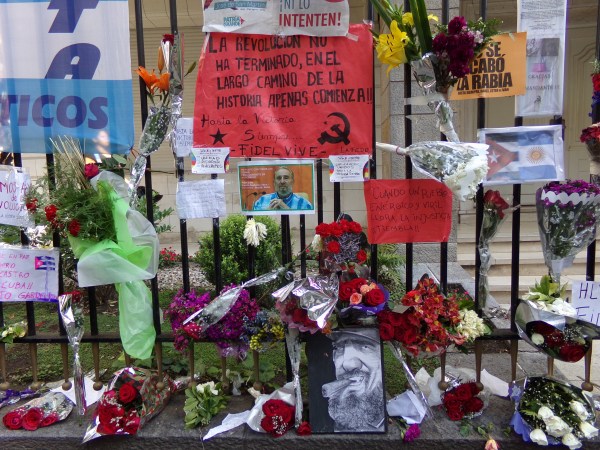
As a tribute to Fidel Castro, flowers and posters adorn the gates outside the Cuban Embassy in Buenos Aires. / Gastón Cuello / Wikimedia / Creative Commons

The death of Fidel Castro last Friday night has drawn largely predictable reactions from largely predictable quarters, but the analysis of the meaning of the comandante’s passing that matters most belongs to the Cuban people.  History may ultimately absolve Fidel of his most egregious excesses and errors over the last six decades, but Cubans are the ones who will decide which parts of his revolution to keep – and which to reject or allow to fade away.  By all accounts, Cubans want to preserve some of the gains of the revolution, including their sense of national dignity and some social benefits, while seeking a vastly improved living standard.  But no one can claim to know exactly what “the people” want – and how they want to achieve it.

  • The economic reforms that President Raúl Castro launched years ago have been halting and hampered by policy contradictions and bureaucratic obstacles rooted in elites’ fears of losing political control. Processes like the 7th Party Congress’ Conceptualización have been so muted as to undermine change and breed cynicism among the population.  Raúl and his team have a roadmap that, while as unorthodox as ever, will move the economy in the right direction.  Fidel’s departure is a signal that the old-timers, perennially blamed for slowing change, represent an eventually diminished threat.  The next generation of Party leaders knows full well that their legitimacy is going to have to come from concrete results, especially improving living standards, and it needs to move ahead with the hundreds of lineamientos, laws and regulations that have already been approved.  It’s their own plan, and the excuses for non-implementation of at least the easier measures are getting thin.  Major reforms such as unifying exchange rates will be a big challenge, as for any country, but the new team at some time will have to bite the bullet.
  • On the political side, Raúl lags even farther behind. Fidel’s passing puts a lot of pressure on him to flesh out his plan to step down as President in 15 months (a commitment that so far seems solid).  Some of Raúl’s actions indicate a desire to build institutions, perhaps even the National Assembly as it moves back into the Capitolio this month; improve decision-making processes; and reduce party intervention in day-to-day matters.  But his handover of power to a new generation won’t work if his policy team stays in the shadows forever.  His vision entails them learning how to do politics among themselves and, increasingly, with the Cuban people – which implicitly entails respect for the plurality of legitimate views across Cuban society.  The Cuban people have shown they’ll not form lynch mobs the moment political space opens up.

Cubans can find support for their evolutionary change in every corner of our Americas, except perhaps one.  Reactions throughout Latin America and the Caribbean differed in tone and effusiveness, but they uniformly showed respect for the deceased comandante and support for the Cuban people.  Regional leaders called him a “giant in history” and “a leader for dignity and social justice in Cuba as well as Latin America” and the like, while one merely tweeted “condolences to the Cuban government” and had staff explain he’d miss the funeral because the logistics of flying to Cuba were “not easy.”  But the region’s best wishes for Cubans to find a stable path from a Castro-dominated past into the future that they collectively – in the Party and “the people” – wish to find were strong.

The outlier is, again, the United States.  President Obama and Secretary Kerry’s messages were statesmanlike and consistent with Washington’s sensitivity toward any country in mourning even if it has different interests and values.  President-elect Trump took a different approach.  His condolence statement focused on issues from the past and his affiliation with combatants from the Bay of Pigs invasion who tried to oust Castro in 1961 and endorsed his own candidacy last month.  He tweeted that he will “terminate the deal” of normalization if Cuba is “unwilling to make a better deal for the Cuban people, the Cuban-American people, and the U.S. as a whole.”  Obama’s staff prematurely declared normalization “irreversible,” and Trump may be equally premature in threatening to reverse it.  Cuba’s changing on its own, and Fidel’s passing will probably give change on the island, if not in Washington, a push.  Efforts to return to a Cold War posture would probably put Cuba on the defensive and slow its transition processes – but not even Fidel could stop the march of time.

November 29, 2016
Cuba: Time to Move Ahead with Reforms

By Ricardo Torres*

cuba-economy

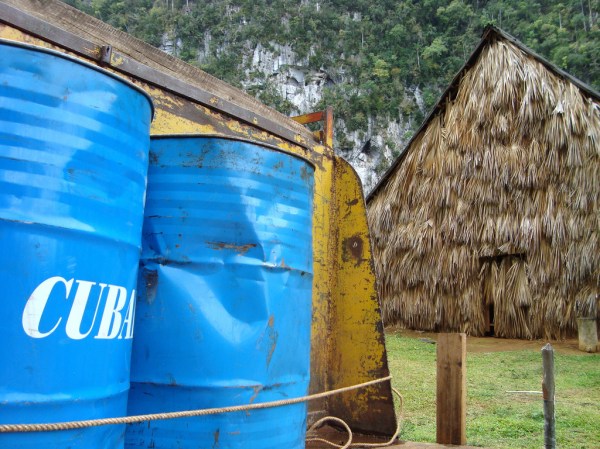
Oil drums and a tobacco curing hut near Viñales, Cuba / Adams Jones / Flickr / Creative Commons

The economic challenges that Cuba currently faces probably do not signal the beginning of a new Período Especial – the profound crisis Cuba experienced in the 1990s – but they are a painful reminder of the country’s chronic structural problem: the inability to generate enough hard currency to develop the economy and the failure of efforts to overcome that obstacle so far.  The immediate predicament was caused by a combination of internal and external factors, including the Venezuelan crisis and the low prices for certain Cuban exports.  (Ironically, oil byproducts from a refinery in Cienfuegos, which Cuba jointly owns with Venezuela’s PDVSA, have become a leading export.)  Venezuela is affecting income from services that Cuba sells there (in particular that of medical doctors) as well as a drop in the supply of oil products, which has covered about a half of Cuba’s needs.  This has placed extreme stress on Cuba’s external finances and forced a significant economic adjustment.  The government has imposed restrictions on energy consumption and a reduction in imports and investments – with important recessionary effects on an economy that desperately needs growth.  The energy rationing has fueled fears that the country could repeat the deep shortages of the early 1990s and again experience one of the most powerful symbols of that period: blackouts.

The situation is serious, but a crisis on the scale of the Special Period does not appear to be on the horizon.  Cuba today has a more diversified economy and produces a significant portion of its own energy, and the majority of the population has other sources of income to cushion themselves during bad times.  Most creditors and suppliers have shown confidence in their ability to move ahead.  In July, important contracts were announced for French companies to expand and operate Havana’s airport, which has been overwhelmed by the increase of international visitors (one of the few bright spots in the economy this year) in tandem with the improvement in relations with the United States.  Early this month, Cuban officials made presentations to firms from around the world on the government’s timely interest in renewable energy.  They emphasized the great opportunities that exist, not just current problems.

Once again, a close partner’s difficulties have put Cuba in a bind – too many times in too short a period.  Moreover, these problems arise at a politically sensitive moment.  Cubans are discussing the new model and development strategy through 2030, and – while Cubans are expecting results after six years of reform – President Raúl Castro has little time remaining in office.  The current complications can further delay essential monetary and exchange reforms.  Cuba needs to fix its foreign trade to supply oxygen for dynamic activities, such as its booming private sector.  Its development potential can’t rely just on its mystique as la Perla del Caribe.  Today’s challenges are an opportunity to remove the obstacles to changes that already have been announced, such as by accelerating the heretofore slow and ineffective implementation of agreed policies on foreign investment.  Some multilateral financial institutions can help, but Havana’s recent agreement with the Corporación Andina de Fomento (CAF), while a positive signal, is not enough.  The short-term answer is clear:  Only a combination of structural measures can guarantee that this latest economic crunch will be the last.

September 12, 2016

*Ricardo Torres is a professor at the Centro de Estudios de la Economía Cubana at the University of Havana and a former CLALS Research Fellow.

Canada-Cuba Relations Poised for Progress under Prime Minister Justin Trudeau

By John M. Kirk*

Cuba Canada

Photo Credits: Wisegie/ Flickr / Creative Commons, Pixabay / Creative Commons

After a decade of ignoring Cuba under the government led by Stephen Harper, Canada is on the cusp of an era of a significant improvement in bilateral relations with the island.  Many constants supporting this longstanding relationship remain: Canada, along with Mexico, was the only country in the Western Hemisphere not to break relations with revolutionary Cuba in 1962; Pierre Trudeau was the first leader of a NATO country to visit Cuba (1976) and developed a strong friendship with Fidel Castro (who was an honorary pall-bearer at his funeral); Canadians make up the largest tourist group (1.3 million a year) there; and the largest single foreign investor in Cuba is the Canadian firm Sherritt International.

Justin Trudeau, elected prime minister in October 2015, has undertaken several significant foreign policy initiatives, mainly in Asia and Europe.  Steps to improve relations with Cuba have been taken slowly, but are noticeable.  In May Cuban Foreign Minister Bruno Rodríguez visited Ottawa and Quebec City, while Canada’s Minister of Tourism Bardish Chagger attended the International Tourist Fair in Havana, at which Canada was the “invited country of honor,” reciprocating an earlier visit by her counterpart.  In December the Canadian Senate held a special session to celebrate the 70th anniversary of diplomatic relations.  Canada has been invited as the country of honor to the International Book Fair in Havana, in March 2017, and it is rumored that Trudeau will shortly visit Cuba.  Significantly, the gradual improvement of bilateral relations is due mainly to Canadian initiatives, and not to developments in the U.S.-Cuba relationship.

  • Investment and trade, however, have not kept up with diplomatic initiatives. Annual bilateral trade remains about $1 billion, mainly because of uncertainty over Cuba’s economy.  Canadian business has yet to take advantage of its privileged relationship, concerned with existing U.S. legislation and the looming wave of U.S. investment once the embargo is lifted.

After a decade of neglect, Canada and Cuba have the potential to rediscover their deep-rooted ties.  Trudeau’s willingness to work with Cuba and his diplomatic initiatives were unthinkable under the Harper government.  A complicating factor for business has been the arrest and imprisonment of two Armenian-Canadian entrepreneurs, found guilty of corruption.  Canadian civil society ties remain strong, with Canada making up 43 percent of tourists to Cuba.  Again, however, concern exists at how Canadian tourists face skyrocketing prices when Americans are allowed to visit the island.  In sum, Canada-Cuba relations are at this point characterized by political commitment to improve ties, largely untapped commercial potential, and anxiety about the ramifications of closer U.S. ties with Cuba.  The big question is whether Canadian trade and investment will provide the energy to propel relations beyond their special past status into a new era of collaboration.

August 8, 2016

*John M. Kirk is Professor of Latin American Studies at Dalhousie University in Canada.  He is the author/co-editor of 16 books on Cuba, and also works as a consultant on investment and trade in Cuba.

Cuba: Implications of U.S. Tourism

By Emma Fawcett*

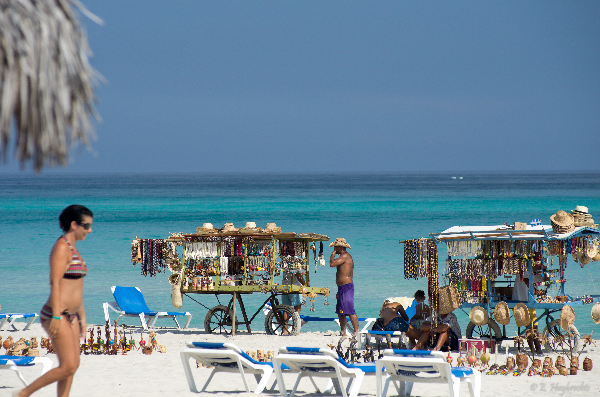
Tourists on beach in Cuba

Photo Credit: Emmanuel Huybrechts / Wikimedia / Creative Commons

U.S. regulations still technically ban tourist travel to Cuba by U.S. citizens, but the Obama Administration’s policies have already spurred significant growth in visitor arrivals to the island – with implications for Cuba and its Caribbean neighbors.  Over the last year, Cuba has experienced a 17 percent increase in total visitors, and a 75 percent increase in arrivals from the United States since Washington expanded the categories of permitted travel and, according to observers, relaxed enforcement.  An agreement to begin commercial airline operations between the two countries promises even more travel.  Other elements of the embargo continue to complicate U.S. travel: most U.S.-issued credit cards still do not work on the island; phone and internet connections are limited; and visitors often face persistent shortages of food items, consumer goods, and hotel rooms.  But the surge almost certainly will continue.

The onslaught of U.S. tourists challenges the Cuban tourism industry’s capacity.  Cuba has one the lowest rates of return visits (less than 10 percent) in the Caribbean; on the other islands, 50 percent to 80 percent of tourists make a return visit.  It has serious weaknesses:

  • While Cuba’s unique appeal may draw in millions of first-time visitors, the still relatively poor quality of service apparently discourages tourists from making the island a regular vacation spot. Sustaining arrivals requires higher marketing costs.  Average spending per visitor, moreover, has been on a fairly steady decline since 2008.
  • About 70 percent of Cuba’s tourists come for sun-and-beach tourism – a sector under state control – but private microenterprises have already demonstrated more agility in responding to demand than the state-owned hotels or joint ventures. The government reported last year that 8,000 rooms in casas particulares, or bed-and-breakfasts in Cubans’ homes, were for rent, and the number is growing steadily.
  • Cuba’s “forbidden fruit” factor may have a limited shelf life as visitors sense the imminent end to Castroism and the arrival of McDonalds, Starbucks, and their ilk. Questions remain about how long Cuba’s current environmental protections will continue when tourist arrivals increase.  Nicknamed the “Accidental Eden,” Cuba is the most biodiverse country in the Caribbean because of low population density and limited industrialization.  But rising visitor arrivals (and the effects of climate change) are likely to increase beach erosion and biodiversity loss.

Ministers of tourism in the other Caribbean countries have downplayed fears about competition from Cuba, but their optimism is sure to be tested.  A successful Cuban tourism sector could conceivably spur region-wide increases in visitor arrivals, but it could also cause other Caribbean countries to lose significant market share.  The official Communist Party newspaper, Granma, has suggested the government’s goal is to almost triple tourist arrivals to 10 million per year.  President Danilo Medina of the Dominican Republic, the most visited country in the region (at about 5.5 million tourists a year), has also set a goal of reaching 10 million arrivals by 2022 – setting that country to go in head-to-head competition with Cuba.  Jamaica, the third most visited country in the region, has instead pursued a multi-destination agreement with Cuba, designed to encourage island-hopping and capitalize on Cuba’s continued growth.  Previous attempts at regional marketing and multi-destination initiatives have had mixed success.  But as Cuba’s tourism sector continues to expand, Caribbean leaders – in what is already the most tourism-dependent region in the world – undoubtedly sense that Cuba is back in the game and could very well change rules under which this key industry has operated for the past six decades.

July 25, 2016

*Emma Fawcett is a PhD candidate in International Relations at American University.  Her doctoral thesis focuses on the political economy of tourism and development in four Caribbean case studies: Haiti, Dominican Republic, Cuba, and the Mexican Caribbean.

Trumping GOP Resistance to Strengthened Ties with Cuba

By Eric Hershberg

Malecon Twilight

Nighttime on the Malécon in Havana, Cuba. Photo credit: William Beem / Google Images / Creative Commons

One wild card on the horizon in the normalization of U.S.-Cuba ties looks unlikely to materialize.  As pointed out in several CLALS publications (such as here and here), ever since Presidents Obama and Castro announced on December 17, 2014, that they intended to improve relations, there has been a sense of uncertainty regarding whether their successors might roll back the advances they make.  This was particularly so when several Republican politicians seeking their party’s presidential nomination campaigned against President Obama’s “coddling” of the Cuban Communists and his “unilateral concessions” to Havana.  Marco Rubio (Florida) and Ted Cruz (Texas) – two of the Cuban-Americans in the U.S. Senate –made particularly aggressive statements indicating an intention to reverse all or parts of the Obama administration’s executive actions affecting Cuba policy, which, unlike legislation, can be reversed by a subsequent administration.  But they have dropped out of the race as presumptive nominee Donald Trump defeated them and former Governor Jeb Bush, whose Florida political base, family background, and public statements also indicated opposition to normalization.

Trump and the leading Democratic candidate, Hillary Clinton, have very significant policy differences on many issues, but apparently not on Cuba.  Clinton in her memoirs about her tenure as Secretary of State, like Trump in his public statements, appears inclined to sustain the current direction of Washington’s engagement with Havana (although Trump claimed last year that “we should have made a better deal”).  The two likely nominees share noteworthy characteristics, including, remarkably, that they are the least popular candidates that either major party has nominated since polling data have been collected. Advocates of full normalization cannot take either candidate’s leadership on the issue for granted. Clinton’s challenger, Senator Bernie Sanders, has pushed her to the left on some domestic issues, but recent press profiles on her indicate that she remains wedded to a hawkish approach to foreign policy.  The endorsement of several key Washington Neo-Conservatives further suggests she could swing to the right on foreign policy matters.  On the other hand, Trump’s zigzagging on Cuba – 15 years ago he was a staunch proponent of the embargo – and his impulsive decision-making style leave open the possibility that he also could reverse Obama’s executive actions and call on the Congress to keep embargo legislation unchanged.

Although mistakes can occur and various wildcards can slow, or even break, the current momentum, the twists and turns of the U.S. primary election season seem to have diminished substantially prospects that a new President sworn in next January would significantly change Obama’s winning formula on Cuba.  Clinton will have no incentives to abandon a policy that she takes some credit for promoting.  Trump has, if anything, proven that he revels in taking on GOP orthodoxy – and will presumably continue to do so on Cuba policy.  His sympathies align much more clearly with the pro-business Chamber of Commerce, an aggressive opponent of the embargo against Cuba, than with the ideologues on the right of his party, and he will give a green light to the many members of Congress who want full trade with and free travel to the island to change the law.  Concerns that a new U.S. president could reverse Obama’s executive actions on January 20, 2017, can now be assuaged, and Congressional proponents of lifting the embargo likely will have time to build momentum to pass legislation rendering the executive measures moot.  One can imagine that the Donald’s criteria of success for Cuba policy begin with the glare of a gaudy neon Trump sign on a casino along the Havana Malecón, but it’s reasonable to wager that the Cuban government will negotiate a better deal.

May 31, 2016


Cuba: Raúl Clarifies the Lack of Clarity on Future

By Fulton Armstrong

raul pcc congress

Photo Credit: Alexandre Seltz and Sarumo74 (modified) / Google Images / Creative Commons

The report that Cuban President Raúl Castro delivered to the 7th Party Congress last weekend walked a tightrope between pressing harder for change – embracing the importance of the small, emerging private sector – and reassuring party conservatives that the basic tenets of the revolution will not be touched.  He reiterated his commitment to step down in 2018 and promote younger cadre, but he left unclear what he proposes the Cuban system look like in the future.  He defended his decision to normalize relations with the United States, but used Washington’s continuation of the embargo and “democracy promotion” and immigration policies as a rationale for not letting down the Party’s guard.  Among key points:

On Conceptualización.  Castro said this Congress was basically to give “confirmation and continuity” to policies set five years ago to update Cuba’s economic and social model,  but it kicks off a process of consensus-building around a conceptualización, which he said “outlines the theoretical bases and essential characteristics of the economic and social model that we aim for as result of the updating process.”  Private property is a major topic, and Raúl sought to reassure the party that respect for it does not mean – “in the slightest bit” – a return to capitalism.

On reforms approved previously.  The road has been difficult, he said, held back by “an obsolete mentality that gives rise to an attitude of inertia and an absence of confidence in the future.”  He referred to the foot-draggers as “having feelings of nostalgia for other, less-complicated moments in the revolutionary process,” such as when the USSR and socialist camp existed.  But he insisted that the reforms have continued advancing at a steady pace – “without hurry but without pause.”

On upcoming reforms.  Castro talked more about what will not happen rather than any new vision.  He firmly ruled out “shock therapies,” and he said that “neoliberal formulas” to privatize state assets and health, education, and social security services “will never be applied in Cuban socialism.”  Economic policies can in no case break with the “ideals of equality and justice of the revolution.”  But he confirmed that one of the potentially most disruptive reforms – unifying currencies and exchange rates – must be done as soon as possible to resolve and many distortions.  On foreign investment, he called on the party “to leave behind archaic prejudices about foreign investment and to continue to advance resolutely in preparing, designing, and establishing new businesses.”

On Cuba’s economic model.  Castro acknowledged “the introduction of the rules of supply and demand” and claimed they didn’t contradict the principle of planning, citing the examples of China and Vietnam.  “Recognizing [the role of] the market in the functioning of our socialist economy,” Castro said, does not imply that the party, government, and mass organizations stand by and watch abuses occur.

On private and state enterprises.  He said the “non-state sector” – which includes “medium, small, and micro-enterprises” – is providing very important goods and services, and expressed hope for its success.  This sector will continue to grow, he said, “within well-defined limits and [will] constitute a complementary element of the country’s economic framework.”  Castro also called for greater reform efforts to strengthen the role of – and, simultaneously, the autonomy of – state companies, telling managers to overcome “the habit of waiting for instructions from above.”    He noted that the creation of cooperatives outside agriculture “continues in its experimental phase,” with some achievements and shortfalls.

On U.S. policies and intentions.  Castro criticized Washington’s efforts to drive political change in Cuba, which he called “a perverse strategy of political-ideological subversion against the very essence of the revolution and Cuban culture, history, and values.”  He said, “We are neither naive nor ignorant of the desires of powerful external forces that are betting on what they call the ‘empowerment’ of non-state forms of management as a way of generating agents of change in hopes of ending the revolution and socialism in Cuba by other means.” Castro said that U.S. officials recognize the failure of past policy toward Cuba but “do not hide that the goals remain the same and only the means are being modified.”

Rhetoric about forever rejecting capitalism (and multi-party democracy) is standard, especially for a Party event meant to assuage anxieties of conservative factions reluctant to give up their familiar, if failed, models.  The re-election of 85-year-old Vice President Machado Ventura is another sop to the aging right as the country inches each day to its biologically imposed transition, as Fidel Castro made explicit in his closing remarks.  The pace of change in Washington is also slow in some areas, particularly the embargo and the Administration’s “democracy promotion” strategies,  but pro-normalization voices cannot be faulted for lamenting that Cuba could more effectively influence U.S. policy through simple regulatory measures encouraging business deals that will give momentum to embargo-lifting initiatives in the U.S. Congress.  All politics is local, however, and both governments seem content holding off on changing their paradigms for now.

April 21, 2016

U.S.-Cuba: Migration Policy Growing Tortuous, Dangerous

By Fulton Armstrong

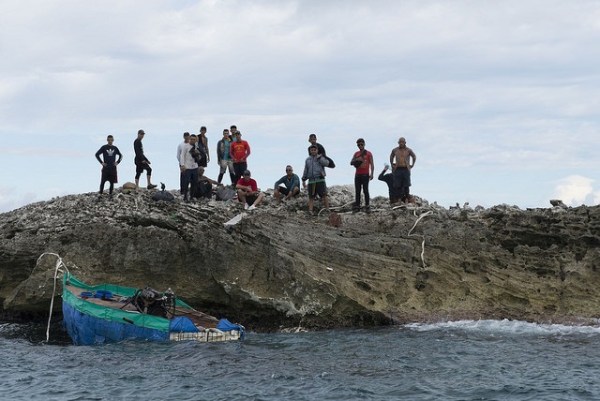
Cuban migrants

Photo Credit: Coast Guard News / Flickr / Creative Commons

The surge in Cuban migration – prolonged at this point by U.S. policy paralysis – may show a dip soon but is growing tortuous and dangerous.  Since January 12, chartered aircraft and buses have been carrying about 360 Cubans a week from Costa Rica to El Salvador, and then through Guatemala and Mexico to the United States, where they are admitted with special status.  The US$550 cost of the trip is being paid by the migrants or unidentified “donors.”  The air bridge has begun relieving pressure on Costa Rica, which has been caring for 8,000 Cubans since Nicaragua in October halted the underground railway transporting them up the Central American isthmus.  (Three thousand more are reportedly stuck in Panama.)  Despite the progress, an estimated 1,500 migrants have left holding facilities and turned to alien-smugglers to take them to Mexico (for $800) or to the United States ($1,500), according to press reports.

  • Cubans’ fear of a change in U.S. migration policy since reestablishment of U.S.-Cuba diplomatic relations is most often cited as causing the surge, estimated at some 40,000 in 2015. It does not explain the estimated 20,000 who crossed into Texas in 2014 and before, when alien-smuggling networks were less developed.
  • Ecuador’s agreement to establish visa requirements for Cubans promises to slow the immediate flow, but the crisis has revealed corruption among migration authorities throughout the region, which will make stopping it difficult.
  • Central American resentment of the welcome Washington gives illegal migrants from Cuba is growing – aggravated in part by the arrival of airplanes from the United States full of deported citizens in the same timeframe. Senior officials from Costa Rica, El Salvador, and Guatemala have blamed the surge in trafficked Cubans on the preferences the United States gives them.

The U.S. Coast Guard reports an increase in the volume and violence of seaborne migration.  Migrants interdicted in Fiscal Year 2015 (ending September 30) grew to almost 3,000 – 900 more than the previous year – and, according to press reports, surged to 1,500 in the last quarter of 2015.  The Coast Guard says the migrants have concluded that Cuba’s economy will not improve even after U.S.-Cuba normalization, and they want to go before U.S. migration policy changes.  The service has reported a spike in violent confrontations with Coast Guard officers, violence against fellow migrants, and even suicide threats..

The U.S. government’s mantra that it will not change policy toward either overland or seaborne migrants is not working – and could even be backfiring by reminding Cubans of the special treatment they receive upon arrival.  The airlift and bussing of thousands of migrants from Costa Rica to the United States helps Costa Rica deal with its crisis, but also signals yet again to Cubans remaining on the island how far the United States will go to bring them in.  Violence among seaborne migrants has traditionally been rare, but the increased aggressiveness suggests that migrants have the impression that they can act with impunity and still be welcomed into the country.  Overland migrants’ preference to use coyotes, known for violence, is another red flag.  The United States has expended political capital by washing its hands of the Cuban migrant mess in Central America, and grumbling among the region’s leaders suggests that options like airlifts will disappear soon.  U.S. law, including the Cuban Adjustment Act, fully empowers the President to turn off the green light to undocumented Cuban migration – and reality could very well nudge him in that direction soon.

February 4, 2016

Cuba: Limited Opportunity Drives Migration

By Ricardo Torres*

Embed from Getty Images


A generation of young Cubans is eager to leave the island because they feel that recent reforms have opened scant opportunities for them, and they see a much brighter economic future for themselves in the United States or Latin America. Cuba has made vast investments over the years in education, generating a population with high levels of human capital and technological potential, but job opportunities – in the declining state sector, in the 200 or so occupations now authorized for cuentapropismo, and in the slowly opening cooperative sector – hold little promise for Cubans under 30. Although statistics on the socioeconomic background of migrants are lacking, a strong body of anecdotal information indicates that this generation, with aspirations of a career that matches their intellectual and technical capabilities, is concluding that there is little for them in Cuba. For a number of reasons, the conditions necessary to start a new business – such as financing and markets – are simply not there.

Mainstream technologies that are now common in modern societies are lacking in Cuba, hindering it from unleashing the potential of its human capital. Inconsistent and excessively controlled access to computer technology and the internet is also discouraging youths to have hope. Free education, healthcare, and a low crime rate set Cuba apart from most other countries in the region producing large numbers of migrants, but those same factors have created expectations among youths that they should have fulfilling, better-paying jobs – which simply are not abundant. Moreover, people under 35 have fewer emotional or historical attachments to the Revolution. They did not experience the purported “Golden Age” of the 1980s, and the “revolutionary and socialist” Cuba they know is one of only economic hardship.

For migrants elsewhere in the region – driven by endemic poverty, violence, and weak, corrupt institutions – young Cubans’ reasons for leaving the island may appear exaggerated. Cubans’ education, health, and relative security, however, do not discount their profound desire, engendered in part by the Communist Party’s own unfulfilled rhetoric about a better life, to seek better fortunes outside their country. They have been trained for knowledge-based economy, but Cuba’s current development model relegates them to low value-added occupations that cannot generate the rewards to which they aspire (or the prosperity that the society needs and in principle could achieve). U.S.-Cuba normalization, particularly if the two governments allow capital and goods to flow freely, and accelerated reforms in Cuba hold some promise of reducing migration pressures from the island in the future, but persuading Cubans that building a better life on the island rather than emigrating elsewhere will take time and vision.

December 17, 2015

*Ricardo Torres, a CLALS Research Fellow, is Professor of Economics and Cuban economy at the University of Havana, and is affiliated with the UH’s Center for the Study of the Cuban Economy.

U.S.-Cuba Migration: The Powerful “Pull” Factors

By Fulton Armstrong

Cuban women

Photo Credit: Guillaume Baviere / Flickr / Creative Commons

The Obama Administration’s repeatedly stated commitment to continue implementing the Cuban Adjustment Act of 1966 is driving a surge in Cuban emigrants through dangerous human trafficking routes in Central America and causing tensions in a region already tied in knots over illegal migration.  The flow of Cubans up the isthmus has been increasing steadily – reaching some 45,000 over the past year – but seemed a manageable issue until Costa Rica broke up a smuggling ring last month.  The publicity prompted Nicaragua to close its borders to the underground railroad, which is carrying thousands each month northbound.  The migrants have been starting their journey by air from Havana to Ecuador (which until last month didn’t require a visa) and are escorted by coyotes as they bribe their way across borders headed north.  A summit of Central American foreign ministers two weeks ago failed to reach agreement on a Costa Rican proposal to create a “humanitarian corridor” for the Cubans by issuing them safe passage.  Relations between San José and Managua, already on edge as they await an ICJ decision this month on a territorial dispute, have turned bitter.

The special treatment that Cubans receive upon setting foot in the United States – including automatic access to permanent residency in one year – is the main stimulus of the flow.  The Clinton Administration adjusted how it handled those intercepted at sea, establishing a distinction between intending migrants with “wet feet” and “dry feet,” which reduced the seaborne flow somewhat.  But Cuba’s decision in 2013 (long urged by the U.S. and international community) to stop requiring citizens to get exit permits; the flow of a billion-plus dollars into Cuba through remittances and small businesses (with which to pay coyotes and corrupt officials along the way); and the growing sophistication of smuggling networks in Central America have fueled a shift in the flow overland.  Despite the Administration’s no-change pledge, some intending migrants say the current rush is being driven by fear that U.S.-Cuba normalization will end the preferences granted to Cubans who reach U.S. soil.

The Adjustment Act authorizes – but does not require – the President, through the  attorney general, to grant parole to Cubans arriving into the United States illegally and grant them permanent residency one year later.  In the absence of any change in Washington’s approach, Cubans will certainly try to avail themselves of its generous provisions.  To move the thousands stuck in Central America off the front page there, Washington may issue them expedited visas and help them with transportation to the United States.  Such gestures, however, will have a high political cost throughout Central America, where the U.S. has asked governments to stanch the movement of their own citizens fleeing violence and dire poverty, and where even well-off, law-abiding citizens have to jump through hoops and pay hundreds of dollars for tourist visas.  As the impasse in Central America grew intense last month, the State Department tweeted a reminder that “There exist legal and safe options for Cubans who want to migrate to the United States.”  Reversing policies that encourage illegal and unsafe migration – while proposing that Congress support a doubling or tripling of the current 20,000 Immigrant Visas the Embassy in Havana issues each year – would make a lot of sense.

December 7, 2015

AULABLOG will examine the powerful “push” factors driving migration from Cuba in a subsequent article.

Cuba’s Limited Absorptive Capacity Will Slow Normalization*

By Fulton Armstrong

Photo Credit: PBS NewsHour / Flickr / Creative Commons

Photo Credit: PBS NewsHour / Flickr / Creative Commons

As the U.S. embargo – the main obstacle to expanding U.S.-Cuban economic ties – is relaxed by presidential regulatory action and eventually lifted by Congress, limits on Cuba’s own willingness and ability to conduct trade, absorb investment, utilize information technology, and even accommodate tourists risk putting a brake on the normalization of economic relations.  Five decades of embargo and failed socialist models have rendered key sectors in Cuba ill-equipped to take advantage of the surge in U.S. business interest in the island.  In some areas, the political will to open up and reform is crucial.  These problems do not translate into a rejection of normalization but rather into a slower timeline than many on and off the island would hope for.

The advantages of economic engagement are well known.  Foreign investment will help provide the $8.7 billion Cuba wants for its “Portfolio of Foreign Investment Opportunities” – some 246 projects in energy, tourism, agriculture, and industry.  Havana also wants growth rates to rise to 4-5 percent per year (from an estimated 1.5 percent in 2014), fueled by at least $2 billion in annual foreign investment.  Trade, investment, and tourism are all potentially powerful engines for growth and employment in Cuba.  Private farmers have long out-produced their state competitors and many cooperatives, making them ideal for engagement under current U.S. regulations if the Cuban government facilitates it.  The small private sector, currently employing over a million people, could – with a more supportive infrastructure – provide many more vital goods, services, and employment that the Cuban government years ago admitted it could not provide.  Sectors utilizing Cuba’s specialized and skilled human capital, such as biotechnology, could also benefit quickly and generously from the new U.S. relationship.

Cuba has a lot going for it – such as its deep reserve of potential human capital – but it is also is held back by a variety of problems, many of which are prolonged by political caution.

  • Cuba is updating laws governing investments, property, and labor – a new foreign investment law in March 2014 and related regulations are steps in the new direction – but the multi-year, incremental process has been too slow to keep ahead of burgeoning opportunities. Regulations on how foreign firms select, pay and release Cuban employees are also antiquated.  Paperwork for approving foreign direct investment remains formidable and must pass through multiple levels.  The country lacks the basic institutions necessary to license import and export transactions for beneficiaries outside government ministries.  Much of the bureaucracy – chronically underpaid and, during periods of party dominance, neglected – has yet to grow into a new, more professional role.
  • Unifying Cuba’s two national currencies is absolutely essential but, despite the government’s repeated declarations of intent, it has still not been done. The existence of a different, lower exchange rate for state enterprises creates distortions that will worsen as demand for imports rises.  The financial system, moreover, is too over-burdened, secretive, and lacking in agility, and continued blocks to Cuba’s access to IMF, World Bank, and Inter-American Development Bank (IDB) funds deny it important breathing room to reform.
  • Cuba lacks an information and communications technology (ICT) framework capable of harnessing and nurturing its human capital and driving growth and efficiency – which will retard progress in a number of priority areas.
  • De-industrialization over the past 25 years has further reduced Cuba’s absorptive capacity. Many key sectors – including textiles, clothing, metals, machinery, transportation equipment, and more – have contracted between 50 and 100 percent.  Much of the infrastructure is dilapidated.  The transportation sector is in dire need of repair and modernization; and the construction industry is inefficient and poorly resourced.

Cuba’s challenges in taking advantage of new opportunities are not insurmountable – with political will and time.  The pace of reform and corresponding expansion of Cuba’s absorptive capacity may be maddeningly slow for many Cubans and Americans alike.  But insofar as the U.S.-Cuba normalization process is irreversible, so too is the conviction in Cuba on the need to “update” the system through reform in order to take advantage of the opportunities it brings.  Cuban national pride and the Communist Party’s fear of losing control could very well be assuaged as the island experiences the benefits of engagement.  Foreigners, especially the United States, who push too hard, too fast, and too haughtily could fail and even delay this aspect of normalization, just as Cubans who move too passively, too slowly, and too skeptically could stymie the process as well.

October 27, 2015

*This blog post is excerpted from the third in a series of policy briefs from the CLALS Cuba Initiative, supported by the Christopher Reynolds Foundation.  Read the full brief here.