Obama’s Second Trip to Central America

SICA logo | Wikimedia Commons | GNU Free Documentation License

SICA logo | Wikimedia Commons | GNU Free Documentation License

The White House has cast President Obama’s trip to Mexico and Central America on May 2-4 as “an opportunity for the President to demonstrate his leadership in the international community in a really important way.”  The spokesman emphasized the “important people-to-people ties” between the United States and Central America because “there are a lot of immigrants” from the region.  The Administration’s press releases stress that the summit in San José, with the presidents of the Central American countries and the Dominican Republic under the rubric of the Central American Integration System (SICA), will focus on collective efforts to promote economic growth and development in the region and on “our ongoing collaboration on citizen security.”

Regional reaction to the visit and summit has been positive – Obama’s interest is clearly welcome – but leaders are already managing expectations.  Costa Rican Foreign Minister Castillo last weekend cautioned that the United States is not able to provide significant new assistance for either economic or security programs.  Commentators note that the visit has not been preceded by the sort of diplomatic activity that would indicate the rollout of significant new policies or programs.

At a summit in Guatemala with Vice President Biden one year ago, Costa Rican President Chinchilla crystalized regional criticism of the U.S. counternarcotics strategy when she said that Central America “is sacrificing the lives, making its enormous sacrifice” and, in a clear reference to Washington, called on the “international community [to] take greater co-responsibility in this struggle.”  Hosting the SICA summit with Obama suggests she is prepared to put such criticism aside, perhaps in hopes that talks focus on the economic and immigration issues.  The White House spokesman’s reference to immigrants – at a time that Obama is pushing ahead with related legislation – may indicate that immigration will be a primary concern for him also.  The last time Obama went to Latin America, for the Summit of the Americas in Cartagena in April 2012, he seemed ill-prepared for criticism of U.S. policies, including its counternarcotics strategy, even from Washington’s closest friends.  With perhaps the exception of Nicaraguan President Ortega, the participants in this Central American get-together seem less likely to deliver a similar grilling, making what diplomats call a “successful meeting” very likely.
Central American Elites Are Evolving But Cling to Power

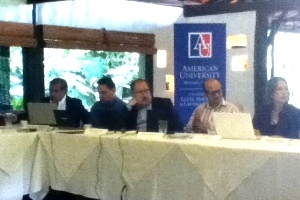
From left to right: Manuel Torres, Ricardo Barrientos, Hugo Noé Pino, Aaron Schneider and Elizabeth Oglesby participating in the project seminar in Costa Rica

From left to right: Manuel Torres, Ricardo Barrientos, Hugo Noé Pino, Aaron Schneider and Elizabeth Oglesby participating in the project seminar in Costa Rica

The sources of Central American elites’ wealth are evolving, as are their fundamental interests and the ways they wield political power.  Land‑intensive production – the focus of decades of insightful scholarship – continues to prevail in Guatemala and Honduras, but the economically powerful now maintain their position through a growing array of service-sector activities and by capturing rents from public coffers.  Changes in their economic foundations are but one of several transformative processes that swept the region beginning during the 1980s, making the past three decades a period of fundamental rupture with the past.

  • Civil wars in El Salvador, Guatemala and Nicaragua during the 1980s transformed the economies in all three countries and had spillover effects in Costa Rica and Honduras.  Most striking is the case of El Salvador, where elites abandoned the countryside upon which they had depended from time immemorial, never to return.
  • Structural adjustment programs, implemented throughout the region during the 1990s, changed the role of the state in Central American economies and thus the ways in which the public sector intersected with the elites’ wealth-accumulation strategies.  Hasty and corruption-ridden privatizations, in particular of energy and telecommunications and of an array of public services, created a reformist façade but gave private-sector groups a piñata that helped to ensure uninterrupted enrichment.
  • During that same decade, transitions to electoral democracy contributed to elite reliance – albeit with some important exceptions – on political parties, campaign strategies and legislative lobbying to protect their interests.  Ties to military and death squad enforcers are no longer the principal vehicles for the enforcement of elite imperatives, though Honduras today is increasingly reminiscent of the worst times in Guatemala and El Salvador.

Central America’s elites have yet to offer the region a vision of reform that will enable the isthmus to overcome misery, exploitation and predatory rule.  While dominant groups have embarked on aggressive state-building strategies, experts question whether these are producing the virtuous dynamics that advance the general welfare of the population and ensure effective governance. 

Scholars from across Central America have reached these conclusions through research and seminars under a multi-year AU program on Central American elites and power.  To foster better understanding of the shifting landscape in the region, and thus to illuminate plausible paths toward more equitable distribution of power and resources, the Ford Foundation is supporting this effort, undertaken in partnership with more than two dozen researchers from institutions throughout the isthmus and the United States.  The project was the focus of a recent workshop at FLACSO Costa Rica, and several publications will result over the course of 2013 and 2014.  Click here for more information.

Central America on U.S. Elections: A Shy Shadow

Photo by Norman B. Leventhal Map Center at the BPL’s | Flickr | Creative Commons

The U.S. election doesn’t seem to matter much for Central America.  Salvadoran President Mauricio Funes – speaking at an event with U.S. Ambassador Mari Carmen Aponte – publicly wished the “best of luck” to President Barack Obama, reflecting his close relationship with the American President.  At the Summit of the Americas in Cartagena last spring, Funes – along with Honduran President Porfirio Pepe Lobo – appeared to be Washington’s closest ally in the “war on drugs.”  This came after newly elected Guatemalan President Otto Pérez had raised the idea of legalizing marijuana, which Obama´s State Department has opposed fiercely.  Costa Rican President Laura Chinchilla slammed “the international community” – code for the United States – for pushing a policy in which only Central Americans died.  Nicaraguan President Daniel Ortega, while perhaps Washington’s most effective partner in counternarcotics, has resorted to old-school anti-U.S. rhetoric.  Panama is missing in action as a Central American voice.

The U.S. has two main interests in the subregion.  One is combating the drug trade, and the other, according to informed observers, is blocking the influence of Venezuelan President Hugo Chávez.  The U.S. Southern Command estimates that roughly 500 tons of cocaine enters the U.S. market through Central America, accounting for some 60 percent of U.S. consumption.  But there are very few clues in the American electoral narrative about either Obama´s or Republican contender Mitt Romney´s views on Latin America, not to mention Central America.  Romney´s Latin America advisors are perceived as the same hawks, with the same close ties to the Miami lobby, who dominated during the Bush administration.  Robert Zoellick, the fixer for the Central American Free Trade Agreement (CAFTA) in Washington some eight years ago, is also close to the GOP campaign and has been mentioned as a potential cabinet member, perhaps suggesting a push for some sort of second chapter of neoliberal reform.  To date there are no signs of fresh faces in the Obama camp, casting doubt as to whether a second-term State Department will be more open to out-of-the-box thinking.

This apparent estrangement comes at a time that the northern triangle of Central America – Guatemala, Honduras and El Salvador – is on a very dangerous path towards uncontrolled violence and even more weakened states. Neighboring countries are hardly in a position to help.  President Laura Chinchilla´s tenure in Costa Rica is fading rapidly toward lame-duck status, and Panamanian President Ricardo Martinelli is surrounded by corruption allegations.  For a second-term or incoming U.S. President, Nicaragua´s slippage on good-governance, despite the country’s economic tranquility, provides little political space for cooperation.  The next U.S. President will have no easy options in the most violent region of the world, which now faces, as Colombia did 20 years ago, a clear and present danger.  The absence of visible alternatives is probably a consequence of the fact that, since the Salvadoran Peace Accord ended the Cold War in Central America, Washington has not perceived much urgency to grapple with the fundamental political and economic challenges confronting the region.  Only by doing so will a new administration identify opportunities to move forward with a jointly articulated agenda.

Fiscal Policies Worsen Security Crisis in Central America

From left to right: Aaron Schneider, Maynor Cabrera and Hugo Noe Pino at the June 5 event on Central American fiscal policy.

Economists are warning that Central America – unlike some South American countries and Mexico – has still not rebounded from the 2007 global economic crisis, and that current fiscal policies dim prospects for improvement.  After making progress reducing poverty prior to 2007, the subregion has been stymied by static tax policies, insufficient investment in physical infrastructure, corruption, and natural disasters induced by climate change.  This is the assessment of Hugo Noe Pino, Ricardo Barrientos and Maynor Cabrera, economists from the Central American Institute on Fiscal Studies (ICEFI), and Aaron Schneider, Professor of Tulane University, who presented their work at a CLALS-sponsored seminar at the Woodrow Wilson Center on June 5.

The specialists’ research indicated that political resistance to fiscal reform is strong and comes from both new and traditional political and economic interests.  Elites have not found common ground with the middle and lower class in most of Central America – a key element of Costa Rica’s success prior to the financial crisis.  Absent an enduring fiscal pact, countries in the region are likely to remain plagued by persistently slow growth and unusually skewed income distribution.

Violence and security dominate Washington’s agenda on Central America, but this focus largely misses the underlying dynamic between economic decline and crime throughout the subregion.  Elites favor policies that discourage effective state‑building – including investment in security forces paid well enough that they are less vulnerable to corruption – and that exacerbate social inequalities.  Political fragmentation and low citizen confidence in government institutions have dire consequences for national security, and countries get caught in the Catch‑22 of being unable to attract investment from abroad and encourage development from within as long as fiscal policies fail to promote an educated, healthy and skilled workforce.

CLALS currently has a program investigating how traditional, renewed and emerging elites shape the political and economic landscape of Central America.  For more information click here.  And click here for a video of the ICEFI presentation and discussion at the Woodrow Wilson Center.