Bracing for Economic Pain in Brazil and Beyond

By Kevin P. Gallagher*

Brazilian Real

Mark Hillary / Flickr / Creative Commons

Brazilian President Dilma Rousseff’s warning to U.S. Fed Chairman Ben Bernanke in 2012 – that his monetary-easing policies were creating a harmful tsunami of financial flows to emerging markets – was spot-on.  U.S. growth and interest rates have been appreciating currencies, causing asset bubbles, and exporting financial instability to the developing world.  Brazil and other emerging-market countries may soon be facing capital flight and exchange rate depreciation that could lead to financial instability and weak growth for years to come.  From 2009 to 2013 countries like Brazil, South Korea, Chile, Colombia, Indonesia and Taiwan all had wide interest rate differentials with the U.S. and experienced massive surges of capital flows.  The differential between Brazil and the U.S. was more than 10 percentage points for a while.  According to the latest estimates by the Bank for International Settlements (BIS), emerging markets now hold a staggering $2.6 trillion in international debt securities and $3.1 trillion in cross-border loans – the majority in dollars.

Now the tides are turning.  Many emerging market growth forecasts are continually being revised downward.  China’s economy is undergoing a structural transformation that necessitates slower growth and less reliance on primary commodities.  The prices of oil and other major commodities are stabilizing or declining.  As growth and interest rates pick up in the United States, the dollar gains strength – and emerging market currencies fall.  Brazil’s real hit a 10-year low last week, down to 2.87 to the dollar, amid continuing predictions of zero growth for the country this year.

The traditional tools for weathering the storm may not be available or enough for developing economies.  Floating exchange rates and the resulting depreciation can cause the debt burden on firms and fiscal budgets can bloat overnight, especially in a lower growth environment.  Increasing competitiveness would have helped boost exports, but an IMF study shows that Latin America failed to use one of the biggest commodity windfalls in its history to invest, hindering competitiveness to ride out the tsunami in short-term inflows.  Local bond markets help, but most debt is indeed in dollars, and most local debt is held by foreigners who are always the first to dump such debt.  Interest rate hikes can also be dangerous; they don’t reverse flight and can choke off what little growth there is to be had in a downturn.  Depleting foreign exchange reserves doesn’t always work; increasing debt could bring financial instability but threaten prospects for growth and employment.  Having no good options, emerging-market and developing countries may need to resort to regulating the outflow of capital alongside these other measures.  Such moves have traditionally been shunned by international institutions and capital markets, and new U.S. trade agreements such as the Trans-Pacific Partnership have stripped out balance-of-payment exceptions that allow nations to regulate capital.  But new research in cutting edge of economics by the IMF and others now justifies such measures to prevent or mitigate a full-blown crisis.  If we have learned anything from the global financial crisis since 2008, it is that nations need as many tools at their disposal to prevent and mitigate financial instability.  Instability anywhere can lead to instability everywhere, so we need all tools and hands on deck.

February 19, 2015

* Kevin P. Gallagher is an associate professor of global development policy at Boston University’s Pardee School for Global Studies, where he co-directs the Global Economic Governance Initiative.  His new book is Ruling Capital: Emerging Markets and the Reregulation of Cross-Border Finance.

Oil Scandal Besets Brazilian Politics … Drip-by-Drip

By Matthew Taylor and Luciano Melo*

Nestor Galina  / Flickr / CC BY-NC 2.0

Nestor Galina / Flickr / CC BY-NC 2.0

Brazil’s oil scandal – the largest corruption scheme in Brazil’s history – probably won’t bring down the government of President Dilma Rousseff but will keep it in constant peril.  Since March 2014 the Brazilian Federal Police have been investigating the disappearance of tens of billions of dollars allegedly siphoned from the national oil company, Petrobras.  The company is a national symbol, founded by legendary President Getúlio Vargas in 1953, and a powerful economic force, especially in light of the discovery of massive deepwater oil off Brazil’s coast and the massive investments that have been undertaken to develop those fields.  No image captured Brazil’s triumphant resurgence over the past decade than a famous 2006 shot of President Lula holding up his hand covered in oil at a ceremony celebrating Brazil’s oil self-sufficiency.  (The picture itself was a takeoff on an iconic photo of Vargas.)

President Dilma Rousseff – who had close ties to the company as chairwoman of its board (2003-2010) and Minister of Mines and Energy (2003-2005) – is now confronting the dark underside of Brazil’s oil dream.  She is respected for her personal probity; nobody has suggested that she gained personally from the brazen corruption within Petrobras.  But critics point out that she was either cognizant of corruption or woefully incompetent.  As a result, the scandal weakens her considerably, just as she faces a revitalized opposition, a restive group of political allies, an economy grinding to a near halt, and a very real possibility that Brazilian debt will be downgraded to junk status.  Indeed, the scandal increases the chances of each of those four outcomes considerably.

The good and bad news from Dilma’s perspective is that the courts are very slow in Brazil.  If this case moves as quickly as the vote-buying mensalão scandal of 2005 – which was actually relatively efficient and effective by the standards of the Brazilian court system – final legal resolution of the case is unlikely before 2021.  Furthermore, for now there seems to be little appetite among the opposition for impeachment, possibly in part because some opposition members are rumored to be implicated as well.  So Dilma seems likely to survive politically, even as the scandal threatens to remain part of the political geography for the remainder of her second term.  This will be excruciating, as each week brings further revelations.  Indictments against a host of politicians are expected as soon as next month.  Perhaps most damaging in the long-term, though, will be the realization that nearly a decade after the mensalão scandal, legislative coalitions continue to be held together by the glue of pervasive corruption, and campaign finance appears deeply rooted in the misappropriation of public resources.

*Matthew Taylor is an associate professor at American University’s School of International Service and currently a fellow at the Woodrow Wilson Center for International Scholars.  Luciano Melo is a Ph.D. student in the School of Public Affairs.

January 22, 2014

Invisibility and Violence in Brazil

By Paula Orlando

Anistia Internacional Brasil / Flickr / CC BY-NC 2.0

Anistia Internacional Brasil / Flickr / CC BY-NC 2.0

Staggering statistics of violence in Brazil continue to make headlines in the country and abroad, but the invisibility of the victims and indifference toward them blunt the impact of the numbers.  According to the 2014 Map of Violence published by FLACSO-Brazil sociologist Julio Jacobo Waiselfisz, 30,000 people between the ages of 15 and 29 – 77 percent of whom are black – are murdered in Brazil every year.  Additionally, the annual report of the widely respected Brazilian Public Security Forum indicates that in 2008-2013 the police killed at a rate of six people per day, while a research group at the Federal University of Sao Carlos (UFSCAR) found recently that 61 percent of those killed by the police in Sao Paolo State are black.  The absence of popular outrage over these facts is being addressed by a range of initiatives, and social media – of which Brazilians are avid users – are an important tool to this end.

  • Amnesty International’s newly launched campaign, Jovem Negro Vivo, uses social media to raise consciousness about the rates of violence and societal responses to it. One of the main parts of the campaign is a video showing a black teen traveling through his neighborhood and city, successively encountering other invisible people.  At the end, the teen faces a similar fate – death and invisibility.  The campaign questions the trivialization of violent deaths and society’s silence about it.  The campaign asks: “84 homicides per day.  Do you care?” And adds: “More shocking than this reality, just indifference.”
  • Rede Jovem, an internationally acclaimed NGO created in 2000, is conducting Projeto Wikimapa with collaborative technologies to identify neighborhoods, streets and services in communities that are invisible – that is, not shown on official maps – even though many are heavily populated. A number of local projects are redrawing the maps of various cities, including Belo Horizonte, Rio de Janeiro, and Sao Paulo.  The resulting maps, which can be accessed on the Web and handheld devices, expose communities’ rich social structures to the world.  Some of this work is presented in a new released documentary, Todo mapa tem um discurso – “Every map has a discourse.”

In a society in which significant numbers of communities and individuals are still invisible to the state and fellow citizens, violence is not surprising.  During the recent and run-off campaigns Dilma Rousseff met with grassroots leaders who demanded urgent action to end systematic violence against poor youth and police abuse.  She promised them that she would push further implementation of specific youth programs such as Juventude Viva, while also recognizing the need to continue confronting racism and start taking serious measures against police abuse.  Human rights organizations and community activists have pledged to hold her to her word.  Communication and technology tools – which activists used during protests last year to gather evidence of police abuse through crowdsourcing – can provide a boost to citizens and activists in reclaiming public spaces and demanding better social services. Creating inclusive and participatory maps, for example, facilitates postal service, the allocation of resources, and the implementation of programs such as cultural and after-school activities that help protect vulnerable youth.  Further, the use of collaborative media technologies has the potential – over time – to reduce invisibility and bring society closer to dealing with the tragedy of the violent deaths of thousands of people every year.

November 25, 2014

Brazil: Implications of Dilma’s Victory

By Eric Hershberg and Matthew Taylor

Sala de Imprensa / Flickr /  CC BY-NC 2.0

Sala de Imprensa / Flickr / CC BY-NC 2.0

President Dilma Rousseff’s reelection – by a tight 3.28 percent of the vote – sets the stage for a period of challenges and political uncertainty.  The Social Democratic Party (PSDB) candidate, former governor Aécio Neves, was truly a formidable contender, and Dilma and the Worker Party (PT) showed new weaknesses.  The battle was marked by a strong desire for change – even Dilma’s campaign slogan was “Governo Novo, Ideias Novas” (New Government, New Ideas) – and the big question now is what sort of change will come from the PT’s fourth consecutive turn in office.

  • Dilma lost overwhelmingly in the Worker Party’s (PT) old stomping grounds of the southeast (by 2-1 margins), but picked up support in Neves’s state of Minas Gerais and thoroughly dominated the northeast (by 3-1 margins in many places), including Pernambuco, which had gone to Marina Silva in the first round.
  • The lower middle class, known widely as Classe C, ultimately appears to have thrown its lot to Dilma – apparently driven by the PT’s relentless message that only it could be trusted to protect their interests and social programs like the Bolsa Família.
  • The PT emerges from the battle bloody and bruised. The Rousseff campaign’s systematic deconstruction of Marina Silva in the first round buys the resentment of a solid fifth of the electorate.  Former president Luiz Inácio Lula da Silva was an uneven participant in the campaign, inexplicably absent at critical moments and losing his cool at others.
  • The PT won 19 of 27 governorships, and Dilma’s alliance did well in the Chamber of Deputies and Senate, but the opposition is likely to be far more assertive, as the combined issues of the economy, public services and corruption proved during the campaign to be useful wedges to drive between the middle class and the PT. A newly combative and forceful Aécio will be the clear leader of the opposition.

Dilma faces formidable challenges.  The economy was moribund for almost all of her first term, and fairly urgent work is needed to cope with a deteriorating current account, the weak fiscal results, resurgent inflation, and declining personal credit, especially among the politically influential Classe C.  Management of public services – theoretically manager Dilma’s strong suit – needs attention, and she actually has little hope of driving meaningful change singlehandedly.  The corruption story, moreover, is an immediate threat.  If the testimony of foreign exchange dealer Alberto Yousseff, who was given whistleblower protection in exchange for testifying to the police, is to be believed, this is an enormous scandal that may shake the administration to its core.  In light of this political scenario, it is perhaps not surprising that Dilma’s victory speech focused on building consensus, suggesting she would push political reform via plebiscite, promising anti-corruption reforms, and suggesting, after largely downplaying the issue on the campaign trail, that inflation and fiscal balance will be key priorities during her second term.  Whether she can actually accomplish these goals on her own timetable is a big question.

October 27, 2014

Elections in Brazil: The Force of the Latin American Left

By Eric Hershberg and Luciano Melo

Aécio Neves – Senador & World Economic Forum / Foter / CC BY-NC-SA

Aécio Neves – Senador & World Economic Forum / Foter / CC BY-NC-SA

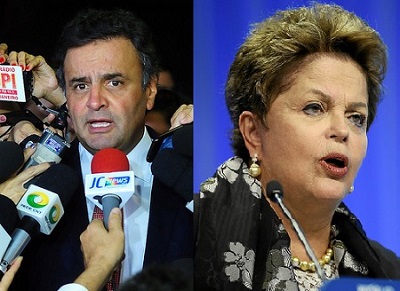
The first round of Brazil’s presidential election has set the stage for a runoff playing primarily to class differences.  By the eve of the election, polls hinted at the real possibility that the center-right candidate Aécio Neves of the Brazilian Social Democratic Party (PSDB) would edge out the other principal opposition contender, former Minister of the Environment Marina Silva.  Silva enjoyed a spike in the polls after she replaced the late Eduardo Campos, who perished in a plane accident in August, as the Brazilian Social Party (PSB) candidate.  Sunday’s results confirmed Silva’s decline, as she captured only 21.3 percent of the votes compared to 33.5 percent for the PSDB and 41.6% for incumbent President Dilma Roussef of the Worker’s Party (PT).  The PT used its potent propaganda machine to portray Silva as a potentially dangerous candidate – an indecisive leader who could not be trusted to sustain popular social programs such as the Bolsa Familia conditional cash transfer program, which has helped lift millions of Brazilians out of poverty.  Also, Aécio and Rousseff built their images upon two iconic ex-Presidents – the former on Fernando Henrique Cardoso (FHC) – seen by the middle and upper classes as the leader who managed to defeat hyperinflation and putting Brazil on track for economic growth – and the latter on Lula, Rousseff’s mentor, who is idolized among the most disadvantaged parts of Brazilian society as the President who helped the poor become less poor.

To win the runoff on October 26, Aécio needs at least 70 percent of Silva’s votes – she has only hinted at supporting him – while Rousseff would succeed with only half of that.  It is clear that Dilma and the PT will double down on their negative advertisements, now aiming at Aécio rather than Marina.  The PT’s barrage over the airwaves will highlight the risks of abandoning the course set out by Lula and followed by Rousseff.  Voters will be told that the opposition may underfund cash transfers, privatize the state oil company Petrobrás or treat it as a profit-making enterprise rather than as a development bank, thus increasing unemployment as occurred during the Cardoso years.  And the PT will no doubt remind voters of its consistent efforts to boost minimum wages and chip away at the vast inequalities that had long characterized Brazil.  Surely they will portray Neves as an elitist out of touch with the majority that has benefited from the PT’s redistributionist agenda.  Aécio and the PSDB, by contrast, will highlight the worrisome slowdown in growth under Rousseff, the failure to significantly improve public services – it was frustration over health, education and, particularly, urban transportation that drove the social protests that began in mid-2013 – and the over-regulated and over-taxed economy.  Most of all, Neves’ campaign will harp on the persistent scandals that have bedeviled the PT over the past decade and that have helped to fuel popular disdain for politicians.

The election results in Brazil are likely to become increasingly polarized in terms of class.  Dilma appears poised to prevail in the poorest states of North and Northeast, where Bolsa Familia and other cash transfer programs, subsidies, wage increases and Lula’s image are compelling.  In turn, Aécio should come out ahead in the richer states such as São Paulo, which offer the largest pool of voters and where highly educated and middle- and upper-income Brazilians are concentrated.  We make divergent predictions: Hershberg anticipates a PT victory, since for all the speculation about the travails of the Latin American left, it has built very substantial foundations of support in societies that credit the left with finally making some advances to tackle Latin America’s yawning inequalities.  Warnings that Aécio represents a return to elite rule will resonate among the PT’s electoral base, and the PT’s success will be nourished by its powerful organizational capabilities.  Melo, by contrast, anticipates a PSDB triumph.  In this scenario, the corruption, disappointing growth rates over the past two years as the commodity boom has slowed, and widespread frustration about the quality of public services will generate an anti-incumbent dynamic that will bring to an end a dozen years of PT rule.

October 10, 2014

Brazil: Is Marina Silva the PT’s Nemesis?

By Luciano Melo

MarinaSilva

Photo courtesy of the Marina Silva campaign website

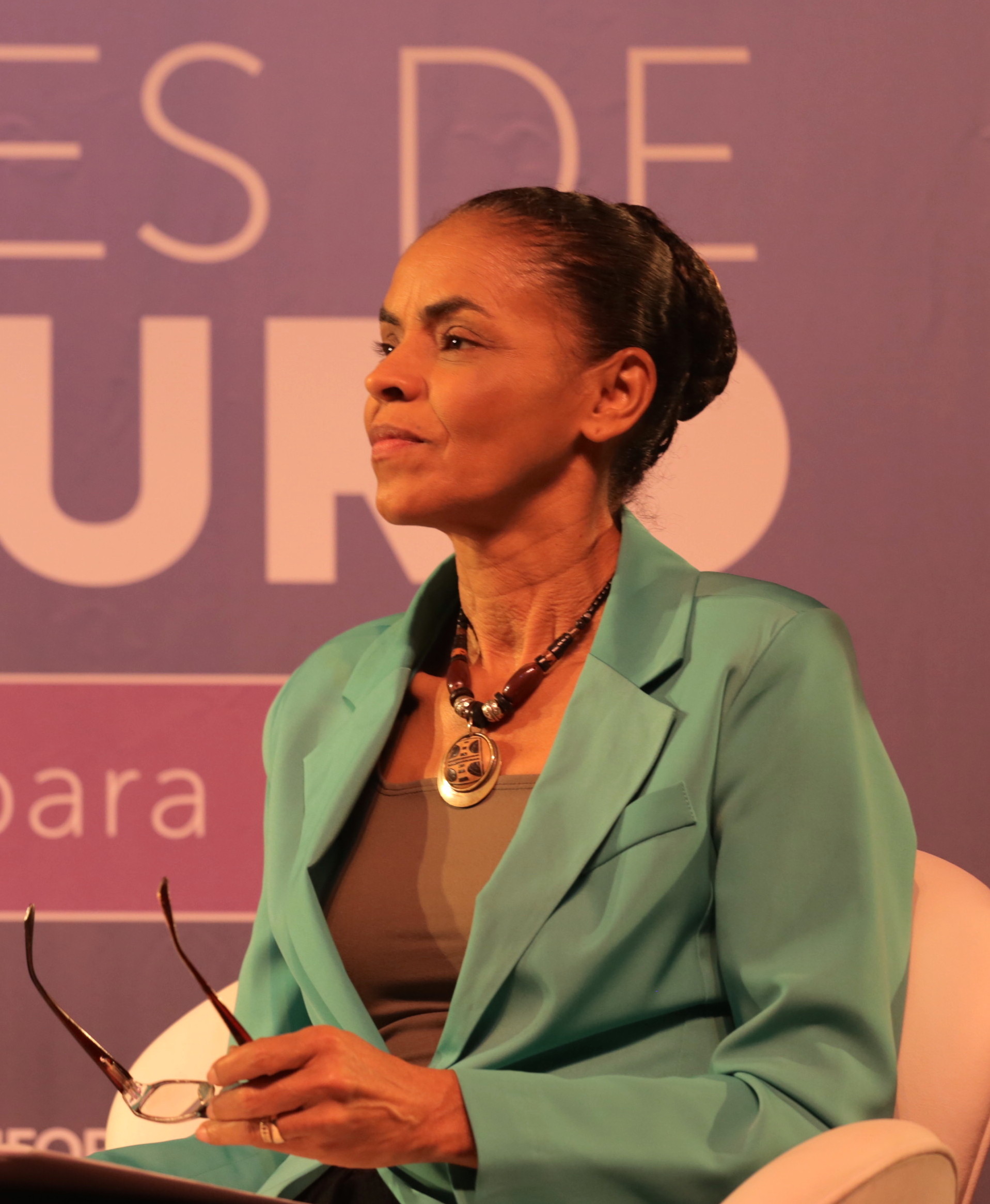
No politician in recent years has been able to shake and polarize Brazilian politics as Marina Silva has since becoming the Brazilian Socialist Party (PSB) presidential candidate after its original nominee, Eduardo Campos, died in a plane crash last month. She has an alluring biography: born into an extremely poor family and illiterate until she was 16, she worked as a rubber tapper and rose to become one of the most prominent ecologists and defenders of the Amazon region alongside Chico Mendes, a true Brazilian hero. After earning a degree in history, Silva entered politics in the mid-1980s. Several years later she received the most votes as a state representative for Acre, served twice as a senator, and later became the Minister of Environment in Lula’s administration (a position from which she resigned due to fundamental divergences with the Workers Party and Dilma Rousseff). In 2007 she won the UN’s Champions of the World award, and three years later she ran for President under the Green Party banner, amassing 20 million votes on a platform emphasizing environmental issues and education.

Recent polls find roughly a third of Brazilian voters favoring Silva in the first round of balloting scheduled for October 5, and running even with or slightly ahead of President Rousseff in an anticipated run-off election three weeks later. The Brazilian media suggest that a large part of Silva’s appeal comes from a personal aura of transparency and rectitude – a refreshing change from others competing for Brazil’s top job. She has also demonstrated an old-fashioned ability to compromise in order to form alliances. A committed environmentalist, Silva teamed up with Eduardo Campos, a titan of agribusiness, and now, heading up the PSB ticket, her running mate is Beto Albuquerque, a moderate farmer who can bring a certain level of balance in the economic-environmental equation. On the separation of church and state, however, Marina may face a difficult balancing act. She is an evangelical Christian, winning a large chunk of religious voters in 2010, and she has defended the teaching of creationism in schools, saying that God created even Darwin. She rolled out an agenda for advancing LGBT rights recently, but criticism by Pastor Silas Malafaia, one of Brazil’s main evangelical leaders, forced her to reverse course and abandon her position 24 hours after having presented it.

Although Brazil is a religious country, laïcité – a French version of secularism – is a serious matter for the upper and middle classes, and Silva’s religiosity may cost her votes. She has exposed her core weak spot, which the other candidates will exploit in the upcoming debates and electoral campaigns. But popular concerns about corruption run much deeper in the eyes of the Brazilian people. The fact that presidents Dilma and Lula and the PT have become synonymous with misconduct in general, and mismanagement regarding Petrobrás in particular – a scandal involving 40 PT members in a multi-million real scheme – weakens their ability to counterattack amidst Silva’s continuous rise. What we will see in the elections in October is therefore a battle between the PT’s Bolsa Família – one of the most successful social programs in the history of Brazil – and a candidate who theoretically embodies honesty and honor. Whatever the outcome, it seems that PT has met its biggest challenge in 12 years.

Building State Capacity in Brazil

By Katherine Bersch, Sérgio Praça, and Matthew M. Taylor*

Photo Credit: Metrix X / Foter / Creative Commons Attribution-NonCommercial-NoDerivs 2.0 Generic (CC BY-NC-ND 2.0)

Photo Credit: Metrix X / Foter / Creative Commons Attribution-NonCommercial-NoDerivs 2.0 Generic (CC BY-NC-ND 2.0)

As the World Cup fades out and Brazilians turn their focus to the October elections, public debate will shift back to economic growth, social services, corruption, and – central to them all – the role of the state.  Is the federal government too big, inefficient and meddlesome, as the opposition argues, or does it need to be strengthened to play a leading role in Brazil’s state capitalist economy, as the incumbent Workers Party has sought?  In a recent paper (click here for draft), based on publicly available data of about 326,000 civil servants working within the 95 most important federal agencies in Brazil, we found a very diverse federal government, with agencies distributed widely on both capacity and autonomy.

Our findings empirically confirm a long literature that highlights the coexistence of so-called “islands of excellence,” with high capacity and high autonomy, alongside low-capacity, low-autonomy laggards.  “Islands of excellence” include Brazil’s Foreign Ministry (Itamaraty), the Central Bank, the Finance Ministry, the Justice Ministry, and the relatively young Comptroller General’s Office (CGU), created in 2001.  Laggards include almost all of the infrastructure agencies, as well as the Ministry of Sports, perhaps helping to explain the recent World Cup construction snafus.  Also interesting are the agencies with high capacity and low autonomy (such as the Federal Highway Police, which most state governors seek to empower and control within their own states), as well as agencies with low capacity and high autonomy, which few politicians seek to control (such as the Public Defenders Office).

We found solid evidence that agency corruption – one of the driving forces behind last year’s political angst and popular protests – is correlated with lower capacity and lower autonomy.  This finding could help frame debate in the upcoming campaigns and beyond: the keys to reducing corruption are to build agencies’ capacity and increase their autonomy from political partisans.  The debate over the role of the state has been ongoing since the return to democracy in the 1980s.  No matter who wins the October elections, the expansion of this data set and measurement effort will provide useful empirical data to more realistically evaluate the evolving performance of the Brazilian state, as well as to recognize the enormous differences and best practices within that state. 

*Katherine Bersch is a doctoral candidate at the University of Texas at Austin.  Sérgio Praça teaches Public Policy at the Federal University of the ABC in São Paulo.  Matthew Taylor, a regular contributor to AULABLOG, teaches at American University.

Brazil: Evangelicals Gaining Influence

By Daniel Azevedo

Photo Credit: Igreja Adventista Central de Porto Alegre / Flickr / Creative Commons Attribution-NonCommercial 2.0 Generic (CC BY-NC 2.0)

Photo Credit: Igreja Adventista Central de Porto Alegre / Flickr / Creative Commons Attribution-NonCommercial 2.0 Generic (CC BY-NC 2.0)

Brazil still has the largest Catholic population in the world, but evangelical churches are gaining in size and political clout.  In the 1980s, persons identifying themselves as evangelicals made up 6.6 percent of the population; today they are 22.2 percent, according to the Brazilian Institute of Geography and Statistics.  Whereas Catholics have generally not organized politically, evangelicals from various parties have gradually been gathering under their religious banner.  They have been growing in numbers and influence since the 2010 elections that chose President Dilma Rousseff.  That year, fearing she would lose the second round of the election to opposition candidate José Serra, Rousseff signed a letter to deputies and senators of the “evangelical bench” promising that she would not sign any laws that went counter to their values, such as legalizing abortion or gay marriage.  The letter gave her the support of evangelical churches, and ensured Dilma’s victory.  Also in 2010, the evangelical bench in the legislature grew 50 percent compared to the 2006 election, reaching 60 deputies and 3 senators.

The evangelical bench anticipates even greater gains in the general elections this October, although polls substantiating its optimism are lacking.  The Folha de São Paulo reports that the Evangelical Parliamentary Front of the House of Representatives estimates it will grow 30 percent, reaching up to 95 representatives – 18 percent of the total House.  This could have legislative consequences.  As a congressman, for example, Pastor Marco Feliciano tried to win approval for a “gay cure” law, which would make it legal for psychologists to treat and “heal” homosexuals in search of heterosexuality.  (Feliciano may at times be an outlier.  Last year he said that “black people are cursed by God in the Bible and, for that reason, Africa is the worst continent in world.”)  Despite the evangelicals’ strong unifying platform, gaining support beyond their bases may be difficult.

The evangelicals seem to have electoral strategies in Rio de Janeiro in place.  Among the four pre-candidates for state governor, two of them are members of the evangelical bench.  Early polls suggest one or the other may become the executive of Brazil’s second most important state, although both face legal problems.  The first one, Anthony Garotinho, has been accused of money-laundering and illegal distribution of political propaganda; his Caravana da Palavra da Paz allegedly misused public money and broke election laws by distributing Bibles and other materials just to people over the minimum voting age.  The other, Marcelo Crivella, is suspected of misusing of public money with his NGO, Farm New Canaan.  (The Portal de Transparência Brasil, an NGO tracking Brazilian politicians, has found that all of the evangelical bench members face unspecified lawsuits, and 95 percent of them are on the list of House members missing the most sessions.)  They are leading the polls, albeit with only 19 percent and 18 percent of intended votes, because the two non-evangelical candidates have apparently more serious political problems.  One is connected to the current and discredited governor, and the other faces serious legal challenges.  Despite the low probability of a breakthrough at the presidential level in the near future, the evangelicals’ efforts in the legislature and states strongly suggest their conservative voice will be an increasingly powerful force to be reckoned with.

Brazil: Sustained Attention to Sustainable Development?

By Evan Berry*

Photo Credit: Rodrigo Soldon / Flickr / Creative Commons Attribution 2.0 Generic (CC BY 2.0)

Photo Credit: Rodrigo Soldon / Flickr / Creative Commons Attribution 2.0 Generic (CC BY 2.0)

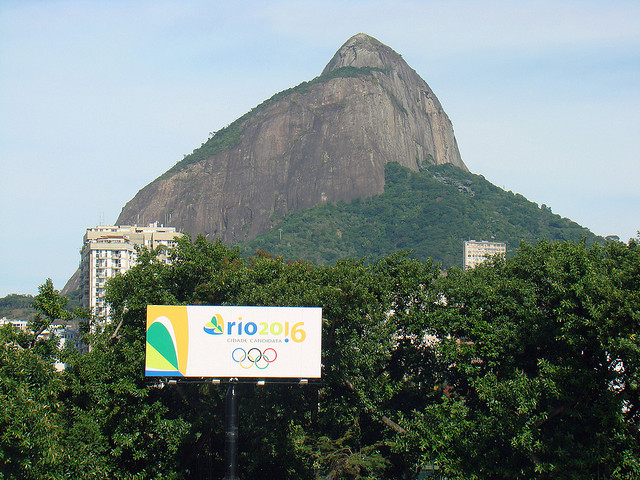
Media coverage of the approaching World Cup in Brazil has touched on the country’s contemporary ecological challenges, but they have glossed over their underlying causes.  Because of Brazil’s association with international sustainability accords, large international events – such as the “Rio+20” sustainable development conference two years ago and the 2016 Olympics – provide vehicles for global news media to focus on Brazil’s performance on environmental issues.  Among this flurry of journalistic coverage, two distinct narratives emerge.  In one, journalists look at sustainability with reference to economic modernization, suggesting that environmental problems are the outcomes of policy failures and ineffective governance.  Commentary in this vein calls for greater technocratic competency and a commitment to the development pathways of the global north.  In the other narrative, sustainability is set in the context of social justice and economic inequality.

These views lead to different responses.  The international bodies overseeing the upcoming sporting events – such as FIFA and the International Olympic Committee – demand that the Brazilian government do more to clean up beaches, improve transportation infrastructures, and purchase carbon offsets to compensate for the impact of new construction.  These prescriptions ignore, however, that environmentalism in the developed northern economies emerged from a distinctly middle- and upper-class preoccupation with aesthetically pleasing environments, such as wilderness, scenic landscapes, and exotic game.  Frustration with the pollution in southeastern Brazil’s Guanabara Bay, for instance, echoes the North American desire for well-managed spaces for outdoor recreation.  So too does the narrow focus on the plight of Brazilian armadillos, the vulnerable species chosen as the World Cup mascot.  This emphasis corresponds with a narrative that many Brazilian leaders would want to put forward – that the natural splendor of Rio de Janeiro in particular, and Brazil in general, can be secured by the kind of straightforward cleanup efforts that attended economic prosperity.  However, Brazil’s ecological woes cannot be solved by garbage scows, and endangered armadillos and the lack of clean recreational spaces are hardly Brazil’s most pressing obstacles to environmental sustainability.  Guanabara Bay is fetid because so many Cariocas, or Rio residents, lack access to basic sanitation.  Armadillos are threatened by deforestation that is as much a byproduct of global economic demand.

As elsewhere, environmental problems in Brazil are caused by myriad social, economic, and political factors.  Ameliorating the most visible impacts of these factors – protecting a charming creature or purifying noxious waters – addresses only symptoms.  International attention to sustainability issues in Brazil should be more mindful of social justice.  Brazil’s current political unrest centers on deeply shared public concerns about injustice, and addressing the problems giving rise to contemporary social movements will offer an important corrective to mainstream public discourse about sustainability.  International attention to the negative environmental impact of international sporting events, and accompanying investments in infrastructure, risks overlooking the unjust structural processes that complicate solutions to environmental problems.  Rather, the global popularity of sport provides an opportunity to deepen and expand international discourse about the human dimensions of ecology.

 *Evan Berry is an Assistant Professor in American University’s Department of Philosophy and Religion.

Brazilian Leadership and the Global Internet

By Sybil D. Rhodes and Leslie Elliott Armijo*

Photo credit: Blog do Planalto / Flickr / CC

Photo credit: Blog do Planalto / Flickr / CC

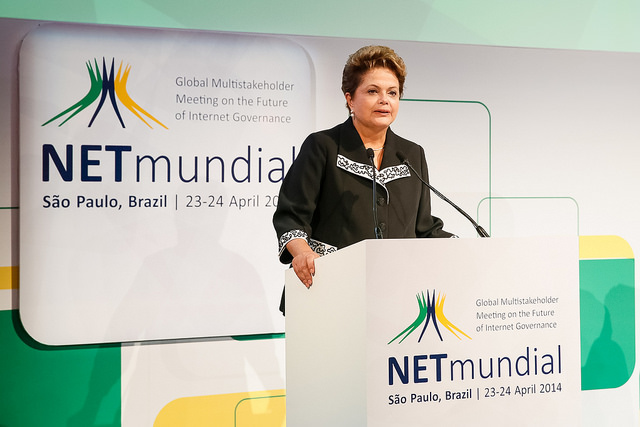
Brazil’s efforts as defender of internet privacy and rights may be effective even if it sparks criticism from all sides of the issue.  Along with German Chancellor Angela Merkel, President Dilma Rousseff has been among the most vocal protestors against spying by the U.S. National Security Agency (NSA).  She used her opening remarks at the United Nations General Assembly (UNGA) in September to criticize the spying.  Three months later, the UNGA passed a resolution initiated by Brazil and Germany in favor of the right to privacy in the digital age.  The Brazilian Chamber of Deputies and Senate have passed legislation, known as the Marco Civil da Internet, which web leaders and scholars consider a pioneering framework for internet governance.  Last week, Brazil hosted the international meeting NETMundial, focused on standards for name registration, domains, and IP addresses.  Rousseff and her Science, Technology, and Innovation minister, Cleio Campolina, emphasized that, as the first such event since U.S. intelligence contractor Edward Snowden leaked information about abuses, privacy concerns should be paramount at the meeting.

Brazil has considered itself an emerging leader in internet governance for at least the last fifteen years, although until 2013 “digital sovereignty” and the allocation of commercial benefits appeared to be more important goals than protecting civil liberties.  Brazil also has counted itself as an important member of a coalition — including India, China, Russia, Arab countries, and the United Nations Working Group on Internet Governance – that has called for less U.S. dominance of internet governance.  The group has proposed that the UN’s International Telecommunications Union (ITU) assume responsibility for the Internet Cooperation for Assigned Names and Numbers (ICANN), the non-profit organization in charge of distributing domain names since 1998.  An American creation, with headquarters in Los Angeles and a Board of Directors supervised by the US Department of Commerce, ICANN is seen by many as embodying U.S.-centric internet regulation.  Critics in Brazil and elsewhere claim that the private-sector and civil-society input into ICANN decisions is disproportionately pro-American.  The U.S. and its supporters, including Google, Microsoft, and civil associations like the Mozilla Foundation and the Electronic Frontier Foundation, argue that the existing regime promotes a “free and decentralized internet” – and that any changes must preserve these principles.

Since Snowden, President Dilma has also renewed emphasis on “digital sovereignty” measures.  For example, provisions in legislation passed in the lower house (but removed from the Senate version) required that Google, Facebook and other companies doing business with Brazilians store their data about Brazilians on local servers.  The government has also promoted building fiber optic cables connections that do not go directly through the United States as a way of preventing NSA espionage.  The economic and technical feasibility of some of these projects is not clear, and some of them have encountered important political opposition within Brazil – because, according to an informal survey of experts, many Brazilians are suspicious of their own government’s regulation of the internet as well.  Language in the new bill simply obligates business to obey national legislation regarding privacy.

Snowden’s revelations have given a boost to efforts to reduce U.S. dominance of internet governance, which previously was viewed as a technical issue for which the existing regulatory regime worked well.  Announcing that the U.S. Department of Commerce will not renew its contract with ICANN when it expires in September 2014, the Obama administration appears to recognize that U.S. credibility as the guarantor of a free and open internet has been undermined.  The exact technical and legal procedures through which privacy and national sovereignty might be better protected on the internet remain open questions in national and global debates.  But Brazil appears poised to play a leading role in setting a moderate middle-range course, one that allows for multipolar or global governance of the internet while protecting the liberal principles the U.S. has long claimed are core values.  Dilma could come in for criticism from both sides – U.S. conservatives who believe that only the United States can guarantee a free internet as well as “anti-imperialist” advocates who will accuse her of selling out to corporate interests.  Moderate heroes are sometimes the most unsung but also the most necessary.

*Sybil D. Rhodes is Director of the MA in International Studies at the Universidad del Cema in Buenos Aires.  Leslie Elliott Armijo is a Visiting Scholar at Portland State University and a Research Fellow at CLALS.  They are currently writing a book about international cooperation in the Western Hemisphere.