Brazil: Sacrificing Anti-Poverty Success?

By Hayley Jones*

Bolsa Familia

Photo Credit: Senado Federal / Flickr / Creative Commons

Brazil’s flagship antipoverty program, the Bolsa Família, faces an uncertain future as the government of Interim President Michel Temer confronts adverse economic and political circumstances.  The program, which provides direct cash benefits to poor households on the condition that children fulfill education and health-related targets, was an important factor in Brazil’s progress on poverty and inequality since the early 2000s – between 2001 and 2013 the poverty headcount ratio declined from 24.7 percent to 8.9 percent, and the Gini coefficient declined from 59.3 to 52.9.  The Bolsa Família (formerly called Bolsa Escola) was a pioneer in the use of cash transfers in social policy in the 1990s.  The idea is enticingly simple: the cash allows families to meet immediate needs, while the education and health conditions ensure poor children are better equipped to lift themselves out of poverty in the long run.  Under Presidents Lula and Dilma, the Partido dos Trabalhadores (PT) put the policy at the heart of its platform, and reaped advantages at the polls with the expansion of coverage and benefits.  The program now reaches about one-quarter of the population.

The social gains made in part thanks to the Bolsa Família may now be at risk.  Brazil has been hit hard by the collapse of commodity and oil prices over the last two years and is currently experiencing what is predicted to be the country’s worst recession since the 1930s.  GDP fell by roughly 4 percent in 2015 and is expected to do the same in 2016.  The deep political crisis gripping the country since earlier this year further threatens the program.  Temer, his party (PMDB), and Finance Minister Henrique Meirelles have stressed the need to cut spending to reduce the deficit.  While many areas of social spending, such as pensions and education, are protected in the budget under the 1988 Constitution,  the Bolsa Família is not.  With the large political constituency benefitting from the program, there is likely little appetite in the interim government to ax the program altogether.  In fact, at the end of June Temer announced a 12.5 percent increase to the Bolsa Família – more than the 9 percent promised by Dilma – to compensate for inflation.  But he also emphasized that benefits should be temporary and that there is a need to focus on exit doors from the program.  Social Development Minister, Osmar Terra, has suggested that the program could be made more efficient and costs cut by 10 percent.

Temer may not be entirely wrong to highlight the need for exit strategies, but they should be exit strategies from poverty rather than from the Bolsa Família itself.  There is so far little evidence that it has done much to change the life trajectories of poor young people that would allow them to move out of poverty. The emphasis on increased school enrollment and attendance as transformative obscures much deeper problems, including poor school progression and completion rates in low-quality schools, a lack of educational infrastructure and resources, poorly trained teachers, and outdated curricula, among others.  If Temer is serious about moving beneficiaries out of poverty and the program, priority will have to be given to correcting regressive spending in public education (which prioritizes higher over basic education); better aligning curricula with labor market demand; and addressing the poor job opportunities for low- and semi-skilled workers. Economic realities and the rhetoric on efficiency and exit strategies do not bode well for such changes.  Under Temer, the Bolsa Família seems likely be limited to a policy tool for risk insurance and meeting basic needs rather than a platform for extending the social gains of the last decade.

July 12, 2016

*Hayley Jones is a DPhil (PhD) Candidate in the Department of International Development at the University of Oxford, United Kingdom.  Her thesis examines long-term poverty reduction in the Bolsa Família program.

Brazil: Daring to Look at Succession Scenarios

By Silvio Levcovitz*

Lava Jato

Photo Credits: Instituto Liberal (Brasil) and Brasil 247 / Google Images / Labeled for noncommercial reuse

Brazil’s snowballing scandals are generating a high level of uncertainty regarding the country’s political future.  “Operation Car Wash”—a two-year investigation by a task force of the Federal Police and the Federal Prosecutors—has already led to the conviction and 20-year imprisonment of several senior officials from Petrobras and prominent construction companies, and others are likely to follow.  In Brazil, congressmen, cabinet ministers, and the President can be criminally charged only by the Supreme Court, through a long, difficult process called “privileged forum.”  On March 17, former President Lula, under investigation for allegedly receiving two properties as a bribe from construction companies, was designated a Minister of State in President Dilma Rousseff’s administration, an appointment that would have afforded him that protection.  The judge pursuing him released a recording of a call from Dilma offering him immunity as well as Lula’s calls on family and other private matters.  Many in the Brazilian legal community have disapproved of the judge’s disclosure of the calls as disrespecting the rule of law and the right to privacy, but the damage to Dilma and Lula was done.

Calls for the President’s impeachment are surging—and she repeatedly rejects the pressure to resign.  On Sunday, March 13, a half-million people protested in São Paulo, and the press estimates that another 1-2 million demonstrated elsewhere around the country.  (Demonstrations supporting Dilma have attracted 100,000 citizens in São Paulo.)  The PMDB, party of Vice-President Michel Temer and President of the House Eduardo Cunha, is officially quitting the government this week, and other minor parties appear likely to do the same, definitely cracking the presidential support.  The impeachment process in Brazil has two steps.  In the House, two-thirds of its 513 members (342 votes) are required for “admission” or approval, in which case the Senate can decide by majority vote to take up the charges, resulting in the President being suspended for up to 180 days.  Conviction requires the votes of two thirds of the 81 senators.  Although press reports indicate the mood is for the impeachment, the government is offering positions and funds individually to Congressmen and in hopes of achieving a low turnout to stop the process in the House.

Predicting the outcome of such a volatile situation is inherently risky, but discussion of post-Dilma scenarios is growing increasingly common.  Should she step down or be removed from office, Vice-President Michel Temer would be her constitutional successor.  Like Dilma, however, Temer is being charged by the Superior Electoral Court on suspicion of illegal campaign financing and, if convicted, would not be allowed to take office.  The next two in line to succeed her—President of the House Eduardo Cunha and President of the Senate Renan Calheiros—have been snagged by Operation Car Wash and face charges by the Supreme Court, suggesting that they too could be disqualified.  (The Federal Attorney General has already asked the Supreme Court to issue a preventive order to remove Cunha because of evidence that he has received US$5 million in secret Swiss bank accounts, without any justification.)  That leaves Supreme Court President Ricardo Lewandowski as a possible successor for a maximum period of 90 days, at which point elections would be called.  As Brazil faces crisis after crisis, the press have taken to commenting that the country’s fast-paced, dramatic events make the American series House of Cards look slow and boring. 

March 30, 2016

* Silvio Levcovitz is a CLALS Fellow and political science PhD candidate at the Universidade Estadual de Campinas, São Paulo.  He has been a public lawyer in Brazil and is researching criminal cases of corruption and civil claims of administrative misconduct from 1991 to 2014.

Brazil: Crises Hindering Foreign Policy

Dilma 2016

Photo Credit: Marcelo Camargo / Agência Brasil / Flickr / Creative Commons

by Tullo Vigevani*

The pace of Brazil’s rise in international affairs since 2000 is likely to be slowed by the multiple crises facing President Dilma Rousseff’s government and the private sector, but Brasilia will strive as best it can to maintain its global and regional priorities.  Political tensions are soaring amid corruption indictments and severe economic contraction – the nearly 4 percent decline in GDP in 2015 is expected to be repeated this year, with increasingly negative social consequences.  The government faces growing criticism that extends beyond the principal opposition parties: its own party base and supportive labor unions and social movements criticizing Rousseff’s administration.  The corruption investigations have spread far beyond the national oil company, Petrobras, and into corporate networks across economic sectors, exacerbating a climate of growing anxiety.  Major media are railing against the President and her predecessor, Luiz Inacio Lula da Silva, whose detention for questioning by a judge last week deepens the crisis and further dims the already faint prospects for a restoration of stability in 2016.

These developments have created an element of paralysis in foreign policy.  Foreign minister Mauro Vieira, like his two immediate predecessors – Luis Alberto Figueiredo (2013-2015) and Antonio Patriota (2011-2013) – has been unable to sustain the “active and proud” policy of Lula-era Foreign Minister Celso Amorim (2003-2010).  After basking not long ago in the fruits of its assertive foreign policies – including selection as host of the 2016 Olympics – Brazil’s government now is dealing with matters such as the Zika virus and microcephaly taking front stage.  Rousseff on one hand is barraged by criticism of a lack of macroeconomic rigor and the failure to better integrate Brazil’s economy into global production chains, and on the other she is criticized for slow investments and development policies.  Her ambition to promote South American trade and economic integration is being undermined by the recessionary pressures confronting Brazil and neighboring economies buffeted by the end of the commodities boom.

  • MERCOSUR remains a priority for the administration. Criticism by liberal economists will mount, however, that Mercosur, as a customs union, discourages potential agreements with developed economies, particularly the United States, thus exacerbating Brazil’s de-industrialization.  There is evidence that Mercosur helps companies that produce high value-added goods: whereas in 2014 manufacturing accounted for 77 percent of Brazilian exports within Mercosur, it accounted for only 4 percent of exports to China.  (The figures for the European Union and the U.S. were 37 and 55 percent, respectively).  Progress on trade agreements with the United States and other developed countries appears unlikely, but agreements on trade promotion seem likely.
  • Cooperation with UNASUR will remain a priority as well, but plans that rely on Brazil’s ability to provide resources face new political and economic restraints. The Ministries of Finance and Planning and the Central Bank reportedly are going to rein in contributions of the Brazilian Development Bank (BNDES), and funding for the South American Council of Infrastructure and Planning (COSIPLAN).  Initiatives such as the South American Defense Council will continue.  Clearly, state enterprises such as Petrobras and private-sector conglomerates will face limits on their foreign activities, reducing Brazil’s influence in the region.

The relationship between domestic and international affairs is inescapable, and Brazil is no exception.  But even as the domestic political and economic conditions deteriorate for a period, the country will not turn inward or abandon its interest in the international arena, particularly with China and the BRICS.  However rough the road ahead, President Rousseff’s government appears likely to remain steadfast in its approach to regional diplomatic and political organizations – including the Community of Latin American and Caribbean States (CELAC) and the OAS – even though resources will be tight.  It will remain active, within its diminished capacity, in an array of multilateral settings ranging from UN peacekeeping operations and the FAO, to the G-20, WTO and IMF.  Moreover, senior officials in Brasilia, including in the Foreign Ministry, appear committed to stronger bilateral ties with core partners, particularly the United States, and continued Brazilian support for democratic stability throughout Latin America, including in resolution of the Venezuelan crisis.  Even though resources and performance may suffer, a robust role in the hemisphere appears likely to remain a pillar of Brazil’s foreign policy.  The idea of Brazil’s autonomy in the international arena has deep roots, and whatever the domestic criticism leveled against the Rousseff administration, these will be matters of interpretation rather than a fundamental questioning of Brazil’s greater insertion into global processes and of political and economic interdependence.

March 7, 2016

*Tullo Vigevani is Professor of Political Science and International Relations at the State University of São Paulo (UNESP) and a researcher at the Center for Studies on Contemporary Culture (Cedec) and the Brazilian National Institute of Science and Technology for Studies on the United States (INCT-INEU), in São Paulo.

Brazil: Not-so-Happy New Year

By Matthew Taylor*

Brazil Basta

Photo Credit: Antonio Thomás Koenigkam Oliveira / Flickr / Creative Commons

A vicious combination of corruption scandal and economic malaise suggests a troubled new year awaits Brazil.  Economists estimate gross domestic product has contracted 3 percent this year and will decline a similar amount in 2016, while inflation and weak government finances hamper efforts to stimulate growth.  Two of three big rating agencies have cut Brazilian debt from investment grade to junk. Unemployment has risen from under 7 percent a year ago to nearly 10 percent, with forecasts of 12 percent on the horizon.  Efforts to reform fiscal policy are getting nowhere, and the champion of fiscal reform, Finance Minister Joaquim Levy, has just resigned.  The bonanza launched by the 2003-2010 presidency of Lula da Silva – seemingly setting Brazil on a unique path of state capitalist development – is long over.

The country’s interconnected scandals cast shadows on many of the leading players on the national stage, including President Dilma Rousseff.

  • Petrobras, the crown jewel of Brazil’s state capitalist model, is at the center of allegedly massive corruption schemes. Rousseff, who was chair of the Petrobras board at the time of the alleged wrongdoing, has claimed absolute ignorance.  But the charges implicate Brazil’s leading political and business elites, many of whom have been jailed in recent months.
  • A feud between Dilma and the president of the Chamber of Deputies, Eduardo Cunha, reached a new low this month after Cunha’s approval of impeachment proceedings against her. (His own ethics problems continue to fester.)  The charge against Dilma is not of personal corruption but rather that Rousseff flouted budget laws by using public banks to cover up unauthorized debt issuance and off-books spending.  Rousseff supporters have argued that the impeachment charges represent the worst of golpismo, or coup-mongering, and a constitutional overreach that threatens to undermine democracy.

For Brazil, 2016 will be dramatic and unpredictable – as the country weathers the most dangerous political crisis since the impeachment and resignation of President Fernando Collor in 1992.  Dilma’s opponents will have difficulty convincing two-thirds of the Chamber and Senate to oust her, but the crisis is already creating significant fissures in the democratic system.  The parties have been turned upside down.  Even if Dilma survives in office, she faces nearly impossible odds in restoring the credibility of her administration and party, the Partido dos Trabalhadores, or PT.  There are early indications that the PT will face a bloodletting in the 2016 municipal elections, and former President Lula, the party’s once-ironclad standard-bearer, has the highest rejection rate (55 percent) of any potential candidate in the 2018 presidential contest.  The PMDB, Dilma’s coalition partner, is threatening to break with the government, but is internally divided. The opposition PSDB is facing scandals, protests, and troubles of its own in the states it governs.  The newfound proactivity of prosecutors and judges is making democratic checks and balances work as never before – and is largely welcomed by Brazilians – but Brazil’s old party system may not be able to keep pace.  Rumblings for a rethinking of the political system will grow louder in the new year, as the crisis deepens.

December 21, 2015

*Matthew M. Taylor is associate professor at the School of International Service at American University.

Transparency in Brazil: More Progress than Meets the Eye

By Vanessa Rodrigues de Macedo*

Photo Credit: Antonio Thomás Koenigkam Oliveira / Flickr / Creative Commons

Photo Credit: Antonio Thomás Koenigkam Oliveira / Flickr / Creative Commons

Amid all the corruption scandals shaking Brazil in recent months, positive signs about future prospects for accountability – in a country where it has historically been lacking – are easy to overlook.

  • The judicial system is improving and – since the historic conviction of 25 of 37 defendants in the notorious mensalão bribery case in 2012 – has shown commitment to meaningful outcomes in corruption cases.  Prominent offenders who in the past would have been untouchable today face a significantly higher probability of conviction and imprisonment.  In March, the Supreme Court authorized investigations into more than 50 high-ranking officials, including the leaders of both legislative houses.  In July-August, prosecutors launched investigations into former President Lula da Silva (as an informant) and senior Petrobras officials.
  • Important transparency initiatives are also taking hold. On paper, these are some of the most demanding standards in the world.  The Freedom of Information Act (FOIA) enacted in 2011 ranks among the top 20 FOIA laws in the world, according to the Global Right to Information Rating.  Since 2012, more than 300,000 FOIA requests have been made through the online request system (e-sic) created by the law. No fewer than 98.34 percent of these requests have been replied to, with an average response time of 14 days.
  • Brazil has been at the forefront of promoting transparency globally.  Together with the United States, it was the founding co-chair of the Open Government Partnership (OGP), a multi-stakeholder partnership that now involves more than 60 countries.

The impact of such initiatives has been limited, however, because they were launched as a result of the mobilization of a handful of NGOs, journalists and international actors, rather than broad societal pressure.  Street protests against government policies have had massive turnouts over the past couple years, but mobilizations in favor of concrete transparency measures and similar reforms have not involved wide swaths of citizens.  Cultural change at the popular level has been slow, reflecting a lack of social maturity to accept responsibility to monitor public policy and demand transparency.  Nonetheless, some important initiatives, such as joint government-citizen policy conferences to discuss public policies, are attracting significant citizen participation. Between 2003 and 2010, 70 such conferences drew 6.5 percent of the Brazilian population, according to academic tallies, and from 2010 to 2014 there were 26 more conferences.

That these achievements haven’t ended corruption is not a sign that they’re useless. Rather, the consolidation of transparency norms and institutions; the continued assertiveness of Brazilian prosecutors and judges; and the expanding opportunities for citizen engagement suggest that the prospects for inculcating a culture of accountability in Brazil are not as bleak as might appear in the almost-daily headlines about endemic corruption in politics and big business. Having transparency initiatives in place has the potential over time to make corruption less frequent, and the more engaged that Brazilian society becomes in the implementation of transparency norms the more likely it is that massive scandals such as those around Petrobras and Lava Jato will become the exception rather than the rule.

*Vanessa Macedo is a CLALS research fellow and political science PhD candidate at the Instituto de Estudos Sociais e Políticos at the Universidade do Estado do Rio de Janeiro (IESP/Uerj).

Dilma – and Brazil – in Crisis

By Eric Hershberg

Photo Credit: Ministério da Ciência, Tecnologia e Inovação / Flickr / Creative Commons

Photo Credit: Ministério da Ciência, Tecnologia e Inovação / Flickr / Creative Commons

Brazil’s corruption scandals and deepening recession have raised doubts about not only the viability of President Dilma Rouseff’s government, but also about the national renaissance and global role that Brazilians have long strived for and seemed only recently to have achieved.  The commodity boom of the past decade propelled Brazil to become the world’s sixth largest economy and make major inroads against its historically obscene levels of poverty and inequality.  Often working in tandem, Brazil’s leading public and private enterprises, assisted by the generous state development bank, prospered immensely and fueled growth in Brazil itself and elsewhere in Latin America, building infrastructure from Ecuador to Cuba.  Four Partido dos Trabalhadores (PT) presidential victories in a row (two each for President Lula da Silva and for Dilma) appeared to validate a development strategy built upon government alliances with ambitious large firms and generous cash-transfer programs for needy segments of the population, which became reliable sources of electoral support.  Brazil, the country that skeptics considered unlikely to ever fulfill its aspiration of becoming more than “the country of the future,” seemed to have turned a historic corner – until it all came crashing down.

With the commodity boom now over, the economy is contracting at an annual rate of more than 2 percent, and a Central Bank survey released last week forecast that the recession will continue into 2016.  The past decade’s extraordinary gains in formal sector employment and wage rates are being rapidly eroded.  The dire macro-economic situation forced Dilma to shift course earlier this year, when to the dismay of her PT base, she appointed pro-austerity economist Joaquim Levy as Finance Minister.  His mandate – to tackle fiscal deficits – required dealing with the end of the commodity-driven cycle of growth and problems with the state capitalist model pursued by the PT since 2004.  Levy’s strategy will take time to bear fruit, probably through most of Dilma’s term, and will be painful.

But the President’s biggest challenges stem from the vast corruption scandals that have devastated her credibility and the reputation of the enormous companies that were the protagonists of Brazil’s latest miracle.  Although Dilma has not been charged with any wrongdoing, the scandalous actions at state oil firm Petrobras, which at its height accounted for as much as 10 percent of Brazil’s GDP, were in full flourish when she was Lula’s Energy Minister and nominally in charge.  Prosecutors have filed evidence of bribery and kickback schemes that bilked billions of dollars from the company’s coffers, and officials in both the PT and allied parties have been charged with serious crimes.  Dilma’s popularity ratings are now in single digits, with little prospect of improvement.  Street protests calling for her impeachment are more focused than those that tormented her in 2013 and 2014, when popular discontent focused less on corruption than on the poor quality of transportation, education, health care, and other public services at a time when the government was making huge investments to prepare for the 2014 World Cup and the 2016 Olympic games.

Further damaging revelations are likely as investigations continue, and they will affect an ever-wider array of political actors and major economic enterprises.  Many of the president’s political foes support either impeachment or resignation, while others are inclined to let her government wither in place.  The key alternative parties – the PSDB of former President Cardoso and the PMDB (the latter rumored to be closer than ever to breaking its tenuous alliance with the President) – are not aligned in a way that establishes a clear path to push Dilma out.  The most optimistic scenario for the President entails remaining, terribly wounded, in office, but this could change if, as many observers believe, the Auditing Court (TCU) determines that Dilma has misused public funds, or if the TSE should press forward with investigations of illegal financing of Dilma’s campaign.  

If two or three years ago it seemed plausible that history would credit the PT for having transformed Brazil into a high-quality democracy with improved social inclusion, today that appears to have been a pipe dream.  Beyond the immediate factor of Dilma’s ineffectual leadership, there are broader, systemic reasons for this tragedy.  Brazil’s fractured party system and the coalition-building it requires engenders corruption-fueled legislative bargaining, as evidenced by the Mensalão scandal.  Brazilian state capitalism has blurred lines between state economic policies and corporate beneficiaries, further fueling a culture of corruption evident by the fact that roughly 40 percent of members of Congress are under investigation, according to the New York Times.  Regardless of whether Dilma survives in office, the current moment has drawn Brazilians’ attention to the deep political and economic roots of their current situation, and dashed their hopes of soon becoming “O País do Futuro.” 

August 24, 2015 

Brazil: Jailing the Youth

By Paula Orlando*

Brazilian Penitentiary System.  Photo Credit: Marcelo Freixo / Flickr / Creative Commons

Brazilian Penitentiary System. Photo Credit: Marcelo Freixo / Flickr / Creative Commons

A push for legislation to lower the age of criminal responsibility to 16 years could worsen court backlogs and overcrowding in Brazil’s notorious prisons.  According to the International Center for Prison Studies (ICPS), the country’s jails now hold the fourth largest prison population in the world, behind the United States, China, and Russia.  The Brazilian inmate population has doubled in the past ten years – from 296,919 people in 2005 to over 615,000 now – boosted by arrests of young and black people.  The Map of Incarceration, a study released this month by researchers at the Federal University of Sao Carlos (UFSCAR), shows that prisoners are increasingly between the ages of 18 and 29 (54.8 percent) and black (60.85 percent), with a growing presence of females (from 4.35 percent in 2005 to 6.17 percent in 2012).  The study also notes that the main reasons for arrest are crimes against property and “involvement in drug trafficking.”  Further, on average 38 percent – or four in every ten inmates – are awaiting trial.  According to a report by the OAS’s Inter-American Commission on Human Rights, the wait times may vary from months to years – sometimes longer than the actual sentence for the crime committed.  Of the total jail population, over 18 percent would be eligible for alternative sentences, but they either haven’t gone to trial yet or the judges have opted for heavier sentences.

A group of hardline conservative legislators – the “bullet caucus” – is pushing aggressively for a law that would lower the age of criminal responsibility from 18 to 16 and consequently place more youth in the already overcrowded adult jails.  Currently, the Child and Adolescent Statute (ECA) establishes that those between 12 and 17 years of age who committed a crime should be sent to juvenile centers, and for a maximum of three years.  The proposal to lower the age has received overwhelming popular support. This support is generally based on the perception that minors commit more violent crimes because they are not currently accountable as adults – and that harsher sentences would deter them.  However, official data shows that, among those in the juvenile system, only 9 percent committed violent crimes.  On the other hand, homicide is the leading cause of death of young people between the ages of 15 and 29.  Out of the 56,000 yearly homicides, 30,000 victims are young.  By crossing data from the Ministry of Justice and the 2014 Map of Violence, the report also debunks the popular perception that more arrests lead to safer cities.  On the contrary, just as incarceration grows, homicide rates have also steadily risen in the country.  According to press reports and other observers, there’s a good chance the legislation will move forward in the next few weeks.

Since the bill amends the Brazilian Constitution, it must pass both the Chamber of Deputies and the Senate with at least two-thirds of the votes.  In addition to increasing youth incarcerations, if passed, the initiative will undermine the 1990 Child and Adolescent Statute, considered a landmark by children’s rights advocates.  It will further remove the state from its responsibility for the protection and education of the youth, essentially eliminating any chance of youths’ rehabilitation while broadening the “school-to-prison pipeline” that envelopes many.   Moreover, passage of this reform, under the banner of law and order, will strengthen the ultra-conservative sectors – including some religious leaders and representatives of agribusiness – who already dominate the Brazilian Congress in an open crusade against social welfare policies and minority rights. 

 June 29, 2015

*Paula Orlando is a CLALS fellow and a PhD candidate at the School of Communication at American University.

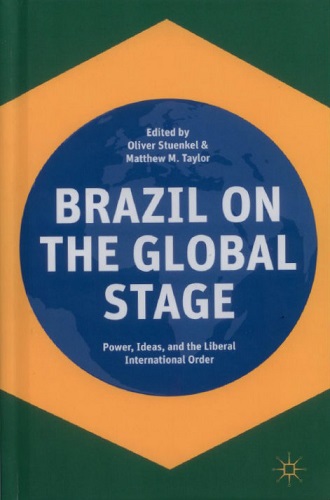
Brazil on the Global Stage: Power, Ideas, and the International Order

By Matthew Taylor and Oliver Stuenkel*

Now available via Palgrave Macmillan.

Now available via Palgrave Macmillan.

Brazil has risen to become the seventh largest economy and fourth largest democracy in the world – yet its rise challenges the conventional wisdom that capitalist democracies will necessarily converge to become faithful adherents of a U.S.-led global liberal order.  Indeed, Brazil demonstrates that middle powers, even those of a deeply democratic bent, may offer important challenges to prevailing conceptions of the world order, differing in their views of what democracy means on the global stage and how international relations should be conducted among sovereign nations.  For Brazil, successful diplomacy involves an increased voice for the developing world, greater accountability in multilateral institutions, and a desire to reduce emphasis on coercive instruments.

  • Because the role of middle powers such as Brazil is often less easily understood in the realist terms that dominate U.S. foreign policy circles, its foreign policy stances are often portrayed by frustrated Washington officials as quixotic and naïve, or ridiculed as puerile and petulant third-worldist jabs at a stereotypical Tío Sam, intended only to win popular approval from a nationalistic and anti-American electorate. In fact, Brazilian foreign policy positions usually have deeper and more enduring origins, embedded within a deeply held set of beliefs that together shape Brazil’s rational strategic perspective on the structure of power in the world today.
  • Brazil’s new role on the world stage has much to do with the country’s success in addressing its own domestic challenges under a succession of democratically elected presidents. Over the past three decades, Brazil has left behind its history of economic disarray, established a robust democracy, and begun to address its record-setting inequality.  It has found paths past the hyperinflation and financial crises of the 1980s and 1990s, undertaken substantial institutional reforms to overhaul the gargantuan and inefficient public sector, and implemented highly regarded social policies.  Even its recent stumbles can be seen in the positive light of democratic progress: the demonstrations that took hold in many Brazilian cities in 2013 and 2014 can largely be attributed to a growing middle class impatient with the pace of change and increasingly conscious of its political rights, a direct consequence of the important successes of the past generation.  Although the country continues to face a number of domestic challenges, the gains of the past generation appear to have fostered an enduring intent to play a role on the world stage.

These conclusions and others are presented in a book entitled Brazil on the Global Stage: Power, Ideas, and the Liberal International Order (Palgrave Macmillan, 2015), co-edited by Professors Matthew Taylor and Oliver Stuenkel.  The book is based on a conference sponsored jointly by American University’s Center for Latin American & Latino Studies and School of International Service, and includes contributions by eight faculty members from AU and Fundação Getulio Vargas (FGV), as well as experts from the Washington community.  It offers a general evaluation of Brazil’s stance toward global order, while also addressing its postures on specific aspects of governance, including trade, foreign and environmental policy, humanitarian intervention, nuclear proliferation, and South-South relations, among other topics.

May 21, 2015

*Professors Matthew Taylor and Oliver Stuenkel teach at American University’s School of International Service and the Fundação Getulio Vargas in Brazil, respectively.

Corruption in Chile and Brazil

By Luciano Melo

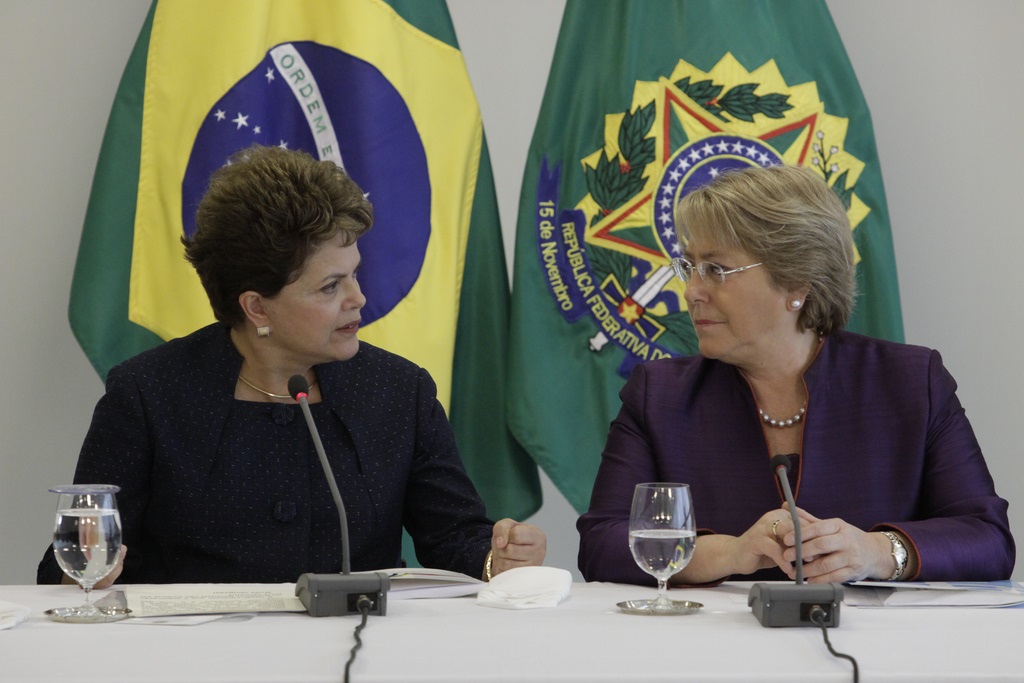
Brazilian Pres. Rousseff (l) and Chilean Pres. Bachelet. Photo Credit: UN Women / Flickr / Creative Commons

Brazilian Pres. Rousseff (l) and Chilean Pres. Bachelet. Photo Credit: UN Women / Flickr / Creative Commons

A growing perception of corruption in Latin America, most recently in Brazil and Chile, is eroding confidence in two of the region’s most dynamic presidents – Dilma Rousseff and Michelle Bachelet.  The Chilean and Brazilian corruption cases are both serious, but differing perceptions and expectations in the two countries suggest the scandals will have different impacts.

  • Chile has long been the darling of economists and political scientists (and U.S. policymakers) in terms of democratic maturity, economic development, and transparency. The use of political influence to secure millions of dollars in sweetheart loans there has pulled the country down from its high perch, and since the issue directly touched President Michelle Bachelet’s own family members, it has become a huge deal in and outside Chile.
  • Although among the six main economies in the world and alone among the BRIC countries in boasting a stable democratic system, Brazil, by contrast, has repeatedly been tainted by corruption scandals that would lead to the fall of most Scandinavian governments in a matter of days. Former President Lula’s son became a millionaire while his father was in power, yet this fact hardly stained the ex-President’s popularity.  The scandals weighing down President Dilma Rousseff are different.  Brazilian citizens customarily have thought of Petrobras, one of the few remaining state enterprises after the wave of privatizations under President Cardoso during the 1990s, as a great source of national pride, and this sentiment was encouraged by the PT government, never a fan of the neoliberal predilections of its predecessor.  So when the scandal touched almost all of the party’s leaders, in addition to the prized national oil company, even Brazilians inured to corruption felt pain. Moreover, Lula and Dilma’s party, the PT, had promised to do politics in a different way.  As a union leader and a woman who fought against the dictatorship, respectively, they represented the rise to power of leaders based entirely outside the traditional parties and their murky ways of doing business.  Now, some of Dilma’s disillusioned supporters are demanding her impeachment, and many famous artists who once endorsed the PT are feeling betrayed.

Latin American voters have long manifested contrasting expectations of their presidents – cynicism about their venal nature coincided, as Latin America specialist Guillermo O’Donnell once said, with hope that they be “acclaimed saviors.”  Within the codependent relationship between citizens and politicians, trust is impaired once betrayal surfaces, but the marriage normally continues.  In some cases of rupture, as happened with impeached President Fernando Collor in 1992, it hasn’t meant the end of the political affair.  In the October 2014 elections Collor was reelected as Senator for the state of Alagoas.  Dilma and Bachelet have already said they will not resign, and that they intend to implement a comprehensive cleanup.  The road will be easier for Bachelet.  The Chilean scandal is still small and remains manageable, and although the decline in commodity prices has already  affected the country’s economy, further taxing Bachelet’s popularity, Chile has a sovereign reserve fund to cushion any blows.  For Dilma the conjuncture is considerably bleaker.  She was on the board of Petrobras while its executives were engaged in costly shenanigans, and it is now known that the fraudulent scheming also involved the Health Ministry and the state-owned bank Caixa Economica Federal.  And in Brazil, in contrast to Chile, the fiscal situation is sufficiently tight as to constrain the president’s room to maneuver as the commodity-driven economy stagnates.  At this point both women appear likely to survive their challenges, but the road ahead looks a lot tougher for Dilma than for Bachelet.

April 16, 2015

Brazilian Truth Commission Looks at Police Violence

By Paula Orlando

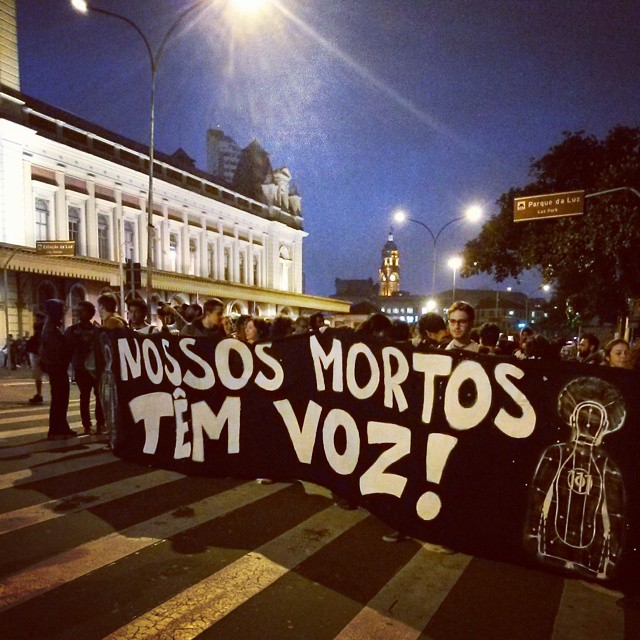
March in commemoration of the 22nd anniversary of the Carandiru massacre in 2014. Photo credit: veredaestreita / Flickr / CC BY-NC-SA

March in commemoration of the 22nd anniversary of the Carandiru massacre in 2014. Photo credit: veredaestreita / Flickr / CC BY-NC-SA

A new truth commission is about to investigate Brazil’s legendary police brutality and, for the first time, attempt to bring some public accountability for the crimes committed by the state. Police kill an estimated six people per day. Civil society organizations persuaded the Sao Paulo Legislative Assembly (ALESP) to establish the commission, the first to focus on human rights violations in the post-dictatorship period. It will hear testimony from witnesses and survivors of police brutality, and examine documents and other evidence related to major cases of police violence in the city and state in the last decades. The initiative follows the recent release of reports by the National and Sao Paulo State Truth Commissions on human rights violations during the military dictatorship (1964-1985). In fact, the reports suggested that present-day violence should be understood as a legacy of the lack of accountability for past violations.

The “Truth Commission of Democracy Maes de Maio” – named after a prominent movement of family members of victims of police violence that fights for justice and changes in security policies – held its first hearing on March 21. Parents of some of those killed in May 2006, when at least 493 civilians were killed in a period of 10 days, testified. (The National Truth Commission had accounted for 434 people killed during the 21 years of military rule.) The violence in May 2006 took place in the context of a conflict between the police forces and the “First Command of the Capital” (PCC) – a criminal organization formed within the detention system, and was justified as part of a “war on crime.” A study conducted by the International Human Rights Clinic of the Harvard Law School and the Brazilian Human Rights Organization Justiça Global contends that at least 122 deaths were directly linked to the police, and many of these bodies showed signs of execution. Four other civilians remain missing after nine years, and nearly all the cases have been archived without a resolution. With the participation of representatives designated by the National Secretariat of Human Rights, legislators, and members of social movements, the new commission will also examine other massacres, such as one at the Carandiru penitentiary in 1992 and the nighttime slaughter – also linked to police officers – of several people who were sleeping near the Sé Cathedral, in downtown Sao Paulo, in August of 2004.

The truth commission is more than a symbolic step towards recognizing and bringing some degree of state accountability in human rights violations; it shows the growing pressure of the movement against anti-police violence and in favor of justice and reparations for victims. Deputy Adriano Diogo, a major proponent of the panel, has warned that the way ahead “will be difficult; this is a discussion that the Brazilian government does not accept to have.” Insofar as the truth commission succeeds, it will not only create an institutional space linked to the state to clarify cases of police violence; it will stimulate an important discussion of the legitimization of police brutality in the context of “fighting crime.” In addition, it could contribute to the understanding that unlawful police violence is a form of political violence that no democratic society should endure.

April 6, 2015