Gender Violence in Argentina and the Education of Mauricio Macri

By Brenda Werth*

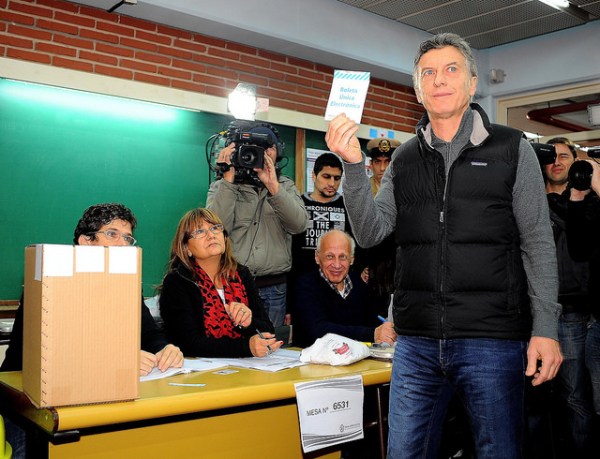
Macri Ni Una Menos

Photo Credit: Mauricio Macri Facebook page. Public Domain.

Argentina’s new President, Mauricio Macri, has an historic opportunity to address the country’s longstanding crisis of gender violence.  In a radio interview in 2014, he notoriously stated that “All women like to be catcalled,” and asserted, “I don’t believe the ones who say they don’t.”  Little did he know at the time that the most intense period of his presidential campaign in 2015 would coincide with a revolution in public awareness of gender violence in Argentina.  #NiUnaMenos – a movement launched in response to a rash of femicides and their graphic coverage by the news media – organized  marches in cities across Argentina, Uruguay, and Chile, drawing an estimated 300,000 protesters in Buenos Aires alone last June.  Journalists, artists, and activists, in collective denunciation of machismo and violence against women, demanded that the government develop a plan of action to implement the Comprehensive Law on the Prevention, Punishment and Elimination of Violence against Women (Law 26.485), approved in 2009.  The law was a significant milestone in addressing violence against women at the national level, yet without government support, its effectiveness has been limited.  Current data indicate that a femicide takes place every 30 hours in Argentina, and statistics suggest that the total number of femicides occurring in 2015 will meet or surpass numbers in 2014.  The NiUnaMenos movement has captured the public’s attention.

The presidential candidates (Macri included) took note of the impact of NiUnaMenos and pledged support to prevent violence against women as outlined in the five major points it published.  Macri posted a picture of himself holding a handmade #NiUnaMenos sign on Facebook and Twitter.  Yet activists remain concerned about Macri’s sincerity, not just because of his 2014 remarks.  As mayor of Buenos Aires (2007-15), he undermined initiatives to prevent violence against women and provide assistance to victims.  Specifically, in 2014 he closed an outreach center for victims of sexual violence that had operated under the Subsecretary of Human Rights in Buenos Aires, and he reduced the budget of the National Agency for Women from 0.1 percent in 2007 to 0.06 percent in 2015.

Macri has his work cut out for him if he wants to be perceived as a leader confronting Argentina’s gender violence.  Although his promises to slash government spending suggest social programs will suffer, there are some promising signs.  Macri’s Minister of Social Development, Carolina Stanley, has offered the post of President of the National Council for Women to Fabiana Tuñez, the founder of the Casa del Encuentro, a leading NGO on gender rights and eliminating sexual violence – and key in the #NiUnaMenos movement.  In a broader human rights framework, Macri’s agenda still remains relatively undefined.  Although his vision will depart significantly from former President Cristina Fernández de Kirchner’s, he has reiterated his commitment to continuing trials against former military accused of human rights abuses during dictatorship, rejecting claims that such efforts reflect “politics of revenge.”  In interviews, moreover, he has emphasized a forward-looking conception of human rights, rooted in the 21st century, focusing on issues related to pubic health, education, and freedom of expression.  While some observers view this as a regression to a “culture of amnesia” associated with the Menemist era, Macri has an opportunity to move the country forward by heeding activists’ demands for leadership addressing gender violence in Argentina. 

January 7, 2016

* Brenda Werth is Associate Professor of World Languages and Cultures at American Unviersity.
What Does Macri’s Victory Mean for Latin America’s Left Turns?

By Eric Hershberg and Fulton Armstrong

South America right

Photo Credits: Douglas Fernandes and _Butte_ / Flickr / Creative Commons

Argentine President-elect Mauricio Macri’s actions since his historic victory last week indicate a rightward shift in domestic and foreign policy that some observers are tempted to proclaim as part of a broader Latin American trend.  He has reiterated promises of broad economic reforms and appointed a cabinet – including former JP Morgan executive and ex-Central Bank chief Alfonso Prat-Gay as his finance minister – to implement them.  He has further pledged to reverse outgoing President Fernández de Kirchner’s protectionist trade policies.  (During the campaign, advocates of unbound capitalism cheered when he named Ayn Rand’s “The Fountainhead” as one of his favorite books.)  Macri has named Susana Malcorra, a senior aide to UN Secretary General Ban Ki-moon with strong diplomatic credentials, to be his foreign minister and, for starters, directed her to reverse policies he judged to coddle Venezuela. The President-elect, who takes office on December 10, is speaking with the confidence of a President elected with more than a 3-point margin over Kirchnerista candidate Daniel Scioli and with control over more than the 91 seats (one third of the total 257 seats) that his Cambiemos coalition won in the lower house of Congress.  (His party is the first, however, to control simultaneously the Province of Buenos Aires, the City of Buenos Aires, and presidency.)

The temptation in some quarters to declare Macri’s victory as the beginning of the end for Latin America’s “Left Turns” is understandable but nonetheless premature.  To be sure, the Argentine electoral results coincide with other major setbacks for various currents of the Latin American left:  The Chavista project in Venezuela is crashing; Brazilian President Rousseff and her party are mired in a corruption morass and economic crisis whose combined effects may cut short her time in office; President Correa, facing a dire economic situation in Ecuador, is increasingly talking about abandoning efforts to run yet again in 2017.  Chilean President Bachelet’s low popularity and declining public support for the Vázquez government in Uruguay may be additional signs that the prospects for the “pink tide” are very much in doubt.

But in Argentina and beyond, the jury is still out.  Through no action of its own, the South American left enjoyed the multiple benefits of the decade-long commodity boom that began in 2003.  Just as its electoral successes did not indicate wholesale shifts to the left in the region – indeed political scientists have long questioned whether the evidence supports claims of a leftward shift in popular preferences – today’s parallel crises may reflect the end of of the boom rather than a rejection of left-leaning governments.  Many of the policies advanced by various currents of the “pink tide” may remain highly popular, even while they are no longer affordable.  Another tempting explanation is that Latin Americans are rejecting leaders who they perceive as corrupt, irrespective of their placement on the left-right spectrum.  In Argentina, notably, Macri hasn’t rejected the Kirchneristas’ redistributive agenda but has instead emphasized the confusing, corrupt way it has been pursued for the past 12 years.  (Never before has an Argentine rightist portrayed eliminating poverty as a core priority.)  It may well be that voters understand economic slowdowns and dysfunction as a product of corruption rather than the fallout from declines in historically high commodity prices.

Regardless of the underlying drivers of electoral change and public disillusion with incumbents, it’s fair to ask if the left’s current travails and the right’s resurgence will open the way toward more accountable political leadership, whatever its ideological proclivities, or just signal an alternation of power.  Like Macri in Argentina, a new cohort of Latin American leaders will have to prove that they are more than outsiders drawing on sentiment to throw out the incumbent rascals.  The question is whether they pursue policies that make democracy more transparent, expand meaningful political participation, and sustain the social gains that have been achieved by the pink tide governments that now appear to be on the ropes.

December 2, 2015

Argentine-U.S. Relations: Things Can Only Get Better

By Federico Merke*

Argentina elections

Argentine presidential candidate Mauricio Macri. Photo Credit: Nico Bovio and Guillermo Viana GCBA / Flickr / Creative Commons

Foreign policy remains largely uncharted territory as Mauricio Macri (Cambiemos) and Daniel Scioli (incumbent Peronist Frente para la Victoria) head into the presidential runoff on November 22, but they both are likely eager to get over Argentina’s rough patch with the United States.  Foreign policy has rarely been a big campaign issue, and this time there are probably reasons behind the silence.  The mainstream Argentine media portray the candidates as representing two different political and economic stances on domestic policies, with only nuanced differences on foreign policy.  Macri is seen as more friendly to the outside world in general and to the U.S. in particular, but he has been reluctant to play up his “anti-Bolivarian” views.  Scioli has the same incentives as Macri to restart a dialogue with Washington, but he has not wanted to highlight this difference between himself and his party’s standard bearer, outgoing President Cristina Fernández de Kirchner (CFK).

Argentina’s relations with the U.S. are at a low point in which nothing really good or really bad takes place.

  • The impasse started early in CFK’s administration. Just two days after her inauguration on December 10, 2007, U.S. federal prosecutors claimed that five foreign nationals in the so-called “suitcase scandal” were attempting to deliver funds to CFK’s presidential campaign.  The President maintained that the United States manufactured the scandal to punish her for maintaining close relations with then-President Hugo Chávez of Venezuela.
  • Washington was clearly irritated again in 2011 when Argentine authorities seized the cargo of a U.S. Air Force plane that was delivering supplies for an authorized police training program. Argentina’s foreign minister accused the United States of smuggling weapons and “drugs” into the country.  In 2013, CFK reached an agreement with Iran to set up a truth commission (which was never established) to investigate the bombings of the AMIA Jewish community center in Buenos Aires in 1994 – alienating Jews in the U.S. and Argentina, but giving her a boost among her domestic constituency.
  • Terrorism, human rights, and nuclear proliferation have brought the two countries together, albeit with little publicity. But Venezuela, Cuba (the U.S. embargo), trade (tough license and import restrictions on both sides), and Iran have been divisive issues.

Because the twists and turns in the bilateral relationship have revolved around scandals, rhetoric, and domestic political maneuvering – not driven by either deep ideological differences or substantive material interests – CFK’s successor will be free to shift gears.  Thus, in a sense, it does not matter who wins on November 22; a new chapter will begin in Argentina-U.S. relations.  Macri no doubt will be more enthusiastic than Scioli in declaring a new beginning, but the latter exhibits a pragmatic tone and intention to attract investment and promote trade, including by resolving the confrontation over “holdout debt” plaguing ties with the U.S. financial community.  Both candidates are aware that the ongoing litigation in New York complicates access to international credit.  Both also understand that the memorandum with Iran represented a major step backwards and thus will probably change course on this matter.  Scioli and Macri exhibit contrasting styles and might look at the world through different lenses, but they both will have the opportunity – and probably the desire – to develop a more constructive relationship with the U.S. 

November 19, 2015

*Federico Merke directs the Political Science and International Relations Programs at the Universidad de San Andrés in Buenos Aires.

Argentina Presidential Campaign: Harbinger of Deep Change?

By Federico Merke*

Candidates, left to right: Daniel Scioli, Mauricio Macri, and Sergio Massa. Photo Credits: Cgazzo, Inés Tanoira, and Tigre Municipio, respectively / Wikimedia Commons / CC BY 2.0

Candidates, left to right: Daniel Scioli, Mauricio Macri, and Sergio Massa. Photo Credits: Cgazzo, Inés Tanoira, and Tigre Municipio, respectively / Wikimedia Commons / CC BY 2.0

As the 2015 presidential race begins to take shape in Argentina, the leading candidates – Daniel Scioli (Frente para la Victoria, FPV), Mauricio Macri (Propuesta Republicana, PRO), and Sergio Massa (dissident Peronist faction Frente Renovador, FR ) – have already begun to outline their visions, but sweeping change doesn’t yet appear on the horizon.  According to early polls, Massa had a strong start in the runup to the August 5 presidential primary, but his popularity has faded, making Scioli and Macri appear to be the real contenders.  Originally considered an unexciting three-way race, it has now become a polarized contest.  It should come as no surprise if campaign speeches start to follow a continuity-versus-change line.

Several developments suggest the presidential race will be close:

  • The fact that Scioli has named Carlos Zannini, President Cristina Fernández de Kirchner’s legal secretary, as his running mate has been a game-changer. The Scioli-Zannini effort to bridge two different factions of the FPV, namely the left-wing Kirchnerites with more business-friendly Peronists, will demand tons of rhetoric.  This ticket casts them as guarantors of continuity: el modelo with some modifications.  Yet in electoral politics, almost everything is about framing – explaining to core and potential supporters how new decisions, which for all their twists and turns, remain faithful to the flags of the party.  This is when Peronism gets real.
  • The Zannini gambit on the Peronist side prompted Macri to follow a pure PRO formula, naming Gabriela Michetti, a former deputy-major of Buenos Aires City, as his vice-presidential candidate. This ticket bets on the idea that most Argentine voters reject the government and want substantial change, while polls suggest that many just opt for moderate adjustments.  Macri’s record indicates that he would propel a more pro-business government than that of Fernández de Kirchner, but his victory would not portend a return to the neoliberal heyday of the Menem years during the 1990s.
  • Sergio Massa, on the other hand, is the plain-speaking candidate of the dissident Peronist faction who’s challenged by the FPV and PRO candidates to duke it out over the issues. Polls indicate that he will draw 15 percent of the votes in the election – making him an important powerbroker.

These early stages of the campaign reflect a recurrent pattern in Argentina’s political landscape: a tendency of ruling party candidates to move away from incumbents with lofty rhetoric but little specificity on the one hand, as opposition candidates issue harsh criticism while at the same time manifesting a reluctance to embrace radical change.  Scioli seems to be going all-out Kirchnerite, but it’s too soon to judge whether the electorate will follow, or whether once in office he would govern as if it were Cristina’s third term.  He and Macri both aspire to grab Massa’s 15 percent, as it could enable them to win the presidency in the first ballot rather than having to contest a second round of voting between the two top vote-getters.  But he hasn’t stated a credible price, and neither Scioli nor Macri seems ready yet to begin bargaining with him.   President Fernández may have avoided plunging the economy into crisis before she steps down, but her successor will definitely have to make tough choices because the country is mired in recession and cannot access foreign investment.  Macri might initially enjoy some leeway to introduce austerity measures that would clean up a good part of the macro-economic mess and reopen Argentina to international capital markets, but even he – like Scioli – is likely to be constrained by embedded Kirchnerism in Congress and in the ministries.  Those in Argentina and beyond who have dreamed that Kirchnerism’s days are numbered will have to wait to see.  Kirchnerism, Argentina’s latest “ism,” has profoundly altered the political and ideological landscape – and, at this early point in the campaign, it appears likely to continue to be part of the country’s political ethos into the future.  It could even turn out to be the dominant force in the administration that takes office in 2016.

July 2, 2015

*Federico Merke directs the Political Science and International Relations Programs at the Universidad de San Andrés in Buenos Aires.

Argentina: Wild Tales, Indeed

By Jeffrey Middents*

Photo Credit: inigo_montoya_es4 / Flickr / Creative Commons

Photo Credit: inigo_montoya_es4 / Flickr / Creative Commons

The Latin American film of the moment – Relatos salvajes or Wild Tales – is not just a cultural phenomenon in Argentina, but perhaps a political touchstone as well  Damián Szifrón’s madcap dark comedy about revenge won this year’s Goya Award for Best Iberoamerican Film and was nominated for this year’s Best Foreign Film Oscar.  It has also been a box-office powerhouse, easily becoming the top-grossing movie of the year at home in Argentina and gaining significant financial success in Spain, Italy and throughout South America.  In the United States, the film’s slow roll-out over the last two weeks since Oscar weekend earned a remarkable $385,000 in just 28 theaters nationwide.  This is particularly impressive since its format – an anthology of six short films that are narratively unrelated – historically results in a somewhat uneven cinematic experience that plays poorly with audiences.  Relatos salvajes bursts at the seams with the hottest Argentine movie stars of the moment: Ricardo Darín from El secreto de sus ojos/The Secret in Their Eyes, Dario Grandinetti from Almodóvar’s Hable con ella/Talk to Her, Leonardo Sbaraglia from Plata quemada/Burnt Money and especially Érica Rivas from Coppola’s Tetro.

The film’s real impact, however, comes from its contemporary themes, which resonate strongly, especially with Argentine audiences.  It has inspired new slang: on the streets of Buenos Aires, “Bombita,” the nickname of the character played by Darín, now refers to the welcome rage against an impossible system.  “Pasternak” also has taken on special meaning that, without spoiling one of the most delicious segments of the film, refers to a low-flying plane involved in a hilarious act of ultimate revenge.  So memorable is this name that, in a public speech about a new train project around the Buenos Aires airport, President Cristina Kirchner last September 8 used it when joking with reporters about the number of low-flying Aerolineas Argentinas flights.  Szifrón even noted her “official support” by posting the clip on his Facebook page.

Kirchner may be ruing the day Relatos salvajes ever appeared in theaters.  Although the film is explicitly unpolitical, commercial cinema – yielding its sharpest dagger against the most universal circumstances of contemporary society writ large – it has steered directly into Argentine politics.  The mysterious death of whistleblower prosecutor Alberto Nisman, blamed on the President, has prompted calls for revenge against her.  The film’s premise – people exacting revenge on the powers they cannot otherwise fight – has surfaced as a common point of departure in several biting op-eds in Argentine newspapers in the last month, referring to the “wild tales” the Kirchner government has been telling to cover up the growing scandal.  “Like the memorable film that arrived on the red carpet this year from the points of the cinematic world,” Federico Sánchez Chopa wrote in Tandil Diario, “Kirchner’s regime wants to launch the last act of its tale in a wild way.”  Nelson Salvidio takes the concept even further in a scathing indictment: “Cristina, Néstor [her husband, and the former president] before her, and their quarrelsome followers can be credited for crafting images and acts so that half the country believes their tales.”

With his midnight-dark, hyper-stylized fable, Szifrón may have inadvertently captured Kirchner in his lens.  In the last segment of the film, the bride exhorts the videographer at her wedding to capture the mayhem she has caused, resulting in another line that has become an Argentine catchphrase: “Shoot this, Néstor!”  We shall see whether Argentina’s real-life revenge narrative will be as entertaining.

March 9, 2015

*Jeffrey Middents is an Associate Professor of transnational cinema and literature at American University, with a particular interest in Latin American narrative. He is currently working on a book on director Alfonso Cuarón.

Argentina: Who killed Alberto Nisman?

By Fulton Armstrong

March for Nisman on January 19, 2015, Buenos Aires, Argentain. Photo Credit: jmalievi / flickr / Creative Commons

March for Nisman on January 19, 2015, Buenos Aires, Argentain. Photo Credit: jmalievi / flickr / Creative Commons

Conspiracy theories, accusations, and counteraccusations – usually driven by personal prejudices and political agendas – are not uncommon in Argentina, but the death of special prosecutor Alberto Nisman on January 18 has brought them to a crescendo.  Each theory probably contains a grain or more of truth, but none adequately explains how this respected man, who had spent 10 years investigating the bombing of a Jewish community center in Buenos Aires 20 years ago that killed 85 and injured hundreds, wound up dead on his bathroom floor with a bullet in his head just hours before he was to testify before Congress.  Three main scenarios have emerged.

Scenario A:  Nisman was a national hero whose assiduous investigation of the AMIA attack, aided by Argentina’s intelligence agency (SIDE), had conclusively demonstrated an Iranian role in planning and funding Hezbollah’s execution of the bombing.  He was about to request the arrest of President Cristina Fernández de Kirchner (CFK) and Foreign Minister Héctor Timerman on charges of colluding with Tehran to cover up Iran’s role – and they or unidentified loyalists ordered his murder to stop him.  Under this scenario, a stealth team working on behalf of the President suborned or sneaked by the 10 body guards placed around Nisman’s apartment to enter and – using a 22-caliber pistol that he’d borrowed from an aide – killed him.

Scenario B:  Nisman was a zealot manipulated by disgruntled SIDE officials and got in over his head in a plot to bring down the President and her government.  Nisman had charged Presidents with coverups before – accusing President Carlos Menem in 2006 of taking a $10 million bribe from Iran to keep investigations from leading to its operatives – and his distaste for CFK was well known.  In December, she fired long-time SIDE chief, Antonio Stiusso, who (according to this theory) sought revenge by helping Nisman make his case.  (Officials close to President made the unsubstantiated and dubious claim that the man who lent Nisman the gun, Diego Lagomarsino, was also an intelligence agent.)  Under this scenario, accepted by very few Argentines, Nisman took his own life.

Scenario C:  In the house of mirrors that is Argentine intelligence, power plays are shrouded in intrigue and hard to divine.  Under this scenario, persistent rumors suggest a struggle between pro- and anti-Stiusso factions in which Prosecutor Nisman was collateral damage, perhaps because of his eagerness to do the dismissed SIDE director’s bidding.  Precious little information is available to label the factions – pro- or anti-CFK, or pro- or anti-Israel, or even pro- or anti-Iran – but there’s a consensus that something was rotten in SIDE.  Eight days after Nisman’s death, CFK announced an effort to dissolve it and set up a replacement agency, and the Congress has already begun to take action.

However much partisans of one perspective or another want to believe these scenarios and their variants, information is too weak or contradictory to give much credibility to any.  CFK and Timerman’s advocacy of trade with Iran – primarily swapping Argentine grain for Iranian oil – and their negotiation on a joint investigation of the bombing weren’t secret.  The exchanges were the subject of numerous public statements since 2013, and a number of Argentine officials, including Stiusso and other senior SIDE officers, were involved in both initiatives.  Interpol officials, moreover, deny that either CFK or Timerman had ever requested suspension of arrest warrants for any of the Iranian suspects.  But the President’s attacks on Nisman before and after his death have been strident and personal – clearly crossing the line for a chief executive talking about a prosecutor – and her public statements, including flip-flopping on whether the death was a suicide, do have a certain odor that create the impression that, as Shakespeare’s Queen Gertrude in Hamlet might say, “the lady doth protest too much, methinks.”  The poisonous political climate in Buenos Aires over el caso Nisman appears likely to drag on – yet another crisis the country can ill afford.

February 9, 2015

Argentina’s Stolen Children and National Narratives of Recovery

By Brenda Werth

Bruno Piatti / Flickr / CC BY-NC 2.0

Bruno Piatti / Flickr / CC BY-NC 2.0

Argentina’s National Day of the Right to Identity (October 22) had special meaning this year because of the recovery in August of Guido Montoya Carlotto, the 114th grandchild to be found, but hundreds of cases remain unsolved.  The day honors the tireless efforts of the Grandmothers of the Plaza de Mayo to recover the identity of the approximately 500 grandchildren who were stolen as babies during the dictatorship and raised in most cases by collaborators of the military regime.  Guido is the grandson of the group’s longstanding president, Estela de Carlotto.  In June, 36-year-old Guido, who grew up in the province of Buenos Aires as Ignacio Hurban, voluntarily submitted a blood sample for DNA testing that confirmed that he is the son of Laura Estela Carlotto and Walmir Oscar Montoya, Montonero militants who were kidnapped and disappeared during Argentina’s last military dictatorship (1976-1983).  Guido subsequently learned he had been born in captivity on June 26, 1978.  He was allowed to stay with his mother for only five hours before being handed over to the couple (whose involvement in his kidnapping is still unclear) who would raise him.  His mother was executed two months later.

The heavy media coverage of the recovery of Guido – who prefers to be called Ignacio Guido – has revived discussions in Argentina about identity narratives  surrounding the stolen children in the wake of dictatorship.  The most prominent human rights organizations to emerge since the mid-1970s are structured along familial lines:  the Mothers of Plaza de Mayo, the Grandmothers of Plaza de Mayo, and the H.I.J.O.S.  (Children for Identity and Justice, Against Forgetting and Silence).  As a result, the recovery of each and every grandchild is inextricably and symbolically linked to national recovery.  Moreover, due to a leak to the press, Ignacio Guido’s reunification with his biological family did not take place in an intimate, private setting but instead unfolded publicly in the national spotlight through a series of highly publicized press conferences and interviews, culminating in a meeting with President Cristina Fernández de Kirchner.  His recovery has generated an outpouring of support and an unprecedented sense of national unity among Argentines.  Politicians, celebrities, and sports figures alike have hailed his identity restitution as both a personal and national triumph.  Due to Estela de Carlotto’s stature as a world-renowned human rights activist and her close ties to the Kirchner government, this case, perhaps more than any other, illustrates how the personal, familial story of recovery can acquire a public dimension and give a push to the national commitment to resolve remaining cases of the stolen children.

Yet it is often during these moments of perceived national consensus when underlying tensions reassert themselves as well, and these tensions have manifested themselves institutionally, specifically in the areas of science, the law, and the Catholic Church.  At the height of the media storm surrounding Guido’s recovery, representatives of the National Genetic Data Bank held a press conference to restate their disapproval of the official decision to transfer the laboratory, including over 20,000 DNA samples, to the Ministry of Science and Technology.  Another tension emerged in the judicial sphere after the judge presiding over the case, María Servini de Cubría, was accused of leaking Ignacio Guido’s identity to the press before he could be reunited with his biological family – creating a rift with the Grandmothers.  In a meeting with Pope Francis on November 5, Carlotto and her grandson presented him with the iconic white handkerchief, which is a symbol of the Grandmothers’ mission, and a sculpture representing the fight for truth, justice, and memory.  Carlotto also took the opportunity to acknowledge that she had committed an error in linking him to the dictatorship in public statements soon after he became Pope in March 2013.  Their gifts were intended to enlist the Church’s support for full disclosure of evidence relating to the stolen children’s identity.  It was also a gesture of reconciliation between human rights organizations in Argentina and the Church, which failed to defend human rights during the dictatorship.  The meeting also strengthened the tight allegiances that President Kirchner has cultivated between her government, human rights organizations, and the charismatic figure of the Pope.  However halting, such moves could ultimately help resolve the cases of the hundreds of stolen children.

November 17, 2014

Argentine Debt and the U.S. Dollar

By Leslie Elliott Armijo

Images Money / Flickr / Creative Commons Attribution-NonCommercial-ShareAlike 2.0 Generic (CC BY-NC-SA 2.0)

Multiple economic and political challenges have called into question the future status of the U.S. dollar as the world’s dominant reserve currency, but backlash from Argentina’s recent spat with the United States over defaulted bonds appears to be fueling interest in reforms that may have beneficial implications.  According to the IMF, some 61 percent of the world’s known foreign exchange reserves held by central banks around the world remain in low-yielding dollar-denominated assets, mainly U.S. Treasury bonds.  The United Nations Conference on Trade and Development (UNCTAD), China, and heavyweights in the Global South, including Brazil, are calling for international trade agreements that would give emerging economies “policy space” – allowing national governments to impose capital controls, fund exports, subsidize local industry, and keep financial services national.  Private U.S. banks, however, claim that continued U.S. dominance of world capital markets – a crucial pillar of continued reserve currency status – requires ever more open trade in financial services.  The BRICS complain about the U.S. government’s “exorbitant privilege” as the reserve currency country, with some of the sharpest complaints coming from joint statements by Brazil, Russia, India, China and South Africa. Chinese officials, though, worried about their own large dollar investments and ambivalent about the implications of renminbi internationalization, more than once have pulled the group toward a softer tone.

Argentina’s ongoing sovereign debt negotiations provide a different window onto the dollar’s reserve currency status.  Like most countries, Argentina has held a large chunk of its government’s savings in the U.S. and hired private U.S. financial institutions as its international bankers.  Today it is trying to extricate itself from U.S. markets and do its saving and financial intermediation elsewhere. Iran and Russia are doing the same, but Argentina has no foreign policy quarrel with the Obama Administration – and is not subject to U.S. financial sanctions over nuclear or military adventurism.  Buenos Aires is among those who chafe at U.S. power through the dollar, but it is primarily motivated by the U.S. Supreme Court’s decision in July to let stand a lower court judgment in favor of investors holding bonds from Argentina’s $82 billion sovereign debt default in December 2001.  Although 92 percent of the original bondholders accepted the Argentine government’s restructured (lower value) bonds in 2005 and 2010, New York Federal District Court Judge Thomas P. Griesa ruled that Argentina’s failure to settle with the holdouts means that any U.S. financial institutions, or their international affiliates, that intermediate funds enabling Argentina to stay current on payments to the majority will themselves be in contempt of court.  This has sent Argentina into “technical default.” Argentina is suing the U.S. in the International Court of Justice (whose jurisdiction the U.S. refuses to recognize) and in the court of global public opinion – pushing, for example, a recent proposal for global financial reform before the U.N. General Assembly. It has also welcomed an $11 billion currency swap agreement with China, and Chinese state banks have since pledged $6.8 billion in new infrastructure loans.  Some observers speculate that the very first loan of the New Development Bank, newly organized by the BRICS countries, could go to Argentina.

The Argentine bond case harms the perceived fairness and credibility of U.S. financial markets and, by extension, the strength of the U.S. dollar because the recent legal judgments seem capricious to many.  Senior figures at the IMF have long supported the routine inclusion in all international sovereign bond issues of a so-called “collective action clause,” which would make any restructuring accepted by two-thirds of bondholders binding on all.  The European Union already has ruled that sovereign bonds issued within the EU, including many for troubled Eastern or Southern European governments, must contain such clauses.  Moreover, the International Capital Markets Association, representing more than 400 of the world’s largest private investment institutions, has just issued a position paper endorsing obligatory collective action clauses, placing it on the same side of this issue as non-governmental organizations advocating financial architecture reform such as the New Rules for Global Finance and the Jubilee Debt Campaign.  This would give taxpayers in emerging economies – the ultimate backstop of the creditworthiness of their governments – the same bankruptcy rights as firms and households.  It is not in the interest of Latin American and other emerging economies for U.S. currency and financial dominance to end anytime soon – a tripolar reserve currency system based on the dollar, euro, and reniminbi does not yet appear able to sustain the worldwide growth and prosperity of recent decades and may in fact entail significant risks – but fairer rules for sovereign financing would benefit everyone.

* Leslie Elliott Armijo is a Visiting Scholar at Portland State University and a Research Fellow at CLALS.  She has just published The Financial Statecraft of Emerging Powers: Shield and Sword in Asia and Latin America (London: Palgrave, 2014).

September 23, 2014

Argentina: Burying the hatchet?

By Arturo C. Porzecanski*

Photo credits: Finizio and Global Panorama / Foter / Creative Commons Attribution-NonCommercial-NoDerivs 2.0 Generic (CC BY-NC-ND 2.0)

Photo credits: Finizio and Global Panorama / Foter / Creative Commons Attribution-NonCommercial-NoDerivs 2.0 Generic (CC BY-NC-ND 2.0)

The administration of Cristina Fernández de Kirchner has shown a willingness to bury the proverbial hatchet and bring to a definitive end what was once the largest sovereign default in recorded history – nearly $100 billion in obligations to domestic and foreign bondholders and official foreign-aid and export-credit agencies, including the United States Export-Import Bank.  In late May, Argentina reached an agreement with its official creditors (gathered as the so-called Paris Club), committing to repay everything that had come due in full and in cash – nearly $10 billion in principal, past-due interest, and interest-on-interest – over the next five years, starting with a down-payment in July.  In recent days, President Kirchner has also signaled that she is ready to negotiate a payment plan with bondholders who are potentially owed even more than the Paris Club creditors.  The trigger for this conciliatory attitude is two U.S. Supreme Court decisions announced on June 16 which granted jilted creditors wide latitude in seeking redress from Argentina.  The first ordered the government in Buenos Aires to stop discriminating among its bondholders by paying most but not all of them; and the second mandated banks operating in the United States to disclose any and all assets owned by Argentina anywhere in the world, facilitating efforts to seize them by unpaid creditors.

Argentine governments since the closing and troubled days of 2001 have taken a notoriously hard line toward creditors ever since Acting President Adolfo Rodríguez Saá announced that he would be suspending payments on the public debt and dedicating all sums budgeted for that purpose to fund an emergency jobs program and increased social spending.  Cristina and her predecessor (and late husband), Néstor Kirchner, embraced a populist-cum-nationalist view of the world according to which the state must favor the interests of the majority of its population, particularly in terms of redistributing income from the “haves” to the “have nots.”  Pervasive state interventionism, confiscatory taxation, disrespect for private property rights, widespread controls (on prices, interest rates, foreign trade, and capital flows), and confrontational attitudes toward investors became the hallmark of economic policy in Argentina.  Despite a vigorous economic recovery starting in mid-2002, creditors never got a single payment from Argentina – and the government made only an arrogant take-it-or-leave-it proposition to private creditors by which they would turn in their bonds and receive new ones worth one third as much.  By late 2010, over 92 percent of the private creditors capitulated and went into the debt exchange.  According to a reputable comparative study of sovereign defaults in the Journal of International Money and Finance published in 2012, Argentina’s behavior towards its creditors displayed an exceptional degree of coerciveness.  While Argentine and European creditors had no luck pursuing their claims in their respective courts, most bondholders who had legal rights under New York State law succeeded in obtaining favorable judgments – and lately, in gaining enforcement rights as well.

Argentina has set such a bad example in terms of how to restructure the public debt that no other nation has dared to follow it since.  Given the recent advance in creditor rights courtesy of the U.S. Supreme Court, chances are that no other government will ever be motivated to copy Argentina’s rogue-debtor behavior – a very good outcome for the world at large.  Concerns that the decade-long judicial fight in the United States will slow down or impede future sovereign debt restructurings are greatly exaggerated.  Before reaching their decisions, the U.S. courts heard from many academic and non-academic experts, and from several governments (Brazil, France, Mexico and the United States), and the New York District Court of Appeals dismissed warnings of impending doom as “speculative, hyperbolic, and almost entirely of [Argentina’s] own making.”  Argentina engaged in uniquely egregious misconduct, violating the well-established norms of sovereign debt restructuring, refusing to negotiate with its creditors, ignoring court orders, and failing to honor its obligations subject to U.S. law despite the country’s unquestioned ability to pay.  The legal rights conferred to minority bondholders in the 1990s, which were actionable in this instance, have been superseded during the 2000s by the widespread inclusion of new “collective action” clauses, inspired by English law, preventing a small minority from blocking a debt restructuring supported by a large majority (at least 75 percent) of creditors.  These clauses have worked very well in recent years, including in the cases of Greece and Belize in 2012 and 2013, respectively.  Therefore, while the advancement of creditor rights brought about by the Argentina litigation will encourage governments to be more conciliatory towards their creditors, the evolution of market practices means that fewer than 8 percent of total creditors will never again be able to demand payment in full the next time that a government obtains the consent of everyone else.

*Dr. Porzecanski is Distinguished Economist in Residence at American University.

Performing the Pope

By Brenda Werth

Photo credit: presidencia.gov.ar | Creative Commons

Photo credit: presidencia.gov.ar | Creative Commons

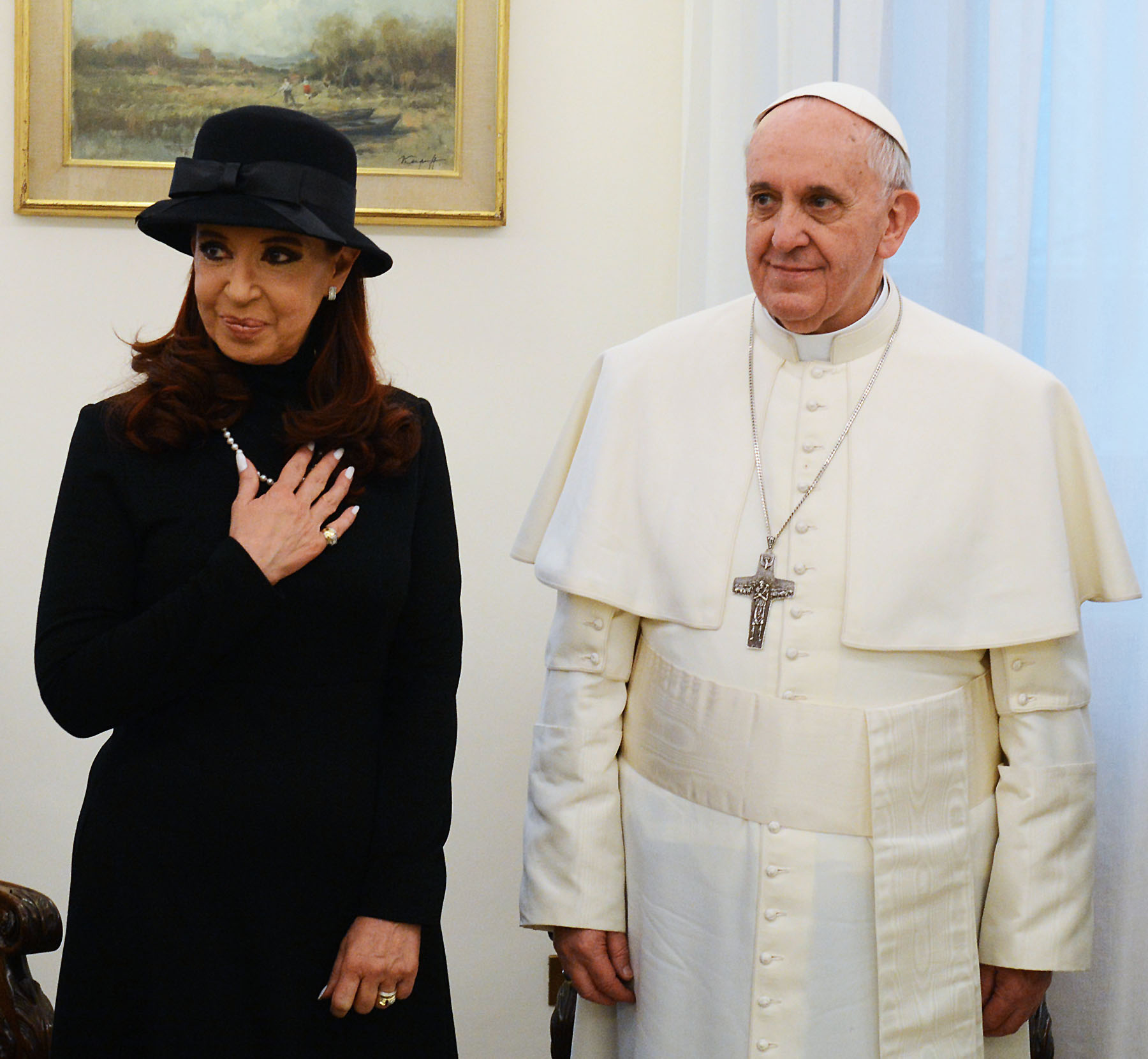
The pope is a populist par excellence – Pope Francis has proven to be no exception – and Argentine President Cristina Fernández de Kirchner (CFK) is trying to harness some of his unprecedented approval for her own ends.  Since his election in March 2013, supporters of Pope Francis have credited him with changing the tone of the Catholic Church, renewing its relevance, detracting attention away from intractable issues (abortion, gay marriage), decrying capitalism and refocusing efforts on fighting inequality and poverty.  “Who am I to judge?” he famously responded when asked to comment on gay priests.  And yet, in his previous life as Archbishop Jorge Bergoglio of Buenos Aires, his judgments with regard to gay rights, specifically his strong condemnation of gay marriage, are what then caused the substantial rift between him and CFK’s government.  The Argentine government has passed some of the most progressive gay rights legislation in the world, making same-sex marriage legal and awarding full adoption rights to same-sex couples in July 2010.  CFK called Bergoglio’s stark opposition medieval.  What is surprising, then, is the conciliation that has taken place between the President and Bergoglio as pope.  It has taken place over the last year in the form of public rituals and urban iconography, bringing the Pope and CFK together in a symbiotic performance of national identity and Peronist imagery.

Given their past differences, their newly fashioned bond conjures a kinship not based solely on shared political views.  CFK has drawn public attention to certain rituals and events that link the two through the construction of familial intimacy.  Perhaps the most stunning example of her attempts to incorporate the Pope into the big happy Kirchner family is in her party’s use of a photographic collage juxtaposing Juan Perón, Néstor Kirchner, CFK, and Pope with the caption, “Mirá pibe a dónde llegamos” (Look, kid, how far we’ve come).  In May 2013 the collage appeared on a gigantic banner covering the façade of the Central Market in plain view of motorists on the heavily transited Riccheri highway.  In June, she broke protocol when she discarded the recommended template and wrote an informal letter to the Pope in honor of the Day of the Pontiff.  Discussed at length in the press, the missive was personal and colloquial in tone and closed mysteriously with Fernández urging the Pope to “take care” and “drink mate.”  When the President’s first grandchild was born a month later, images of the President accepting the Pope’s gift of baby shoes circulated widely in the press, together with her exclamations of “Look what the Pope got me for Néstor Iván.”  And in August, the Perón-Kirchner-Pope collage appeared blazoned on the side of a van deemed the Argentine version of the “Pope mobile,” unveiled by the Kirchner party in support of Frente por la Victoria candidates.

The collage captures perfectly CFK’s campaign to include the Pope in the big happy Kirchner family, but more importantly, it positions CFK herself as a key member of this influential family as she seeks to consolidate not only her own legacy, but also her political future.  With Juan Perón positioned top left and Néstor Kirchner top right, the collage resembles a family tree, in which CFK and the Pope are both direct descendents of a conflated Peronist/Kirchner genealogy.  Recast as founding fathers in this familial image, Juan Perón and Néstor Kirchner look down at CFK and the Pope from an atemporal, mythological realm, their solemn gaze directed at the newfound alliance between CFK and the Pope, solidified through the handshake between two of the world’s savviest of populists.  Dictatorial and democratic regimes alike have manipulated family discourse in Argentina to achieve political means.  The almost imperceptible image of the National Congress Building that constitutes the background of this collage is a reminder of what this performative family portrait ultimately seeks to achieve.  The Pope’s enthusiasm to play the familial role is unclear; a sign of wariness might be detected in his decision to postpone his first official trip to Argentina until 2016.  This date, ostensibly chosen in order for the Pope to participate in the bicentennial of the Declaration of Independence, perhaps more conveniently allows him to avoid the intense campaign period preceding general elections in 2015.