Cumbritis and Prospects for Latin American Regionalism

By Carlos Portales
Washington College of Law and Center for Latin American and Latino Studies
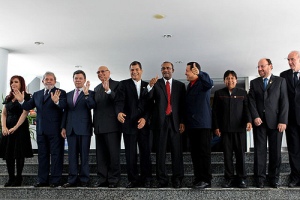
UNASUR Cumbre by  Globovisión | Flickr | Creative Commons

UNASUR Cumbre by Globovisión | Flickr | Creative Commons

Latin America has experienced a veritable proliferation of presidential summits (cumbres) in recent years, an indication of how the hemisphere’s complex web of regional ties is shuffling the landscape of multilateral organizations. This trend was manifested in the Nov. 16-17 Iberoamerican Summit in Cadiz, Spain, followed in quick succession by summits for UNASUR on Nov. 30 and MERCOSUR on Dec. 7. The New Year will witness two summits in Santiago, Chile, the first between the European Union and Latin American and Caribbean States, the second among Latin American and Caribbean States (CELAC).  While sometimes useful in isolation, the cumulative impact of these meetings may be less than the sum of its parts. Indeed, the region may be suffering a bout of cumbritis that is as distortive as it is productive.

The Cadiz summit reflected Spanish determination to sustain an Ibero-American bloc amidst its own profound crisis. Spain’s investments in Ibero-America, particularly in banking and telecommunications, are keeping alive important sectors of the Spanish economy. When the VI UNASUR Summit met in Lima two weeks later, the Presidents of Argentina, Brazil, Venezuela and suspended Paraguay were all absent. Still, the meeting reaffirmed UNASUR’s role in political and military matters: UNASUR was active in the crisis in Paraguay, sent its first-ever electoral mission to Venezuela, the South American Defense Council provides coordination in defense industries and natural disaster responses, and aspires to support protection of human rights.

The following week in Brasilia, MERCOSUR formally incorporated Venezuela and signed an adhesion protocol with Bolivia. However, as Tom Long wrote in “Mercosur’s future: Whither economics?” on Dec. 18, MERCOSUR’s expanding breadth masks a lack of depth. The trade bloc has not agreed on a common external tariff, and integration has stalled as Argentina and Brazil adopted unilateral protectionist measures both during and after the global financial crisis. Though its market is growing, MERCOSUR’s ability to negotiate with third parties is limited. The countries most interested in boosting trade have split off on their own under the loose Pacific Alliance (PA), whose Presidents met on the sidelines during the Cadiz summit. Chile, Colombia, Mexico and Peru have set high targets for the reduction of customs duties and plan on reducing visa requirements for their citizens while already having FTAs with the US and Europe.  Chile and Peru have reached similar accords with China and other main Asian countries. However, the Alliance is primarily an informal gathering of free-trade-minded presidents, and so far institutionalization is minimal.

Brazil is leading South America-centered institutions (UNASUR and MERCOSUR) when it perceives that these suit its interests; The Venezuela-led ALBA has lost steam due in part to President Chavez’s illness; the PA process remains low-key and trade centered. Meanwhile, the Organization of American States risks irrelevance. Its robust human rights system has come under attack from ALBA countries and others, while four ranking members of the U.S. Senate Foreign Relations Committee have lambasted its leadership publically. The OAS may not be unsalvageable, and it remains potentially useful, though that potential will only be realized if the United States endeavors to support rather than undermine its efforts.

And Summits alone will not ensure the success of any of these multilateral forums: increasingly ubiquitous conversations among presidents can be effective for defusing immediate crises and for establishing guidelines for cooperation, but their long-term impact on policy coordination will be limited if they are not matched by analogous cross-national dialogue among key government ministries. The symptoms of chronic cumbritis lie in the failure of many presidential declarations to result in concrete advances in cooperation.
Mercosur’s Future: Whither Economics?

By Tom Long

Mercosur’s December 6 meeting in Brasilia might seem to be a watershed. The organization formally integrated Venezuela and signed adhesion agreements with Bolivia. Ecuadorean President Rafael Correa was in attendance, too, along with officials from other South American countries. The bloc was established starting in 1991, with goals of removing internal tariffs, setting a common external tariff, coordinating commercial policies, and harmonizing regulations. An unwritten objective was to spur industrialization and decrease dependence on foreign manufactures. Yet more than twenty years on, Mercosur appears to be further than ever from establishing a common market. The Inter-American Development Bank notes that Brazil and Argentina have traded protectionist measures, and that “Buy Brazil” provisions in government procurement have been a bilateral irritant.

Mercosur

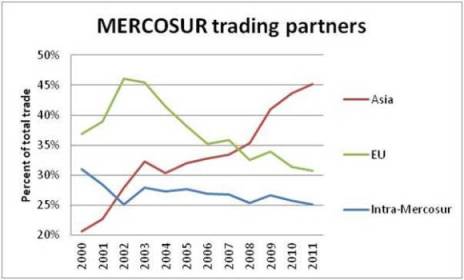
Expanding breadth masks decreasing depth. While both Mercosur’s total trade and trade among its members have grown greatly over the past decade, the former has outpaced the later.  WTO data show that intra-regional trade as a percentage of total trade has declined from 31 percent in 2000 to 25 percent in 2011. Instead of being driven by integration, MERCOSUR’s trade patterns are propelled by skyrocketing trade with Asia, led by Argentine and Brazilian commodity exports. In this light, the failure of late October meetings between Mercosur and the European Union suggest that China has taken the place of Europe.

Evaluated from a strictly economic perspective, Mercosur’s recent expansion represents a step backwards. The inclusion of Bolivia will not add much economic heft to the pact, and with the addition of each new member, reaching consensus will become even more difficult. The full membership of Venezuela increases the bloc’s size, but also its dependence on natural-resource exports. Neither newcomer—nor the two original heavyweights—appear committed to the original common market mission. Is the bloc’s raison d’etre shifting from the economic to the political? If so, what will be Mercosur’s relation to ALBA and UNASUR? Whereas Brazil was never fully comfortable with the Bolivarian Alliance—in part because of the anti-U.S. tone—it has now brought ALBA’s two most committed members to its own table. Inside Mercosur, Brazil has a greater voice than it does in UNASUR, but the hijacking of a potentially important trade alliance masks a lack of economic leadership for South America.

After Chávez?

Photo by:     UKBERRI.NET Uribe Kosta eta Erandioko agerkari digitala | Flickr | Creative Commons

Photo by: UKBERRI.NET Uribe Kosta eta Erandioko agerkari digitala | Flickr | Creative Commons

Venezuelan President Hugo Chávez’s solemn appearance on national television on December 8 may have marked more than his departure for a fourth round of cancer treatment in Cuba.  His designation of Vice President and former Foreign Minister Nicolás Maduro as his successor in the event he could not continue his duties indicated an initial farewell from politics as well – with wide-ranging implications in- and outside Venezuela.  Chávez asked “with all my heart” that his supporters elect Maduro to continue the Bolivarian revolution in the event of his death or inability to continue his mandate, with a clear eye to the constitutional requirement for emergency elections to be held within just 30 days should the president die or become incapacitated within the first four years of the term.  On Tuesday, Maduro announced that the president was recuperating after a six-hour procedure in Havana.  He did not declare a sure and speedy recovery but rather asked for Venezuelans’ prayers.

Speculation about the domestic scenario, including struggles within the ruling party, is intense.  Maduro’s most frequently mentioned rival to succeed Chávez is Diosdado Cabello, who was also alongside Chávez as he made the announcement last week.  While Maduro and Cabello both have had years of government experience and demonstrated political loyalty, questions remain about whether they – or anyone else – could replicate Chávez’s connection with poor voters and keep their weak political party together.  Informed speculation about the long-term impact on the region, if the succession stumbles, ranges from predictions of a cutoff of subsidies and subsidized oil, that would destabilize Cuba, Nicaragua and others to, among those who never saw Chávez as effective regionally, shrugged shoulders.

An even greater unknown is how well the opposition would do in the event of a snap election.  It is far from certain that these forces would re-unite around former candidate Henrique Capriles so shortly after he lost the October 2012 election.  The new system of primary elections that produced the single candidate last year would be difficult to replicate so quickly.  With both the ruling and opposition parties vulnerable to tensions and splits, a scenario of instability could easily result.  If Chávez’s health permits, he could conceivably resign the presidency and oversee elections that, although probably skewed, will help maintain the institutional order. If Venezuela is indeed on the brink of a succession process, the fortunes of both Chavismo and the opposition, and indeed of the Venezuelan population, will depend in large part on the capacity of both sides to maintain unity around alternative candidates for the Presidency.

ICJ Decision on Colombia-Nicaragua Dispute Settles Little

Photo: Patricia Iriarte Diaz Granados "orianauta" | Flickr | Creative Commons

Photo: Patricia Iriarte Diaz Granados “orianauta” | Flickr | Creative Commons

The decision announced last month by the International Court of Justice on a three-decade maritime dispute between Nicaragua and Colombia has pleased Managua and angered Colombia.  The court confirmed Colombia’s sovereignty over seven islets known as San Andrés and Providencia, but it extended Nicaragua’s sovereignty over 200 nautical miles.  The ruling means that, although Colombian jurisdiction includes a 12-mile radius around the islands, Nicaragua will control a much bigger area of the Caribbean – and greater access to fishing grounds and potential underwater oil deposits.

Colombia has rejected the ICJ verdict; refused to withdraw its navy from the contested waters; and withdrawn from the Pact of Bogotá, which recognizes ICJ jurisdiction.  Foreign Minister Holguín said Colombia wants to protect itself from future challenges to Colombian territory.  This position has implications for its neighbors.  Colombia’s withdrawal leaves a pending case brought against it by Ecuador regarding harm caused by herbicides from aerial fumigation near its border.  It also shifts back into bilateral renegotiations Colombia’s dispute with Venezuela over the Gulf of Venezuela, which Colombia had often proposed taking to the ICJ.  According to press reports, Panama, Costa Rica, and Honduras did not see themselves affected by the ICJ decision.

While ICJ decisions are final and cannot be appealed, the Court lacks the means to enforce them.  Colombia’s rejection of the ruling suggests it will take advantage of that, setting itself and Nicaragua on a collision course that will undoubtedly raise tensions in the region.  (Non-enforcement is an old problem.  The United States got the UN Security Council to support it in rejecting an ICJ decision in the 1980s that Nicaragua was entitled to reparations for U.S. support of the Contras.)  Even if the countries don’t come to blows, the dispute puts regional cooperation in crucial areas, such as counternarcotics, at risk.  It also raises questions about the willingness of countries to work with multilateral institutions.  The ALBA countries support ICJ jurisdiction now, but Colombia’s position probably will embolden them to reject it if inconvenient in the future.  Maritime disputes appear to be increasing worldwide, and Central America promises to be no different.

Obama and Peña Nieto: Turning the same page?

By Tom Long
CLALS doctoral research fellow

Official White House photo by Pete Souza | public domain

Official White House photo by Pete Souza | public domain

On Saturday, Mexico’s new president Enrique Peña Nieto took office and the country’s oldest party, the Partido Revolucionario Institucional, returned to power. After six years dominated by an exhausting and bloody war against drug cartels, Mexico seems ready to turn the page on outgoing President Felipe Calderón. During the last few months, Peña Nieto has tried to steer the attention of the world—and the United States—away from a disproportionate focus on drug violence. In a recent article published in The Economist, the new president downplayed drug cartels, focusing instead on plans for the economy and to “recover our leadership in Latin America.” Security was just one of thirteen proposals in his inaugural speech. In part, Calderón has given Peña Nieto a head start as he begins his term, leaving behind strong economic growth and a dip in violence. Although Calderón himself started the switch to a violence-reduction strategy, his name is likely to remain closely associated with the frontal military assault on the cartels launched at the beginning of his administration and recalibrated only in his final year; Peña Nieto is positioned to gain credit for a return to normalcy.

This desire to turn the page also marked Peña Nieto’s s pre-inaugural meeting with President Barack Obama. Both leaders seemed to be playing the same tune.  Mexico has become the front line in the war on drugs, and the U.S. has spent billions on military, police, and other projects lumped under a “Merida Initiative” label. After their meeting, Obama and Peña Nieto promised to expand the bilateral agenda to include an expansion of trade, cooperation on energy, and discussions of immigration that go beyond border fences. Obama spoke effusively of Mexico’s importance as a partner, while Peña Nieto said the two had a “shared vision” of how to create jobs in both countries. On the stage with Obama as elsewhere, Peña Nieto reiterated calls for the United States and Canada to build on NAFTA and further regional integration to improve competitiveness.

It would be a healthy change if the two presidents could restore balance between economic and security aspects of U.S.-Mexico relations. Image matters – and the deterioration of Mexico’s brand has undermined both investment and tourism. The military approach to drug trafficking has inflicted enormous costs in economic and human terms with questionable payoffs, but Mexico cannot go back to old patterns of accommodation. Domestically, the new president needs to attack the culture of impunity by building a stronger and more independent judiciary in order to reduce the frightful percentages of crimes that are never investigated or prosecuted. Accountability remains weak, especially at state and local levels; improving it would require Peña Nieto to take on powers in his own party. Placing all these objectives under a “Merida plus” framework would counterproductively squeeze broad reforms into the drug-war box. If the two presidents are sincere about rebuilding a balanced partnership, they need to take action quickly on immigration and commerce. Otherwise, the gravitational pull of the war of drugs will again consume bilateral ties.

A Nicaraguan Model for the Drug War?

Daniel Ortega | Photo by: Presidencia de la República del Ecuador | Flickr | Creative Commons

Bilateral tensions going back to the Cold War have obscured the value of counternarcotics cooperation between the United States and one of its least-favorite governments in Latin America – that of former Sandinista guerrilla and three-term Nicaraguan President Daniel Ortega.  The man who battled U.S.-funded proxies, the Contras, in the 1980s is now the most effective soldier against the drug trade in Central America, although Washington appears loathe to admit it and to imbue the cooperation with political good will.  However, while closer U.S. allies such as Honduras and El Salvador have seen levels of violence climb, Nicaragua remains relatively safe.  According to U.S. government estimates, Honduras (with vastly greater assistance) interdicted more cocaine than did Nicaragua in 2011 (22 v. 9 metric tons), seized one-tenth as much heroin (8 v. 86 kilograms) and arrested only half as many drug-related criminals (84 v. 168) – but had a homicide rate six times greater than Nicaragua.

Managua has achieved its relative success with an approach quite different from its neighbors’ –less costly in both dollars and bloodshed.  Compared to the flow of allegations about human rights violations committed by the Mexican security forces, Nicaragua’s record appears clean and citizens feel relatively confident providing information to the police.  Its armed forces have been involved in drug interdiction, focusing on coastal seizures, often in cooperation with the U.S. Navy.  But the backbone of Nicaragua’s strategy has been a series of local initiatives such as community policing.  These programs focus on “juvenile delinquency, education, and reintegration into society by gang members and other young offenders,” scholars noted in a recent special issue of the journal Policing and Society.  Nicaragua’s geography may be a factor as well.  The cartels’ main routes to Mexico are through the northern tier of the isthmus, and Nicaragua does not have the same sort of migration patterns that shaped Salvadoran gangs, as Insight Crime noted last year.

Scaling up Nicaragua’s local solutions to fit Mexico would be an immense challenge because of the disparity between the countries’ size and history.  But elements of Managua’s approach could be tried and adapted in neighboring countries, particularly its emphasis on community policing and anticorruption efforts that help gain citizens’ confidence.  Within Nicaragua itself, some observers argue that the government should do more to integrate its Afro-descendant Creole population into these supportive measures.  Currently, these Creole coastal communities bear much of the effect of military-oriented U.S.-Nicaraguan counternarcotics cooperation, without the social assistance to deal with the underlying problems in the region.  As the costs – and limits on effectiveness – of the full-frontal assault on cartels become ever clearer, Nicaragua’s relative success stands as an important reminder that other paths are possible.

Colombia Peace Talks in Havana: Peace on the Horizon?

Photo by: “medea_material” | Flickr | Creatives Commons

The Colombian government and its old adversary, the FARC, are taking tentative steps toward peace.  After a brief delay, the two sides initiated negotiations on a five-point agenda in Havana this week and quickly showed signs of progress.  The FARC declared a unilateral, two-month truce – a step beyond what they granted the last time talks were held from 1999-2001 – without assurance that the Colombian government would reciprocate.  President Juan Manuel Santos, already criticized for the talks, has rejected a cease-fire so far and appears reluctant to double-down on his political bet.  If the truce holds, it would create a much improved environment for the talks.

Most commentators have stressed that the Colombian government is in a much better position now than a decade ago because the FARC has been beaten back militarily.  What has received less attention is how President Santos has put himself in a better position through important non-military reforms.  He has pressed through important measures such as the ley de víctimas, compensating those who have suffered from the conflict; the creation of a more independent judiciary; and agrarian reform measures intended to improve life in the countryside.  Santos is not about to adopt the FARC’s anti-capitalist line, but his policies have addressed some of the problems the guerrillas claim to be fighting to redress.  At the same time, nearly three-quarters of the Colombian people support the talks, according to a Gallup Colombia poll.

Stronger rhetorical support from the Obama Administration – even as it properly remains on the sidelines of the actual talks – would enhance the peace process.  Even an implicit U.S. guarantee of support for implementation of any accord would be a powerful boost to President Santos and help him face down criticism from ex-President Álvaro Uribe and his political allies.  It would also be a clear signal to Latin America that Washington supports social and economic reforms to attain peace and stability, not just military programs.  The Cuban government, accused of fomenting unrest in the past, has shown that it favors peace and undertaken this initiative apparently without expecting any quid pro quo from Colombia’s primary backer, the United States.  Chile and Venezuela have shown support as observers.  For the United States to hesitate, apparently in response to bombastic comments from the Chair of the House Foreign Affairs Committee, Rep. Ileana Ros-Lehtinen, undermines U.S. influence and leadership on an important issue with hemispheric implications.

Ecuador Elections: Four More Years for Correa?

Photo by: Rinaldo Wurglitsch “Rinaldo W.” | Flickr | Creative Commons

Like him or not, President Rafael Correa has done what few recent Ecuadorean presidents have done – complete a term in office.  When he announced on November 10 his intent to run for re-election, observers in and outside Ecuador immediately declared him the favorite.  (Correa ran a second time in 2009, without completing his first term, under the rules of a new Constitution.)  Such predictions make it easy to forget how uncertain Correa’s presidency looked when he started it in 2007 – as a 43-year-old, U.S.-educated economist – and how few expected him to succeed.  In the ten years prior, social movements led by workers and indigenous peoples toppled a succession of seven presidents.  Rejection of IMF-led reforms had been both deep and broad in Ecuador, and it was hard for a president to complete a year, let alone a term.

High oil prices have helped Correa succeed by facilitating visible public spending, but that is not the whole story.  By almost all accounts, Correa has been far from perfect – his treatment of the press has particularly troubled rights experts – but he has provided some stability and halted the cycle of mass protests, strikes, and presidential turnover.  With a blend of economic populism and nationalist rhetoric, Correa has turned the same social movements that were once the scourge of Ecuadorean presidents into a base of support.  He has incorporated formerly marginalized people into the “nation” that he claims to defend – what academic Steven Ellner called “a new narrative of nationhood that challenges long-held assumptions.”  He has unified policies such as ending the U.S. lease of the Manta airbase with resource-based economic nationalism.

Though Correa’s reelection next February 17 looks easy, he will face increased tensions in his third term.  Government revenues remain dependent on oil and mining, which are susceptible to price fluctuations.  The expansion of extractive activities in areas inhabited by Correa’s indigenous base could strain his coalition – it has already stirred environmental concerns – and government spending has neglected the need to diversify the economy and reduce its reliance on the extractive industry.  In addition, Correa has benefited from the generosity of Venezuela, but that support could wane as President Hugo Chávez turns inward to deal with domestic challenges.  The opposition, which has continued to present half a dozen candidates for the presidency, will likely begin to unify if it feels threatened by a further concentration of power in the Executive.  To win reelection and govern effectively, Correa will need to maintain the unity of an uneasy coalition, without riding roughshod over the opposition and press freedom. 

U.S. Marijuana Vote Unlikely to Impact Mexico in Short Term

The following is excerpted from an article by InSight Crime* analyst Elyssa Pachico

Photo by: Editor B | Flickr | Creative Commons

Approval last week in Colorado and Washington state of measures allowing the recreational use of marijuana has fueled debate on whether legalization will reduce drug traffickers’ profits and the violence surrounding the illicit narcotics trade.  In both states, ballots passed with comfortable margins of 53 percent (Colorado) and 55 percent (Washington).  The measures legalize personal possession of up to one ounce of marijuana and allow the drug to be legally sold (and taxed) in licensed stores.  A similar initiative failed to pass in Oregon, gaining less than 45 percent of the vote.

A recent study by a Mexican think tank, the Mexican Institute of Competitiveness (IMCO), and Alejandro Hope (an InSight Crime contributor) found that passage of the initiatives in all three states would reduce the revenue of Mexican drug trafficking organizations by as much as 30 percent.  Hope has pointed out on Animal Político, a popular Mexican news site, that the impact will depend on the U.S. federal government’s response.  Attorney General Eric Holder strongly opposed such measures in 2010 when California residents voted on Proposition 19, but he did not issue strong statements this year.  The government’s response to last week’s votes has been muted; according to Reuters, the US Justice Department reacted to the measures by stating that its drug enforcement policy had not changed.

Mexico, a major supplier of marijuana, is unlikely to feel the impact of these measures for a while.  Parts of the Colorado measure will come into effect after 30 days, but the Washington measure will not take effect for a year.  But, over the long term, the votes indicate shifting attitudes towards marijuana prohibition in the United States – on the heels of similar shifts in Latin American countries eager to find alternatives to the current war on drugs.  The presidents of Guatemala, Mexico, and Colombia have emphasized the need for discussions, and Uruguay and Chile have considered their own marijuana legalization bills.  InSight Crime cautions, however, that the drug organizations have proved to be very adaptable in finding new sources of revenue – including methamphetamines, migrant smuggling, and even illegal mining.

Insight Crime is affiliated with American University’s Center for Latin American and Latino Studies, which produces AULABLOG.   Click here for the full text and additional links. 

Argentina Foreign Policy – National Pride or Domestic Consumption?

Photo by Jonathan Huston

The stridency of Argentina’s foreign policy over the past two years suggests an effort by President Cristina Fernández de Kirchner to capitalize on elements of authentic nationalism and harness them into a durable political tool at home.  Buenos Aires has dialed up the pressure on the Falklands-Malvinas dispute with the United Kingdom by seeking regional support and calling for a boycott.  The nationalization of the holdings of Spain-based oil giant Repsol has also soured relations with several European states.  Recently, the Argentine government has assailed the impounding of an historical frigate, the Libertad, in Ghana by agents of an investment fund that owns defaulted Argentine sovereign debt, labeling them “vultures.”  Argentina has ramped up criticism of U.S. restrictions on its agricultural exports, as the two countries trade accusations in the World Trade Organization.

The conventional wisdom in Washington has been that President Fernández de Kirchner is picking fights abroad to distract attention from economic and political problems at home.  Following its record $100 billion default in 2001, Argentina remains locked out of most international financial markets despite deals to discount and reschedule much of that debt.  Inflation is high and capital flight is so serious that the government has imposed strict controls on sending dollars out of the country – a measure unpopular with the middle and upper classes.  These problems have taken a toll on the president’s popularity, as have intimations that she might change the Constitution to permit her to run for a third term.

The view from Washington misses a couple key points.  Many of these nationalist moves have been wildly popular – above all the Repsol decision.  To attribute them to President Fernández de Kirchner alone ignores deep feelings in Argentina that the country deserves greater respect than it gets, as well as the fact that since the peso crisis, rejection of the sort of “carnal relations” that President Carlos Menem had with Washington (in his own words) in the 1990s has grown strong.  The current foreign policy orientation harkens to a much longer tradition, from Peronism and beyond.  There is little chance that issues such as the Malvinas or the Libertad are going to make Argentines forget about everyday economic challenges.  Rather, they are a manifestation of an Argentine narrative in which the country is denied its rightful place in international politics and trade – and in which it is being held unfairly in the penalty box for the peso crisis.  The United States support for the billionaire investors and hedge fund managers who bought deeply discounted bonds but are demanding full payment, and Washington’s subsequent vote against loans Buenos Aires needs from international financial institutions, are playing into nationalist themes.  Fernández de Kirchner’s foreign policy rhetoric taps into resentment; she is hardly responsible for creating it.