Cuba: Time to Move Ahead with Reforms

By Ricardo Torres*

cuba-economy

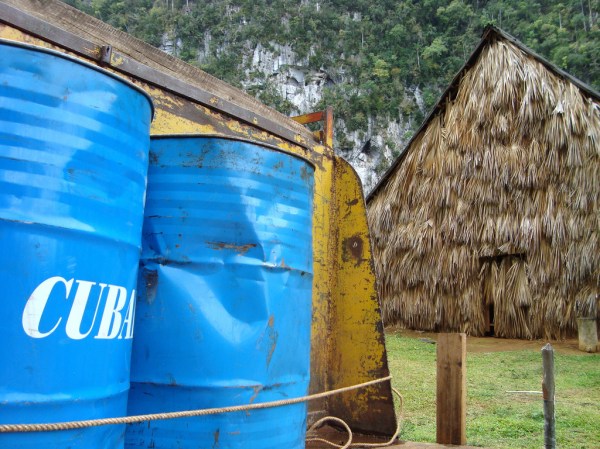
Oil drums and a tobacco curing hut near Viñales, Cuba / Adams Jones / Flickr / Creative Commons

The economic challenges that Cuba currently faces probably do not signal the beginning of a new Período Especial – the profound crisis Cuba experienced in the 1990s – but they are a painful reminder of the country’s chronic structural problem: the inability to generate enough hard currency to develop the economy and the failure of efforts to overcome that obstacle so far.  The immediate predicament was caused by a combination of internal and external factors, including the Venezuelan crisis and the low prices for certain Cuban exports.  (Ironically, oil byproducts from a refinery in Cienfuegos, which Cuba jointly owns with Venezuela’s PDVSA, have become a leading export.)  Venezuela is affecting income from services that Cuba sells there (in particular that of medical doctors) as well as a drop in the supply of oil products, which has covered about a half of Cuba’s needs.  This has placed extreme stress on Cuba’s external finances and forced a significant economic adjustment.  The government has imposed restrictions on energy consumption and a reduction in imports and investments – with important recessionary effects on an economy that desperately needs growth.  The energy rationing has fueled fears that the country could repeat the deep shortages of the early 1990s and again experience one of the most powerful symbols of that period: blackouts.

The situation is serious, but a crisis on the scale of the Special Period does not appear to be on the horizon.  Cuba today has a more diversified economy and produces a significant portion of its own energy, and the majority of the population has other sources of income to cushion themselves during bad times.  Most creditors and suppliers have shown confidence in their ability to move ahead.  In July, important contracts were announced for French companies to expand and operate Havana’s airport, which has been overwhelmed by the increase of international visitors (one of the few bright spots in the economy this year) in tandem with the improvement in relations with the United States.  Early this month, Cuban officials made presentations to firms from around the world on the government’s timely interest in renewable energy.  They emphasized the great opportunities that exist, not just current problems.

Once again, a close partner’s difficulties have put Cuba in a bind – too many times in too short a period.  Moreover, these problems arise at a politically sensitive moment.  Cubans are discussing the new model and development strategy through 2030, and – while Cubans are expecting results after six years of reform – President Raúl Castro has little time remaining in office.  The current complications can further delay essential monetary and exchange reforms.  Cuba needs to fix its foreign trade to supply oxygen for dynamic activities, such as its booming private sector.  Its development potential can’t rely just on its mystique as la Perla del Caribe.  Today’s challenges are an opportunity to remove the obstacles to changes that already have been announced, such as by accelerating the heretofore slow and ineffective implementation of agreed policies on foreign investment.  Some multilateral financial institutions can help, but Havana’s recent agreement with the Corporación Andina de Fomento (CAF), while a positive signal, is not enough.  The short-term answer is clear:  Only a combination of structural measures can guarantee that this latest economic crunch will be the last.

September 12, 2016

*Ricardo Torres is a professor at the Centro de Estudios de la Economía Cubana at the University of Havana and a former CLALS Research Fellow.

Colombia: Peace by Pieces

By Angelika Rettberg*

colombiapaz

Photo Credit: Government of Venezuela / Public Domain.

Despite challenges ahead, the Colombian state’s confrontation with one of the longest active revolutionary groups in the Western Hemisphere appears likely to reach closure by December.  As Colombian writer Héctor Abad has said, the peace agreement preliminary signed on August 24 is long, imprecise, often ambiguous, and tedious – certainly not a piece of entertaining literature – but it is the most eagerly awaited, downloaded, shared, and controversial official document in recent Colombian history.  The signatures of Colombian President Santos and FARC leader “Timochenko” are still pending, as is the result of a national plebiscite, to be held on October 2.

  • Humberto de la Calle, the government’s chief negotiator, defined the agreement as the “best possible” – a lukewarm description that fits well a process that has been rather anti-climactic. President Santos, who started the peace process and staked his reelection (which he barely won) on it two years ago, was more emotional and said, “Today, August 24th, we can say that hope has become reality.”
  • The agreement has already made permanent a cease-fire between the two sides. FARC fighters have begun to gather in the areas in which they will hand in their weapons and await the initiation of transitional justice proceedings.

Even if “yes” wins in the upcoming plebiscite – as surveys now predict – this peace by pieces presents challenges.  The accord has accomplished more than any Colombian process before and, by many normative international and academic standards, has been better designed and more professionally negotiated than any other Colombian accord.  It does not seem, however, to awaken most Colombians’ enthusiasm.  A generalized apathy or, in many cases, open disapproval of the negotiations can be linked to the absence of a sense of conflict-related crisis, especially in urban areas, where there has been a steady decline in battle-related casualties for years.  In addition, as the World Bank and international media have reported, Colombia’s economic performance has been steadily improving.  No longer the Andean problem case, Colombia is now a preferred destination for international investment in Latin America.  The “paradox of plenty, Colombian style” – success in promoting security and investment amid conflict resulting – has ended up eroding support of peace negotiations.

International support for several peace-building tasks will not translate into enormous amounts of desperately needed resources.  FARC demobilization, victims’ reparations, and addressing the needs of the most conflict-affected regions of the country will carry a big price tag for years to come.  Most economic and political resources for implementing the agreements will need to be raised domestically, and local authorities and communities will be increasingly reluctant to prioritize the needs of conflict-related social groups.  In addition, much needed fiscal reform will further affect political support for the government.  A core group of economic elites have backed negotiations unconditionally and have been well represented at the table.  However, the costs and vagaries of the implementation process will strain the support of peace´s crucial allies.  In this context, it will be difficult for any leading candidate to fully endorse the agreements in the upcoming presidential election of 2018.  Considering these limitations, not only the peace agreement, but also the resulting change, may only be “the best possible.”

September 7, 2016

* Angelika Rettberg is Associate Professor in the Political Science Department, Universidad de los Andes, in Bogotá.

Peru’s Frente Amplio: The Emergence of a Post-Extractivist Left

By Carlos Monge*

OperacionesYanacocha

An abandoned gold mining project in the Cajamarca region, Peru / Wikimedia / Creative Commons

The surprising emergence of the Frente Amplio (FA), a coalition of political parties, social organizations and independent activists, in Peru’s recent presidential and congressional elections signals the first significant support for the Peruvian Left since the collapse of the Izquierda Unida in the 1980s.  The Left was not able to present its own alternatives in the ‘90s, the early 2000s, and again in 2011.  In October 2015 barely 13 percent of Peruvians knew about FA’s internal election to select presidential candidates.  Veronika Mendoza had the support of only 1 percent of intending voters, and over 60 percent of Peruvians did not even know who she was.  Nevertheless, FA ended up receiving 18.74 percent of the vote in the first electoral round, coming in third and only a couple of points behind Pedro Pablo Kuczynski (PPK), who secured 21.05 percent and ended up defeating the Fuerza Popular’s candidate, Keiko Fujimori, to become President for the 2016-2021 period.

FA’s “post-extractivist” program has been key.  Breaking away from the nationalist redistributive programs of leftists in Venezuela, Ecuador, Bolivia, Brazil, and Argentina, FA espouses economic diversification and tax reform rather than more mineral or hydrocarbon exports to sustain economic growth and public incomes.  FA also emphasizes the need to protect the environment and renewable natural resources for future generations and to recognize indigenous rights to territories, autonomy, direct political representation and effective consultations.

  • These are not only electoral campaign ideas. Indeed, FA local activists and national leaders have maintained staunch opposition to emblematic mining projects such as the Conga project in the northern Cajamarca region and the Tía María project in southern Arequipa.  In the same way, FA is denouncing that the new government is trying to lower air quality environmental standards to ease foreign investments in mineral smelters and has harshly criticized the new Minister of Production for abandoning the National Plan for Productive Diversification launched by the outgoing Ollanta Humala administration.
  • Frente Amplio is grounded in social movements that have long confronted extractivist projects. Veronika Mendoza left President Humala’s Nationalist Party in 2012 in a dispute over his repressive response to socio-environmental protests around mining projects in the highlands of her native Cusco.  Tierra y Libertad, FA’s largest party, has its roots in the Cajamarca rondas campesinas resistance against the Conga project.  Another factor is that the end of the commodities “super cycle” has moved extractive rents off center stage.  Even in Venezuela the official discourse is now moving in the direction of economic diversification.

Frente Amplio is not alone in Latin America in attempting to build a post–extractivist platform, but it seems to be the region’s most successful.  Similar policies were at the heart of the presidential campaign of Alberto Acosta and a coalition of social and indigenous organizations in Ecuador.  And in El Salvador, the Farabundo Martí government is also keeping extractivist temptations at bay.  But Acosta did not manage to get significant support or to build a stable political alternative, and El Salvador is not a major commodity exporter.  The importance of the FA experience is that it happens in a significant mineral and gas producer, that it has had immediate electoral success, and that it can become a permanent political player in Peruvian democracy.  FA and PPK will probably agree on issues such as the fight against corruption, crime, and violence against women, but they will certainly disagree over macroeconomic and sector policies, such as taxes.  Also, FA has denounced PPK for his call to lower air pollution standards and for his authorization to large fishing factories to operate up to 5 km off the coast, leaving very little for artisanal, small scale, internal market-oriented fishing activities.  Where this ends up is anybody’s guess, but this is certainly a process worth keeping an eye on.

August 29, 2016

*Carlos Monge is Latin America regional director at the Natural Resource Governance Institute in Lima.

Can Latin America Escape the Middle-Income Trap?

By Rick Doner and Ben Ross Schneider*

challenges logo (revised)2

Photo Credit: Inter-American Development Bank / CLALS / Edited 

Most literature on the “middle-income trap,” widely understood as a core obstacle to sustained development in Latin America, focuses solely on economic dynamics and understates the importance and challenges of political coalition-building.  That literature, largely generated by economists in academe and international financial institutions, argues convincingly that in Latin America, as well as Southeast Asia, once countries achieve some degree of success in economic development, they get stuck.  They are unable to compete with low-cost producers in traditional sectors – initial development success brings higher wages and other costs – while they also have failed to gain the capacity to compete with developed economies in frontier industries, where technological capabilities and productivity levels are far higher.  These analysts stress that Argentina, Brazil, Chile and Mexico – or for that matter Indonesia, Malaysia and Thailand – need to build on their achievements over the past half century in order to make the leap into the ranks of the world’s most prosperous nations.  They highlight the trap’s proximate origins in productivity slowdowns and recommend policy solutions that focus on improving human capital through investment in education and vocational training.  But identifying problems and potential solutions does not explain why leaders fail to adopt the solutions.  In other words, it’s not clear from existing writings why the trap is actually a trap.

The literature does not acknowledge that fundamental political obstacles, especially lack of effective demand and pressure for these solutions, are at the heart of the problem.  As is evident from the history of failed programs to improve education and R&D, political will to invest in such public goods is in short supply.  Politicians are rarely willing to forgo the short-term political benefits of satisfying entrenched interest groups for the long-term developmental benefits of creating institutions capable of helping the broader citizenry to upgrade its capacity for technology absorption.  A core reason for this lack of political will is the weakness of the societal constituencies that might demand the necessary policies and effective institutions.  Our research indicates that relations among key societal actors in middle-income countries are less amenable to building the consensus that economists advocate. In a recent article, we argue that the same conditions that facilitated or accompanied movement to middle-income status – such as foreign investment, low-skilled and low-paid work, inequality, and informality – have generated political cleavages that impede upgrading policies and the construction of institutions necessary to implement them.  This fragmentation is why the trap is a trap. Three lines of fragmentation are key:

  • Big business is divided between foreign and domestic firms. The former can undertake productivity-improving measures in-house and/or at their home headquarters, whereas local firms tend to focus in non-tradeable services and commodities whose demand for better training and R&D is lower than in manufacturing.
  • Labor is fractured between formal and large, growing informal sectors. Enjoying longer job tenure and on-the-job training for specific skills, formal workers have little interest in broader skills development.  Informal workers, on the other hand, constantly shift jobs and would prefer investments in vocational institutions offering general training.
  • These societies remain overall less equal and, as is now well known, inequality undermines the will and capacity to provide broad public goods such as quality universal education and support for technology development.

 Pro-growth coalitions of various types have been key to productivity improvements in now-high income East Asian countries, such as Korea and Taiwan.  The fact that these countries had stronger (and more autocratic) governments does not preclude developing or building on such coalitions in countries with messier political systems and weaker bureaucracies.  First, leaders can build on sectoral pockets of high productivity, such as aquaculture in Chile, wine in Argentina (and rubber in Malaysia).  Second, international and regional institutions can help supplement demands for skills by supporting programs that focus on technical and vocational institutions that actually meet and are linked to employers’ needs.  Third, organizations such as the ILO can promote business associations that represent the local firms for whom collective technical training and R&D are especially important.

August 22, 2016

* Rick Doner and Ben Ross Schneider teach political science at Emory University and MIT, respectively.

Zika Overshadows Haiti’s Continuing Cholera Epidemic

By Emma Fawcett *

Haiti Cholera Treatment Center

Inside a cholera treatment center in Haiti. Photo Credit: CDC Global / Flickr / Creative Commons

As the number of Zika victims rises into the tens of thousands and dominates the media, Haiti’s cholera outbreak rages on reaching 785,530 cases and 9,361 deaths since 2010.  According to the Haitian Ministry of Public Health and Population, more than 3,500 people were infected and 26 died in June alone.  Ten communes in Haiti’s Center and West departments are on “red alert,” indicating a surge of cholera cases.  This surge is expected to continue throughout hurricane season, as the increased rainfall leads to further contamination of open water sources.  Recent research by Doctors Without Borders has indicated that, if anything, the Ministry’s death tolls have understated the severity of the epidemic, as several of the hardest hit communities experienced death counts three times higher than officially recorded.

  • Unlike Zika, cholera can be prevented through hand-washing and water purification, but campaigns to distribute soap and chlorine tablets and increase public education have met with limited success. Moreover, those infected require immediate treatment with intravenous fluids and oral rehydration therapy, and there are too few cholera treatment centers to handle the number of patients.

The crisis is all the more dismaying because cholera is not endemic to Haiti.  The disease was brought to the country in the wake of the 2010 earthquake by Nepalese United Nations peacekeepers with poor sanitation controls.  The UN delayed by more than a year the release of its own audit report, which found that wastewater was not properly managed or treated and was released directly into a tributary of the Artibonite River.  The UN has been sued in New York federal court by a group of 5,000 cholera victims, who have demanded that the UN provide a national water and sanitation system, pay reparations to victims, and issue a public apology.  The UN claims that international treaties give it immunity.  The case is currently before the U.S. Court of Appeals.  Some 130 members of the U.S. Congress, in a rare bipartisan effort, sent a letter to Secretary of State John Kerry accusing the UN of failing to “comply with its legal and moral obligations” to assist cholera victims and noting that “the State Department’s failure to take more leadership in the diplomatic realm might be perceived … as a limited commitment to an accountable and credible UN.”

Public awareness of Haiti’s ongoing cholera epidemic – one of many tragedies in the hemisphere’s poorest country – has been eclipsed by fears about the Zika virus.  While the more than one thousand reported cases of microcephaly are devastating and frightening, Zika is very rarely fatal.  Unlike Zika, cholera has not spread throughout the hemisphere or grabbed headlines at the Olympics, and so the disease rages on in a country plagued by political dysfunction and grinding poverty.  Virtually every institution has abdicated responsibility.  The United Nations has been accused of actively covering up its own role, and its attempts at combating the epidemic have been slow and poorly executed.  Haiti’s medical residents and interns have been on strike for the last four months, protesting low pay and poor conditions, resulting in the closure of many public hospitals.  The Haitian government has been more focused on political infighting and securing international funding for its next round of elections than for additional cholera support, and even nongovernmental organizations render most healthcare services in haphazard fashion.  While bureaucrats point fingers, politicians dawdle, and global attention turns elsewhere, Haiti’s poorest continue to suffer through the worst cholera outbreak in recent history largely in silence. 

August 15, 2016

*Emma Fawcett recently completed a PhD in International Relations at American University.  Her doctoral thesis focused on the political economy of tourism and development in four Caribbean case studies: Haiti, Dominican Republic, Cuba, and the Mexican Caribbean.

Canada-Cuba Relations Poised for Progress under Prime Minister Justin Trudeau

By John M. Kirk*

Cuba Canada

Photo Credits: Wisegie/ Flickr / Creative Commons, Pixabay / Creative Commons

After a decade of ignoring Cuba under the government led by Stephen Harper, Canada is on the cusp of an era of a significant improvement in bilateral relations with the island.  Many constants supporting this longstanding relationship remain: Canada, along with Mexico, was the only country in the Western Hemisphere not to break relations with revolutionary Cuba in 1962; Pierre Trudeau was the first leader of a NATO country to visit Cuba (1976) and developed a strong friendship with Fidel Castro (who was an honorary pall-bearer at his funeral); Canadians make up the largest tourist group (1.3 million a year) there; and the largest single foreign investor in Cuba is the Canadian firm Sherritt International.

Justin Trudeau, elected prime minister in October 2015, has undertaken several significant foreign policy initiatives, mainly in Asia and Europe.  Steps to improve relations with Cuba have been taken slowly, but are noticeable.  In May Cuban Foreign Minister Bruno Rodríguez visited Ottawa and Quebec City, while Canada’s Minister of Tourism Bardish Chagger attended the International Tourist Fair in Havana, at which Canada was the “invited country of honor,” reciprocating an earlier visit by her counterpart.  In December the Canadian Senate held a special session to celebrate the 70th anniversary of diplomatic relations.  Canada has been invited as the country of honor to the International Book Fair in Havana, in March 2017, and it is rumored that Trudeau will shortly visit Cuba.  Significantly, the gradual improvement of bilateral relations is due mainly to Canadian initiatives, and not to developments in the U.S.-Cuba relationship.

  • Investment and trade, however, have not kept up with diplomatic initiatives. Annual bilateral trade remains about $1 billion, mainly because of uncertainty over Cuba’s economy.  Canadian business has yet to take advantage of its privileged relationship, concerned with existing U.S. legislation and the looming wave of U.S. investment once the embargo is lifted.

After a decade of neglect, Canada and Cuba have the potential to rediscover their deep-rooted ties.  Trudeau’s willingness to work with Cuba and his diplomatic initiatives were unthinkable under the Harper government.  A complicating factor for business has been the arrest and imprisonment of two Armenian-Canadian entrepreneurs, found guilty of corruption.  Canadian civil society ties remain strong, with Canada making up 43 percent of tourists to Cuba.  Again, however, concern exists at how Canadian tourists face skyrocketing prices when Americans are allowed to visit the island.  In sum, Canada-Cuba relations are at this point characterized by political commitment to improve ties, largely untapped commercial potential, and anxiety about the ramifications of closer U.S. ties with Cuba.  The big question is whether Canadian trade and investment will provide the energy to propel relations beyond their special past status into a new era of collaboration.

August 8, 2016

*John M. Kirk is Professor of Latin American Studies at Dalhousie University in Canada.  He is the author/co-editor of 16 books on Cuba, and also works as a consultant on investment and trade in Cuba.

Tim Kaine: Boon for Latin America Policy?

By Tom Long*

Tim Kaine

Photo Credit: Disney | ABC Television Group / Flickr / Creative Commons

U.S. Presidential candidate Hillary Clinton’s vice-presidential nominee, Virginia Senator Tim Kaine, may help her politically in the November election, and his potential influence on U.S. policy toward Latin America could be extremely important over the long haul.  Though Kaine’s Latin American experience likely was a secondary consideration in his selection, it is consistent with the role of the office of the vice president that has emerged during the Obama Administration as a center for serious policy initiatives in the Americas.

  • Kaine spent nine months in El Progreso, Honduras, as a young man working at a high school founded by Jesuit missionaries; he learned Spanish there and frequently mentions the period as formative. His approach to the region and immigration seems anchored in a focus on human dignity and belies an understanding of the difficult circumstances many there face.  El Progreso is close to San Pedro Sula, which has been a center of the country’s staggering violence and emigration.  In the Richmond Times-Dispatch, Kaine wrote that when unaccompanied minors arrived to the U.S. border in unprecedented numbers, “I felt as if I knew them.”
  • As a member of the Senate Foreign Relations Committee, Kaine has developed a rare policy focus on Honduras. He has pressed the U.S. and Honduran governments on issues of human rights in the wake of the 2009 coup.  In 2013, Kaine urged Secretary of State John Kerry for stronger U.S. support for elections.  Just two weeks ago, he called on Honduran President Hernández for greater effort on justice in the killing of environmental activist Berta Cáceres.
  • Kaine has placed immigration policy at the confluence of foreign and domestic policy. He has pressed President Obama to halt “deportation raids targeting families and unaccompanied minors who have fled the rampant violence in Central America’s Northern Triangle.”
  • Kaine’s political rhetoric often reflects his Jesuit background, and his Catholicism-inspired references to social justice – and his warm welcome for Pope Francis – are likely to earn him an empathetic ear among many throughout Latin America.

Vice-presidential leadership for the Americas offers an important opportunity – and one that Tim Kaine, if elected, is likely to use wisely.  He has complained that Washington usually pays attention to Latin America only in moments of crisis, and has argued the region should get similar priority as China, Russia, or the Middle East.  He would build on efforts initiated by Vice President Joe Biden, who has chaired a “High Level Economic Dialogue” with Mexico and pushed for the $750 million “Alliance for Prosperity” in Central America.  Kaine would be an asset in relationships that often fuse international and domestic policy, slicing across the domains of myriad departments and agencies.  While Kaine’s personal interest and positive relationships don’t guarantee policy successes on migration, drug policy, citizen security, and development assistance as vice president, his language skills and reputation for treating colleagues with respect all but guarantee a warm reception from leaders of countries long aggrieved by U.S. highhandedness. 

August 2, 2016

*Tom Long is a Lecturer in International Relations at the University of Reading (UK) and an Affiliated Professor at the Centro de Investigación y Docencia Económicas in Mexico City.  He is the author of Latin America Confronts the United States: Asymmetry and Influence, published last year by Cambridge University Press.

Cuba: Implications of U.S. Tourism

By Emma Fawcett*

Tourists on beach in Cuba

Photo Credit: Emmanuel Huybrechts / Wikimedia / Creative Commons

U.S. regulations still technically ban tourist travel to Cuba by U.S. citizens, but the Obama Administration’s policies have already spurred significant growth in visitor arrivals to the island – with implications for Cuba and its Caribbean neighbors.  Over the last year, Cuba has experienced a 17 percent increase in total visitors, and a 75 percent increase in arrivals from the United States since Washington expanded the categories of permitted travel and, according to observers, relaxed enforcement.  An agreement to begin commercial airline operations between the two countries promises even more travel.  Other elements of the embargo continue to complicate U.S. travel: most U.S.-issued credit cards still do not work on the island; phone and internet connections are limited; and visitors often face persistent shortages of food items, consumer goods, and hotel rooms.  But the surge almost certainly will continue.

The onslaught of U.S. tourists challenges the Cuban tourism industry’s capacity.  Cuba has one the lowest rates of return visits (less than 10 percent) in the Caribbean; on the other islands, 50 percent to 80 percent of tourists make a return visit.  It has serious weaknesses:

  • While Cuba’s unique appeal may draw in millions of first-time visitors, the still relatively poor quality of service apparently discourages tourists from making the island a regular vacation spot. Sustaining arrivals requires higher marketing costs.  Average spending per visitor, moreover, has been on a fairly steady decline since 2008.
  • About 70 percent of Cuba’s tourists come for sun-and-beach tourism – a sector under state control – but private microenterprises have already demonstrated more agility in responding to demand than the state-owned hotels or joint ventures. The government reported last year that 8,000 rooms in casas particulares, or bed-and-breakfasts in Cubans’ homes, were for rent, and the number is growing steadily.
  • Cuba’s “forbidden fruit” factor may have a limited shelf life as visitors sense the imminent end to Castroism and the arrival of McDonalds, Starbucks, and their ilk. Questions remain about how long Cuba’s current environmental protections will continue when tourist arrivals increase.  Nicknamed the “Accidental Eden,” Cuba is the most biodiverse country in the Caribbean because of low population density and limited industrialization.  But rising visitor arrivals (and the effects of climate change) are likely to increase beach erosion and biodiversity loss.

Ministers of tourism in the other Caribbean countries have downplayed fears about competition from Cuba, but their optimism is sure to be tested.  A successful Cuban tourism sector could conceivably spur region-wide increases in visitor arrivals, but it could also cause other Caribbean countries to lose significant market share.  The official Communist Party newspaper, Granma, has suggested the government’s goal is to almost triple tourist arrivals to 10 million per year.  President Danilo Medina of the Dominican Republic, the most visited country in the region (at about 5.5 million tourists a year), has also set a goal of reaching 10 million arrivals by 2022 – setting that country to go in head-to-head competition with Cuba.  Jamaica, the third most visited country in the region, has instead pursued a multi-destination agreement with Cuba, designed to encourage island-hopping and capitalize on Cuba’s continued growth.  Previous attempts at regional marketing and multi-destination initiatives have had mixed success.  But as Cuba’s tourism sector continues to expand, Caribbean leaders – in what is already the most tourism-dependent region in the world – undoubtedly sense that Cuba is back in the game and could very well change rules under which this key industry has operated for the past six decades.

July 25, 2016

*Emma Fawcett is a PhD candidate in International Relations at American University.  Her doctoral thesis focuses on the political economy of tourism and development in four Caribbean case studies: Haiti, Dominican Republic, Cuba, and the Mexican Caribbean.

Can Latin America Achieve Fiscally Sustainable and Egalitarian Social Citizenship?

By Fernando Filgueira*

Uncertain Future

Photo Credit: Jan Tik / Flickr / Creative Commons

Latin America is undergoing a profound transformation of its social policies and of the very concept of social citizenship, but the outcome of this process is far from certain.  Electoral democracy, urbanization, increased educational attainment, and increased exposure to new and broader consumption patterns have destroyed the political foundations for conservative modernization.  The turn of the century has witnessed advances in social outcomes and public policies that for the first time provide a true window of opportunity for achieving more productive and egalitarian societies.

  • Decreasing poverty, lower income inequality, improved and expanded employment, and access to transfers and services to popular sectors were made possible by five critical factors: booming prices for Latin American commodities fueled economic growth and employment; stable prices – a positive legacy of the Washington Consensus era – meant that wages and transfers were not undermined by inflation; increased state fiscal capacity and commitment to social policy enabled a doubling in 15 years of real social per-capita expenditure; a demographic dividend, when combined (the young and the elderly) dependency ratios are lowest as a percentage of the population; and improved education access, completion, and credentials, which facilitated enhanced opportunity and increased productivity.

Yet these five advantages will lose steam in the next couple of decades.  Growth will wither as the commodity boom ends and expansionary monetary policy is limited.  Most Latin American economies are facing increased inflationary pressures. Existing tax structures and in some cases productivity levels will not permit social expenditure to increase at the rate of the last 15 years.  The easy phase of the demographic transition (when dependency rates are going down) is or will be over in most countries towards 2025.  Some countries in the region will face the European dilemma of an aging population, but they will do so with a lower GDP per-capita, weaker fiscal capacities of states, and a significantly more unequal income distribution.  While the soft targets of expanded education – primary school and expansion of lower middle school – have been achieved, the tough ones remain: extended coverage in early childhood, completion of high school, quality improvement, and true reduction of inequality of outcome in learning.

  • Five fault lines in Latin American social regimes make these problems a major threat to the sustainability of both social and economic development. A) Women’s incorporation into the labor market remains low (50 percent) and is highly stratified.  B) The absence of a robust state-led care system for early childhood and the persistence of a patriarchal distribution of care burdens undermines a route to development that is both more efficient and egalitarian.  C) Stark contrasts between insiders and outsiders in informal and formal labor markets and access to social protection and cash transfer  systems contribute to an expansionary monetary and fiscal policy that mainly benefits insiders unwilling to be taxed for redistributional public and collective goods and insurance. D) The region’s middle class and new emergent class, moreover, are not willing to increase taxation, since they do not perceive the quality of public goods and collective social services as adequate. And E) the pattern of fertility shows some of the worst patterns in social terms, including that most biological reproduction is left to the poor: Latin American governments do not equalize opportunity early on and through the educational system – which in the most unequal region of the world with diminishing but non-convergent fertility rates – leads to a productivity failure since underinvesting in the poor is underinvesting in the frontier of productivity enhancement.

These challenges will condition the possibility of a new social citizenship and a social investment model based on robust public goods, expansion of merit goods, and universality of entitlements.  It is not enough that elites are no longer able to control the political and economic game through status enclosure and authoritarianism.  In order to craft truly universal social policies conducive to providing inclusion for all, societies must confront narrow corporatism and restricted targeting – and the political economy they sustain.  Contributory models based on formal wages and targeted social policies based on need will not disappear, but they have to take a back seat to a model of basic universalism where access to quality public and collective goods is truly universal, and entitlements in transfers and services are not dependent on need or labor formality.  There have been important advances, such as a marked increase in non-contributory systems of cash transfers in terms of pensions and child-family transfers, but the commodity boom and the rise of the emergent and middle classes that drove them are not permanent.  A coalition that is willing to forgo private spending power in order to enhance quality of life through collective services is needed.  Such a coalition is made conceivable by these political, economic, and social epochal changes, but it is by no means guaranteed.  If reforms do not make it a reality, the promise will be shattered, and the pendulum between failed populism, with state-led “Robin Hood” incorporation attempts, and a technocratic closure of democracy and state bashing, will remain the central and tragic dynamic of the region.**

July 18, 2016

*Fernando Filgueira is a Senior Resarcher at the Centro de Información y Estudios del Uruguay (CIESU) and Collaborating Researcher the Economic Commission for Latin America and the Caribbean.  He is a member of the International Panel for Social Progress led by Amartya Sen.

**Read the full version of this essay, which is based on research done for the Economic Commission for Latin America and the Caribbean (ECLAC) and for EUROsociAL on social policy, labor dynamics, and demographic change.

Brazil: Sacrificing Anti-Poverty Success?

By Hayley Jones*

Bolsa Familia

Photo Credit: Senado Federal / Flickr / Creative Commons

Brazil’s flagship antipoverty program, the Bolsa Família, faces an uncertain future as the government of Interim President Michel Temer confronts adverse economic and political circumstances.  The program, which provides direct cash benefits to poor households on the condition that children fulfill education and health-related targets, was an important factor in Brazil’s progress on poverty and inequality since the early 2000s – between 2001 and 2013 the poverty headcount ratio declined from 24.7 percent to 8.9 percent, and the Gini coefficient declined from 59.3 to 52.9.  The Bolsa Família (formerly called Bolsa Escola) was a pioneer in the use of cash transfers in social policy in the 1990s.  The idea is enticingly simple: the cash allows families to meet immediate needs, while the education and health conditions ensure poor children are better equipped to lift themselves out of poverty in the long run.  Under Presidents Lula and Dilma, the Partido dos Trabalhadores (PT) put the policy at the heart of its platform, and reaped advantages at the polls with the expansion of coverage and benefits.  The program now reaches about one-quarter of the population.

The social gains made in part thanks to the Bolsa Família may now be at risk.  Brazil has been hit hard by the collapse of commodity and oil prices over the last two years and is currently experiencing what is predicted to be the country’s worst recession since the 1930s.  GDP fell by roughly 4 percent in 2015 and is expected to do the same in 2016.  The deep political crisis gripping the country since earlier this year further threatens the program.  Temer, his party (PMDB), and Finance Minister Henrique Meirelles have stressed the need to cut spending to reduce the deficit.  While many areas of social spending, such as pensions and education, are protected in the budget under the 1988 Constitution,  the Bolsa Família is not.  With the large political constituency benefitting from the program, there is likely little appetite in the interim government to ax the program altogether.  In fact, at the end of June Temer announced a 12.5 percent increase to the Bolsa Família – more than the 9 percent promised by Dilma – to compensate for inflation.  But he also emphasized that benefits should be temporary and that there is a need to focus on exit doors from the program.  Social Development Minister, Osmar Terra, has suggested that the program could be made more efficient and costs cut by 10 percent.

Temer may not be entirely wrong to highlight the need for exit strategies, but they should be exit strategies from poverty rather than from the Bolsa Família itself.  There is so far little evidence that it has done much to change the life trajectories of poor young people that would allow them to move out of poverty. The emphasis on increased school enrollment and attendance as transformative obscures much deeper problems, including poor school progression and completion rates in low-quality schools, a lack of educational infrastructure and resources, poorly trained teachers, and outdated curricula, among others.  If Temer is serious about moving beneficiaries out of poverty and the program, priority will have to be given to correcting regressive spending in public education (which prioritizes higher over basic education); better aligning curricula with labor market demand; and addressing the poor job opportunities for low- and semi-skilled workers. Economic realities and the rhetoric on efficiency and exit strategies do not bode well for such changes.  Under Temer, the Bolsa Família seems likely be limited to a policy tool for risk insurance and meeting basic needs rather than a platform for extending the social gains of the last decade.

July 12, 2016

*Hayley Jones is a DPhil (PhD) Candidate in the Department of International Development at the University of Oxford, United Kingdom.  Her thesis examines long-term poverty reduction in the Bolsa Família program.