
One Year into Trump 2.0, Some Immigration Myths are Shattering, but Some of the Big Lies from the 2024 Trump Campaign Continue
By Ernesto Castañeda, PhD
One year into Trump’s second administration, significant developments have reshaped U.S. immigration policy. This piece examines key changes and events, clarifies factual misunderstandings, and analyzes how immigration has been framed and discussed in media coverage and political commentary.
Biden Did Not Have an Open Border
It is factually wrong to claim that “Biden had an open border policy and welcomed a record number of undocumented immigrants.” Although this claim is frequently repeated, it is misleading. Following the COVID-19 Pandemic, the U.S., along with the rest of the world, closed its borders for months. Under the pretense of public health, Title 42 was used to block access to asylum at the border. Thus, many individuals seeking asylum, attempting to reunite with family members, or workers reporting to jobs in the United States were trapped en route. Ultimately, a lot of people were forced to wait in Mexico for their opportunity to request asylum, and hundreds of thousands of people were deported from the border shortly after entry.
Interestingly, after the end of the pandemic and the eventual lift of Title 42, members of the Biden administration came up with creative solutions to deal with a border surge — which again was not caused by the Biden administration but was a by-product of the pandemic and the terrible political, economic, and security conditions across much of Latin America and the Caribbean. In response, the Biden administration implemented the use of the CBP One mobile application, an app developed during the first Trump administration, which allowed individuals to obtain a spot in line to present themselves at border ports of entry for an orderly metered process to enter and request asylum. This was not a promise that all of them would be granted asylum or allowed to stay, but it did allow them to start their legal process.
There were technical problems with this trial app, and in practice, it amounted to an online algorithmic lottery that created competition among hundreds of thousands of people for appointments. Nevertheless, it was an improvement from sleeping in camping tents during the winter while in line at border entrances in Mexico, or having notebooks where people wrote their names to hold their place in line on a first-come, first-served basis. The CBP One app also generated data on who sought to enter the country and on those permitted to enter.
Other alternatives to detention, such as ankle bracelets and other tracking apps, allowed the U.S. government to identify newcomers and track their whereabouts. These tools have been used by ICE under the current Trump administration to locate and deport individuals who entered legally under these programs. As I said following Trump’s election, ICE agents would be tempted to detain and deport these easy-to-find immigrants in temporary or between immigration statuses in order to fulfill quotas while inflating the numbers of “dangerous” deportees.
Given hemispheric geopolitics, the Biden administration also created a legal program, known as CHNV, for certain people with family or contacts in the US who could offer financial support if needed and vouch for them to enter the U.S. legally through airports from Cuba, Haiti, Nicaragua, and Venezuela, to apply for asylum. These new programs were created for populations from countries to which the U.S. was sympathetic, and because these countries would not accept deportations. These programs shifted what could have been undocumented immigration flows into technically legal immigration flows. These new arrivals quickly received work permits so that they could work legally. This system became a lifeline for the U.S. economy and a lifeline for essential workers, allowing the U.S. economy and society to recover faster from the negative effects of the COVID pandemic.
Images of lines at the border and people sleeping in the streets of El Paso and in front of the Roosevelt Hotel in New York City after the busing of immigrants and the unfortunate statements from New York’s Mayor Adams seemed to make these arrivals unmanageable, but as we have researched at The Immigration Lab, new arrivals have managed to find jobs to pay for the housing, food, and other expenses and even send some money to family in their places of origin. These individuals enter with permission from the government, which knows who and where they are. They are not undocumented nor “illegal.”
The Biden administration deported hundreds of thousands of people from the border, and people from Mexico and many other countries were not allowed in.
The Biden administration actively helped individuals fleeing crises in Cuba, Venezuela, Haiti, Nicaragua, as well as those displaced from violent conflict in Ukraine and Afghanistan. Most people were coming into the U.S./Mexico border, raising their hands, waving, presenting themselves to authorities at the border, giving their information, and then following the procedures and instructions that they were given. Many, but not all, of them were then legally allowed into the country, granted work visas soon after staying a few days on the streets of host cities like El Paso, New York City, or Washington, DC. The great majority of the new arrivals eventually found places to rent and obtained jobs in the broader economy. Today, many are either still working or have been deported with no legal grounds or reasons beyond fulfilling ICE quotas to reduce the number of people of color born abroad.
Any serious discussion of immigration must take into account the barriers preventing people from returning and rebuilding a life in their country of origin, including instability, political repression, and economic hardships in countries like Venezuela and Haiti.
Claims that the Border is Now Secured
Border communities in the United States have long been safe, as documented in our book “Immigration Realities.” It is true that fewer people are arriving at the U.S.-Mexico border seeking entry, but this is not purely a Trump effect. There are five main reasons for this:
1) The pandemic created a bottleneck influx of immigrants that eventually eased during the second part of the Biden administration. The programs discussed above (CBP One and CHNV) onboarded quickly those people who had been waiting at the border for years before. These numbers had already begun to decrease in the last months of the Biden administration due to policy changes and the organic leveling off from the bottleneck and pent-up demand.
2) There was lower demand for people from Ukraine and Afghanistan to enter through the border.
3) Mexico, Guatemala, El Salvador, Panama, and Colombia were pressured by the U.S. to make it even harder to cross the Darien Gap and to get close to the U.S./Mexico border. Many of these countries used their military to control, dissuade migration, and deport people, often without due process. As a result, new arrivals stopped.
4) On January 20, 2025, Trump declared a national emergency at the border and sent the military to certain areas of the border.
5) People from Latin America are largely no longer arriving seeking to apply for asylum because, contrary to international and U.S. law, people are not allowed to enter the country by applying for asylum at the borders. Title 42 conditions have become chronic. These immigration policies, along with the strong campaign rhetoric, dissuaded many from entering the country, whether illegally or legally.
At his January 20, 2026, press conference, Trump compared his desire for the U.S.-Mexico border to that of North Korea. Likewise, in order to carry out these mass deportations quickly, authoritative actions of going against civil liberties are needed, as seen in Minnesota. He also boasted that “the border is secure” and with “no legislation” on the topic.
For those concerned about “chaos at the border,” or upset that some new migrants were entering with permission at the border while others could not previously, do not worry. Most of the new arrivals have lost their legal status; many have been detained or deported, or are in the process of moving back. Their absence will have negative consequences for the U.S. employers, neighbors, and communities that relied on them.
All Immigrants Are Criminals
Trump promised he would deport “the worst of the worst.” Many voters, and even some immigrants themselves, supported and voted for Trump, believing that he was referring only to criminals, not themselves or their loved ones. As 2026 is already showing, nothing could be further from the truth. Most people detained and deported have no criminal records. For Trump and MAGA, no immigrants from non-majority White countries were welcome or innocent. Even if they had an H1-B visa.
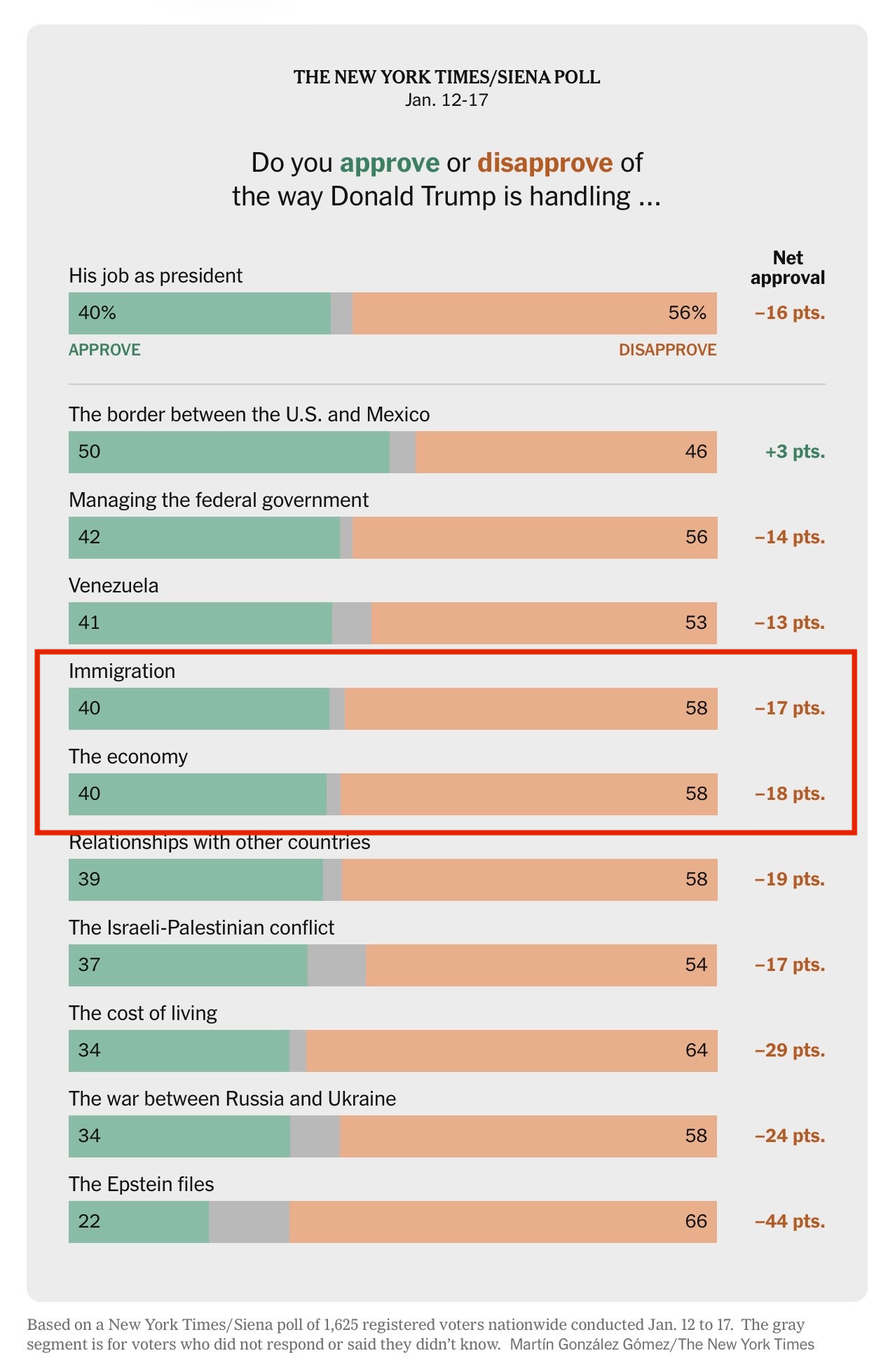
The goal to deport the “worst of the worst” to send ICE or the National Guard to reduce crime in cities was always a lie. There is no need to keep repeating it as either a supposed campaign promise or ICE’s mission, only to compare it to the excesses we have seen on the streets this year. We do not need to abolish ICE; we need amnesty to regularize people. Local police and courts can handle the small percentage of foreign-born individuals who commit crimes. At some point, Trump officials said that most immigrants detained had a criminal record or could build one in the future. In hindsight, the criminalization of migration that Trump and Vance were promoting during the 2024 presidential campaign was successful because they (barely) won the elections. But since the election, those happy with Trump closing the border were in the low 50s in polls at their highest points in time. On January 23, 2026, the views on the border are 50/50; nothing to campaign on. Most people who identify as Democrats and the great majority of independents oppose ICE. Regarding immigration policies in general, the administration is underwater, with many more people saying they have gone too far than supporting it.
In 2025, many Democratic elected federal politicians had been saying on TV interviews that Trump had won the immigration argument, meaning electorally but also implying empirically and in terms of policies. Immigration policies as a whole have been toxic. Contrary to the desire of people in the center right to deport all people without a current immigration status, detentions and deportations in the first year of this Trump administration have largely focused on people who entered legally with a visa or CBP One, people applying to renew their TPS, or asking for asylum. People have been arrested in immigration courts even when judges have not asked for removal. Some individuals have been arrested during their naturalization ceremonies just minutes before becoming citizens. This makes sense if one cares more about quotas and about removing people who are not seen as White before they become American citizens and/or have more U.S.-born children. Trump has also gone after birthright citizenship and has asked for denaturalizations —stripping citizenship from those who proactively jumped all the hoops to become citizens. These facts, along with the many dog whistles and open loudspeaker broadcasting to extreme right subcultures in public speeches, conferences, and X posts, show that the energy behind all these immigration policies is White Christian Nationalism. A dream about racial purity, one not too far from being open to using violence to achieve it, possibly leading to genocide if nobody opposes it. Fortunately, most Americans are against that. But many of those in favor of the current full immigration agenda openly say they do not want religious and racial minorities in the U.S., and even want more to be done. There is no staying neutral on these matters while people are shot at, imprisoned, and terrorized.
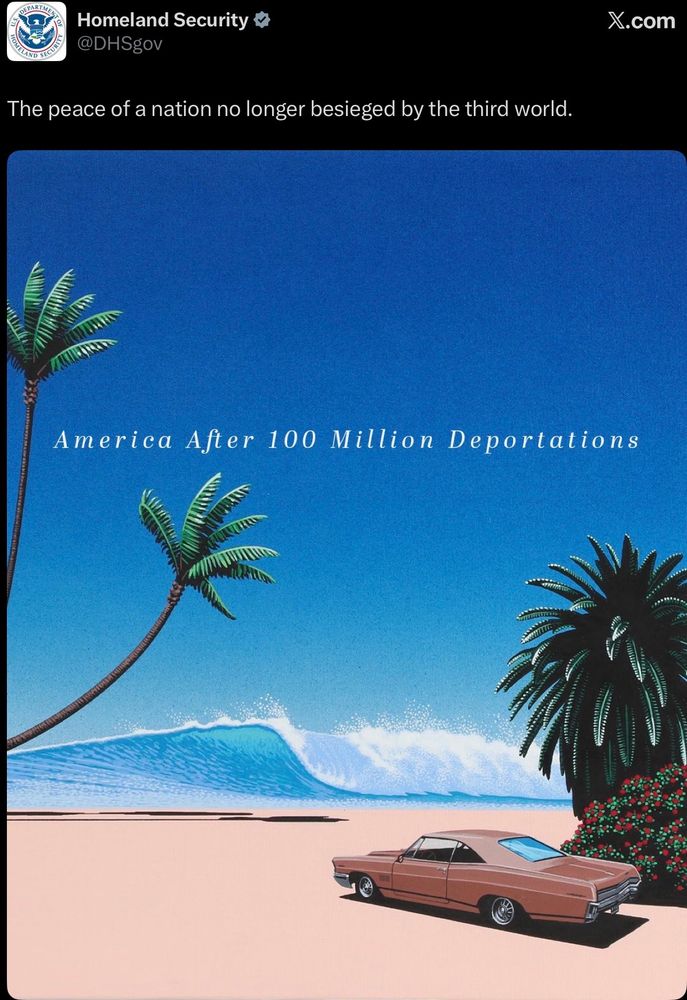
Unfortunately, in early 2026, I still hear some elected Democrat officials and operators saying that Trump “had won the immigration debate.” That is false. Others claim without evidence that Trump won, including in 2024, because of his promise to close the border. They forget the 2016 promise about the border wall and how little he built. They do not explain why anti-immigrant claims against caravans and Central American immigration did not help him win in 2000. Other problematic praises from Democratic officials come along the lines of saying, “Trump did a great job closing the border to undocumented immigrants, and that this is a good thing, that should continue.” MAGA without MAGA.
That is disrespectful to the undocumented immigrants and their communities, which would prefer to vote Democrat but are repulsed by such Trumpian comments. In another sense, polls and massive protests show that most people in the interior do not really care about the status of border crossings. What most people care about today is what we see in Minneapolis and what we saw before in Los Angeles, Chicago, Washington, New Orleans, and many other places around the country. That is an excessive use of force by ICE to find our neighbors who happen to be undocumented. Violations of the Bill of Rights, unconstitutional stops, entering homes without judicial orders, and racial profiling.
Mass Deportations are Regular Politics
The number of undocumented people in the U.S., between 8 and 15 million, and probably around 11 million when Trump retook the Presidency constitutes around 3% of the overall population in the United States. For the U.S. to get rid of all its undocumented population, it would indeed need something related something akin to an authoritarian state. That is what we have started to see, and that is what most people don’t like because there are undocumented kids in schools. There are undocumented nurses. There are undocumented teachers, agricultural workers, construction workers, and also people with their own businesses providing professional services, designing and renovating homes, etc. So, in order to find them, we will have to trample the civil liberties of many citizens. Is it worth it? I don’t think so. So, rather than just calling for the abolition of ICE, reform, or a return to the status quo so that the minimum due processes are followed before deportation, we have to start talking again about amnesty, paths to citizenship, and expanding chosen ways for legal immigration. Because, despite a false rhetoric that this was about “illegality,” this second Trump administration has also limited the legal pathways for migration. He has limited people’s ability to seek asylum. He has really reduced the number of refugees, made it more difficult and expensive to obtain professional visas like the H-1B visa, and curtailed other forms of legal migration, including for international students, the diversity visa lottery, and other programs that had bipartisan consensus that they were good for the country. He has also limited the ability to apply for new immigrant visas and green cards for people from over 75 countries, plus a travel ban of at least 19 countries, and has declared places such as Belize as safe third countries, making gaining asylum in the U.S. more difficult if people passed through those countries and making it easier to deport people from third countries there.
So, it is a masquerade to say that this was only about illegal immigration or getting criminals off the streets. These have been other of the big lies of the 2016 and 2024 campaigns. It is time that we get rid of those lies and we talk about the truth. We need immigration reform that allows people who are already living and paying taxes in the U.S. to do so legally, safely, and as fully recognized members of society. And lastly, we must establish a new legal pathway for newcomers because the country needs workers to keep the U.S. population and economy growing. So that’s what we need today. That’s the truth about immigration.
Ernesto Castañeda is a Professor at American University, where he leads the Immigration Lab and the Center for Latin American and Latino Studies. He has been studying immigration scientifically for over 20 years and has written many books on the subject, among them “Reunited: Family Separation and Central American Youth Migration” and “Immigration Realities: Challenging Common Misperceptions.”


 AULA Blog