
Myths about the Causes Behind the 2024 U.S. Presidential Election Results
By Ernesto Castañeda
November 16, 2024
I was wrong about Harris winning. Concerns about the future of democracy were mainly an issue for around 32% of those who voted for Democrats (according to NBC exit polls). The uncommitted, abstainers, and disengaged affected turnout. Both candidates were voted by a diverse electorate. As I wrote before the election, “An unintended effect of Trump’s hate speech has created a certain increase in support among some Black, Latino, and Asian voters.” This was not enough in itself for Trump to win, but it added to the lead among White voters. What I wrote about the rightward shift of the Latino vote [here, here, and here] holds true.
Cable news coverage across the board has obsessed with “immigration” and “the economy” being the main concerns of the electorate and that public opinion favors Trump to handle them. But in polls and exit polls, these were the main issues for less than half of the electorate, and they were the main issues for Republican respondents, who naturally favor Trump’s solutions in these areas.
In terms of the “economy,” members of union households voted slightly more for Democrats (53%) than non-union households (47%). The voting split was not that different across income brackets. Even if unemployment is low, and wage and economic growth rates are positive and steady, with a big improvement from 2020, still many minimum-wage earners and the lower middle class are no longer happy with the economic status quo, as I wrote here.
The biggest errors in the 2024 election coverage have been the out-of-proportion focus on the economy and immigration as the biggest concerns of all voters when, indeed, these complaints are not fully based on reality and are mainly coming from Republican-leaning voters. But the exaggeration around immigrants did not cost Trump the election and probably reinforced his dog whistles and helped in an election against a Black female opponent. Her identity was my major question here about whether Nikki Haley supporters, independents, and enough White men without a college education could vote and actively campaign for Harris.
The Harris campaign was strong, but its short duration meant that many voters did not feel like they knew her well enough. The campaign was careful to stick to the center and even to appeal to Republicans. As in 2016, in 2024, more White women supported Trump than the female candidate. In some states, they voted for Trump and still voted for some protections for abortion in certain cases.
Trump did not win because of the politicization of immigration. One reason for this is that only in a few polls did “immigration” rank as the main concern for over 50% of likely voters. Only a minority said they would vote for a presidential candidate solely on that issue. Those who did were over 70% Republican across polls. There was a similar dynamic regarding “economics.” It was misleading, both during the campaign and after the election, to assert that the primary concerns of the electorate are the economy and immigration. For example, an exit poll from ten key states conducted by NBC shows that only 11% of the electorate saw immigration as the issue that “mattered most” for their vote (when given only five possible issues), and of those voters, 90% of them were Republican.

A different response to that poll sheds further light on the polarization along party lines regarding immigration policy: 75% of Democrats (and 56% of respondents overall) support offering a chance for undocumented immigrants to apply for legal status. In contrast, 87% of Republicans (40% of respondents overall) favor deportation.

Immigration is not the weakness for Democrats that many make it to be. Still, the Harris campaign was hesitant to discuss immigration or border issues in detail. This is largely due to the narrative among mainstream media pundits and consultants, who believe that Trump’s “strengths” lie in the economy and immigration, as these same polls indicated that voters trusted Trump slightly more on these issues. However, this average was significantly impacted by Republican respondents, and the headlines failed to mention that respondents across party identification trusted Harris more on most other issues. Regardless of rhetoric or immigration policies presented by the Democrats (whether it was the bipartisan Senate deal or restriction on asylum seeking at the border), Trump supporters were always going to vote for Trump. As a result, the Harris campaign could have taken a stronger stance against the misinformation about immigrants that the Trump campaign consistently spread and that many others amplified.
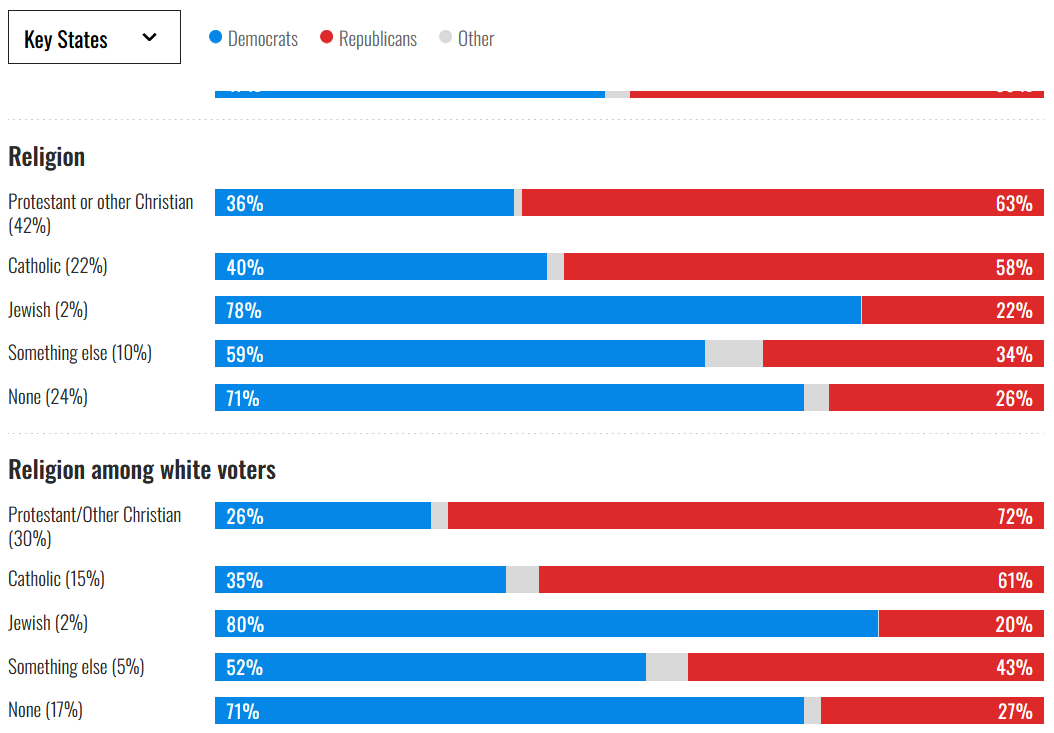
The MAGA base cannot be swayed by facts about the issue because they use the term “immigration” as code to promote a White Christian Ethnostate. This goal was said or implied by Trump and his surrogates and is part of Project 2025. Trump’s largest base of support was White men (60%), white people who never attended college 66%), and especially White Protestants/Christians (72%). Many understood Trump to be the White Christian Nationalist Candidate on the presidential ballot.
What Does This All Mean for Immigration Scholars?
My point above indicates that we need to research immigration, racialization, and the politicization of religion in tandem. These processes are linked to each other by right-wing ideologues. Many of us look at immigration; some of us are starting to look again at the relationship between immigration policies and race, and key sociologists have coined and looked at the rise of White Christian Nationalism.
There is much misinformation about immigration trends and processes, and as a community, we have much to offer. Moderates and independents are open to learning more about immigration, and Democratic-leaning voters and spokespeople need more fact-based talking points. For this reason, Carina Cione and I recently published the book “Immigration Realities: Challenging Common Misperceptions” (Columbia University Press 2024). This work condenses years of research on immigration, making it accessible for journalists, policymakers, students, and the public who want to access social science without facing paywalls or complicated jargon.
However, to be realistic, few people read books, much less academic books. Professors are less likely to assign books than before. Thus, to reach a wider audience, we have to write accessible pieces like op-eds, blogs, and newsletters and talk to the media. I encourage all of you to do so more often. If approached, agree to share your insights. It’s important that people learn about our research findings to help shift the negative and inaccurate stereotypes about immigrants.
As we write and read books about recent immigrants, the immigrant rights movement, Dreamers, and similar topics, we tend to focus on immigrants who are left-leaning, progressive, and activists themselves. Some of us often assume that an increase in immigrants and children of immigrants would lead to a shift towards more liberal views among the electorate. This last election puts that assumption partly into question, but what does this mean for immigration studies? As we have collectively written about, immigrants adapt, acculturate, and become distinct from those in their countries of origin. Over time and across generations, many immigrants become culturally like Americans. This means that, eventually, the public opinion of immigrants tends to align with the national average and those of their neighbors and social circles. In a country where around half of the electorate leans Republican, it is likely that around half of Latinos, Asians, and other immigrant groups, particularly those in the third generation, would do the same —whether we like it or not. This is indeed evidence of integration and assimilation. Their voting patterns will increasingly be influenced by education levels, gender, geographic location, and religion, as they do for White Americans.
Prices have gone up around the world, the working class is under large pressure, and housing is scarce. There is much conflict-driven immigration around the world. There is not a federally financed emergency shelter and welcome system in the U.S. similar to that used for refugees. The American immigration legal system is antiquated and inadequate. These are issues that must be addressed by Congress. It is hard for non-specialists to understand how all the pieces are connected, and it is easy for politicians to point to real images of lines at the border, asylum-seekers sleeping in the streets, or outside of shelters and hotels in U.S. cities to say that these human beings in need will lead to local fiscal crises. In a forthcoming report, we show how that is not the case.
To conclude, the results of this election were not determined by immigration policies or the misinformation around it. However, to animate its base with racist dog whistles, Trump vilified, scapegoated, and spread lies about immigrants and minorities. We need to combat these misconceptions. While naturalized citizens and U.S.-born Latino votes did not determine the election outcome, they were used to polarize the electorate, painting Haitians and Latino men as dangerous criminals. In response, some Latinos themselves spread hate speech as a way to pass and protect themselves.
As we have documented well in sociology, many individuals draw symbolic boundaries, try to create distinctions, and avoid racialization and exclusion by trying to pass as White or White-adjacent in response to the stigmatization of whole categorical groups. Individuals in tenuous situations understand that adopting majority opinions and beliefs may be a survival strategy. This is caused by racism. We have collectively documented cases like this for a long time. However, among the public, there is a lack of understanding (even among immigrants, their children, and grandchildren) about immigration history and the common exclusion of newcomers. New immigrant groups are often framed as unassimilable, and once they do, many descendants of those groups repeat the pattern and exclude those who come after them.
Our research is more relevant than ever as we teach our students, readers, and the public about the many positive outcomes brought about by immigration in the long term and about how immigration status does not equal morality. It is not that individuals want to be undocumented, but many find themselves in that situation amidst strong labor demand in the U.S., a lack of legal pathways for many, as well as armed conflicts, and economic and political crises abroad.
Ernesto Castañeda is a Full Professor of Sociology at American University and Director of the Immigration Lab and the Center for Latin American and Latino Studies. Among his latest books, he published with Daniel Jenks, “Reunited: Family Separation and Central American Youth Migration” (Russell Sage Foundation 2024).
A shorter version of this text was written for the newsletter of the International Migration Section of the American Sociological Association.


 AULA Blog